Category Archives: HUMAN RIGHTS

Latin American Legislators, a Battering Ram in the Fight Against Hunger

…. HUMAN RIGHTS ….

An article by Marianela Jarroud, Inter Press Service News Agency (reprinted by permission)

Lawmakers in Latin America are joining forces to strengthen institutional frameworks that sustain the fight against hunger in a region that, despite being dubbed “the next global breadbasket”, still has more than 34 million undernourished people. The legislators, grouped in national fronts, “are political leaders and orient public opinion, legislate, and sustain and promote public policies for food security and the right to food,” said Ricardo Rapallo, United Nations Food and Agriculture Organisation (FAO) Food Security Officer in this region.

hunger
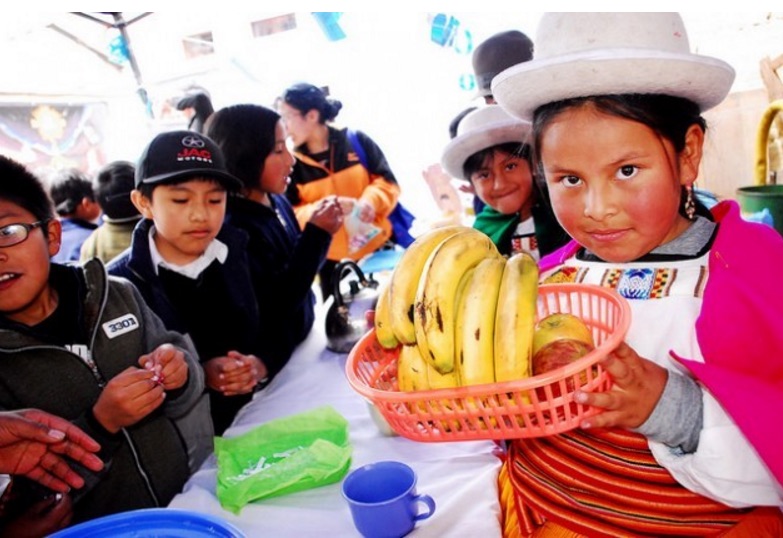
A girl in traditional festive dress from Bolivia’s highlands region displays a basket of fruit during a fair in her school in central La Paz. F Credit: Franz Chávez/IPS

The members of the Parliamentary Front Against Hunger also “allot budget funds, monitor, oversee and follow up on government policies,” Rapallo told IPS at FAO regional headquarters in Santiago, Chile.

A series of successful public policies based on a broad cross-cutting accord between civil society, governments and legislatures enabled Latin America and the Caribbean to teach the world a lesson by cutting in half the proportion of hungry people in the region between 1990 and 2015.

But the 34.3 million people still hungry in this region of 605 million are in need of a greater effort, in order for Latin America to live up to the 2030 Agenda for Sustainable Development, which is aimed at achieving zero hunger in the world.

The Sixth Forum of the Parliamentary Front Against Hunger (PFH), to be held in Lima Nov. 15-17, will seek to forge ahead in the implementation of the “plan for food security, nutrition and hunger eradication in the Community of Latin American and Caribbean States (CELAC) by 2025.”

The plan, which sets targets for 2025, is designed to strengthen institutional legal frameworks for food and nutritional security, raising the human right to food to the highest legal status, among other measures.

“The Parliamentary Front Against Hunger is a key actor in the implementation of CELAC’s Food Security Plan, for the construction of public systems that recognise the right to food,” the regional director of FAO, Raúl Benítez, told IPS.

The PFH was created in 2009 with the participation of three countries. Six years later, “there are 15 countries that have a strong national parliamentary front recognised by the national Congress of the country, which involves parliamentarians of different political stripes, all of whom are committed to the fight against hunger,” Rapallo said.

As a result, “laws on family farming have been passed, in Argentina and Peru, and in the Dominican Republic there are draft laws set to be approved. To these is added the food labeling law in Ecuador,” the expert said, to illustrate.

Bolivia sets an example

In Bolivia, the School Feeding Law in the Framework of Food Security and the Plural Economy, passed in December 2014, is at the centre of the fight against poverty in an integral fashion, Fernando Ferreira, the head of the national Parliamentary Front for Food Sovereignty and Good Living, told IPS in La Paz.

This model, which draws on the successful programme that has served school breakfasts based on natural local products in La Paz since 2000, is now being implemented in the country’s 347 municipalities.

The farmer “produces natural foods, sells part to the municipal government for distribution in school breakfasts, and sells the rest in the local community,” said Ferreira, describing the cycle that combines productive activity, employment, nutrition and family income generation.

The school breakfast programme has broad support among teachers because it boosts student performance and participation in class, Germán Silvetti, the principal of the República de Cuba primary school in the centre of La Paz, told IPS.

“They didn’t used to care, but now they demand their meals,” Silvetti said. “Some kids come to school without eating breakfast, so the meal we serve is important for their nutrition.”

(Article continued on right side of page.)

(Article continued from left side of page.)

In the past, students didn’t like Andean grains like quinoa. But María Inés Flores, a teacher, told IPS she managed to persuade them with an interesting anecdote: “astronauts who go to the moon eat quinoa – and if we follow their example we’ll make it to space,” she said to the children, who now eat it with enthusiasm.

Appealing to the appetites of the 145,000 students served by the school breakfast programme is a daily challenge, but one that has had satisfactory results, such as the reduction of anemia from 37 to two percent in the last 15 years, Gabriela Aro, one of the creators of the programme and the head of the municipal government’s Nutrition Unit, told IPS.

Authorities in Bolivia say the government’s “Vivir Bien” or “Good Living” programme will reduce the proportion of people in extreme poverty which, according to estimates from different national and international institutions, stands at 18 percent of the country’s 11 million people.

Mexico, another case

In Mexico, a nation of 124 million people, meanwhile, poverty has grown in the last three years, revealing shortcomings in the strategies against hunger, which legislators are trying to influence, with limited results.

“Legislators must be more involved in following up on this, one of the most basic issues,” Senator Angélica de la Peña, coordinator of the Mexican chapter of the Parliamentary Front Against Hunger, told IPS in Mexico City. “Even if we define budgets and programmes, they continue to be resistant to making this a priority.”

There are 55.3 million people in poverty in Mexico, according to official figures from this year, and over 27 million malnourished people.

The increase in poverty reflects the weaknesses of the National Crusade Against Hunger, the flagship initiative of conservative President Enrique Peña Nieto, which targets undernourished people living in extreme poverty.

The Crusade is concentrated in 400 of Mexico’s 2,438 municipalities, involves 70 federal programmes, and hopes to reach 7.4 million hungry people – 3.7 million in urban areas and the rest in the countryside.

The Senate has not yet approved a “general law on the human right to adequate food”, which was put in motion by the Parliamentary Front and involves the implementation of a novel constitutional reform, which established in 2011 that “everyone has a right to sufficient nutritional, quality food, to be guaranteed by the state.”

The draft law will create a National Food Policy and National Food Programme, besides providing for emergency food aid.

But in spite of the limitations, Mexico’s social assistance programmes do make a difference, albeit small, for millions of people.

Since February, Blanca Pérez has received 62 dollars every two months, granted by the Pension Programme for the elderly (65 and older), which forms part of the National Crusade Against Hunger.

“It helps me buy medicines and cover other expenses. But it is a small amount for people our age – it would be better if it was every month,” this mother of seven told IPS. She lives in the town of Amecameca, 58 km southeast of Mexico City, where half of the 48,000 inhabitants live in poverty.

Pérez, who helps her daughter out in a small grocery store, is also covered by the Popular Insurance scheme, a federal government programme that provides free, universal healthcare. “These programmes are good, but they should give more support to people like me, who struggle so much,” she said.

Two urgent regional needs

Above and beyond the progress made, Rapallo said Latin America today has two urgent needs: reduce the number of hungry people in the region to zero while confronting the problem of overnutrition – another form of malnutrition.

Overweight and obesity “are a public health challenge, a hurdle to national development, and a moral requisite that we must address,” said Rapallo.

In that sense, he added, “parliamentarians are essential” to bring about public policies that contribute to good nutrition of the population and their growing demands.

“There are parliamentarians that are real leaders in their respective countries. But if all of this were not backed by a strong civil society that puts the issue firmly on the agenda, we wouldn’t be able to talk about results,” he said.

(Thank you to Janet Hudgins, the CPNN reporter for this article.)

France: Territories of zero long-term unemployed

… HUMAN RIGHTS …

An article from ATD Fourth World

As part of the World Day to Overcome Extreme Poverty, the “Territories of zero long-term unemployed”, an experiment initiated by ATD Fourth World, launched a strike notice of the unemployed. On October 15, around friendly pickets, everyone will work.

chomage

As part of the World Day to Overcome Extreme Poverty, the “Territories of zero long-term unemployed”, an experiment initiated by ATD Fourth World, launched a strike notice of the unemployed. On October 15, around friendly pickets, everyone will work.

The strike of the unemployed, what is it?

In the same way that employees disgruntled by their working conditions cease their activity, unemployed citizens who protest against the deprivation of employment begin a strike.

Instead of remaining idle, the unemployed and those who support them perform useful work that is not being done otherwise. (see press release).

Why?

The “Territories of zero long-term unemployed” proposes to create new jobs funded by the transfer of the costs of long-term unemployment. This will need a law authorizing it. Introduced by Laurent Grandguillaume, deputy of the Côte-d’Or, the bill will receive its first reading at the National Assembly the week of November 23, 2015.

What is being done in what places?

There is no shortage of work that needs to be done nor the skills to do it. The project stakeholders, the unemployed, entrepreneurs, elected officials, have identified social needs that are not satisfied, and on October 15, strikers will complete the related work in the following regions.

 Ille-et-Vilaine: Saint Ganton and Pipriac

– Creation of a garden shared between the nursing home and home of persons with disabilities
– Landscaping the site of a Neolithic village
– Miscellaneous maintenance and beautification of the town center
– Timely support to the work of harvesting a vegetable garden
– Helping children cross streets to go to schools in Pipriac and Saint-Ganton,
– Collecting cardboard and paper from companies
– Various administrative tasks in the city councils of the two towns, as well as in businesses.

Meurthe-et-Moselle: Colombey and South Toulois

– Work at the leisure center of Favières,
– Workshop for apple juice manufacturing at the “cuvée des bras perdus”
– A hall for trades and know-how

Deux-Sèvres: Grand Mauleon

-Cleaning brush from public spaces
-Setting up recycling collection with the elderly
-Workshops for reading, computer-initiation and creation of a tourist circuit.

Nièvre: in Prémery, Community of Municipalities Entre Nièvres and forests

– -Part of the premises of a disused factory will be rehabilitated to accommodate local enterprises

( Click here for the French version of this article.)

Question for this article:

Can state funds be used to provide work for the unemployed?

Germany: PRO ASYL presents human rights award to U.S. AWOL soldier

… HUMAN RIGHTS …

An article by Connection e.V. – International Support of Conscientious Objectors and Deserters

On September 12, 2015, in Frankfurt/Main the foundation, PRO ASYL will present its this year’s human rights award to the U.S. AWOL soldier and asylum candidate in Germany, André Shepherd. The international conscientious objector network, Connection e.V., salutes this decision.

asylum
André Shepherd

“A tremendous amount of courage is required to oppose the Iraq War as André Shepherd did”, declared Rudi Friedrich today for Connection e.V. “Until today, André Shepherd has still unsuccessfully tendered hopes of receiving a positive ruling concerning his asylum case. With his refusal to participate in crimes against humanity, he clearly not only questions the legality of the Iraq War, but also shows that this legally legitimate decision against participation in war should be supported through a granting of asylum.”

In the invitation for the presentation of this award PRO ASYL declared: “With his application for asylum, André Shepherd assumes in this case the burden of establishing a legal precedence. Through his persistent resistance, he has risked his right to a normal existence in the United States. Almost eight years after his decision to seek asylum, André Shepherd continues to argue his case in court, knowing that his example is also that of the many servicemen resisting illegal wars. His efforts have made him a paragon of resolution and humanity. The foundation PRO ASYL gratefully presents him the 2015 PRO ASYL-Hand Award.

The award will be presented on Saturday, September 12, 2015, at 2 PM in the “Haus am Dom”, Domplatz 3, 60311 Frankfurt. Further information is available here.

(Thank you to Janet Hudgins, the CPNN reporter for this article.)

Question(s) related to this article:

Freedom of Expression and Assembly in Vietnam and Cambodia

… HUMAN RIGHTS …

An article from Amnesty International Canada

On September 2, 17,000 prisoners are expected to be released in an act of mass amnesty marking Vietnam’s National Day. This is the largest expected prisoner release in Vietnam’s history.

amnesty
Housing rights march, Cambodia, December 2013

We are working to ensure that the governments of Vietnam and Cambodia adhere to international human rights laws and standards related to freedom of expression and assembly. We will not only take action ourselves towards government officials but we will support those parts of civil society in each country which are aware of their rights under international law and are attempting to enforce them. In particular there is an increased willingness on the part of many Cambodians to stand up for their rights. Information about the lack of access to freedom of expression and assembly – and its place in international human rights law – will be shared with local activists.

Vietnam has at least 75 prisoners of conscience and 100’s of political prisoners, in addition to many national human rights defenders and activists whose activity is criminalized rather than seen as acceptable under international standards. Also Cambodia harasses, intimidates and imprisons those who attempt to exercise their right to expression and assembly – and offers impunity to those who perpetrate human rights abuses against them.

We will work through online awareness campaigns and individual actions on behalf of prisoners of conscience and those in need of urgent action.
In 2014 we managed to initiate a mission to Vietnam – the first in decades. In both countries there were welcome releases of small numbers of individuals for whom Amnesty had campaigned. 2015 will see us continue our research leading to action on behalf of individual prisoners of conscience and human rights defenders. A report on the right to freedom of peaceful assembly in Cambodia is planned.

(Thank you to Janet Hudgins, the CPNN reporter for this article.)

Question(s) related to this article:

UN: Worldwide displacement hits all-time high as war and persecution increase

… HUMAN RIGHTS …

An article from The Office of the United Nations High Commissioner for Refugees

Wars, conflict and persecution have forced more people than at any other time since records began to flee their homes and seek refuge and safety elsewhere, according to a new report from the UN refugee agency. UNHCR’s annual Global Trends Report: World at War, released on Thursday (June 18), said that worldwide displacement was at the highest level ever recorded. It said the number of people forcibly displaced at the end of 2014 had risen to a staggering 59.5 million compared to 51.2 million a year earlier and 37.5 million a decade ago.

unhcr-english

The increase represents the biggest leap ever seen in a single year. Moreover, the report said the situation was likely to worsen still further.

Globally, one in every 122 humans is now either a refugee, internally displaced, or seeking asylum. If this were the population of a country, it would be the world’s 24th biggest.

“We are witnessing a paradigm change, an unchecked slide into an era in which the scale of global forced displacement as well as the response required is now clearly dwarfing anything seen before,” said UN High Commissioner for Refugees António Guterres.

Since early 2011, the main reason for the acceleration has been the war in Syria, now the world’s single-largest driver of displacement. Every day last year on average 42,500 people became refugees, asylum seekers, or internally displaced, a four-fold increase in just four years.

“It is terrifying that on the one hand there is more and more impunity for those starting conflicts, and on the other there is seeming utter inability of the international community to work together to stop wars and build and preserve peace,” Guterres added.

The UNHCR report detailed how in region after region, the number of refugees and internally displaced people is on the rise. In the past five years, at least 15 conflicts have erupted or reignited: eight in Africa (Côte d’Ivoire, Central African Republic, Libya, Mali, northeastern Nigeria, Democratic Republic of Congo, South Sudan and this year in Burundi); three in the Middle East (Syria, Iraq, and Yemen); one in Europe (Ukraine) and three in Asia (Kyrgyzstan, and in several areas of Myanmar and Pakistan).

“Few of these crises have been resolved and most still generate new displacement,” the report noted, adding that in 2014 only 126,800 refugees were able to return to their home countries — the lowest number in 31 years.
Meanwhile, decades-old instability and conflict in Afghanistan, Somalia and elsewhere means that millions of people remain on the move or – as is increasingly common – stranded for years on the edge of society as long-term internally displaced or refugees.

One of the most recent and highly visible consequences of the world’s conflicts and the terrible suffering they cause has been the dramatic growth in the numbers of refugees seeking safety through dangerous sea journeys, including on the Mediterranean, in the Gulf of Aden and Red Sea, and in Southeast Asia.

Half of all refugees are children

The Global Trends report detailed that in 2014 alone 13.9 million people became newly displaced – four times the number of the previous year. Worldwide there were 19.5 million refugees (up from 16.7 million in 2013), 38.2 million were displaced inside their own countries (up from 33.3 million in 2013), and 1.8 million people were awaiting the outcome of claims for asylum (against 1.2 million in 2013).

Most alarmingly, however, it showed that over half the world’s refugees are children.

(Article continued on right side of page.)

(Click here for the French version of this article.)

Question(s) related to this article:

The refugee crisis, Who is responsible?

What is the state of human rights in the world today?

(Article continued from left side of page.)

“With huge shortages of funding and wide gaps in the global regime for protecting victims of war, people in need of compassion, aid and refuge are being abandoned,” warned Guterres. “For an age of unprecedented mass displacement, we need an unprecedented humanitarian response and a renewed global commitment to tolerance and protection for people fleeing conflict and persecution.”

Syria is the world’s biggest producer of both internally displaced people (7.6 million) and refugees (3.88 million at the end of 2014). Afghanistan (2.59 million) and Somalia (1.1 million) are the next biggest refugee source countries.

Almost nine out of every 10 refugees (86 per cent) are in regions and countries considered economically less developed.

Europe (up 51%)

Conflict in Ukraine, a record 219,000 Mediterranean crossings, and the large number of Syrian refugees in Turkey – which in 2014 became the world’s top refugee-hosting nation with 1.59 million Syrian refugees at year’s end – brought increased public attention, both positive and negative, to questions to do with refugees.

In the EU, the biggest volume of asylum applications was in Germany and Sweden. Overall, forced displacement numbers in Europe totalled 6.7 million at the end of the year, compared to 4.4 million at the end of 2013, and with the largest proportion of this being Syrians in Turkey and Ukrainians in the Russian Federation.

Middle East and North Africa (up 19%)

Syria’s ongoing war, with 7.6 million people displaced internally, and 3.88 million people displaced into the surrounding region and beyond as refugees, has alone made the Middle East the world’s largest producer and host of forced displacement. Adding to the high totals from Syria was a new displacement of least 2.6 million people in Iraq and 309,000 newly displaced in Libya.

Sub-Saharan Africa (Up 17%)

Africa’s numerous conflicts, including in Central African Republic, South Sudan, Somalia, Nigeria, Democratic Republic of Congo and elsewhere, together produced immense forced displacement totals in 2014, on a scale only marginally lower than in the Middle East.

In all, sub-Saharan Africa saw 3.7 million refugees and 11.4 million internally displaced people, 4.5 million of whom were newly displaced in 2014. The 17 per cent overall increase excludes Nigeria, as methodology for counting internal displacement changed during 2014 and it could not be reliably calculated. Ethiopia replaced Kenya as the largest refugee-hosting country in Africa and the fifth largest worldwide.

Asia (up 31%)

Long one of the world’s major displacement producing regions, the number of refugees and internally displaced people in Asia grew by 31 per cent in 2014 to 9 million people. Continuing displacement was also seen in and from Myanmar in 2014, including of Rohingya from Rakhine state and in the Kachin and Northern Shan regions. Iran and Pakistan remained two of the world’s top four refugee hosting countries.

Americas (up 12%)

The Americas also saw a rise in forced displacement. The number of Colombian refugees dropped by 36,300 to 360,300 over the year, although mainly because of a revision in the numbers of refugees reported by Venezuela. Colombia continued, nonetheless to have one of the world’s largest internally displaced populations, reported at 6 million people and with 137,000 Colombians being newly displaced during the year. With more people fleeing gang violence or other forms of persecution in Central America, the United States saw 36,800 more asylum claims than in 2013, representing growth of 44 per cent.

The full Global Trends report with this information and more, and including data on individual countries, demographics, numbers of people returning to their countries, and available estimates of stateless population is available at < href="http://unhcr.org/556725e69.html">http://unhcr.org/556725e69.html.

Protecting Schools 80 Years After Roerich

… HUMAN RIGHTS …

Bede Sheppard, Human Rights Watch (abridged)

Eighty-years ago today [July 13], the United States became the first country to ratify the international treaty commonly known as the Roerich Pact. Actually, “commonly” is a bit of a stretch—the 80-year-old agreement doesn’t get a lot of attention these days—yet one of its key objectives has recently been in the spotlight.

safeschools
A child’s painting of education under attack: A student depicts the scene at her school in Sagene during the years of German occupation. Randi Lind/1944

The pact’s full name, the “Treaty on the Protection of Artistic and Scientific Institutions and Historic Monuments,” gives a clearer overview of its intentions. The treaty’s first article notes that “educational…institutions shall be considered as neutral and as such respected and protected by belligerents… The same respect and protection shall be accorded to…educational…institutions in time of peace as well as in war.”

Only 10 countries joined the treaty—all of them from the Americas. The Americas is also the region with the highest number of countries in which laws explicitly limit the authority of government security forces to enter higher education institutions. Most recently, many countries in the Americas have been early and enthusiastic supporters of the Safe Schools Declaration that was opened for states to join at an international summit in Oslo, Norway, on May 28-29.

The Safe Schools Declaration was drafted under the leadership of Argentina and Norway. The 47 countries that have joined so far include Argentina, Brazil, Chile, Costa Rica, Ecuador, Honduras, Jamaica, Panama, and Uruguay. The Declaration is a political commitment to do more to protect students, teachers, schools, and universities from attack during times of armed conflict. It also allows countries to endorse and commit to use a set of Guidelines for Protecting Schools and Universities from Military Use during Armed Conflict, which call upon armed forces to refrain from converting schools or universities into military bases, barracks, defensive positions, detention centers, and weapons caches.

The need to continue working for the protection of education institutions 80 years after the Roerich Pact remains clear. In the past decade, schools have been used for military purposes in at least 26 countries with armed conflict—the majority of countries with armed conflict during that time. The practice exposes students and teachers to the danger of incoming attacks if they remain in the school while they are being used, as well as the risk of harassment, rape, and forced recruitment by the soldiers inside the school. When schools are taken over completely, those buildings may still be damaged or destroyed, with long-term consequences for students’ education. The practice has also been shown to cause students to drop out of school as well as harming school attendance, new enrollment, and advancement to higher levels of education.

But 80 years after being the first to join the Roerich Pact, the United States has shown no interest in joining the Safe Schools Declaration. At the United Nations Human Rights Council in Geneva this month, the United States joined countries such as China, Cuba, Pakistan, and Saudi Arabia to snub efforts to highlight the Oslo Safe Schools Summit in an annual resolution on the right to education. (Bolivia and Venezuela sat out the vote as well.) . . .


Question related to this article:

The Roerich Pact, Is it still relevant?

Readers’ comments are invited on this question and article. See comments box below.

US: Columbia University Will Divest From Private Prison Companies

… HUMAN RIGHTS …

An article by Tyler Kingkade for the Huffington Post (reprinted according to fair use principle)

Columbia University trustees voted (June 22) Monday to divest from for-profit prison companies because of concerns about mass incarceration, becoming the first major university to do so.

prisons
Photo from Columbia Prison Divest/Facebook

Columbia, in New York, owned more than 230,000 shares of Corrections Corp. of America, the largest private prison company, headquartered in Nashville, Rolling Stone reported last year. The school no longer owns those shares, law professor Jeff Gordon disclosed in April. The school still holds shares in G4S, a British prison and security services company.

The trustees’ vote pledges Columbia will not invest its endowment of more than $8 billion in for-profit prisons in the future. It follows a recommendation this year from the school’s Advisory Committee on Socially Responsible Investing, and was endorsed by university President Lee Bollinger.

“This action occurs within the larger, ongoing discussion of the issue of mass incarceration that concerns citizens from across the ideological spectrum,” Columbia trustees said in a statement. “We are proud that many Columbia faculty and students will continue their scholarly examination and civic engagement of the underlying social issues that have led to and result from mass incarceration.”

Gordon, chair of an advisory subcommittee, said the group is considering whether Columbia should divest from fossil fuel companies as a stand against global warming.

Students protested for months to get Columbia to divest from for-profit prisons, citing alleged violence and human rights abuses.

An article in The Guardian described a G4S facility in England as rife with drugs and alcohol. An American Civil Liberties Union lawsuit accused a Corrections Corp. of America-owned prison as permitting excessive violence and prison guards who laughed as they declined to treat prisoners’ injuries.

According to the ACLU, “several studies suggest that prisoners in for-profit prisons face greater threats to their safety than those in publicly-run prisons.”


Question related to this article:

Divestment, is it an effective tool to combat the violation of human rights?

Readers’ comments are invited on this question and article. See comments box below.

Truth and Reconciliation Commission: Canada guilty of cultural genocide against Indigenous peoples

… HUMAN RIGHTS …

An article from APTN National News

Canada is guilty of committing cultural genocide against Indigenous people, the Truth and Reconciliation Commission said in a summary of its final report released Tuesday.

trc-canada

The TRC builds a case that leads it to conclude Canada committed cultural genocide against Indigenous peoples and used Indian residential schools used as its main weapon.

“These measures were part of a coherent policy to eliminate Aboriginal people as a distinct peoples and to assimilate them into the Canadian mainstream against their will,” said the TRC report. “Residential schooling quickly become a central element in the federal government’s Aboriginal policy.”

The TRC unveiled two volumes and a summary of its final report which is expected to be released later this year. One volume was titled, What We Have Learned, and the other was titled, The Survivors Speak.

The TRC was created as part of the multi-billion dollar settlement agreement between Ottawa, the churches and survivors. About 150,000 Indigenous children went through Indian residential schools throughout the systems over century-long existence.

The TRC’s report said cultural genocide is defined as the “destruction of those structures and practices that allow the group to continue as a group.”

States that engage in cultural genocide aim to destroy political and social institutions by seizing land, persecuting spiritual leaders, banning languages, outlawing cultural practices, restricting movement and disrupting families so cultural values can’t be passed on to successive generations, said the report.

“In its dealing with Aboriginal people, Canada did all these things,” said the report.

The TRC report said Canada’s negotiation of treaties with First Nations were “marked by fraud and coercion.” The report said the federal government continues to stall on the implementation of treaties to this day.

The TRC suggests the only reason Canada bothered to enter treaties was because it couldn’t afford to subdue the Indigenous population through war. In 1870, the total of Canada’s budget was about $19 million. Across the border during the same time period, the U.S. was spending $20 million just to fight its “Indian Wars,” said the report.

Early post-Confederacy Canada had one goal in mind when it began negotiating treaty, said the TRC.

“The intent of the government’s policy…was to assimilate Aboriginal people into broader Canadian society,” said the report. “At the end of this process, Aboriginal people were expected to have ceased to exist as a distinct people with their own governments, cultures and identities.”

Canada’s first prime minister, Sir John A. Macdonald told the House of Commons in 1883 that residential schools would be one of the main weapons used to eliminate the “savage” before it grew to become incorrigible.

“When the school is on the reserve the child lives with its parents, who are savages, he is surrounded by savages, and though he may learn to read and write his habits and training and mode of thought are Indian,” said Macdonald, in a passage quoted by the report. “He is simply a savage that can read and write.”

(Article continued in right column)


Question related to this article:

Truth Commissions, Do they improve human rights?

(Article continued from left column)

The policy persisted into the 20th Century and was supported by Church leaders of all denominations running residential schools, the report said.

Supreme Court Justice Beverley McLachlin echoed the TRC’s findings in a speech delivered last Thursday when she said Canada committed cultural genocide.

The Harper government, however, has stated it does not support the view.

Canada’s attempts to wipe out Indigenous culture failed, but not without leaving deep wounds, said the report.

“Despite coercive measures that the government adopted, it failed to achieve its policy goals. Although Aboriginal peoples and cultures have been badly damaged, they continue to exist,” said the report. “Aboriginal people have refused to surrender their identity.”

The TRC report said Canada is getting another chance at reconciliation. The report notes that the 1996 Royal Commission on Aboriginal Peoples called on Canada to begin a process of reconciliation. That commission was triggered by the 1990 Oka crisis that saw armed Mohawks face down the Canadian military to protect a burial site from being turned into a golf course.

“In 2015, as the Truth and Reconciliation Commission of Canada wraps up its work, the country has a rare second chance to seize a lost opportunity for reconciliation,” said the report. “The urgent need for reconciliation runs deep in Canada. Expanding public dialogue and action on reconciliation beyond residential schools will be critical in the coming years.”

The TRC report said the relationship between Canada and Indigenous peoples is “deteriorating.” The report lists First Nations education, child welfare and justice as sources of “divisive conflicts” and “barriers” to reconciliation.

Prime Minister Stephen Harper has failed to live up to the promise of the 2008 apology, the report said.

“The promise of reconciliation, which seemed so imminent back in 2008 when the prime minister, on behalf of all Canadians, apologized to survivors, has faded,” said the report.

The report said too many Canadians are still ignorant of First Nations, Inuit and Metis history and it bleeds into the government sphere.

“In the public realm, it reinforces racist attitudes and fuels civic distrust between Aboriginal peoples and other Canadians,” said the report. “Too many Canadians still do not know the history of Aboriginal peoples’ contributions to Canada, or understand that by virtues of the historical and modern Treaties negotiated by our government, we are all Treaty people.”

The TRC lays out 94 recommendations it believes help mark the path toward reconciliation. The recommendations include:

Ottawa, the provinces and territories should fully adopt the UN Declaration on the Rights of Indigenous peoples.

Ottawa, in conjunction with Indigenous peoples, should develop a new Royal Proclamation on Reconciliation.

Ottawa should repudiate the Doctrine of Discovery and the concept of terra nullius.

Ottawa and Treaty nations should renew the Treaty relationship.

Ensure Indigenous peoples are full partners in Confederation by reconciling Crown and Indigenous legal orders.

The parties to the Indian residential school settlement agreement should sign a Covenant of Reconciliation.

A National Council for Reconciliation should be created.

The Pope should issue an apology to survivors of Indian residential schools.

Canada should mark the 150th anniversary of the country by creating a fund for reconciliation commemoration projects.

Ottawa should commit $10 million for the funding the National Centre for Truth and Reconciliation over the next seven years.

The Oath of Citizenship should be changed to include the following passage, “I will faithfully observe the laws of Canada including Treaties with Indigenous peoples, and fulfill my duties as a Canadian citizen.

(Thank you to Janet Hudgins, the CPNN reporter for this article.)

5 brave ways activists are fighting for LGBTI rights worldwide

… HUMAN RIGHTS …

An article by Azmina Dhrodia, Amnesty International (abridged)

Around the world, people face violent attacks and threats simply because of who they are or who they have sex with. But some brave activists are still standing up for their rights. To mark the International Day against Homophobia, Transphobia and Biphobia (IDAHOT) on 17 May, we celebrate the courageous activism of lesbian, gay, bisexual, transgender and intersex (LGBTI) people worldwide.

lgbt
click on photo to enlarge

1. Pushing to end hate crimes in Greece

. . . On this international day of action, activists from Greece and around the world are using the hashtag #KostasZabi to send support to the couple on social media, and to tell the Greek government to end hate crimes and stand against homophobia and racism. Greek activists, including Kostas and Zabi, will organize a ‘kiss-in’ in front of Parliament to highlight their case and the situation for LGBTI people in the country.

2. Ending homophobic violence in Cameroon

In Cameroon same-sex sexual conduct is punishable by up to five years in prison and a fine, and LGBTI people suffer violence, police harassment and even arrest and detention. . .

In 2011, Stéphane, a 36-year old gay man, was dragged away from his house by a group of men, stripped, beaten and tortured for hours. Four years later, the men who attacked him have not faced justice. But that has not stopped Stéphane. “Today my fight is so that my younger brothers or my friends don’t suffer discrimination like this,” he tells us. “I am alive today and I want to be an example, a living example. I will keep telling my story for as long as I can.”

3. Standing up for LGBTI rights in Tajikistan

Across Central Asia, homophobia and transphobia is on the rise. Police blackmail gay men, threatening to ‘out’ them to family and colleagues unless they agree to pay a bribe. Lesbian women face violence and abuse from within their families, and may be forced to marry against their will.

One example is Komil, a gay man from Tajikistan who was kidnapped, tortured, beaten and humiliated by police, and was eventually forced to flee the country. “Can you understand spending your whole life hiding that you are gay just to stay alive?” he tells us. “I am not a politician. I am a simple person who just wants a tiny piece of his own happiness. That is all.” With the help of his friends, he is rebuilding his life, and now speaks out for LGBTI rights in the region.

4. Celebrating EuroPride in Latvia

Latvia will be the first post-Soviet country to host EuroPride – a Europe-wide event dedicated to promoting LGBTI rights. In 2015, the event also celebrates a decade since Riga held its first Pride event: when 70 activists marched for their rights in spite of threats of violence and hostility from several thousand protestors. . . .

5. Campaigning for transgender rights in Norway

John Jeanette Remø Solstad is a 65-year-old transgender Norwegian woman who wants to change her legal gender from ‘male’ to ‘female’. . . .

In April 2015, an expert group appointed by the Norwegian government stated that the current practice is a violation of fundamental human rights, and stressed the need for change. “this is everything I have dreamt of and hoped for,” she told us. “It was worth the fight. It took a long time, but when the results of our work finally came, it felt great.”


Question related to this article:

The struggle against homophobia, Is progress being made in your community?

It would seem from articles on CPNN that progress is being made in some communities. In particular this is true in the United States according to the article by Danny B and in Bulgaria according to the article by Diana Tashkova.

WACC-SIGNIS Human Rights Award 2014 goes to “Taxi”

. HUMAN RIGHTS .

an article by Signis, World Catholic Organization for Communication

The WACC-SIGNIS Human Rights Award 2014 has gone to the film Taxi directed by Jafar Panahi (Iran, 2014), a feature-length documentary highlighting contemporary society in Iran.

teheran
click on the photo to enlarge

“Taxi”, by Jafar Panahi © Jafar Panahi Film Productions

An unusual and creative way of promoting the human right to communicate, challenging censorship and breaking the taboo of silence within and about Iran. A yellow cab driving through the vibrant streets of Tehran plays host to diverse passengers who express candid views while being interviewed by the driver, who is none other than the film’s director Jafar Panahi.

Taxi plays a dual role visually mediating freedom of expression while ironically showing how new technologies are part and parcel of life and social interaction today. The film underlines and critiques how media images often govern people’s understanding of what is official, authentic, and legal as opposed to what is unofficial, false or downright criminal.

Panahi achieved international recognition with his feature film debut, The White Balloon , which won the Caméra d’Or at the 1995 Cannes Film Festival, the first major award won by an Iranian film at Cannes. Although his films were often banned in his own country, he continued to receive international acclaim from film critics and won numerous awards, including the Golden Leopard at the Locarno International Film Festival for The Mirror (1997), the Golden Lion at the Venice Film Festival for The Circle (2000), and the Silver Bear for Best Director at the Berlin Film Festival for Offside (2006).

Panahi’s films are known for their humanistic perspective on life in Iran, often focusing on the hardships of children, the impoverished, and women. In his own words, “I’m a filmmaker. I can’t do anything else but make films. Cinema is my expression and the meaning of my life. Nothing can prevent me from making films. Because when I’m pushed into the furthest corners I connect with my inner self.”

Abbas Kiarostami, who made Iranian cinema world-famous, often set his protagonists in cars so that the audience sees what the actor sees. The car and the eyes of the viewer became one, a large moving camera, so that the film director shares observations and thoughts with the viewers.

Jafar Panahi uses a similar technique in Taxi , although the decision to do so was not entirely voluntary. Panahi is currently banned from making films in his home country and is not allowed to travel abroad. Although sentenced to a term in prison, his was freed as a result of pressure from abroad. However, he has chosen to disregard the work ban imposed on him.

Taxi is a courageous act of resistance. The director plays the taxi driver in his own film, making conversation with numerous passengers as he drives them around Tehran. Some of these passengers address Iran’s democratic abuses very directly. In this respect, Taxi is a politically committed film.

It is also fun. And the taxi driver and his passengers often talk about cinema. The resulting conversations are very insightful, resulting in a clever take on current events.

The criteria for the international WACC-SIGNIS Human Rights Award are a documentary film (rather than a feature film) from the year in question that seeks to throw light on a question of human rights reflecting the values and priorities of WACC [World Association for Christian Communication] and SIGNIS [World Catholic Organization for Communication].

(Click here for the French version of this article or here for the Spanish version.)

Question for this article: