Category Archives: HUMAN RIGHTS

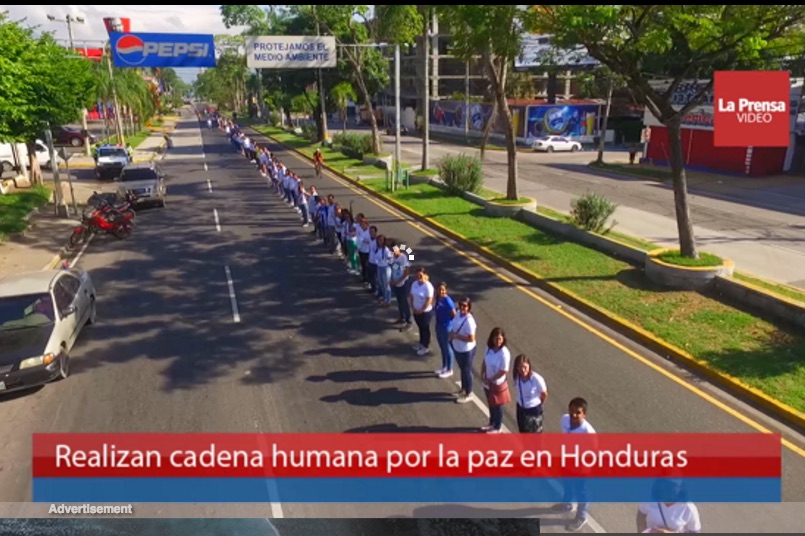
40,000 Create Human Chains to Protest Violence in Honduras

. HUMAN RIGHTS .

An article from Telesur TV

Over 40,000 people participated Sunday [October 23] in human chains throughout Honduras, including in the capital, Tegucigalpa and about 300 other cities, protesting against violence and homicide rates. The event was meant to “raise awareness against violence, in favor of a culture of peace and healthy cohabitation,” said one of the participants.

honduras
Video: Human Chain to Protest Violence in Honduras

The human chains were organized by 30 human rights groups, including the Honduras Towns Association and the “Say Yes to Life” movement.

“The human chain is a peaceful demonstration, focused on citizenship, on all the Hondurans who have experienced the pain of violence in various ways,” said Nery Cerrato, head of Amhon, to EFE. ”Honduran society does not deserve to be stigmatized as the most violent country in the world,” she added.

The event was meant to “raise awareness of the population against violence, in favor of a culture of peace and healthy cohabitation,” said one of the participants Nicolle Betancourt.

According to the protestors, there are 14 homicides per day in the country, while the U.N. Refugee Agency reported 200,000 people forcefully displaced. In 2015, over 16,000 Hondurans requested asylum in other countries like the United States and Costa Rica.

(Click here for an article in Spanish about this event)

Questions related to this article:

Poland: Women force historic U-turn on proposed abortion ban

. HUMAN RIGHTS .

An article from Amnesty International

The decision by Polish MP’s to reject a proposed amendment to their already restrictive abortion laws is a huge victory for women and girls, said Amnesty International.

“Women in Poland made history today [October 8]. This is a huge victory for the millions of women and girls who mobilized, showed their fury, and successfully blocked a law which would have taken away their rights and endangered their health,” said Gauri van Gulik, Amnesty International’s Deputy Director for Europe.

Poland
“More hell for women!”
Click on image to enlarge

“Through standing up for their rights they have forced Poland’s normally intransigent government to reconsider further restrictions to an abortion law that is already one of the most restrictive in Europe.”

“We salute all the inspirational women and girls who stood in the rain, raised their voices and went on strike on Monday to stand up for their rights.’

“A woman who needs an abortion is not a criminal and decisions about her body and her health should never be placed in the hands of politicians.”

After yesterday’s hastily organised session, which most civil society organisations were unable to attend, the Parliamentary Committee rejected the bill and the Parliament’s plenary rejected it this morning as well.

Question related to this article:

Guatemala: 28 years of struggle for the life, dignity and rights of women survivors of genocide

…. HUMAN RIGHTS ….

An article from CLOC – the Latin American Coordination of Peasant Organizations (translated by CPNN)

We express our deep appreciation for another year of life to our Creator and Maker, to our grandmothers and grandfathers who taught us the ways of resistance, defense and the practice of our languages, our arts, customs, ancestral knowledge. They support and encourage us, and work for the fullness of life, gratitude, reciprocity and harmony with Mother Earth and her natural resources.

conavigua
(Click on photo to enlarge)

From our emergence as the National Coordination of Widows of Guatemala -CONAVIGUA-, beginning September 12, 1988, we have achieved the organization of widows and orphans, starting our way to defend the dignity of women victims of violence and to defend our children from discriminatory forced military recruitment. We have searched tirelessly for those missing from our families and for detainees, knocking on the doors of justice in the courts and searching in clandestine cemeteries, hoping to find the truth and whereabouts of our loved ones.

As women we have told our stories in the RHEMI report, the Historical Clarification Commission, the Public Ministry, the National Compensation Program and many more with the aim that our truth is recognized. We bring content to the Peace Accords, and we have actively participated in promoting compliance with the Accords. In addition, we have promoted, together with other women’s organizations, the institutionalization of DEMI, SEPREM and others.

(Article continued in the right column)

(Click here for the original Spanish version of this article)

Questions related to this article:
Protecting women and girls against violence, Is progress being made?

(Article continued from the left column)

It’s been 20 years since the signing of the Peace Accords and 28 years since the beginning of our organization. We continue to demand respect for life, human rights, an end to the persecution, violence and rape against women survivors of genocide. We fight to defend our land, territory, water, holy sites and the individual and collective property of our peoples. We demand compliance with international conventions and treaties on the rights of women, indigenous peoples, youth , justice, environment, peace and security

As women who possess experience in community and social work, we have submitted proposals for legislative initiatives and organized campaigns for women’s access to education, health, housing, agroecology and civic and political participation. We have supported the struggles against impunity, demanded justice against genocide and made claims for the defense of Mother Earth.

In CONAVIGUA have accompanied participation and community organization, strengthening of ancestral authorities and empowerment of women. This has led to trials to bring charges against the perpetrators and masterminds of violence and rape against women, as in the cases of the women from Tululché, and Sepur Zarco Ixil. We also demand an end to the criminal prosecution of the leaders of our struggles and our social organizations.

Our vision is to promote changes and transformations and to continue the work with the excluded sectors for a multiethnic, multicultural and multilingual country that includes women and indigenous peoples. We are committed to further deepening and strengthening networks and local, national and international alliances in different spaces and levels.

For compliance with the rights of women and the eradication of violence against women .

For the culture of peace.

For the Unity and Dignity of Women

Papua New Guinea: Thousands march to ‘make a stand for peace’

. HUMAN RIGHTS .

An article from Nonviolent Conflict News

As many as 10-thousand people walked for peace in the Papua New Guinea capital over the weekend [of September 10-11]. The governor of Port Moresby says the Sunday morning event was planned as a stand against violence in the country following a brawl at a rugby league match which left an innocent bystander dead.

png

Powes Parkop tells Dominic Godfrey the death of Joe Pidik was a tragedy that he and others are ashamed of.

POWES PARKOP: We don’t condone this type of activity and we want to make a statement. It is not something that we accept and we want the public to come out to make that statement, to ourselves more particularly. Also, it’s leading up to our anniversary of our 41st year’s independence. We want to also make a statement for peace and unity in our country.

DOMINIC GODFREY: Next year of course PNG is co-hosting the Rugby League World Cup. Has there been any reaction to this outbreak of violence from your co-host countries?

PP: Yes. We had a grave concern expressed, especially by the Rugby League World Cup secretariat down in Australia. They rightfully expressed to us concerns that the games that we are going to host might be addressed. But we have given them the assurance that this is only a minority activity. This doesn’t represent all our people in Papua New Guinea and especially in Pt Moresby and so I hope they put their fears to rest and we are looking forward to hosting the three games for the Rugby League World Cup.

We will be hosting the Under 20 FIFA Women’s World Cup too in November and December of this year. That’s 16 countries coming from five continents of the world. Young leaders of tomorrow will be coming to our city and our country and it’s also important that we send that message loud and clear to the participating countries in particular but to the world generally that this type of behaviour is not acceptable, not tolerated. It’s why we came out in big numbers on Sunday with our minister for sport and rugby league board and chairman, and some of our rugby league teams and other sport teams.

Everybody came out in a very strong powerful way to send a message, especially going to our own people. It’s a problem that we have with our own people and we need to get our people to change their behaviour, change their habits and that’s essentially the main purpose we marched for yesterday. We need our people, the majority of whom reject violence, and if many more of people come out and make these type of statements, then it will get this minority to change their behaviour and attitudes so I’m very pleased with the outcome yesterday.

DG: What would the message be to the people of Papua New Guinea and Pt Moresby?

PP: Violence is an impediment to prosperity and development of our people.

(Thank you to Janet Hudgins, the CPNN reporter for this article.)

Questions related to this article:

The Elders welcome Myanmar peace conference

. HUMAN RIGHTS .

Press release from The Elders

The Elders warmly welcome the Union Peace Conference convened by State Counsellor Daw Aung San Suu Kyi. They believe the conference represents Myanmar’s best chance to date to bring a definitive end to the many violent conflicts that have plagued its ethnic minority regions almost continuously since independence in 1948.

myanmar
Gro Harlem Brundtland

Gro Harlem Brundtland, Deputy Chair of The Elders who led the group’s last delegation to the country in December 2014, said:

“The basic rights of all Myanmar’s people regardless of race, religion or citizenship should be a guiding principle as the country charts its way to a fully democratic and peaceful future. We hope that all parties to the Union Peace Conference hold firm to this principle and engage in its proceedings in good faith.”

The Elders note that since coming to power in November 2015, Daw Aung San Suu Kyi has given highest priority to national reconciliation and inclusiveness, stressing the need to bring all armed factions into a political dialogue about the country’s future constitutional make-up.

They are pleased to see that most of the ethnic armed groups will be taking part in this latest peace conference, though they remain concerned about fighting still persisting in parts of Kachin and Shan states. All sides must demonstrate sincerity about their stated wish to find peaceful solutions to problems.

The Elders also welcome last week’s announcement by the Myanmar Government of the establishment of an independent commission headed by Kofi Annan tasked with recommending measures to improve the dire situation in Rakhine State. The former UN Secretary-General, who is also Chair of The Elders, will be undertaking this important mission in his own capacity.

Question related to this article:

UN: National Human Rights Institutions will play a more strategic role in education

…. HUMAN RIGHTS ….

An article from the Danish Institute for Human Rights

A new UN resolution on Human Rights Education emphasizes the strategic role of National Human Rights Institutions concerning the promotion of human rights education.

humanrights

The United Nations Human Rights Council agreed on a new resolution on Human Rights Education and Training at the Human Rights Council’s Thirty-first session this spring. The resolution reconfirms and supplements state parties’ commitment to national implementation of international standards for human rights education five years after the UN Declaration on Human Rights Education and Training from 2011. Due to a timely and targeted effort and a fair portion of good luck, The Danish Institute for Human Rights manged – through the international coordinating committee of the human rights institutions (GANHRI) – to give NHRIs remarkable space for manoeuvring on the educational scene.

Human rights education is important in order for children, youth and adults to know their rights and duties and to respect and uphold the rights of others. Moreover, it’s important that duty bearers such as teachers, police, social workers and other civil servants who act on behalf of the state, know their duties to respect, protect and fulfil the state’s human rights obligations whether behind the desk formulating policies or acting on the ground with vulnerable citizens.
The new resolution text reads that states “Recognizes the important role of national human rights institutions in promoting effective policies on human rights education and training, and calls upon them to contribute further to the implementation of human rights education programmes”.

(Article continued in the right column)

Question(s) related to this article:

What is the state of human rights in the world today?

(Article continued from the left column)

“This is the first time we see a resolution on education which stresses the strategic role of NHRIs on promoting effective policies for human rights education and training. Focus has shifted from NHRI assisting in conducting education programmes on human rights, to assisting in the development of effective policies at the structural level. In other words, this reflects the shift in focus amongst NHRIs to work across their NHRI mandates such as coordination, giving advice and monitoring on human rights education. They will thereby have a more far reaching and sustainable impact on the education sector”, says Cecilia Decara, Senior Adviser at The Danish Institute for Human Rights who has worked on impacting the resolution together with Olga Ege, who is also a Senior Advisor at the institute.

The new paragraph also have a deep impact on the work of NHRIs, says Cecilia Decara: “It reflects that there is a need for NHRIs to work both on the structural level influencing the adoption of effective policies for human rights education, and also contribute to the implementation of programmes. It’s the conjunction of working at both levels, which qualifies the monitoring and follow up process e.g. giving advice to duty bearers.”
The new resolution will be helpful to set a further framework for our advice and network on human rights education with less experienced NHRIs, Cecilia Decara adds.

The UN Human Rights Council also decided to “convene at its thirty-third session a high-level panel discussion to mark the fifth anniversary of the United Nations Declaration on Human Rights Education and Training”. This high-level panel discussion will focus on good practice and challenges of the implementation of the declaration.

(Thank you to the Global Campaign for Peace Education for calling this article to our attention)

Malaysia: Tenaganita Still Fighting for Women Workers’ Rights, 25 Years On

…. HUMAN RIGHTS ….

An article by Mickey Spiegel for Human Rights Watch

It’s now a quarter of a century since Tenaganita, a civil society pioneer in the fight for women workers’ rights in Malaysia, was founded. It has thrived despite persistent government harassment and roadblocks to its work. But one look at its determined and principled leadership explains a lot.

malaysia
Irene Fernandez speaks at the presentation of the winners of the Right Livelihood Awards in Stockholm, Sweden on December 7, 2005. © 2005 Reuters
Click on photo to enlarge

Since Tenaganita has never blown its own horn, too few people know of the group’s ground-breaking struggles for decent working conditions for both Malaysian and migrant women – be they on remote palm oil plantations, crowded factory assembly lines, or isolated in private homes as abused migrant domestic workers. Since 1991, Tenaganita has been instrumental in fighting for justice for women and men trafficked into forced labor and sexual exploitation in Malaysia; for urban refugees seeking the right to work and for their children’s right to schooling; and fighting for a bigger vision – that all ASEAN countries make their laws and practices conform with international rights standards.

(Article continued in the right column)

Question(s) related to this article:

The right to form and join trade unions, Is it being respected?

(Article continued from the left column)

I and other Human Right Watch staff members learned much from Tenaganita about finding possible solutions for women workers’ struggles. The first lesson came from visiting its modest offices, jammed each day with clients patiently waiting their turn for help, and watching the staff never hurry a person in distress, no matter how late the hour or how difficult their case. The combination of modesty and principled persistence won through.

A second lesson came from the exceptional women who formed and led Tenaganita. The inimitable founder, Irene Fernandez, faced down repeated government threats to her work and her freedom in a trial and appeal that lasted 13 years. The authorities charged her for “maliciously publishing false news” after Tenaganita issued a report about the abysmal conditions in Malaysia’s immigration detention centers. After a seven-year-long trial, she was found guilty in 2003 – a conviction that hung over her head until the High Court overturned the verdict in 2008.

I’m forever grateful to Irene, who passed away in 2014, for the advice she gave me on migrant issues; to her sister Aegile Fernandez, part of the leadership team since the beginning; and to Glorene Das, now executive director. Glorene, dynamic yet modest, is never too busy to explain a new convoluted government program, or to rally activists when it is apparent that workers are in peril.

The hope, of course, is that someday workers will no longer need groups like Tenaganita. But it is a life saver for those in need. I am confident it will tackle challenges with the expertise, modesty, and tenaciousness that has been its trademark for 25 years.

‘March of Silence’ in Uruguay sends message of remembrance to South America

…. HUMAN RIGHTS ….

An article by Andre Vitchek in RT News

They were marching shoulder-to-shoulder, young and old, in absolute silence. Some were carrying small placards with names and photos of their loved ones, who disappeared four decades ago, during the pro-Western dictatorship here in Uruguay. The entire center of Montevideo came to a standstill. Blocks and blocks of this marvelous city were literally inundated by the river consisting of human bodies.

uruguay
video of march

Then, in front of the municipality, the silence was broken. A huge screen above the square lit up, and photographs of each man and woman who disappeared, suddenly emerged, one by one. When no photograph was available, a gray contour was projected on the white screen. Two voices, one of a man, and one of a woman, were reading names of the victims. And the crowd chanted back in unison: “Presente!”

One block further, the “March of Silence” ended. The national anthem of Uruguay resonated across the old city. Some people stood still, in silent salute and reverence, others fell into each other’s arms, weeping openly and uncontrollably.

Uruguay, at least to some extent a socialist country, was still standing. All over the continent, however, left-wing governments were collapsing, under the terrible weight of constitutional coups as well as the media and business manipulations of the ‘elites’ and the Empire.

Argentina was crying out in pain under the neoliberal President Mauricio Macri, while the great Brazilian nation – fooled, cheated and spat at – was just slowly and painfully waking up after the long night of a shameless coup that brought a corrupt lackey and snitch of the West – Michel Temer – to power.

But even in Uruguay, the old establishment was still clinging to power, blocking many essential changes, resisting and silencing the calls for justice.

Around 300 people disappeared in tiny Uruguay during the extreme right-wing dictatorship (1973-85), of course much less than in Argentina or Chile.

“But that is enough. Enough!” An old lady who was holding a placard with the image of her sister told me. “300 are much more than enough. We want justice and truth. Because without those, there could be no real progress in this country.”

(Article continued in the right column)

(Article continued from the left column)

One of the posters read:

AGAINST IMPUNITY OF THE PAST AND PRESENT! TRUTH AND JUSTICE!

Other placards were much more explicit:

NO FORGETTING NO FORGIVENESS!

And an even stronger one:

THEY ARE INSIDE US, SHOUTING ‘REVOLUTION!’

“This is so impressive, so touching!” whispers my friend Lilian Soto, a leading Paraguayan left-wing politician and former MP and Presidential candidate. “I have already participated in this march on several occasions. I really love this country!”

I briefly speak to my colleague and comrade from TeleSur, who is covering this great event for the entire Latin America and the world.

This year, after what happened in neighboring Argentina and Brazil, the march is gaining great symbolism. Cuban flags are flying, not far from the great Uruguayan Cinemateque, where my film about the US-backed 1965 coup in Indonesia had been shown, many years ago. In front of the statue of Socrates, a man poses, proudly, wrapped in a huge Brazilian flag.

“Those flags were just personal statements by several individuals,” explains my friend, Uruguayan journalist and activist Agustin Fernandez. “The demonstration was still mainly about the crimes committed by our past dictatorship.”

Mainly, yes; but those men and women I spoke to, on the night of 21 May, in the center of Montevideo, appeared to be extremely concerned about the macabre developments shaking the neighboring countries.

In Latin America, as well as all around the world, everything is clearly inter-connected. The West; the Empire, are behind almost all the horrid crimes against the humanity.

A great Greek film director, Costa Gavras, depicted the Uruguayan dictatorship and the Yankee involvement (a story of a US diplomat and expert in torture, who was kidnapped by the Uruguayan resistance group Tupamaros), in his iconic film “State of Siege” (1973).

The US and the West were behind the disappearances and torture in this historically peaceful and democratic country… as they were responsible for the horrors of fascist dictatorships in Chile, Argentina, Brazil and elsewhere… and just as they are accountable for the recent ‘events’ in Argentina and Brazil.

Who said that the US was ‘too busy in the Middle East, while also provoking Russia and China?’ Who said that ‘the Empire finally closed its eyes, stopped looking south?’ It never does! It never sleeps!

Walking down the streets of Montevideo, photographing and talking to the marching masses, on several occasions I was tempted to shout:

“Hugo Chavez Frias!”

And:

“Salvador Allende Gossens!”

Expecting to hear those loud, clear and proud voices replying to me: “Presente!”

Muhammad Ali’s American Faith Journey

…. HUMAN RIGHTS ….

An article by Varun Soni in the Huffington Post (reprinted according to the principle of “fair use”)

Muhammad Ali was the greatest athlete of the 20th century and arguably the most famous athlete to ever live. His extraordinary record of athletic achievement includes six Kentucky Golden Gloves titles, two national Golden Gloves titles, an Olympic gold medal, and three World Heavyweight Championships. Heralded for his eloquence and loquaciousness, Ali was a poet with a flair for the theatrical who redefined what it meant to be an athlete in the public sphere. Indeed, the convergence of his craft and charisma resurrected professional boxing with Ali as its undisputed ambassador. Named “Sportsman of the Century” by Sports Illustrated and “Sports Personality of the Century” by BBC, it is difficult to accurately convey how dramatically Ali transformed the global sports landscape. But despite Ali’s unparalleled accolades as a professional boxer, his most profound legacy is that of a moral leader, peace ambassador, civil rights icon, and global humanitarian, a legacy that emerges from his deep religious beliefs and spiritual convictions.

Muhammed Ali
Click on image to enlarge

In 1964, a promising young boxing champion named Cassius Clay converted to Islam, became Muhammad Ali, and embarked upon one of the most visible and impactful faith journeys in American history, a journey that would take him from being one of America’s most divisive figures to one of its most beloved. Ali came to Islam through the Nation of Islam and his personal friendship with Malcolm X, who challenged Ali to translate his religious beliefs into social action. Like Malcolm X, Muhammad Ali would eventually leave the Nation of Islam, but he continued his faith journey as a Sunni Muslim, and later as an adherent of Sufism, which represents the mystical dimensions of Islam.

In 1967, Muhammad Ali refused to participate in the draft for the Vietnam War, citing his religious beliefs in his petition as a conscientious objector. As a result, in the prime of his boxing career, Ali was convicted of draft evasion, stripped of his heavyweight championship, and banned from professional boxing. For almost four years, Ali appealed his case while remaining one of the most prominent and outspoken opponents of the Vietnam War. Finally, in the landmark decision of Clay, aka Ali, v. United States (1971), the United States Supreme Court unanimously upheld Ali’s conscientious objector claim and dismissed all charges against him.

(Article continued in the right column)

(Article continued from the left column)

By sacrificing the peak years of his professional boxing career and relinquishing his heavyweight boxing title in order to promote a culture of peace, Ali became firmly enshrined in the pantheon of the world’s great peace icons. In 1998, Ali’s status as an international peace luminary was cemented as he was officially named a United Nations Messenger of Peace. Ali was also the recipient of Amnesty International’s Lifetime Achievement Award, Germany’s Otto Hahn Peace Medal, and the Presidential Medal of Freedom.

Muhammad Ali’s journey from sportsman to statesman, from fighter to peacemaker, was more than just symbolic. Indeed, his post-fighting career is replete with examples of his courageous public diplomacy initiatives. He negotiated the release of 15 American hostages from Iraq during the first Gulf War; he spearheaded reconciliation programs in South Africa and Vietnam; he delivered medical aid and supplies to Cuba; and he traveled to North Korea and Afghanistan as a goodwill ambassador. Additionally, as a philanthropist, he raised millions of dollars for Parkinson’s research, distributed meals to homeless families in the United States, and participated in the Make-A-Wish Foundation and the Special Olympics.

Muhammad Ali’s dedication to global peace, public diplomacy, and philanthropy exemplified his foundational belief in Islam as a religion of peace. Accordingly, throughout his public religious life, Ali remained the most important Muslim in the world. His renowned status in the Muslim world made him a significant global leader, for he is as beloved in Kenya and Kuwait as he is in his native Kentucky. And after 9/11, Ali publicly denounced terrorism while promoting the core values of Islam – peace, charity, humility, justice, beauty, and grace – prompting Slate magazine to describe him as the “Dalai Lama of the post-9/11 world.”

Ultimately, Muhammad Ali’s root identity as an American Muslim empowered him to claim a mantle of moral authority and do the prophetic work of peace and justice. In doing so, he embodied the hopes, dreams, aspirations, and promise of the Muslim American community. Reflecting upon his unique faith journey, Ali said, “I set out on a journey of love, seeking truth, peace, and understanding.” His remarkable journey endures as a quintessentially American journey of reconciliation and redemption.

Red carpet film festival asserts Gaza’s pride and talent

…. HUMAN RIGHTS ….

An article by Lara Aburamadan in Electronic Intifada

A grand red carpet ran between rows of destroyed apartment blocks and houses in the Gaza City district of Shujaiya last week, temporarily transforming one of the areas most devastated during Israel’s 51 days of bombing last summer. Dozens of men, women and children were massacred in Shujaiya on 20 July 2014. The red carpet occasion was the Karama Human Rights Film Festival, produced by the Gaza-based production company Lama Film.

gaza
Click on photo to enlarge

Khalil al-Mozayen, a film director and the manager of the festival, stated at a press conference that “The red carpet symbolizes equality — that not only celebrities and high profile personalities or politicians deserve to walk on red carpets but also the people who witnessed the brutal war and experienced the loss of a family member or the imprisonment of another.”

The festival audience was mainly made up of residents of Shujaiya, including many children.

Attendees walked down the red carpet nearly 500 meters away from the militarized boundary with Israel and the army sniper towers. Stepping foot on the red carpet stirred up both joy and sorrow for Shujaiya’s residents, as well as pride and dignity, and a reminder that they are not forgotten.

The approximately two dozen festival selections mainly concerned human rights.

Spokesperson Saud Aburamadan told The Electronic Intifada that the festival is the first of its kind in Gaza and that it sends a message that “in spite of siege and destruction, we have our minds and talents and creativity. We want to reflect an image that the darkness of wars can never hide Gaza’s shine because people love life.”

Al-Mozayen said, “Gaza embraces cinema despite the war and siege. Cinema is our gate to the world and we hope that next year we will be able to make the festival in West Bank and Jerusalem.”

Carol Scheller replied on Wed, 05/20/2015 – 07:40

This event is the most powerful and human statement as to what Israel wreaked on Gaza last summer and to what everyone there yearns for: just a life that includes going to the movies ! The three days of films restored dignity and recognition to the people of Gaza who in their great majority detest all politics. It gave hope and joy: many young Gazans have never been to the cinema; older ones remember by-gone days when Palestinians there adored going to films. The Karama Film Festival will long be remembered when the ruins of Shijahiya are no more. It has gone a long way towards reconstructing Gaza, more than reports and empty déclarations – it has given its people the inner strength they need to continue to demand justice.

Questions related to this article: