Category Archives: WOMEN’S EQUALITY

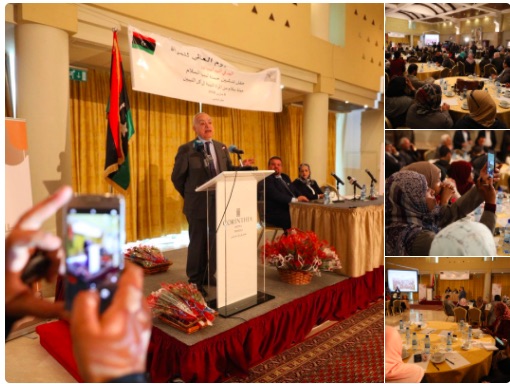
International Women’s Day Celebration and Launching Ceremony of the “Libya for Peace” Campaign, 8 March 2018

. WOMEN’S EQUALITY .

Announcements from CNBC Africa and UNSMIL twitter

The “Libya for Peace” Campaign was launched on International Women’s Day held in cooperation with the General Authority for Culture and the support of the United Nations.


GhassanSalame addressing the launch of ‘#Libya for #Peace Campaign (photo from UNSMIL twitter)
.

(Article continued in the right column)

Question for this article

Do women have a special role to play in the peace movement?

(Article continued from the left column)

“Libya for Peace” Campaign aims at promoting a culture of peace and peaceful coexistence and highlighting the role of women in peacemaking.

This Campaign was initiated by a group of Libyan women after a series of meetings and conferences that resulted in the nomination of seven women from different regions of Libya as coordinators of the campaign.

This inaugural ceremony is the first of several activities to highlight the general plan of the “Libya for Peace” Campaign and the Women’s Peace Document that emerged from the Libyan Women’s Peace Conference held in Montreux, Switzerland, in September 2015.

Opening Remarks:

•       Coordinators of the “Libya for Peace” Campaign

•       Dr. Hassan Ewneis, Director of the General Authority for Culture

•       Dr. Asma Alosta, Minister of State for Women Affairs and Social Development

•       Dr. Ghassan Salamé, Special Representative of the Secretary-General in Libya.
Distributed by APO Group on behalf of United Nations Support Mission in Libya (UNSMIL).

What Women Bring to the Constitution-Writing Table

. WOMEN’S EQUALITY .

A blog by Marie O’Reilly* for Ms Magazine Blog

When social norms are upended by violence—including relations between women and men—constitution reform presents an opportunity to transform power dynamics in a society. Rewriting a country’s constitution is a frequent step on the path toward peace, and is a particularly important entry point for women to address their historic marginalization and have a say in the future of their societies.


UN Women / Creative Commons
.

Yet among the 75 countries that undertook constitution reform in the wake of conflict or unrest between 1990 and 2015, women made up only one in five constitution drafters.

As individuals, women play myriad roles in peace and conflict—victims and perpetrators, peace activists and politicians—and they often embody many of these identities at once. But a new study from the nonprofit Inclusive Security, where I serve as research director, shows that when women do participate in constitution making, they consistently advocate for constitutional provisions that advance gender equality.

In Kenya, this meant equal rights and non-discrimination in marriage, divorce, property and citizenship—as well as a commitment that no more than two-thirds of any elected body could be of the same gender. In Rwanda, it meant a guarantee that women would occupy at least 30 percent of seats in parliament.

These kinds of gender equality provisions help to ensure that women can continue to influence public policy after the constitution-making process ends.

They also help lay a foundation for peace.

(Article continued in the right column)

Question for this article

Do women have a special role to play in the peace movement?

(Article continued from the left column)

There are many drivers of conflict, but scholarly research suggests a strong relationship between gender equality and peace. This is particularly true for women’s participation in politics and the durability of peace after war. A study of 58 conflict-affected states between 1980 and 2003 found that when no women were represented in the legislature, the risk that a country would relapse into war increased over time. But when 35 percent of lawmakers are women, the risk of relapse is near zero. The causal direction is not always clear, but working for both equality and peace at once appears to be in everyone’s interest.

Beyond advocating for their own rights in the constitutional text, our research showed that women tended to advance peace-building as part of the constitutional process. Across eight case studies, women frequently bridged acute political and religious divides to advance their gender equality agenda, modeling for other policymakers how communities affected by conflict can collaborate and develop consensus on priority issues.

Women’s civil society groups also consistently led outreach initiatives to broaden societal participation and help cement the social contract as it was being created.

In the Philippines, women’s organizations engaged former combatants, students, academics and religious, tribal and business leaders to develop draft provisions on topics such as indigenous peoples’ rights, the justice system and policing.

Of course, it takes much more work to turn constitutional provisions into tangible change. In Rwanda, women now have the highest rates of parliamentary representation in the world. In Kenya, on the other hand, the parliament has failed to enforce the two-thirds principle. But as a foundational legal text, a constitution provides a framework for advocacy and further legislation. Kenyan women took the streets last January to protest their president’s failure to name women to at least one-third of his new cabinet, and their banners referenced the constitutional provisions that he was violating. Two Kenyan rights groups have taken the issue to the High Court.

If done right, constitution-making lays the groundwork for civil contestation, rather than violent confrontation. But its potential to transform conflict into democratic deliberation depends, in part, on who gets to participate.

* Marie O’Reilly is director of research and analysis at Inclusive Security.

Women take to the streets as the world marks International Women’s Day

. WOMEN’S EQUALITY .

An article from PBS (Pubic Broadcasting Service)

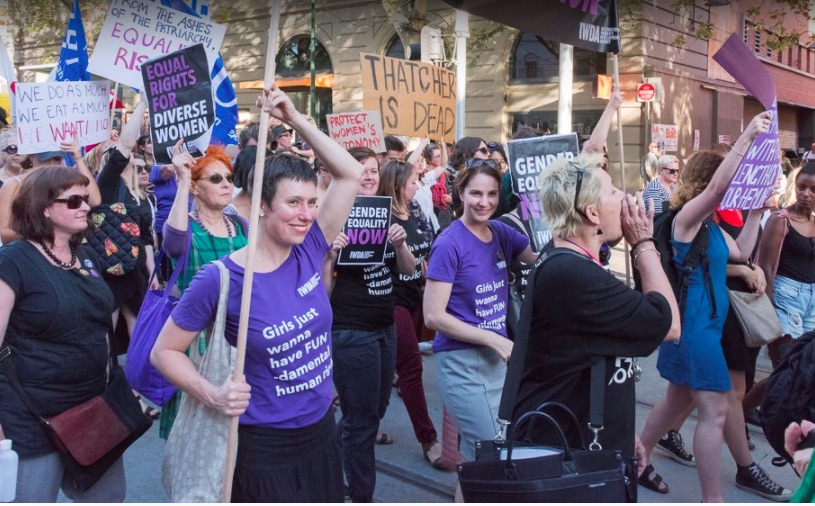
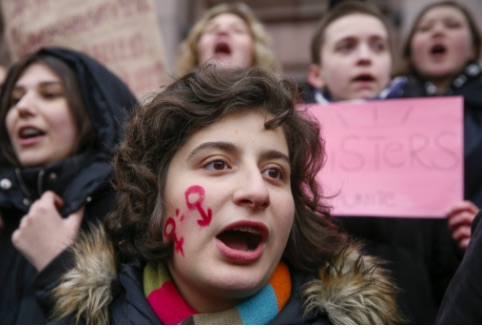
Women across Europe and Asia shouted their demands for equality, respect and empowerment Thursday to mark International Women’s Day, with protesters in Spain launching a 24-hour strike and crowds of demonstrators filling the streets of Manila, Seoul and New Delhi.


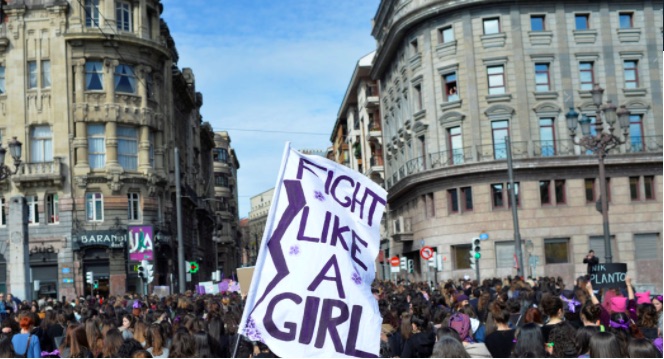
A protester holds a banner reading “Fight Like A Girl” during a demonstration for women’s rights on International Women’s Day in Bilbao, Spain. Photo by Vincent West/Reuters
.

Spanish women were staging dozens of protests across the country against the wage gap and gender violence. In Madrid, a massive demonstration was planned for the evening. In Barcelona, protesters who disrupted traffic into the city center were pushed back by riot police.

In some countries, protests were more muted, however.
International Women’s Day is a public holiday in Russia, but opposition presidential candidate Ksenia Sobchak was one of the few demonstrators in Moscow.

In a protest reminiscent of the #MeToo movement, which aims to hold those involved in sexual misconduct, and those who cover it up, accountable, Sobchak staged a solo picket outside the lower house of the Russian parliament to demand the resignation of a prominent lawmaker whom several female journalists accuse of sexual harassment.


Participants shout slogans during a rally for gender equality and against violence towards women on the International Women’s Day in Kiev, Ukraine. Photo by Valentyn Ogirenko/Reuters

On a lighter note, a leading French newspaper found a witty way of making its point about discrimination and the gender pay gap — by upping its price for men. The left-leaning daily Liberation said that for one day only, men would pay 50 euro cents more than women, in a reflection of the 25 percent less that women in France are paid, on average.

Across Asia, women came out to mark the day. In China, students at Tsinghua University used the day to make light of a proposed constitutional amendment to scrap term limits for the country’s president. One banner joked that a boyfriend’s term should also have no limits, while another said, “A country cannot exist without a constitution, as we cannot exist without you!”

But photos of the students’ banners, like other content about the proposed amendment, were quickly censored on social media.


A woman takes pictures of men standing behind booths during an International Women’s Day event inside a shopping mall, where customers can rent a “boyfriend” for 30 minutes with one yuan ($0.16), in Binzhou, Shandong province, China. Photo by Reuters


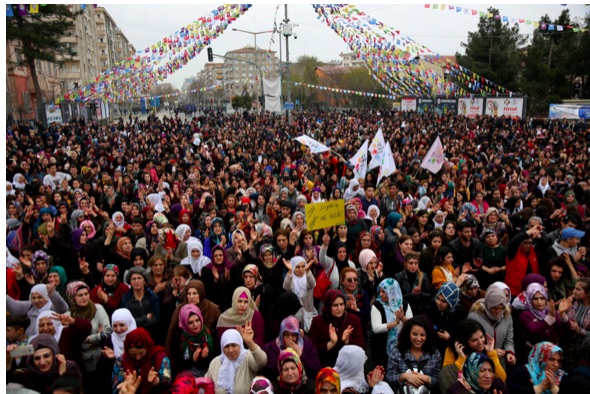
Women gather during a rally on the International Womens Day in Diyarbakir, Turkey. Photo by Sertac Kayar/Reuters

Hundreds of activists in pink and purple shirts protested in downtown Manila against Philippine President Rodrigo Duterte, calling him among the worst violators of women’s rights in Asia. Protest leaders sang and danced in a boisterous rally in Plaza Miranda, handing red and white roses to mothers, sisters and widows of drug suspects slain under Duterte’s crackdown on illegal drugs.

(Article continued in the right column)

Question for this article

Do women have a special role to play in the peace movement?

(Article continued from the left column)

Human rights groups have condemned Duterte’s sexist remarks, including one in which he asked troops to shoot female communist rebels in the genitals. Protest leader Jean Enriquez also railed against Duterte’s anti-women remarks, saying: “We’re so alarmed. We have seen his direct attacks on women under his iron-hand rule and it’s now time to heighten our resistance.”

In Afghanistan, hundreds of women, who would have been afraid to leave their homes during Taliban rule, gathered in the capital to commemorate the day— and to remind their leaders that plenty of work remains to be done to give Afghan woman a voice, ensure their education and protect them from increasing violence.

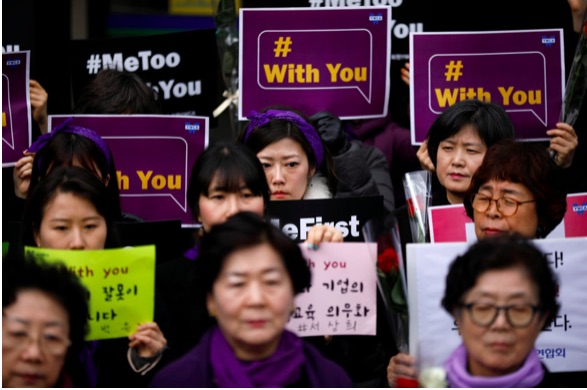
Hundreds of South Koreans, many wearing black and holding black #MeToo signs, rallied in central Seoul. South Korea’s #MeToo movement has gained significant traction since January, when a female prosecutor began speaking openly about workplace mistreatment and sexual misconduct. The list of women who speak out is growing day by day.

Several high-profile South Korean men have resigned from positions of power, including a governor who was a leading presidential contender before he was accused of repeatedly raping his female secretary.

Women attend a protest as a part of the #MeToo movement on International Women’s Day in Seoul, South Korea. Photo by Kim Hong-Ji/Reuters


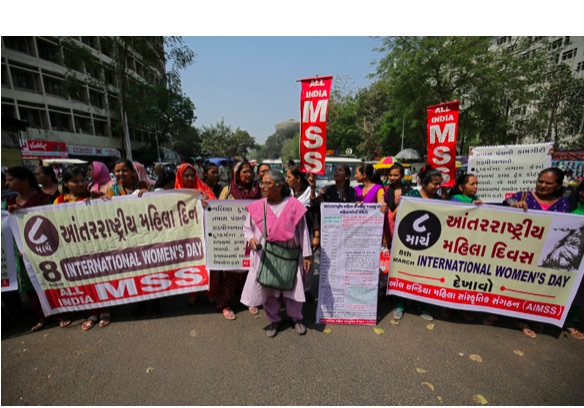
Demonstrators hold banners during a protest demanding equal rights for women on the occasion of International Women’s Day, in Ahmedabad, India. Photo by Amit Dave/Reuters

In India, hundreds of women, including students, teachers and sex workers, marched through the capital to bring attention to domestic violence, sexual attacks and discrimination in jobs and wages.

“Unite against violence against women,” one placard urged. “Man enough to say no to domestic abuse,” said another. “My body, My choice.”

India had its first female leader in 1966 when Indira Gandhi became prime minister, but Indian women are still often relegated to second-class citizenship.

In Africa, Ugandan President Yoweri Museveni urged men to stop physically abusing their wives. Domestic violence is common in Uganda, although victims rarely report perpetrators to the police for fear of being stigmatized or thrown out of their homes.
“If you want to fight, why don’t you look for a fellow man and fight?” Museveni said, calling domestic abusers cowards.

Back in Europe, the European Commission said in a statement published on Twitter that the continent “is one of the safest and most equal places for women in the world.” On the other hand, it noted that “the path to full equality in practice is still a long one.”
“The issue of gender equality is high on the agenda,” Frans Timmermans, the European Commission’s first vice-president, said, “but progress is still slow on the ground.”

German Chancellor Angela Merkel, considered by many to be one of the world’s most powerful women, echoed those sentiments, saying in a video message the struggle for greater equality in Germany and worldwide must continue. She said “many women before us have made sacrifices and fought persistently so that women would have more rights … but there’s still a lot to do.”

As if to prove that point, Belgian women’s groups spoke out angrily as the world of sport provided an immediate and visible target for their struggle.

The Belgian football federation, saying it did not want to be taken “hostage” by women’s groups, refused Thursday to back down from its decision to choose a rapper known for lacing his songs with misogynistic lyrics to produce its official World Cup song.
The Women’s Forum, a coalition of Belgian women’s groups, said it was unacceptable that an artist using degrading lyrics could be picked to produce what should be a unifying song.

Tim Sullivan in Delhi, Barry Hatton in Lisbon, Portugal, and AP correspondents around the world contributed to this report.

Nobel Women Peace Laureates Call for an End to Rohingya Genocide

. WOMEN’S EQUALITY .

A press release from the Nobel Women’s Initiative

As three Nobel peace laureates—Tawakkol Karman of Yemen, Shirin Ebadi of Iran, and Mairead Maguire of Northern Ireland – conclude their visit to Bangladesh on the six-month anniversary of the current Rohingya crisis, the three women are calling for an immediate end to the “genocide” of the Rohingya people.


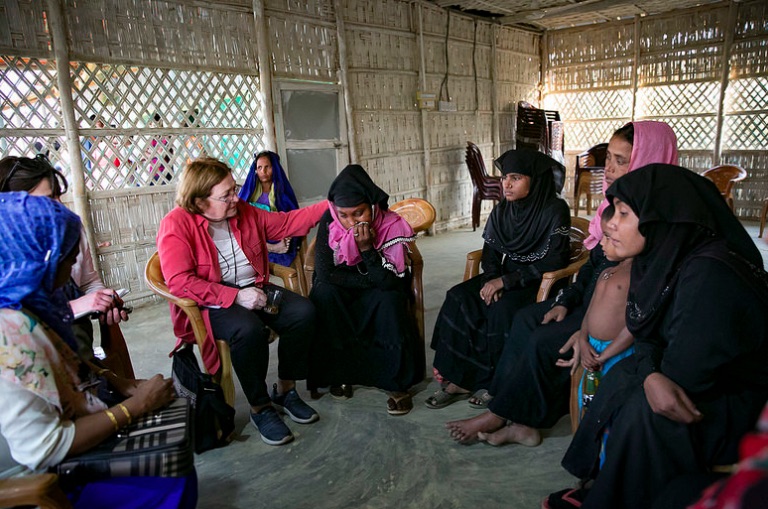
Mairead Maguire meets with Rohingya survivors of gender based violence in Kutupalong Rohingya refugee camp February 25, 2018 in Cox’s Bazar, Bangladesh. Photo by Allison Joyce

This week, the three women Laureates ­––in partnership with Bangladesh women’s organization Naripokkho­­––spent time listening to stories, meeting over 100 women refugees in the Cox’s Bazar area, and travelling to “no man’s land”, where thousands of Rohingya have been stranded between Myanmar and Bangladesh.

After hearing testimonies describing how security forces burned villages, tortured, killed and systematically raped women and girls—as well as reports from humanitarian organizations and UN officials—the Laureates concluded that the on-going attacks on the Rohingya of Rakhine State amount to crimes against humanity and genocide.

The Laureates are calling on Laureate Aung San Suu Kyi and the Myanmar military to put an end to the killings and the persecution of the Rohingya people.

“She must stop turning a deaf ear to the persecution of the Rohingya or risk being complicit in the crimes,” said Tawakkol Karman. “Wake up or face prosecution.”

As women committed to peace, the Laureates are urging Aung San Suu Kyi to exercise her personal and moral responsibility stop the genocide. “If she fails to do so, her choice is clear: resign or be held accountable, along with the army commanders, for the crimes committed” added Karman.

The Laureates heard how Rohingya women have been twice victimized: for being Rohingyas and for being women. They described stories of horrific violence and systematic mass rape.

“My 18-year old daughter had her breasts cut off and she died,” a Rohingya woman in the Thyankhali camp told the Nobel peace laureates.

“My baby was only 1-year and 6-months old. The military tore her from my arms and slaughtered her in front of me,” said a Rohingya survivor of rape. She then passed around a photo she had of her child. She wanted everyone to see her little girl.

The laureates heard stories of children being thrown into fires and drowned in rivers. They heard stories of houses and complete villages being burned to the ground and children being shot while running to the forest to seek shelter and safety.

“The torture, rape and killing of any one member of our human family must be challenged, as in the case of the Rohingya genocide,” said Mairead Maguire. “Silence is complicity.”

(article continued in right column)

Questions for this article

Do women have a special role to play in the peace movement?

(article continued from left column)

The Nobel peace laureates were impressed by the strength and resilience of the women who had survived such horrific crimes. One woman at the Thyankhali camp told them, “Why should we feel shame? We were tortured. We don’t need to feel shame about that.”

Another woman at Camp Kutupalong said, “We are not afraid of anything. We want our stories to be told.”

The Laureates are calling for the perpetrators of these heinous crimes to be brought to justice before the International Criminal Court.

“With over a million Rohingya displaced, countless dead or missing, and rape and sexual violence being used as a weapon of war, it is well past the time for the international community to act,” said Shirin Ebadi.

The Laureates met with Prime Minister Sheikh Hasina, government officials, human rights organizations and humanitarian agencies. They extended their thanks to Prime Minister Hasina and to both the Government and the people of Bangladesh for their exemplary acts of compassion for the Rohingya refugees.

The Laureates also expressed deep appreciation to the Bangladeshi government and to the various humanitarian agencies that have met the extraordinary challenge of setting up the Refugee and Relocation Camps for over one million Rohingya refugees.

As a result of their visit to Bangladesh, the Nobel Laureates are calling for:

* An immediate end to the genocide against the Rohingya in Rakhine, and an order to the Myanmar military to immediately stop all acts of sexual violence.

* Justice for Rohingya victims: perpetrators of crimes must be brought to justice through the International Criminal Court (ICC).

* Bangladesh, as the only country in South Asia to have ratified the Rome Statute, should, along with other states parties, the UN Security Council and the Human Rights Council, refer the case to the ICC.

* Alternatively, the ICC Prosecutor should open an independent investigation into crimes against humanity and genocide perpetrated in Rakhine State.

* A voluntary, safe and dignified return. There should be no forced repatriation. When Rohingya do return to Rakhine State, they should be offered security and be granted full citizenship.

* The government of Myanmar to take immediate action to address the systematic discrimination of the Rohingya in Rakhine State, and ensure the Rohyinga’s right to nationality, land ownership, freedom of movement and other fundamental rights.

* A comprehensive arms embargo on Myanmar to ensure that there are no sales of weapons or other military equipment.

* The international community to increase its support to Bangladesh’s humanitarian response.

* Bangladesh to ratify the 1951 Geneva Refugee Convention, as a major step to give protection to refugees and set an example in South Asia.

For more information, please contact:
Ketty Nivyabandi, Media Associate: knivyabandi@nobelwomensinitiative.org + 1 613 691 1419
Katia Gianneschi, Media Outreach: Katia.Gianneschi@gmail.com +1 613 614 9740

(Thank you to Janet Hudgins, the CPNN reporter for this article.)

India: ’Life: A Mystical Journey’- A Gathering of 500 Women Leaders To Explore Spirituality as Tool For Peace And Empowerment

. WOMEN’S EQUALITY .

An article from India Education Diary

Over 500 accomplished women achievers, artists, policymakers, sportswomen among others will participate in the 8th International Women’s Conference (IWC). Titled, ‘Life: A Mystical Journey,’ the conference will be held at The Art of Living International Center, Bengaluru between February 23 and 25.


IWC has unique twin goals- individual development and collective action. It facilitates partnership-building and leadership development among women leaders globally.

Some of the speakers for this year’s conference include Arundhati Bhattacharya, former chairman, State Bank of India; Chetna Gala Sinha, Founder-Chairperson Mann Deshi Bank and Mann Deshi Foundation, Rani Mukherji , Indian Actress,  Vandana Shiva, environmentalist, and ecologist; Madhoo Shah, actress, MridulaSinha, Governor, Goa,  Adriana Marais, theoretical physicist, head of innovation at SAP Africa; Professor MaithreeWickramasinghe, founder director of Center for Gender Studies at the University of Kelaniya.

“Women are leading peacemakers. They work together towards creating a stress-free, violence-free society. The conference is a message in peace and unity,” shares BhanumathiNarasimhan, Chairperson, IWC.

(article continued in right column)

Questions for this article

Do women have a special role to play in the peace movement?

(article continued from left column)

Increasing number of women are leading from the front in multiple fields. The IWC builds on this trend. It works with women leaders to enhance their impact and gives an impetus to the global advancement of women from all backgrounds.

The 2018 conference will explore ways to amplify the message of peace and empowerment, including spiritual tools.

“The role of women in the development of a society is of utmost importance. It is the only criterion that determines whether a society is strong and harmonious,” says Gurudev Sri Sri Ravi Shankar, Founder, The Art of Living, which is one of the conference partners.

Since its inception in 2005, the conference has focused on diversity and inclusiveness. Over 375 eminent speakers and 5500 delegates from over 100 countries have participated in the conference. The IWC focuses on advancing the status of women in fragile and post-conflict states. It also worked with the World Bank Institute to develop empowerment schemes for women in vulnerable nations and expanded vocational training for widows in Iraq.

The IWC also supports The Art of Living’s Gift A Smile project. Over 58,000 students study in 435 free schools across 20 Indian states. Encouragingly, girl children comprise 48% while 90% are first-generation learners. Promoting girl child education is the underlined focus area for IWC.

This year the focus will also be to create open defecation free districts in India. In phase 1, the organization will work towards sensitization and awareness about use of toilets and increasing health and hygiene in these areas. In Phase II, 4000 toilets will be built.

IWC in the past has been associated with pivotal social initiatives like constructing homes for the under privileged, creating awareness about environment and environmental care, movement to stop violence against women, and child and women empowerment through skills training.

Women’s March protests across America against President Trump

. . WOMEN’S EQUALITY . .

An article from Deutsche Welle

Thousands of protesters took to the streets across the United States on Saturday for the second annual Women’s March against US President Donald Trump, to coincide with the one-year anniversary of his inauguration.

The rallies aim to translate female activism into gains in a broad swathe of state and federal elections later in the year.

The biggest demonstrations were taking place in Washington, New York, Los Angeles and Chicago — but there were also marches in about 250 other cities and towns across the country. Support was also coming from abroad, with rallies in Britain, Italy and Japan among other countries.


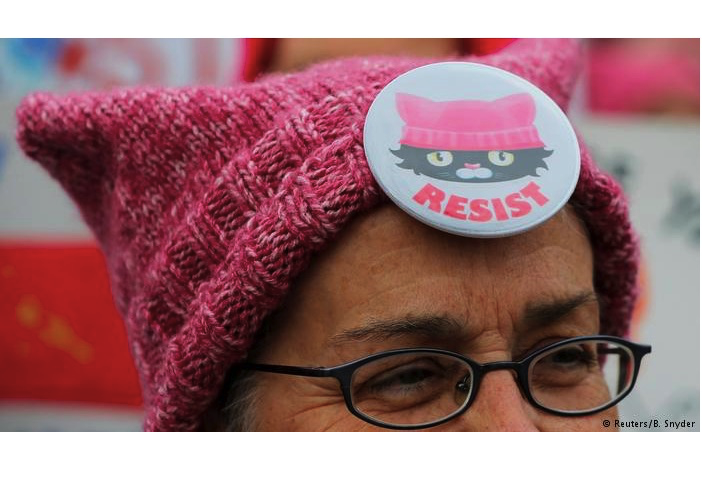
Photo from Reuters. For other photos, see CNN coverage

“We will make our message heard at the polls this fall,” Emily Patton, a rally organizer, told thousands of demonstrators at the Reflecting Pool on Washington’s National Mall. “That is why we are urging people to register to vote today.”

Thousands of people gathered in Chicago’s Grant Park. Fawzia Mirza drew cheers from the crowd as she kicked off the event with a reference to the government shutdown, which began hours earlier.

(article continued in right column)

Questions for this article

Do women have a special role to play in the peace movement?

The post-election fightback for human rights, is it gathering force in the USA?

(article continued from left column)

“When the government shuts down, women still march,” she said, adding that the event was about channeling women’s energy and “putting that power in the polls.”

Also high on the list of complaints with the US president are multiple allegations of predatory sexual behavior at a time when there is a growing backlash against such behavior, as illustrated by the growing social media phenomena known as #MeToo and #TimesUp.

Hollywood actors Eva Longoria, Natalie Portman, Viola Davis, Alfre Woodard, Scarlett Johansson, Constance Wu, Adam Scott and Rob Reiner addressed a crowd of hundreds of thousands in Los Angeles.

Longoria told marchers that their presence mattered, “especially when those in power seem to have turned their backs on reason and justice.”

Jane Fonda joined the march in Park City, Utah, where the annual Sundance Film Festival is taking place.

Hillary Clinton tweeted that the marches around the US and the world were “a testament to the power and resilience of women everywhere.”

Trump tweeted later in the day that it was a “perfect day” for women to march to celebrate the “economic success and wealth creation” that’s happened during his first year in office.

Several dozen activists demonstrating in Rome in protest were joined by the Italian actress and director Asia Argento, who alleged in October she had been sexually assaulted by Hollywood producer Harvey Weinstein in the 1990s.

Argento addressed the criticism she received once she spoke up about her abuse, saying she was there to “assess the necessity of women to speak out and change things.”

Libyan activists design a peace campaign

. WOMEN’S EQUALITY .

An article from Relief Web

Women and men activists from Libyan civil society organizations met in Tunis from 12 to 15 December to continuing the process of preparing a campaign aimed at fostering the culture of peace, reconciliation and peaceful co-existence in Libya. The idea of the campaign came as a result of two conferences, the first held in late 2015 to develop the Libyan women peace agenda and the second held early 2017 to develop an action plan to implement the agenda. In the training, the participants learned about conflict analysis tools and why it is important to include women in the peace process for the global peace and security. They also learnt lobby and advocacy skills to present the United Nations Security Council Resolution 1325 on Women, Peace and Security (UNSCR 1325) to Libyan people over the course of the campaign.


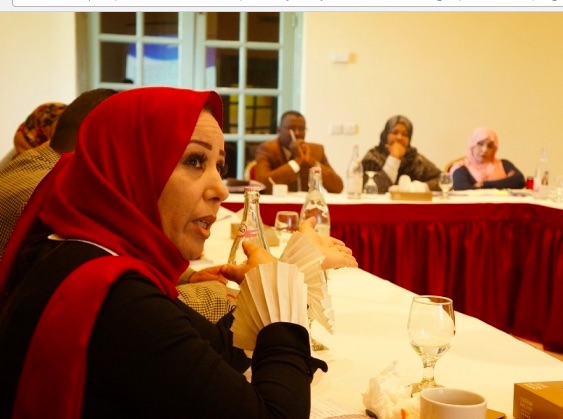
A Participant talks about UN Security Council Resolution 1325 on Women, Peace and Security. © UNDP

During the workshop, organized by the United Nations Development Programme (UNDP) in partnership with the United Nations Support Mission in Libya (UNSMIL), the seven designated focal points for Tripoli, Benghazi, Misrata, Obari, Sebha, Albaida and Zawia, and their team members gained a better understanding of the UNSCR 1325 and became well versed on the best ways of communicating about it.

(Article continued in right column)

Question for this article:

UN Resolution 1325, does it make a difference?

(Article continued from the left column.)

“I am now better prepared to start the campaign in my hometown. This workshop has allowed me to develop my presentation and communication skills. It has also deepened my understanding of the objectives and means of implementing the UNSCR 1325”, said Ms. Leila Bousif from Benghazi, President of Aoun organization for Human Rights.

The participants also discussed the role of women in peaceful coexistence since the campaign, called “Peace Libya,” intends to raise women awareness of the principles of peace and community cohesion.

“Libyan women are not very active in achieving peace, but they always leaning towards it. There won’t be stability in Libya without women`s participation. Although they are paying a high price because of the war, they must play a more active and positive role to end it,” added Ms. Bousif.

“Peace Libya” campaign will be launched next year with this core message: “promotion of peaceful coexistence is the responsibility of every Libyan citizen.”

“Knowing how to transmit the messages of the campaign to local communities is a very important mater. Libya is a diverse country. At the end of the training, I felt happy because I learned new skills to communicate with people from diverse cultural background,” said Rabha Farcy.

During the training, some participants pointed out that exposing women to the UNSCR 1325 can encourage many of them to play a more active role in peace building in Libya.

“As part of the Peace Libya campaign and based on the skills I have gained in this training, I will try to explain the UNSCR 1325 to as many women as possible when I head back to Libya. Participation in the peacebuilding process is not exclusive to men. Women should also make their voices heard,” said Ms. Asia Shwihdi from Misrata.

The training was organized as part of the project ‘Advancing Libyan Women’s Participation During the Transition.’ Known as AMEL project, it aims to strengthen the role of Libyan women in the political transition.

Education unions join in the global call to end school-related gender-based violence

. . WOMEN’S EQUALITY . .

An article from Education International

On the occasion of the 16 Days of Activism to End Violence 2017, the Global Working Group to End School-Related Gender-Based Violence, which Education International is part of, called to action for development actors, donors and governments, outlining necessary key steps towards ending this scourge.


Teachers are central to any effective response to school-related gender-based violence

The call to action is available here. Excerpts follow.

School-Related Gender-Based Violence (SRGBV) is a phenomenon that affects millions of children, teachers and education personnel, as well as their families and communities. It occurs in all countries of the world. Young people have different experiences of SRGBV depending on their sex, their gender identity, their country and context. SRGBV occurs as a result of gender norms and stereotypes, and is enforced by unequal power dynamics. Inequitable gendered practices are “performed” in schools through policies, pedagogies and curriculum, and through everyday relationships between and among students and teachers that establish a ‘gender regime’.

Schools are places of learning and growth, but can also often become unsafe spaces, where students, both girls and boys, can be victims and perpetrators of violence. Too often, teachers are viewed as part of the problem with regard to violence be it for administering corporal punishment or demanding sex in exchange for grades, for example. At the same time, schools are also places of work in which teachers and education support personnel can be both victims and perpetrators of violence.

Several studies have found that teacher training establishments do not necessarily equip teachers to challenge abusive behaviour and attitudes about violence against women and children. While there is limited data on the impact of SRGBV on teachers and education personnel, anecdotal evidence indicates that female teachers are particularly vulnerable to GBV, experiencing harassment and abuse at the hands of students, fellow teachers, school management, in teacher training institutions and systems of administration.

(article continued in right column)

Click here for the version in Spanish of this article, or click here for the version in French)

Question related to this article:

Protecting women and girls against violence, Is progress being made?

What is the contribution of trade unions to the culture of peace?

(article continued from left column)

Educators also witness discrimination, violence and abuse, which reinforces their vulnerability at school and at home. This poses a challenge, because violence is never excusable and teachers must uphold the highest standards of ethics and care. However, knowing that teachers too may be victims and understanding how this manifests can enable educational systems to provide informed support to teachers, so that they in turn can provide the best possible support and help for students and act as agents for positive change.

Globally, teachers must be valued as the most important education resource globally, who have a crucial role to play in ending SRGBV. Initiatives addressing SRGBV necessarily must involve teachers – not only in terms of enabling them to perform their duties of providing quality education to their students and promoting values of gender equality, non- violence, child rights and equity, but also by creating safe spaces for them to work in. It is imperative, therefore, to take a broader perspective on the role of teachers – as change agents and as professionals within the education system. Skills and capacity development must be combined with efforts to create an enabling environment where teachers can fulfill their duties and exercise their rights.

In recognition of the critical role teachers play in ending School-Related Gender-Based Violence, the Global Working group to end SRGBV calls on DEVELOPMENT ACTORS, EDUCATION UNIONS, DONORS and GOVERNMENTS to:

Recognise teachers as key influencer’s in the lives of children and in preventing school-related gender-based violence.

. . . . . . .

Adopt a systems wide approach in addressing SRGBVacross the education sector, so that teachers have a supportive enabling environment.

. . . . . . .

Work with education unions and Ministries of Education to shape policies and plans to address SRGBV.

. . . . . . .

Strengthen professionalism and accountability for SRGBV in the teaching profession.

. . . . . . .

Provide teachers with the skills and tools to address SRGBV.

. . . . . . .

(Thank you to Janet Hudgins, the CPNN reporter for this article)

16 Days of Activism: Meet Felicity Ruby, Australia

. . WOMEN’S EQUALITY . .

An article from the Nobel Women’s Initiative

Nuclear disarmament activist. Australian activist Felicity Ruby was the first staff member and coordinator of the International Campaign to Abolish Nuclear weapons (ICAN). ICAN was awarded the 2017 Nobel Peace Prize for “for its work to draw attention to the catastrophic humanitarian consequences of any use of nuclear weapons and for its ground-breaking efforts to achieve a treaty-based prohibition of such weapons.” Felicity is now pursuing her Ph.D. at Sydney University.


Photo courtesy of Felicity Ruby

What did you feel when you heard ICAN had won the Nobel?

Joy and surprise. Coincidentally, I was dining with Dave Sweeney, an ICAN board member, and we were quickly joined by Dimity Hawkins, the driving force behind getting ICAN off the ground. We made so much noise! And called rooms of people in other countries to make even more noise!

How did ICAN begin?

The Medical Association for the Prevention of War, the Australian chapter of the International Physicians for the Prevention of Nuclear Warfare (IPPNW) drove ICAN’s beginnings. The idea was to reinvigorate the anti-nuclear movement, which had decades of incredible work behind it, but needed a new umbrella to unite efforts and a new approach to bring younger generations into the debate.

We secured IPPNW’s support and funding from the Poola Foundation, and began a global effort to agitate for nuclear disarmament, with new slogans, visuals, demands, alliances, audiences and strategies.

How was this new approach to disarmament different? Was it influenced by the International Campaign to Ban Landmines, which won the Nobel Peace Prize in 1997?

We were in many respects saying ‘lets do a landmines effort on nuclear weapons.’ How? By building a new, enduring, intelligent and strategic NGO coalition united around a simple demand: a Nuclear Weapons Convention – that is, a proposed multilateral treaty to outlaw nuclear weapons. Spearheaded by the medical professionals, who emphasized the very real impact of radiation and nuclear militarism on human health, we brought in networks, constituencies and professionals from around the globe.

How did you help build ICAN into a mass movement?

Understandably, the anti-nuclear movement had a fairly chronic humour deficiency. For me the real magic sauce was our determination to stigmatise nuclear weapons using humour, hope and horror in fairly equal quantities. We also organized global days of action, held awareness-raising events, shared the testimonies of survivors from Hiroshima and Nagasaki and engaged in advocacy at the United Nations and in national parliaments.

(Article continued in right column)

Question for this article

Do women have a special role to play in the peace movement?

(Article continued from left column)

It was important that ICAN was an invitation to an exciting new project, not an instruction. There was freedom for groups to use the disarmament education materials we created in their own ways. The message that change is possible was carried in the very name of the campaign, which projects the distinct and very likely possibility that human beings can eliminate nuclear war and evolve past the social behaviour, economic habit and political practice of nuclear violence.​

​You’ve spent a great deal of your professional life in a variety of disarmament efforts. What specifically drew you to this issue?

It’s a no brainer. The arms industry absorbs the very resources we need to address all of the world’s environmental, social and economic problems. The choice is between weapons that kill and mutilate and a decent, just society.

You’ve long advocated a specifically feminist view of disarmament.

Gender analysis provides some important tools that explain why weapons are valued, why states seek and keep them, and why leaders resort to the use of force to obtain policy objectives. Possessing and brandishing an extraordinarily destructive capacity is a form of dominance associated with masculine warriors (nuclear states are sometimes referred to as the “big boys”) and is more highly valued than feminine-associated disarmament, cooperation, and diplomacy.

The association of weapons with masculinity, power, prestige, and technical prowess has a direct effect on policy decisions. It remains a hurdle on the road to disarmament and nonproliferation – even though the idea that security can be achieved through weaponized strength clearly has not worked.

Last July, declaring that “nuclear weapons pose a constant threat to humanity and to life on Earth,” 122 nations – though not nuclear states — adopted the UN Treaty on the Prohibition of Nuclear Weapons. Does this mean that the debate is shifting?

The UN Treaty was a real moment of triumph. A large group of countries stood up and defied the nuclear weapons states. This is especially important at a time when escalating tensions around North Korea’s nuclear weapons make the danger even more apparent. We need to turn nuclear weapons to rust before they turn the earth to dust.

When you look to the future, what gives you hope?

The enduring courage of whistleblowers and activists, the enduring courage of activists standing up and organizing keeps my hope alive. So does spending time in nature. I now work in the field of technology and I’m inspired by those creating tools to put technology in the hands of people, not vice versa. I’m also working on my PhD dissertation, which focuses on social movements and am constantly inspired by these efforts to resist injustice.

I would tell activists keep going – but look after yourself, too. Activism should be joyful, and if you’re burnt out, you’re not helping any movement grow.

I truly believe that humanity can drag itself from the pit of war, racism and discrimination. Violence is not inevitable; it is a learned behaviour, from which we can and will – and must – evolve.

(Thank you to Janet Hudgins, the CPNN reporter for this article.)

16 Days of Activism: Meet Rasha Jarhum, Yemen

. . WOMEN’S EQUALITY . .

An article from Nobel Women’s Initiative

Human rights activist. Rasha Jarhum is a Yemeni activist currently based in Geneva. She is a founder of the Peace Track Initiative, established to create a space for the contributions of women, youth and civil society organizations to peace processes.

Your mother, Hooria Mashhour, is a longtime activist; after the 2011 uprising in Yemen, she became the country’s first Human Rights Minister. Is it fair to say that you were raised in the struggle?

My mother was a fierce advocate for women’s rights. She served in the Women National Committee for almost a decade, and after the uprising began was the first government official to quit her position in protest of the vicious force used against peaceful protesters. Later, she was selected as spokesperson of the revolution forces council – the first time in Yemeni history that a woman spoke for a political movement. I was privileged to have her as my mentor. Since I was a child, I joined her in workshops and campaigns – she is the reason I became an activist. We have our political disagreements, and I love that she has never tried to pressure me to change my position.

You also learned from your mother that activism can be costly.

That’s something my whole family understands. My husband’s father, who was the first to sue Yemen’s former president Ali Abdullah Saleh for embezzling state money, was assassinated. In the current war, which began in 2014, we lost family members and property and were threatened and followed. My mother’s name was put on a list of wanted infidels, and armed men appeared at her office. She left to seek political asylum in Germany.

Why did you also leave Yemen?

After the 2011 uprising, when President Saleh stepped down, I believed that we would be able to build a modern civil state in Yemen. As part of the UN, I worked on a programme to mobilize people, including women, to vote. I wanted to make Yemenis taste the future of democracy.

But I’d lived through two devastating earlier wars, in 1986 in South Yemen and the 1994 war between North and South, and I had two young sons. During the uprising, we witnessed armed conflict in Sana’a, and out of fear for our children that the conflict would escalate, my husband and I began seeking opportunities outside the country. In 2012, he got a job offer in Lebanon, and we went to Beirut for five years. From there, I continued to support civil society organizations remotely, and worked with Oxfam on the Syrian Refugee Crisis and Gender Justice Programme. When the 2014 war in Yemen began, I knew it would be long and ugly.

(Article continued in right column)

Question for this article

Do women have a special role to play in the peace movement?

(Article continued from left column)

What’s the purpose of the Peace Track Initiative?

The Initiative works towards localizing peace processes and insuring inclusiveness, with an underlying premise that those directly affected by war are those with the greatest stake in peacebuilding. It has two components: one that focuses on Yemen, and the other on the whole Middle East and North Africa region. In Yemen, I support women-led organizations at the community level and women’s groups in peacebuilding activities. So much of what these women do is invisible to the world.

What are local women doing in promote peace in Yemen? Why doesn’t the international community hear more about it?

Historically, the situation for women in Yemen was bad. Women had no freedom to go to work, travel, even get married. Legislative, institutional and societal norms all hindered women. But women led the revolution in 2011, and today, Yemeni women are again on the frontlines. In besieged areas, women walk for miles to bring lifesaving items to their families, mobilize relief convoys, smuggle medicine to hospitals. It is estimated that one-third of fighters in Yemen are children, and women are addressing the issue of child recruitment. Women are working on complicated issues such as releasing detainees, combating terrorism through social cohesion work and the de-radicalization of youth. Women are working to revive the economy through collective saving groups, farming and social entrepreneurship.

When women are involved in peace processes, we focus on responsibility-sharing rather than power-sharing. The participation of women in national dialogue in 2011 led to the creation of one of the strongest rights and freedom’s packages in Yemeni history.

But the humanitarian agencies working in Yemen portray women only as passive victims. The stories of their resilience and their leadership do not get reported. Part of the problem is that local women may be working as individuals or in coalitions that are not formally registered, and thus deprived of funding opportunities. In addition, many Yemeni women do not speak English.

On December 4, former president Saleh was killed, and the situation in Yemen seems to have grown even worse.

For years, Yemen was the worst country for women to live in. With this war, our humanitarian crisis increased. We now have a million pregnant women at risk of malnutrition and around two million women and girls at risk of gender-based violence, including rape.

But when you hit rock bottom, there is only one way to move: up. I believe that a real, sustainable and inclusive peace can be achieved in Yemen. And I think the solution is really in the hands of women.

(Thank you to Janet Hudgins, the CPNN reporter for this article)