Category Archives: WOMEN’S EQUALITY

San Luis Potosi, Mexico: Teachers of the Municipal Educational System Trained against Gender Violence

. . WOMEN’S EQUALITY . .

An article from Gobierno muncipal de San Luis Potosi

– Within the framework of the Campaign for the Elimination of Violence against Women “Paint the world orange 2020”

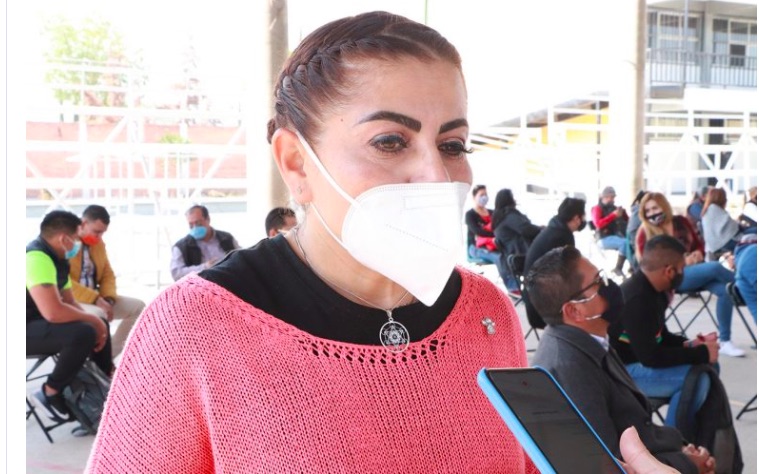
In the framework of the Declaration of Gender Alert Against Women (DAVGM), and continuing the commitment to educate and form a vision of the world based on values ​​and principles for human rights, the Directorate of the Municipal Education Department offered training to its teaching staff for the elimination of violence against women.


Training workshops and conferences, both face-to-face and digital, were carried out for 16 consecutive days for all personnel in the educational system managed by the City Council.

(Click here for the original article in Spanish.)

Questions related to this article:

Protecting women and girls against violence, Is progress being made?

Is there progress towards a culture of peace in Mexico?

The head of Municipal Education, Azalea Martínez Navarro, explained that the commitment of the Capital Government is to articulate actions that promote healthy and peaceful coexistence, through strategies that help raise awareness and reduce violence.

“For more than 15 days, we worked to prevent and eradicate violence against women, where for the first time the entire teaching staff, as well as the directors of each educational entity, joined in raising the voice of no more violence against women and girls, working for a culture of peace, for equal conditions and for students to have hope for the future ”.

The official thanked all the educational staff for assuming this commitment, facing the challenges so that all girls and boys can live a life free of violence.

The closing event was also attended by the head of the Women’s Instance, Sofía Córdova Nava; the Executive Secretary of the Municipal System for the Comprehensive Protection of Girls, Boys and Adolescents – SIMPINNA -, Jesús Hernández Jiménez; as well as the Municipal Director of Social Prevention of Violence and Crime with Citizen Participation, Jassán Nieto Guerrero.

Mexico: SSPC meets with 217 Networks of Women Peacebuilders

. . WOMEN’S EQUALITY . .

An article from La Jornada (translation by CPNN)

The Secretariat for Security and Citizen Protection (SSPC) held a meeting with 217 members of the Networks of Women Peace Builders (MUCPAZ), in order to inform them about the progress in the commitment acquired with the United Nations (UN), in the fight against discrimination and gender violence.


Members of the MUCPAZ Peacebuilding Women Network during a meeting in Tuxtla Gutiérrez. Photo taken from the Twitter account @nadgasman

(Click here for the original article in Spanish.)

Questions related to this article:

Do women have a special role to play in the peace movement?

Is there progress towards a culture of peace in Mexico?

The meeting was led by the head of the National Center for Crime Prevention and Citizen Participation (CNPDyPC), Luis García López Guerrero, who explained to the attendees the strategy to combat family violence and promote a culture of peace.

“The comprehensive strategy to prevent and address family and gender violence consists of five components: Networks of Peacebuilders Women (MUCPAZ Networks); sensitization; care, support and channeling; training and job placement; and improvement and appropriation of areas and / or community spaces with a gender perspective, ”the official explained.

Currently, a total of 6,510 women are members of the MUCPAZ, forming collaborative work groups with public and citizen institutions to multiply peace processes at the municipal and local level.

The representative of UN Women in Mexico, Belén Sanz Luque, who participated in this virtual meeting, also recognized the importance of the Women Peacebuilders Program.

Sinaloa, Mexico: III International Congress on women and the culture of peace

. . WOMEN’S EQUALITY . .

An article from Debate (translation by CPNN)

After two days of work, the III International Congress “Culture of peace by women: various worldviews; women and men for positive masculinities” was concluded in Culiacán with the participation of prominent specialists in these issues.


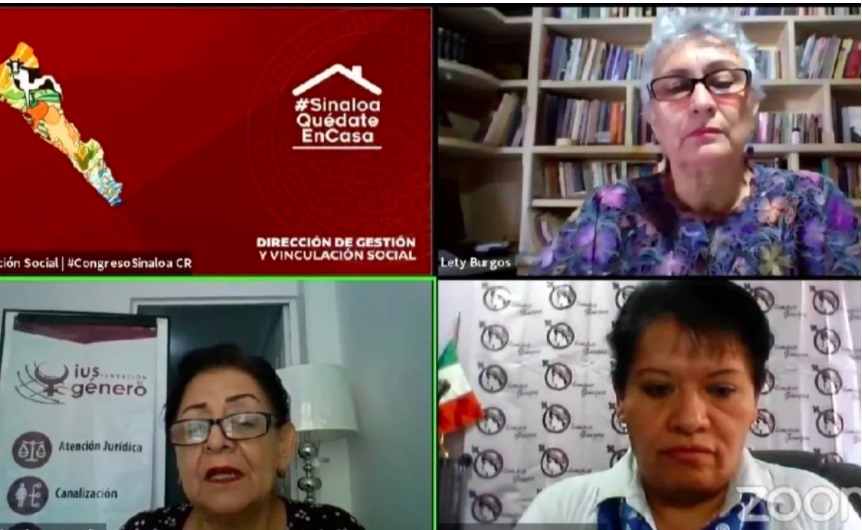
Image of the congress participants via Zoom.

(Click here for the original article in Spanish.)

Questions related to this article:

Do women have a special role to play in the peace movement?

Prospects for progress in women’s equality, what are the short and long term prospects?

The event was organized by the Sinaloa State Congress, the Autonomous University of the West and the civil association Building Spaces for Peace as part of the International Day for the Elimination of Violence Against Women and the 16 days of activism.

Some of the topics that were developed on November 27 and 28, were health and social work with pregnant women, victims of family violence, the evaluation of Gender Alerts, Culture of Peace, Human rights of women, bullying and sexual violence.

On the second and last day of activities, the speakers were Leticia Burgos, coordinator of the National Alert Network; Argentina Casanova, representative of the Social and Gender Observatory, and María Luisa Sosa de la Torre, of the National Network for Effective Parity and the National Network of Political Rights Trainers.

I am Generation Equality: Ixchel Lucas, youth advocate for girls’ leadership

. WOMEN’S EQUALITY .

An article from UN Women

I am Generation Equality because…

Adolescent and young girls should have the space and opportunity to lead without fear of discrimination or violence.

I was selected by my peers to represent my class and organize students when I was seven. I liked having the opportunity to express my opinion and to participate in social and cultural events. Over time, I started raising awareness about the challenges that adolescent and young girls face in Guatemala, where I am from. More of our voices should be heard.


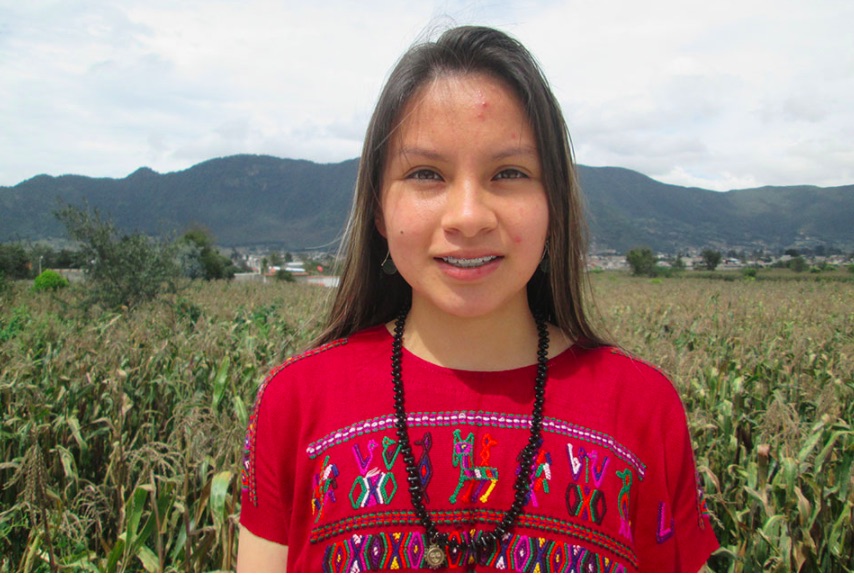
Ixchel Lucas. Photo: Las Niñas Lideran
Stepping up during the global pandemic

Even before COVID-19 hit, the situation was difficult for girls and women. In many places, women are still not allowed to speak up. Food is served first to boys and men, and the best pieces of food are reserved for them.

The challenges young girls face in Guatemala have worsened during COVID-19. Lack of access to the Internet, smart phones and computers is hampering their access to education. Additionally, girls are facing increased domestic violence and have been forced to continue living with their abusers, and support services are limited. As a result, we are seeing an increase in teenage pregnancies and maternal and child mortality – particularly in the rural areas, where there is a marked lack of access to proper healthcare.

(continued in right column)

Questions for this article
 
Does the UN advance equality for women?

Prospects for progress in women’s equality, what are the short and long term prospects?

(continued from left column)

I had the opportunity to raise these issues during a high-level meeting  of the UN General Assembly on behalf of other young girls. Governments should invest more in supporting us by increasing healthcare services, enhancing services to survivors of violence and increasing access to education.

What keeps me going is that I have seen that [when given a platform] we can achieve.

I am part of the “Las Niñas Lideran” (Girls Lead) organization and following our advocacy work a few years ago, our municipality, Concepción Chiquirichapa adopted a new policy covering education, health, protection, participation and culture. The municipality held education fairs with multiple schools, providing children and adolescents with information on HIV, teenage pregnancy, girls’ leadership and more. There were also numerous cultural activities led by adolescent girls, [to raise awareness of] and mitigate the risk of rising suicide among adolescent girls. .

Society has a lot to learn from adolescent and young girls, as we see problems through very different lens.

* * * * *

Ixchel María José Lucas Adolfo, 21, is the Training Coordinator at Las Niñas Lideran in Guatemala and a youth leader in the Action Coalition on Gender-Based Violence. She is also currently studying Physiotherapy. The Action Coalitions are global, innovative partnerships with governments, civil society, international organizations, and the private sector, convened in the context of the Generation Equality Forum. They aim to catalyze collective action, drive increased public and private investment, and deliver game-changing results for women and girls everywhere..

Africa Beijing+25 Youth Baraza: Fem-Foster, Enable, Mobilize

. WOMEN’S EQUALITY .

Video on Youtube

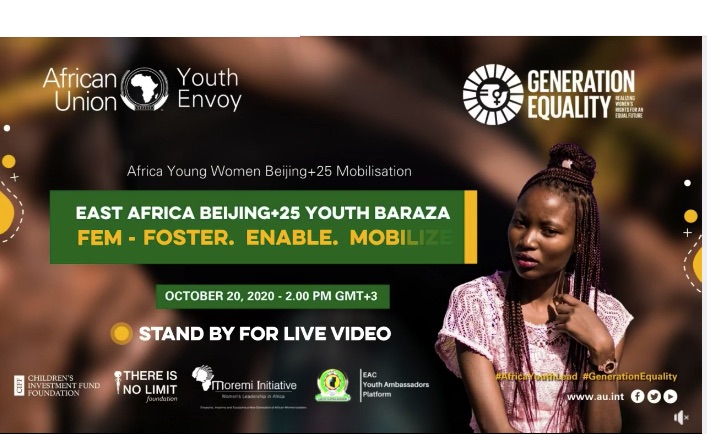
The Office of the Envoy of the African Union for Youth in collaboration with the Women, Gender and Development Directorate has organized five regional events of the “Beijing + 25 Mobilization of Young African Women” co-organized with the African Women Leaders Network (AWLN) Young Women Leaders Caucus and the International Youth Task Force for Beijing + 25.

The events take place by internet.

Here are some notes from the event for East Africa that took place on October 20. For details, see the video link above.

The closing remarks were moderated by Dr. Chiamaka Nwachukwu from the African Union Office of the Youth Envoy. She introduced reports from the following breakout groups.

Ms Mohamed reported from the group on economic rights and justice.

(Article continued in right column)

Question for this article

Can the women of Africa lead the continent to peace?

(Article continued from left column)

Ms Joyce Nwati reported from the group on sexual reproductive health and rights.

Ms Joanita B reported from the group on feminist action for climate justice.

Ms Sodfa Daaji reported from the group on technology and innovation for feminist action.

Ms Steff Musho reported from the feminist movement and leadership group.

Ms Lusunga Kalanga reported from the gender-based violence group

Ms Irena Kinabo reported from the group that addressed youth silencing the gun.

Ms Gloria Mangi, speaking on behalf of the African Union Youth Task Force and the Moremi Initiative for Leadership Development and Empowerment (MILEAD) addressed the development of young women leadership in Africa.

The event for West Africa was scheduled for October 16. Click here for a video from the event.

The event for Southern Africa took place on Friday, October 23. Here is a video of the closing remarks.

The event for Central Africa was scheduled to take place on October 27 at 14H00 EAT (GMT+3)

The event for Northern Africa was scheduled for October 30.

Mairo Al-Makura African First Ladies Peace Mission is Serious Business

. WOMEN’S EQUALITY .

An article from This Day Live

Inspired by the UN World’s Women Conference 1995, popularly known as the Beijing Conference, the African First Ladies Peace Mission (AFLPM) is designed as an umbrella body of wives of African Heads of State/Presidents and Government to play a supportive role to the African Union, regional organisations, and national governments in fostering peace and reduce conflicts and their effects on the African continent. In this interview with Olaoluwakitan Babatunde, Special Assistant to the President on AFLPM and former First Lady of Nasarawa State, Dr. Mairo Al-Makura, who is now one in office, dissects the Mission’s journey so far and outlines efforts to rave up the organisation to better deliver on its mandate. Excerpts below:

You are now a year in office as the Special Assistant to President Muhammadu Buhari on African First Ladies Peace Mission where the First Lady, Mrs. Aisha Buhari is the Acting President. How has it being, helping the First Lady run the affairs of the Mission?
It has been a tasking, but great experience. It is a kind of thing I am cut out for. Any endeavour that will promote peace and advance the welfare of women and children is my natural call. I must thank President Muhammadu Buhari for seeing the prospects the organisation holds for peace in Africa and also the First Lady, Mrs. Aisha Buhari, for deeming me fit to assist in driving the Mission. As you rightly mentioned, the First Lady is the Acting President of the Mission and I am greatly motivated by her passion for peace and success of the AFLPM.

The AFLPM has been in existence since the past 23 years, yet not many appear to know much about the organisation and its mission. At most, it is since as the pet project of successive Nigerian First Ladies?

(Laughs) No, while the passion of our First Ladies towards the African First Ladies Peace Mission, AFLPM is not in doubt, while AFLPM is headquartered in Abuja,; and whereas Mrs. Maryam Abacha, was the pioneer President of the AFLPM, it is a truly pan-African organisation that has equally been headed by the First Ladies of various other African countries. I’m talking about the likes of Excellencies Madame Constancia Mangue De-Obiang of Equitorial Guinea, Madame Antoinette Sassou Nguesso of Congo Brazzaville, and Mrs. Chantal Campaore. And they have made their great contributions.

Meanwhile, as you rightly pointed out, the AFLPM is 23 years old as it was inaugurated in 1997. It was inspired by the 4th World Conference on Women, better known as the 1995 Beijing Conference. Recall that one of the affirmations was the equal rights and inherent human dignity of women and men as enshrined in the Charter of the United Nations, the Universal Declaration of Human Rights and other international human rights instruments, in particular the Convention on the Elimination of All Forms of Discrimination against Women and the Convention on the Rights of the Child, as well as the Declaration on the Elimination of Violence against Women.

The Beijing declaration equally recognises that local, national, regional and global peace is attainable and is inextricably linked with women as fundamental force for leadership, conflict resolution and the promotion of lasting peace.

Now, if you also recall clearly, Africa has suffered an unfair share of the global conflicts and instability. In particular, we had full-blown wars and all manner of conflicts in Africa around 1995. While some African countries were enmeshed in armed conflicts, some were just emerging from it, while several others were sliding into conflicts. Talk about the Burundi civil war, Rwanda civil war, Sierra Leone civil war, Liberia civil war, conflicts in Somali, Sudan, the Eritrea-Ethiopian border conflicts, the Republic of Congo, the Congo DR, and you name them. So, the African First Ladies thought it wise to come up with an international NGO, a rallying organisation to begin to mobilise both government and non-governmental resources to promote the culture of peace, to prevent conflicts, and to reduce violence and mitigate their effects on Africans, particularly the women and children.

You know, when two elephants fight, it is the grass, in this case, the women, girls, and children that bear the brunt. It is the women and children that suffer the hunger and starvation during conflicts. It is the women that are abducted, abused, raped and killed. It is our husbands and sons that are killed, leaving us empty-handed like the hen, which has been rendered childless by the kites and hawks. So, whichever you look at it, we are at the receiving end. So, our First Ladies knew they wouldn’t sit by and watch these things continue.

The AFLPM equally believes that one of the best ways of preventing conflicts is by promoting democratic principles, cultures, and institutions as well as popular participation and good governance. For instance, if elections are free and fair, if governments across Africa respect the rule of law, if they respect the separation of powers and checks and balances, if they respect human rights, and if there is less political persecution, conflicts and instability on the continent will drop drastically.

Another major objective of the AFLPM is to work hand-in-hand with appropriate international partners in promoting peace and the eradication of preventable diseases and promotion of good health in Africa.

So, these and more were the ideals that birthed the AFLPM. The African First Ladies felt they have something to contribute to advance the cause of peace and stability and by extension, development in Africa.

(Article continued in right column)

Question for this article

Can the women of Africa lead the continent to peace?

(Article continued from left column)

So, would you say that the AFLPM has truly delivered on its objectives and mandate considering that?

Indeed the AFLPM has made a lot of contributions in fostering peace on the continent, in advocacy in matters concerning the rights and protection of women, children, and the girl child from violence. The AFLPM has equally rendered support to women and children.

However, I must concede that the Mission could have made more progress but for palpable challenges, fundamental of which is resources as well as other factors such as lack of a place of our own. At 23, AFLPM is still a tenant in Abuja. These challenges have . The good news, however, is that the Acting President of AFLPM, Her Excellency, Mrs. Aisha Buhari, is currently doing a whole lot of reorganisation and repositioning to take the AFLPM a notch higher.

On her instruction, I undertook in-depth appraisal of the place to know the challenges and how best to fix them. And I am happy that we are making great progress in terms of coordination and day-to-day running of the organisation. AFLPM is not a pet project of the incumbent Acting President or any future President of the organisation. So, we are repositioning it to run more properly as an independent and international NGO.

How much of international support do you get at the moment?

We are quite aware that AFLPM can’t achieve much without international support. Since I was appointed, we have, on the directive of Her Excellency the First Lady as the Acting President of the organisation, been building the necessary international partnerships and goodwill. We are determined to make AFLPM a respected global voice and institution the world cannot ignore.

In conjunction with the Government of Nigeria, we were supposed to host a “Roundtable on Women, Peace, and Security in Africa” in New York on the margins of the 64th Session of the UN Commission on the Status of Women last March. Sadly COVID-19 struck. The theme was actually “Young Women as Ambassadors of Peace”, and the First Lady of Gambia, Mrs. Fatouma Barrow; the Assistant Secretary General and Deputy Executive Director of UN Women, Anita Bhatia; AU Special Envoy on Youth, Mme Aya Chebbi; and Nigeria Minister of Women Affairs, Dame Pauline Tallen were all supposed to feature at the event.
In fact, from United States to Canada and Europe, we are getting cooperation by development agencies and getting better connected to the global grid of hose who make peace and development happen.

In your statement on the occasion of the 2020 International Day of Rural Women, you bemoaned the effects of insurgency on women. Why?

(Cuts in) Yes, because as I said earlier, women and children bear the brunt of insurgency. Look at the Boko Haram insurgency and their splinter groups in the Lake Chad Region alone. That is talking about Nigeria, Chad, Cameroun, and Niger Republic. According to the United Nations Office for Coordination of Humanitarian Affairs, the insurgency affects more than 17 million people in the Lake Chad Region and more than 2.2 million have been displaced; most of them are women and children. In fact, children alone constitute half of the displaced. The women and children are in the eye of the storm and more than 10.8 million people are in dire need of humanitarian assistance.

As we stated on that occasion, whenever insurgents strike, women and girls suffer abduction, rape, violation, and fatality. So, you can see where we are coming from and why we want a strong global alliance to help Africa to flush insurgents from the face of the continent. Besides, in a globalised world, no one is really safe until every part of the world, Africa inclusive, is sufficiently safe.

Talking about violence against women, statistics showed that cases of rape rose during the COVID-19 lockdown?

That is quite regrettable. But the thing is that we are not resting on our oars in the fight against violence against women, be it rape, domestic violence, and by whatever name it is called. By the way, the UN Declaration on the Elimination of Violence Against Women 1993, defines violence against women as “any act of gender-based violence that results in, or is likely to result in physical, sexual or psychological harm or suffering to women, including threats of such acts, coercion or arbitrary deprivation of liberty, whether occurring in public or private life.

To mark this year’s International Day for the Elimination of Violence Against Women, we are holding a live virtual event as we join the UN Secretary – General’s campaign, UNiTE to End Violence against Women by 2030. Apart from the First Lady of Nigeria, who will be delivering the keynote address, the First Ladies of Sierra Leone, Congo Brazzaville, Gambia, and South Sudan as well as representatives of international organisations from the United Nations, African Union and ECOWAS will be speaking a the event too.

Apart from raising awareness on violence perpetuated done to women and girls, there will equally be trauma and counseling session for the victims and those who survived such violence. We are also making arrangement to support them with relief packages.

You talked about lack of permanent office earlier. How come AFLPM does not have an office it can call its own after 23 years?

It is a long story and this has greatly hampered our programmes. Mind you that we are not talking about just office spaces. If it were so, we wouldn’t be bothering ourselves. However, because AFLPM is not a jamboree. It is utilitarian in concept and that is why we equally need a permanent office that is also utilitarian in nature.

The Acting President of AFLPM, Her Excellency, Mrs. Aisha Buhari has made it one of her cardinal agenda to ensure we build one soonest. We will be reaching out to all African nations as well as captains of industry and public-spirited individuals across the continent, who believe the cause of peace and women for their support. We believe it is doable and we will do it in our time.
Côte d’Ivoire. Association and community leaders make their contribution to peace

. WOMEN’S EQUALITY .

An article from Abidjan News (translation by CPNN)

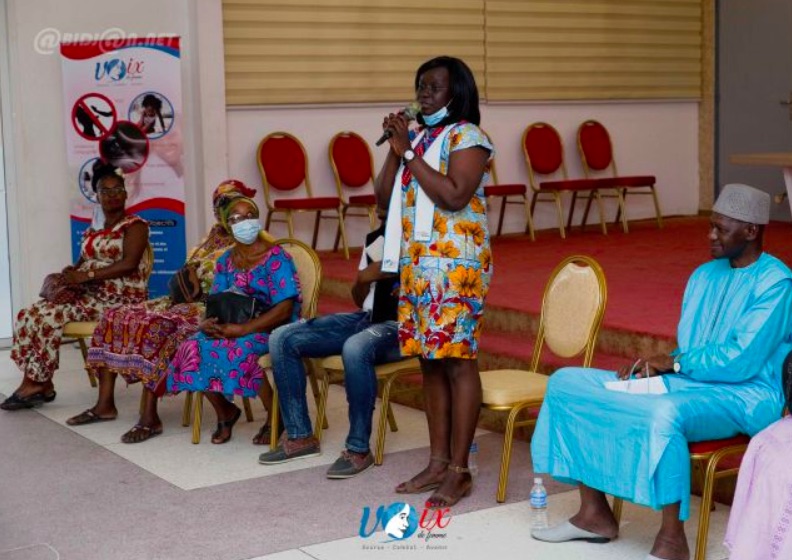
“I love my country, I participate in peace” is the slogan of the NGO “Voice of Women” for its awareness campaign in favor of peace during this election period. Through a series of tours since September 22 in the municipalities of Abidjan, Voice of Women initiated a dialogue with the populations to promote their contribution to peace. The closing stage in Koumassi on Friday, October 09, 2020 at the mayor’s office was no exception. A round table allowed the people to make their contribution to a culture of peace.

(Article continued in right column)

(Click here for the original French version)

Question for this article

Can the women of Africa lead the continent to peace?

(Article continued from left column)

Yao Akissi Cedia Christelle, president of the NGO said that the original goal of Voice of Women was to fight against violence against women and children, to build effective leadership of women and young girls in order to ensure their autonomy and development, help these women victims in the judicial and psychological process, educate and sensitize children and adolescents, educate illiterate women and create a reception center. According to President Cynthia, these objectives can only be achieved within a framework of peace, hence the need during this election period for a woman’s voice to take up her pilgrim’s staff and to go out to meet the people to talk about peace.

Mr. Koffi Wilfried Kpondou Deputy Head of the Project Commission stresses the non-political nature of the NGO. In the same vein, the sponsor Kourouma Rokia informed the audience that the Voice of Women intends to maintain this apolitical character in order to achieve its objectives.

Touré Souleymane vice president of cultural and community affairs onveyed the support of Mayor Cissé Bacongo for this initiative, which bodes well for his municipality and the whole of Côte d’Ivoire. According to Mr. Touré, his long teaching career has enabled him to know “the importance of dialogue and above all of the interest of peace and of man at the center of the debates”, he said before declaring the round table open.

Diffa, Niger: Launch of an awareness campaign to strengthen the participation of women and young people in intercommunity dialogue

. WOMEN’S EQUALITY .

An article by Mato Adamou in News a Niamey (translation by CPNN)

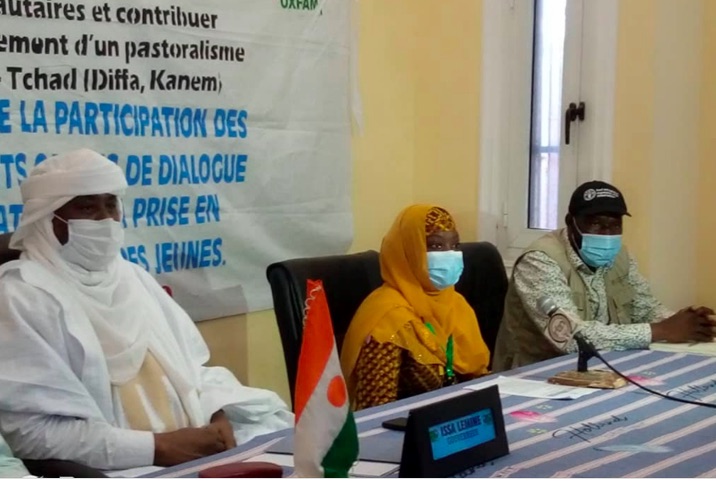
On Tuesday, September 29, 2020, there was a launching ceremony of the awareness campaign to strengthen the participation of women and young people in the various inter-community dialogue frameworks and to facilitate the consideration of their specific needs. This ceremony took place in the meeting room of the Governorate under the chairmanship of the Governor of the region Mr. Issa Lemine.

We noted on this occasion the presence of the prefect of Diffa, the Head of the Diffa office of OXFAM, the head of the FAO Sub-Office, the Head of Canton of Koumadougou, representatives of the Communes of N’Gourti, of N ‘ Guigmi, Kablewa, Toumour, Gueskérou and Bosso. Organized by the NGO OXFAM, this ceremony aims to put in place a holistic approach that supports the Emergency-Development-Peacebuilding triptych.

(Article continued in right column)

(Click here for the original French version)

Question for this article

Can the women of Africa lead the continent to peace?

(Article continued from left column)

In her speech on this occasion, the Head of the OXFAM office first thanked the participants for their massive participation in this ceremony before setting the objective of this activity. According to Hadjia Gouya Mahamane Delley, the aim is to sensitize communities on the importance of taking into account the specific needs of women and young people in community decision-making bodies. It is also about sensitizing these communities on the role of women and young people in the culture of peace, social cohesion, peaceful coexistence and non-violent conflict management. The Head of the Diffa office of OXFAM also noted the feasibility of presenting a plea to the leaders for a better representation of women and young people in community programs. Finally, she insisted on the important role of women in the management of conflicts linked to transhumance.

Launching this campaign, the Governor of Diffa first welcomed the initiative to involve women and young people in the different decision-making systems within the communities. Mr. Issa Lemine then underlined that the issue of local development is essential for good governance. It is a challenge for public authorities, local authorities and local communities. For the governor of the Diffa region, this approach is part of the participatory and in-depth analysis of the determinants of conflicts and factors of peace to strengthen regional and local consultation frameworks, with a view to facilitating peaceful access to natural and especially pastoral resources for a contribution to the consolidation of peace.

The International Network of Latin American and Caribbean Women is inaugurated

. . WOMEN’S EQUALITY . .

An article from El Mostratodor

The network seeks, from a gender perspective, to foster a culture of peace and promote regional integration.

We are “Latin American women with a deep vocation for peace, committed to the democratic struggle, social equality and human rights of women and all citizens.” Thus the International Network of Latin American and Caribbean Women (RIMLAC) presented themselves on Saturday 29, via zoom.

To date, the network has 50 members from the region.

(article continued in right column)

(Click here for the original article in Spanish)

Questions related to this article:
 
Do women have a special role to play in the peace movement?

(article continued from left column)

The group’s statement states that “in our political and professional career we have been linked to the international field, foreign relations and feminism.”

Along with highlighting the commitment to the gender equality agenda, the document underlines the interest in “socializing collaborative practices that reject traditional dualisms” and that contribute to creating trust and reaffirming a Latin American identity, fostering a culture of peace and promoting regional integration. .

Coming from Argentina, Bolivia, Brazil, Chile, Peru, Mexico, Panama, Colombia, Dominican Republic, Uruguay, Haiti, El Salvador, Paraguay, the women express in the document: “We promote policies and cultural changes that stop violence against women , guarantee sexual and reproductive rights and sexual dissidence, as well as the permanent fight against racism and social inequality “.

These objectives, say its members, “call us to work for fairer and more inclusive democracies, the full validity of human rights, a lasting peace and the strengthening of multilateralism at the regional and global levels.”

The initiative to create this Latin American network arose from the reflections of the Group of Women that develops the Permanent Forum of Foreign Policy of Chile.

International Alert Programme on Women, Peace and Security in Nigeria

. WOMEN’S EQUALITY .

An article from International Alert

In 2000, the United Nations Security Council passed Resolution 1325, which stressed the importance of the equal participation and full involvement of women in all efforts to maintain and promote peace and security. This resolution, with its four pillars of prevention, participation, protection, and peacebuilding and recovery, has become the focal point for galvanizing worldwide efforts to deal with the many challenges that women face in situations of conflict.

International Alert is implementing a programme on Women, Peace and Security in Nigeria, to support the federal government’s commitments to localising the broad goal of gender-inclusive and sustainable peace. Alert will support the Ministries of Women Affairs to develop action plans to support engagement with legislative, security and judicial actors to facilitate strategic policy-making that accounts for gender dynamics in dealing with conflict issues.

(Article continued in right column)

(Click here for the original Spanish version)

Question for this article

Can the women of Africa lead the continent to peace?

UN Resolution 1325, does it make a difference?

(Article continued from left column)

Alert will also identify, enable and support a network of women mediators who will take tangible action on peace and security issues; amplify messaging that promotes women’s participation and leadership in decision-making on peace and security; and identify male champions to influence social behaviour change towards women’s participation in peace and security mechanisms.

This will help to increase women’s effective participation in peace and security processes, peace negotiations, and conflict prevention and resolution. It will also help improve public perception on the role of women in peace and security, at all levels.

This project is currently implemented in Bauchi, Ningi, Tafawa Balewa and Itas Gadau Local Government Areas of Bauchi and Gwer West, Guma, Logo and Agatu Local Government Areas of Benue State, respectively.

The project run from July 2019 to November 2020.