Category Archives: SUSTAINABLE DEVELOPMENT

Greenpeace on COP15: A bandage for biodiversity protection

. . SUSTAINABLE DEVELOPMENT . .

An article by Gaby Flores from Greenpeace

The 15th UN Conference on Biodiversity, known as COP15, has ended. The final deal, known as the Kunming-Montreal Agreement, is being labelled historic but is just the beginning of the work needed to halt mass extinction.


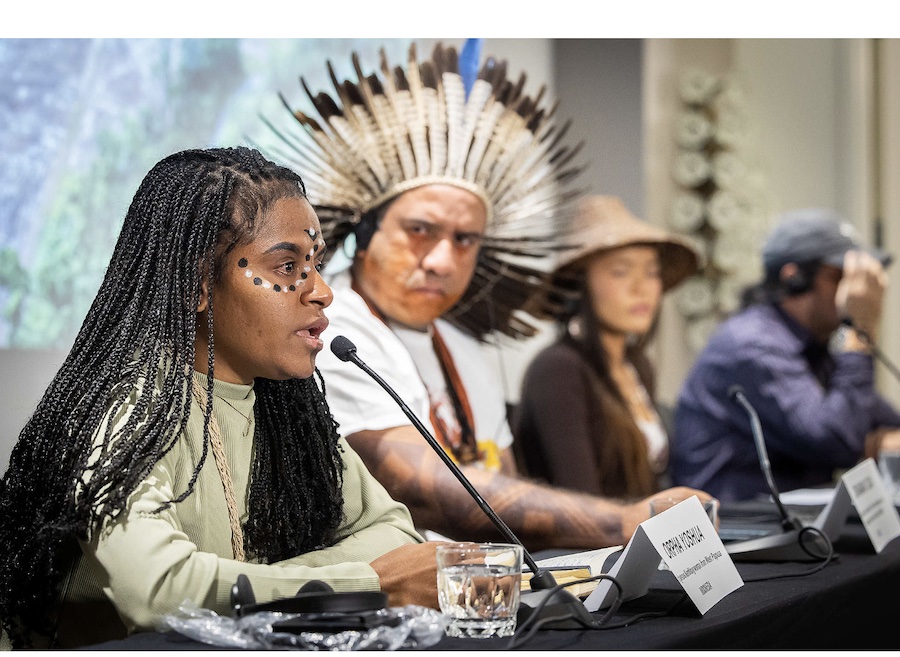
At a press conference in Montreal’s Hotel10 during COP15, global Indigenous leaders from Brazil, Canada, the Democratic Republic of Congo, Cameroon and Indonesia gathered to call for nature protection that centres Indigenous rights and shifts power from industry to Indigenous Peoples and local communities.
© Toma Iczkovits / Greenpeace

What’s good about the agreement?

The final text recognises Indigenous Peoples’ work, knowledge and practices as the most effective tool for biodiversity protection. Indigenous Peoples represent 5% of humanity but protect 80% of Earth’s biodiversity, and the language in the text is now clear: the implementation of the Kunming-Montreal deal must respect their territories, ensure their rights and their free, prior and informed consent ─  according to the UN Declaration on the rights of Indigenous Peoples ─ and their effective participation in decision making.

(article continued in right column)

Question for this article:

Indigenous peoples, Are they the true guardians of nature?

Sustainable Development Summits of States, What are the results?

(Article continued from the left column)

 In short, Indigenous-led conservation models must become the standard from now on if we are going to take real action on biodiversity.

What’s not so great?

The target to protect at least 30% of land and of seas by 2030 successfully secured a spot in the agreement but does not explicitly exclude damaging activities from protected areas. Without the crucial qualifiers, the needed goal risks remaining an empty number, with protections on paper but nowhere else.

Moreover, corporate schemes like nature-based solutions and offsets are included in the text and will allow industries seeking to profit from biodiversity to continue exploiting nature. These false solutions and greenwashing may prove to be costly mistakes. 

Finally, the often fought over question of finance is still not answered, with commitments made not yet sufficient to bridge the biodiversity finance gap. To save biodiversity, finance will not only be a question of how much, but how fast. 

What’s next for Biodiversity protection?

The Biodiversity COP15 left the most crucial work for nature protection as homework for world leaders. To start with: setting up a fund in 2023 to get money to developing countries faster as well as direct finance for Indigenous Peoples. Rights-based protections are the future of conservation and to global biodiversity protection. Additionally, vital to making 30 x 30 actually happen will be securing a historical Global Ocean Treaty at the reconvening of IGC5 in February 2023.

COP16 will convene in Türkiye in 2024, where governments will need to act fast to build upon the work done in Montreal. 

Main Recommendations of the 6th Edition of the African Forum of Territorial Managers and Training Institutes targeting Local Governments

. . SUSTAINABLE DEVELOPMENT . .

An article from United Cities and Local Governments of Africa

The 6th edition of the African Forum of Territorial Managers and Training Institutes targeting Local Governments was held over 6 days, from November 28th to December 03rd, 2022 at the Training Center of the Faculty of Medicine and Pharmacy of the Ibn Zohr University in the city of Agadir, Morocco.
The theme chosen for this edition was: “The challenge of training and capacity building of Local Elected Officials and Local Government Staff in Africa in Climate Action”.

This important annual meeting of Territorial Managers, held just one week after COP27, was organized by United Cities and Local Governments of Africa (UCLG Africa) through its African Local Government Academy (ALGA), in partnership and with the support of the European Commission, the Directorate General of Local Authorities of the Ministry of the Interior of Morocco, the Region of Souss-Massa, the Prefectural Council of Agadir Ida- Outanane, the Provincial Council of Tiznit, the Provincial Council of Taroudant, the Ibn Zohr University and the Training Center of the Faculty of Medicine and Pharmacy of Agadir, the National Agency for the Development of Oasis and Argan Zones (ANDZOA), the National Associations of Local and Regional Governments of Morocco (namely ARM, AMPCPP and AMPCC), the Ecological Transition Agency ADEME of France, the 4C-Maroc Center, the Office of the United Nations Project on Governance, Directorate of Public Institutions and Digital Governance (DIPGD) of the United Nations Department of Economic and Social Affairs (UNPOG/ DPIDG/ UN DESA), as well as the Ministry of Energy Transition, and Sustainable Development, and the Municipal Council of Agadir.

During the six days of proceedings, more than 300 participants attended the Forum from 40 countries, including 33 African countries. These delegations took part in and contributed to the work of:

– An official opening ceremony, under the chairmanship of the Honorable Mr. Karim ACHENGLI, President of the Souss-Massa Region Council and the Honorable Mrs. Jeannette NYIRAMASENGESHO, President of the Rwandan Association of Local Authorities (RALGA) of Rwanda , President of the Ngororero District Council of the Western Province, President of the Association of Local Governments of East Africa, having represented the Honorable Mrs. Fatimetou ABDEL MALICK, President of UCLG Africa, President of the Permanent Gender Committee of UCLG, President of the Region of Nouakchott, Mauritania;

– Four (4) Plenary Sessions on issues related to Climate Action;
– Eight (8) parallel workshops on climate challenges and capacity building challenges;
– Three (3) Master classes having focused on the concepts and approaches of Climate Action, Decentralized Cooperation and e-Learning;
– One (1) Training of Trainers Seminar on Climate Action for the benefit of 26 beneficiaries from different African countries, within the framework of the Partnership Agreement with ADEME;
– Three (3) field visits.
– South-South partnership and Decentralized Cooperation agreements, discussed and signed;
– A closing, recognition, and certification ceremony;
– A tree planting by the African Delegations.

The discussions held during the proceedings focused on the challenges related to climate change for local governments, in particular:

– How can we create an enabling environment for the Localization and Territorialization of Climate Action?
– What has COP27 generated for Local Governments?
– How to enable Local Governments to benefit from Climate Finance?
– What are the challenges in terms of education, training, and capacity building?
– How to promote decentralized multi-actor cooperation that can be at the service of climate action?…

The takeaway from these debates is that we find ourselves in a turbulent context as well as a deep world division generating crises; that only 10% of climate finance benefits to the local and territorial levels; that the challenges in terms of training and capacity building are enormous and that it is time to act to enable Local Elected Officials and their civil servants s to take ownership of Climate Action, and integrate it into their Governance and planning.

The proceedings and contributions led to the following 20 main recommendations:

1) Need to increase public funding in terms of volume and as a share of adaptation and resilience funding (Need to mobilize the 140 to 300 billion US dollars needed annually by 2030).

2) Need to strengthen and make more coherent the architecture of concessional climate finance, which includes the Green Climate Fund, the Global Environment Facility, the Climate Investment Funds, the Adaptation Fund as well as the concessional windows of the multilateral development banks, as well as the Global Infrastructure Fund.

3) Need to become aware of and know how to take advantage of the many opportunities for financing climate action.

4) Need to increase local climate finance for localized climate action, to better understand the role of the local and territorial dimension of climate action in Africa, if we are to thrive as a community of nations, with local governments as a driver of sustainable development.

5) Need to localize and territorialize NDCs, because everything is done in cities; concrete actions must be taken at this level.

6) Need to raise awareness and territorialize political actions related to climate change and involve women and young people in Climate Action.

7) Need to give more space and importance to cities in the context of the localization of the Climate Agenda and put in place mechanisms to facilitate access to international climate finance, because only 10 % of climate finance is found locally.

8) The diversification of energy sources (highlighted by COP27, starting from the importance of the mix of clean energies).

9) Need to take Africa to the next level and provide incentives that leverage innovations already underway in the region that will have greater impact (e.g. acting for the informal sector and encouraging youth participation).

10) Need to prioritize financial innovation (80% of climate finance in Africa comes from public resources) and therefore there is an urgent need to increase private sector finance in climate action.

11) A paradigm shift is needed in Africa’s climate narrative; the continent’s current narrative must shift from projecting responsibility and risk to projecting investment and opportunity.

(article continued in right column)

Question for this article:

Despite the vested interests of companies and governments, Can we make progress toward sustainable development?

(Article continued from the left column)

12) Need to transform Nationally Determined Contributions (NDCs) and Commitments into clear investment plans with a clear return on investment in the different areas prioritized in the NDCs.

13) The urgency of harnessing empirical evidence on key gaps and opportunities to be filled to scale up these successes and create targeted incentives that will need to be applied to enable them to progress.

14) Need to increase support for holistic capacity development assessments at the national, subnational, and local levels.

15) Need to apply a multi-stakeholder approach by involving a wide range of actors and stakeholders, at all levels of governance (national, subnational, and local).

16) Develop long-term capacity building interventions.

17) Need to strengthen international, regional and national knowledge networks, platforms, communities of practice as well as peer-to-peer learning and support.

18) Developed countries should ensure that more climate finance is available for stand-alone capacity building programs at the national, subnational, and local levels and to increase coordination among entity capacity building service providers of developed and developing countries.

19) Need to invest in conflict prevention through a supportive and facilitating environment.

20) Capacity building for the promotion of the Culture of Peace and the art of negotiation.

“We attach importance within UCLG Africa to the efforts of our Academy: ALGA. We will try to follow up on the implementation of all the recommendations that will come out of this important meeting”, declared, through a video intervention, the President of UCLG Africa, the Honorable Mrs. Fatimetou Abdel Malick.
The Forum also served as a framework for the holding of the meetings of three Professional Networks of UCLG Africa, namely:

– The meeting of the Network of Human Resources Directors (Africa Local RHNet);
– The African Network Meeting Permanent Secretaries/Executive Directors of National and Regional Associations of Local Governments;
– The meeting of the African Network of Territorial Directors in charge of Decentralized Cooperation and International Action of Territorial Governments (RAMCD).

Field visits were made to 3 cities in the Souss-Massa Region to inquire about transformational projects and cultural heritage as a vector of peace and development. The Delegations were divided into three groups:

– Group 1 visited the Province of Taroudant and was received by the Honorable President of the Provincial Council of Taroudant. The participants had the opportunity to discover the ancestral Walls of the City of Taroudant, as well as Cooperatives which promote and market local products, such as Argan Oil, Saffron, Honey, Olive Oil, etc.

– Group 2 visited the Province of Tiznit where the Delegations were welcomed by the Governor of the Province and the Honorable the President of the Provincial Council of Tiznit. Participants discovered part of the city’s cultural heritage, transformational projects linked to climate action, cooperatives promoting and marketing local products, as well as shops that market silver jewelry in addition to other reputable products from that Province;

– Group 3 visited the City of Agadir where the delegations were received by the Honorable Vice-President of the Municipal Council. They had the opportunity to visit two transformational projects in connection with Climate Action, namely the Chtouka -Aït Baha water desalination station intended for the drinking water supply of the Greater Agadir area, as well as the wastewater treatment plant.

To materialize their ecological commitment, the African Delegations present at FAMI6_2022 planted thirty (30) Argan trees, provided and offered by the National Agency for the Development of Oasis Zones and the Argan Tree (ANDZOA) in the premises of the Ali Ben Chekroun High School and College in Agadir. The delegations also discovered the creative genius of the students of these two institutions, as well as their mastery of Moroccan, patriotic, and modern music and songs.

The closing ceremony was moderated by Dr. Najat ZARROUK , Director of Development and of the African Local Government Academy (ALGA) of UCLG Africa, member of the Committee of Experts on Public Administration of the United Nations, and President of the International Association of Schools and Institutes of Administration (IASIA), representing Mr. Jean Pierre ELONG MBASSI, Secretary General of UCLG Africa who was during the same week attending another mission in Brazil to promote relations between Africa and this Latin American country.


This ceremony was marked by the presence of:

– The Honorable Madam Jeannette NYIRAMASENGESHO, President of the Rwandese Local Government Association (RALGA), President of the Ngororero District Council of the Western Province, President of the Association of Local Governments of East Africa, who said in her speech: “I would like to thank the Kingdom of Morocco for hosting us throughout this week. The theme of this Forum reflected the firm commitment of Local Authorities to the implementation of the Climate Agenda, but above all our commitment to support the roadmap for COP 28 scheduled to take place in Dubai in 2023”;


– Mr. Morris MBOLELA, Deputy Secretary General of UCLG Africa; The Vice-President of the Council of the Region of Souss-Massa, representing the Honorable Mr. Karim ACHENGLI , President of the Council of the Region of Souss-Massa,
The Honorable Mr. Lahcen AMROUCH, President of the Communal Council of Argana, Vice-President of the Provincial Council of Taroudant, and Vice-Treasurer of the Moroccan Association of Presidents of Communal Councils (AMPCC),
The Vice-President representing the Honorable President of the Prefectural Council of Agadir Ida-Outanane.

The participants in FAMI 6_2022, finally sent a Message of Gratitude and Thanks to the High Attention of His Majesty King MOHAMMED VI of the Kingdom of Morocco -May God Assist him- .

PJ: Photos of days :
1 : https://www.flickr.com/photos/196672214@N05/sets/72177720304050556/
2 : https://www.flickr.com/photos/196672214@N05/sets/72177720304095249/
3 : https://www.flickr.com/photos/196672214@N05/sets/72177720304161662/
4 : https://www.flickr.com/photos/196672214@N05/sets/72177720304251154/
5 : https://www.flickr.com/photos/196672214@N05/sets/72177720304258583/

Video of the Best of days:

1 : https://www.youtube.com/watch?v=QwM1xm2fuHs

2 : https://www.youtube.com/watch?v=DFicOVMrglA

3 : https://www.youtube.com/watch?v=i21ctlwOhR8

4 : https://www.youtube.com/watch?v=pFX0Hzwnaxs

5 : https://www.youtube.com/watch?v=TnmlMw-HQ_Y

Report of the Forum:

For more information, please contact:
Gaelle Yomi: Phone: + 212 610 56 71 45
e-mail: gyomi@uclga.org; UCLG Africa website: www.uclga.org
ALGA website of UCLG Africa : www.uclgafrica-alga.org
‘Historic Win’: UN Members to Start Talks on ‘Inclusive and Effective’ Global Tax Standards

. . SUSTAINABLE DEVELOPMENT . .

An article by Jessica Corbett from Common Dreams

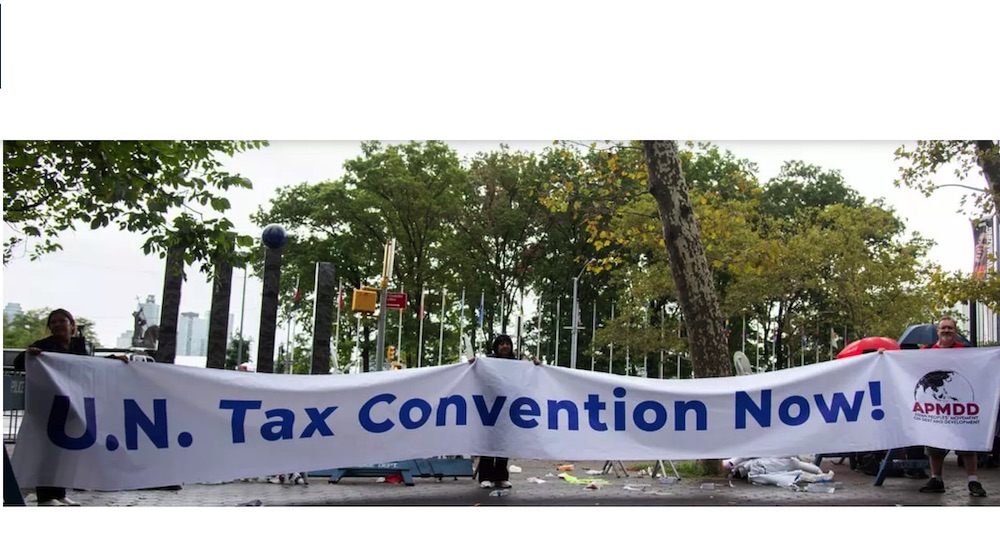
Tax justice advocates around the world on Wednesday celebrated the unanimous adoption of a resolution to “begin intergovernmental discussions in New York at United Nations Headquarters on ways to strengthen the inclusiveness and effectiveness of international tax cooperation.”


The U.N. General Assembly (UNGA) resolution on the “promotion of inclusive and effective international tax cooperation at the United Nations” was spearheaded by the African Group —which is composed of the continent’s 54 member states—and comes after about a decade of delays on the topic at the Organization for Economic Cooperation and Development (OECD).

“We note that the OECD has played a role in these areas,” a representative of the Nigerian delegation to the U.N. reportedly said Wednesday. “It is clear after 10 years of attempting to reform international tax rules that there is no substitute for the global, inclusive, transparent forum provided by the United Nations.”

“The African Group urges countries to remain committed to the development of inclusive tax instruments at the United Nations and encourage the OECD to play a supporting role in this regard,” the Nigerian representative continued.

After the resolution was adopted, Global Alliance for Tax Justice executive coordinator Dereje Alemayehu declared that “this is a historic win for the tax justice and the broader economic justice movement and a big step forward to combat illicit financial flows and tax abuse.”

“African countries stood together and made historic strides, breaking through the long-standing blockade by the OECD countries,” Alemayehu added. “Shifting power from the OECD is paramount to end the exploitation and plunder of developing countries.”

Tax Justice Network chief executive Alex Cobham similarly commended member nations “on their bold action today to move rule-making on global tax into the daylight of democracy at the U.N.,” highlighting that “the adopted resolution will now open the way for intergovernmental discussions on the negotiation of a U.N. tax convention and a global tax body.”

A proposed amendment to the resolution from the United States that would have cut the mention of “the possibility of developing an international tax cooperation framework or instrument that is developed and agreed upon through a United Nations intergovernmental process” was defeated.

Cobham emphasized that the resolution moved forward despite the fact that “the OECD has been unprecedentedly aggressive in its lobbying.”

“Some OECD countries spoke in favor of the organization’s role after the resolution’s adoption, but… the OECD’s two-pillar tax proposal is on life support, with even the organization’s own members… struggling to defend its work,” he said. “Work which has failed to deliver after nearly a decade of promises and work which has left countries losing $483 billion in tax to tax havens a year; and work which has been widely identified as exclusionary by countries outside the core membership of rich countries. Ultimately, this only confirms the importance of moving tax rule-making to a globally inclusive and transparent forum at the United Nations.”

(Article continued on the right column)

Question for this article:

Opposing tax havens and corruption: part of the culture of peace?

(Article continued from the left column)

Though it was backed by more than 100 countries and jurisdictions last year, the OECD’s international tax reform framework has been called “skewed-to-the-rich and completely unfair,” with critics warning that its 15% global minimum tax for multinational corporations is “way too low.”

“Fears that the OECD process had stalled grew over the summer after the nation of Hungary blocked a 15% minimum corporate tax from being adopted in the European Union,” The Hill reported Wednesday. Experts said the timing of the UNGA resolution was tied to “the delay on the OECD provision that stipulates where a corporation can be taxed for the use of its products as well as frustration from lower-income countries about the amount of that tax.”

According to news outlet:

“There’s a document that’s supposed to be coming out in December outlining which unilateral measures will need to be abandoned, including digital services taxes,” Daniel Bunn, president of the Tax Foundation, a Washington think tank, said in an interview. “The goal is to have a multilateral treaty ready for signature middle of next year.”

On the amount that corporations can be taxed—which is known as Pillar Two within the agreement—E.U. finance ministers are set to meet again in December.

“The language of their announcement is that they’re going to be ‘aiming for agreement’ on Pillar Two, but it’s not clear that that’s certain. Hungary has been holding things up,” Bunn added.

Other analysts in Washington say that the interests of developing countries are not given proper consideration in the OECD’s framework, an oversight that could further delay a final deal.

Tove Maria Ryding, tax coordinator at the European Network on Debt and Development (Eurodad), said Wednesday that “some rich countries are still holding on to the archaic idea that they can keep global rule-making on tax under the control of the OECD—also known as the rich countries’ club.”

“But today’s vote shows that at the end of the day, they know they cannot stop the development towards inclusive, transparent, and U.N.-led tax governance, which is already highly overdue,” Ryding argued. “The OECD-led governance is coming to an end—both because it was deeply unjust and biased in favor of a few rich countries. But also because the OECD has so blatantly failed to stop international tax abuse.”

While welcoming the success of the resolution on Wednesday, Pooja Rangaprasad at the Society for International Development warned that “the post-adoption statements by some developed countries have made it clear that the road ahead will be challenging.”

“However, it is in the interest of all countries to fix an outdated international tax system that is bleeding hundreds of billions of dollars in much-needed resources and public revenue,” Rangaprasad said. “The fight continues in holding all our governments accountable to agree to an effective U.N. tax convention that will ensure wealthy corporations and elites pay their fair share in taxes.”

Cobham of Tax Justice Network stressed that “the intergovernmental discussions next year will be crucial in setting the path for this new era of international tax. It is vital that countries in each region of the world follow the African leadership that underpinned this success, and engage together to generate common positions on an ambitious agenda.”

The Elders welcome historic breakthrough on loss and damage at COP27, but call on G20 leaders to phase out fossil fuels faster

. . SUSTAINABLE DEVELOPMENT . .

A press release from The Elders

The agreement reached at COP27 in Egypt shows that solidarity and co-operation between nations on the world’s most pressing issues is possible through negotiation and compromise, even in testing times. But the world needs urgent actions, not just carefully crafted words, to avoid climate catastrophe.


Photo: Rafapress/Shutterstock

We welcome governments’ reaffirmation of the need to limit the global temperature rise to 1.5℃,  the historic breakthrough on financial help for countries experiencing loss and damage caused by climate change, and the pressure COP27 has added for bold reform of the international financial system to generate more climate finance.

We now call on G20 leaders in particular to build on this restored foundation of cooperation to implement the changes needed, before it is too late. It is time for governments to turn their commitments into real change, not more promises that are broken. 

With the 1.5℃ limit reinforced in the final COP27 agreement, following similar commitments at the G20 summit last week, world leaders now have a clear mandate to redouble efforts to reduce global emissions by 43% by 2030. This will require bold leadership at home to convince citizens and businesses that the costs of inaction outweigh the costs of action, and reform of the multilateral development banks to generate more money to support countries most in need of help.

We welcome the recognition that renewables are the answer to the energy crisis, but regret that not all governments could agree the necessity of phasing down fossil fuels to keep 1.5℃ alive, notably Saudi Arabia and Russia. Disappointingly, developed countries failed to follow up on their COP26 pledge to double adaptation finance by agreeing a roadmap for delivery. At future COPs, climate science must drive decisions, and commitments must be kept.

We welcome the USA and China’s renewed dialogue at the G20 and COP27. We call for sustained leadership from the world’s two largest economies and emitters, and for all G20 countries to reduce emissions more rapidly and accelerate their phase out of fossil fuels by transitioning faster from coal, oil and gas to renewable energy. We urge accelerated financing of just transition partnerships in South Africa, Indonesia and elsewhere to ensure this change happens across all major emitters.

(article continued in right column)

Question for this article:

Sustainable Development Summits of States, What are the results?

Despite the vested interests of companies and governments, Can we make progress toward sustainable development?

(Article continued from the left column)

We commend youth activists, indigenous communities, other civil society organisations and businesses who refused to allow governments to backtrack on the Paris Agreement and COP26 commitments to 1.5℃. Their persistence, in spite of unacceptable state restrictions on civic space in Egypt, reminds us why COPs should be open and inclusive, with hosts abiding by their human rights commitments. The climate crisis affects us all, and everyone’s voice should be heard in finding solutions to it.

The outcome of COP27 demonstrates the potential for multilateral negotiations to deliver tangible results, sometimes against predictions. But this was only a partial success. There is no room for complacency, given the continuing increases in global emissions and extreme weather events around the world.

Mary Robinson, Chair of The Elders and former President of Ireland, said:

“In a year of multiple crises and climate shocks, the historic outcome on loss and damage at COP27 shows international cooperation is possible, even in these testing times. Equally, the renewed commitment on the 1.5℃ global warming limit was a source of relief. However, none of this changes the fact that the world remains on the brink of climate catastrophe.

“Progress made on mitigation since COP26 in Glasgow has been too slow. Climate action at COP27 shows we are on the cusp of a clean energy world, but only if G20 leaders live up to their responsibilities, keep their word, and strengthen their will. The onus is on them.

“All climate commitments must be transformed into real-world action, including the rapid phase out of fossil fuels, a much faster transition towards green energy, and tangible plans for delivering both adaptation and loss and damage finance. We avoided backsliding and made progress in Sharm El-Sheikh. Now leaders must stop sidestepping and fulfil their promises to safeguard a liveable future.”

Graça Machel, Deputy Chair of The Elders and first Education Minister of Mozambique, said:

“This was the ‘African COP’, and at COP27 in Sharm-el-Sheikh the multiple crises of food, energy and the impacts of climate change on vulnerable nations were at the forefront of discussions. Though there were restrictions on civil society in Egypt, people living on the frontlines of the climate crisis still made their voices heard: their cries for a loss and damage fund for nations devastated by climate impacts were heeded. Now rich countries must deliver on their promises and ensure the funding starts to flow as quickly as possible.”

Ban Ki-moon, Deputy Chair of The Elders and former UN Secretary-General, said:

“Richer countries – particularly those in the G20 – must continue to come together to address the threat posed by the climate crisis, and to seek solutions inside and outside the UNFCCC system. We have seen signals of solidarity on tackling climate change at COP27, but these signals must evolve into meaningful actions that benefit the most vulnerable. COP27 is part of a process, not an endpoint.”

In COP27 Speech, Lula Vows to Make Amazon Destruction ‘A Thing of the Past’

. . SUSTAINABLE DEVELOPMENT . .

An article by Kenny Stancil from Common Dreams

Leftist Brazilian President-elect Luiz Inácio Lula da Silva vowed Wednesday to halt deforestation of the Amazon and to establish a special ministry to protect Indigenous forest dwellers from human rights abuses.


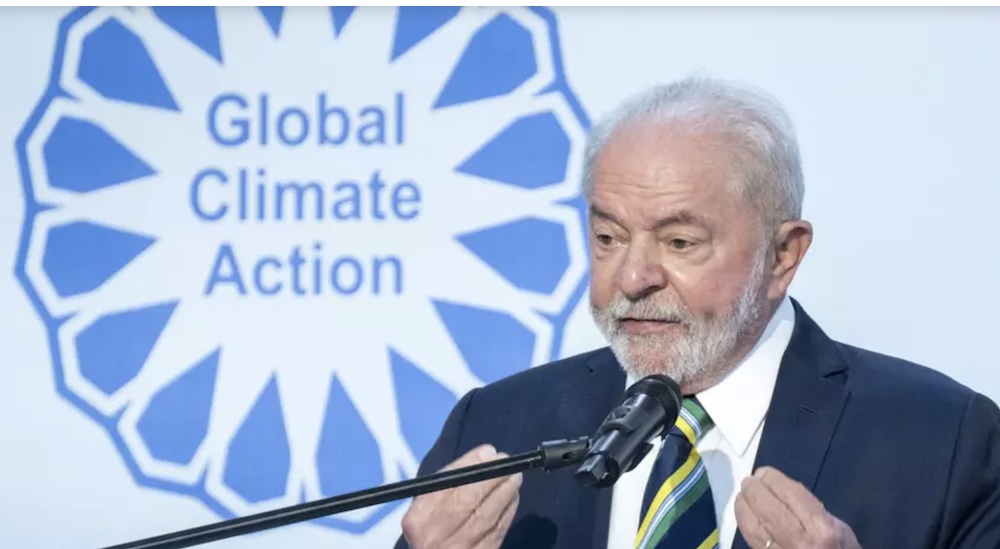
Luiz Inácio Lula da Silva, the president-elect of Brazil, speaks at the COP27 summit in Sharm El-Sheikh, Egypt on November 16, 2022. (Photo: Christophe Gateau/picture alliance via Getty Images)

During a  speech  at the United Nations COP27 climate conference in Egypt—his first on the international stage since he  defeated  Brazil’s outgoing far-right president, Jair Bolsonaro, just over two weeks ago—Lula  said  that “there’s no climate security for the world without a protected Amazon,” roughly 60% of which is located in Brazil.

(article continued in right column)

Question for this article:

Despite the vested interests of companies and governments, Can we make progress toward sustainable development?

Latin America, has it taken the lead in the struggle for a culture of peace?

(Article continued from the left column)

Parts of the Amazon, often referred to as the “lungs of the Earth” due to its unparalleled capacity to provide oxygen and absorb planet-heating carbon dioxide, recently  passed  a key tipping point after Bolsonaro  intensified  the destruction of the tropical rainforest during his four-year reign. According to one  estimate , Bolsonaro’s regressive policy changes are responsible for the eradication of as many as two billion trees in South America’s largest nation.

“This devastation [of the Amazon] will be a thing of the past,”  said  Lula, who previously served as Brazil’s president from 2003 to 2010 and takes office again on January 1. “The crimes that happened during the current government will now be combated. We will rebuild our enforcement capabilities and monitoring systems that were dismantled during the past four years.”

Most of the deforestation that occurred under Bolsonaro was illegal, propelled by logging, mining, and agribusiness companies that often used violence to run roughshod over Indigenous inhabitants of the Amazon.

“We will fight hard against illegal deforestation,” the 77-year-old Lula, a member of the Workers’ Party, continued. “We will take care of Indigenous people.”

“I’m here to tell you that Brazil is back in the world. Brazil is emerging from the cocoon to which it has been subjected for the last four years,” added Lula, who drastically reduced deforestation and channeled an economic boom into downwardly redistributive programs that  curbed inequality  when he governed Brazil earlier this century.

Peace Through Tourism had a Family Meeting with You included

. . SUSTAINABLE DEVELOPMENT . .

An article by  Juergen T Steinmetz in eTurboNews

Family meetings are usually private, but the family of the International Institute for Peace through Tourism thinks tourism is a global family and you should be included.

Supporters, Board-members and followers of the International Institute for Peace Through Tourism (IIPT) organization met virtually last week as a “global family” meeting arranged by the World Tourism Network and eTurboNews.

Louis D’Amore founded IIPT 34 years ago and expressed his commitment to welcome 1000 peace parks. Currently, IIPT has established peace parks in every continent except Antarctica

The family meeting heard chapter updates from around the world including Jamaica, Australia, Iran, and welcomed a new chapter in the Maldives.

Listen to the podcast.

Family meetings are usually private, but the IIPT board decided to make last week’s virtual meeting public. Peace Through Tourism after all is a Global Family of peace-loving members of the travel and tourism industry anywhere.

IIPT family members attending included Dr. Taleb Rifai, former two-time secretary-general of the UNWTO, Ajay Prakash , VP & President of IIPT India, Kiran Yadov, VP and Co-founder IIPT India, Diana McIntyre, president of the Caribbean Chapter, Gail Parsonage, president IIPT Australia, Fabio Carbone, IIPT Ambassador at Large and President IIPT Iran, Philippe Francois, CEO World Association for Hospitality and Tourism Education& Training, Juergen Steinmetz, Founder World Tourism Network and CEO of the Travel News Group, Maga Ramasamy, President IIPT Indian Ocean Islands, Ms. Mmatsatsi, President IIPT South Africa, Bea Broda, film-maker, Mohamed Raadih , IIPT Maldives Chapter President, among others.

(continued in right column)

Question related to this article:

How can tourism promote a culture of peace?

(continued from left column)

The International Institute for Peace through Tourism (IIPT) was born in 1986, the International Year of Peace, with a vision of travel and tourism becoming the world’s first global peace industry and the belief that every traveler is potentially an “Ambassador for Peace.” The IIPT First Global Conference, Tourism: A Vital Force for Peace, Vancouver 1988, with 800 delegates from 68 countries was a transformative event. At a time that most tourism was ‘mass tourism’, the Conference first introduced the concept of ‘Sustainable Tourism’ as well as a new paradigm for a “Higher Purpose” of tourism that gives emphasis to the key role of tourism in fostering travel and tourism initiatives that contribute to international understanding; cooperation among nations; an improved quality of environment; cultural enhancement and the preservation of heritage; poverty reduction; reconciliation and healing wounds of conflicts; and through these initiatives, helping to bring about a peaceful and sustainable world. IIPT has since organized some 20 international conferences and global summits in different regions of the world with a focus on actual case studies that demonstrate and promote these values of tourism.

In 1990, IIPT pioneered the role of tourism in poverty reduction by identifying potential projects in four countries of the Caribbean and three in Central America. Following the U.N. Conference on Environment and Development (Rio Summit in 1992), IIPT developed the world’s first Code of Ethics and Guidelines for Sustainable Tourism and in 1993, conducted the world’s first international study on Codes of Conduct and Best Practices for Tourism and Environment. IIPT’s 1994 Montreal Conference: “Building a Sustainable World through Tourism” was the first major international conference on sustainable tourism.  The Conference was instrumental in the World Bank beginning its support for tourism projects aimed at poverty reduction in developing nations. Other development agencies followed and by 2000, tourism’s role in poverty reduction became widely recognized.

The Amman Declaration resulting from IIPT’s Global Summit in Amman, Jordan 2000 was adopted as an official document of the United Nations. Similarly, the Lusaka Declaration on Sustainable Tourism Development, Climate Change and Peace, resulting from the IIPT Fifth African Conference, 2011, was adopted by UNWTO and broadly circulated. The Conference also resulted in a book publication: Meetng the Challenges of Climate Change to Tourism and was instrumental in the UNWTO 20th General Assembly being co-hosted by Zambia and Zimbabwe. The IIPT Global Symposium, 2015 in Johannesburg, South Africa honored the legacies of Nelson Mandela, Mahatma Gandhi and Martin Luther King, Jr. IIPT has also had featured events each year since 1999 at World Travel Market, London – the past four years at ITB, Berlin and several manor Chapter conferences and events in the Caribbean, Australia, India, Jordan, Malaysia and Iran.

In 1992, as part of Canada 125 celebrations commemorating Canada’s 125th birthday as a nation, IIPT conceived and implemented “Peace Parks across Canada.” 350 cities and towns from St. John’s, Newfoundland across five time zones to Victoria, British Columbia, dedicated a park to peace on October 8 as the nation’s Peace-Keeping Monument was being unveiled in Ottawa and 5,000 Peace Keepers passing in review.  Of the more than 25,000 Canada125 projects, Peace Parks across Canada was said to be the “most significant.” Since then, IIPT international peace parks have been dedicated as a legacy of each of IIPT’s international conferences and global summits. Noteworthy IIPT International Peace Parks are located at Bethany Beyond the Jordan, site of Christ’s baptism; Victoria Falls, one of the seven natural wonders of the world; Ndola, Zambia, site of U.N. Secretary-General Dag Hammarskjold crash en route to a peace mission in the Congo; DMedellin, Colombia, dedicated on Opening Day of the UNWTO 21st General Assembly; Sun River National Park, China; and the Uganda Martyr’s Catholic Shrine, Zambia.

‘Big Win’ for Climate: EU Parliament Backs Fossil Fuel Non-Proliferation Treaty

. . SUSTAINABLE DEVELOPMENT . .

An article by Julia Conley from Common Dreams licensed under Creative Commons (CC BY-NC-ND 3.0). Feel free to republish and share widely.)

Just a year after angering climate campaigners by voting down a resolution to call for a Fossil Fuel Non-Proliferation Treaty, the European Parliament on Thursday overwhelmingly approved the measure, demonstrating that “momentum is growing”  in the push for a global, rapid shift away from planet-heating oil, gas, and coal.

450 members of the body  voted for the resolution and 119 opposed it—a reversal of last year’s vote in which just 168 approved of the resolution and 510 opposed it.

“This is a major development in the global push for a fossil fuel treaty,” said the Fossil Fuel Non-Proliferation Treaty Initiative, an international campaign group.

The resolution outlines the Parliament’s demands for the 2022 United Nations Climate Change Conference (COP27), which is scheduled to begin in Sharm El Sheikh, Egypt on November 6.

Included in  the resolution  is language demanding that “all parties must make financial flows—public and private, domestic and international—compatible with the path towards the 1.5°C target in the Paris Agreement; reiterates the need to urgently end fossil fuel subsidies” and that encourages nations represented in the European Parliament “to work on developing a fossil fuel non-proliferation treaty.”

(article continued in right column)

Question for this article:

Sustainable Development Summits of States, What are the results?

Despite the vested interests of companies and governments, Can we make progress toward sustainable development?

(Article continued from the left column)

Such a treaty would end all new coal, oil, and gas production; phase out existing production infrastructure, which is responsible for 80% of fossil fuel emissions over the last decade; and  ensure a just transition  to “enable economic diversification” and “support every worker, community, and country.”

E.U. members must “stand ready to contribute to closing the gap necessary to limit global warming to 1.5°C, in a just, socially balanced, fair, and cost-effective way, while taking into account aspects of global fairness and equity and the E.U.’s historical and current responsibility for the emissions causing the climate crisis,”  reads  the resolution.

“We welcome this resolution,”  said  Tzeporah Berman, chair of the Fossil Fuel Non-Proliferation Treaty Initiative. “Phasing out fossil fuels is now clearly the test for climate leadership at COP27 in Egypt. It is not a transition if we are growing the problem. If we are going to break free from the tyranny of oil we need countries to cooperate to stop the expansion of fossil fuels.”

The resolution was passed just over a month after the World Health Organization  led  a coalition of global public health experts calling for a fossil fuel non-proliferation treaty on the grounds that the continued extraction of coal, oil, and gas poses “serious global health risks.”

Youth climate leaders made a  similar call  in June, and more than 100 Nobel laureates, 69 cities, and more than 1,700 civil society groups have  supported the push for such an agreement.

Last month, Vanuatu  became  the first nation state to officially call for a fossil fuel non-proliferation treaty during the U.N. General Assembly.

By joining the tiny Pacific island nation, which is vulnerable to rising sea levels and other impacts of the climate crisis, in supporting the treaty “the E.U. can stand on the right side of history,”  said  Tasneem Essop, executive director of Climate Action Network International.

“The momentum behind a treaty to keep fossil fuels in the ground in a fair and timely fashion is phenomenal and growing,”  said  Andrew Simms of the Rapid Transition Alliance.

Economic Commission of Central African States: First biennial for a culture of peace

. SUSTAINABLE DEVELOPMENT . .

An article from Digital Congo

The College of Advanced Studies in Strategy and Defense (CHESD) has been hosting since Friday, October 14, 2022, the biennial of the Economic Commission of Central African States (ECCAS) for a culture of peace.

Placed under the theme: “APSA@20: challenges and prospects for silencing the guns in Central Africa: Retrospection and prospective analysis”, this conference is organized in partnership with the Government of the DRC, the United Nations Development Program ( UNDP) and with the support of CHESD led by Major General Augustin MUBIAYI MAMBA, the African Center for the Constructive Resolution of Conflicts (ACCORD), the Institute for Security Studies (ISS), UNESCO, the ‘OIF, CICIBA, CERDOTOLA.

It also provides an opportunity for participants to reflect on better coordination of efforts at continental, regional and local level for the realization of the African Union’s Agenda 2063 on democracy, good governance, and a peaceful and secure Africa. .

In her speech, the Resident Representative ai of the UNDP, Mrs. Rokya Ye NDIENG indicated that:

“The theme of this conference, namely ‘Culture of Peace’ presents three essential opportunities to participants. First, it is the opportunity to assess existing approaches, tools and systems for conflict management at all levels, then, the need to propose concrete recommendations to improve strategies for strengthening peace and security and finally, the imperative to formulate a roadmap to “Silencing the guns” by 2031, in Central Africa (…)”.

(article continued in right column)

(Click here for a version of this article in French.)

Question for this article:

Can the African Union help bring a culture of peace to Africa?

(article continued from left column)

She continued: “The dynamics of conflicts on the continent have changed in recent years. New threats have emerged, such as climate change, pandemics and cybersecurity. They require adapted, coherent and concerted responses. these conflicts have also evolved and their modi operandi have changed, such as pirates, terrorists and criminal organizations (…)”

“(…) the African peace and security architecture created by the African Union in collaboration with the Regional Economic Communities must respond to these challenges which are becoming increasingly complex in order to prevent, manage and resolve conflicts on the continent (…) the UNDP supports the strategic vision of the African Union declined through the 2063 Agenda for a prosperous and peaceful Africa.

This vision contributes to the achievement of Sustainable Development Goal (SDG) 16 aimed at “promoting the advent of peaceful and inclusive societies for the purposes of sustainable development, ensuring access to justice for all and establishing, at all levels, effective, accountable and open institutions (…) there can be no sustainable development without peace and stability. The prevention and peaceful resolution of conflicts are therefore necessary conditions for the achievement of the Sustainable Development Goals. Sustainable Development, particularly in the context of the Central African sub-region marked by political, economic, social and security fragilities (…)”, she specified.

Additionally: “(…) a holistic approach to conflict prevention is essential if we want to build and root a culture of peace on the continent and more particularly in Central Africa. Building peace through building inclusive, peaceful and resilient societies presupposes the establishment of functional conflict prevention and resolution mechanisms at all levels with a view to strengthening the African peace and security architecture. youth to continental, regional, national and local peace efforts is an imperative (…)”

In addition, the President of the Commission, Gilberto da Piedade Verissimo, for his part, welcomed the holding of these meetings which is in line with finding a lasting peace in Central Africa.

It should be noted that this first biennial, the closing of which takes place this Saturday, October 15, 2022, brings together high-level participants from the region and around the world, youth and women’s groups, civil society organizations, NGOs and Representatives of various United Nations entities.

The “Fihavanana” of Madagascar: corruption or culture of peace?

. . SUSTAINABLE DEVELOPMENT . .

Translated and edited for CPNN from a post of July 30, 2022 on Blogger.com.

We will not stop repeating it, we must fight against corruption before corruption fights against us. Because not to act is to approve and to approve it amounts to showing non-assistance to a country in danger. And as corruption becomes a way of life on the Big Island, more and more people are pointing the finger at Fihavanana.

In its traditional use Fihavanana is a Malagasy cultural concept based on mutual aid that maintains a culture of peace and harmony by avoiding or resolving family disagreements, in the neighborhood or across the country.


Photo from the article The Fihavanana: Myths and Realities of a Value that Guarantees Social Peace

(click here for the original french version of this article.)

Question for this article:

Opposing tax havens and corruption: part of the culture of peace?

It’s a big problem that this collective way of thinking is now in the service of corruption. It threatens to lobotomize the Malagasy at the cost of a common value.

Mutual aid is being diverted towards bribes; officials in charge receive compensation to make procedures more flexible or to make requests favorable. The bribes are justified by the desire to maintain the “Fihavanana”. It is no longer even a question of avoiding disagreements, they will rather use it to make favoritism, priority to acquaintances in the neighborhood. Who care about skill and effort! Positions and places will go first to family members. It is nepotistic “Fihavanana”.

Some go so far as to falsify data to favor their relatives, risk their work for corruption. But ironically, is it really better to lose money than to lose family as the Malagasy proverb says?

The blame should not be on the “Fihavanana” but in the use that one makes of it. A culture of peace cannot be harmful. But a fight against corruption is necessary so that the “Fihavanana” regains its traditional meaning instead of corrupting a national value, a culture that characterizes Madagascar. And even if the country has made some progress by going from 149th in 2020 to 147th in 2021 on the Corruption Perception Index (CPI), the fight is even becoming cultural.

(Thank you to Jay Ralitera for sending this article to CPNN)

Nigeria: Reps Push For ‘Silence The Guns’ Implementation

. . SUSTAINABLE DEVELOPMENT . .

An article by Philip Nyam in New Telegraph

The House of Representatives recently passed a resolution calling on the executive to immediately implement the “silence the guns” peace policy of the African Union (AU). PHILIP NYAM reviews the roadmap

Worried by growing conflicts and widespread insecurity across the continent, the African Union met in Lusaka, Zambia in 2016 and drew a master roadmap of practical steps to silence guns in Africa by the year 2020. Six years after, the implementation of the roadmap titled “Lusaka Master Roadmap 2016” has been beset by challenges and Nigeria, the biggest black nation on earth is yet to fully integrate the policy.

It was in view of this that the House of Representatives last month passed a resolution to impress on the government to speed up the process of its implementation. The House resolution came barely after the meeting of the African Union Commission in Lusaka, Zambia, between June 6 and 8 brought together participants from the relevant departments of the AU Commission, Divisions within the Political Affairs, Peace and Security Department, representatives from RECS/RMs, representatives of the African Union Mechanism for Police Cooperation (AFRIPOL), African Centre for the Study and Research on Terrorism (ACSRT) and Economic, Social and Cultural Council (ECOSOCC) and representatives of AUC partners supporting silencing the guns project such as the UN Department of Political and Peace-building Affairs.

The meeting finalised an implementation plan that will guide the operationalisation of the monitoring and evaluation (M&E) framework of the AU Master Roadmap Silencing the Guns AU and Regional Economic Communities converge to finalise the implementation plan and road map on practical steps to silence the guns in Africa. This is in addition to adopting the terms of reference of an AURECs/ RMs Steering Committee on Silencing the Guns. The meeting also agreed on the establishment of the Steering Committee including the relevant departments of the AUC and focal points/officers in each REC/RM to follow up and coordinate activities related to the STG Initiative.

It also served as a collaborative platform to facilitate regular exchanges between the AU, RECs/RMs, Civil Society Organisations, academia, the private sector and other stakeholders that have a role to play in the implementation of the Silencing the Guns Master Roadmap. Explaining why the implementation had to be postponed from 2020 to 2030, the Coordinator of Silencing the Guns under the Political Affairs, Peace and Security at the African Union Commission, Mr. Advelkader Araoua, said that “the extension of the life span of the AU master roadmap on practical steps to silence the guns in Africa to the year 2030, is a test of our ability to deliver on our commitments to free the African continent from wars, civil conflicts, humanitarian crises, human rights violations, gender-based violence, and genocide.” Also, the Head of Governance, Peace and Security at the COMESA Secretariat, Ms. Elizabeth Mutunga stressed the need to continuously assess the external environment in developing an implementation plan for the monitoring and evaluation.

“Emerging and unpredictable factors, that have not necessarily originated from our region are having a very big impact on the peace, conflict and security dynamics of our region,” she noted. The motion It was after the meeting that the House of Representatives passed a resolution pushing for the implementation of the roadmap. In a motion titled “Need to adopt and implement the “Silencing the Guns” Road Map, Hon. Ahmed Munir noted that “Silencing the Guns 2030” is a flagship roadmap project adopted in Lusaka, Zambia in 2016 by the African Union with the aim of realising a Conflict-Free Africa by the year 2030. He said that the concept of silencing the guns was borne out of the observation that the African Continent is the scene of numerous violent conflicts that make the desired economic and political integration of the continent difficult. As part of the AU’s Agenda 2063, the AU sought to ensure that Africa is characterised by peace, political tolerance and good governance.

Hon. Munir expressed concerns that initially, the roadmap was to be achieved by 2020 of which the continent fell short and the goal was further extended to 2030 “cognisant that peace and security matters across Africa are interwoven and the continent cannot afford to further miss the 2030 set target.” In adopting the motion, which was unanimously endorsed, the House urged the Ministry of Foreign Affairs to fully embrace the report and ensure relevant Ministries, Departments and Agencies (MDA’s) key into the roadmap. The lawmakers also urged the office of the National Security Adviser to fully adopt the report and cascade it down to other relevant security agencies.

Synopsis of the roadmap

The African Union Master Roadmap of practical steps to silence guns in Africa by the year 2020 better known as the Lusaka Master Roadmap 2016 entails the following. The continuing insecurity, instability, disruption of political harmony, erosion of social cohesion, destruction of the economic fabric and public despondency in various parts of Africa call on the Peace and Security Council (PSC) to play a locomotive role in spearheading strategic interventions to put this sad situation to an end.

(continued in right column)

Question related to this article:

Can the African Union help bring a culture of peace to Africa?

(continued from left column)

Most crises and violent conflicts in Africa are being driven by poverty, economic hardships, violation or manipulation of constitutions, violation of human rights, exclusion, inequalities, marginalisation and mismanagement of Africa’s rich ethnic diversity, as well as relapses into the cycle of violence in some post-conflict settings and external interference in African affairs. Undoubtedly, these challenges can be overcome, as long as the correct remedies are idenpletified and applied.

It is in this context that the PSC convened a Retreat that was dedicated to the theme: Practical Steps to Silence the Guns in Africa by the Year 2020, from 7 to 9 November 2016, in Lusaka, Zambia. The Retreat regrouped the PSC Member States, representatives of the Economic, Social and Cultural Council (ECOSOCC), the AU Commission, Regional Economic Communities/ Regional Mechanisms for Conflict Prevention, Management and Resolution (RECs/RMs), Civil Society Organisations (CSOs), the Committee of Intelligence and Security Services of Africa (CISSA) and the Regional Centre on Small Arms (RECSA).

This was all the more urgent given the central thrust of Agenda 2063 and the overall AU Vision of building a peaceful, stable, secure, integrated and prosperous Africa, and the essence of Agenda 2030 on sustainable development goals. Notably, the 4th aspiration of Agenda 2063, which is the African Union’s strategic framework for socio-economic transformation of the continent over the next five decades, highlights the need for dialoguecentred conflict prevention, as well as the management and resolution of existing conflicts, with a view to silencing the guns in our Continent by the Year 2020. Agenda 2063 provides that in order to achieve sustainable conflict prevention and resolution, a culture of peace and tolerance must be cultivated and nurtured in our children and youth, among others, through peace education.

Furthermore, in its first 10 years implementation plan, Agenda 2063 stresses the imperative of ending all wars, civil conflicts, gender-based violence and violent conflicts and prevent genocide, as part of Africa’s collective efforts to silence the guns in the continent by the year 2020. In organising the retreat, the PSC was inspired and guided by the clarion call in the OAU/AU 50th Anniversary Solemn Declaration adopted by the AU Heads of State and Government in Addis Ababa on 26 May 2013, in which they, among other aspects, expressed their “determination to achieve the goal of a conflict-free Africa, to make peace a reality for all our people and to rid the continent of wars, civil conflicts, human rights violations, humanitarian disasters and violent conflicts, and to prevent genocide.”

The PSC’s resolutions further read: “We pledge not to bequeath the burden of conflicts to the next generation of Africans and undertake to end all wars in Africa by 2020. In this regard, we undertake to address the root causes of conflicts, including economic and social disparities; put an end to impunity by strengthening national and continental judicial institutions, and ensure accountability in line with our collective responsibility to the principle of non-indifference.

“We undertake to eradicate recurrent and address emerging sources of conflict including piracy, trafficking in narcotics and humans, all forms of extremism, armed rebellions, terrorism, transnational organized crime and new crimes such as cybercrime; push forward the agenda of conflict prevention, peace-making, peace support, national reconciliation and post-conflict reconstruction and development through the African Peace and Security Architecture; as well as, ensure enforcement of and compliance with peace agreements and build Africa’s peacekeeping and enforcement capacities through the African Standby Force.

“We will maintain a nuclear-free Africa and call for global nuclear disarmament, nonproliferation and peaceful uses of nuclear energy; ensure the effective implementation of agreements on landmines and the non-proliferation of small arms and light weapons; address the plight of internally displaced persons and refugees and eliminate the root causes of this phenomenon by fully implementing continental and universal frameworks.”

In conceiving practical steps to silence the guns in Africa by the year 2020, the PSC took into consideration the political history of the African continent, which has been marred particularly by three major tragedies, namely, slavery, colonization and the unpaid extraction/ exploitation of natural resources, which have created a huge burden for Africa and its people. The end of slavery at the end of the 19th century and the fall of colonialism under the weight of protracted nationalist and liberation struggles across the continent ushered in a new era in Africa.

However, the new era is faced with a myriad of challenges that the continent has not yet been able to successfully overcome. The cycle of violent conflicts and disruptive crises persist on the continent, so do situations of relapses back into the cycle of violence and destruction for some countries that were perceived to have already emerged from conflicts. It is therefore critically important for Africa and its people to put in place strategic guidelines for addressing these challenges.

In some instances, the African continent has also not been able to foster and manage effective political transitions, partly due to the fact that the erstwhile liberation movements have taken too long to transform themselves into dynamic governing political parties, which could more successfully adapt to operating in pluralistic democratic societies as agents of political discourse and crucial facilitators rather than act as a stumbling block to any democratic dispensation.

Similarly, failures to transform some of the military wings of some of the liberation movements into professional and disciplined national armies, which pledge loyalty to civilian government regardless of the political party in power, have brought problems to some parts of Africa. All of these facts have stifled serious attempts to silence the guns in Africa.

Yet, peace, security and socio-economic development should be pursued simultaneously. Equally challenging is the task of sustaining transitions from war to peace and to prevent relapses. This is why the AU PSC developed a Master Roadmap of realistic, practical, time-bound implementable steps to silence the guns in Africa by 2020.

The master Roadmap is premised on the principle that Africa should take, assume total responsibility for its destiny. Assuming such responsibility should also take into account the fact that, while appropriate decisions and programmes have been adopted with a view to resolving some of the challenges Africa is faced with, there has been encroachment on some of those decisions by the implementation deficit.