All posts by CPNN Coordinator

About CPNN Coordinator

Dr David Adams is the coordinator of the Culture of Peace News Network. He retired in 2001 from UNESCO where he was the Director of the Unit for the International Year for the Culture of Peace, proclaimed for the Year 2000 by the United Nations General Assembly.

Lebanese dialogue aims to strengthen unity in diversity

TOLERANCE & SOLIDARITY .

an article by Nohad Topalian, Al-Shorfa

A group of Lebanese intellectuals of various political, ideological and sectarian affiliations met in Beirut in February for the “Permanent Conference for Peace in Lebanon”, an on-going dialogue that aims to find constructive ways to build and reinforce peace, co-existence and democracy in the country.


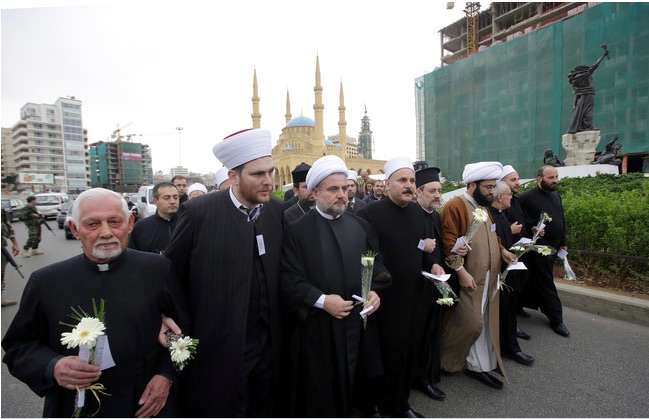
Clerics representing the various Lebanese religious communities march for peace in central Beirut on the eve of the anniversary of the civil war in April 2013. [Joseph Eid/AFP]

The conference, which opened in early February, is a reincarnation of the “Permanent Conference for Inter-Lebanese Dialogue”, which had been formed in 1993 and played a prominent role in promoting a culture of dialogue and co- existence among Lebanon’s various sects and Lebanese in general.

“The timing of the launch of the conference is linked to two factors: the outbreak of violence at an extraordinary level in the region and its impact on Lebanon, and the inability of the political class of all affiliations to grasp the gravity of the violence and [failure] to work to avert its consequences on Lebanon,” said political thinker Samir Frangieh of the March 14 Alliance, who launched the conference.

“So it was necessary to launch a cry to mobilise civil society to build some sort of a safety net in the country,” he told Al-Shorfa.

The conference, he said, aims to work on several levels to restore a culture of peace in Lebanon and launch initiatives in various areas to establish the principles of co-existence, as well as educate Lebanese expatriates about how Lebanon serves as a model of conflict resolution.

“Lebanon is the only country in the world where Muslims and Christians share authority, and the only country in the Muslim world where Sunnis and Shias share in operating this system of rule alongside Christians,” he said.

The conference seeks to give prominence to moderates within all the Lebanese sects without directly changing the positions of their political parties, as well as seeks to help strengthen democracy, Frangieh said.

“We talk about promoting and enhancing co-existence [because] it has a positive effect on democracy, particularly since we in Lebanon have a model of democracy that is based on two principles, the first relating to the rights of individuals, and the second to guarantees for groups,” he said, adding that some countries in the region need this model to break the cycle of violence.

Future bloc MP Mohammed Qabbani said the conference is significant because its participants are convened on a national, not sectarian basis.

“We have been suffering from sinking ever deeper in the sectarian and denominational quagmire in recent years, to such an extent that it has become our daily language,” he told Al- Shorfa. “But I reject this logic because I regard Lebanon’s four million citizens, and many times that number abroad, as one people, not a collection of sects sharing one land that is falsely called a country.”

“So we must start at the root level and the culture. […] We are one people in everyday life, one regardless of whether the citizen belongs to a church or mosque,” Qabbani said. . . .

Other articles related to this one:

Almería, Spain: Over 100,000 students participate in “The school as a space of peace”

.. EDUCATION  FOR PEACE ..

an article by Teleprensa (abbreviated)

The 268 schools in the province integrated into the network ‘The school as a space for peace’ celebrated today [January 30] the School Day of Non-violence and Peace with a program of fun and cultural activities promoting democratic values, equality, respect for diversity, dialogue and tolerance. More than 100,000 students and 5,000 teachers participate in these initiatives to improve coexistence in the educational community.


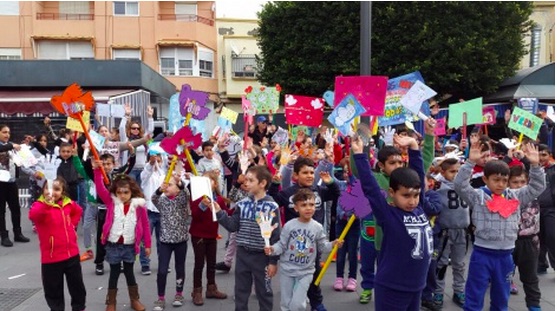
Children from the public school of Chanca have taken to the streets for their own peace demonstration

The main event was held at the Multipurpose Center of Berja, organized by the seven schools in the municipality involved in the network ‘The school as a space for peace’ with the project collective ‘Berja: Puerta de la Paz de La Alpujarra’ . It consists of the infant school Barajas, the primary schools Andrés Manjón, San Tesifón and Celia Viñas, the CDP school Our Lady of Gádor, Villavieja and the IES school Sierra de Gador. More than five hundred students attended this event which read the ‘Manifesto 2000’, a formulated by a group of Nobel Peace Prize winners on the occasion of the 50th anniversary of the Universal Declaration of the Human Rights to spread the culture of peace and nonviolence. The text incorporates the idea of individual responsibility in the family, the village, the region and the country to practice and promote non-violence, tolerance, dialogue, reconciliation, justice and solidarity on a daily basis.

The students read messages about respect for life, rejection of violence, generosity, understanding, preservation of the environment and natural resources, solidarity and equality. In addition, with the patronage of Municipal Sports, their schools organized a charity race to benefit the NGO Save the Children. The primary school Palomares, Cuevas del Almanzora, has also supported this NGO to raise funds for the people of the Sahel. Previously, students have studied in their classrooms about the food crisis and the living conditions in the African region. . .

In Vicar, the primary school Federico García Lorca has organized several circuits of cooperative games on the values of peace with the participation of families and secondary students as monitors.

The School Day of Non-violence and Peace has been celebrated on January 30 since 1964, when it emerged as an initiative of the Spanish professor Llorenç Vidal to spread education and tolerance, solidarity, harmony and respect for human rights. In 1993 he received the support of UNESCO that made this a World Day celebration. The event coincides with the date when Mahatma Gandhi was assassinated in 1948.

The Junta delegate of Education, Culture and Sports, Elizabeth Arevalo, stressed that ‘the culture of peace is not only a main issue but is one of the ultimate goals of the public education system in Andalusia as embodied in the Plan Andaluz of Education for a Culture of Peace’, which involved the creation of the Network “The school as a space of peace” ‘in the 2002-2003 academic year.

(Click here for a Spanish version of this article)

Question related to this article:


What is the best way to teach peace to children?

Comment by Jeanne posted: Mar. 04 2015

The best ways to teach peace to children pre-K to 12:
1. Create schools and classrooms where children live and learn in environments that foster kindness and caring with empathy, respect for everyone and personal responsibility for all that you say and do.
2. Teach the concept of human rights and dignity and the skills of critical thinking and peaceful conflict resolution.
3. Integrate and infuse the concepts and skills in all curriculum subject areas so children develop into knowledgeable and thoughtful world citizens who feel empowered to make the world better for everyone and who are not afraid to take on the political establishment.

Our world leaders of tomorrow are in our classrooms today. What a wonderful opportunity educators have to impact our quest for that elusive culture of peace!

If you want to receive by pdf, our Newsletter with resources and ideas for educators, please contact me:

Jeanne Morascini, Founder
Curriculum of Hope for a Peaceful World
Jemora@aol.com

Más de 100.000 escolares participan en la red ‘Escuela: Espacio de Paz’ en Almería, España

. . . EDUCACIÓN PARA LA PAZ . . .

un artículo de Teleprensa (abreviado)

Los 268 centros educativos de la provincia integrados en la Red ‘Escuela: Espacio de Paz’ celebran hoy el Día Escolar de la No Violencia y la Paz [30 de Enero] con un programa de actividades lúdicas y culturales de promoción de los valores democráticos de la igualdad, el respeto a la diversidad, el diálogo y la tolerancia. Más de 100.000 alumnos y 5.000 docentes participan en estas iniciativas de mejora de la convivencia entre la comunidad educativa.

spain
Haga clicK en la foto para ampliarla

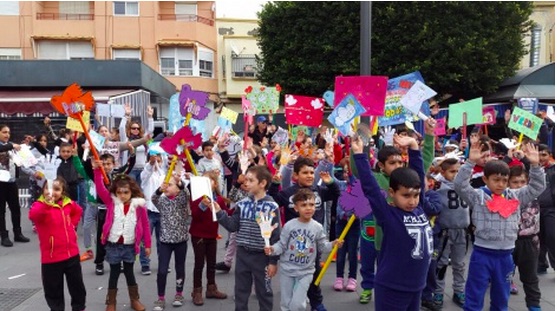
Niños del colegio público de La Chanca han tomado las calles del barrio en su peculiar manifestación por la Paz

l acto principal se ha celebrado en el Centro de Usos Múltiples de Berja, organizado por los siete centros educativos del municipio que participan en la Red ‘Escuela: Espacio de Paz’ con el proyecto colectivo ‘Berja: Puerta de la Paz de La Alpujarra’. Se trata de la Escuela Infantil Barajas, CEPR Andrés Manjón, CEIP San Tesifón, CEIP Celia Viñas, CDP Nuestra Señora de Gádor, IES Villavieja e IES Sierra de Gádor. Más de medio millar de alumnos han asistido a este acto en el que se ha leído el ‘Manifiesto 2000’, un documento formulado por un grupo de Premios Nobel de la Paz con motivo de la celebración del 50 aniversario de la Declaración Universal de los Derechos Humanos para difundir la cultura de la paz y no violencia. El texto recoge la idea de la responsabilidad individual para actuar en el marco de la familia, la localidad, la región y el país practicando y fomentando la no violencia, la tolerancia, el diálogo, la reconciliación, la justicia y la solidaridad día a día.

Los escolares han leído mensajes sobre el respeto a la vida, el rechazo de la violencia, la generosidad, la comprensión, la conservación del medio ambiente y de los recursos naturales, la solidaridad y la igualdad. Además, los centros educativos han organizado, con la colaboración del Patronato Municipal de Deportes, una carrera solidaria a beneficio de la ONG Save the Children. El CEIP Palomares, de Cuevas del Almanzora, también se ha apuntado a la carrera de esta organización no gubernamental para recaudar fondos destinados a la población de El Sahel. Previamente, los alumnos han trabajado en sus aulas la información sobre la crisis alimentaria y las condiciones de vida en esta región africana. . .

En Vícar, el CEIP Federico García Lorca ha organizado varios circuitos de juegos cooperativos sobre los valores de la paz con la participación de la familias y con los alumnos de Secundaria como monitores.

El Día Escolar de la No Violencia y la Paz se celebra el 30 de enero desde 1964, cuando surgió como una iniciativa del profesor español Llorenç Vidal para la difusión de la educación en y para la tolerancia, la solidaridad, la concordia y el respeto a los derechos humanos. En 1993 recibió el respaldo de la UNESCO que convirtió esta celebración en Día Mundial. La efeméride coincide con la fecha de la muerte de Mahatma Gandhi, asesinado en 1948.

La delegada de Educación, Cultura y Deporte de la Junta, Isabel Arévalo, ha destacado que ‘la cultura de la paz no es sólo un contenido transversal sino que es una de las finalidades últimas del sistema público educativo en Andalucía que se concreta en el Plan Andaluz de Educación para la Cultura de Paz’, que supuso la creación de la Red ‘Escuela: Espacio de Paz’ en el curso 2002-2003.

( Clickear aquí para la version inglês)

Latest Discussion

What is the best way to teach peace to children?

Maria Montessori believed that peace was innate within children. Her timeless educational philosophy was developed around this basic understanding. Perhaps all we need to do as teachers is to provide stimulating learning environments that validate this knowing and understanding and nurture it. We may not have to actually teach it, Sharing peace-building stories gently attends to this. Strong, creative and imaginative peace-building characters who focus upon win-win and have faith in peace being possible are at the centre of the story plots. In Hassaun Ali-Jones Bey’s (Boundless Gratitude http://boundlessgratitude.com/products.html ) unique and mesmerising story, Black Ink is such a character who bravely crosses the universe seeking validation of what he knows in his heart. The magical character also models all the important peace-building values, understandings and actions needed for peace-building. I believe also that peace-building must be modelled and the whole teaching-learning environment should reflect similar values, understandings and actions…as is the primary focus of the Save the Children Australia UN Global Peace School Program upon which I am presently fortunate to be working. As Gandhi stated: ‘If we want peace in the world then we need to begin with the children.’ We need to listen to them. I also believe there are many ways to attend to peace-building..there’s not just one way…and fun and creativity should be elements of any peace-learning programme with children working together. Parents are also teachers and they can choose to share peace-building stories with children as well.

Dominican Republic: Attorney General, Justice & Transparency Foundation promote culture of peace

. DEMOCRATIC PARTICIPATION .

an article by El Periodico

In order to join efforts to strengthen the system of mediating conflicts and promoting a culture of dialogue in the country, the Attorney General and Justice and Transparency Foundation (FJT) will implement a series of actions for the prevention and resolution of conflicts at the family, school, work and community levels.

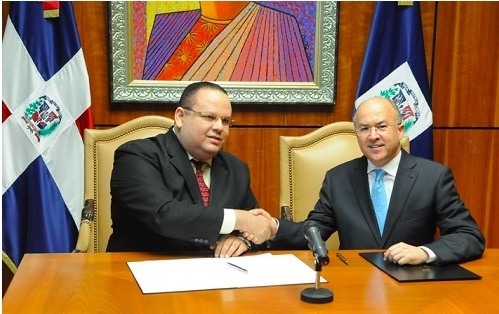
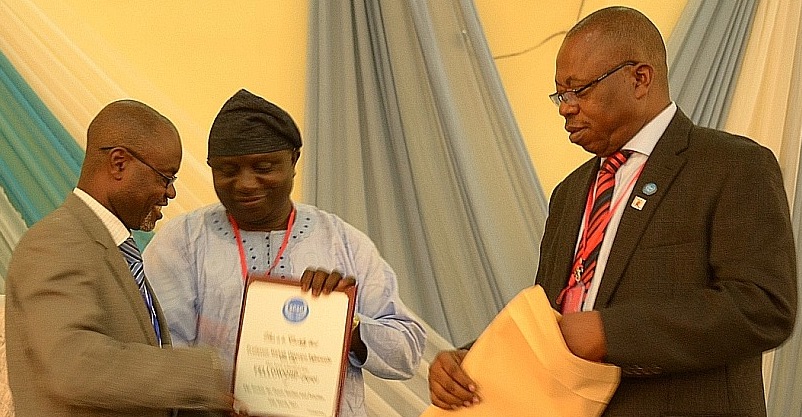
In this regard a joint cooperation agreement was signed by the Attorney General of the Republic Francisco Dominguez Brito and by FJT president Trajano Vidal Potentini Adames, and as a witness, the CEO of the National Conflict Resolution System of Public Prosecutions ((SINAREC), Angel Gomera.

Attorney General Dominguez Brito expressed his appreciation for the support and the willingness expressed by the Justice and Transparency Foundation to strengthen and expand the concept of reconciliation and conflict resolution as an alternative to the system of justice in cases of conflicts that can be resolved with understanding and respect for the dignity of each of the parties.

“This step contributes greatly to strengthening the justice of reconciliation in the Dominican Republic,” said the Head of Public Prosecutions.

For his part, Trajano Vidal Potentini highlighted the commitment of the authorities of the Attorney General to undertake what he called a new culture that established the Code of Criminal Procedure for the issue of reconciliation, which he described as essential for the development and harmony of the judicial system.

“We are very satisfied to be part of these efforts to establish a culture of peace, even more, of the community and in the neighborhoods to bring the good news that is developing in the direction of alternative dispute resolution,” said the FJT president.

As part of the commitment it was agreed to strengthen and disseminate community models that fit the needs, conditions and criteria for prospective or future centers of mediation, negotiation and conciliation in family, school, work and community order.

Also it was agreed to prepare and present a bill to support the application and development of alternative dispute resolution methods as a public policy to be implemented in the country.

The Public Ministry will ensure the presence of members of this institution trained in the application of the alternative methods of dispute resolution programs that are being developed by the foundation.

The agreement, which was signed at the headquarters of the Public Ministry in the Centro de los Héroes, will be effective for one year.

(Click here for a Spanish version of this article)

Question related to this article:

Rethinking Post-Election Peacebuilding in Africa

. DEMOCRATIC PARTICIPATION .

an article by Society for Peace Studies and Practice

The 9th International Conference and General Assembly of the Society for Peace Studies and Practice will take place from 9-13 August at the Igatius Ajuru University of Education in Port Harcourt, Rivers State, Nigeria. Its theme will be “Rethinking Post-Election Peacebuilding in Africa.”

The call for papers provides the following analysis:

There are three phases: pre-election, election, and post-election . . . Where the first two phases are well handled, the post- election environment is peaceful but where they are poorly managed, the post-election environment is usually crisis-ridden. Given that not much work exists on post-election questions and their management in Africa, the Society for Peace Studies and Practice would like to commit it 2015 to addressing this critical issue, shedding more light on the nature, impact and management of post-election environment in Africa. Our particular interest is how to build peace after elections. . .

How do we restore healthy relationship between political actors after elections? What should be the role of winners and losers of elections? What should be the role of the judiciary, political parties, the media, electoral management bodies, private but prominent citizens in preventing post-election violence and other forms of political instability? What are the existing global best practices in post-election peace building? There will be special panels on post-election peacebuiling in Nigeria covering the 1999, 2001, 2003, 2007, 2011 and 2015 elections. . .

The conference program will consist of Commissioned Papers (Plenary Session) and Open Theme/Special Panels (Parallel Sessions). Potential participants are therefore invited to submit abstract proposals to the organizers.

In the event of the abstract being accepted, the deadline for submission of full draft paper will be 30th May 2015. Details are available at http://www.spsp.org.ng .

The Society for Peace Studies and Practice (SPSP) is a Not-for-Profit organisation that promotes non-violent approach to conflict resolution, through multi-level research, advocacy and actions that strengthen local capacities that will bring about a sustainable culture of peace.

The Society began as the brainstorm of a group of passionate advocates of the postgraduate programme of the Peace and Conflict Studies, Institute of African Studies, University of Ibadan, in 2003 seeking to prioritize conflict management as a professional practice and how to streamline the ethics that will guide scholars and practitioners in the field of peace building.

Initially spearheaded by staff and student members from the University of Ibadan led by Professor Isaac Olawale Albert; the Society was formally initiated and registered with the Corporate Affairs Commission (CAC/IT/NO.21194) as a Not-For-Profit Civil Society in 2004 and has gained national outlook and acceptance with its network of branches spread all-over Nigeria and beyond.

Question related to this article:

How should elections be organized in a true democracy?

CPNN receives more and more articles from Africa about initiatives that contest the European model of “winner-takes-all” elections, and demand that elections should only be part of a broader democratic process that seeks consensus and compromise.

This fits with the pre-colonial systems of justice in Africa, when there was no monotheism and no single supreme god, no single supreme law, no single “truth” provided by divine intervention, but rather a compromise among many different “gods,” perspectives and “truths” arrived at through a process of mediation, for example, the “palabra.”

Ghana Youth Coalition wants politicians to commit to peace in 2012

Women’s World in Nationwide Sensitization [Sierra Leone]

Varsities vouch for peace ahead of general elections (Kenya)

Zimbabwe: Christian denominations launch peace initiative

Rethinking Post-Election Peacebuilding in Africa

Hibakusha of Japan nominated for Nobel Peace Prize

DISARMAMENT & SECURITY .

an article by Colin Archer Secretary‐General, International Peace Bureau (IPB)

To the Norwegian Nobel Committee.

I am pleased to convey to you the IPB’s nomination for the Nobel Peace Prize 2015. A total ban and the elimination of nuclear weapons was the task set out by the very first resolution of the first General Assembly of the United Nations (January 1946), a task that remains unfulfilled. Yet, as seen in the success of the international conferences on the humanitarian impact of nuclear weapons, held in Oslo in 2013 and in Nayarit and Vienna in 2014, momentum is building up once more, and promises to turn this 70th anniversary of the tragedies of Hiroshima and Nagasaki into a milestone on the path to a world free of nuclear weapons.


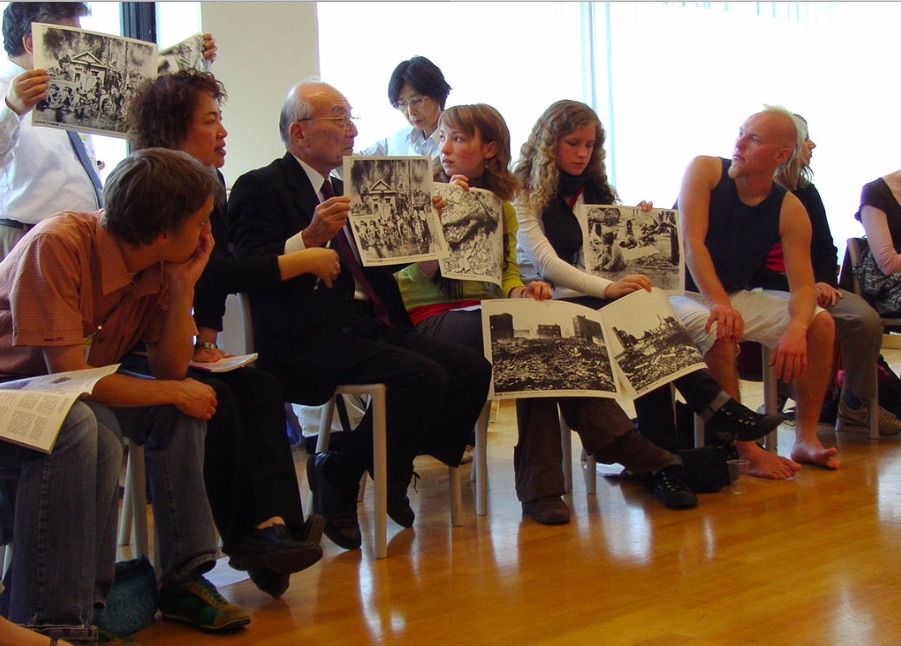
A hibakusha, a survivor of the atomic bombing of Nagasaki, tells young people about his experience and shows pictures. United Nations building in Vienna, during the NPT PrepCom 2007. Photo from Wikimedia Commons

For this reason IPB once again nominates for the Nobel Peace Prize the Hibakusha, those who personally suffered from the atomic bombings of the two cities. They are quite simply extraordinary human beings; not giving in to despair, they became convinced, through their struggle to survive the attacks and the subsequent long years of suffering, that their agonies must never be repeated anywhere. Over these 70 years they have made the choice of activism, unceasingly recounting their experiences and struggles, and working constantly for a total ban and the elimination of nuclear weapons, appealing to governments and peoples all over the world.

We nominate :

1) the Japan Confederation of A­- and H-­Bomb Sufferers Organizations (Nihon Hidankyo), a nationwide independent organization of the Hibakusha. Since its founding in August 1956, it has been working in unity, beyond the difference of beliefs and opinions, encouraging its members to help each other to promote the cause of a ban on atomic and hydrogen bombs, by making known their sufferings and struggles. Their activities are fully worthy of the name, “champion of peace”, in the light of the ideal of disarmament, for which Alfred Nobel established the Nobel Peace Prize.

2) (2) Mr. Sumiteru TANIGUCHI and (3) Ms. Setsuko THURLOW, outstanding representatives of the Hibakusha movement, who have been at the forefront of the efforts of the Hibakusha throughout their lives, calling for a ban and for the abolition of nuclear weapons, based on their own painful experiences.

Background details on all 3 nominees can be found at Annexes 1‐3, below.

IPB believes that the award of the Nobel Peace Prize to these courageous persons, and indeed to a courageous movement, would be a contribution of unique value and extraordinary importance to the worldwide community of nuclear disarmament advocates, itself 70 years old this year.

The continued existence of nuclear weapons threatens the very survival of life on earth. The Norwegian Nobel Committee has recognised this supreme threat in several of its previous awards. We urge the Committee, at this historic moment, to return to this theme and to itself make a courageous choice: to recognise and reward the Hibakusha.

(This article is continued in the discussion board on the upper right of this page)

(The following is continued from the article on the left.)


ANNEX 1: The Japan Confederation of A­ and H­Bomb Sufferers Organizations (Nihon Hidankyo) Address

Gable Bldg. #902 1‐3‐5 Shiba‐Daimon Minato‐ku Tokyo 105‐0012 Japan Phone: +81‐3‐3438‐1897
Fax: +81‐3‐3431‐2113
Email: kj3t‐tnk@asahi‐net.or.jp http://www.ne.jp/asahi/hidankyo/nihon/
Co­chairpersons
Sunao TSUBOI (Mr.) Sumiteru TANIGUCHI (Mr.) Prof. Mikiso IWASA (Mr.)
Secretary General:
Prof. Terumi TANAKA (Mr.)
Founding
August 10, 1956
Organization and Membership
NIHON HIDANKYO is the only nationwide organization of A‐bomb survivors of Hiroshima and Nagasaki (Hibakusha). It has member organizations in all 47 Japanese prefectures, thus representing almost all organized Hibakusha. Its officials and members are all Hibakusha. The total number of the surviving Hibakusha living in Japan is about 190,000, as of the end of 2014. Also there are Hibakusha living in Korea and other parts of the world outside Japan. HIDANKYO is cooperating with them in their effort to defend their living conditions and human rights.
Main Objectives
1) Prevention of nuclear war and the elimination of nuclear weapons, by way of an international agreement for a total ban and the elimination of nuclear weapons.
2) State compensation for the A‐bomb damages. The state responsibility of having launched the war, which led to the damage by the atomic bombing, should be acknowledged, and the state compensation provided.
3) Improvement of the policies and measures on the protection and assistance for the Hibakusha.
Major Activities
1) Telling stories of the Hibakusha to make known their experiences, actual damage and after‐effects of the A‐bombings both within and outside Japan; Sending A‐bomb sufferers to the U.N. and other international fora, nuclear‐weapon states and other countries;
2) Actions for the enactment of a Hibakusha‐aid law providing state compensation for the Hibakusha themselves and bereaved families; Running signature drives, marches, sit‐ins and other forms of action.
3) Providing counseling and other assistance to the Hibakusha in their difficulties on health and living.

Major Actions since the Founding
HIDANKYO has held dozens of petition actions every year to urge both the Japanese government and the Diet to take steps to make known to the world community the full dimension of the damage caused by the A‐bombings and take the lead in promoting public opinion for the prevention of nuclear war and the elimination of nuclear weapons. HIDANKYO also urges the Japanese government to admit Japan’s responsibility for having launched the war, which eventually led to the atomic bombing, and that it should provide state compensation for the bereaved families, as well as the sufferers on whom health damage was inflicted.
The “Hibakusha Aid Law” demanded by HIDANKYO, therefore, is to include a pledge that Japan would make every effort so that there would never be another Hibakusha anywhere.
HIDANKYO is playing a major role in the movement against A and H bombs. Not only taking part in a number of peace events during summer, HIDANKYO sends its representatives all over Japan, who bear witness to their A‐bomb experiences, helping to promote the public awareness on the need for a ban and the elimination of nuclear weapons. Internationally, HIDANKYO sends many Hibakusha overseas, to make heard their appeals for the prevention of nuclear war and the abolition of nuclear arms.
Hibakusha, sent by HIDANKYO, have made contributions to many important international forums, including two UN Special Sessions on Disarmament in 1982 and 1988, the NPT Review Conferences in 2005 and 2010 and its Preparatory Committee sessions, and the three International Conferences on Humanitarian Impact of Nuclear Weapons in March 2013 in Oslo, February 2014 in Nayarit, and December 2014 in Vienna.

Lancement du réseau jeunesse et culture de la paix en Afrique

LIBERTE DE L’INFORMATION

un article par l’UNESCO Département Afrique (abrégé)

Video: Youth and Culture of Peace in Africa

« On dit parfois que la jeunesse, c’est l’avenir – mais pour moi, la jeunesse, c’est le présent » a déclaré la Directrice générale le 13 décembre à Libreville, entourée de 90 jeunes africains et africaines en provenance d’une quarantaine de pays rassemblés à Libreville pour le Forum Panafricain « La jeunesse africaine et le défi de la promotion d’une culture de la paix ».

libreville
cliquez sur le photo pour l’élargir

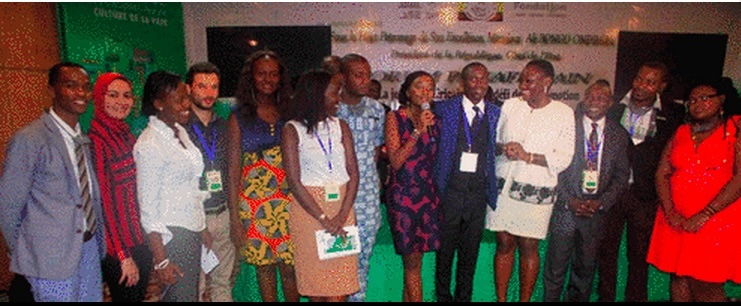
Jeunes participants au Forum

Le forum s’est tenu du 11 au 13 décembre au Gabon, en présence de Madame Pascaline Mferri Bongo Ondimba, Présidente d’honneur de la Fondation Omar Bongo Ondimba, Madame Ida Reteno Assonouet, Ministre de l’Education nationale et de l’Enseignement Technique et Professionnel, Présidente de la Commission Nationale Gabonaise pour l’UNESCO, Monsieur Anatole Collinet Makosso, Ministre congolais de la Jeunesse et de l’Instruction Civique et président en exercice de la du Comité technique spécialisé de la jeunesse, de la culture et des sports de l’Union Africaine, Madame Rosa Christiane Ossouka Raponda , Maire de Libreville, ainsi que Monsieur Forest Whitaker, Envoyé Spécial de l’UNESCO pour la paix et la réconciliation.

L’événement a été marqué par le lancement officiel du Réseau « Jeunesse et culture de la paix » constitué par les Conseils de la jeunesse et des organisations de la jeunesse d’Afrique et de la diaspora, engagés dans des actions de promotion d’une culture de la paix, dont le Gabon accueillera le Secrétariat.

Le Forum a également mis à l’honneur le renforcement du partenariat avec la Fondation « Whitaker Peace and Development Innitiative (WPDI), visant à promouvoir la capacité des jeunes à œuvrer à la paix et au développement dans leurs communautés au sein des pays en situation vulnérable. Forest Whitaker a pour sa part déclaré à l’intention des jeunes participants, « votre génération est celle qui fera croître les graines » de la paix et de la prospérité, « la seule limite que vous rencontrerez, c’est votre imagination.

La Fondation Omar Bongo Ondimba pour la paix, la science, la culture et l’environnement, a par ailleurs annoncé la création d’un prix international de la jeunesse pour la culture de la paix qui récompensera l’action de trois organisations de la jeunesse, qui se répartiront un montant de 45 millions CFA soit près de 85 000 USD.

Dans son allocution d’ouverture, Madame Bokova . . . a salué le travail des jeunes entamé trois mois auparavant sur une plateforme en ligne créée par l’UNESCO avec l’appui de la Fondation Omar Bongo Ondimba et de la Commission nationale gabonaise pour l’UNESCO. Très vite, les jeunes se sont appropriés cet outil pour débattre des activités conjointes de leur réseau ainsi que de son organisation. Ce travail préparatoire a mobilisé plus de 200 organisations de jeunesse d’Afrique et de la diaspora. Le rendez-vous de Libreville a permis de prolonger les discussions en ligne par une série de travaux participatifs et prospectifs qui leur ont permis d’envisager leurs stratégies à long terme. A travers ces innovations dans les méthodes de travail, les jeunes ont pu élaborer un plan d’action et un format de réseau qu’ils finaliseront au cours des mois à venir via la plateforme en ligne. A la fin du Forum, un bureau du Réseau a été mis en place avec deux délégués représentant chacune des 6 régions région d’Afrique, y compris la Diaspora.

Les jeunes du Réseau ont conclu la cérémonie en entonnant la chanson qui a rythmé tout leur Forum : « La guerre ne paie pas ; la paix veut nos bras ».

>Pour plus d’information, voir le dernier paragraph de l’article.

( Cliquez ici pour une version anglaise.)


Question related to this article.

Will UNESCO once again play a role in the culture of peace?

Most recent comment:

It is very appropriate that this new impulse for the culture of peace at UNESCO should come from Côte d’Ivoire, since the global movement for a culture of peace was initiated at a UNESCO conference in that country in 1989. See Yamoussoukro and Seville in the early history of the culture of peace.

Note added on September 2:

The official reports from the UNESCO Conference in Abidjian are now available:

English

French

Launch of the Network Youth and Culture of Peace in Africa

FREE FLOW OF INFORMATION

an article by UNESCO Priority Africa (abridged)

Video: Youth and Culture of Peace in Africa

“It is often said that youth is the future – but for me, youth is the present,” said the Director-General on 13 December in Libreville surrounded by 90 young African men and women, coming from forty countries for the Libreville Pan African Forum — “African youth and the challenge of promoting a culture of peace”.


Youth participants in the Forum

The Forum was held from 11 to 13 December in Gabon, with the participation of Pascaline Mferri Bongo Ondimba, Honorary President of the Omar Bongo Ondimba Foundation, Ida Reteno Assonouet Minister of National Education and Technical and Vocational Education, President of UNESCO’s National Commission for Gabon, Anatole Collinet Makosso, Congolese Minister of Civic Education and President of the Conference of Ministers of the African Union responsible for youth, Rose Christiane OSSOUKA RAPONDA, Mayor of Libreville as well as Forest Whitaker, UNESCO Special Envoy for peace and reconciliation.

The event was marked by the official launch of the “Youth and Culture of Peace” Network, made up of National Youth Councils and youth organizations from Africa and its Diaspora, engaged in actions aimed at promoting a culture of peace. Gabon will host its secretariat.

The Forum also celebrated the strengthening of the partnership with UNESCO Special Envoy Forest Whitaker’s Foundation for Peace and Reconciliation (WPDI), which aims to promote young people’s ability to work for peace and development in their communities within fragile states. Forest Whitaker said to the young participants: “your generation is the one that will grow the seeds” of peace and prosperity, “the only limit you will encounter is your imagination.”

The Omar Bongo Ondimba Foundation for Peace, Science, Culture and the Environment also announced the creation of an international youth prize for the culture of peace that will reward the action of three youth organizations, who will share a total of 45 million CFA (nearly 85 000 USD). . .

The work of young people began three months earlier on an online platform created by UNESCO with the support of the Foundation and Omar Bongo Ondimba of Gabon National Commission for UNESCO. Soon, the young people took ownership of the tool to discuss joint activities of their network and its organization. This preparatory work has mobilized more than 200 youth organizations from Africa and its Diaspora. The meeting of Libreville allowed online discussions to continue through a series of participatory and prospective work that enabled them to consider their long-term strategies. Through these innovations in the methods of work, young people were able to develop an action plan and a structure of the network that they will finalize in the coming months via the online platform. At the end of the Forum, a bureau of the network was elected with two delegates from each of the six regions of Africa region, including the Diaspora.

Young participants from the Network concluded the event by singing the song that guided their Forum: “War does not pay; peace wants our arms”.

( Click here for the French version.)


Question related to this article.

Will UNESCO once again play a role in the culture of peace?

Most recent comment:

It is very appropriate that this new impulse for the culture of peace at UNESCO should come from Côte d’Ivoire, since the global movement for a culture of peace was initiated at a UNESCO conference in that country in 1989. See Yamoussoukro and Seville in the early history of the culture of peace.

Note added on September 2:

The official reports from the UNESCO Conference in Abidjian are now available:

English

French

República Dominicana: Procuraduría y Fundación coordinan para cultura de paz

. PARTICIPACIÓN DEMOCRATICA .

un artículo de El Periodico

Con la finalidad de sumar esfuerzos para fortalecer el sistema de mediación de conflictos y fomentar la cultura del diálogo en el país, la Procuraduría General y la Fundación Justicia y Transparencia (FJT) implementarán una serie de acciones para la prevención y resolución alternativa de conflictos en el ámbito familiar, escolar, laboral y comunitario.

dominican
Haga clic en la foto para ampliarla

Así lo establece un acuerdo de cooperación conjunta que fue firmado por el procurador general de la República, Francisco Domínguez Brito; el presidente de la FJT, Trajano Vidal Potentini Adames, y como testigo, el director general del Sistema Nacional de Resolución de Conflictos del Ministerio Público ((SINAREC), Ángel Gomera.

El procurador general Domínguez Brito agradeció el apoyo y la voluntad manifestada por la Fundación Justicia y Transparencia de fortalecer y difundir todo lo que es el concepto de la conciliación y la resolución de conflictos, lo cual señaló es una alternativa al sistema de Justicia en casos que pueden corregirse mediante el entendimiento y el respeto a la dignidad de cada una de las partes.

“Con este paso se contribuye enormemente al fortalecimiento de la justicia de conciliación en la República Dominicana”, manifestó el máximo representante del Ministerio Público.

De su lado, Trajano Vidal Potentini resaltó el empeño de las autoridades de la Procuraduría General de cuidar lo que definió como una nueva cultura que instauró el Código Procesal Penal para el tema de la conciliación, lo cual calificó de fundamental para el desarrollo y la armonía del sistema judicial.

“Para nosotros formar parte de estos esfuerzos de instaurar la cultura de paz, más aún, de llevar a nivel comunitario y a los barrios las buenas nuevas que se están desarrollando en el sentido de la resolución alternativa de conflictos, resulta de gran satisfacción”, expresó el presidente de la FJT.

Como parte del compromiso asumido se acordó fortalecer y difundir los modelos comunitarios que se adecúen a las necesidades, condiciones y criterios de los eventuales o futuros centros de mediación, negociación y conciliación en el orden familiar, escolar, laboral y comunitario.

Igualmente se impulsará la elaboración y presentación de un anteproyecto de ley que sustente la aplicación y desarrollo de los métodos alternos de resolución de conflictos como política pública de aplicación en el territorio nacional.

El Ministerio Público garantizará la presencia de miembros de esta institución capacitados en la aplicación de los métodos alternos de resolución de conflictos en los programas que la fundación desarrolle.

Un año de duración tendrá de vigencia el convenio, que fue firmado en la sede del Ministerio Público, en el Centro de los Héroes.

( Clickear aquí para la version inglês)

Pregunta(s) relacionada(s) al artículo

Restorative justice, What does it look like in practice?

Comentario más reciente:

On this theme, I encourage CPNN readers to read Restorative Justice for Children in Brazil.

Le Centre de la paix organise de soutien pour les enfants de Gaza

.DESARMAMENT & SECURITE.

un article par ziad medoukh

Le dimanche 25 janvier 2015, sept jeunes du Centre de la paix : Ahmed Jamal, Baràa Abou Khoussa , Hind Harazine , Iman Ryach, , Mahmoud Dhaher, Ola Atta , et Rawan Shawa , ont organisé une séance de soutien psychologique pour les dizaines d’enfants de la ville de Gaza.
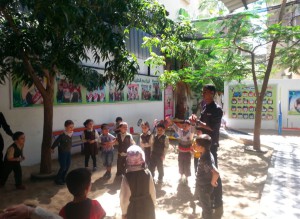
palestine
cliquez sur le photo pour l’élargir

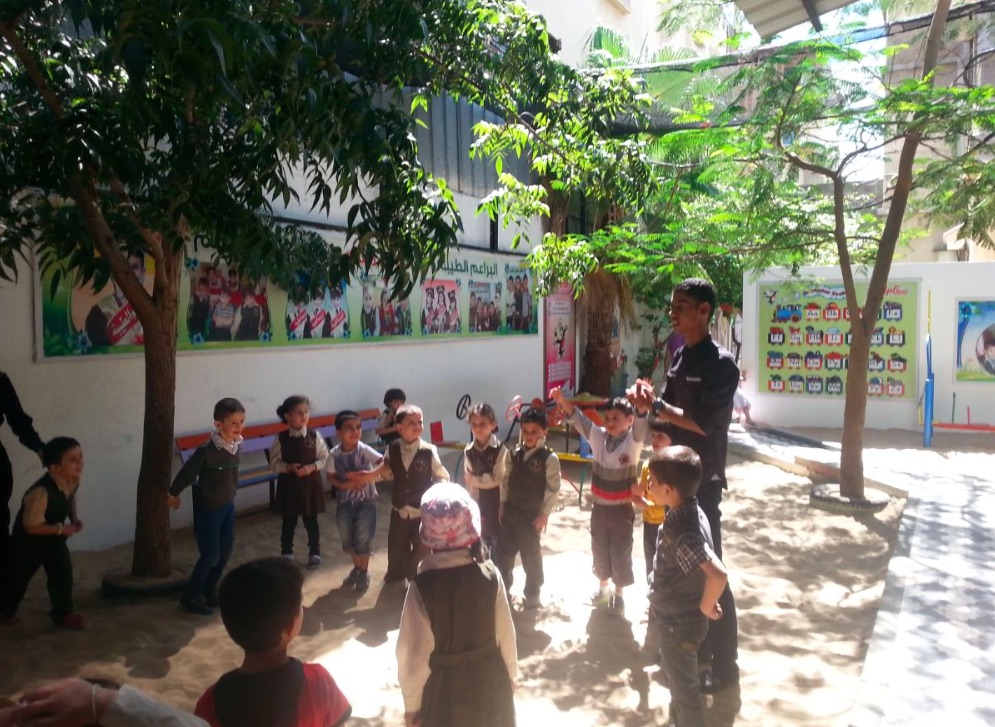
L’activité qui a duré trois heures s’est déroulée dans le jardin d’enfants (les petits anges) du quartier défavorisé Al- Tofah, Les 60 petits participants ont été très attentifs et très intéressés.

L’équipe formée au Centre en septembre 2014, et qui s’occupe de différents centres d’accueil de la bande de Gaza, leur a proposé plusieurs activités.

Avec du matériel scolaire, différents objets et jouets, elle a organisé des ateliers et des activités variés : théâtre, dessin sur le visage , sur des cahiers et sur le mur, concours, jeux, activités sportives, chansons, musique, échanges, jeu de rôle animations, expression dramatique et lecture de bandes dessinées.

Les enfants ont suivi avec beaucoup d’intérêt les différentes activités proposées par les jeunes du Centre, ils ont oublié leur timidité et se sont bien intégrés dans le groupe.

La directrice de la structure enfantine a remercié les intervenants pour leur talent et leur créativité, elle a constaté que les enfants avaient beaucoup changé dans leur comportement après cette séance d’animation. Elle leur a demandé de revenir une autre fois afin d’assurer d’autres animations pour les enfants et leurs mères.

( Cliquez ici pour une version anglaise.)


Question related to this article.

Presenting the Palestinian side of the Middle East, Is it important for a culture of peace?

How are the Palestinians responding to the latest attacks?

CPNN has received the following Statement from the National Coalition of
Christian Organizations in Palestine on the situation: Support Gaza’s Right to Life

“Justice and security are two sides of the same coin. Israel’s security can never be an excuse for denying justice to the Palestinian people.”

In the spirit of the living God who sanctifies all life and in keeping with our faith and its teachings we appeal to all people across the world to work with their fellow citizens and governments to end Israel’s Operation Protective Edge and the brutal military siege that has been going on for the past seven years which includes a naval and economic blockade. Gaza has no port or airport thus no way to import or export its products.

This not a war. This is only vengeance and collective punishment. A responsible authority works to stop useless vengeance and violence. Instead, it fosters general atmosphere of incitement, in order to please a Palestinian hating population, and not knowing what to do, the irresponsible Israeli Authority, just kills Palestinians and demolishes their houses, in order to please their people. We acknowledge the voice and action of the few Israelis who expressed themselves against this policy of their government.

This is not an escalation or a war. Gaza has no military or ability to protect itself other than to fire some homemade rockets. The 1.7 million people, mostly children (2/3 of the population) are also mostly refugees (1.1 million) from areas of 1948 and 1967. Furthermore under the 4th Geneva Convention Palestinians, as a militarily occupied people, have the right to defend themselves.

Our justice loving God demands us to speak out on behalf of the security for all people. In the name of the Advocate Spirit, we ask you to speak out now to call a halt to this long term offensive operation which aims to wipe out a lonely, besieged and unarmed people. Whether you think the new unity government is viable or not, or if Hamas is a terrorist organization or not, or whether you think they might have been behind the death of the three Israeli teens murdered near Hebron, (which is not proven so far) it is against international law to collectively punish or target an already besieged 1.7 millon population. It is inhumane. It is a war crime.

As of July 10th, the date of this Appeal Israeli military struck 430 targets across the Gaza Strip. 77 people have been reported dead and more than 500 wounded.. The majority of the dead are civilians. 18 are children including a baby one month old.

We pray for the memory of those killed. Each of them has a name and a family who is suffering great loss. We also pray for all those wounded or injured in body, mind, or spirit. We pray for solace and comfort also for the families whose homes, businesses, agricultural fields, or fishing boats that have also been destroyed. We pray for the people of Gaza and ask that God be with them.

Support Palestinian’s right to life by joining with Christians throughout the world in their call for a just peace in this land that all call holy. We have been down this road one too many times and know what will happen if we fail to act. Please join us through letters and petitions to your government officials to raise awareness about this offensive military operation and Gaza’s ongoing siege. Ask them to pressure Israel to stop its
brutal assault or face sanctions from the international community.

Support Palestinian’s right to life, say with a loud voice: stop killing and demolishing houses. Join with Christians throughout the world in their call for a just peace in this land that all call holy.

Quote from article by Jeremy Corbynn,, “Who Mourns for Palestine”

NCCOP

Jerusalem
· Arab Catholic Scouts Group
· Arab Orthodox Society – Jerusalem
· Caritas- Jerusalem
· Department of Service to Palestinian Refugees- Middle East Council of
Churches
· Greek Catholic Sayedat AlBishara Association
· International Christian Committee
· Laity Committee in the Holy Land
· National Christian Association
· Pontifical Mission Palestine
· SABEEL – Ecumenical Liberation Theology Center
· Seeds of Better life
· Union of Arab Orthodox Club – Jerusalem
· Young Men’s Christian Association –YMCA
· Young Women’s Christian Association –YWCA

Gaza
NECC office

Bethlehem (NCOB)
Network of Christian Organizations in Bethlehem
· The East Jerusalem YMCA /Beit Sahour Branch
· The Arab Educational Institute,
· Holy Land Trust, Bethlehem
· Wi’am Center, Bethlehem
· Saint Afram Assyrian Society,
· Holy Land Christians Ecumenical Foundation, Bethlehem
· Al-Ihsan Arab Orthodox Society, Beit Jala
· Arab Orthodox Club, Beit Sahour
· Arab Orthodox Club, Beit Jala
· Arab Orthodox Club, Bethlehem
· The Arab Orthodox Charitable Society, Beit Sahour
· Bethlehem Bible College
· Siraj Center for Holy Land Studies
· Alternative Tourism Group, ATG, Beit Sahour
· Senior Citizen Charitable Society
· Environmental educational Center, Beit Jala
· Saint Vincent Charitable Society, Beit Jala
· Shepherds’ Children Society, Beit Sahour
and KAIROS PALESTINE