Tag Archives: global

Global Feast for Peace, held annually during Peace Week, Sept. 15-21

DISARMAMENT & SECURITY .

An article from the International Cities of Peace

International Day of Peace, September 21st of each year, was created by a United Nations Resolution in the 1980s and has grown to become a day of global celebration, education, and reflection on peace in local communities and throughout the world. During Peace Week, Sept. 15-21, families, friends, organizations, as well as cities, towns, and villages across the world gather and break bread together in a Global Feast for Peace.

Arment

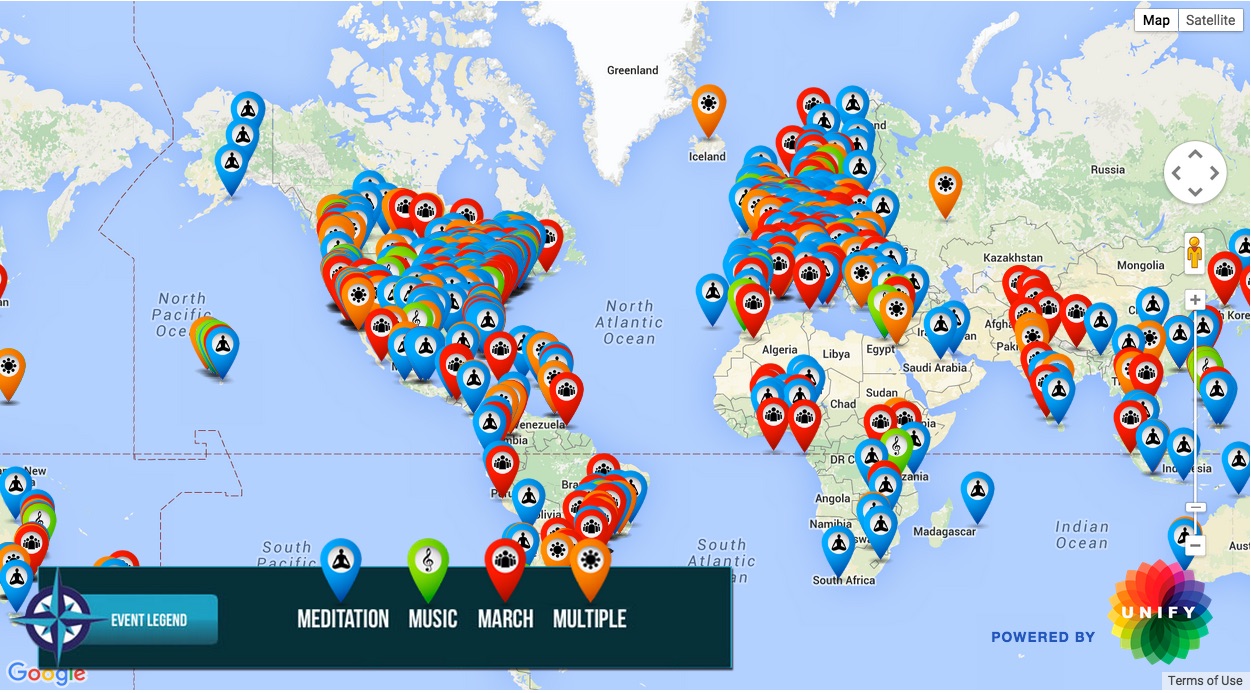
ADD YOUR CITY TO THE MAP OF CITIES HAVING A FEAST FOR PEACE!

Sharing food together in celebration of friendship and common interest is a tradition as old as the human family. The Global Feast for Peace is part of the U.N. sponsored International Day of Peace, celebrated around the world on September 21st each year. Whether it’s a small family celebration or a large community gathering, the Feast for Peace is a simple and profound expression of peace that everyone, no matter how humble or blessed their circumstances, can connect with and enliven the global celebration. Feast for peace!

Who can participate?

• Families, neighborhoods, communities, and cities
• Organizations, including faith-based, interfaith and secular
• Businesses, both for-profit and not-for-profit
• Schools from nursery schools to higher education
• Anyone who wishes to express their wish for peace

What to do?

Join together during International Day of Peace or during Peace Week. The gathering can be a formal lunch or a group potluck where people bring a dish and share. Other events can be planned before, during, and/or after the Global Feast, including bell ringing, speakers, musical events, meditations and prayers, moments of silence and other activities that foster a culture of peace.

When to celebrate and plan?
Each year, there are thousands of celebrations around the world. Planning for the Global Feast should begin weeks or, better, several months ahead in order to involve as many people as possible.

Where to have the Feast?
The place for the Feast can be as small as a family dining room or as large as an amphitheater. One person can even Feast for Peace at home!

Why plan a Global Feast?
To come together as members of the human family; to honor those who have worked and who are working today for a more peaceful world; to encourage the next generation of peacebuilders. The Global Feast for Peace is a thanksgiving of the peace we have and to inspire actions to foster a culture of peace during the coming year.

To Register Your Event:
Send info to: story@internationalcitiesofpeace.org
Join our Facebook Page: https://www.facebook.com/pages/Global-Feast-for-Peace/490665730993992

Initiated by members of the Peace Cities Subcommittee of the IDP NGO for United Nations International Day of Peace.

Question for this article:

The Elders urge world leaders to take bold and decisive action on climate in 2015

. . SUSTAINABLE DEVELOPMENT . .

A press release from The Elders

Ahead of the UN Sustainable Development Goals summit, The Elders call on world leaders to agree on a common approach that yields a “radical and sustainable” plan to tackle climate change.

elders

In a letter to heads of state and government attending the launch of the new UN Sustainable Development Goals in New York on 26 September, The Elders told leaders:

“2015 is the year in which the community of nations will conclude two of the most important international processes of our times […] You have a decisive role to play in charting the course of history.”

The Sustainable Development Goals are the successors to the UN’s Millennium Development Goals which ran from 2000 to 2015. The COP 21 summit in Paris in December is seen by scientists as the last opportunity to commit to meaningful action to prevent a future climate catastrophe.

The Elders warned:

“If action is not taken immediately to stop and reverse current climate trends, we shall face a world with average global temperatures several degrees higher than when we were children.”
Specifically, they urged leaders attending the launch of the SDGs to:

– Inject a new sense of urgency into the Paris negotiations to secure an international binding agreement that would limit the increase in average global temperature to less than two degrees Celsius;

Establish a goal for all nations to reach carbon neutrality by 2050 and agree a timetable to phase out fossil fuel subsidies, with early action on coal;

– Commit to mechanisms within the Paris agreement that can assess progress and ratchet up the commitment of all signatories on climate mitigation and adaptation efforts every five years;

– Approve a financial package that increases investment in clean energy and supports climate adaptation by poor countries.

Even at this late stage, The Elders believe that transformative leadership can yield radical and sustainable results, telling heads of state and government:

“You can prove to be an historic generation of leaders who will have a profound and positive impact that echoes throughout the century […] the courage and conviction you show will be remembered for decades to come.”

(Thank you to Janet Hudgins, the CPNN reporter for this article.)

Question for this article:

ICRC re Arms Trade Treaty: We must stop irresponsible arms trade or transfers

DISARMAMENT & SECURITY .

A declaration by the International Committee of the Red Cross

First Conference of the States Parties to the Arms Trade Treaty, Cancun, Mexico, 24-27 August 2015. Statement delivered by Peter Maurer, President of the ICRC, as a video address at the Conference.

icrc-english-french
ICRC Video

I am honored to be addressing you today on this historic occasion of the First Conference of the States Parties to the Arms Trade Treaty (ATT), a treaty that promises to reduce the tremendous human suffering caused by the widespread and poorly regulated availability of conventional weapons.

The ATT establishes a global norm for responsible arms transfers. By requiring States Parties to consider respect for international humanitarian law and human rights law in their arms transfer decisions and to take measures to prevent the diversion of weapons, this Treaty will help to ensure that arms do not end up in the hands of those who would use them to commit war crimes, serious violations of human rights and other serious crimes.

In adopting the ATT, States have recognized that arms and ammunition can no longer be regarded as just another form of commercial goods. They have recognized that arms transfers require particular caution because of the devastating and irreparable harm that is caused when weapons fall into the wrong hands. And they have explicitly recognized that cooperation, transparency and information sharing underpin the responsible arms trade, and are critical to building confidence among States and therefore to the Treaty’s effectiveness.

The ATT’s aim to increase responsibility and transparency in the international trade in conventional arms will depend not only on the implementation of the Treaty’s requirements by States Parties, but also on the openness and transparency of the forums set up under the Treaty to review its implementation and operation, notably of the Conference of the States Parties. A strong level of transparency, notably in the initial and annual reports required under the Treaty, and in the review of the operation of the Treaty by the Conference of the States Parties will facilitate cooperation and build the confidence necessary for the Treaty’s success. The ICRC urges States Parties to keep this in mind in the decisions that they will take this week, notably on the rules of procedure and on the reporting mechanism.

(Article continued on the right column)

(Click here for a version of this article in French or here for a version in Spanish.)

Question for this article:

Do you think handguns should be banned?, Why or why not?

(Article continued from the left column)

The significance of the ATT, and the milestone that this First Conference of the States Parties represents, cannot be overstated. If we have reached this point today, it is thanks to all those who have worked tirelessly over the last decade and a half to make this Treaty a reality: the States that drove the process leading to the ATT’s adoption; the United Nations and the International Red Cross and Red Crescent Movement, which each drew attention to the high human costs of poorly controlled arms transfers; and, of course, the non-governmental organizations which first called for an arms trade treaty some fifteen years ago. In this respect, the crucial role played by the “Control Arms” coalition of NGOs in bringing about the ATT, and the invaluable expertise and assistance that they are now providing to universalization and implementation efforts, must be recognized.

The concerted efforts of States, international organizations, NGOs and the ICRC must be sustained and hopefully increased in the Treaty’s implementation phase, of which this First Conference of the States Parties is the starting point. Our work has only just begun. Not only must we strive to achieve the broadest possible adherence to the Treaty, notably by States involved in the arms trade, but also crucially we must ensure that the Treaty’s core obligations are faithfully implemented, notably through the establishment of robust national control systems.

In this regard, I remain concerned about the gap that subsists between the duty to ensure respect for international humanitarian law in arms transfers, and the actual transfer practices of too many States. The ICRC is directly confronted with this gap, in many countries where we witness the appalling consequences for civilians of the widespread availability and misuse of weapons, which facilitate violations of international humanitarian law, endanger vital medical and humanitarian assistance, provoke displacement and prolong armed conflicts. As weapons continue to flow, either through overt or covert transfers or through diversion, to some of the most brutal armed conflicts such as those seen in parts of the Middle East and of Africa today, there is an urgent need to close the gap between law and practice.

The true measure of success of the ATT is the extent to which this gap will be filled and the Treaty changes people’s lives in the years to come. If States were to join the Treaty but continue to transfer arms to belligerents with a record of committing war crimes or serious violations of human rights, this would severely undermine the ATT’s humanitarian purpose and its credibility.

UN: High Level Forum on a Culture of Peace

FREE FLOW OF INFORMATION

A letter from the The President of the UN General Assembly

To all permanent representatives and permanent observers to the United Nations New York

Further to my letter dated 27 July 2015 on the convening of a High-Level Forum on a culture of Peace on 9 September 2015 at the United Nations Headquarters in New York, I have the pleasure to transmit herewith a Concept Note with more details.

HLF

As the international community moves toward the adoption of a transformative post-2015 development agenda by world leaders at a Summit in September 2015, the important linkage between peace and development has been underscored in the Sustainable Development Goals.

The High-Level Forum will highlight the importance of implementation of the Declaration and Programme of Action on a Culture of Peace and the need to further strengthen global movements to promote a culture of peace.

I have the honor to invite Member States and Observers to participate at the highest possible level. A provisional program will be provided in due course.

Please accept the assurances of my highest consideration.

Sam K. Kutesa, 12 August 2015

[Editor’s note: Click here for the Concept Note, which indicates that the Forum will have two panels: Promotion of the Culture of Peace in the context of the Post-2015 sustainable development agenda; and Role of the media in the promotion of the culture of peace.

Question(s) related to this article:

UN: Worldwide displacement hits all-time high as war and persecution increase

… HUMAN RIGHTS …

An article from The Office of the United Nations High Commissioner for Refugees

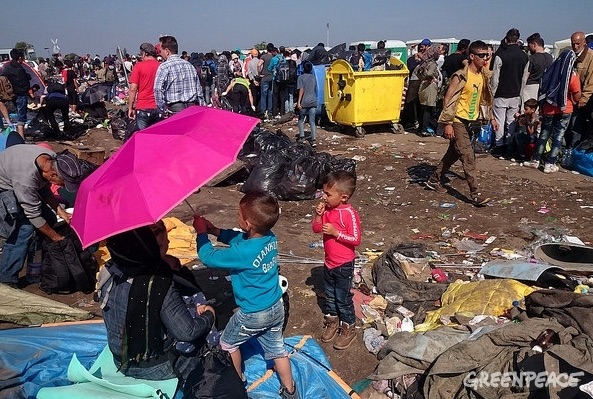
Wars, conflict and persecution have forced more people than at any other time since records began to flee their homes and seek refuge and safety elsewhere, according to a new report from the UN refugee agency. UNHCR’s annual Global Trends Report: World at War, released on Thursday (June 18), said that worldwide displacement was at the highest level ever recorded. It said the number of people forcibly displaced at the end of 2014 had risen to a staggering 59.5 million compared to 51.2 million a year earlier and 37.5 million a decade ago.

unhcr-english

The increase represents the biggest leap ever seen in a single year. Moreover, the report said the situation was likely to worsen still further.

Globally, one in every 122 humans is now either a refugee, internally displaced, or seeking asylum. If this were the population of a country, it would be the world’s 24th biggest.

“We are witnessing a paradigm change, an unchecked slide into an era in which the scale of global forced displacement as well as the response required is now clearly dwarfing anything seen before,” said UN High Commissioner for Refugees António Guterres.

Since early 2011, the main reason for the acceleration has been the war in Syria, now the world’s single-largest driver of displacement. Every day last year on average 42,500 people became refugees, asylum seekers, or internally displaced, a four-fold increase in just four years.

“It is terrifying that on the one hand there is more and more impunity for those starting conflicts, and on the other there is seeming utter inability of the international community to work together to stop wars and build and preserve peace,” Guterres added.

The UNHCR report detailed how in region after region, the number of refugees and internally displaced people is on the rise. In the past five years, at least 15 conflicts have erupted or reignited: eight in Africa (Côte d’Ivoire, Central African Republic, Libya, Mali, northeastern Nigeria, Democratic Republic of Congo, South Sudan and this year in Burundi); three in the Middle East (Syria, Iraq, and Yemen); one in Europe (Ukraine) and three in Asia (Kyrgyzstan, and in several areas of Myanmar and Pakistan).

“Few of these crises have been resolved and most still generate new displacement,” the report noted, adding that in 2014 only 126,800 refugees were able to return to their home countries — the lowest number in 31 years.
Meanwhile, decades-old instability and conflict in Afghanistan, Somalia and elsewhere means that millions of people remain on the move or – as is increasingly common – stranded for years on the edge of society as long-term internally displaced or refugees.

One of the most recent and highly visible consequences of the world’s conflicts and the terrible suffering they cause has been the dramatic growth in the numbers of refugees seeking safety through dangerous sea journeys, including on the Mediterranean, in the Gulf of Aden and Red Sea, and in Southeast Asia.

Half of all refugees are children

The Global Trends report detailed that in 2014 alone 13.9 million people became newly displaced – four times the number of the previous year. Worldwide there were 19.5 million refugees (up from 16.7 million in 2013), 38.2 million were displaced inside their own countries (up from 33.3 million in 2013), and 1.8 million people were awaiting the outcome of claims for asylum (against 1.2 million in 2013).

Most alarmingly, however, it showed that over half the world’s refugees are children.

(Article continued on right side of page.)

(Click here for the French version of this article.)

Question(s) related to this article:

The refugee crisis, Who is responsible?

What is the state of human rights in the world today?

(Article continued from left side of page.)

“With huge shortages of funding and wide gaps in the global regime for protecting victims of war, people in need of compassion, aid and refuge are being abandoned,” warned Guterres. “For an age of unprecedented mass displacement, we need an unprecedented humanitarian response and a renewed global commitment to tolerance and protection for people fleeing conflict and persecution.”

Syria is the world’s biggest producer of both internally displaced people (7.6 million) and refugees (3.88 million at the end of 2014). Afghanistan (2.59 million) and Somalia (1.1 million) are the next biggest refugee source countries.

Almost nine out of every 10 refugees (86 per cent) are in regions and countries considered economically less developed.

Europe (up 51%)

Conflict in Ukraine, a record 219,000 Mediterranean crossings, and the large number of Syrian refugees in Turkey – which in 2014 became the world’s top refugee-hosting nation with 1.59 million Syrian refugees at year’s end – brought increased public attention, both positive and negative, to questions to do with refugees.

In the EU, the biggest volume of asylum applications was in Germany and Sweden. Overall, forced displacement numbers in Europe totalled 6.7 million at the end of the year, compared to 4.4 million at the end of 2013, and with the largest proportion of this being Syrians in Turkey and Ukrainians in the Russian Federation.

Middle East and North Africa (up 19%)

Syria’s ongoing war, with 7.6 million people displaced internally, and 3.88 million people displaced into the surrounding region and beyond as refugees, has alone made the Middle East the world’s largest producer and host of forced displacement. Adding to the high totals from Syria was a new displacement of least 2.6 million people in Iraq and 309,000 newly displaced in Libya.

Sub-Saharan Africa (Up 17%)

Africa’s numerous conflicts, including in Central African Republic, South Sudan, Somalia, Nigeria, Democratic Republic of Congo and elsewhere, together produced immense forced displacement totals in 2014, on a scale only marginally lower than in the Middle East.

In all, sub-Saharan Africa saw 3.7 million refugees and 11.4 million internally displaced people, 4.5 million of whom were newly displaced in 2014. The 17 per cent overall increase excludes Nigeria, as methodology for counting internal displacement changed during 2014 and it could not be reliably calculated. Ethiopia replaced Kenya as the largest refugee-hosting country in Africa and the fifth largest worldwide.

Asia (up 31%)

Long one of the world’s major displacement producing regions, the number of refugees and internally displaced people in Asia grew by 31 per cent in 2014 to 9 million people. Continuing displacement was also seen in and from Myanmar in 2014, including of Rohingya from Rakhine state and in the Kachin and Northern Shan regions. Iran and Pakistan remained two of the world’s top four refugee hosting countries.

Americas (up 12%)

The Americas also saw a rise in forced displacement. The number of Colombian refugees dropped by 36,300 to 360,300 over the year, although mainly because of a revision in the numbers of refugees reported by Venezuela. Colombia continued, nonetheless to have one of the world’s largest internally displaced populations, reported at 6 million people and with 137,000 Colombians being newly displaced during the year. With more people fleeing gang violence or other forms of persecution in Central America, the United States saw 36,800 more asylum claims than in 2013, representing growth of 44 per cent.

The full Global Trends report with this information and more, and including data on individual countries, demographics, numbers of people returning to their countries, and available estimates of stateless population is available at < href="http://unhcr.org/556725e69.html">http://unhcr.org/556725e69.html.

UN: Consensus Reached on New Sustainable Development Agenda to be adopted by World Leaders in September

. . SUSTAINABLE DEVELOPMENT . .

An article by the United Nations Development Program

The 193 Member States of the United Nations reached agreement today [August 2 ]on the outcome document that will constitute the new sustainable development agenda that will be adopted this September by world leaders at the Sustainable Development Summit in New York.

UNDP

Concluding a negotiating process that has spanned more than two years and has featured the unprecedented participation of civil society, countries agreed to an ambitious agenda that features 17 new sustainable development goals that aim to end poverty, promote prosperity and people’s well-being while protecting the environment by 2030.

UN Secretary-General Ban Ki-moon welcomed the agreement, saying it “encompasses a universal, transformative and integrated agenda that heralds an historic turning point for our world.”

“This is the People’s Agenda, a plan of action for ending poverty in all its dimensions, irreversibly, everywhere, and leaving no one behind. It seeks to ensure peace and prosperity, and forge partnerships with people and planet at the core. The integrated, interlinked and indivisible 17 Sustainable Development Goals are the people’s goals and demonstrate the scale, universality and ambition of this new Agenda.”

Mr. Ban said the September Summit, where the new agenda will be adopted, “will chart a new era of Sustainable Development in which poverty will be eradicated, prosperity shared and the core drivers of climate change tackled.”

He added that the UN System stands ready to support the implementation of the new agenda, which builds on the successful outcome of the Third International Conference on Financing for Development in Addis Ababa, and which, he said, will also contribute to achieve a meaningful agreement in the COP21 in Paris in December.
UNDP Administrator Helen Clark said “This agreement marks an important milestone in putting our world on an inclusive and sustainable course. If we all work together, we have a chance of meeting citizens’ aspirations for peace, prosperity, and wellbeing, and to preserve our planet.”

More than 150 world leaders are expected to attend the Sustainable Development Summit at the UN headquarters in New York between 25 to 27 September to formally adopt the outcome document of the new sustainable agenda.

The new sustainable development agenda builds on the success of the Millennium Development Goals, which helped more than 700 million people escape poverty. The eight Millennium Development Goals, adopted in 2000, aimed at an array of issues that included slashing poverty, hunger, disease, gender inequality, and access to water and sanitation by 2015.

The new sustainable development goals, and the broader sustainablity agenda, go much further, addressing the root causes of poverty and the universal need for development that works for all people.

The preamble of the 29-page text, “Transforming Our World: The 2030 Agenda for Sustainable Development,” states, “We are resolved to free the human race from the tyranny of poverty and want and to heal and secure our planet.” It continues, “We are determined to take the bold and transformative steps which are urgently needed to shift the world onto a sustainable and resilient path. As we embark on this collective journey, we pledge that no one will be left behind.”

Rio+20 and the intergovernmental process

At the Rio+20 Conference of 2012, Member States agreed to launch a process to develop a set of sustainable development goals, which will build upon the Millennium Development Goals. The Millennium Development Goals have proven that goal-setting can lift millions out of poverty, improve well-being and provide vast new opportunities for better lives. It was agreed that the new goals would be global in nature and universally applicable to all countries while taking into account different national realities, capacities and levels of development and respecting national policies and priorities.

(Article continued in the right side of the page)

( Click here for the French version of this article or here for the Spanish version.)

Question for this article:

Can UN agencies help eradicate poverty in the world?

(Article continued from the left side of the page)

The negotiations were co-facilitated by the UN Permanent Representative of Ireland, Ambassador David Donohue, and the UN Permanent Representative of Kenya, Ambassador Macharia Kamau, over two years. The inclusive and transparent consultations by Member States, with the strong engagement of civil society and other stakeholders, have served as a basis for the conclusion of the intergovernmental negotiations on the emerging universal and people-centred agenda.

Core elements of the agreed outcome document

The outcome document highlights poverty eradication as the overarching goal of the new development agenda and has at its core the integration of the economic, social and environmental dimensions of sustainable development. The emerging development agenda is unique in that it calls for action by all countries, poor, rich and middle-income. Member States pledge that as they embark on this collective journey, no one will be left behind. The ‘five Ps’—people, planet, prosperity, peace, and partnership—capture the broad scope of the agenda.

The 17 sustainable goals and 169 targets aim at tackling key systemic barriers to sustainable development such as inequality, unsustainable consumption and production patterns, inadequate infrastructure and lack of decent jobs. The environmental dimension of sustainable development is covered in the goals on oceans and marine resources and on ecosystems and biodiversity, bringing core issues into the goal and target framework.

The means of implementation outlined in the outcome document match its ambitious goals and focus on finance, technology and capacity development. In addition to a stand-alone goal on the means of implementation for the new agenda, specific means are tailored to each of the sustainable development goals.

Member States stressed that the desired transformations will require a departure from “business as usual” and that intensified international cooperation on many fronts will be required. The agenda calls for a revitalized, global partnership for sustainable development, including for multi-stakeholder partnerships. The agenda also calls for increased capacity-building and better data and statistics to measure sustainable development.

An effective follow-up and review architecture – a core element of the outcome document – will be critical to support the implementation of the new agenda. The High Level Political Forum on sustainable development, set up after the Rio+20 Conference, will serve as the apex forum for follow up and review and will thus play a central role. The General Assembly, the Economic and Social Council and specialized agencies will also be engaged in reviewing progress in specific areas.

Based on the outcome document, the agenda will include a Technology Facilitation Mechanism to support the new goals, based on multi-stakeholder collaboration between Member States, civil society, business, the scientific community, and the UN system of agencies. The Mechanism, which was agreed at the Addis Conference in July, will have an inter-agency task team, a forum on science, technology and innovation, and an on-line platform for collaboration.

The successful outcome of the Addis Conference gave important positive momentum to the last stretch of negotiations on the post-2015 development agenda. It is expected that the consensus reached on the outcome document will provide momentum for the negotiations on a new binding climate change treaty to culminate at the Climate Change Conference in Paris from 30 November to 11 December 2015.

The draft agreement can be found here.

World unites to fight wildlife crime as UN adopts historic resolution

. SUSTAINABLE DEVELOPMENT .

An article by WWF (reprinted according to Creative Commons Attribution)

Faced with an unprecedented surge in wildlife crime, the UN today adopted a historic resolution committing all countries to ramp up their collective efforts to end the global poaching crisis and tackle the vast illegal wildlife trade. Initiated by Gabon and Germany and co-sponsored by 84 other nations, the UN General Assembly resolution, Tackling the Illicit Trafficking in Wildlife, is the result of three years of diplomatic efforts and is the first time that every nation has acknowledged the seriousness of wildlife crime and the urgent need to join forces to combat it.

wildlife
caption: © Sarah Goddard / WWF

“The UN resolution marks a new phase in the fight against wildlife crime, which is threatening countless species with extinction while jeopardizing national security and sustainable development,” said Marco Lambertini, Director General of WWF International. “This landmark resolution proves that ending wildlife crime is no longer just an ‘environmental’ issue and not just limited to a few countries: it has become a priority for every nation.”

With elephant populations collapsing in Mozambique and Tanzania and record numbers of rhinos being killed in South Africa, the poaching crisis is clearly undermining global conservation efforts. But the UN resolution also spells out the broader effects of wildlife crime, which undermines good governance, the rule of law and the well-being of local communities as well as financing criminal networks and funding armed conflict.

“Just weeks before the UN meets to finalize the Sustainable Development Goals, it is significant that every country has signed up to tackle the growing threat organized wildlife crime poses to sustainable development,” said Lambertini.

Recognizing that only a comprehensive approach can curb the current crisis, all 193 UN member states agreed to enhance regional and international cooperation along the entire illegal wildlife trade chain, including measures to stop the poaching, trafficking and buying.

Along with strengthening judicial processes and law enforcement, the resolution encourages countries to actively involve local communities in the fight against the illicit trade by enhancing their rights and capacity to manage and benefit from wildlife resources.

“Nepal has already proved that this comprehensive approach works, having achieved three years of zero poaching of rhinos since 2011 thanks to a combination of high-level political will, dedicated rangers, and genuine community participation – now it is up to other countries to follow Nepal’s lead and the measures outlined in this historic resolution,” said Elisabeth McLellan, Head of the Wildlife Crime Initiative, WWF International.

Attracted by the relatively low risks and high returns, organized crime networks have muscled their way into the illegal wildlife trade, bringing with them more sophisticated poaching and trafficking methods – and greater violence and corruption.

In response, the resolution highlights the transnational and organized nature of crimes that impact the environment and stresses the need for countries to counter corruption and address money laundering linked to wildlife crime.

(Continued on right side of page)

Question for this article:

What is the relation between the environment and peace?

(Article continued from left side of page)

“If countries fully implement the resolution, wildlife crime will become far riskier and far less rewarding,” said McLellan. ”The resolution’s strong reporting mechanism should ensure that real progress is made and that any critical gaps are effectively addressed.”

Starting in 2016, the UN secretary general is tasked with presenting an annual report on global wildlife crime and countries’ implementation of the resolution, together with recommendations for further action. Already lined up for debate next year is the possible appointment of a special envoy – a move that WWF believes would promote greater awareness and help hold countries to account.

“WWF has played a key role in shifting global attitudes towards wildlife crime over recent years, highlighting its impact on communities and on dwindling populations of elephants, rhinos, tigers and other species,” said Lambertini. “WWF will now focus on assisting countries in their crucial efforts to implement the resolution and help end the terrible global scourge that is wildlife crime, once and for all.”

World Congress of Education International: Call for values and end to violence

EDUCATION FOR PEACE .

An article from Education International

Several resolutions were passed at Education International’s 7th World Congress on the promotion of democracy, sustainable development, fair trade, basic social service and health and safety through solidarity and cooperation among member organisations, the international trade union movement and civil society.

edinternational
Photo Credit: Gabriel Castro – IEAL

Resolution 4.1: The Promotion and Protection of Standards and Values in the World “recognises four major interlinked challenges: the liberalisation of the economy, the lack of respect for agreed standards by governments, geopolitical shifts, particularly in Eastern Europe, and the rise of religious extremism,” said EI’s General Secretary, Fred van Leeuwen, who proposed the resolution on 25 July. The resolution calls on EI to work with its members and stay vigilant in response to these four global challenges, he said, adding that EI must continue to engage with the UN and other international organisations.

Speakers to the debate raised concerns about privatisation, standardised tests, violence against teachers and students, the environment, climate change, and urged unions to protect agreed standards and shared values.

Millions of children across the globe are involved in child labour, denied their right to education and health. So said James Tweheyo, Uganda National Teachers’ Union in proposing Resolution 4.2: Accelerated Action Against Child Labour in Connection with the Post-2015 Sustainable Development Goals on 25 July. “The damage to these children is too much to ignore.”

Speakers called for further actions of education trade unions in collaboration with other unions, civil society organisations, governments and international institutions to eliminate child labour. The Resolution echoed the keynote speech earlier on 25 July by Nobel Peace Prize winner Kailish Satyarthi, the founder of the Global March Against Child Labour, who said that EI, trade unions, and teachers played a key role in facilitating the building of the Global March Against Child Labour. “I refuse to think the world is so poor that it cannot bring all children to school,” he said.

Society should not have to witness the abduction and killing of students and teachers across the world, said Philipa Harvey of the National Union of Teachers (UK). She was proposing Resolution 4.3 Resolution on Education, Peace and Justice in Conflict Areas to Congress on 26 July.

The resolution instructs the Executive Board to encourage affiliates to promote peace, justice and conflict resolution. And it urges affiliates to press governments to adopt and endorse international guidelines for protecting schools and universities from military use during armed conflict.

Delegates raised concerns around extremism and school shootings and the education deficit caused by warfare and violence.

The need to promote values to combat extremism was a common theme in contributions to Resolution 4.4 Resolution on Education and Extremism. “Education is key to tackling extremism in all its forms,” said Arthur Frederick Brown, of the National Association of Schoolmasters Union of Women Teachers (NASUWT). “The role of teachers and trade unions is to promote the values of equity, solidarity, democracy, and respect for others.”

Amongst other elements, Congress resolved to ensure EI continues to demonstrate its commitment to equality and diversity and its opposition to exclusion and extremism in all its forms.

Question for this article:

At the UN: Women, Peace and Security Agenda Still Hitting Glass Ceiling

. WOMEN’S EQUALITY .

Nora Happel, Inter Press Service (reprinted by permission)

This October will mark the 15th anniversary of the adoption of U.N. Security Council Resolution 1325. The landmark resolution on Women, Peace and Security (WPS) recognises not only the disproportionate impact armed conflict has on women, but also the lack of women’s involvement in conflict resolution and peace-making.

1325
Liberian National Police Officer Lois Dolo provides security at the third annual commemoration of the Global Open Day on Women, Peace and Security in Liberia. Credit: UN Photo/Staton Winter

It calls for the full and equal participation of women in conflict prevention, peace negotiations, humanitarian response and post-conflict reconstruction and urges member states to incorporate a gender perspective in all areas of peace-building and to take measures to protect women from sexual violence in armed conflict.

Since its passage, 1325 has been followed by six additional resolutions (1820, 1888, 1889, 1960, 2106 and 2122).

But despite all these commitments on paper, actual implementation of the WPS agenda in the real world continues to lag, according to humanitarian workers and activists.

Data by the U.N. and NATO show that women and girls continue to be disproportionately affected by armed conflict.

Before the Second World War, combatants made up 90 percent of casualties in wars. Today most casualties are civilians, especially women and children. Hence, as formulated in a 2013 NATO review, whereas men wage the war, it is mostly women and children who suffer from it.

Kang Kyung-wha Assistant Secretary-General for Humanitarian Affairs and Deputy Emergency Relief Coordinator at the U.N. Office for the Coordination of Humanitarian Affairs (OCHA), who spoke at a recent lecture series on WPS, cited as example the situation of women and girls on the border between Nigeria and Niger, where the average girl is married by 14 and has two children by age 18.

Secondary education for girls is almost non-existent in this area and risks of violence, sexual abuse, exploitation and trafficking are particularly high, she said.

“Thus marginalised and disempowered, [these women and girls] are unlikely to play any part in building stable communities and participate in the socio-economic development of their societies and countries,” Kang said.

“Despite 1325 and the successor resolutions…women and girls continue to be routinely excluded from decision-making processes in humanitarian responses as well as in peace-negotiations and peace-building initiatives.”

High expectations are placed on the World Humanitarian Summit, scheduled to take place in May 2016 in Istanbul. Activists hope that the summit will help turn the numerous rhetorical commitments into concrete actions.

Marcy Hersh, Senior Advocacy Officer at Women’s Refugee Commission, who also spoke on the panel, told IPS: “Women and girls are gravely implicated in peace and security issues around the world, and therefore, they must be a part of the processes that will lead to their protection.”

(Article continued in right column)

Question for this article:

UN Resolution 1325, does it make a difference?

(Article continued from the left column.)

“The key challenges in protecting women and children in emergencies, and ensuring women are able to participate in these processes, is not related to knowing what needs to happen…We need a commitment to do it. We need to see leadership and accountability in the international community for these issues.”

“If humanitarian leadership, through whatever mechanisms, can finally collectively step up to the plate and provoke the behavioral change necessary to ensure humanitarian action works with and for women and girls, we will have undertaken bold, transformative work.”

Another challenge in making the women, peace and security agenda a reality is linked to psychological resistance and rigid adherence to the traditional status quo. Gender-related issues tend to be handled with kid gloves due to “cultural sensitivity”, according to Kang Kyung-wha.

“But you can’t hide behind culture,” Kang said.

Also, women activists continue to face misogyny and skepticism in their communities and at the national level. Christine Ahn, co-founder of the Korea Policy Institute and former Senior Policy Analyst at the Global Fund for Women, told IPS that often enough the involvement of women in peace-keeping processes seems inconceivable to some of the men in power who hold key positions in international relations and foreign policy.

“They are calling us naive, dupes, fatuitous. Criticism is very veiled of course, we are in the 21st century. But even if it is a very subtle way in which our efforts are discounted, it is, in fact, patriarchy in its fullest form.”

Christine Ahn spoke at the second event of the lecture series at the United Nations. She is one of the 30 women who, in May 2015, participated in the Crossing of the De-Militarised Zone (DMZ) between North and South Korea as part of a one-week long journey with North and South Korean women.

The project aimed at fostering civil society contacts between women in North and South Korea and promoting peace and reconciliation between the countries.

The symbolic act for peace at one of the world’s most militarised borders can be seen as a practical example of Security Council resolution 1325.

Ahn told IPS: “We will use resolution 1325 when we advocate that both of Korean women are able to meet because under each government’s national security laws they are not allowed to meet with the other – as it is considered meeting with the enemy.”

(Thank you to Janet Hudgins, the CPNN reporter for this article.)

Education International to focus on refugees

EDUCATION FOR PEACE .

Education International (reprinted according to terms of Creative Commons)

Education International (EI) must – and will – work to ensure that education is made available to displaced children, according to Education International’s 7th World Congress in Ottawa, Canada.

refugees
Michael Thomson of the National Tertiary Education Union (NTEU/Australia), Photo Credit: Gabriel Castro – IEAL

At the end of 2014, 60 million people were displaced. These UN statistics were brought to Congress by Graham Dawson, of the National Association of Schoolmasters Union of Women Teachers (NASUWT/UK) who proposed a resolution on the Right to Education for Displaced People, Refugees and Stateless Children. He highlighted the plight of refugees from Iraq, Syria, the Middle East, North Africa, and elsewhere saying they “should not be allowed to struggle alone.”

The Resolution outlines Congress’ resolve to support member organisations in countries hosting large numbers of refugees and displaced children. It also outlined Congress’ resolve to pressure national and international agents to prioritise financial assistance for the education of refugees and internally displaced people.

The treatment of refugees all over the world is unacceptable, said Michael Thomson of the National Tertiary Education Union (NTEU/Australia), adding that the “inhuman treatment of children” must be tackled head on by trade unions.

EI should call for an extra protocol to make those responsible for war also responsible for education, said Jean Kamdem, Fédération des syndicats de l’enseignement et de la recherche (FESER/Cameroon). This would promote quality education for all, he said, and would also promote education in areas of conflict.

Contributions to the debate were made by Michelle Olivier, SNUIPP-FSU (France), Rose Therese Magalie Georges, CNEH (Haiti), Stephanie Ly, AFT (US), Aurelia Sarasin, SNES-FSU (France), and Abdelaziz Iouy, SNE-FDT (Morocco).

(Thank you to Janet Hudgins, the CPNN reporter for this article.)

(click here for the French version) of this article or here for the Spanish version

Question for this article: