Tag Archives: global

Annual Report of The Elders

FREE FLOW OF INFORMATION

Excerpts from the section for a “Stronger UN” in the Annual Report of the The Elders and excerpts from their proposal “Four Ideas to Save the Peace.” The Elders are a small, dedicated group of individuals including former Heads of State and former Heads of International Organizations convened by Nelson Mandela in 2007 to use their collective experience and influence to help tackle some of the most pressing problems facing the world today.

In 2015, The Elders launched a major new initiative aimed at strengthening the United Nations in its core responsibility for the preservation of peace and security worldwide. . . The Elders’ proposals were publicly launched at the Munich Security Conference in early February before a large audience of top government officials and parliamentarians from around the world. After the presentation, the Elders – Martti Ahtisaari, Kofi Annan, Gro Harlem Brundtland, and Graça Machel – held a series of private bilateral meetings with other delegations. An Op-Ed signed by Kofi Annan and Gro Brundtland which outlined “Four Ideas to Save the Peace” was published simultaneously in nine countries, in different languages. The Elders participated in five meetings on different aspects of the subject in New York alone (three of them well-attended events at UN Headquarters). . .

elders
The Elders grouped around Nelson Mandela. Left to right: Graca Machel, Fernando Cardoso, Desmond Tutu, Jimmy Carter, Mary Robinson, Kofi Annan, Gro Harlem Brundlandt, Martti Ahtisaari, Eli Bhatt and Lakhdar Brahimi.

Click on photo to enlarge

Together with Liechtenstein, a close ally for this initiative, in early September, The Elders convened a private meeting in Vaduz of active and retired senior officials with first-hand knowledge of the Security Council. The subsequent report was disseminated in New York to all UN delegations in September and was later the subject of a meeting at the UN Headquarters at which Lakhdar Brahimi spoke. . . .

It is clear that The Elders have acted as a catalyst for intergovernmental action at the UN with respect to the Secretary-General selection process. Their leadership has been frequently cited by civil society activists in this and other areas of proposed reform such as restraint by the five permanent members of the Security Council in the use of their veto powers in cases of mass atrocities and expansion of the Council to bring in new semi-permanent members. This last proposal is aimed at breaking the deadlock of the past two decades in intergovernmental negotiations at the UN which has stymied progress towards making the Council more democratic and representative of today’s world. In the coming year, The Elders aim to build on the solid achievements of 2015 under this initiative. . . .

(Article continued in the column on the right)

Questions related to this article:

Where in the world can we find good leadership today?

(Article continued from the column on the left)

FOUR IDEAS TO SAVE THE PEACE

1. A new category of members [of the UN Security Council] . . .

Let the states which aspire to permanent membership accept instead, at least for the time being, election to a new category of membership, which would give them a much longer term than the two years served by the non-permanent members, and to which they could be immediately re-elected when that term expires. This would enable them to become de facto permanent members, but in a more democratic way, since it would depend on them continuing to enjoy the confidence of other member states. By making the Council more democratic, this change would increase its legitimacy in the eyes of the world, thereby enhancing its authority and so also making it more effective.

2. A pledge from permanent members [of the UN Security Council] . . .

We therefore call on the five existing permanent members to pledge themselves to greater and more persistent efforts to find common ground, especially in crises where populations are being subjected to, or threatened with, genocide or other atrocity crimes. States making this pledge will undertake not to use, or threaten to use, their veto in such crises without explaining, clearly and in public, what alternative course of action they propose, as a credible and efficient way to protect the populations in question. This explanation must refer to international peace and security, and not to the national interest of the state casting the veto, since any state casting a veto simply to protect its national interests is abusing the privilege of permanent membership. And when one or more permanent members do feel obliged to cast a veto, and do provide such an explanation, the others must undertake not to abandon the search for common ground but to make even greater efforts to agree on an effective course of action.

3. A voice for civil society [in the UN Security Council] . . .

We call on all members of the Security Council to make more regular and systematic use of the “Arria formula” (under which, in the last two decades, Security Council members have had meetings with a wide variety of civil society organisations), to give groups representing people in zones of conflict the greatest possible opportunity to inform and influence Council decisions. At present, meetings under the Arria formula are too often attended only by junior officials, whose reports can easily be ignored. In future, we call on the heads of the delegations of all countries serving on the Security Council, including the permanent members, to attend all meetings held under this formula in person. Members of the Council must use such meetings to ensure that their decisions are informed by full and clear knowledge of the conditions in the country or region concerned, and of the views of those most directly affected.

4. A more independent Secretary-General

We call on the General Assembly to insist that the Security Council recommend more than one candidate for appointment as the Secretary-General of the United Nations, after a timely, equitable and transparent search for the best qualified candidates, irrespective of gender or regional origin. We suggest that the next Secretary-General be appointed for a single, non-renewable term of seven years, in order to strengthen his or her independence and avoid the perception that he or she is guided by electoral concerns. She or he must not be under pressure, either before or after being appointed, to give posts in the Secretariat to people of any particular nationality in return for political support, since this is clearly contrary to the spirit of the Charter. This new process should be adopted without delay, so that the United Nations can make full use of it to choose the best person to assume the post in January 2017.

UK Stop the War Coalition: Convoy to Calais

TOLERANCE AND SOLIDARITY .

Announcement from the Stop the War Coalition

Now more than ever we need a huge response to the refugee crisis to counter the racist rhetoric across Europe trying to demonise and disenfranchise victims of war, oppression and poverty. Some of the largest mass movements in Britain have joined together with major trade unions to show solidarity.

Calais

The Convoy to Calais will leave Central London for Calais on Saturday June 1 at 10 am. Organised by: Stop the War Coalition, Stand up to Racism, People’s Assembly Against Austerity, War on Want, Unite the Union, Communications Workers Union, Momentum and the Muslim Association of Britain

If you can give aid of any sort, material or financial, for our Convoy to Calais please do. Better still come on the Convoy yourself. Any vehicle will do: lorry, bus, coach, van, minibus, car, taxi, motorbike or scooter!

This is practical aid but it is also a huge moving protest at the way governments across the continent are failing refugees. This is the time to come together and say: stop the scapegoating, solidarity with the refugees.

REFUGEES ARE WELCOME HERE.

For more information email – calaisconvoy@gmail.com

Download PDF Flyers here: http://bit.ly/1SfhwLl

Download Model Resolution here: http://bit.ly/1rp3qP4

(Thank you to Janet Hudgins, the CPNN reporter for this article)

Question for discussion

Mennonite Central Committee: Peace education in photos

EDUCATION FOR PEACE .

An article compiled by Elizabeth Kessler for the Mennonite Central Committee

Our Global Family education program supports nine projects that focus on peace education. Students learn about diversity, forgiveness and the skills they need to mediate conflicts between their peers. These programs are all located in places that have a history of violent conflict, and our local partners believe that the children who learn nonviolence have the potential to grow to be leaders of change.

mennonites
Click on photos to enlarge
Photo credits (left to right): Dave Klassen, Khamsa Homsombath, Ryan Rodrick Beiler, Majeda Al Saqqa, Edupaz, Sezam, Grassroots Development Initiative, Help the Afghan Children

Nigeria

Patrick Asuquo Effiwatt is the head boy at Township Primary school in Plateau State, Nigeria. He is also one of the student leaders in the school’s Peace Club, which was set up by our partner Emergency Preparedness Response Teams (EPRT). EPRT is working to start 50 new peace clubs in secondary schools across the state.

Each club brings students together to learn how to resolve conflict between their peers. “I have been part of the Peace Club for two years now, and it has impacted my life greatly,” testifies Patrick. “Conflict is a given. But there are ways to settle differences that lead to forgiveness and nonviolence. I want to be part of those solutions.”

Caroline Emmanuel told us, “I once mediated between my grandmother and my aunt when a serious disagreement erupted.” She’s a member of the Mangu Hale school Peace Club, one of the clubs set up by EPRT. The members of the club have been praised by the school’s parent committee for the positive impact they have had on the school.

Laos

These kids are learning about trust through a teambuilding activity at a peacebuilding summer camp organized by Mittapab (Friendship), a group of educators and young adults who teach peace skills to their peers in Vientiane, Laos. Global Family provides resources for workshops, internships and the peacebuilding summer camp.

Sunsany Khodphoutone, the leader in the red shirt, has been a volunteer since 2011.

“I take my role as a peacebuilder seriously,” he says. “Sometimes I am so excited about what I have learned that I can’t help but teach everyone I come into contact with…. I really love what Mittapab is doing—more than my study subject at college. I will continue to improve myself to be a good leader and peacebuilder for the future of Laos.”

Gaza

Suheil Arandas (age 10, in the red shirt) participates in a dance class at Shoroq wa-Amal. Shoroq wa-Amal means “Sunshine and Hope”, and is a program for refugee children at the Khan Younis refugee camp in Gaza. The Culture and Free Thought Association (CFTA), a Global Family partner, is providing leadership training and healthy outlets for expression for the children, many of whom have lost loved ones to violence. The CFTA believes that trauma healing is an important building block for a future of peace in Palestine and Israel. Global Family provides stipends for counsellors to meet with the students.

Ahmed Zokmatt, another student at Shoroq wa-Amal, draws a crowd of children protesting for their right to feel safe.

Ahmed was devastated by the death of his cousin, who was killed in an Israeli air strike during the 2014 Israel-Hamas conflict. “He was a dear friend of mine,” he says. “When I knew Ibrahim was coming to visit I could not sleep from happiness. We would laugh, eat, play and he would sleep next to me. I am in disbelief that I will never see him again.”

(Article continued in right column)

Question for this article:

Can peace be guaranteed through nonviolent means?

(Article continued from left column)

While at Shoroq wa-Amal, Ahmed expresses his feelings through drawing and painting.

“I want to tell the world that children in Gaza have the right to play, smile, be happy and feel safe and secure,” Ahmed said.

Colombia

Luis Esteban Estupiñan Mosquera teaches English and physical education in Cali, Colombia. He has been a teacher for 14 years, but came to a new school in 2014 where MCC partner Edupaz has been working to teach students, teachers and parents how to mediate conflicts.

At the schools where he taught before, Luis says the teachers didn’t know how to handle conflict, and used “punitive methods” with the students. Many of the students come from families that fled violence in rural Colombia during the decades-long civil war, and still experience the effects of street violence and domestic violence.

Coming to this new school changed things for Luis. “The fact that this school is teaching alternatives to managing conflict has changed a lot in my performance as a teacher and in my personal life,” he says. “I have now learned how to teach my students to avoid conflict. This is wonderful!”

Bosnia and Herzegovina

Dženaida Dizdarevic Subašic is a teacher and participant of Education for the Future, a Global Family-supported program in Bosnia and Herzegovina that trains primary school teachers in modelling tolerance and acceptance of differences.

Neighbouring communities in Bosnia and Herzegovina are ethnically divided, and children go to separate religious schools. By promoting trauma healing, peacebuilding and reconciliation, teachers can have a positive impact on how Christians and Muslims coexist.

Dženaida was skeptical about the training at first, but she now teaches nonviolent communication to her students. “Skills learned in nonviolence workshops also help students have better relationships and more respect in dealing with each other,” she says.

Kenya

This photo was taken at Rae Kanyika Primary School in Kisumu, Kenya. Christopher Omondi, on the right, is conducting a session on leadership with the Student Leaders Council of the school. Christopher is a volunteer with Grassroots Development Initiative (GDI), a local organization in Kisumu that works to promote peaceful environments in schools.

In April 2016, GDI will become one of Global Family’s newest partners. Global Family will provide funding to train teachers in restorative discipline as an alternative to corporal punishment. GDI will also train teachers in conflict resolution and confronting gender discrimination.

Afghanistan

Atifa is a grade seven student in Paghman District, Kabul Province, Afghanistan. She is proud to have been able to settle disputes between her classmates ever since taking a peace education course offered by Help the Afghan Children, a Global Family partner.

Help the Afghan Children (HTAC) works in 15 schools in Paghman District, offering peace education as well as computer classes with support from Global Family. While it is usually difficult to directly measure the impact of peace education, we know that aggressive conflicts between students in Paghman District dropped by 63% between 2011 and 2013, and two-thirds of students were seen to be modelling the behaviour taught in HTAC classes.

2016 World Press Freedom Index ­– leaders paranoid about journalists

FREE FLOW OF INFORMATION

An article from Reporters without Borders

Most of the movement in the World Press Freedom Index unveiled today by Reporters Without Borders is indicative of a climate of fear and tension combined with increasing control over newsrooms by governments and private-sector interests.

press-freedom
Click on the image to enlarge

The 2016 World Press Freedom Index reflects the intensity of the attacks on journalistic freedom and independence by governments, ideologies and private-sector interests during the past year.

Seen as a benchmark throughout the world, the Index ranks 180 countries according to the freedom allowed journalists. It also includes indicators of the level of media freedom violations in each region. These show that Europe (with 19.8 points) still has the freest media, followed distantly by Africa (36.9), which for the first time overtook the Americas (37.1), a region where violence against journalists is on the rise. Asia (43.8) and Eastern Europe/Central Asia (48.4) follow, while North Africa/Middle East (50.8) is still the region where journalists are most subjected to constraints of every kind.

Three north European countries head the rankings. They are Finland (ranked 1st, the position it has held since 2010), Netherlands (2nd, up 2 places) and Norway (3rd, down 1). The countries that rose most in the Index include Tunisia (96th, up 30), thanks to a decline in violence and legal proceedings, and Ukraine (107th, up 22), where the conflict in the east of the country abated.
(Article continued in the right column.)

(Click here for the French version of this article or click here for the Spanish version.)

Question(s) related to this article:

Free flow of information, How is it important for a culture of peace?

(Article continued from left column)

The countries that fell farthest include Poland (47th, down 29), where the ultra-conservative government seized control of the public media, and (much farther down) Tajikistan, which plunged 34 places to 150th as a result of the regime’s growing authoritarianism. The Sultanate of Brunei (155th, down 34) suffered a similar fall because gradual introduction of the Sharia and threats of blasphemy charges have fuelled self-censorship. Burundi (156th, down 11) fell because of the violence against journalists resulting from President Pierre Nkurunziza’s contested reelection for a third term. The same “infernal trio” are in the last three positions: Turkmenistan (178th), North Korea (179th) and Eritrea (180th).

“It is unfortunately clear that many of the world’s leaders are developing a form of paranoia about legitimate journalism,”[ according to] RSF secretary-general Christophe Deloire “The climate of fear results in a growing aversion to debate and pluralism, a clampdown on the media by ever more authoritarian and oppressive governments, and reporting in the privately-owned media that is increasingly shaped by personal interests. Journalism worthy of the name must be defended against the increase in propaganda and media content that is made to order or sponsored by vested interests. Guaranteeing the public’s right to independent and reliable news and information is essential if humankind’s problems, both local and global, are to be solved.”

Published annually by RSF since 2002, the World Press Freedom Index is an important advocacy tool based on the principle of emulation between states. Because it is now so well known, its influence over the media, governments and international organizations is growing.

The Index is based on an evaluation of media freedom that measures pluralism, media independence, the quality of the legal framework and the safety of journalists in 180 countries. It is compiled by means of a questionnaire in 20 languages that is completed by experts all over the world. This qualitative analysis is combined with quantitative data on abuses and acts of violence against journalists during the period evaluated.

The Index is not an indicator of the quality of the journalism in each country, nor does it rank public policies even if governments obviously have a major impact on their country’s ranking.

Renewable Energy Investments: Major Milestones Reached, New World Record Set

.. SUSTAINABLE DEVELOPMENT ..

An article by the United Nations Environment Program

Coal and gas-fired electricity generation last year drew less than half the record investment made in solar, wind and other renewables capacity – one of several important firsts for green energy announced today in a UN-backed report. Global Trends in Renewable Energy Investment 2016, the 10th edition of the UN Environment Programme’s (UNEP’s) annual publication, launched today by the Frankfurt School-UNEP Collaborating Centre for Climate & Sustainable Energy Finance and Bloomberg New Energy Finance (BNEF), says the annual global investment in new renewables capacity, at $266 billion, was more than double the estimated $130 billion invested in coal and gas power stations in 2015.

renewables
Data source: Frankfurt School-UNEP Centre / BNEF Global Trends in Renewable Energy Investment 2016

All investments in renewables, including early-stage technology and research and development as well as spending on new capacity, totalled $286 billion in 2015, some 3 per cent higher than the previous record in 2011. Since 2004, the world has invested $2.3 trillion in renewable energy (unadjusted for inflation).

(All figures for renewables in this release include wind, solar, biomass and waste-to-energy, biofuels, geothermal, marine and small hydro, but exclude large hydro-electric projects of more than 50 megawatts).

Just as significantly, developing world investments in renewables topped those of developed nations for the first time in 2015.

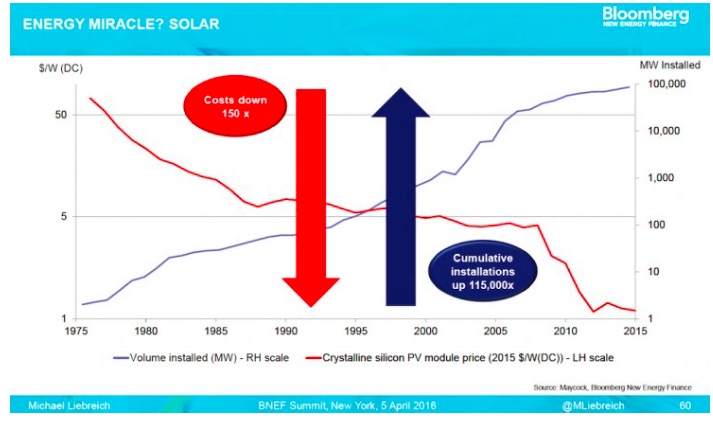
Helped by further falls in generating costs per megawatt-hour, particularly in solar photovoltaics, renewables excluding large hydro made up 54 per cent of added gigawatt capacity of all technologies last year. It marks the first time new installed renewables have topped the capacity added from all conventional technologies.

The 134 gigawatts (GW) of renewable power added worldwide in 2015 compares to 106GW in 2014 and 87GW in 2013.

Were it not for renewables excluding large hydro, annual global CO2emissions would have been an estimated 1.5 gigatonnes higher in 2015.

UNEP Executive Director Achim Steiner said, “Renewables are becoming ever more central to our low-carbon lifestyles, and the record-setting investments in 2015 are further proof of this trend. Importantly, for the first time in 2015, renewables in investments were higher in developing countries than developed.”

“Access to clean, modern energy is of enormous value for all societies, but especially so in regions where reliable energy can offer profound improvements in quality of life, economic development and environmental sustainability. Continued and increased investment in renewables is not only good for people and planet, but will be a key element in achieving international targets on climate change and sustainable development.”

“By adopting the Sustainable Development Goals last year, the world pledged to end poverty, promote sustainable development, and to ensure healthier lives and access to affordable, sustainable, clean energy for all. Continued and increased investment in renewables will be a significant part of delivering on that promise.”

Said Michael Liebreich, Chairman of the Advisory Board at BNEF: “Global investment in renewables capacity hit a new record in 2015, far outpacing that in fossil fuel generating capacity despite falling oil, gas and coal prices. It has broadened out to a wider and wider array of developing countries, helped by sharply reduced costs and by the benefits of local power production over reliance on imported commodities.”

(Continued on right side of page)

Question for this article:

Are we making progress in renewable energy?

(Article continued from left side of page)

As in previous years, the report shows the 2015 renewable energy market was dominated by solar photovoltaics and wind, which together added 118GW in generating capacity, far above the previous record of 94GW set in 2014. Wind added 62GW and photovoltaics 56GW. More modest amounts were provided by biomass and waste-to-power, geothermal, solar thermal and small hydro.

In 2015, more attention was drawn to battery storage as an adjunct to solar and wind projects and to small-scale PV systems. Energy storage is of significant importance as it is one way of providing fast-responding balancing to the grid, whether to deal with demand spikes or variable renewable power generation from wind and solar. Last year, some 250MW of utility-scale electricity storage (excluding pumped hydro and lead-acid batteries) was installed worldwide, up from 160MW in 2014.

Developing countries on the rise led by China and India

In 2015, for the first time, investments in renewable energy in developing and emerging economy nations ($156 billion, up 19 per cent compared to 2014) surpassed those in developed countries ($130 billion, down 8 per cent from 2014).

Much of these record-breaking developing world investments took place in China (up 17 per cent to $102.9 billion, or 36 per cent of the world total).

Other developing countries showing increased investment included India (up 22 per cent to $10.2 billion), South Africa (up 329 per cent to $4.5 billion), Mexico (up 105 per cent to $4 billion) and Chile (up 151 per cent to $3.4 billion).

Morocco, Turkey and Uruguay all joined the list of countries investing more than $1 billion.

Overall developing country investments last year were 17-times higher than in 2004.

Among developed countries, investment in Europe was down 21 per cent, from $62 billion in 2014 to $48.8 billion in 2015, the continent’s lowest figure for nine years despite record investments in offshore wind projects.

The United States was up 19 per cent to $44.1 billion, and in Japan investment was much the same as the previous year at $36.2 billion.

The shift in investment towards developing countries and away from developed economies may be attributed to several factors: China’s dash for wind and solar, fast-rising electricity demand in emerging countries, the reduced cost of choosing renewables to meet that demand, sluggish economic growth in the developed world and cutbacks in subsidy support in Europe.

Still a long way to go

That the power generation capacity added by renewables exceeded new capacity added from conventional sources in 2015 shows that structural change is under way.

Renewables, excluding large hydro, still represent a small minority of the world’s total installed power capacity (about one-sixth, or 16.2 per cent) but that figure continues to climb (up from 15.2 per cent in 2014). Meanwhile actual electricity generated by those renewables was 10.3 per cent of global generation in 2015 (up from 9.1 per cent in 2014).

“Despite the ambitious signals from COP 21 in Paris and the growing capacity of new installed renewable energy, there is still a long way to go,” said Prof. Dr. Udo Steffens, President of the Frankfurt School of Finance & Management.

“Coal-fired power stations and other conventional power plants have long lifetimes. Without further policy interventions, climate altering emissions of carbon dioxide will increase for at least another decade.”

The recent big fall in coal, oil and gas prices makes conventional electricity generation more attractive, Dr. Steffens added. “However, the commitments made by all nations at the Paris climate summit in December, echoing statements from last-year’s G7 summit, require a very low- or no-carbon electricity system.”

(Thank you to the Good News Agency for sending us this article.)

On Earth Day, Commit To The Great Turning

. . SUSTAINABLE DEVELOPMENT . .

An article by Rivera Sun, Peace Voice (reprinted according to Creative Commons)

Viewing the destruction of the planet and our natural systems as a form of violence, Campaign Nonviolence – a long-term movement to build a culture of nonviolence – engages people across the country in working toward sustainability, renewable energy, lowering meat consumption, supporting local food, and many other practices of living nonviolently on this beautiful Earth.

earthday

As we commemorate Earth Day on April 22, we are called upon to recommit to protecting our planet to ensure that the human species and our fellow beings will have a long-term future. Founded in 1970, Earth Day is an internationally celebrated day, honoring the natural systems of the planet, and a day of action in support of climate protection. The commemoration was first proposed by two different people, peace activist John McConnell, who created the iconic Earth Flag, and Senator Gaylord Nelson.

In an era of climate crisis, Earth Day reminds us of the urgency and importance of transforming our way of life . . . today! One resource for this is to reimagine these times as an epochal period of great change, one that many people are calling the Great Turning.

The Great Turning is a phrase popularized by many people including Joanna Macy and David Korten that describes our current time period as a massive shift from the industrial growth society to a life-sustaining civilization. We may not make this transition in time to prevent catastrophic climate change . . . but billions of people around the globe are engaged in the three types of actions that support the Great Turning.

These three types of actions are:

Holding actions to slow the destruction of human-based systems on the Earth and other beings. These activities include all the political, legislative, and legal work required to reduce the destruction, as well as direct actions–blockades, boycotts, civil disobedience, and other forms of noncooperation and nonviolent intervention.

These are important to stop the worst of the destruction, but they are not enough on their own; they must be supported by . . .

Creating new systems that support a life-affirming society, including local agriculture, reducing meat consumption, switching to renewable energy, creating mass transit systems, watershed protection and restoration, cooperative housing and eco-villages. And, to support the movement toward these visionary goals, it is also necessary to engage in a . . .

Shifting beliefs away from old concepts of domination, separateness, greed and destruction. We must move towards new understandings of interconnection, general and living systems theory, deep ecology, cooperation, and collaboration.

The three dimensions of the Great Turning are equally vital. Look around your community and notice how many people are engaged in one or several aspects of this work! Question your own participation – how do you contribute? What more could you engage in? What excites and intrigues you? For the Great Turning to be successful, we need all hands on deck! How will you be a part of this historic moment?

Question for this article:

Nonviolence Charter: Progress Report #8 (April 2016)

EDUCATION FOR PEACE .

An article by Robert J. Burrowes, Anita McKone and Anahata Giri in the TRANSCEND Media Service (abbreviated)

Here is the latest six-monthly report on progress in relation to ‘The People’s Charter to Create a Nonviolent World’ and a sample of news about Charter signatories. Building a worldwide consensus against the use of violence in all contexts is quite a challenge but we are making solid progress!

charter

Since our last report on 14 October 2015 –which Antonio C. S. Rosa kindly published in the TRANSCEND Media Service Weekly Digest—

–we have gained our first signatories in another four countries – Argentina, Costa Rica, Kazakhstan and West Papua – a total of 93 countries now. We also have 104 organisations from 33 countries, the latest of which is the Associação Internacional de Poetas based in Brazil. If you wish, you can see the list of organisational endorsements on the Charter website.

If you wish to see individual signatories, click on the ‘View signatures’ item in the sidebar. You can use the search facility if you want to look for a specific name.

The latest progress report article ‘Ending Human Violence is a Task for Each of Us’ was recently distributed to many progressive news websites and mainstream newspapers: it was published by a number of progressive outlets in fourteen countries, thanks to very supportive editors–several of whom are Charter signatories. . .

You may remember that in the last Charter progress report we repeated our promise to report on those of you about whom we knew less by asking you to send us some information about yourself and the reminder that you don’t have to be world famous to be valued here. Well, the good news is that a number of people responded and, in addition, we did some more research ourselves. However, as we continue to find, extraordinary people seem to invariably consider themselves ‘ordinary’. So, irrespective of how you consider yourself, we would love to hear about you for the next report!

(Editor’s note: The news of charter signatories is too long to be printed here, so reader’s are encouraged to see them here in the full report.

Question for this article:

It’s Campaign Season for UN Secretary General…And It Is Pretty Radical

FREE FLOW OF INFORMATION

An article by Mark Leon Goldberg, UN Dispatch

The race to become the next UN Secretary General just got slightly more crowded yesterday [April 5] when Helen Clark, former New Zealand prime minister and the current head of the UN Development Program, tossed her hat in the ring. Clark is one of the higher profile of the eight declared candidates. She is the fourth woman in the field and the only non-European to enter the race so far.

secgen

What makes her entry into the race particularly interesting is this straightforward video of her announcing her candidacy. It is the latest manifestation of just how radically new this process is to select a UN secretary general.

For the first time ever there will be a public campaign in the race to become the next UN Secretary General.

In the 70 years of United Nations, each of the eight Secretaries General were selected behind closed doors. Those doing the selecting were the five permanent members of the Security Council: the USA, Russia, the UK, France and China. Those countries would select a man to represent the United Nations and then the General Assembly, which is made up of all UN member states, would rubber stamp the pick.

This time around is wholly different. First, to be considered for the job, each candidate must first be nominated by their country. The process for doing so is straightforward: the country sends the nominating letter to the President of the General Assembly, who posts the candidates’ nominating letters and resumes to this website.

Now, for the first time in 70 years the general public knows exactly who is in the running for UN Secretary General. This counts as radical: even that modest amount of transparency was never really in the cards before.

The declared candidates as of April 4 (minus Helen Clark) and the dates they entered the race.

Dr. Srgjan Kerim, 30 December 2015
Prof. Dr. sc. Vesna Pusic, 14 January 2016
Dr. Igor Luksic, 15 January 2016
Dr. Danilo Turk, 9 February 2016
Ms. Irina Bokova, 11 February 2016
Ms. Natalia German, 19 February 2016
Mr. Antonio Guterres, 29 Febuary 2016

Because the process is open, there is a degree of public campaigning that has never existed. Candidates will be forced to go on the record with their positions on various key global issues. Their performance as communicators, diplomats and politicians will be evaluated by the press, the public, and all UN member states.

(Article continued in right column)

(Click here for the original Spanish of this aricle.)

Question(s) related to this article:

Can the UN help move the world toward a culture of peace?

(Article continued from left column)

On April 12, 13, and 14 each candidate will submit to two hours of questioning from the General Assembly. The President of the General Assembly, Mogens Lykketoft of Denmark, is presiding over the affair. For two hours, each candidate will be put on the spot by member states. Not only will their answers be judged on the merits, but their effectiveness as communicators will be tested as well.

And because this has never been done before, no one really knows what kinds of questions will be asked. Will groups of countries, like the EU, band together to ask the same questions to each candidate? Will it result in high minded discussions of the future of the UN? Will individual countries use their moment at the mic to score petty domestic political points? The answer is that we have absolutely no clue. That’s what makes this moment so interesting for UN watchers–the theater is not only in the answers given, but the questions asked. Also, questions will not only come from member states, but also from the NGO community and civil society, which has been invited to participate in this vetting.

Then, later in the week, the Guardian is holding town-hall style debate in New York in which journalists and the public can pose questions to the candidates. (Questions from the public are being solicited here.) Later in the Spring, a similar event will take place in London.

The Security Council is expected to begin its deliberations in July. To be sure, as in year’s past the candidate must find favor (or at least not be vetoed) by each of the five permanent members. The Security’s Council’s selection is then passed along to the General Assembly for a final vote.

But unlike year’s past, each member of the General Assembly — and the public at large — will have had the opportunity to vet the candidates. The candidate will need to prove her or his worth well before the final selection this summer.

(Thank you to Janet Hudgins, the CPNN reporter for this article.)
Nonviolent Peaceforce: A paradigm shift?

EDUCATION FOR PEACE .

An article from the Nonviolent Peaceforce

As violent chaos overwhelms all existing approaches to civilian protection, unarmed civilian protection is gaining attention. Over the past three months, NP has given high-level presentations in Europe, the Middle East and the US.

paradigm

On February 1, Rolf Carriere, NP board member and senior advisor, spoke at a Brussels forum on Civil Society Perspectives on European Union Implementation of the 2015 UN Reviews. In noting that unarmed civilian protection (UCP) was prominently cited in two UN reviews, Mr. Carriere asserted, “UCP is ready for scaling up. There is almost no conflict where it would not be suitable for these unarmed strategies to be used, especially if the engagement is early on in the conflict cycle, more preventative.”

NP board chair Mukesh Kapila and Tiffany Easthom, NP director for the Middle East, spoke on a panel at the World Bank’s Fragility Forum in Washington DC., March 1-3, where they noted that the sum of the various efforts by international actors is clearly not adequate to today’s needs of rising toll of humanitarian disasters and violence against civilians. They stressed the need to be guided by the local communities, to utilize unarmed approaches and to challenge institutional norms.

Two weeks later, Dr. Rachel Julian of Leeds Beckett University in the UK joined Easthom in Berlin to testify before a subcommittee of the Bundestag. Based on evaluations, case studies and interviews of those involved with nine organizations providing unarmed civilian protection, Dr. Julian has found that UCP changes the behavior of armed actors, helps communities stay at home and saves lives. Ms. Easthom was impressed by the parliamentarians’ high level of knowledge and keen interest to scale up UCP. Mel Duncan followed up with a delegation of German parliamentarians when the visited New York in early April.

(Article continued in the right column)

Question for this article:

Can peace be guaranteed through nonviolent means?

(Article continued from the left column)

Chris Holt and Shannon Radsky of NP’s team in South Sudan spent a week in mid-March speaking at parallel events for the UN’s Commission on the Status of Women as well as meeting with UN officials in New York. While affirming the findings of the March 10th UN High Commissioner on Human Rights Report of extreme violence in South Sudan, they went on to detail ways that women are not only victims but also effective agents of civilian protection.

On the religious front, Easthom participated in a retreat sponsored by the World Council of Churches in Beirut where they adopted a strong theme of nonviolent approaches. And Mel will take part in a conference on nonviolence at the Vatican in mid April.

So what does this all mean? Merely a dizzying array of junkets? Or will this advocacy translate into a meaningful increase in the protection of civilians? Dr. Julian observes that a paradigm shift is underway, “One of the most dramatic shifts will have taken place when everyone realizes that, the assumption that an armed actor will not yield to anything except a weapon has been proven to be untrue.”

Together we are proving that point from the bush of South Sudan and bringing the messages to places like Bundestag of Germany.

(Thank you to Janet Hudgins, the CPNN reporter for this article.)
Landmark Vatican conference rejects just war theory, asks for encyclical on nonviolence

TOLERANCE AND SOLIDARITY .

An article by Joshua J. McElwee for the National Catholic Reporter

The participants of a first-of-its-kind Vatican conference have bluntly rejected the Catholic church’s long-held teachings on just war theory, saying they have too often been used to justify violent conflicts and the global church must reconsider Jesus’ teachings on nonviolence.
Members of a three-day event co-hosted by the Pontifical Council for Justice and Peace and the international Catholic peace organization Pax Christi have also strongly called on Pope Francis to consider writing an encyclical letter, or some other “major teaching document,” reorienting the church’s teachings on violence.

vatican

There is no ‘just war,'” the some 80 participants of the conference state in an appeal they released Thursday morning.

“Too often the ‘just war theory’ has been used to endorse rather than prevent or limit war,” they continue. “Suggesting that a ‘just war’ is possible also undermines the moral imperative to develop tools and capacities for nonviolent transformation of conflict.”

“We need a new framework that is consistent with Gospel nonviolence,” say the participants, noting that Francis and his four predecessors have all spoken out against war often. “We propose that the Catholic Church develop and consider shifting to a Just Peace approach based on Gospel nonviolence.”

NCR’s sister publication Celebration offers a FREE resource guide on Pope Francis’ The Face of Mercy. Get it here.
FaceofMercy_coverSMALL.jpg
Just war theory is a tradition that uses a series of criteria to evaluate whether use of violence can be considered morally justifiable. First referred to by fourth-century bishop St. Augustine of Hippo, it was later articulated in depth by 13th-century theologian St. Thomas Aquinas and is today outlined by four conditions in the formal Catechism of the Catholic Church.

The Rome conference, held Monday through Wednesday [April 10-13], brought experts engaged in global nonviolent struggles to reconsider the theory for the first time under the aegis of the Vatican.

It comes after a number of theologians have criticized continued use of the theory in modern times, saying that both the powerful capabilities of modern weapons and evidence of the effectiveness of nonviolent campaigns make it outdated.

At a press event launching the conference’s final appeal document — given the title “An Appeal to the Catholic Church to Re-Commit to the Centrality of Gospel Nonviolence” — several of the event’s participants said the church should simply no longer teach the just war theory.

“I came a long distance for this conference, with a very clear mind that violence is outlived,” said Archbishop John Baptist Odama of Gulu, Uganda. “It is out of date for our world of today.”

“We have to sound this with a strong voice,” said the archbishop. “Any war is a destruction. There is no justice in destruction. … It is outdated.”

The Catechism currently outlines as one criteria for moral justification of war that “the use of arms must not produce evils and disorders graver than the evil to be eliminated” and notes that “the power of modern means of destruction weighs very heavily in evaluating this condition.”

Odama, who also leads Uganda’s bishops’ conference, said the conditions in the Catechism “are only given to say in reality there should be no war.”

“This is where the group was very strong,” he said, referring to the conference. “We should not give now, at this moment, reasons for war. Let us block them and promote relationships of harmony, of brother and sisterhood, rather than going for war.”

Marie Dennis, an American who serves as a co-president of Pax Christi International, said she and the conference group “believe that it is time for the church to speak another word into the global reality.”

(article continued on the right side of the page)

Question for this article

Where in the world can we find good leadership today?

Readers’ comments are invited on this question and article. See below for comments box.

(article continued from the left side of the page)

“When we look at the reality of war, when we look at the teachings of Jesus, we’re asking what is the responsibility of the church,” she said. “And it is, we believe, a responsibility to promote nonviolence.”

Dennis also said she understands that people may raise concerns in rejecting the just war theory over needing to stop unjust aggressors. Her group, she said, agrees that violent aggressors have to be stopped.

“The question is how,” said Dennis. “Our belief would be that as long as we keep saying we can do it with military force, we will not invest the creative energy, the deep thinking, the financial and human resources in creating or identifying the alternatives that actually could make a difference.”

“As long as we say that dropping bombs will solve the problem we won’t find other solutions and I think that’s feeling more and more clear to us,” he said.

The April conference on just war theory had been discussed for months and was the first cohosted by the Vatican’s pontifical council and Pax Christi, an international Catholic coalition akin to Amnesty International that maintains separate national groups in many countries.

The conference was organized around four sessions allowing participants to dialogue and share experiences with one another. The only scheduled talk at the event was given by Cardinal Peter Turkson, the head of the pontifical council, who also read a letter sent to the participants by Francis.

Among other participants were bishops from Nigeria and Japan, and leaders of the Rome-based umbrella groups for men and women religious around the world. Also taking part were a senior policy fellow at the U.S. Institute of Peace, several noted theologians, and Irish Nobel Peace Prize winner Mairead Maguire.

The group’s final appeal states succinctly: “The time has come for our Church to be a living witness and to invest far greater human and financial resources in promoting a spirituality and practice of active nonviolence.”

“In all of this, Jesus is our inspiration and model,” they state. “Neither passive nor weak, Jesus’ nonviolence was the power of love in action.”

Odama said Jesus “always asked his followers not to resort to violence in solving problems, including in his last stage of life.”

“On the cross, [Jesus] said, ‘Father forgive them because they don’t know what they’re doing,'” said the archbishop. “In this statement, he united the whole of humanity under one father.”

“He does not take violent words and violent actions,” said Odama. “That is the greatest act of teaching as to how we should handle our situations. Not violence.”

Dennis said that part of the goal in organizing the conference “was to ultimately lead to an encyclical or a process that would produce major Catholic teaching on nonviolence.”

“We haven’t run into a roadblock yet,” she said. “There are no promises.”

“What we really hope will happen is a process that will engage the Vatican and the Catholic communities around the world in exactly these questions,” said Dennis. “What can we know better about the role that nonviolence can play in shifting our world to a better place?”

Ken Butigan, a lecturer at DePaul University in Chicago and executive director of the non-profit group Pace e Bene, said: “We have gotten a green light for months that this is something that Pope Francis is excited about moving forward on.”

“We are determined to support that momentum at this historical moment,” he said. “We know Pope Francis has a vision and we’re here to support that vision.”

(Thank you to Janet Hudgins, the CPNN reporter for this article.)