Tag Archives: Europe

UK: Surprise, Surprise, Jeremy Corbyn’s Anti-War Policies Turned out to Be a Vote Winner

DISARMAMENT & SECURITY .

An article by Chris Nineham for Stop the War Coalition

Theresa May’s humiliating failure to gain a majority in the General Election is a great boost to everyone who opposes foreign wars. May is an enthusiast for the ‘War on Terror’ and has been one of the political world’s keenest supporters of Trump’s deranged foreign policy since day one. She very publicly backed his provocative attacks on Assad’s forces in April and, during the election period, she threatened to follow up with a British escalation against the Syrian regime if she got a majority. 

(Click on image to enlarge)

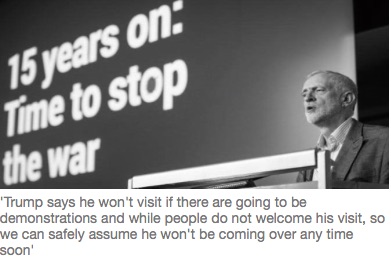
Given her dreadful election result a May-led government, if it gets off the ground at all, is likely to be way too weak to pursue any more foreign wars. She may try to do so using her unholy alliance with the DUP, but her fatal weakness makes this much easier to oppose. What is more, the fact that Trump has been forced to call off his planned visit in October for fear of demonstrations is an unprecedented blow against the special relationship as well as being more proof that protests work. Trump says he won’t visit if there are going to be demonstrations and while people do not welcome his visit, so we can safely assume he won’t be coming over any time soon.

This is more than a matter of movement self-congratulation. Britain has been the US’s key political and military ally throughout the ‘War on Terror’. The removal of Britain at least as a public champion of the US is a big foreign policy setback for a regime whose serial aggressions are isolating it further and further on the world stage.  

But there is more heartening news to be extracted from the experience of the election. First, the concerted attack on Jeremy Corbyn over his refusal to promise to ‘press the nuclear button’ failed to make an obvious difference to the election campaign, despite the fact that an ambush was staged against him on the high-profile Question Time ten days before the election. 

(Article continued in right column)

Question related to this article:

How can the peace movement become stronger and more effective?

(Article continued from left column)

Reeling from her manifesto blunders, it was felt by some that the two appalling terrorist attacks in the election campaign would allow Theresa May to play the security card and re-establish her ‘strong and stable’ credentials but this was clearly not the case. In the days after the attacks the media went on a co-ordinated rampage against Corbyn’s record on war and peace. The day before the election the Sun led with a so-called expose on ‘Jezza’s Jihadi Comrades’, the Telegraph claimed ‘Corbyn Ducks Terror Challenge’ and the BBC obediently followed suit with a photomontage of Jeremy Corbyn next to Osama Bin-Laden.  

All this appears to have failed to make much of an impact on the general public. The surge to Labour continued right up until election day and beyond. Jeremy Corbyn had responded to the dreadful attack in Manchester by calling a press conference at which he explicitly argued that Western foreign policy has been one of the drivers of the spread of terrorist attacks and organisation. Despite the media onslaught an opinion poll taken days after showed that the overwhelming majority of the population agreed with him. The ORB survey found 75 per cent of people believe interventions in Iraq, Afghanistan and Libya have made atrocities on UK soil more likely. Even 68% of Tory voters agreed.

This underlines the growing sense that despite the fact that 70% of the newspapers backing the Tories, the print media is losing what ability it ever had to shape popular opinion. Partly no doubt it was a product of the novelty of a party leader breaking the taboo on discussing the causes of terrorism and putting a coherent and clear argument against the record of the War on Terror. But partly it revealed something deeper.

Despite the failure of the media to engage in a real debate, despite the refusal of the establishment to accept the findings of the Chilcot report and at least four parliamentary investigations into the wars that we have been dragged into, popular opposition to foreign aggression has only deepened over the years. A largely unreported YouGov poll which came out during the election campaign showed that between 43% and 55% of the population disapproved of the wars in Afghanistan, Iraq and Libya with less than 25% in favour and that more people opposed than supported even the first Gulf war in 1991. 

All this is important for a number of reasons. It is a reminder that we mustn’t make the mistake of reading public opinion off from the people who claim to be opinion formers in British society almost all of whom regard criticism of Britain’s war record as being beyond the pale. It tells us too that those siren voices in the Labour Party who believe that anti war policies are too radical for the British electorate are plain wrong.

It indicates in fact that it is now time to launch a concerted campaign for a fundamentally new foreign policy. Such a new direction is a necessary counter to the right wing vision of a world of more security, surveillance and international retribution.

Swiss vote in in favor of gradual nuclear phaseout

. .. SUSTAINABLE DEVELOPMENT .. .

An article from Deutsche Welle

Switzerland held a referendum on Sunday on the government’s planned transition from the nuclear power provided by the country’s aging reactors to renewable energy sources. The majority of voters supported the shift, with 58.2 percent voting in favor of the referendum, according to the final tally. Only four of Switzerland’s 26 cantons votes against the overhaul to renewables.


The Fukushima disaster caused several countries, including Germany, to rethink nuclear energy

Most voters had already cast their ballots by post over the past few weeks.
The Swiss government decided to gradually phase out nuclear power after the disaster in Fukushima, Japan, in 2011, where there were three nuclear meltdowns at a plant after a tsunami caused by an earthquake. Berlin took a similar step after the disaster by announcing the phaseout of nuclear power in Germany.

Switzerland’s so-called Energy Strategy 2050, spearheaded by Energy Minister Doris Leuthard, who is also the current Swiss president, involves decommissioning Switzerland’s five reactors as they reach the end of their safe operational lifespan. Currently, they produce around a third of the country’s electricity.

(article continued in right column)

Question for this article:

Are we making progress in renewable energy?

(article continued from left column)

More renewables, more efficiency

Although the plan does not lay down a clear timetable for phasing out the plants, it does envisage increasing reliance on hydraulic power and solar, wind, geothermal and biomass energy sources, as well as reducing energy consumption and improving energy efficiency.

Its targets are ambitious, with the aim being to cut the average energy consumption per person per year by 43 percent by 2035 as compared with levels in 2000.

Last year, Swiss voters rejected a call to accelerate the decommissioning of the plants, a move that would have seen three of the five reactors closing this year.

‘Cold shower’ claim

The government’s energy strategy is supported by the Swiss parliament, with the exception of the country’s largest political party, the right-wing populist Swiss People’s Party (SVP), which called for Sunday’s referendum.

The SVP has criticized the plan, saying it would cost up to 3,200 Swiss francs (2,934 euros, $3,288) per four-person household per year in additional energy costs and taxes. The government rejects the claim, estimating the additional cost per household will be at 40 Swiss francs more per year.

Germany Breaks Record: 85% of Energy Comes From Renewables Last Weekend

. .. SUSTAINABLE DEVELOPMENT .. .

An article by Lorraine Chow for Ecowatch

Germany’s “Energiewende”—the country’s low-carbon energy revolution—turned another successful corner last weekend when renewable energy sources nearly stamped out coal and nuclear.

Thanks to a particularly breezy and sunny Sunday, renewables such as wind and solar, along with some biomass and hydropower, peaked at a record 85 percent, or 55.2 gigawatts, and even came along with negative prices for several hours at the electricity exchange.

Conversely, coal use was at an all-time minimum. According to DW, on April 30, coal-fired power stations were only operational between 3 and 4 p.m. and produced less than eight gigawatts of energy, well below the maximum output of about 50 gigawatts.

“Most of Germany’s coal-fired power stations were not even operating on Sunday, April 30th,” Patrick Graichen of Agora Energiewende told RenewEconomy. “Nuclear power sources, which are planned to be completely phased out by 2022, were also severely reduced.”

Graichen added that days like Sunday would be “completely normal” by 2030 thanks to the government’s continued investment in the Energiewende initiative.

Following the Fukushima disaster in Japan, Germany announced in May 2011 that it plans to phase out nuclear and shut down all its nuclear power plants by 2022. That Sunday, nuclear power plants reduced their output from 7.9 to 5 gigawatts.

Germany’s ambitious energy transition aims for at least an 80 percent share of renewables by 2050, with intermediate targets of 35 to 40 percent share by 2025 and 55 to 60 percent by 2035.

Question for this article:

Grenoble, France : Ecole de la Paix

. . DEMOCRATIC PARTICIPATION . .

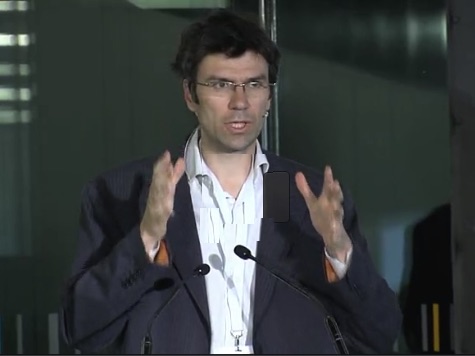
A talk by Matthieu Damian, Director of Ecole de la Paix at the Madrid forum on urban violence and education for peace, April 2017

In Grenoble, a few years ago we started an projet in education for peace to guide young people from Grenoble to become commited and responsible citizens. Because I only have 5 minutes to talk, i’ll go straight to the 6 mains points of the project.

First of all, we make a diagnosis of the territory concerned. We intervene in complicated suburbs facing unemployement, urban violence, etc. We go to schools, middle schools and secondary schools (different schools for children from 3 to 15 years old) and educational centres asking them to tell us their needs. We don’t impose ready-made solutions, we first figure out their needs.

As an association, we are committed to work in a long term perspective in those different suburbs, realizing that nothing can be gained without long term action.

Thirdly, we offer a number of educational tools from the Ecole de la Paix (School of Peace) based on what we call “mental pictures. ”

The comic strips drawns by Pixar called “Vice Versa”, speak of 5 main emotions : Fear, Anger, Joy, Sadness and Disgust. We can see that characters have, for each of these emotions, a lot of associated memories, either positive or negatives, which are mental pictures.

In l’Ecole de la Paix, (School of Peace), we provide a number of mental pictures in favour of « Living together ».

What do we mean by mental images ? It can be a story or an attitude or actions in favour of peace or in favour of violence. Our logic at the School of Peace is to provide a certain number of teaching tools to children. Thanks to them, once they have to make a decision, they will search in their memories and choose mental pictures they’re filled with to make a good decision.

(article continued in right column)

(Click here for the French version of this article)

Question related to this article:


How can culture of peace be developed at the municipal level?

(article continued from left column)

On the other hand, we know that if the child has negative mental pictures, he’ll make bad decisions. That’s why it is important to regularly repeat positive mental picture, and to adopt them. Because if you see people talking about positive mental pictures but aren’t adopting them, there is evidently a problem.

The forth aspect is an African proverb:  « It takes a whole community to raise a child ».

The Ecole de la Paix (School of Peace) cannot succeed alone, we’re not wizards. We involve judges, policemen, firemen, etc. in order to restore a dialogue between public authority and young people in those places where authority is less and less respected, whether it’s for a good or a bad reason. For example, when the police officer first comes into the room, the pupils have a negative corporal attitude, with their bodies leaning backwards. By the end of the meeting, their bodies are much more leaning forwards. They are listening much more and some are raising their hands.

Obviously, this cannot change everything but it helps them to play the role of civil society.

Fifthly, we intervene not only in schools but also in educational centres, on Wednesdays afternoon, to fortify messages we’ve sent out in schools. Pedagogy requires repetition.

Finally, we try to include parents in our action. To that end, we invite them to our actions at a theatre forum where their children do role-playing in which they react as citizens or not. We realize via the theatre forum that it is often the child who creates difficulties who has himself the solution of his bad behavior and is able to reestablish the « Living together ». It’s really a great thing to be able to say to a child « you’re creating difficluties but you also have to solution to solve it so show it us how». Very often, they take on this role with a lot of pleasure.

Madrid, Spain: International Conference on Security, Conflict and Cross-cultural Dialogue

FREE FLOW OF INFORMATION

An announcement from the International Conference on Conflict and Aggression (CICA) (abbreviated)

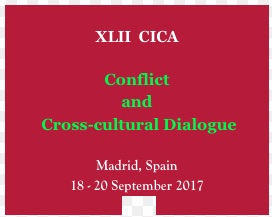
We would like to inform that the coming 42nd CICA (International Conferences on Conflict and Aggression) will take place in Madrid, Spain, from 18th to 20th September 2017.

The main goal of this 42nd CICA, organized by the Nebrija-Santander Global Chair for Management of Risks and Conflicts (Center for Conflict Studies, Nebrija University) and the Spanish Pugwash National Group, will be an opportunity to exchange our ideas on the main issues in the broad field of Conflict and Aggression, with a specific focus on the current knowledge and research on Conflict and Cross-cultural Dialogue, emphasizing that problems or disputes cannot be permanently resolved through the use of military force, but through respect, tolerance and dialogue. This, indeed, may be a quite effective tool for bridging the diverse cultures and, consequently, for solving many of the conflicts of today’s world, characterized by a dynamic interchange of populations with very diverse cultural and ethnic backgrounds.

Consequently, the main, but not exclusive, topics of this conference are: international conflict and security problems, with a special focus on migrations and refugees, and their possible solutions; values and risks of cross-cultural societies; and the crosscultural dialogue as a mean for overcoming this kind of conflicts.

(continued in right column)

Question(s) related to this article:

Global meetings, conferences, assemblies, What is the best way for delegates to interact afterwards?

(continued from left column)

For this purpose, we have the tentative active participation of reputed scholars from different continents and from different cultures and fields of expertise. Among them, the following keynote speakers:

Hon. Erna Hennicot-Schoepges, President of the Parliament., Luxembourg.

Sheikh Dr. Hojjat Ramzy, Executive Member of the Muslim Council of Britain. U.K.

Prof. Saideh Lotfian, Chair, International Council, Pugwash Movement (Nobel Peace Prize 1995). Iran.

Ms. Emina Omanovic, Secretary General, ABACUS., Bosnia and Herzegovina.

Hon. Amiira Neff, President of l’Alliance Globale MGF. Switzerland.

Prof. Predrag Vujovic, Founder and President. PublicRelations Business School, Serbia.

Dr. Abraham Haim, President of the Council, Sefardi Community of Jerusalem. Israel.

George Rayess Yazbeck, Interpreter & Journalist., Líbano.

* * * * * *

Please, submit communications abstracts by July 15th, 2017 (notification of acceptance will be e-mailed in one week), and early registration deadline: July 30th, 2017. The submitted contributions (with title, authors with short biosketches, and about 300 words abstracts) may have the form of:

1. Oral (duration: about 20 min) and Poster presentations

2. Symposium (3-4- talks on a common topic, with a total duration of about 90 min)

3. Languages: English and Spanish

An edited volume based on the most outstanding contributions of the conference will be published by a prestigious international Publisher.

For their submission and more information, you may contact us, writing directly to both the following e-mail addresses:
• cica@nebrija.es
• agressionresearch@med.ucm.es

In any case, we would be grateful for spreading the attached invitation and draft program throughout your respective networks. Since this is meant to be a multidisciplinary event, the widest diversity in backgrounds (business, science, government, international organizations, civil society, media, etc.) will be welcome.

France: Pierre Rabhi decorated with the Legion of Honor

. . SUSTAINABLE DEVELOPMENT . .

An article by Auguste Bergot for La Relève et la Peste (translated by CPNN)

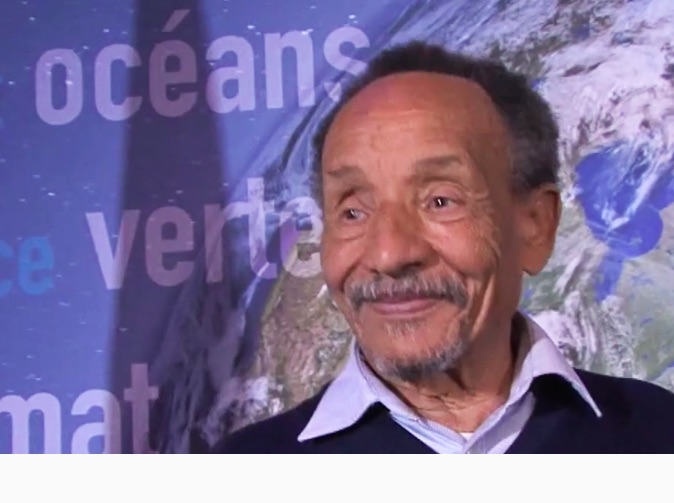
Ségolène Royal, Minister of the Envirornment, has presented Pierre Rabhi with the insignia of Chevalier in the National Order of the Legion of Honor, rewarding the unusual journey of a true humanist who has devoted his life to the development of ecological agriculture and dissemination of an ethic of life advocating “happy sobriety”. Here is the course of this French peasant, writer and thinker of Algerian origin.


The course of his life

Pierre Rabhi was born in 1938 in Kenadsa, Algeria. After spending his youth in Oran with his adopted family, he left for Paris at the time when the Algerian War broke out. With his wife Michèle he then realized the dream of emerging from urban life to adopt a rural lifestyle and turn to agriculture. They therefore went to the Ardèche before the great wave of the neo-rural movement of the late 1960s. Pierre Rabhi enrolled in a rural family house to be trained. He embarked on goat farming by refusing the productivist model to prefer an experimental method of biodynamic farming, a method consisting of considering any agricultural domain as the most autonomous and diversified living organism linking the lunar and planetary rhythms to agricultural activity. In 1985, he founded a training center for agroecology in Gorom-Gorom, Burkina Faso, and then extended consciousness-raising and training programs throughout the African continent, particularly where the land is most difficult to farm.

In 1994 he created the association “Les Amis de Pierre Rabhi”, which was later renamed “Terre & Humanisme” and “Mouvement Colibri” whose mission is “to inspire, connect and support all those involved in building a new project of society “. He has also published some twenty books, among them Towards Happy Sobriety, Agroecology, an ethics of life and The power of moderation. They call for an “insurrection of consciences” to humanize globalization, to unite humanity around the return to earth and to emerge from the myth of indefinite growth.
(Article continued on the right column)

(Click here for a version of this article in French)

Question for this article:

What is the relation between movements for food sovereignty and the global movement for a culture of peace?

(Article continued from the left column)

“fertilize consciences”

After dedicating his life to spreading an alternative model and proposing new paths of thought, Pierre Rabhi was decorated on Thursday 23 March with the highest honorary decoration of France that rewards citizens who have rendered “eminent merits” to the Nation. Ségolène Royal, Minister of the Environment, Energy and the Sea, emphasized in a complimentary speech his “refusal of voluntary servitude” which led him to invent, produce and above all “fertilize consciences”. It also recalls the terms that Pierre Rabhi himself used to speak of his profession and which summarize well the path that followed and teach it: “the farmer installs a concord between the land and himself, He shapes life, he enslaves nothing, he is free in conforming to the laws of nature. ”

Pierre Rabhi the humanist

Faithful to his will to fertilize consciences, Pierre Rabhi insisted in his discourse on the crucial role of education. Regretting the aesthetics of wars and conquests, as well as the “duality and competitiveness” that govern our school system, he pleads for an education that is done “in solidarity”. In the words of a “humanity in disarray in relation to the continuation of history”, he militates that “humanity should recognize itself as such”, one with solidarity, committed together on its original ark. The wisdom of his speech is, as always, a source of meditation, but also of hope.

(Thank you to Kiki Chauvin, the reporter for this article.)

Iceland Will Be First to Require Proof of Equal Pay

. WOMEN’S EQUALITY .

An article by Vala Hafstad in Iceland Review

Iceland will become the first country in the world to require companies to prove they pay all employees the same, regardless of gender, ethnicity, sexuality and nationality, the country’s government announced yesterday, on International Women’s Day, the StarTribune reports. The story, originally from the Associated Press, has been covered by numerous foreign media.

The government stated it would introduce a bill in parliament this month that will obligate every company with 25 or more employees to obtain a certificate proving they provide equal pay for work of equal value. While equal-salary certificate policies exist in other countries, Iceland is believed to be the first country planning to make it mandatory for both public and private companies.

The plan is to eradicate the gender pay gap by 2022. Minister of Social Affairs and Equality Þorsteinn Víglundsson said, “the time is right to do something radical about this issue.”

He continued, “Equal rights are human rights. We need to make sure that men and women enjoy equal opportunity in the workplace. It is our responsibility to take every measure to achieve that.”

The World Economic Forum has ranked Iceland the best country in the world for gender equality, but Icelandic women still earn between 7 and 18 percent less than men, according to the Center for Gender Equality [Jafnréttisstofa] in Iceland.

Thousands of Icelandic women all over Iceland walked out of their workplaces at 2:38 pm on October 24 last year to protest the gender pay gap. The timing, 2:38 pm, was no coincidence. Compared to men’s earnings, organizers of the event estimated that women work without pay after that hour every day.

Question for this article

France: The farmers who bought an old Lidl supermarket

. . SUSTAINABLE DEVELOPMENT . .

An article from Jeunes Agriculteurs

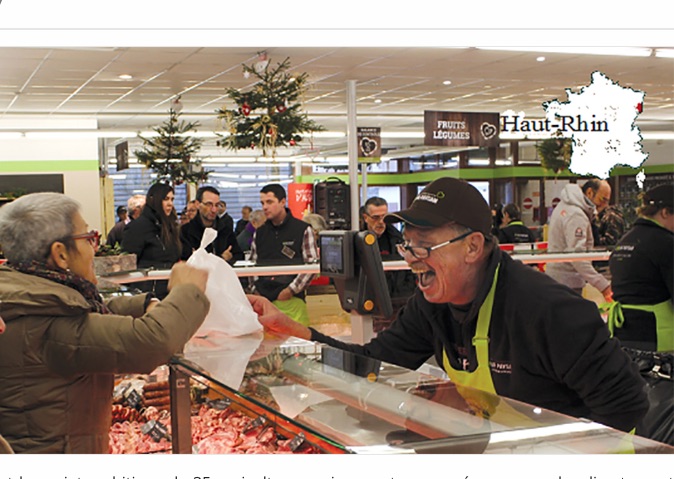
Coeur paysan (literally farmer’s heart) is the name of an ambitious project of 35 farmers who have joined toegher to sell their products directly. Their store is in Colmar, in an old Lidl supermarket. A real symbol.


Colmar, December 6, 2016. The persistent mist accentuates the cold of winter that is already biting. But the occupants of the 82-84 Neuf-Brisach Road are not cold. In this former Lidl, supermarket, closed more than two years ago ,people are busy and in good humor. We cut meat, we place cheeses in the showcases, we stick on the last labels … These are the 35 producers who have invested in these walls to market their products directly. The opening preview is scheduled for 3:00.

The old Lidl is transformed to Coeur Paysan. A rea; symbol! Colmar, wotj ots 70,000 inhabitants, finally has its market of local producers. The locals can buy fruits and vegetables, cheeses, dairy products, meat, bread, etc. The farmers themselves sell the product, working in the store half day per week. A classic operation for a grocery store. What is less important is the size of the project, which required 1.5 M € of investment. This was necessary to renovate the premises, to buy equipment (showcases, boxes, etc.), to invest in communication. As soon as it opened, the store employed six people.

Better valuation. With 35 farms, Coeur Paysan offers a range of products ranging from wild game to teas, snails and smoked trout. These are an asset to achieve the ambitious objective set by the group: to achieve a turnover of 2.5 M € per year. “The hard core of the group is a team of entrepreneurs,” says Nicolas Guibert, tasting his organic goat cheese produced in Linthal, 35km away. “The hardest part is finding a team,” he says jovially. The group met and worked very quickly: the project was completed in eight months, compared to the usual two years preparation for this type of store.

Thirty of the suppliers are now shareholders of SAS Cœur Paysan, which manages the point of sale. The investment – financial and time (sales) – varies according to the turnover expected by each producer. Six of the shareholders bought the building, via an SCI. “We wanted to be independent,” says Denis Digel, President of SAS Cœur Paysan. It is up to us to take our destiny in hand. “As initiator of the project, he is also president of the cooperative of market gardeners of Sélestat. It was “the desire for proximity with consumers” that guided this union leader. A rapprochement synonymous with better valorisation, because “we, the producers, do not draw our chestnuts from the fire!”, he insists.

(Article continued on the right column)

(Click here for a version of this article in French)

Question for this article:

What is the relation between movements for food sovereignty and the global movement for a culture of peace?

(Article continued from the left column)

Battle of the image. Between the riesling of the Domaine Rieflé and the beer of the brewery Saint-Alphonse, a poster proclaims: “Behind every product, there is a producer.” For, beyond the valorization of products, there is a battle of images. In this struggle, farmers have the key cards: “Consumers want to see and touch the producer,” says Denis Digel. Distributors like Intermarché, have understood this, as they claim to be a “producer-trader”. With Cœur Paysan, the farmers have responded in their own way. Modern and rustic, the visual identity of Cœur Paysan, developed by a communication agency, is widely available in the store, on the clothes of sellers and on the Internet. Upon entering the store, customers come across a large sign presenting all the producers.

Inevitably, some people are disturbed. To those who accuse him of overshadowing supermarkets, Denis Digel replies: “We are responding to a new demand that retailers are unable to satisfy.” We fill a need in Alsace. “The proof with Fabien Barre. This young farmer, newly installed in 2014, was looking for a new and secure outlet for his organic goat cheeses. For this farmer, the store has the advantage of “not competing with the goat farmers already on the market”. And it corresponded to his wish to “offer local products directly to the consumers at a correct price.”

Installed in the village of Soultzeren, Fabien transforms into cheeses the whole milk produced by his 60 goats, which allows him to fix his own prices. His goal ? “10 to 20% of my turnover to Cœur Paysan would not be bad. The shop could thus take over from one of the three markets where I am now selling. “Between the cheese-making and its sale,” I have less time with my goats,” he regrets. This is why he is considering to hire someone to help “A project like this comes only once in a lifetime; I don’t want to waste the opportunity.

(Thank you to Kiki Chauvin, the CPNN reporter for this article.)O

Education for Culture of Peace in Cyprus: Sharing Best Practices

… EDUCATION FOR PEACE …

An announcement from the Global Campaign for Peace Education

As part of the project Education for a Culture of Peace as a Vehicle for Reconciliation in Cyprus, Education for a Culture of Peace is organising an International Conference entitled “Education for Culture of Peace: Sharing Best Practices” on 24th and 25th February 2017 at Fulbright Center in Ledra Palace Buffer Zone in Nicosia.


On 24th of February, Friday from 4.00pm to 8.00pm, there will be a conference session examining best practices in Peace Education in two panel discussions. The first panel entitled “Local Practices on Education for a Culture of Peace” will feature representatives of the Scientific Committee of the project who will present the practices of critical education and schooling in Cyprus.

The second panel entitled “Alternative Education: Methodology and Teaching or Different Pedagogical Approaches and Schooling?” will feature international experts who will talk about the methodologies, principles and practices of literacy for peace culture and the actualisation of peace education.

On 25th of February, Saturday, there will be three parallel workshops to be held all day from 9.30am until 5.00pm at three different venues in the Buffer zone. These two-hour workshops will be limited to a group of 20 educators each and will be facilitated by the academic guest experts.

Limited seats available on first come first serve basis. RSVP at +3922276843 or +357 97743074 or at postresearchinstitute@gmail.com or info@postri.org by 20th February, Monday.

For the details of the conference, please visit the event page on facebook: https://www.facebook.com/events/269974243435439/ – Education For a Culture of Peace (E4CP) and also the websites of the project: www.e4cp.org and/or postri.org.

Questions for this article:

Vatican: PCID and WCC to draw up document on Education for Peace

, TOLERANCE & SOLIDARITY .

An article from Vatican Radio

Educating for peace is the theme of a proposed joint document to be drawn up by the Pontifical Council for Interreligious Dialogue and the World Council of Churches’ Office of Interreligious Dialogue and Cooperation.

The proposal was the main subject under discussion at a meeting of staff members of the Pontifical Council and colleagues from the WCC office this week. During the encounter in the Vatican on Monday and Tuesday, participants also discussed recent and future activities, underlining the urgency of interfaith dialogue “in today’s global context”.

Below please find the full statement:

The staff-members of the Office of Interreligious Dialogue and Cooperation (IRDC) of the World Council of Churches (WCC) as well as their colleagues from the Pontifical Council for Interreligious Dialogue (PCID), held their annual meeting at the PCID Offices on 30th-31st January 2017.

Both the delegations expressed their appreciation for the opportunity to meet a few days after the conclusion of the Week of Prayer for Christian Unity. They gave thanks to God for their friendship and fruitful cooperation in promoting constructive relations with individuals and communities belonging to other religious traditions.

The principle agenda of the meeting was to discuss and to deliberate upon a proposed joint document on Education for Peace, following similar joint projects in the past.

It was followed by the exchange of news and views on their respective activities over the past year and planned activities.

Both the PCID and the IRDC agreed to continue their collaboration, in particular, the work relating to the joint document on Education for Peace, given the urgency of the matter in today’s global context.

(Thank you to the Newsletter of the Global Campaign for Peace Education for bringing this article to our attention.)

Question related to this article: