Tag Archives: Europe

France: More people marched in the demonstration #NousToutes than in the demonstration of the “Yellow Vests”

. . WOMEN’S EQUALITY . .

An article from the Huffington Post (translated by CPNN)

SEXISM – “Down with Rape!”: Tens of thousands of women and men, according to the organizers, took to the streets in France this Saturday, November 24 at the call of a collective that had called for a “feminist tidal wave” against sexist and sexual violence a year after the start of the #MeToo movement.
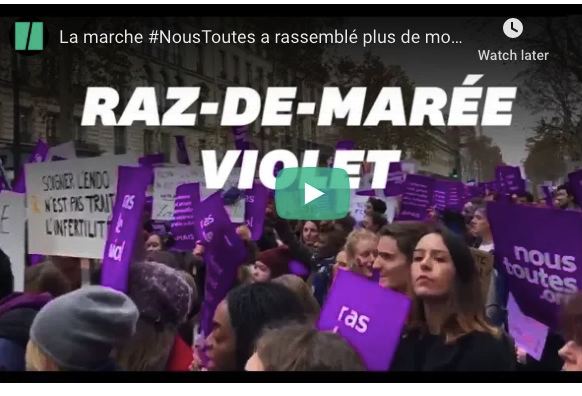

Video of the demonstration

In contrast to the “yellow vests“, demonstrations in France [editor’s note: demonstrations against the rise in gasoline prices that turned to violence], the women’s demonstrations are adorned with purple, the color chosen by the movement #NousToutes for the actions organized on the eve of the International Day for the Elimination of Violence to women.

Similar events took place in other European cities, including Rome, Athens and Geneva.

“This is the biggest feminist mobilization that we have known in France,” said its organizer, Caroline De Haas, who announced that 50,000 people took to the streets, including 30,000 in Paris. Last year, there were 2000 in the Paris demonstration, according to police source.

On Saturday, police and prefectures estimated 12,000 demonstrators in Paris between Opera and Republic, 2400 in Lyon, 1500 in Marseille, 950 in Rennes, 850 in two processions in Nantes, 600 in Toulouse …

Many demonstrators carried placards “Down with rape!”, demanding the end of “the impunity of the aggressors” and “sufficient financial means” for the fight against this violence.

Muriel Robin, Eva Darlan and Vanessa Demouy were present

Personalities from diverse backgrounds, including actresses Muriel Robin, Eva Darlan and Vanessa Demouy, joined the Parisian march.

“I’m here to support all the victims and continue this fight that began well before me,” said Muriel Robin, wearing a purple scarf on her arm. She had gathered more than a thousand women in Paris in October against domestic violence.

(article continued in right column)

Click here for the original in French)

Questions related to this article:

Protecting women and girls against violence, Is progress being made?

How effective are mass protest marches?

(article continued from left column)

From Rennes to Lyon and Toulouse, the processions were composed mostly of women of all generations, but also of men. For Tanguy, a 19-year-old Rennes student, “it’s a movement that has no sex”, “a fight of both men and women, together, against inequalities”.

Rirette, 84, came to protest in Lyon for “equality of pay, rights and sexual behavior.” “Non-consent is a horrible thing and it is judged (by the courts) too lax,” denounced this former administrator.

“The street is ours”

“Sexism kills”, “You are not alone”, “The street is ours”, “No means no”, could be read on the signs in Lille, along with flags of political movements (Generations , EELV) and trade unions (CGT and Sud).

In Toulouse, the entire event sang with one voice several slogans carefully prepared: “Proud, ‘venerable’, not ready to be silent!”, “Freedom, equality, sorority”, “Your hand on my ass, my fist in your mouth “,” Tax cons, not tampons”…

Born in September and supported by a number of associations, the #NousToutes movement was “moving from testimony to action” one year after #MeToo, which boosted the number of sexual violence cases reported to the police by 23%.

In France, in 2016, 123 women were killed by their spouse or ex-companion, about one every three days. Each year, nearly 220,000 women experience violence from their spouses or ex-companions, according to official 2017 figures. In addition, more than 250 women are raped each day, and one in three has been harassed or sexually assaulted at work.

Equality between women and men “great cause of the five-year electoral period” Macron

A year ago, President Emmanuel Macron decreed equality between women and men “great cause of the next five year electoral period”, during a speech at the Elysee.

But “if there is no money, public policies will not follow,” said Caroline De Haas. Funds earmarked to help women who are victims of domestic violence are expected to rise to at least € 506 million a year from 79 today, five organizations including the Economic, Social and Environmental Council (EESC) said this week.

Hundreds of personalities and trade unionists – women and men – joined Saturday’s movement.

In Paris, men were excluded from a “small non-mixed space” to reassure” women victims of various forms of violence who did not feel comfortable to march with men around them. This initiative was criticized on social networks, including by feminist activists, and it attracted only five people, according to the person in charge of this space.
Macron, Merkel defend multilaterism as Trump avoids peace forum

. .DISARMAMENT & SECURITY. .

An article from Thomson Reuters

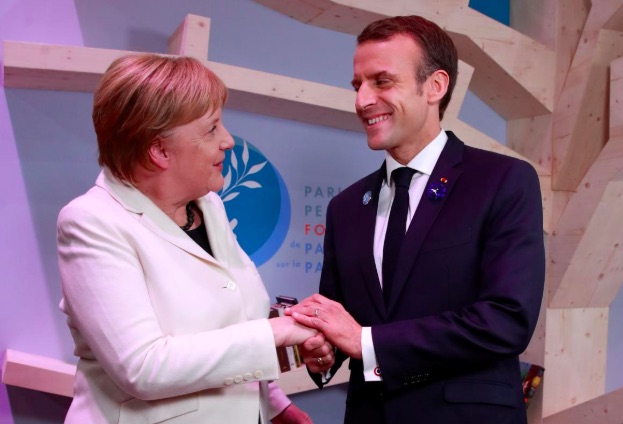
German Chancellor Angela Merkel opened the Paris Peace Forum, which followed a ceremony in the French capital to mark the centenary of the end of World War One, with a warning that “blinkered” nationalism was gaining ground in Europe and beyond.


German Chancellor Angela Merkel and French President Emmanuel Macron hold hands after leaving books at the peace library at the Paris Peace Forum. REUTERS/Gonzalo Fuentes/Pool

Echoing comments made by Macron, she said there was a worrying readiness by some to promote self-interest and ignore ties that have underpinned peace since the end of World War Two.

“Most of the challenges today cannot be solved by one nation alone, but together. That’s why we need a common approach,” Merkel told the audience. “If isolation wasn’t the solution 100 years ago, how can it be today in such an interconnected world?”

Macron hopes the forum can lead help avoid falling into the traps of the past by promoting multilateralism. He wants it to demonstrate the power of reconciliation a century after Europe was torn apart by one of history’s bloodiest conflicts.

Leaders including Russian President Vladimir Putin and his Turkish counterpart Tayyip Erdogan were among those who listened as Merkel, Macron and United Nations Secretary General Antonio Gutteres lauded the U.N. and institutions like it that seek multilateral solutions to global problems.

Trump, who champions a policy of ‘America first’ and has said he is proud to be a nationalist, snubbed the event. Air Force One departed Paris for Washington shortly after the peace forum opened.

(Continued in right column)

Question related to this article:

Can the culture of peace be established at the level of the state?

(Continued from left column)

Macron has repeatedly called for “collective action” to tackle crises ranging from the environment, Islamist militancy and nuclear proliferation to anti-Semitism.

“Will today be a symbol of lasting peace or a last moment of unity before the world falls into more disorder?” The French leader Macron asked the gathering. “It depends solely us.”

Earlier on Sunday, Macron led a solemn ceremony to commemorate the centenary of the armistice that brought the Great War to an end, and appeared to take aim at Trump as he warned of the perils of resurgent nationalism.

Trump, who champions a policy of ‘America first’ and has said he is proud to be a nationalist, snubbed the event. Air Force One departed Paris for Washington shortly after the peace forum opened.

Macron has repeatedly called for “collective action” to tackle crises ranging from the environment, Islamist militancy and nuclear proliferation to anti-Semitism.
“Will today be a symbol of lasting peace or a last moment of unity before the world falls into more disorder?” The French leader Macron asked the gathering. “It depends solely us.”

Earlier on Sunday, Macron led a solemn ceremony to commemorate the centenary of the armistice that brought the Great War to an end, and appeared to take aim at Trump as he warned of the perils of resurgent nationalism.

Justin Vaisse, who organized the forum, told Reuters it was not intended to mediate solutions to existing conflicts, but seek ways to create strengthen multilateral organizations.

It is designed to be held annually and bring together a mixture of politicians, foreign policy experts, non-governmental organizations and representatives of civil society, he said.

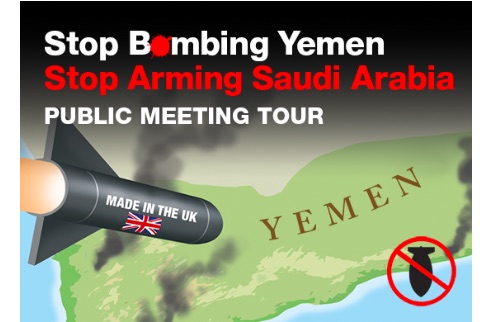
UK Nationwide Public Meeting Tour: Stop Bombing Yemen, Stop Arming Saudi

. .DISARMAMENT & SECURITY. .

From the website of Stop the War Coalition

The Saudi regime is one of the most brutal and authoritarian anywhere in the world. Its ruler Mohammed Bin Salman is implicated in the murder of journalist Jamal Khashoggi in Turkey and has rounded up and tortured opponents at home. His government is also the main protagonist of the terrible war on Yemen.

The Saudi led war has already devastated Yemen and killed tens of thousands of people. Aid agencies warn that if it continues it will cause the worst humanitarian catastrophe since World War Two.

Yet the British government continues to back the regime. Earlier this year Theresa May welcomed Bin Salman to Britain, claiming he was a reformer. Really the British government stays close to Saudi Arabia because Saudi buys more arms from Britain than any other country, because it is a major oil supplier to the West and because it has long been a key ally in a region the West is desperate to control.

(continued in right column)

Question for this article:

How can we be sure to get news about peace demonstrations?

(continued from left column)

Ending arms sales to Saudi Arabia is essential and urgent. It could help to avert catastrophe. Come to one of our public meetings near you and join us in our campaign to make it happen:

>> 08 Nov | York | Stop Arming Saudi Arabia

>> 12 Nov | Brent | Break Links with Saudi Arabia: End the War in Yemen

>> 15 Nov | Cardiff | Vigil 4 Yemen

>> 27 Nov | London | Stop Arming Saudi – Stop Bombing Yemen

>> 27 Nov | Portsmouth | Stop Bombing Yemen, Stop Arming Saudi

>> 30 Nov | Norwich | Stop Bombing Yemen, Stop Arming Saudi

>> 01 Dec | Merseyside | Justice For Palestine: Freedom, Human Rights and a Lasting Peace

>> 04 Dec | Manchester University | Stop Arming Saudi – Stop Bombing Yemen

>> 04 Dec | Sheffield | Stop Bombing Yemen, Stop Arming Saudi

>> 06 Dec | Basingstoke | Stop Bombing Yemen, Stop Arming Saudi

>> 07 Dec | Liverpool Hope University | Stop Arming Saudi – Stop Bombing Yemen

>> 08 Dec | Edinburgh | Stop Arming Saudi, Hands Off Yemen Protest

>> 13 Dec | Lewisham | Stop Arming Saudi – Stop Bombing Yemen

Paris: World summit brings surge of new commitments to protect human rights defenders

…. HUMAN RIGHTS ….

A press release from the International Federation for Human Rights

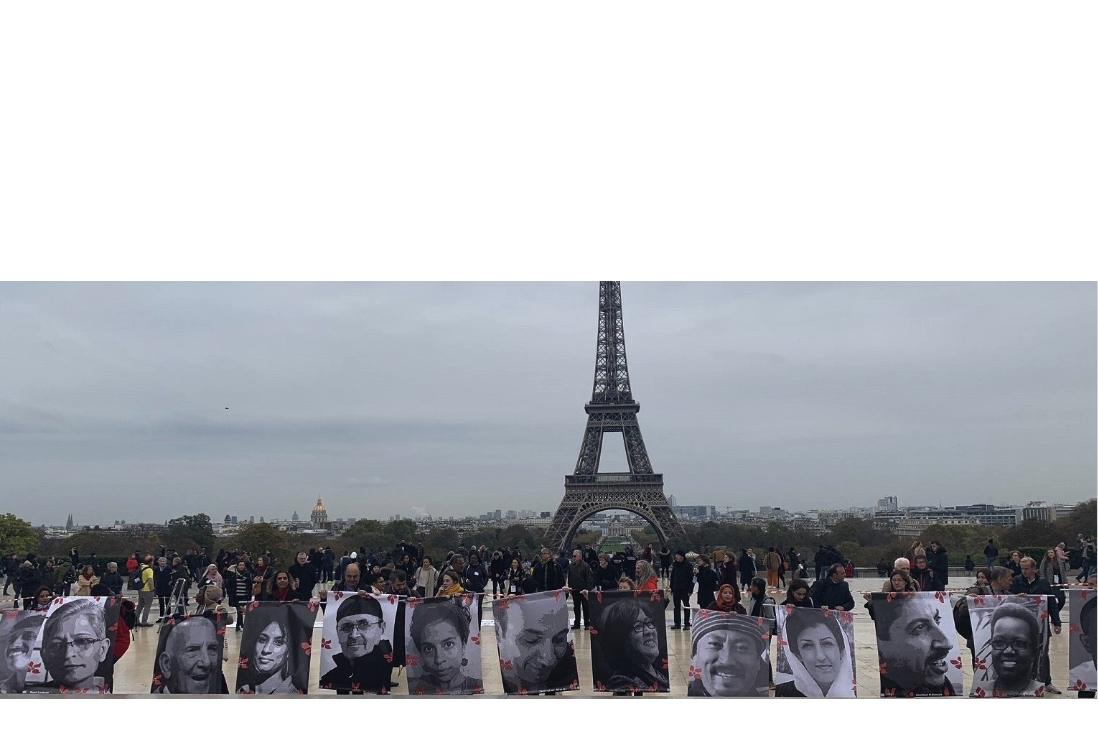
Human rights defenders from across all corners of the world gathered this week [31 October] in Paris for the Human Rights Defenders World Summit, to develop a plan of action for how to protect and promote the work of activists fighting for rights, 20 years on from the first UN Declaration on Human Rights Defenders.

After three days of discussions and strategy development spanning regional and global issues, environmental rights and women human rights defenders and the increasing attacks on human rights defenders everywhere, the momentum culminated in the presentation of a landmark action plan which will be presented to the UN in December.


(Click on photo to enlarge)

UN High Commissioner for Human Rights Michelle Bachelet, who spoke at the opening ceremony said: “What human rights defenders teach us is that all of us can stand up for our rights and for the rights of others, in our neighborhoods, in our countries and all over the world. We can change the world .”

The Summit discussed calls on Governments, corporations, international financial institutions, donors and others, including the adoption of national governmental action plans, implementation of legislation to legally uphold the UN declaration, protecting defenders as a priority in foreign policy and prioritizing the protection and work of women human rights defenders, LGBT+, indigenous rights defenders and other marginalized defenders.

(Article continued in the right column)

Question related to this article:

What is the state of human rights in the world today?

(Article continued from the left column)

Kumi Naidoo, Amnesty International’s Secretary General, said: “The level of danger facing activists worldwide has reached crisis point. Every day ordinary people are threatened, tortured, imprisoned and killed for what they fight for or simply for who they are. Now is the time to act and tackle the global surge in repression of human rights defenders.”

The closing ceremony took place at the Palais de Chaillot, where the Universal Declaration of Human Rights was signed 70 years ago. The 150 defenders gathered together to set out the Action Plan and pay tribute to the men and women who work tirelessly to defend human rights around the world.

Among those in attendance over the last three days were Alice Mogwe, Secretary General of FIDH and the Director of Botswana Ditshwanelo; Pulitzer Prize-winning journalist Matthew Caruana Galizia, who is calling for justice after his mother, Daphne Caruana Galizia, was assassinated one year ago in Malta; Anielle Franco, who is bravely campaigning on behalf of her sister, Marielle Franco, a Brazilian activist and elected councillor who was shot dead in her car seven months ago.

Hina Jilani, President of OMCT, founder of the Human Rights Commission of Pakistan, and the first UN Special Rapporteur on the situation of human rights defenders said: “States have never given us space. It is because of human rights defenders that there is space for civil society. Seeing you all here engaged in defending human rights, I am not too pessimistic. As a movement, we have never been as global as we are now. But we have to be clear to states: you need to live up to the challenge and speak out for defenders. Human rights don’t come for free .”

The 1998 UN Declaration on Human Rights Defenders

In 1998, governments adopted the Declaration on Human Rights Defenders to acknowledge the key role of human rights defenders. Despite progress in some areas, many governments are continuing to fall short of their commitments 20 years on from the first Summit and the global context in which human rights defenders operate in has become increasingly challenging. Democratic values are under threat and systemic corruption, extreme inequality and discrimination, religious fundamentalism and extremist policies are all on the rise. Alongside this, we have seen a concerted effort to undermine, discredit and kill human rights defenders. In 2017, at least 312 human rights defenders were assassinated, twice as many as in 2015, almost all with impunity for the perpetrators. The Action Plan hopes to tackle these injustices and support Human Rights Defenders to continue their critical work in a safe environment.

Città della Pieve, Italy: The Declaration of the Scientists for Peace

. . SUSTAINABLE DEVELOPMENT . .

A press release from Comunità di Etica Vivente

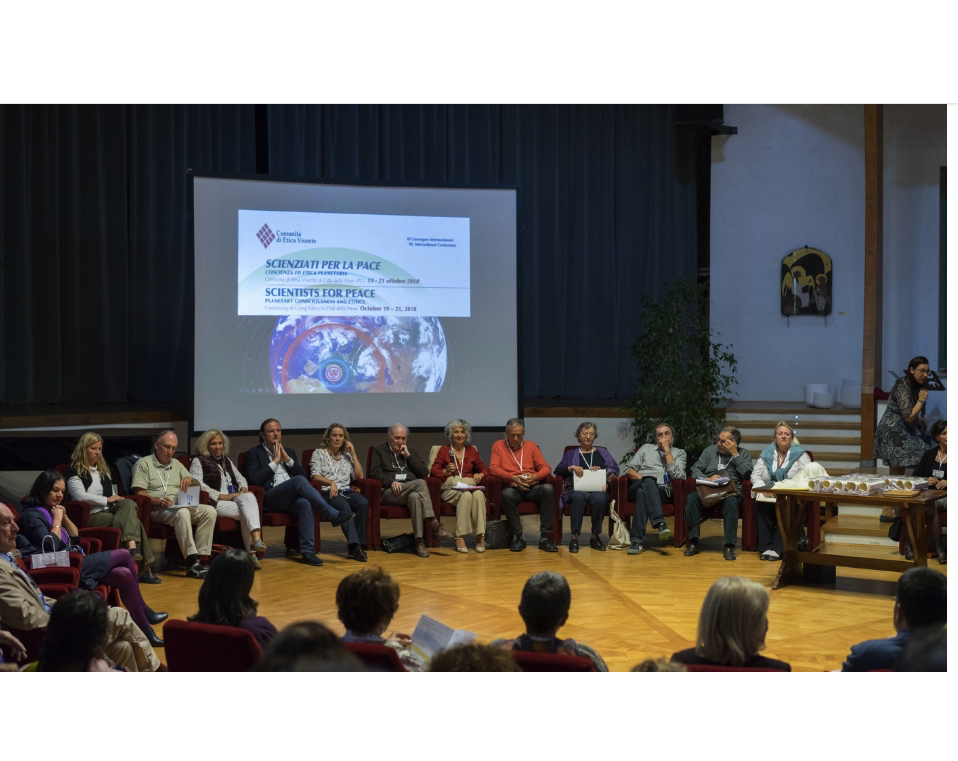
Can Peace be conquered on the Planet permanently? For the researchers of various branches of learning who took part in the International Conference “Scientists for Peace” – which was recently held in the “Aula della Cultura” – the answer is yes.


(Click on photo to enlarge)

The first step will be the commitment to increase the awareness of that part of the public opinion conditioned by information that is often distorted and incomplete.

Only effective communication can enable individuals to know, and therefore operate, with increasing awareness, in their daily actions, respecting themselves and their peers. Starting from their own consumptions and rethinking their needs, whose ideological, as well as economic, burden harms the entire planet and its resources.

All this requires dialogue between the various disciplines to arrive at a joint effort where Psychology and Physics intertwine in Mathematics and Law, Economics and Education, Philosophy and Medicine.

The goal is a Healthy world where Prejudice, Fear and War are no longer present. Where Science, as well, gives human beings awareness of the Cosmos, revealing more and more surprising analogical correlations and interconnections, taking a position for certain distortions to be corrected.

For these purposes, the scholars who took part in the Convention have signed the “Declaration of the Scientists for Peace” which will be sent to UNESCO [see text below]. Formative interventions are encouraged to increase a responsible human and social conscience in the school and university paths of those who become practitioners of applied sciences. Starting from the acceptance that scientists and technicians who are part (or that such could become) of a chain of production of war instruments can oppose, appealing to the ethical principles on which the applied sciences must be based. And that, at the same time, intervene in the media so that the war does not continue to be considered possible but definitely reveals the face of an absolute aberration and violation of fundamental human rights.

The Declaration will be brought into the world and will be enriched in the coming months with the signing of other scientists who will be joined under the aegis of “Flag of Peace”, the international association that promoted the conference and has in its mission the promotion of Culture as instrument of Peace, through Science, Art and Philosophy.

(Article continued in the right side of the page)

Question for this article:

How can we ensure that science contributes to peace and sustainable development?

(Article continued from the left side of the page)

Visit the Conference page to see photos, videos and to download the file of the abstracts of the speeches.

Declaration

Recommendations from the “Scientists for Peace” Conference

Science has an important role to play in promoting and achieving peace on Earth. The main question which we ask in this respect is, why are scientists and engineers, highly educated individuals, willing to violate basic humanistic principles by developing and producing weapons? This is mostly due to a limited ethical consciousness, whereby each human being is seen as an isolated individual, and the wider implications of one’s work for society and for humankind are usually belittled.

To change this state of affairs we must become conscious of the fact that humankind can only thrive in peace if it is able to live up to universal ethical principles. Peace on Earth can be fostered and maintained; a world without wars can be developed, where peaceful relationships of responsibility and respect among peoples and individual human beings are properly cultivated.

How can this vision be achieved? What is the proper role for scientists and engineers to fulfil this vision?

We are committed to a view of science as an invaluable resource to promote peace in all areas of life. Accordingly, as a meaningful step towards realizing Peace on Earth, we submit to the United Nations the following recommendations, directed to the world of science and engineering:

• Schools and universities should be strongly invited to offer courses addressing the social responsibilities of scientists and engineers, especially concerning the potential and actual warfare applications of their work. Along with their professional expertise, science and engineering students should develop the ability to raise societal awareness about the threats that existing and prospective weapons systems pose to the survival and flourishing of humankind, especially in connection with weapons of mass destruction.

• It should be made clear that scientists and engineers consciously participating in the development, production, distribution and use of weapons of mass destruction go against the fundamental ethical principles that should be at the core of science and engineering.

• Everybody shall have the right to refuse to obey when it comes to the use of weapons of mass destruction and should be protected accordingly.

• It should be continually reaffirmed that mass media and other sources of information which advocate the view that waging war is an acceptable way to solve conflicts betray universal ethical principles enshrined in the Charter of the United Nations and the prohibition of propaganda for war asserted in the United Nations International Covenant on Civil and Political Rights.

(Thank you to the Good News Agency for calling our attention to this article)

Abolish Militarism and War: Mairead Maguire to the International Conference against US/NATO Military Bases

FREE FLOW OF INFORMATION

Transcript at Transcend

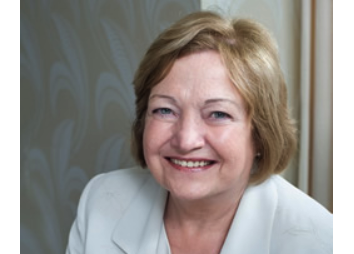
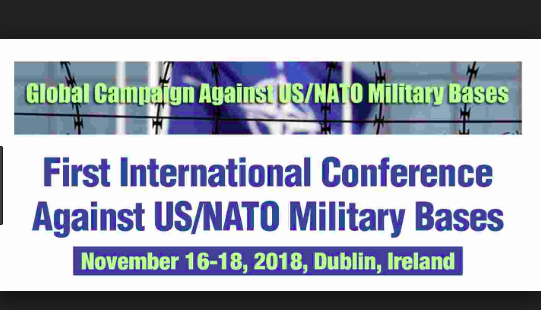
Presentation by Mairead Maguire, Nobel Peace Laureate at the International Conference against US/NATO Military Bases, 16-18 Nov 2018, Dublin, Ireland

Dear Friends, It is good to be here with you all. I would like to thank the organizers for inviting me to address the conference.  Firstly I thank you all for your work for peace.  It is good that we will have an opportunity in the next few days to get to know each other and together discuss what kind of a world we want to live in?  There will be many different perspectives on this and the way forward, but let us agree to respect each other and to engage in deep listening and conversation no matter how hard and where the dialogue might take us!


Let us be encouraged by the fact that we have made an important first step when we agree to enter into dialogue, and when we agree that peace is both the means and the great achievable gift. It would be wonderful too no matter what area of social/political change we work in, if we can unite on a shared vision of a demilitarized world and find strength in agreeing we will not limit ourselves to civilizing and slowing down militarism, but demanding its total abolition.

Some people might argue that peace is not possible in such a highly militarized world.  However, I believe that peace is both possible and urgent.  It is achievable when we each become impassioned about peace and filled with an ethic that makes peace our objective and we each put into practice our moral sense of political/social responsibility to build peace and justice.

To build peace we are challenged to reject the bomb, the bullet, and all the techniques of violence.  Unfortunately, we are constantly bombarded with the glorification of militarism and war; therefore building a culture of peace and nonviolence will not be an easy task.  We are hearing about the building of a European army and we are asked to accept austerity and budget cuts to our health, education, etc. whilst increasing money to our own armies and also European military expansion.

The North Atlantic Treaty Organization-NATO, which should have been disbanded when the Warsaw Pact was dissolved, continue to carry out wars and proxy wars in many countries pushing towards the borders of Russia and resurrecting a cold war between the East and West. I believe that NATO should be disbanded and should be made accountable and make restitutions to the millions of people in countries such as Afghanistan, Iraq, Libya, and many others it has illegally attacked, invaded, destroyed.   We will never be allowed by our governments, or our mainstream media, to hear many of the stories of the lives of so many civilians killed by US/NATO forces.  NATO forces have targeted and assassinated individuals and entire families.

It is to all our shame in the International community, that their illegal criminal acts   of horror and bloodletting which embodies the comeback of barbarism, is allowed to continue.  NATO should be brought before the International Criminal Court  for war crimes.

(Article continued in the column on the right)

Questions related to this article:

Where in the world can we find good leadership today?

(Article continued from the column on the left)

It would be all too easy to point fingers and play the blame game but unless we all take responsibility for the highly dangerous militarised situation with which we are faced in the world today, things will not get better.

Ireland with the militarization of its Foreign and Defence Policy has been unfaithful to the Irish peoples’ wish for a Neutral State and worse by being complicit in accommodating illegal wars.  Ireland’s peace activists have been peacefully protesting US military use of Irish airports whereby over two and a half million armed US troops have passed through Shannon Airport on their way to and from the US-led Afghan and Iraq wars.  I believe ireland should refuse permission to any further stopover and refueling facilities being granted to aeroplanes ferrying troops or munitions to the wars and also withdraw Irish participation from all NATO and EU military operations overseas.

Ireland is deeply admired in many countries and has a proud record in helping developing countries.   Their role as mediators and peace negotiators is well known.   I would like to propose that Ireland disband their army and focus their finance and people on developing their great expertise in the science of peacemaking through a Government Dept. of Peace.   Recommitting to its tradition of neutrality and multilateralism, placing ethics, morality and justice as core values at the heart of its foreign policy would send out a clear message of Irish Government rejecting the road of militarism and war and choosing the road of peace and reconciliation, both locally and internationally.

For our survival through the UN we need to move to General and Complete Disarmament – including nuclear weapons.  This is not an impossible dream.  I commend the Irish Government in their work at UN to work for Nuclear Disarmament.  I believe we can take hope from Pope Francis statement after pointing out the dangers of nuclear weapons when he says‚

‘The threat of their use, as well as their very possession, is to be firmly condemned.’

And the Pope quotes as an example the

‘historic vote at the UN the majority of the members of the international community determined that nuclear weapons are not only immoral, but also must be considered an illegal means of warfare.’

It is to be hoped that UK, Israel, USA and other nuclear armed states will begin to dismantle their nuclear weapons and help turn back the hands of the doomsday clock.   Up to the end of 1961 at the United Nations general and complete disarmament was the aim of all governments.  In a joint Soviet-United states statement of 20 Sep l961 they stated,

‘The goal of negotiations is to achieve agreement on a program which will ensure that disarmament is general and complete and war is no longer an instrument for settling international problems’.

Let us unite our voices to call for an end to enmity and war, and for President Trump and President Putin to join together with all world leaders in a World Peace Conference to work for an agreed Programme of General and Complete Disarmament.  Such courageous leadership towards dialogue and disarmament would give hope to humanity.

Madrid: Women close the Anti-Violence Forum with a message of peace

. . WOMEN’S EQUALITY . .

An article from Ultima Hora (Note: Also available from Europapress)

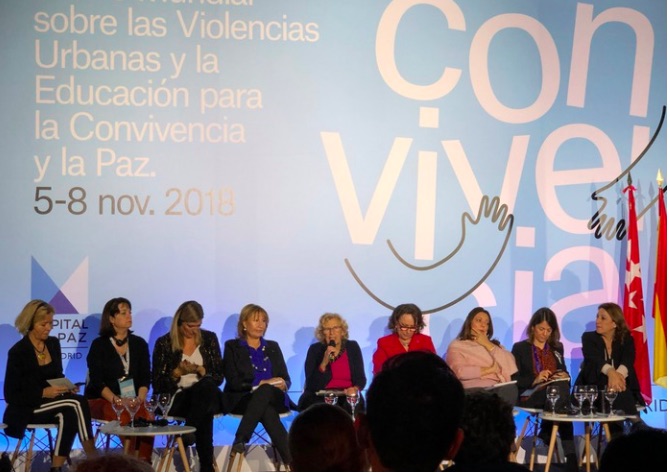
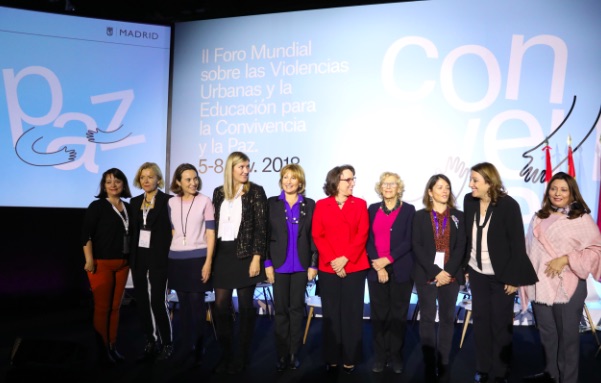
Ten women leaders of politics and society closed today [Nov 8] the II World Forum on Urban Violence and Education for Coexistence and Peace in Madrid with a message of peace.

“Women do not shy away from conflict. When there is injustice, it must be revealed, “said the mayor of the Spanish capital, Manuela Carmena. “But the big difference is that we do not use violence to resolve conflicts. Women are agents of peace.”

For two hours before an audience that interrupted the interventions with applause, the participants discussed from a feminist perspective a large part of the topics of the forum organized by the city council of Madrid in the Matadero cultural venue, which included dozens of papers, workshops and events.

Mayor Carmena had the last word, sending a message of hope and asking for a cultural change. “Why have we chosen this extraordinary panel to finish? It has an explanation: we have defined 2018 as the violet year. Millions of women went out to the streets to remember that the prominence of women is still pending. We must be protagonists in the 21st century and in the following centuries,” she said.

“Violence is still linked to the culture of machismo and that erroneous concept of masculinity. Earlier we heard that in Latin America there are 400 homicides a day. But that statistic does not say that most are committed by men. Just 1 percent are committed by women,” she added.

“We have to say it. Women do not have their hands stained with blood, “said Carmena, who nevertheless pointed out that the culture of peace has been moving forward in the 20th century despite the atrocities of world wars.

As noted, interpersonal violence has been reduced by 16 percent. “And that’s partly due to the triumph of women’s values,” she said. “You just have to read the women of the past. The war correspondents all spoke against the war, but they were not listened to. Now we are here their daughters and granddaughters so that it is known that the voice of women is the voice of peace “.

(Continued in right column)

(Click here for a version in Spanish)

Questions for this article:

How can culture of peace be developed at the municipal level?

Do women have a special role to play in the peace movement?

(Continued from left column)

Sitting next to Carmena, the Ibero-American General Secretary, Rebeca Grynspan, drew a somewhat more pessimistic picture of Latin America, which she described as “one of the most violent regions in the world.”

To the data of 400 daily homicides, she added that more than half of citizens say they live with fear. In addition, she stated that many countries in the region are among the worst in feminicide statistics.

“We must change the conception of masculinities and we must ensure that women have more autonomy,” said the Costa Rican official, who also pointed out some immediate measures that can be taken to reduce violence in the cities.

“We know that where public areas are set up for sport, culture or art, violence is reduced. We know that where there is less overcrowding violence is reduced. We know that putting more light on the city reduces violence. But we also need a longer-term vision,” she said.

The Latin American region was also represented by the president of the Association of Municipalities of Bolivia, Rocío Alejandra Molina, and by the mayor of Rosario, Mónica Fein.

Molina said that her country is in a “process of change” and stressed that more than 50 percent of Bolivian parliamentarians are women, but that there is still much to be done to eradicate “structural violence.” For her part, Fein recalled the strength of the feminist movement in Argentina and the struggle to pass a law in favor of the voluntary interruption of pregnancy. “We have won many battles, but there are still many battles to be fought,” she warned.

Other participants in the panel included: Liv Torres, executive director of the Nobel Peace Center; Concepción Gamarra, mayor of Logroño and first vice president of the FEMP; Beatrice Fihn, executive director of the International Campaign to Abolish Nuclear Weapons; Emilia Saiz, General Secretary of UCLG; Elena Biurrun, Mayor of Torrelodones, and Tunisian Ouided Bouchmaoui, Nobel Peace Prize 2015.

In her brief closing speech, Carmena thanked Pope Francis for the message of support he sent to the forum and that was read during the women’s talk, as well as insisting on what he said on Monday at the inauguration, citing the legendary former South African president Nelson Mandela: “Violence is not intrinsic in the human being.”

Dublin: Global Campaign Against US/NATO Military Bases

FREE FLOW OF INFORMATION

Excerpts from the website of No US/NATO Bases

Conference Program and Schedule

November 16-18, 2018 — Liberty Hall, Dublin, Ireland

Friday, November 16

1:00 – 3:00 PM — Registration and Check-in


3:00 – 5:00 PM — Rally Against US/NATO Military Bases at the Dublin General Post Office, Site of the Irish Rising of 1916

5:00 – 7:00 PM — Dinner (on your own)

7:00 – 10:00 PM — International Night

Chair: Ed Horgan, International Secretary, Peace and Neutrality Alliance, Ireland

• Welcoming Remarks

— Roger Cole, Chair, Peace and Neutrality Alliance, Ireland
— Bahman Azad, Coordinator, Coalition Against U.S. Foreign Military Bases, US

• Keynote Speakers:

— Aengus Ó Snodaigh TD, Dail Eireann, Ireland
— Clare Daly TD, Dail Eireann, Ireland

• International Speakers:

— Socorro Gomes, President, World Peace Council
— Thanassis Pafilis, Member of Greek Parliament; General Secretary of WPC
— Alfred L. Marder, President, U.S. Peace Council
— Mairead Maguire, Nobel Peace Laureate
— Ann Wright, Veterans For Peace, CodePink
— John Lannon, Member of the Executive, PANA; Founding Member, Shannonwatch, Ireland
— MK Aida Touma-Sliman, President, Peace and Solidarity Committee, Israel
— Dave Webb, Chair, Campaign for Nuclear Disarmament (CND), UK
— Moara Crivelente, Member of the Executive, CEBRAPAZ, Brazil
— Chris Nineham, Chair, Stop the War Coalition, UK
— Paola Renada Gallo Peláez, President, MOPASSOL, Argentina
— Dr. Zuhal Okuyan, Chairwoman, Peace Committee of Turkey
— Joe Lombardo, Co-Coordinator, United National Antiwar Coalition, US
— Kristine Karch, Stop Air Base Ramstein, Germany

• Musical Performance

Saturday, November 17

8:00 – 9:00 AM — Registration and Check-in

9:00 – 9:45 AM — Opening Session

Chair: Gerry Condon, President, Veterans For Peace, US

• Keynote Speaker:

— Dr. Aleida Guevara, Member of Cuban National Assembly, Cuba

10:00 – 11:15 AM — Plenary 1: Militarism, Nuclear Weapons, and Military Bases

Chair: Margaret Flowers, Popular Resistance, US

— Iraklis Tsavaridis, Executive Secretary, World Peace Council, Greece
— Dave Webb, Chair, Campaign for Nuclear Disarmament (CND), UK
— Gerry Condon, President, Veterans For Peace, US

Q & A / Discussion

(Article continued in the column on the right)

Questions related to this article:

Where in the world can we find good leadership today?

(Article continued from the column on the left)

11:30 AM – 12:45 AM — Plenary 2: Environmental and Health Impact of Military Bases

Chair: Senator Grace O’Sullivan, Green Party, Ireland

— Hideki Yoshikawa Director, Okinawa Environmental Justice Project, Okinawa
— Milan Krajca, Chairman, Czech Peace Movement, Czech Republic
— Dr. Zuhal Okuyan, Chairwoman, Peace Committee of Turkey

Q & A / Discussion

12:45 – 1:45 PM — Lunch (served)

1:45 – 3:00 PM — Plenary 3: Central and South America / Guantanamo

Chair: James Patrick Jordan, Alliance for Global Justice, US

— Silvio Platero, President, MOVPAZ, Cuba
— Myriam Parada Avila, Executive Director, School of Peace Foundation, Colombia
— Paola Renada Gallo Peláez, President, MOPASSOL, Argentina

Q & A / Discussion

3:15 – 4:30 PM — Plenary 4: Asia Pacific / Pivot to Asia / Okinawa

Chair: Anette Brownlie, Chairperson, IPAN, Australia

— Hiroji Yamashiro, Director, Okinawa Peace Action Center, Okinawa, Japan
— Teddy Casiño, Former Member of Congress, Philippines
— Tarak Kauf, Formre Member of National Board, Veterans For Peace, US

Q & A / Discussion

4:45 – 6:00 PM — Plenary 5: The Middle East: US/NATO Plan

Chair: MK Aida Touma-Sliman, Peace and Solidarity Committee, Israel

— Dr. Issam Makhoul, Chair, Emil Touma Institute, Israel
— Medea Benjamin, Founder, CODEPINK, US
— Dr. Akel Taqaz, Coordinator, Palestinian Committee for Peace and Solidarity, Palestine

Q & A / Discussion

6:00 – 7:30 PM — Dinner (on your own)

7:30 – 9:00 PM — Cultural Event

Sunday, November 18

9:00 – 10:15 AM — Plenary 6: Europe / NATO Expansion

Chair: David Swanson, World BEYOND War, US

— Chris Nineham, Chair, Stop the War Coalition, UK
— Ilda Figueiredo, Chair, Conselho Português para a Paz e Cooperação, Portugal
— Frank Keoghan, Chair, People’s Movement, Ireland

Q & A / Discussion

10:30– 11:45 AM — Plenary 7: Africa / Africom

Chair: Margaret Kimberley, UNAC; Black Agenda Report, US

— Ajamu Baraka, Black Alliance for Peace, US
— Anne Atambo, President, WILPF Kenya
— Chris Matlhako, South African Peace Initiative, South Africa

Q & A / Discussion

11:45 – 12:45 PM — Lunch (served)

12:45–2:15 PM — Regional Organizing Breakout Meetings

— Discussing Regional Plans of Action
— Regional Report Back to the Final Plenary

12:45–2:30 PM — Final Plenary: Global Campaign’s Future Plan of Action

Chairs: Roger Cole, PANA, Ireland; Bahman Azad, Coalition Against US Foreign Military Bases, US

— Identifying Major Campaign Areas
— Planning Other Actions for the Coming Year
— Confirmation of the Coordinating Committee for the Global Campaign

2:30 – 3:00 PM — Closing Remarks

Navarra, Spain: The “Schools for Peace and Coexistence” Program will be extended to 61 centers and more than 10,800 participants

… EDUCATION FOR PEACE …

An article from Pamplona Actual

The “Schools for Peace and Coexistence” Program will continue for a third year, responding to the requests received from Primary, Secondary and Vocational Training centers throughout Navarra, as well as the Public University of Navarra.


Promoted from the 2016-2017 academic year by the General Directorate of Peace, Coexistence and Human Rights of the Department of Citizen and Institutional Relations in cooperation with the Department of Education, “Schools for Peace and Coexistence” has been consolidated and each course serves a greater number of students, families and education professionals.

The Program makes available to schools several educational and educational tools that enable both students and teachers and families to address, from a positive and educational point of view, different aspects of coexistence. It brings together training workshops, pedagogical experiential activities and participatory workshops that are being carried out in public and concerted educational centers throughout Navarre.

The objective of the workshops is to advance in the construction of coexistence and a culture of peace through activities that allow the educational community:

(Articles continued in right column)

(Click here for the original article in Spanish)

Questions for this article:

Where is peace education taking place?

(continued from left column)

– to learn the different ways of expressing and verbalizing a conflict in order to approach its solution in a positive way;

– to know which are the most important humanitarian crises worldwide and reflect on Human Rights in these contexts;

– to experience and reflect on the damage and the conflict that negative attitudes and prejudices cause when they put in risk the coexistence between people of different ethnicity, culture, ideology, religion, etc .;

– to learn to make correct use of new technologies free of abusive and violent practices;

– to learn to play cooperatively in the spaces and times that the educational centers allocate to activities, without discrimination, without exclusions and without violence;

– and to internalize skills and favorable attitudes for the positive transformation of conflicts.

In addition, this Program is complemented with other initiatives of Peace and Coexistence that are expressly open to the participation of schools, such as exhibitions, film forums, contests, etc.

The Program in data

During the 2016/2017 academic year, a total of 4,311 students participated in the first edition of the program, from 41 educational centers and throughout 140 activities carried out. In the 2017/2018 academic year, the number of participants increased to 6,499 from 63 educational centers, with a total of 385 activities carried out.

This course, the Regional Government has received the request of 61 centers, so that a total of 10,832 people participate in the programmed activities.

The II Forum on Urban Violence closes in Madrid with the commitment to an agenda of cities of coexistence and peace

.. DEMOCRATIC PARTICIPATION ..

An article from Tercera Informacion (translation by CPNN)

The II World Forum on Urban Violence and Education for Coexistence and Peace closes Thursday [November 10] with the commitment to elaborate an agenda of cities of peace. Madrid continues the line started in April last year when, in the first edition of this meeting, a line of work was opened that highlighted the potential of cities as a stage to advance in the achievement of the 17 Sustainable Development Goals (ODS), through the construction of a culture of peace.

The instruments to materialize such actions include:

– implement policies of caring rather than policies of security;

– articulate with the state governments the preparation, implementation and supervision of action plans for the prevention of violence;

– develop local action plans to address them.

In this sense, both the Forum and the commitment with which it closes its second edition “could become the basis for a more continuous and systematic expression of a local effort aimed at the prevention of violence.”

Pope Francis sent, through the archbishop of Madrid, Carlos Osoro, a letter to all the participants in the II World Forum on Urban Violence in which he expressed his hope that these days have served for dialogue and exchange: “That they have been an auspicious occasion to promote the construction of the social fabric of our towns and cities, so fragmented today by selfishness, injustice and aggression.”

(Continued in right column)

(Click here for a version in Spanish)

Questions for this article:

How can culture of peace be developed at the municipal level?

(Continued from left column)

The Pope’s letter also encourages all participants to welcome certain people in a special way: “To the most fragile members, to the marginalized, to the discarded, so that they may have the opportunity to feel at home in a community that welcomes, integrates, sustains, and favors the recognition of the other in his own wealth and diversity.”

The words of the Holy Father were read by Carlos Osoro in the plenary on interreligious dialogue that was held early in the morning. Subsequently, Juan Luis Cano, the moderator of the closing, who read the letter during that session concluded the forum in a roundtable with a dozen women with experience in institutional representation and in government work and who have participated or actively participate in public life and the responsibilities of city government.

Women, agents of peace

“Women can feel safe being agents of peace. The most positive data on the culture of peace according to the latest statistics available for 2014 show that 16% of interpersonal violence has been reduced in the world “. This was pointed out by Mayor Carmena during the closing ceremony of the second edition of a forum that exceeded the figures of the previous year by bringing together 5,000 participants and sharing1000 experiences.

Liv Torres, executive director of the Nobel Peace Center, recalled that the regard and presence of women in conflict resolution is more important than ever: “The processes of mediation in which women participate last longer and they are more sustainable over time. We have to sit next to each other, support each other and show the value of women in their role as leaders.”

For its part, the Ibero-American General Secretary, Rebecca Grynspan, has pointed out that inequality is one of the main causes of violence and has added: “In Latin America there are 400 homicides per day but 80% of those cases occur in 2% of the Latin American territory.”

All have agreed on the importance of talking about education, changing the conception of masculinity and giving more economic autonomy to women to ensure that future generations really live in cities of peace.

After the debate, 400 girls and boys, between 12 and 16 years old, from different schools in the two districts of Valleca, have drawn the symbol of peace in Plaza Matadero, accompanied by an orchestra of social excluded children, an action initiated by the NGO Mundo sin Guerras.