Tag Archives: Mideast

The Palestinian Hunger Strike: “Our chains will be broken before we are..”

. HUMAN RIGHTS .

A blog by Richard Falk

On April 17th at least 1500 Palestinian prisoners launched a hunger strike of indefinite duration, responding to a call from Israel’s most famous Palestinian prisoner, Marwan Barghouti. It also happens to be that Barghouti is the most popular political leader, far more liked, trusted, and admired that the President of the Palestinian Authority, Mahmoud Abbas. Barghouti is serving a series of lifetime terms for his alleged role in directing an operation during the Second Intifada in which five Israelis were killed.


Palestinian activists stand around a mosaic portrait of political prisoner Marwan Barghouti near an Israeli military installation in the West Bank city of Ramallah. File photo: Nasser Shiyoukhi/AP

Barghouti who has been in prison for fifteen years, gave his reasons for the strike as “torture, inhumane and degrading treatment, and medical negligence,” as well as a failure to abide by international legal standards pertaining to prison conditions during a military occupation. Even the normally timid International Committee of the Red Cross acknowledged prisoner demands by issuing a public statement asserting that the denial of family visits and moving Palestinian prisoners and detainees outside of the occupied territory to Israeli jails were violations of international treaty norms set forth in the Fourth Geneva Convention governing belligerent occupation.

Because Barghouti expressed his grievances in an article somewhat surprisingly published by the NY Times on April 16th. Surprising because the Times, an influential media outlet, has over the years been reliably deferential to the Israeli rationalizations for Israeli contested policies and behavior. It turns out that the newspaper was nervous about this departure from its normal operating mode. Barghouti’s piece only appeared in its international edition, and had a qualifying editorial note appended: “This article explained the writer’s prison sentence but neglected to provide sufficient context by stating the offenses of which he was convicted. They were five counts of murder and membership in a terrorist organization. Mr. Barghouti declined to offer a defense at his trial and refused to recognize the Israeli court’s jurisdiction and legitimacy.” [italics in the original]

In retaliation for daring to publish this opinion piece Barghouti was severely punished. He was immediately placed in solitary confinement, has not been allowed to change his clothes for the past month, and is inspected by prison guards four times a day.

The notorious Canadian ultra Zionist media watchdog, Honest Reporting, explains on its website that its goal is “defending Israel from media bias.” Honest Reporting expressed its outrage by condemning the NY Times for opening its pages to a convicted Palestinian ‘terrorist.’ It is Orwellinan to so describe Barghouti, a political leader courageously defending his people against an unlawful and oppressive occupation that is approaching its 50th anniversary, and is now best understood as a crime against humanity taking the form of apartheid victimizing the Palestinian people as a whole, and not just those living under occupation. If the Honest Reporting was indeed honest it would expose the pronounced media bias in the West shielding Israel from international accountability and obscuring the severity of Palestinian grievances under international law and morality.

The world media treatment of this massive Palestinian strike is typical, although nevertheless disappointing. It gives meager attention to the dramatic character of such a prison protest that has continued for over a month, stimulating many solidarity demonstrations throughout occupied Palestine, a sympathy 24-hour hunger strike by South Africans including the prominent Deputy President Cyril Rhamaposa, and widespread shows of support throughout the Palestinian diaspora. The reaction of the Palestinian Authority has been evasive, with Abbas giving a token show of public support for prisoner goals, while letting it be known privately that he hopes the strike will end as soon as possible.

(Blog continued in right column)

Question for this article

Presenting the Palestinian side of the Middle East, Is it important for a culture of peace?

(Blog continued from left column)

The behavior of the Israeli Prison Service is an indirect confirmation of prisoner discontent. In a sadistic taunt, Israeli settlers were allowed to have a barbecue in the parking lot in front of one of the prisons, apparently mocking the hunger strikers with the pungent aroma of meat being grilled. Worse than this, a fake video was distributed by prison official purporting to show Barghouti having a snack in his cell. This effort to discredit the strike and its leader has been angrily denied. Khader Shkirat, Barghouti’s lawyer, explained that there was no way food could be smuggled to someone in solitary, especially with frequent room searches. It was finally conceded by prison officials that food was delivered to Barghouti’s cell by prison guards trying unsuccessfully to tempt him to break the fast. Barghouti on his side responded via his lawyer, “I plan to escalate my hunger strike soon. There is no backtracking. We will continue until the end.” Barghouti, 58, has according to the last report has lost 29 pounds since the start of the strike, and now weighs 119, planning to refuse even water.

Even if this dire commitment is not carried through to a potentially grim finality it will not tarnish the significance of what has been undertaken, and the great reluctance of the world to focus its attention on such a display of nonviolent martyrdom. This is not the first Palestinian prison strike motivated by abusive prison conditions and instances of administrative detention, arresting and jailing without any formal charges. But it appears to be the most consequential due to the participation of Marwan Barghouti along with so many other Palestinian prisoners as well as producing many displays of solidarity beyond the prison walls.

As Ramzy Baroud has pointed out in an Al Jazeera article published on May 10, 2017, the strike, although putting forth demands relating to prison conditions, is really a reflection of the underlying ordeal, what he refers to as “the very reality of Palestinian life”; it is above all “a call for unity against factionalism and Israeli occupation.” The distractions created by the Trump presidency, Brexit and the rise of the European right-wing, and turmoil in the Middle East have given Israel’s leadership the political space to push their expansionist agenda toward an imposed outcome of one Jewish state imposing its will on two distinct peoples. Such an endgame for this version of colonialist displacement and subjugation of the indigenous majority population will extend Palestinian suffering in the short-run, but will over time undermine Israeli security and stability, and bring the long Palestine nightmare to an end.

The British leadership finally appreciated their own interests, forging a political compromise in Northern Ireland in the form of the Good Friday Agreement, which while fragile and imperfect, has mostly spared Catholics and Protestants further bloodshed. Will the Israeli and U.S. leadership grow responsive to the moral and legal imperatives that call for a sustainable and just peace between these two peoples before the political imperative of such an essential outcome assume more menacing forms?

Against all expectations, the South African leadership did eventually become so responsive, but only after enough pressure was exerted internally and internationally. The South African leadership produced a new dawn by releasing its prime ‘terrorist’ inmate, Nelson Mandela, from prison, and the rest is history. Marwan Barghouti is clearly available to play such an historical role in relation to Israel. It will be a tragedy if Zionist ambitions and American led geopolitics preclude this from happening! The road to peace for Israel is the similar to the road to peace for apartheid South Africa: dismantle the apartheid regime that now dominates and discriminates against the Palestinian people on a systematic and totalizing basis. Such a projected future may seem a dream, but dreams can be made to come true through the dynamics of a struggle for justice. If so, we may look back on Barghouti’s hunger strike as the beginning of a winning Palestinian endgame.

It is important that we appreciate that a hunger strike is not only a pure form of nonviolence, but is also a self-inflicted sacrifice by those who seek to exhibit their opposition to the existing state of affairs in this manner, hoping to create conditions that produce change. It is an extreme type of resistance that in its essence is an appeal to the conscience and compassion of its opponents and public opinion generally. As Gandhi found out in racist South Africa, if that conscience and compassion are not sufficiently present within a given society such tactics are futile, and violent resistance becomes the only alternative to submission and despair. Israel has been repeatedly challenged by the Palestinians to do the right thing, but responds increasingly by treating all of its adversaries as ‘terrorists’ regardless of their behavior, while itself continuing to defy international law thereby denying the most fundamental rights to the Palestinian people and repeatedly relying on excessive force to safeguard its dominance.

The Inside Story on Our UN Report Calling Israel an Apartheid State

. .DISARMAMENT & SECURITY. ,

An article by Richard Falk reprinted by Transcend Media Service

Six months ago, the UN’s Economic and Social Commission for West Asia (ESCWA) asked Virginia Tilley and me to write a study examining the applicability of the international criminal law concept of apartheid to Israel’s policies and practices toward the Palestinian people. We were glad to accept the assignment, and conceived of our role as engaging in an academic undertaking. ESCWA, one of several UN regional commissions, requested the study as a result of an uncontested motion adopted by its 18 Arab member governments.


A Palestinian woman argues with Israeli soldiers at a West Bank checkpoint south of Hebron on August 16, 2016. (Reuters / Mussa Qawasma)

Almost within hours of its release on March 15, our report was greeted by what can only be described as hysteria. The US ambassador to the UN, Nikki Haley, denounced it and demanded that the UN repudiate it. The newly elected secretary general, António Guterres, quickly and publicly called for ESCWA to withdraw the report from its website, and when Rima Khalaf, the head of the commission, resisted, Guterres insisted. Rather than comply, Khalaf resigned. Soon thereafter, the report was withdrawn from the commission’s website, despite its having been published with a disclaimer noting that it represents the views of its authors and not necessarily that of ESCWA or the UN.

What is striking about this response, which resembles in many respects the US government response to the Goldstone Report (the UN Fact-Finding Mission on the Gaza Conflict of 2008-9), is the degree to which Israel’s supporters, in response to criticism, have sought to discredit the messenger rather than address the message.

We had hoped that our analysis would prompt debate, dialogue, and consideration of our recommendations.

Tilley, a professor of political science at Southern Illinois University Carbondale, and I, as well as ESCWA, would welcome substantive discussion of and critical feedback on our report, and we had hoped that our analysis and conclusions would provide the basis for dialogue and further consideration of the recommendations appended at the end. ESCWA, for its part, took steps to ensure that the report lived up to scholarly standards, submitting the draft text to three prominent international jurists, who anonymously submitted strong positive appraisals along with some suggestions for revision, which we gratefully incorporated before the final text was released. For government officials and others to dismiss our report as a biased polemic is irresponsible, with respect both to the authority of the UN and to international law.

During my tenure as the UN’s Special Rapporteur on human rights in the occupied Palestinian territories (2008-14), I saw how defenders of Israel attempt to discredit critics. My reports in that post often contained sharp criticisms of Israel and other actors, ranging from defiance of international law, unlawful expansion of settlements, excessive use of force, and complicity of international corporations and banks that do business for profit with the settlements. To my surprise, I never received substantive pushback regarding my allegations, but I did have the unpleasant experience of having my words on unrelated issues torn out of context. Among my harshest critics were not only the usual ultra-Zionist NGOs, but also Barack Obama’s diplomats at the UN, including Susan Rice and Samantha Power, as well as then-Secretary General Ban Ki-moon. I mention this personal experience only to note that it falls into a longstanding pattern of rebuttal that prefers to smear rather than engage in reasoned debate about important issues of law and justice.

The international crime of apartheid was set forth in the 1973 Convention on the Suppression and Punishment of the Crime of Apartheid. The main elements of the crime consist in deliberate and systematic acts of racial discrimination with the purpose of maintaining unlawful structures of domination by one race over another. Our report also considered whether, in the context of inquiring into the presence of apartheid, it was appropriate to consider Jews and Palestinians as distinct races; we found that there was abundant grounding to do so. As our report shows, “race” in this context is treated as a socially and politically constructed category defining a distinct people. It has no necessary correlation with biogenetic realities, which in this case show an overlap between Jews and Palestinians.

Even Palestinian citizens of Israel, who can vote and form political parties, are subject to many discriminatory laws.

The report also proceeds from the proposition that whether apartheid exists or not depends on the overall treatment of the Palestinian people as a whole. Adopting what we believed to be innovative methodology, we approached this challenge by dividing the Palestinians into four domains that correspond to the manner in which Israel has exercised its authority over the course of many decades, although specific tactics of control have varied through time. In the past, a thorough study by international law scholars found that Israel’s practices in the occupied Palestinian territories are consistent with apartheid. It called attention to the discriminatory treatment of Palestinians, who are subject to military administration as compared to the Jewish settler population, which enjoys the full benefit of the rule of law as it is observed in Israel in relation to Jewish nationals. That study found that such features as “settler-only roads,” dual legal systems, and the draconian separation of the two populations into regions on the basis of race are the hallmark of apartheid. Repressive practices that have made the lives of ordinary Palestinians a daily ordeal are part of this system, as international law establishes that penalizing resistance to apartheid is itself a crime of apartheid.

(article continued in right column)

Question related to this article:

Presenting the Palestinian side of the Middle East, Is it important for a culture of peace?

How can a culture of peace be established in the Middle East?

(article continued from left column)

A second domain investigated in the report involves Palestinians who are residents of Jerusalem. Here the apartheid character of Israeli rule is exhibited in the way the government undermines the security of those Palestinians, manipulating their rights of residence as well as imposing a variety of discriminatory practices, ranging from fiscal measures to the issuance of building permits.

The third domain concerns the Palestinian minority living in Israel, perhaps the most problematic component in terms of establishing a definition of apartheid that encompasses the entire Palestinian population. In this category are some 1.7 million citizens of Israel, who are allowed to form political parties and vote in elections. But this minority, which makes up about 20 percent of the overall Israeli population, is prohibited by law from challenging the proclaimed Jewish character of the state and is subject to a wide range of discriminatory nationality laws as well as administrative practices that severely restrict their rights, with effects on land acquisition, property, immigration, family reunification, and marital freedom.

International law has detached apartheid from its South African origins; it’s now a stand-alone crime against humanity.

A fourth domain, and the one affecting the largest demographic segment, is made up of Palestinians registered as refugees by UN procedures or living under conditions of involuntary exile. In the background is the non-implementation of UN General Assembly Resolution 194 (1948), which confirms the right of return enjoyed by Palestinians dispossessed or displaced by Israel in 1948. This right of return is declared in General Assembly Resolution 3236 to be an “inalienable right,” which thus presumably incorporates those additional several hundred thousand Palestinians displaced by the 1967 war. As far as is known, no Palestinian displaced since the establishment of Israel in 1948 has been granted the right of return to resume residence.

From the perspective of international law, the crime of apartheid has been detached from its historical origins in South Africa. Neither the 1973 Convention nor the 1998 Rome Statute underlying the International Criminal Court ties apartheid to South Africa, but rather treats its practice as a stand-alone crime against humanity. Thus, there are important differences between the way apartheid operated in South Africa and the way it is currently being imposed on the Palestinians, but these differences are not relevant to the question of whether it fairly and accurately applies to Israel. One notable difference is that in South Africa the Afrikaner leadership forthrightly proclaimed apartheid as a reflection of its ideological belief in the separation of races, whereas for Israel such a structure of separation on the basis of race is denied and repudiated. There are other differences as well, relating to degrees of labor dependence and the demographic ratio.

This quasi-permanent structure of domination cannot be justified convincingly by reference to Israeli security needs.

Our report concludes that Israel has deliberately fragmented the Palestinian people in relation to these four demographic domains, relying on systematic discrimination, including “inhuman acts,” to maintain its control, while continuing to expand territorially at the expense of the Palestinian people. On the basis of these findings—backed up by detailed presentations of empirical data, including reliance on Israeli official sources—we conclude that the allegation of apartheid as applied to the Palestinian people is well founded.

We realize that our report is the work of academic investigators and is not an authoritative finding by a formal judicial or governmental institution. At this point it has not—contrary to media reports and diplomatic denunciations—even been endorsed or accepted by the UN, or even ESCWA. We do recommend such an endorsement, and we urge the UN, national governments, and civil society to take measures designed to encourage Israel to dismantle its apartheid regime and treat the Palestinian people in accord with the dictates of international law and human rights, as well as elementary morality.

The broader setting associated with our contention that Israel has become an apartheid state draws on the reality that there is no peaceful resolution to the conflict on the diplomatic horizon, and thus no foreseeable prospect for ending the discriminatory regime. This quasi-permanent structure of domination cannot be justified convincingly by reference to Israeli security needs. A people cannot be permanently repressed in these various ways without viewing the structure that has emerged as an apartheid regime. Indeed, part of the reason for not awaiting a more formal assessment of these charges is our sense of urgency in ending a set of arrangements that have for so long been responsible for so much suffering and denial of basic rights, above all the right of self-determination.

It remains our central hope, one shared by ESCWA, that the widespread availability of the report will lead to a clearer understanding of the Palestinian plight and encourage more effective responses by the UN, by governments, and by civil society. Beyond this, it is our continuing wish that people of good will throughout the world, especially within Israel, will work toward a political solution that will finally allow Jews and Palestinians to live together in peace, with justice.

258,000 Iraqi children back at school in eastern Mosul as battle rages in west of city

… EDUCATION FOR PEACE …

An article from Theirworld: A brighter future for every child (reprinted by permission)

At least 320 schools have reopened in eastern Mosul and nearby towns – allowing around 258,000 children to return to education while fighting continues in the west of the embattled Iraqi city. Some of the children had been out of school for more than two years, with girls largely banned from getting an education by the terror group Islamic State.


Heba, Noor, and Janna in a classroom at a recently reopened school in eastern Mosul, Iraq — UNICEF / Anmar

In February, UNICEF provided learning materials including science and maths kits to 87 of the East Mosul schools, reaching 73,780 children including 31,890 girls. The United Nations children’s agency said the need for furniture, teaching materials, and teacher training remains a challenge.

Concern about unexploded devices in and around schools is high. But with only a limited number of agencies authorised to deliver Mine Risk Education (MRE) sessions, the authorities are concerned. In Anbar province, MRE took place in 50 schools, with awareness and safety messages reaching an estimated 25,000 students, including about 45% of girls.

Paul St. John Frisoli, a senior education technical adviser on the Middle East region for the International Rescue Committee, said schools in Mosul can save children’s lives by giving student, teachers, school staff and parents crucial life-saving information about mine awareness.

In a blog for Refugees Deeply, he added: “IRC staff deployed into recently retaken villages and displacement camps around Mosul have observed high rates of distress among children and families.

(Article continued in right column)

Question for this article:

What is the relation between peace and education?

A culture of peace in Iraq, Is it possible?

(Article continued from left column)

“Education can help children cope with the consequences of conflict by providing a secure, predictable and nurturing environment. Having access to education offers children hope for and a sense of control over their future during crisis.”

Millions of children across the world miss out on school as a result of humanitarian emergencies including conflicts, natural disasters and health crises. Education can be lifesaving – not being in school in emergencies can leave children at risk of child labour, early marriage, exploitation and recruitment into child labour.

Military operations to retake western parts Iraq’s second largest city started on February 19 after Iraqi forces were successful in removing the terror group from the east.

The United Nations estimates that around 750,000 civilians remain inside the western section of the city.

Humanitarian groups are deeply concerned about the situation of civilians trapped there, including around 412,000 children.

Since February 19, more than 31,500 people – including 14,800 children – have been displaced from West Mosul. The majority of people have been sent to new IDP camps in south Ninewa.

In January, 70 schools reopened in Mosul. Hessam al-Din Abar, a representative at the Provincial Council in Nineveh, where Mosul is the capital, said schools had been turned into places for terrorists to train new recruits and promote extremism.

Many families would not allow their children to attend schools while ISIL – which seized the city in 2014 – was controlling them.

An estimated 3.5 million Iraqi children are missing out on education.

(Thank you to Janet Hudgins, the CPNN reporter for this article.)

Egypt : Launch of the 27th session of the International Conference on Islamic Affairs

TOLERANCE AND SOLIDARITY .

An article in Nile International (translated by CPNN)

The Islamic Affairs Council launches the work of the 27th session of the International Conference on Islamic Affairs in the Ministry of Waqfs under the name of “the role of leaders and decision-makers in the spread of the culture of peace and the fight against terrorism and its challenges “.

The work of the international conference on Islamic affairs will take place for two days under the auspices of President Abdel Fatah El-Sissi.

The inaugural meeting was attended by the Minister of Waqfs Mohamed Mokhtar Gomaa, the Mufti of the Republic Dr. Chawki Gomaa, and ambassadors from many Islamic countries, both Arab and foreign.

The conference focuses on how to combat terrorism and extremism, the role of political and parliamentary leaders, international organizations, media and religious leaders in the spread of peace and the confrontation of terrorism and the role of political parties in consciousness-raising among young people.

A tourist, cultural and religious tour will be organized for the participants of the conference.

Also, foreign participants will organize a press conference to review their impressions of the situation in Egypt.

(Click here for the original French version of this article.)

Question for this article

2015-16 Recipients of UN Youth Solidarity Fund, Africa and Middle-East

TOLERANCE AND SOLIDARITY .

From the website of the United Nations Alliance of Civilizations

The Youth Solidarity Fund (YSF) supports youth-led organizations that foster peaceful and inclusive societies by providing direct funding to outstanding projects promoting intercultural and interfaith dialogue. Established in 2008, the Fund responded to calls for action made by youth-led organizations around the world on the importance of establishing funding mechanisms for youth. Today, the Fund is more relevant than ever: As the global agenda increasingly speaks of youth’s participation and contribution to peace, development and security, it is critical to support this participation and contribution through funding and partnership opportunities.


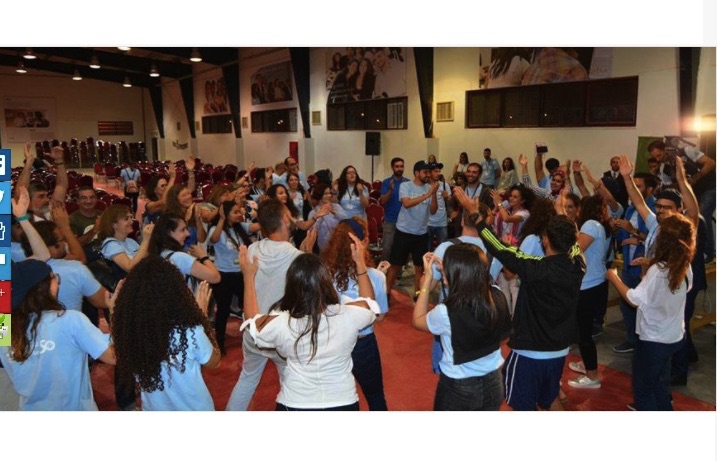
Foto from AFCIG
(Click on the photo to enlarge)

The funded projects are youth-led and youth-focused (18-35 years) but have an impact on entire communities, often involving religious or political leaders, policy-makers, educational institutions and media organizations. The Fund also links small scale and local work to larger movements for social and global change, for a broader and deeper impact.

UNAOC offers technical support and capacity building to the organizations during and/or after the implementation of funded projects in the areas of gender mainstreaming, media relations, advocacy, financial management, networking, sustainability, monitoring and evaluation.

Since 2008, UNAOC has launched four editions of the YSF and provided funding to youth-led organizations based in Africa, the Americas, Asia and Europe. A total of 43 projects were completed as of 2015 reaching a total of over 800,000 persons (youth and non-youth) in over 30 countries.

Here are the five projects chosen in 2015-2016 to be supported (text abbreviated):

1) Action Foundation Common Initiative Group (AFCIG)

AFCIG, based in Cameroon, enables youth to attain independence through self-help, good health and entrepreneurship, in a culture of excellence, gender sensitivity, leadership and innovation. Its key areas of work are: conducting research; developing and implementing programs and projects to promote the development of youth; and advocating for the creation of an enabling environment within which youth can develop. Their projects focus of human and electoral rights, culture and peacebuilding, health and HIV/AIDS, education and entrepreneurship and the environment. . .

One Cameroon (OC) seeks to promote tolerance, respect and acceptance of different religions, cultures and languages by Cameroonian youth. The project encourages youth to leverage the advantages inherent in both cultures and different religions, such as the ability to speak both French and English. It will promote unity among youth from all backgrounds, reject secessionist tendencies and promote peace and unity between Muslims, Christians and Traditionalists in the context of increasing islamophobia. By the end of the project AFCIG expects to:

– Organize 3 workshops to train 60 peer educators to develop their capacity to promote the strength of their country’s diversity, religious and cultural tolerance amongst youth and other Cameroonians;

– Develop a media campaign on peace, religious and cultural tolerance, especially with respect to the Anglophone-Francophone cultures and the Christian-Muslim religions to reach over 2 million Cameroonians in the form of social media posts, spots broadcast on national television, music and radio debates promoting religious and cultural tolerance broadcast on local radio.

2) Approches Locales pour le Développement Durable (ALDED)

ALDED, based in Cameroon, aims to contribute to improving the living conditions of disadvantaged and marginalized populations through the valorization of local initiatives for sustainable development. Its key areas of work are: support for socio-economic integration of young people of all categories; independent monitoring of public policies at local level; promotion and protection of human rights and the fight against corruption. . .

ALDED proposed a project that would contribute to strengthening religious tolerance and constructive dialogue in this context, especially among youth. The project aims to contribute to improving the understanding and the culture of interreligious tolerance in the young population of central, southern and eastern regions Cameroon. By the end of the project ALDED expects to:

– Organize 3 radio roundtables between representatives of different religious faiths and local boards of the Youth in target regional capitals on issues of religious tolerance in Cameroon;

– Create a Facebook forum of around 3000 young people to exchange on challenges and opportunities of religious, cultural and ethnic diversity in Cameroon;

– Produce awareness raising and educational materials (streamers, bilingual comic strips) on interreligious stigma and discrimination and on the difference between the principles of peace promoted by religions such as Islam and acts of religious extremism made by extremist groups such as Boko Haram;

– Train 90 youth leaders on interreligious and intercultural dialogue and tolerance;

– Establish a network of 90 focal points monitoring and managing conflicts arising from interreligious stigma and discrimination.

(Article continued in right column)

Question for this article

Youth initiatives for a culture of peace, How can we ensure they get the attention and funding they deserve?

How can just one or a few persons contribute to peace and justice?

(Article continued from left column)

3) Leadership Initiative for Youth Empowerment (LIFE)

LIFE works in Nigeria since 2012 to empower young people with life skills, information and capacity building to promote their self-actualization. The organization’s key areas of work are: human rights, leadership, peacebuilding and intercultural learning. . .

Leadership Initiative for Youth Empowerment (LIFE) through its Volunteer Corps intends to intervene in this challenge. Specifically, LIFE will train young people from the Muslim community of internally displaced persons and young people from the local community, including Christians and others, to serve as Intercultural Ambassadors. These ambassadors will serve as interns in churches and mosques and will implement community events to promote understanding and tolerance. The project aims at promoting intercultural learning as a key element for peace in Lagos State. By the end of the project LIFE expects to:

– Train 60 youth representatives to act as intercultural ambassadors and increase intercultural learning among internally displaced persons and community residents in 6 Local Government Areas (LGAs) in Lagos State Nigeria;

– Raise awareness on the importance of intercultural and interreligious learning for peaceful co-existence for 3,000 young people and 30,000 community members in 6 LGAs;

– Organize 5-month internships for the 60 intercultural ambassadors in 30 religious organizations;

– Offer 4 awareness-raising sessions on intercultural learning for peaceful co-existence to 1,200 participants in 6 LGAs.

4) Palestinian Center for Communication and Development Strategies (PCCDS)

PCCDS works since 2009 in the West Bank in the areas of youth, human rights and development. They build the capacity of youth on the issues of democracy, justice, social accountability, non-violence and human rights. . .

PCCDS’s project proposes to open new doors of dialogue among Palestinian Islamist, Secular and Liberal youth, animated by the belief that young men and women have a strong power to change themselves and effect positive social change. It also aims to further empower young Palestinians to be part of the solution to the Israeli-Palestinian conflict and contribute to peacebuilding. By the end of the project, they expect to:

– Train 50 students from 2 universities on intellectual and cultural dialogue;

– Sensitize 390 young Islamist, Secular and Liberal young people on the necessity of intellectual and cultural dialogue;

– Issue two booklets written by young Islamist, Secular and Liberal participants on intellectual and cultural dialogue and distribute them in cooperation with university administrations;

– Launch an online forum for intellectual and cultural dialogue giving space to the multiple perspectives and a platform for their interaction;

– Hold an anti-extremism youth national dialogue conference and mainstream its outcomes with the media, government, political parties and community leaders.

5) YaLa Palestine

YaLa believes in the power of education to empower young Palestinians and Middle Easterners to build a better, more peaceful future for themselves and for the region. YaLa works since 2011 to develop on- and off-line educational projects in the areas of citizen journalism, community organizing, youth empowerment, dialogue and peacebuilding. YaLa believes that citizen journalism is a powerful tool to provide a counter voice to the traditional media that often inflames conflict and tensions. Citizen journalism can be used to create a space for individuals to promote nuanced perspectives that underpin the processes of understanding, peace and reconciliation. . .

YaLa proposed a project that would harness new media activism as an unprecedented opportunity for influencing the younger generation and the wider public in MENA in favor of greater understanding, coexistence and peace. Through citizen journalism training and practice, the project seeks to enable Arab and Israeli youth to engage new media more effectively to promote positive messages of understanding and peace, and to develop acquaintance, empathy and trust via online and face-to-face learning and collaboration opportunities. Ultimately, the youth will be motivated to develop and share – with each other and the world – original and fresh citizen journalism pieces on their identity, religion, traditions, daily life, aspirations and other issues of importance to them as a way to increase mutual understanding and cooperation and reduce conflict and polarization. By the end of the project, YaLa expects to:

– Conduct a 4-month online training program in Citizen Journalism for Coexistence for 55 Palestinian, Israeli and MENA youth, meeting on a bi-weekly basis;

– Hold two face-to-face workshops on storytelling and videomaking for 20 Palestinian and 20 Israeli youth participants;

– Produce a video of the storytelling and videomaking workshops to offer as an online learning resource for MENA participants and other youth;

– Post and disseminate online and in mainstream and non-mainstream media some of the journalism pieces produced by the participants in order to advocate for and foster a more inclusive and diverse practice of media production and consumption.

Jordan: RC societies meeting kicks off Tuesday to promote culture of peace

DISARMAMENT & SECURITY .

An article from Petra, Jordan News Agency

The meeting of the Red Cross and Red Crescent Societies for Middle East and North Africa (Mena) region will convene Tuesday [Jan. 24] in Amman under the theme” together for Humanity.”

A statement by Jordan’s Red Crescent Monday said the three-day meeting will tackle a scope of tops including the emergency response to the challenges in Mena region, the importance of promoting a culture of peace, tolerance and non-violence, as well as issues of displacement and migration in the region.

Participants of the ninth edition of the meeting, which will be held under the auspices of Senate President Faisal Fayez, will also focus on issues of reducing urban risks, enhancing humanitarian response in cities and protecting volunteer health and safety.

Some 17 national societies from Mena region are participating in the conference, which is co-organized with the International Federation of Red Cross and Red Crescent Societies, in addition to a number of observers that represent global and regional humanitarian societies, including the International Committee of the Red Cross and Arab Red Crescent and Red Cross Organization (ARCO).

Question related to this article:

Middle East Peace Conference Joint Declaration

DISARMAMENT AND SECURITY .

Conference Declaration as published by France Diplomatie

I) Following the Ministerial meeting held in Paris on 3 June 2016, the Participants met in Paris on 15 January 2017 to reaffirm their support for a just, lasting and comprehensive resolution of the Israeli-Palestinian conflict. They reaffirmed that a negotiated solution with two states, Israel and Palestine, living side by side in peace and security, is the only way to achieve enduring peace.


(Click on photo to enlarge)

* They emphasized the importance for the parties to restate their commitment to this solution, to take urgent steps in order to reverse the current negative trends on the ground, including continued acts of violence and ongoing settlement activity, and to start meaningful direct negotiations.

* They reiterated that a negotiated two-state solution should meet the legitimate aspirations of both sides, including the Palestinians’ right to statehood and sovereignty, fully end the occupation that began in 1967, satisfy Israel’s security needs and resolve all permanent status issues on the basis of United Nations Security Council resolutions 242 (1967) and 338 (1973), and also recalled relevant Security Council resolutions.

* They underscored the importance of the Arab Peace Initiative of 2002 as a comprehensive framework for the resolution of the Arab-Israeli conflict, thus contributing to regional peace and security.

* They welcomed international efforts to advance Middle East peace, including the adoption of United Nations Security Council resolution 2334 on 23 December 2016 which clearly condemned settlement activity, incitement and all acts of violence and terror, and called on both sides to take steps to advance the two-state solution on the ground ; the recommendations of the Quartet on 1 July 2016 ; and the United States Secretary of State’s principles on the two-state solution on 28 December 2016.

* They noted the importance of addressing the dire humanitarian and security situation in the Gaza Strip and called for swift steps to improve the situation.

* They emphasized the importance for Israelis and Palestinians to comply with international law, including international humanitarian law and human rights law.

(Continued in right column)

(Click here for a version in French)

Question related to this article:

How can a culture of peace be established in the Middle East?

(continued from left column)

II) The Participants highlighted the potential for security, stability and prosperity for both parties that could result from a peace agreement. They expressed their readiness to exert necessary efforts toward the achievement of the two-state solution and to contribute substantially to arrangements for ensuring the sustainability of a negotiated peace agreement, in particular in the areas of political and economic incentives, the consolidation of Palestinian state capacities, and civil society dialogue. Those could include, inter alia :

* a European special privileged partnership ; other political and economic incentives and increased private sector involvement ; support to further efforts by the parties to improve economic cooperation ; continued financial support to the Palestinian authority in building the infrastructure for a viable Palestinian economy ;*

* supporting and strengthening Palestinian steps to exercise their responsibilities of statehood through consolidating their institutions and institutional capacities, including for service delivery ;*

* convening Israeli and Palestinian civil society fora, in order to enhance dialogue between the parties, rekindle the public debate and strengthen the role of civil society on both sides.*

III) Looking ahead, the Participants :*

* call upon both sides to officially restate their commitment to the two-state solution, thus disassociating themselves from voices that reject this solution ;*

* call on each side to independently demonstrate, through policies and actions, a genuine commitment to the two-state solution and refrain from unilateral steps that prejudge the outcome of negotiations on final status issues, including, inter alia, on Jerusalem, borders, security, refugees and which they will not recognize ;*

* welcome the prospect of closer cooperation between the Quartet and Arab League members and other relevant actors to further the objectives of this Declaration.*

As follow-up to the Conference, interested Participants, expressing their readiness to review progress, resolved to meet again before the end of the year in order to support both sides in advancing the two-state solution through negotiations.*

France will inform the parties about the international community’s collective support and concrete contribution to the two-State solution contained in this joint declaration.*

Confessions of a Megalomaniac by Uri Avnery of Gush Shalom (Israel)

. .DISARMAMENT & SECURITY. ,

An article by Uri Avnery from Transcend

The Arab taxi driver who brought me to Ramallah had no trouble with the Israeli border posts. He just evaded them.

Saves a lot of trouble.

I was invited by Mahmood Abbas, the President of the Palestinian National Authority (as well as of the PLO and the Fatah movement) to take part in joint Palestinian-Israeli consultations in advance of the international conference in Paris.

Since Binyamin Netanyahu has refused to take part in the Paris event side by side with Mahmood Abbas, the Ramallah meeting was to demonstrate that a large part of Israeli society does support the French initiative.

SIMPLE AS it sounds, the Ramallah meeting was not simple at all.

Before the death of Yasser Arafat in 2004, such meetings were almost routine. Since our groundbreaking first meeting in Beirut in 1982, during the Israeli blockade, Arafat met many Israelis.

Arafat had almost absolute moral authority, and even his home-grown rivals accepted his judgment. Since, after our first meeting, he decided that Israeli-Palestinian meetings served the cause of Palestinian-Israeli peace, he encouraged many such events.

After his murder, the opposite trend gained the upper hand. Palestinian extremists held that any meetings with Israelis, whoever they might be, served “normalization” – a terrible, terrible bogeyman.

Abbas has now put an end to this nonsense. Like me, he believes that Palestinian statehood and independence can come about only through a joint struggle of the peace forces on both sides, with the help of international forces.

In this spirit, he invited us to Ramallah, since Palestinians are not normally allowed into Israeli territory.

He seated me next to him on the stage, and so the meeting started.

MAHMOOD ABBAS – or “Abu Mazen”‘, as he is generally known – was gracious enough to mention that he and I have been friends for 34 years since we first met in Tunis, soon after the PLO had left Beirut and moved there.

Through a number of years, when my friends and I came to Tunis, the same procedure was followed: first we met with Abu Mazen, who was in charge of Israeli affairs, and drew up plans for joint action. Then we all moved to Arafat’s office. Arafat, who had an almost uncanny capacity for making quick decisions, would decide within minutes “yes” or ‘no”.

There could hardly be two more different characters than Abu-Amar (Arafat) and Abu-Mazen. Arafat was a “warm” type. He embraced and kissed his visitors in the old Arab style – a kiss on each cheek for ordinary visitors, three kisses for preferred ones. After five minutes, you felt as if you had known him all your life.

Mahmood Abbas is a much more reserved person. He embraces and kisses too, but it does not come quite as naturally as with Arafat. He is more withdrawn. He looks more like a high-school principal.

I have a lot of respect for Mahmood Abbas. He needs tremendous courage to do his job – the leader of a people under brutal military occupation, compelled to cooperate with the occupation in some matters, endeavoring to resist in others. The aim of his people is to endure and survive. He is good at that.

When I complimented him on his courage, he laughed and said that it was more courageous of me to enter Beirut during the siege of 1982. Thanks.

The Israeli government succeeded, even before Netanyahu, in splitting the Palestinians in the country into two. By the simple device of refusing to honor their solemn pledge under Oslo to create four “safe passages” between The West Bank and Gaza, they made a split almost inevitable.

(article continued in right column)

Question related to this article:

Presenting the Palestinian side of the Middle East, Is it important for a culture of peace?

How can a culture of peace be established in the Middle East?

(article continued from left column)

Now, while officially treating the moderate Abbas as a friend and the extremist Hamas in Gaza as an enemy, our government behaves exactly the other way. Hamas is tolerated, Abbas is considered an enemy. That seems perverse but is really quite logical: Abbas can sway public opinion throughout the world in favor of a Palestinian state, Hamas cannot.

AFTER THE Ramallah meeting, in a private session, I submitted to Abbas a plan for consideration.

It is based on the appreciation that Netanyahu will never agree to real peace negotiations, since these will lead inevitably to the Two-State Solution, tut-tut-tut.

I propose to convene a “Popular Peace Conference”, which will meet, say, once a month inside the country. In each session, the conference will deal with one of the paragraphs of the future peace agreement, such as the final location of the borders, the character of the borders (open?), Jerusalem, Gaza, water resources, security arrangements, refugees, and so on.

An equal number of experts and activists from each side will deliberate, put everything on the table and thrash it all out. If agreement can be reached, wonderful. If not, the proposals of both sides will be clearly defined and the item left for later.

In the end, after, say, half a year, the final “popular peace agreement” will be published, even with defined disagreements, for the guidance of the peace movements on both sides. Deliberations on the disagreements will continue until agreement is found.

Abbas listened attentively, as is his wont, and in the end I promised to send him a written memorandum. I just did so, after consulting with some of my colleagues, like Adam Keller, the Gush Shalom spokesman.

Mahmood Abbas is now preparing to attend the Paris conference, the official aim of which is to mobilize the world for the Two-State Solution.

SOMETIMES I WONDER how I do not get infected with megalomania. (Some of my friends believe that this cannot happen to me, since I already am a megalomaniac.)

A few weeks after the end of the 1948 war, a tiny group of young people in the new State of Israel met in Haifa to debate a path to peace based on what is now called the Two-State solution. One was a Jew (me), one a Muslim and one a Druze. I, just released from hospital, was still wearing my army uniform.

The group was completely ignored by everybody. No takers.

Some ten years later, when I was already a member of the Knesset (as, by the way, were the other two), I went abroad to see who could be convinced. I wandered around Washington DC, met with important people in the White House, the State Department and the UN delegations in New York. On the way home I was received in the Foreign Offices in London, Paris and Berlin.

No takers, anywhere. A Palestinian state? Nonsense. Israel must deal with Egypt, Jordan et al.

I made many dozens of speeches about this proposal in the Knesset. Some powers started to take it up. The first was the Soviet Union, though rather late, under Leonid Brezhnev (1969). Others followed.

Today there is no one around who believes in anything but the Two-State Solution. Even Netanyahu pretends to believe in it, if only the Palestinians would become Jews or emigrate to Greenland.

Yes, I know that I didn’t do it. History did it. But I might be excused for feeling just a tiny little bit of pride. Or a mini-megalomania.

THE TWO-STATE SOLUTION is neither good nor bad. It is the only.

The only solution there is.

I know that there are a number of good, even admirable people who believe in the so-called One-State Solution. I would ask them to consider the details: what it would look like, how it would actually function, the army, the police, the economy, the parliament. Apartheid? Perpetual civil war?

No. Since 1948 everything has changed, but nothing has changed.

Sorry, the Two-State Solution is still the only game in town.

The Elders welcome Paris Mideast peace conference, urge all P5 states to show leadership

. .DISARMAMENT & SECURITY. ,

A press release from The Elders

The Elders welcomed the latest international conference on the Israeli-Palestinian conflict held in Paris on 15 January 2017 at the initiative of the French Government, and commended their leadership in pushing for a viable two-state solution.

They urged all the wider international community, and in particular all five permanent members of the United Nations Security Council, to play an active and concerted role to secure a lasting and just peace for the peoples of Israel and Palestine.

The Elders reiterated their support for UN Security Council Resolution 2334 passed in December 2016 which condemned all settlement activity in the occupied Palestinian territories, including East Jerusalem, and all acts of violence and terror. They hoped this consensus in the Council is maintained in the coming months as the best chance of ensuring the survival of the two-state solution.

Kofi Annan, Chair of The Elders, said:

“The French government has worked hard over the past twelve months to garner international support for a viable two-state solution. It is vital that these calls are heeded and efforts redoubled by all key players, especially on the UN Security Council. Israeli and Palestinian leaders, and all States in the region and beyond, must abjure obstructionism which will only prolong the sufferings of Israelis and Palestinians alike.”

Lakhdar Brahimi, Elder and international conflict mediator, said:

“Yesterday’s Paris conference sent out an important message to the world. Scores of nations gathered, demonstrating the international community’s desire to promote the best hope for a sustainable peace for Israelis and Palestinians: two states living peacefully side by side. Any moves that imperil that solution, including settlement activities in the occupied Palestinian territories, are incompatible with international law and UN resolutions, including Security Council Resolution 2334 of December 2016.”

Question related to this article:

Morocco: Madagh hosts eleventh World Meeting of Sufism

TOLERANCE AND SOLIDARITY .

An article from Libération (translated by CPNN)

The 11th edition of the World Meeting of Sufism opened Saturday in Madagh, province of Berkane under the slogan “Sufism and culture of peace: universal vision of Islam for the values ​​of living together and the peace of civilizations “.

This meeting, organized under the patronage of His Majesty King Mohammed VI, is an opportunity to highlight the contributions of Sufism to build peace, give special care to living together and constructive cooperation among countries. Organizers in a note of presentation of this annual meeting, added that the objective is to “show Islam in its true face, tolerant, advocating peace and respect for all civilizations.”

Speaking on this occasion, Mounir El-Kadiri Boudchich, Director of the meeting, welcomed the fact that this intellectual and spiritual encounter has become, over the years, a meeting of choice for scholars and researchers to discuss issues related to the coexistence and living together between religions and cultures of peace, stressing the importance of the theme chosen for this edition insofar as the culture of peace is now at the center of the concerns of the whole world.

For several centuries, the presence of the Zaouiya in Morocco has continued to cultivate these values ​​on a large scale and to train men of exception, able to incarnate and make them radiate, estimate the organizers, adding that the Morocco of today is a worthy heir of this history, holding high its values ​​which makes it a particular case but also an example to be followed.

“Culture of Peace: Concept and Meanings”, “Culture of Peace in Islam: Contents and Expressions”, “Culture of Peace: Individual, Social and Cultural Dimensions”, “Sufism and Culture of Peace” Peace: Historical Examples “,” Culture of Peace and Practice of Spiritual Diplomacy “and” Sufism and Green Peace “.

On the sidelines of this edition, meetings and conferences will be organized in Oujda and Berkane to make known Sufism as the foundation of the Moroccan identity.

Several other activities are also planned in the margins of this edition, including “a village of solidarity” dealing with the creation of associations and cooperatives in the Oriental region and solidarity and social economy, training sessions for local journalists and meetings dedicated to ecology dealing with the importance of the protection of the environment in Islam.

“The Sufi approach can not be identified with a philosophical discourse on peace, it is rather characterized by a practical method aimed at purifying man from the evil inclinations inciting him to evil, conflict, hatred, domination or violence,” explains the initiators, adding that today’s societies in search of stability and development “will undoubtedly find in the Sufi model and methodology an inspiration to found peace at the individual, family and social levels, the economy and the environment “.

The history of Morocco, which has long been the supreme land of Sufism, is a testimony to a peace founded on the spiritual purification of man, the same source points out, emphasizing the predominant role played by the zaouiyas in The rooting of values ​​of tolerance, cohabitation and respect for others.

(Click here for the original French version of this article)

Question for this article