Tag Archives: Europe

Third edition of the Paris Peace Forum

FREE FLOW OF INFORMATION

Press release from the Paris Peace Forum

The third edition of the Paris Peace Forum, which is set to take place 11-13 November 2020, will be the first event on the international calendar focused on constructing a better world post-pandemic. During the Paris Peace Forum, the Finance in Common Summit on 12 November will highlight the role of Public Development Banks in reconciling the necessary short-term responses to the crisis with sustainable recovery measures that will have a long-term impact on the planet and societies.


Bouncing back to a better planet

Amid suffering, anxiety and uncertainty, the COVID-19 pandemic has brought to the fore the urgency to better organize the planet through innovative new forms of collective action.

Chiefly devoted to the multi-actor response to the COVID-19 pandemic and serving as a platform to push forward solutions both to improve our immediate response and to be better prepared in the future, the 2020 Paris Peace Forum is based on the conviction that we can collectively overcome the enormous challenges before us – and learn from this crisis to rebuild a more sustainable world. The main issues covered throughout the Forum will focus on solutions to recover from the pandemic: to improve global governance of health; to fix and make capitalism greener; and to get data and social media to help, not hurt.

In 2020, the Forum will thus emphasize projects and initiatives from around the world seeking to respond to the COVID-19 crisis, improve our collective resilience and build a more robust and sustainable world. All key actors of global governance, from Public Development Banks, states, international organizations, NGOs, companies, foundations, philanthropic organizations, religious groups, trade unions, think tanks, universities, and more are invited to submit innovative solutions to the 2020 Call for Projects of the Paris Peace Forum, currently open through 12 May at 6pm (Paris time).

(continued in right column)

Click here for the version in French)

Question(s) related to this article:

Global meetings, conferences, assemblies, What is the best way for delegates to interact afterwards?

(continued from left column)
 
As the Paris Peace Forum convenes actors of change from around the world to discuss global governance and multilateralism, the Finance in Common Summit will gather the whole development bank community, comprising more than 400 Public Development Banks (PDBs). PDBs are public institutions controlled or supported by governments, with a mission to perform public mandates, so that certain social and economic objectives drive their operations. The Summit will examine their crucial role, both during the crisis and in the long-term, in building a more resilient and sustainable world going forward. The first gathering of its kind, the Finance in Common Summit is a unique opportunity to build a new coalition of Public Development Banks, to foster cooperation among them, and to reconcile the entire finance community in support of common action for climate and Sustainable Development Goals.

The ambition of the Summit is to release a collective statement from all Public Development Banks declaring their willingness to align with sustainable finance principles and incorporate the goals of the Paris Agreement, the objectives of the Convention on Biological Diversity (CBD), and the 2030 Agenda into their business strategy, core standards and impact analysis.

Leading up to the Summit, a research conference will be held on 10 November, during which a consortium of prominent academic institutions will present papers and share insights about how PDBs can produce better finance over the long term.

“The current crisis shows how dependent national leaders are – even those rejecting multilateralism – on collective action for essential tasks like finding and distributing a vaccine, supporting fragile countries, and restoring a Coronavirus-free world. Never has the multi-actor approach that underpinned the creation of the Paris Peace Forum been so necessary.”

– Justin Vaïsse, Director General of the Paris Peace Forum

“IDFC members have collectively mobilized their financial capacity and expertise to provide an immediate response to the short-term health challenges as well as to prepare for a postCOVID-19 world that will require a long-awaited paradigm shift.”

– Rémy Rioux, IDFC Chairperson

“We need to think multilateralism in networks, closer to the people; we need to work hand in hand with regional organizations but also financial institutions, development banks and specialized agencies.”

– António Guterres, United Nations Secretary-General

As the global public health situation is at this stage impossible to predict come midNovember 2020, the event is currently planned to take a hybrid format: partly inperson, partly online.

(Thank you to Phyllis Kotite, the CPNN reporter for this article.)
Russia: Ambassadors of Specially Protected Natural Territories

. . SUSTAINABLE DEVELOPMENT . .

Excerpts from the website of Vuz Ecofest (translated from the Russian by CPNN)

Here are the results from the Competiton for young leaders who are ready to contribute to the development of conservation in the Russian Federation.

The organizers of the Competition in 2020-2021 are the Autonomous Non-profit Organization “Territory of Sustainable Development” within the framework of the “VuzEcoFest-2020” and the ANO “Wildcamp National Park Development Center (Wild Camp)”. It receives information support from the Ministry of Natural Resources and Ecology of the Russian Federation and the Autonomous Non-profit Organization “Good Surfing – Travels with Meaning”.

The winners of the Competition are provided with an opportunity to participate in the design and educational program for one year on the development topics of protected areas of the Russian Federation, as well as the opportunity to communicate with a curator, mentor and expert.

The main objectives of the Competition are :

1. Attracting the attention and interest of young people to study and preserve the natural and cultural heritage of the Russian Federation, popularizing the activities of protected areas.

2. The involvement of young people in the development of ecological tourism in the Russian Federation.

3. Identification of young leaders who are ready to contribute to the formation of geo-brands of protected areas.

4. Teaching young people the knowledge and skills to work in institutions that manage protected areas, the formation and training of personnel reserve for them.

5. Promoting the development of nature conservation, environmental education of citizens, the formation of support for the system of protected areas from the general public.

From July 7, 2020 to June 1, 2021, the winners go through the educational and design program, which consists of the following stages:

July – August 2020 – introductory lectures, acquaintance with ambassadors, mentors, curators, experts; study of documents, functions of protected areas, analysis of recognition of protected areas geobrand, drawing up a portrait of protected areas;

September-October 2020 – studying the theory of wildlife management in Russia and abroad, leadership and team training; development, together with the mentor and leader of the work plan for the formation / development of the brand of protected areas;

(continued in right column)

Question for this article:

What is the relation between the environment and peace

(continued from left column)

October 2020 – June 2021 – project work on community formation, communication strategies and marketing of protected areas with regular practical tasks; promotion of the protected areas brand and implementation of the developed plan.

During July 2021, the “Best Protected Area Ambassador 2020-2021” will be determined based on the results of practical tasks, taking into account the mentor’s recall and presentation of the work done.

The winners and their protected areas.

Elizaveta Ramilevna Tairova
State Natural Reserve Utrish

Ekaterina Yuryevna Semenova
Polistovsky State Nature Reserve

Anna Alexandrovna Baeva
Caucasian State Natural Biosphere Reserve named after H.G.Shaposhnikov

Arina Veniaminovna Zaporozhtseva
Black Lands State Reserve

Margarita Vasilievna Reznichenko
Natural and historical park “Moskvoretsky” (Moscow)

Marina Borisovna Popova
Lapland State Nature Biosphere Reserve

Mariam Amayakovna Andreasyan
National Park “Bashkiria”

Sergey Igorevich Guryanov
National Park “Khvalynsky”

Elena Dmitrievna Syromyatnikova
Darwin State Nature Biosphere Reserve

Andrey Vasilievich Izmailov
Natural and Historical Park Pokrovskoye-Streshnevo (Moscow)

Anna Valerevna Begeba
Kenozersky National Park

Anastasia Igorevna Dubrovskaya
Natural and historical park “Kuzminki-Lublino” (Moscow)

Daniil Valentinovich Luchkin
Taganay National Park

Ekaterina Vadimovna Gushchina
Alanya National Park

Victoria Gennadyevna Koltinova
Curonian Spit National Park

(Thank you to Anastasia Okorochkova, for sending this to CPNN.)

More than 29 thousand people registered in the Second International Montessori Congress, a free virtual event

. EDUCATION FOR PEACE .

An article from Murcia.com

From July 6 to 10, the second International Montessori Congress will be held, organized by Miriam Escacena, head of Your Montessori Guide, and by the renowned researchers, trainers and founders of Montessori Canela International, who this year will join the organization of this international event, Marco Zagal and Betzabé Lillo Orellana, who contribute their more than 10 years of experience in teacher training and transformation of schools in Spain and various countries.

The virtual event will bring together thirty experts from Spain, Chile, Mexico, Argentina, Brazil, Puerto Rico, Sweden, France, Slovakia and Italy. Most of the speakers are friends and collaborators of Montessori Canela and will speak on different topics related to education as an element of social change. The presentations can be seen for free during the week of July 6-10.


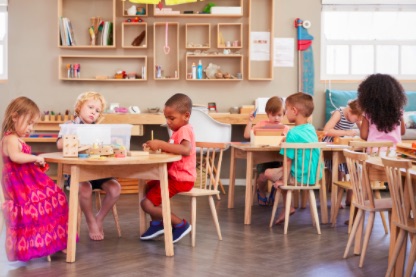
In Montessori schools, the children are not required to sit passively in regimented rows of desks.

In Spain there are around 150 Montessori schools.

This year marks the 150th anniversary of the birth of María Montessori, the founder of Montessori schools.

The program is based on eight axes: Montessori Education, Human Development, Inclusive Education, Educational Neuroscience, Public Schools, Educating with the family and Educational documentary films, united by the theme “Educating in the now: Montessori, culture of peace” ..

The opening ceremony will take place on Sunday, July 5 at 6:00 p.m. in mainland Spain and will be broadcast through the organizers’ social networks.

(Article continued in right column)

(Click here for the original Spanish version of this article)

Question related to this article:
 
What is the best way to teach peace to children?

(Article continued from left column)

Betzabé Lillo Orellana points out that “the purpose of this congress is to be able to convey a message of hope, optimism and tranquility in a context as uncertain as we are in, which is why we emphasize Educating in the Now, since it is important to take this crisis as an opportunity to rethink how we want to live life, discovering the essentials in everyday life, getting closer to the real meaning of happiness.”
The Congress promises a space that allows participants to :

– Become aware of the human potential that is present in the adverse situations of life, because, well oriented and accompanied, they become a source of growth to consider adversity as an opportunity.

– Search for alternatives to find within yourself that energy that is needed to overcome and advance in any difficult or problematic situation that we are experiencing.

– Connect with the creativity that is in each child, youth and adult as part of their being, as a transforming force that takes greater prominence in family, socio-cultural and specific adversity situations such as what happens in these times of pandemic.

– Know experiences, life stories and the creative duality of theory and practice in different areas that favor a more humane education.

– Mutually share inspiration to be able to help all of us nurture an awareness that helps us see that everything we are experiencing is an opportunity to change and grow.

This Congress is aimed at all people who seek to contribute to a better education, to a better society. Marco Zagal explains to us that “there are parents, professionals, and self-taught people from different areas who are always looking to learn something new or reinforce ideas that allow them to create respectful spaces in the different areas of childhood and adolescence. The contribution that we believe this Congress will give to families and professionals is directly related to a broader understanding of what children and adolescents are, and how caring for their psychological, emotional, social and physical life is the best gift. and the best inheritance that we can leave them. ”

Miriam Escacena highlights that “after the success of the congress last year, this year we are once again uniting with a spirit of trust with great expectation”. In these times in which we are facing a true paradigm shift, in which that change in the educational system that so many long for is finally coming true, accessible and quality initiatives are necessary more than ever.

France: Solidarity with the struggles of pacifists and anti-racists in the USA, following the murder of G. Floyd

TOLERANCE & SOLIDARITY .

A post on June 1 from the facebook page of Roland Nivet, Mouvement de la Paix, France [Peace Movement]

Protests and demonstrations following the murder of George Floyd in Minnesota (USA) last week by police continued to intensify across the United States on Sunday and Monday to protest this horrific murder and the string of racist murders in the US.

President Donald Trump attributed the violence to “thugs” who, he said, “dishonored the memory of George Floyd. This comment, which preceded the announcement of repressive measures against various American organizations, drew criticism from Keisha Lance Bottoms, the Democratic mayor of Atlanta.

(continued in right column)

Readers’ comments are welcome. See the form below.
 

(continued from left column).

According to Amnesty International of the USA, “the US police do not respect the right to peaceful protest. They are failing throughout the country to meet their obligations under international law to respect and facilitate the right to peaceful protest … This exacerbates a tense situation and endangers the lives of demonstrators. We call for an immediate end to all excessive use of force and for law enforcement officials to guarantee and protect the legal right to demonstrate. »

Our pacifist correspondents in the US believe that current events “should be interpreted as public mourning, from people shouting that the killing of black and brown people should no longer be tolerated. These uprisings across America reveal a thirst for democracy and the fact that young and old of various ethnicities recognize that this is a time when we must stand up against this history of inhumanity that has existed for too long and that discrimination, racism, and the killing of black and brown people must be stopped. For these activists, “Now is the time to change America! We are going to fight together with the awareness that our struggle is linked to struggles inside and outside the country, wherever there is injustice.

Mouvement de la Paix condemns this new racist murder and brings its total solidarity to the peace and anti-racist activists who are fighting a hard fight in the USA.

Mouvement de la Paix reaffirms its determination to continue its fight against racism and xenophobia in France. More than ever, the fight against racism, xenophobia and the rise of extreme right-wing extremism must unite all humanists throughout the world.

Transatlantic Dialogue wins Luxembourg Peace Prize

EDUCATION FOR PEACE .

An article from the University of Luxebourg

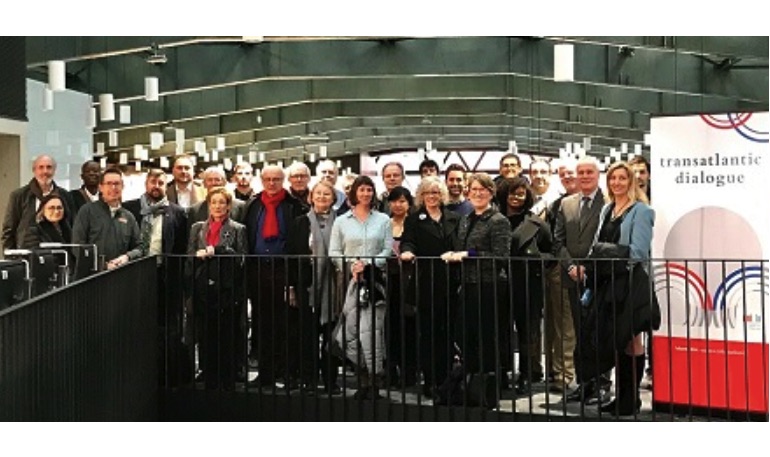
The Transatlantic Dialogue, a cooperation between the University of Luxembourg and Miami University, Ohio, is awarded the Luxembourg Peace Prize 2020 for “Outstanding Peace Education” by the Schengen Peace Foundation.

Question for this article:

What is the relation between peace and education?

Where in the world can we find good leadership today?

The Transatlantic Dialogue is a global conference series, held in Luxembourg since 2008 and organised by the University of Luxembourg and the Miami University, Ohio. It explores the significance of culture and liberal education for fostering global citizenship from U.S. and European perspectives. The prize for “Outstanding Peace Education” recognises the Transatlantic Dialogue’s efforts for fostering a culture of peace among all ages, groups, youngsters, elderly, women, refugees etc. with a global impact over the years.

The award ceremony will take place as part of the 5th Transatlantic Dialogue. Originally scheduled to take place in May 2020, it has been postponed to May 2021 due to the current COVID-19 pandemic.

Spain: Movimiento por la Paz launches an online course with «five paths for peace»

… EDUCATION FOR PEACE …

An article from El Faradio (Copied and disseminated according to the Creative Commons License of El Faradio)


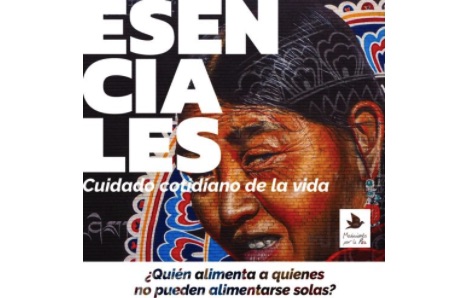
One of the images from the campaign “Essentials”

Given the situation of confinement including education, the Movimiento por la Paz (MPDL), a member of the Cantabrian Coordination of NGDOs, emphasizes more than ever the need for an education in values ​​based on respect and mutual support in which no one is left behind.

“From leisure and free time, favorable spaces are generated where the culture of peace can be fostered, with a focus on gender and Human Rights,” they highlight, which is why they have organized an online course for people who work in this area.

The course “Five paths for peace: a strategy of education in values ​​for free time” will begin on May 18 and will be conducted through a virtual platform that an be freely accessed.

There are twenty places for participants that will be filled in order of registration.

To be able to register, it will be necessary to do it at the link https://forms.gle/Tygx46gZZ5HTLyr28 or via email r.cifrian@mpdl.org .

(Continued in right column)

(Click here for the original Spanish version of this article.)

Question for this article:

Where is peace education taking place?

How can we work together to overcome this medical and economic crisis?

(Continued from left column)

The course will address the keys and educational resources to promote values ​​education in leisure and free time, including cultural diversity, gender equality, the fight against poverty, care for the environment, and human rights.

‘ESSENTIALS’

On May 1, on the occasion of the International Day of Workers, the Movimiento por la Paz wants to especially recognize women workers in the domestic and care fields and their activity as essential for the care of life. That is why they demand the construction of a new model in which care becomes an essential element of our production and coexistence system.

Under this message they have launched the ESSENTIAL campaign, to make care visible as an essential element for the protection of life and to raise the voice against the labor exploitation of women workers in the domestic and care fields.

Women domestic and care workers face triple discrimination: they are women, mostly migrants, and exploited. They are especially vulnerable because of the violation of their labor rights, which is explicitly reflected in current legislation.

The Domestic Service appears as a Special Regime within the General Social Security Regime, which is characterized by deficiencies related to remuneration, contribution and working conditions. “In this sense, we are facing the only group of workers who do not have the right to unemployment benefits in our country,” laments the organization.

To get an idea, in Spain according to the latest Labor Force Survey (EPA), the domestic employment sector employs 637,700 people. Almost all of the positions are occupied by women (96%) and only 420,288 are registered with Social Security.

To this we must add that 42% of the workers have foreign nationality and as it is mainly in the private sphere, it is a job that largely deals with women in an irregular situation.

Sabadell, Spain: Ensuring intercultural mediation and interfaith dialogue

.. DEMOCRATIC PARTICIPATION ..

A report from the Council of Europe

The Intercultural city aims at building its policies and identity on the explicit acknowledgement that diversity can be a resource for the development of the society.

The first step is the adoption (and implementation) of strategies that facilitate positive intercultural encounters and exchanges, and promote equal and active participation of residents and communities in the development of the city, thus responding to the needs of a diverse population. The Intercultural integration policy model is based on extensive research evidence, on a range of international legal instruments, and on the collective input of the cities member of the Intercultural Cities programme that share their good practice examples on how to better manage diversity, address possible conflicts, and benefit from the diversity advantage.

This section offers examples of intercultural approaches that facilitate the development and implementation of intercultural strategies.

(report continued in right column)

Questions for this article:

How can culture of peace be developed at the municipal level?

How can different faiths work together for understanding and harmony?

(report continued from left column)

The city of Sabadell [Spain] has a municipal mediation system which deals with all kind of conflicts and situations, including intercultural mediation. Intercultural mediation and dynamization is provided by two professionals from the Council: one profile works with Maghrebian people and the other with Sub-Saharan people. The service is offered to professionals from the different municipal services (social services, education, economic promotion, housing, etc.) as well as to supra-municipal institutions (hospital, ambulatories, etc.) and to entities and associations that require it. In addition, mediators provide accompaniment whenever necessary, to various external services (social security, tax, courts, etc.).

Regarding Interreligious Dialogue, there is a specialised person at the Department of Civil Rights and Gender who offers support to the activities implemented by the different confessions, provides advice on the establishments of new worship centres and deals with the administration (other departments) especially in topics related with activity licenses or building new centres. This person also coordinates the Table of Religious Beliefs, a space for debate, which reflects and seeks consensus in the areas of management of religious diversity in the city,  participates in the updating of the Map of Beliefs (see Good Practice), and year after year collaborates in the organisation of the Open Day for Worship Centres (see Good Practice). The table is a space for debate, reflection and consensus of all areas of management of religious diversity in the city.

In addition, the map of the diversity  of beliefs of Sabadell takes stock of all the communities, representatives of spiritual, religious or non-religious traditions, humanistic, present in the city, with information such as where their places of worship are, when they meet, how to contact, with whom you can talk, etc. Religions and humanistic currents, the common heritage of all citizens, have community and spiritual resources that, if properly managed, can contribute very positively to the achievement of a culture of peace and a more just society. The map is a tool to make them closer to each other and to encourage them to set up common projects. Everyone wins. Through this interactive map, a journey can be made through the cultural and religious diversity of the city. 

Finally, the Open day for worship centres  celebrated its 10th edition. The programme offers different activities to promote knowledge of religious diversity and freedom of conscience, combating mistrust, favoring coexistence and posing in common the values on which these beliefs are based. The central activity consists of a guided tour and open doors to various worship centres in Sabadell.

Intercultural Cities: Raseborg, Finland, testing solutions to Covid crisis

.. DEMOCRATIC PARTICIPATION ..

A report from the Council of Europe

In the wake of the Covid-19 crises, municipalities across the globe are taking action to serve their residents under the new conditions. This is also the case in Finland, where cities have found new innovative ways of sharing information and utilising already existing services, as well as learn from each other. One example of services offered can be found in the municipality of Raseborg, where a number of actions have been taken, including:

Questions for this article:

How can culture of peace be developed at the municipal level?

How can we work together to overcome this medical and economic crisis?

Finland is famous for the school lunch which is served to all students until high school. At the moment, schools are working remotely. Losing this daily meal service places added economic strain on families. To assist, the municipality now offers the opportunity for families with children to reach out to receive the daily meal delivered home.

In Finland, persons over 70 are asked to self-quarantine as a protective measure. The municipality calls residents over 70 to assess their needs and to inform them of the services available from the municipality (for example delivery of groceries).

Local youth centres are now available online when the physical locations are closed.

Offering online training programmes on their Facebook and also offer the opportunity to have a call with the sports leaders of the city for personalised training at home.

Do you know of good practices in other cities? The ICC is collecting new practices and policies created as a response to the Covid-19 crisis, with the aim of spreading the information to assist cities across the globe in managing the crisis. Contact us with ideas you wish to bring forward.

Trailblazing Nobel Peace Laureate Betty Williams Dies in Belfast

FREE FLOW OF INFORMATION

An article from the Nobel Women’s Initiative

Nobel peace laureate, Betty Williams, was a force of nature. She was awarded the Nobel peace prize in 1976 alongside Mairead Maguire for their work for peace in Northern Ireland. Betty once said, “Fear’s contagious, but so is courage.” Looking back on all that she has accomplished, it couldn’t have been more true.


Photo courtesy of the PeaceJam Foundation.

Betty and Mairead met under tragic circumstances. Earlier that year Betty witnessed a horrible car crash. A runaway car driven by Irish Republican Army member Danny Lennon, who had been fatally shot while fleeing from British soldiers, crashed into a family of four who were out for a walk. All three children; Joanne, John, and Andrew, were killed. Betty immediately sprung into action, circulating petitions. In the process she met the children’s aunt, Mairead Maguire.

Determined to use this tragedy to push for an end to the violence, Betty and Mairead organized a peace march. More than 10,000 Protestant and Catholic women came to show their support. The following week, 35,000 people marched with Betty and Mairead, demanding an end to the violence in their country.

Alongside journalist Ciaran McKeown, the two women co-founded /Peace People, an organization dedicated to nonviolence in Northern Ireland and throughout the world. In the thirty years since the award, Williams devoted her life to working for peace around the world, and a movement to begin a reversal of thinking on how we deal with the injustices, cruelty and horror perpetuated on the world’s children.

(Article continued in the column on the right)

Questions related to this article:

Where in the world can we find good leadership today?

(Article continued from the column on the left)  
  
Betty was the head of the World Centers of Compassion for Children International, which was founded in 1997 in honour of His Holiness the Dalai Lama. She was also the Chair of Institute for Asian Democracy in Washington D.C. and a founding member of the Nobel Women’s Initiative. She was the recipient of dozens of honours, including the Schweitzer Medallion for Courage and the Eleanor Roosevelt Award.

Betty passed away on March 18 in Belfast. Her legacy and incredible work for peace  in Northern Ireland, and the rights of children in war everywhere, will never be forgotten. She will be greatly missed. We send our deepest condolences, solidarity and love to her family and friends at this difficult time.

Condolences from Fellow Laureates

“It is with the greatest sadness that I heard of the death of my friend and co-worker for peace Betty Williams. Betty was a woman of great courage with a passion for peace and a love and compassion for all children. Betty will be sadly missed but remembered lovingly by all of us who knew Betty. I felt privileged to know her as a great peace activist and friend.” – Nobel peace laureate, Mairead Maguire.

“Betty was a dynamo – a force of nature that left a big mark in the world. She will be missed.” – Nobel peace laureate, Jody Williams.

Read more tributes

Read this beautiful tribute from Nobel peace laureate Mairead Maguire at Peace People.

Read these touching words about Betty from His Holiness the Dalai Lama.

Read moving obituaries from the New York Times  and the BBC.

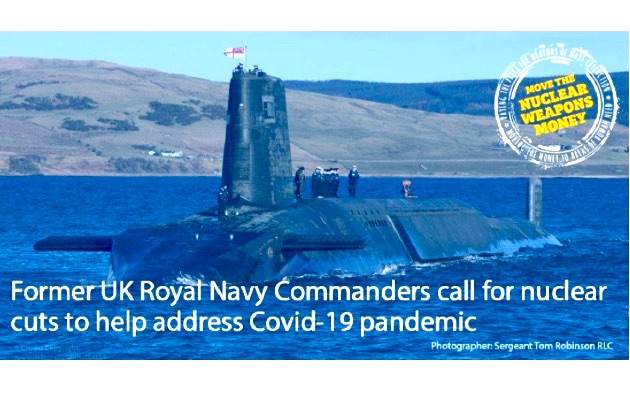
Former UK Royal Navy Commanders call for nuclear cuts to help address Covid-19 pandemic

DISARMAMENT & SECURITY .

An article from Move the Nuclear Weapons Money

Three former UK Royal Navy Commanders sent a letter to all UK parliamentarians on April 1 questioning the policy of maintaining a continuous at sea nuclear deterrent.

The commanders note that the £2 billion a year cost of maintaining this nuclear posture and readiness for war appear to be unjustifiable, especially as the economic costs of the coronavirus pandemic are mounting, and while there appears to be no threat of a ‘bolt from the blue’ nuclear attack against the UK, for which the policy is intended to counter.

In addition, the letter questions the decision by parliament to invest even more substantial resources in building new nuclear warheads and the submarines to carry them.

“It is completely unacceptable that the UK continues to spend billions of pounds on deploying and modernising the Trident Nuclear Weapon System when faced with the threats to health, climate change and world economies that Coronavirus poses,” said Commander Robert Forsyth RN (Ret’d), a former nuclear submariner, signatory to the letter and supporter of the Move the Nuclear Weapons Money campaign.

The letter was organised by the Bertrand Russell Peace Foundation and sent to all members of the UK House of Commons, UK House of Lords, Scottish Parliament, National Assembly for Wales, and Northern Ireland Assembly.

(continued in right column)

Question related to this article:
 
Does military spending lead to economic decline and collapse?

How can we work together to overcome this medical and economic crisis?

(continued from left column).

“This pandemic, and the inability of the British government to either prepare for or effectively respond to such an immediate threat to life, demonstrates the twisted priorities at the heart of nuclear weapons spending,’ said Tom Unterrainer, Director of the Bertrand Russell Peace Foundation. “Rather than work to guarantee real security this government prioritises the acquisition and deployment of weapons of mass murder.”

The signatories to the letter hope that their efforts to question the nuclear ‘Continuous At Sea Deterrent’ will encourage politicians and the wider public to begin to question the morality and the feasibility of nuclear weaponry.

According to Commander Robert Green RN (Ret’d), former nuclear-armed aircraft bombardier-navigator and one of the other co-signers of the letter, ‘Nuclear deterrence is no more than a repulsive, unlawful protection racket used as a counterfeit currency of power, and hugely profitable to the corporate arms industry.’ (Commander Green is also a supporter of the Move the Nuclear Weapons Money campaign).

The letter was supported by a number of UK parliamentarians including Rt Hon Ian Blackford MP (SNP Westminster Group Leader), Lord Green of Deddington, Baroness Sue Miller of Chilthorne Domer and Bill Kidd (Member, Scottish Parliament). Baroness Miller and Mr Kidd are the UK Co-Presidents of Parliamentarians for Nuclear Non-proliferation and Disarmament (PNND).

“Covid-19 is showing us that humanity’s worst threats- pandemics and climate change are shared globally,’ said Baroness Sue Miller. ‘We should not waste resources on renewing nuclear weapons as we should be using all resources we can in tackling these all too real issues.’

All of the nuclear weapons powers, and those states which are supportive of them, are wasting precious resources on the likes of Trident against the wishes of their peoples, when they should be addressing the real and deadly enemy in the form of COVID19,’ said Bill Kidd MSP, who also serves as the Convenor of the Cross-Party Group in the Scottish Parliament on Nuclear Disarmament.

“With human beings and national economies under genuine threat, it is the duty of governments and parliamentarians to pull back from nuclear war planning and preparation, and to instead cooperate internationally on facing down this deadly pandemic,” concluded Mr Kidd.