Les jeunes de Gaza solidaires de la France

. . TOLÉRANCE & SOLIDARITÉ . .

Spécial pour CPNN

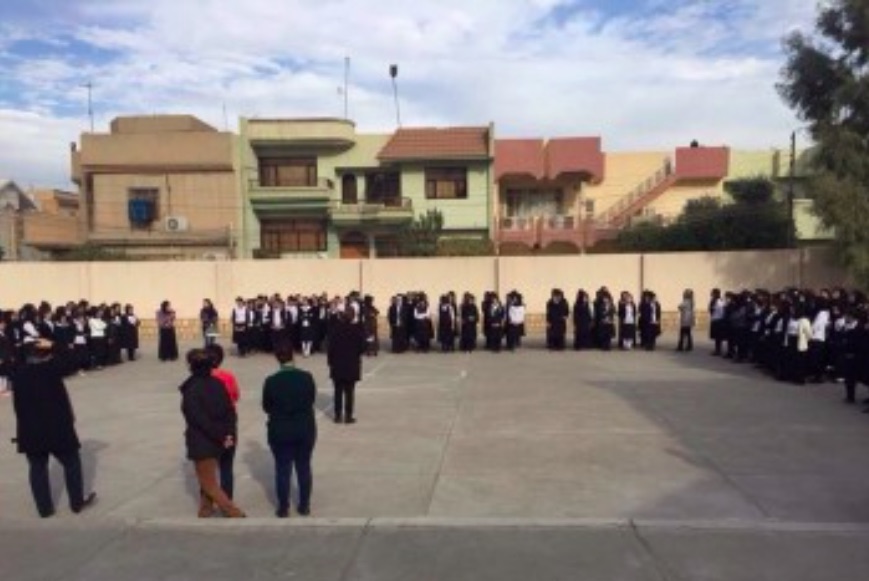
Le mardi 17 novembre 2015, des dizaines de jeunes étudiants, ainsi que quelques professeurs et membres du personnel de l’université Al-Aqsa de Gaza se sont rassemblés devant le département de français , en solidarité avec le peuple de France après les attentats meurtriers qui ont frappé Paris vendredi dernier.

gaza
Cliquez sur le photo pour l’élargir

Malgré la pluie , le mauvais temps, et la période d’examens, les jeunes étudiants ont insisté pour  participer à ce rassemblement de solidarité.  

Ce regroupement a été organisé à l’initiative du département de français de l’université Al-Aqsa de Gaza, et du Centre de la paix de cette université.

Il  avait pour objectif de montrer que les jeunes de Gaza, malgré leur souffrance quotidienne,  malgré un blocus israélien inhumain et les conséquences dramatiques de la dernière offensive militaire israélienne de l’été 2014, veulent exprimer leur solidarité à un pays ami de la Palestine et à une population de plus en plus solidaire de la cause palestinienne.

Les participants sont venus avec des pancartes qui disent toute  la solidarité des jeunes de Gaza avec la France.

Elles portaient les slogans suivants :

-Les jeunes de Gaza solidaires de la France

– Gaza solidaire de Paris

-Pour la liberté, contre la haine

-Amitiés de Gaza la vie à Paris la vie

-Vive les relations franco-palestiniennes

-Malgré leur souffrance, les Palestiniens de Gaza envoient un message de soutien à la France

-Contre la violence, pour la paix, la justice et la tolérance

-Amour, paix, fraternité, égalité, liberté, justice, solidarité

Ce rassemblement de solidarité a été bien couvert par les médias nationaux et internationaux.

Ziad Medoukh, directeur du département de français, Coordinateur du Centre de la paix , ainsi que quelques étudiants de français ont accordé des interviews aux chaînes de radio et télévision présentes.

(Merci à Phyllis Kotite d’avoir envoyé ceci à CPNN.)

(Cliquez ici pour une traduction anglaise.

Nearly 100 Home-based Workers from 24 Countries Gather in Delhi to Adopt Historic Delhi Declaration on Workers’ Rights

…. HUMAN RIGHTS ….

An article from WIEGO, Women in Informal Employment Globalizing and Organizing

On February 8th and 9th, 2015, nearly 100 home-based worker representatives and supporters from 24 countries took part in a first-of-its kind global meeting in New Delhi, India, to draft and adopt the Delhi Declaration of Home-based Workers. The group also devised a five-year Action Plan to improve conditions for millions of home-based workers around the globe.

wiego

The two-day event was organized by Women in Informal Employment Globalizing and Organizing (WIEGO) and HomeNet South Asia (HNSA) to provide a platform for home-based workers, who are primarily economically and socially disadvantaged women, to build solidarity, share experiences and learnings and move toward unified action with the Declaration and five-year Plan.

Supported by WIEGO and HomeNet South Asia, participants worked collaboratively to formulate the Delhi Declaration and adopted it in the presence of honourable guests, Ms. Roberta Clarke, Regional Director, UN Women, Asia Pacific, and Ms. Devaki Jain, a well-known development economist.

“The home-based worker movement started 20 years ago,” says Chris Bonner, Director, Organization & Representation Program, WIEGO. “It’s been a difficult and slow process, but today’s achievements are really significant.”

The Delhi Declaration of Home-based Workers declares a commitment to supporting, building and strengthening related organizations and calls for the following key points to improve the lives of home-based workers:

Recognition of home-based workers as workers and as women who contribute significantly to improving their family’s income security and to the local and national economies;

Formulation and implementation of social protection and labour laws to live free from discrimination, poverty and depravation;

Systematic collection of data on home-based workers;

Recognition of rights to freedom of association and collective bargaining;

Building better and inclusive markets;

Formulation of effective local and national policies on home-based workers;

Extending social protection schemes and interventions to home-based workers;

Provision of essential urban infrastructure services to home-based workers;

Ratification of the International Labour Organization Home Work Convention, 1996 (no. 177).

(Article continued on right side of page.)

(Article continued from left side of page.)

The 60 organizations present also devised a five-year action plan to ensure implementation of the Declaration in the regions present, including Latin America, Africa, Eastern Europe, South Asia and Southeast Asia.

“I celebrate with you down a common road of equality and justice for all,” said Clarke. “We will stand with you and strengthen partnerships. We will stand with you in advocacy.”

About HomeNet South Asia

HNSA is the regional network of organizations of home-based workers. It currently has a presence in eight countries of South Asia. It works towards building regional solidarity among home-based workers, especially women workers, and empowering them to lead a life of dignity, free of poverty, by obtaining decent work and social protection, within a rights based framework.

See http://www.homenetsouthasia.net

About Women in Informal Employment Globalizing and Organizing

WIEGO is a global action-research-policy network that seeks to improve the status of the working poor, especially women, in the informal economy: through stronger organizations, better data and research, and fairer policies and regulations. Visit http://www.wiego.org

For more information or to interview organizers, home-based workers or researchers, please contact:

Shalini Sinha, Home-based Worker Sector Specialist, WIEGO, at +91-9810111368 or shalini.sinha(at)wiego(dot)org

Firoza Mehrotra, Director Programmes, HomeNet South Asia, at +91-9958323674 or mehrotrafiroza7(at)gmail(dot)com

USA: Our Economy Is Not Working: Joseph Stiglitz on Widening Income Inequality & the Fight for $15

…. HUMAN RIGHTS ….

An article and video by Amy Goodman, Democracy Now (reprinted according to provisions of Creative Commons)

The fight over income inequality gained national attention when fast-food workers walked off the job in hundreds of cities across the country on Tuesday demanding a $15-an-hour minimum wage and union rights. Some “Fight for $15” protesters rallied outside the Republican presidential debate in Milwaukee. During the debate, billionaire Donald Trump and other Republican contenders rejected calls to increase the minimum wage. We speak to Nobel Prize-winning economist Joseph Stiglitz, author of the new book, “Rewriting the Rules of the American Economy: An Agenda for Growth and Shared Prosperity.” “We’re saying something is wrong with the way our economy is working,” says Stiglitz. “The fact that at the bottom, minimum wage is as low as it was 45 years ago, a half-century ago, says something. … It’s not a living wage.”

stiglitz
Video of Stieglitz interview

TRANSCRIPT
This is a rush transcript. Copy may not be in its final form.
AMY GOODMAN: We turn right now to Joe Stiglitz, to the Nobel Prize-winning economist.

NERMEEN SHAIKH: The fight over income inequality gained national attention when fast-food workers walked off the job in hundreds of cities across the country on Tuesday demanding a $15-an-hour minimum wage and union rights. Some “Fight for 15” protesters rallied outside the Republican presidential debate in Milwaukee. During the debate, billionaire Donald Trump and other Republican contenders rejected calls to increase the minimum wage.

DONALD TRUMP: Taxes too high, wages too high, we’re not going to be able to compete against the world. I hate to say it, but we have to leave it the way it is. People have to go out, they have to work really hard, and they have to get into that upper stratum. But we cannot do this if we are going to compete with the rest of the world. We just can’t do it.

AMY GOODMAN: We end today with Part 2 of my interview with the Nobel Prize-winning economist Joe Stiglitz and his plan to address income inequality. He has written a new book called Rewriting the Rules of the American Economy: An Agenda for Growth and Shared Prosperity. I asked him what an agenda for growth and shared prosperity would look like.

(Article continued on right side of page.)

(Article continued from left side of page.)

JOSEPH STIGLITZ: Well, it is about rewriting the rules in a fairly comprehensive way. I mean, the basic—

AMY GOODMAN: Who writes them?

JOSEPH STIGLITZ: Well, that has to be done by Congress, and it has to be with a lot of popular support. And in a way, we’re beginning to do that. You know, the Fight for 15 movement, raising the minimum wage, that’s one of the rules. But one of our points is that we need a more comprehensive agenda than just raising the minimum wage, and that if we make—and the two words there, for “growth” and “shared prosperity,” so our view is that the only sustainable prosperity is shared prosperity and that one of the problems is that the way the rules have been rewritten since the beginning of Reagan has been to actually slow the American economy.

And let me give you one example. When you have corporations having a very shortsighted view, paying their CEOs such outrageous monies with less money spent on investment, of course you’re not going to make long-term investments that are going to result in long-term economic growth. And at the same time, there’s going to be less money to pay for ordinary workers. And paying that low wages to ordinary workers, not giving them security, not giving them paid, you know, family leave, all that results in a less productive labor force. So what we’ve done is we’ve actually undermined investments in people, investments in the corporation, all for the sake of increasing the income of the people at the very top. So there’s a really close link here between the growing inequality in our society and the weak economic performance.

AMY GOODMAN: We’re in the midst of an extended election year. But that goes to the issue of how we govern ourselves in this country, a very critical point. Let’s talk about what underlies these elections: campaign finances. How does campaign finance reform fit into rewriting the rules of the American economy?

JOSEPH STIGLITZ: Well, it’s actually absolutely essential. And, you know, the problem is that we’ve gone basically from a political system with “one person, one vote” to “one dollar, one vote.” And, you know, Citizens United made that worse. So, the only way that you can combat the force of money is, you might say, people power, people coming out. And we’ve seen this work. I mean, we’ve seen it work in raising the minimum wage. You know, just—we couldn’t do it in Congress, because the gridlock there, the money there, so we’ve done it in city after city—Seattle, Los Angeles, San Francisco, in New York. So, we’ve actually been able to see that this kind of uprising can work, even in a political system with money making so much difference.

(Thank you to Janet Hudgins, the CPNN reporter for this article.)

Latin American Legislators, a Battering Ram in the Fight Against Hunger

…. HUMAN RIGHTS ….

An article by Marianela Jarroud, Inter Press Service News Agency (reprinted by permission)

Lawmakers in Latin America are joining forces to strengthen institutional frameworks that sustain the fight against hunger in a region that, despite being dubbed “the next global breadbasket”, still has more than 34 million undernourished people. The legislators, grouped in national fronts, “are political leaders and orient public opinion, legislate, and sustain and promote public policies for food security and the right to food,” said Ricardo Rapallo, United Nations Food and Agriculture Organisation (FAO) Food Security Officer in this region.

hunger
A girl in traditional festive dress from Bolivia’s highlands region displays a basket of fruit during a fair in her school in central La Paz. F Credit: Franz Chávez/IPS

The members of the Parliamentary Front Against Hunger also “allot budget funds, monitor, oversee and follow up on government policies,” Rapallo told IPS at FAO regional headquarters in Santiago, Chile.

A series of successful public policies based on a broad cross-cutting accord between civil society, governments and legislatures enabled Latin America and the Caribbean to teach the world a lesson by cutting in half the proportion of hungry people in the region between 1990 and 2015.

But the 34.3 million people still hungry in this region of 605 million are in need of a greater effort, in order for Latin America to live up to the 2030 Agenda for Sustainable Development, which is aimed at achieving zero hunger in the world.

The Sixth Forum of the Parliamentary Front Against Hunger (PFH), to be held in Lima Nov. 15-17, will seek to forge ahead in the implementation of the “plan for food security, nutrition and hunger eradication in the Community of Latin American and Caribbean States (CELAC) by 2025.”

The plan, which sets targets for 2025, is designed to strengthen institutional legal frameworks for food and nutritional security, raising the human right to food to the highest legal status, among other measures.

“The Parliamentary Front Against Hunger is a key actor in the implementation of CELAC’s Food Security Plan, for the construction of public systems that recognise the right to food,” the regional director of FAO, Raúl Benítez, told IPS.

The PFH was created in 2009 with the participation of three countries. Six years later, “there are 15 countries that have a strong national parliamentary front recognised by the national Congress of the country, which involves parliamentarians of different political stripes, all of whom are committed to the fight against hunger,” Rapallo said.

As a result, “laws on family farming have been passed, in Argentina and Peru, and in the Dominican Republic there are draft laws set to be approved. To these is added the food labeling law in Ecuador,” the expert said, to illustrate.

Bolivia sets an example

In Bolivia, the School Feeding Law in the Framework of Food Security and the Plural Economy, passed in December 2014, is at the centre of the fight against poverty in an integral fashion, Fernando Ferreira, the head of the national Parliamentary Front for Food Sovereignty and Good Living, told IPS in La Paz.

This model, which draws on the successful programme that has served school breakfasts based on natural local products in La Paz since 2000, is now being implemented in the country’s 347 municipalities.

The farmer “produces natural foods, sells part to the municipal government for distribution in school breakfasts, and sells the rest in the local community,” said Ferreira, describing the cycle that combines productive activity, employment, nutrition and family income generation.

The school breakfast programme has broad support among teachers because it boosts student performance and participation in class, Germán Silvetti, the principal of the República de Cuba primary school in the centre of La Paz, told IPS.

“They didn’t used to care, but now they demand their meals,” Silvetti said. “Some kids come to school without eating breakfast, so the meal we serve is important for their nutrition.”

(Article continued on right side of page.)

(Article continued from left side of page.)

In the past, students didn’t like Andean grains like quinoa. But María Inés Flores, a teacher, told IPS she managed to persuade them with an interesting anecdote: “astronauts who go to the moon eat quinoa – and if we follow their example we’ll make it to space,” she said to the children, who now eat it with enthusiasm.

Appealing to the appetites of the 145,000 students served by the school breakfast programme is a daily challenge, but one that has had satisfactory results, such as the reduction of anemia from 37 to two percent in the last 15 years, Gabriela Aro, one of the creators of the programme and the head of the municipal government’s Nutrition Unit, told IPS.

Authorities in Bolivia say the government’s “Vivir Bien” or “Good Living” programme will reduce the proportion of people in extreme poverty which, according to estimates from different national and international institutions, stands at 18 percent of the country’s 11 million people.

Mexico, another case

In Mexico, a nation of 124 million people, meanwhile, poverty has grown in the last three years, revealing shortcomings in the strategies against hunger, which legislators are trying to influence, with limited results.

“Legislators must be more involved in following up on this, one of the most basic issues,” Senator Angélica de la Peña, coordinator of the Mexican chapter of the Parliamentary Front Against Hunger, told IPS in Mexico City. “Even if we define budgets and programmes, they continue to be resistant to making this a priority.”

There are 55.3 million people in poverty in Mexico, according to official figures from this year, and over 27 million malnourished people.

The increase in poverty reflects the weaknesses of the National Crusade Against Hunger, the flagship initiative of conservative President Enrique Peña Nieto, which targets undernourished people living in extreme poverty.

The Crusade is concentrated in 400 of Mexico’s 2,438 municipalities, involves 70 federal programmes, and hopes to reach 7.4 million hungry people – 3.7 million in urban areas and the rest in the countryside.

The Senate has not yet approved a “general law on the human right to adequate food”, which was put in motion by the Parliamentary Front and involves the implementation of a novel constitutional reform, which established in 2011 that “everyone has a right to sufficient nutritional, quality food, to be guaranteed by the state.”

The draft law will create a National Food Policy and National Food Programme, besides providing for emergency food aid.

But in spite of the limitations, Mexico’s social assistance programmes do make a difference, albeit small, for millions of people.

Since February, Blanca Pérez has received 62 dollars every two months, granted by the Pension Programme for the elderly (65 and older), which forms part of the National Crusade Against Hunger.

“It helps me buy medicines and cover other expenses. But it is a small amount for people our age – it would be better if it was every month,” this mother of seven told IPS. She lives in the town of Amecameca, 58 km southeast of Mexico City, where half of the 48,000 inhabitants live in poverty.

Pérez, who helps her daughter out in a small grocery store, is also covered by the Popular Insurance scheme, a federal government programme that provides free, universal healthcare. “These programmes are good, but they should give more support to people like me, who struggle so much,” she said.

Two urgent regional needs

Above and beyond the progress made, Rapallo said Latin America today has two urgent needs: reduce the number of hungry people in the region to zero while confronting the problem of overnutrition – another form of malnutrition.

Overweight and obesity “are a public health challenge, a hurdle to national development, and a moral requisite that we must address,” said Rapallo.

In that sense, he added, “parliamentarians are essential” to bring about public policies that contribute to good nutrition of the population and their growing demands.

“There are parliamentarians that are real leaders in their respective countries. But if all of this were not backed by a strong civil society that puts the issue firmly on the agenda, we wouldn’t be able to talk about results,” he said.

(Thank you to Janet Hudgins, the CPNN reporter for this article.)

Global climate cash flows neared $400bn in 2014 – report

. . SUSTAINABLE DEVELOPMENT . .

An article by Megan Darby, Climate Change News

Climate-friendly investments worldwide reached a record US$391 billion in 2014, up 18% from 2013 levels.

climatechange
(Photo from Flickr/Aaron)

Private sources poured US$243 billion into renewable energy, a 26% increase on the previous year. Public investment rose steadily to $148 billion.

That is according to Climate Policy Initiative’s latest climate finance report, which covers flows within national borders as well as from rich to poor countries.

“There is more money than ever before being invested in low carbon and climate resilient action,” said lead author Barbara Buchner. “At the same time, more needs to happen.”

East Asia and the Pacific accounted for $119bn of the total, up 22% by 2013, with China alone the destination for $84bn.

Africa, Latin America, East Asia and the Caribbean received the bulk of funds for adaptation projects.

Experts say trillions will be needed over the coming decades to hold global warming to 2C, the goal of next month’s Paris climate summit.

That includes targeted funds to help poorer countries green their economies and protect citizens from the impacts of climate change.

But in 2014 three quarters of the total and 92% of private money was spent in its country of origin.

“If countries get their domestic policy frameworks right, that really can trigger a big change in making money flow,” Buchner told Climate Home.

National contributions submitted to a UN climate deal set out policies in areas like clean energy, flood defences and forest protection for more than 160 countries.

These “give an indication countries are serious about this issue,” said Buchner.

Only 17% of the public finance went towards adaptation, however – measures to guard against weather extremes and sea level rise, which are of particular concern to the world’s poorest.

(Thank you to Janet Hudgins, the CPNN reporter for this article.)

Questions for this article:

Nazca-Desventuradas: Chile’s New Marine Reserve

. . SUSTAINABLE DEVELOPMENT . .

An article by Sara Jones, Council on Hemispheric Affairs (reprinted by permission)

At the 2015 Our Ocean Conference, Chilean president Michelle Bachelet announced the creation of a new marine park off the coast of Chile, which, if created, would be the largest fully protected marine reserve in the world. This action taken by Bachelet spurred questions across the international community over whether Chile might become the world’s next leader in ocean conservation. The project has been met with both skepticism and enthusiastic support by the Chilean nation and by the international community.

Chile
Bunaken Marine Park in Indonesia (Sakurai Midori)

The Nazca-Desventuradas National Marine Park was unveiled in October and will encompass a surface area of 297,518 square kilometers (114,872 square miles), the equivalent of 8 percent of the world’s oceans that have been declared as no fishing areas or have no-take protections. It would include the waters off the coast of Rapa Nui (Easter Island) and the waters surrounding San Ambrosio and San Félix Islands.[These two islands are called the ‘Islas Desventuradas’ (Unfortunate Islands) and are the namesake of the marine park. The purpose of creating this national park is to reduce the amount of fishing in the area in order to protect the ecosystems within its borders. The waters surrounding the islands have been the site of “a modest amount of fishing, mainly for swordfish” but the creation of the park designates this area as a marine protected area (MPA). According to the International Union for Conservation of Nature (IUCN), the definition of a protected area is “A clearly defined geographical space, recognized [sic], dedicated and managed, through legal or other effective means, to achieve the long-term conservation of nature with associated ecosystem services and cultural values.” The IUCN stresses the importance of having a long-term plan to actually have an impact on conservation and ocean recovery. The creation of a marine reserve gives the Chilean government legal means to enforce the limits that could be imposed on fishing, especially by using its navy as a deterrent. Local fisherman can still fish in an area 50 miles from the coast, but industrial fishing will ideally be eliminated.

Environmental and Cultural Impact

The creation of a new marine reserve in this area will bring about a multitude of environmental benefits to the area. According to National Geographic, the area that the park will protect has a unique oceanic environment which encompasses a variety of tropical and temperate species.[8] Furthermore, National Geographic writes that “About 72 percent of the species found around Desventuradas and an island chain known as the Juan Fernández archipelago—about 466 miles (750 kilometers) to the south— is endemic.” Fishing and pollution are two causes of environmental degradation in the ocean; so creating a marine park to protect the ecosystems of this region is a positive step towards changing the way the sea is protected.

In addition to its environmental benefits, the marine reserve also represents an important step towards protecting the cultural interests of the people of Rapa Nui. For this community, the ocean surrounding their island is an important part of their culture and way of life. The mayor of Rapa Nui, Pedro Edmunds Paoa, said, “This marine park will not only conserve the many species endemic to the waters of Easter Island but also the traditions of our Polynesian ancestors and the Rapa Nui people…The park will be complemented by a fishing area that will allow our ancient practice of tapu—or smart fisheries management—to endure.” The Rapa Nui gain their livelihood from the surrounding waters and many of them are excited about the prospect of protecting this area from industrial fishing trawlers. Joshua S. Reichart, an environmentalist from Pew Research Center, states that the marine park would not only represent an accomplishment for president Bachelet, but also a “triumph for the Rapa Nui.”

Historical Context of Marine Conservation in Chile

When it comes to environmental protection of marine areas, Chile may not have much experience, but it has focused recent efforts in addressing this issue. The Nazca-Desventuradas National Marine Park is not the only marine conservation effort the country has made. At the 2015 Our Ocean Conference, Chile also announced its promise to creating a marine protected area (MPA) in an exclusive economic zone near the Island of Rapa Nui. At the 2014 Our Ocean Conference, Chile agreed to join the United Nations Fish Stocks Agreement. It also fulfilled its commitment by implementing a new policy to combat IUU fishing (Illegal, Unreported and Unregulated fishing). According to Oceana, an international organization dedicated to conducting research on oceans, Chile’s creation of a new national policy of IUU is “a move that gives the Chilean Navy increased resources to conduct enforcement operations in the high seas.” The areas that have been protected were vulnerable areas and thus the new policy is necessary for giving Chile the legal means to more effectively regulate fishing activities. Furthermore, Chile has created a new Ocean Policy Council which focuses on addressing the threats to its ocean waters and marine ecosystems. The main objectives of this council are to protect the sustainability and security of Chile’s marine environments.[ Another measure the country has taken to protect its marine environments is the creation of a group called the Friends of the Port State Measures Agreement, which promotes support between Latin American states in the endeavor of improving the protection of marine areas ] In the past two years, Chile has made great efforts to address the environmental threats to its marine areas.

(Article continued in the right column)

(Article continued from the left column)

International Context of Marine Conservation

Chile is not the only country which has recently announced the creation of a marine reserve. The Nazca-Desventuradas National Marine Park will be the largest park of its kind in the world only if the United Kingdom does not create its marine park near the Pitcairn Islands first. The Pitcairn Islands are located in the Pacific Ocean, where the United Kingdom plans on creating the largest continuous marine reserve in the world. This marine reserve has a similar goal to the Chilean project. Adam Vaughn, a reporter for The Guardian, writes that: “The zone is expected to ban commercial fishing, and will cover a 834,000 sq km (322,000 square miles) area where previous expeditions have found more than 80 species of fish, coral and algae.” While this project is still underway, another marine reserve created by the United Kingdom is currently the largest marine protected area. This is encompasses the waters surrounding the Chagos archipelago in the Indian Ocean.

The United Sates has also announced the creation of two new marine sanctuaries. The first is to be constructed on the western side of Lake Michigan and the second one is the Mallows Bay-Potomac River in Maryland. Both of these locations are the sites of shipwrecks. Meanwhile, Cuba has announced that it is participating in negotiations with the United States to create sister marine protected areas. According to National Geographic, “The U.S. side would include the Florida Keys National Marine Sanctuary, the Flower Garden Banks in the Gulf of Mexico, and the Dry Tortugas and Biscayne National Parks. The Cuban side includes the Guanahacabibes National Park on the western tip of the country.”

New Zealand has also announced a new marine reserve in the Kermadec which is northeast of New Zealands’ North Island. The recent surge in marine protection programs is heartening for supporters of marine preservation; however, they do not come without criticisms.

Support for the Nazca-Desventuradas National Marine Park

As previously noted, the new marine park in Chile is of great interest for the local fishing community and the Rapa Nui community. Although support for the program is not unanimous for either group, voices of support can be found in each.

For many local fishermen in Chile, a growing issue is the presence of industrial fishing trawlers, which are not only making it more difficult for local fishermen to gain their livelihood, but also engage in illegal fishing. In addition to this criticism of industrial fishers, local fishermen complain that they are at fault for increasing pollution in the oceans. The Guardian quoted Sara Roe, the president of a Chilean fisherman’s association: “Between 2004 and 2013, she said, there was a dramatic decline in the tuna, swordfish and barracuda her fishermen caught, forcing some into land-farming and construction jobs.”

Francesca Avaka Teao, a representative of the Hanga Roa Tai fisherman association, said that “in addition to the ecological importance of these waters, culturally and since ancestral times, the sea has been synonymous to abundance, richness and connection to nature for our town. The community of Rapa Nui develops diverse activities in it, not only in terms of nourishment, but also in terms of sports, art, recreation, and world view, among others.” The representative’s statement shows that the concerns expressed by the fishing community are tied to the environmental and cultural concerns expressed by the rest of the Rapa Nui community.

Criticisms of the Nazca-Desventuradas National Marine Park

While some members of the Rapa Nui community have expressed their support for the marine park, others had expressed doubt that the park would actually be created and a fear that the new marine park will encounter the same issues that the natural park on the mainland of Rapa Nui had faced. The creation of Rapa Nui National Park led to a spike in tourism on the island, which some members of the community opposed. The primary concern of the Rapa Nui people is that the previous natural park was created by the government without their consultation. However, President Bachelet has addressed this concern and affirmed that the marine park plan will be implemented following consent of the Rapa Nui community.

At first glance, the marine park represents a strong initiative to protect the ocean. However, Russell Moffitt, a conservation analyst at the Marine Conservation Institute, criticizes the project by questioning whether the location that is being protected is really the best place to make a real environmental impact for the oceans. He says that it might be more urgent to protect near-shore waters because these areas are more impacted by fishing and pollution. He adds that protecting these areas will not be sufficient, but they are easy goals. It would be more beneficial to create a variety of types of marine reserves.

What will be the fate of the ‘Unfortunate Islands’?

By creating the Nazca-Desventuradas marine park, Chile could become a leader in the international community in terms of marine preservation. Its recent efforts in preserving its marine environments with the support of local indigenous communities, is commendable. While the marine park is not without its criticisms, it has the potential for protecting important ecosystems and the culture of the Rapa Nui people. The impact that the new marine park will have is uncertain, but overall it is a positive step for marine preservation in a time where marine preservation has become increasingly important to the international community.

(Thank you to Janet Hudgins, the CPNN reporter for this article.)

The refugee crisis, Who is responsible?

. . . TOLERANCE & SOLIDARITY . . .

As a response to this question, CPNN readers are encouraged to read the full text of the analysis of the refugee crisis in Europe by Kofi Annan, former Secretary-General of the United Nations, in a speech on October 9, 2015.

Here are a few excerpts from his speech:

* * * * * *

The refugee crisis is a by-product of at least three broader trends:

First and foremost, it is the result of the breakdown of the authoritarian state order in the Middle East and Africa after the destruction of authoritarian states in Iraq and Libya, as well as the Arab Spring.

What we are witnessing today is not just a series of civil wars, but also a geopolitical struggle to redefine the balance of powers in the Middle East.

Second, the inability of the Security Council to find a compromise that can resolve the crisis in Syria has undermined its own authority and perpetuated the conflict.

Finally, the growing migratory flows are also compounded by demographic growth in countries in the Middle East and Sub-Saharan Africa that are unable to generate sufficient employment for young people.

The populations of Sub-Saharan Africa and Middle East have multiplied by four since 1950 . On current trends, both will double again their 2000 populations by 2050.

This underlying trend is exacerbating political instability in the Middle East and Africa and fuelling migration.

Europe sees the massive influx of refugees and migrants from the Middle East and Africa as a threat.

In reality, it is an endorsement of the European project, an opportunity, but also a challenge that will require decisive action.

Europe is a symbol of freedom, prosperity and justice that attracts immigrants. At a time when the EU is not popular within its own borders, Europeans should reflect on the significance of their popularity abroad.

But migrants should not be regarded merely as beneficiaries of Europe’s bounty: they also represent an opportunity for Europe itself.

By definition, immigrants are entrepreneurial people. After all, they have taken huge risks to seek a better life for themselves and their families.

It should not, therefore, come as a surprise that they are over-represented amongst entrepreneurs. In fact, more than 40 per cent of the Fortune 500 companies were founded by an immigrant or the child of an immigrant .

I am certain that many of the wealthy philanthropists in this room, like Mr. Arton himself, are immigrants or children of immigrants.

Moreover, immigrants can help to compensate for the ageing population of many European countries, and can therefore help sustain their welfare states into the future.

* * * * * *

The historic refugee crisis Europe is facing today is so hard to solve because it is not a one-off, humanitarian phenomenon.

It is, in fact, a by-product and symptom of much deeper political problems that beset regional and global order.

It will therefore require concerted action not just in and by Europe, but amongst the regional powers of the Middle East, and the global powers of the Security Council.

Like climate change, it is one of those issues that epitomise our era of globalisation, when crises in one part of the world can no longer be isolated or ignored by the rest.

Once again, international cooperation and dialogue will be the key to finding solutions.

According to an African proverb, if you want to go fast, go alone. But if you want to go far, go together.

We have a long way to go; we can only do so if we go together.

This question applies to the following CPNN articles:

The sea rescue association SOS MEDITERRANEE wins the Right Livelihood Award 2023

Spain: More than 140 people participate in the first Congress ‘Aragon, culture of peace

Some villages in France have found a second life by welcoming refugees

United Kingdom : Little Amal: Coventry welcomes giant refugee puppet to city

Milan, Italy: Anti-racism protesters denounce Italy’s right-wing government

Italy: Mayors of Florence, Palermo and Naples “Rebelled” against a Tough Anti-Immigrant Law

France: Culture for Peace Award to The Artists in Exile Workshop

The Elders challenge leaders to confront migration lies and make UN deal a success

Artist’s Portraits Show Migrant Caravan’s Hope, Joy: ‘These Are Regular People’

UNESCO recognizes Cortes de Baza for Dialogue and Coexistence

Nobel Women’s Initiative: Standing with Rohingya Women, Spotlighting Survivors for World Refugee Day

The Coming Wave of Climate Displacement

France / Refugees. Resumption of Trial of Martine Landry, Member of Amnesty International France and Anafé Unfairly Pursued for “Crime of Solidarity”

Germany: The dead refugees lament! Action September 5

Barcelona demonstration calls for the reception of refugees

Una multitud clama en Barcelona por la acogida de refugiados

From the “jungle” to the theater, refugees replay their exile to Europe

De la “jungle” au théâtre, des réfugiés rejouent leur exil vers l’Europe

The international Society Culture of Peace: Solidarity concerts in Athens and Mytilini / Lesbos

Greece: Union pushes for access to education for all refugee children

The Elders hail Germany’s engagement on refugee and migration issues

USA: Refugee Orchestra Project Showcases Refugees” Impact through Music on World Refugee Day

Grecia: Un sindicato nacional ejerce presión en favor del acceso a la educación para todos los niños refugiados

Grèce: Un syndicat national exerce des pressions afin de garantir l’accès à l’éducation de tous les enfants réfugiés

MOAS & EMERGENCY NGO partner up to provide rescue and medical care to migrants in the Mediterranean

Hundreds join refugee solidarity rally in Madrid, slamming NATO invasions

Latin America heeds the cries of refugees

The International Cities of Refuge Network (ICORN)

USA: Indiana Said No; New Haven Said Yes To Refugees

France: Comment venir en aide aux réfugiés ?

France: How to help the refugees?

Michael Moore (USA): My home is open for Syrian refugees

Spain: The Spanish Commission for Refugee Aid

UNHCR welcomes first arrivals of Syrian refugees in Canada

The Barcelona Declaration – Refugees: Meeting the Challenge to Our Humanity

USA: 18 mayors join forces to commend Obama administration, and call on them to accept more refugees amid Syrian crisis

2015 MacBride Prize to Lampedusa (Italy) and Gangjeon Village, Jeju Island (S. Korea)

Is dropping more bombs on Syria way to solve refugee crisis?

USA: Restorative Practices in Schools

. . DEMOCRATIC PARTICIPATION . .

Excerpts from September and August News Roundups by Restorativeworks.net

Detroit Public Schools says crime reports down 29% due to restorative practices. The article notes: “This year, restorative practices training will cover two new areas: trauma and grief counseling to help students dealing with death and other hardships, and ‘conferencing training’ to assist students’ transition back into school after a suspension or expulsion.”

restorative

NAACP (Chattanooga) seeks alternative discipline methods for schools.” This TV news video includes footage from a recent professional development event and a brief interview with IIRP Instructor Steve Korr. . .

During a discussion circle in a Chicago school, students learn empathy when they discover they each have had first-hand exposure to gun violence and one classmate had a gun pointed at her head.

The International Bullying Prevention Association will hold its annual conference Reaching New Heights in Bullying Prevention through Empathy and Kindness in Denver, CO, November 8-10 and will feature a pre-conference workshop on restorative practices with IIRP Lecturer Elizabeth Smull.

(This article is continued on the right side of this page.)

Discussion question

Restorative justice, What does it look like in practice?

(Article continued from left side of this page.)

The American Federation of Teachers — one of the nation’s largest unions — takes on the issue of racial justice using restorative practices. . .

A new report by The Advancement Project, the Alliance for Quality Education, Citizen Action of New York and the Public Policy and Education Fund reveals that “Buffalo, NY, Schools’ new code of conduct results in more days in school, fewer suspensions.” . .

Restorative practices are being used in more and more schools throughout the U.S. Here are a few examples that came to our attention this month:
San Diego, CA (cuts suspensions by 60%)
Hamilton, OH
Waco, TX
Rochester, NY
Beloit, WI (PBIS program to incorporate restorative practices)
Santa Ana, CA
Jefferson Parish, LA (prompted by employees and complaints by the Southern Poverty Law Center)
Springdale, AK
The State of Illinois (Governor signs sweeping school discipline bill championed by students)

International dialogue on gender equality in the media to be held in Geneva

. WOMEN’S EQUALITY .

An article from UNESCO

From 7 to 10 December, UNESCO and the Global Alliance on Media and Gender (GAMAG) will hold the first International Development Cooperation Meeting on Gender and Media and the first General Assembly of the Global Alliance on Media and Gender (GAMAG), in Geneva, Switzerland.

geneva
Pupils participating in a physical education class at Tutis Primary School in Oromia State of Ethiopia, November 2013. © UNICEF Ethiopia

The events are co-hosted by the Republic of Lebanon and the Hellenic Republic (Greece) and supported by close to 20 UN organizations. Both events will coincide with the International Human Rights Day, December 10.

Women’s participation, their leadership and fair representation in media and technology are way below that of their male counterparts. After four decades of research and development actions, little change can be celebrated.

The world famous actor* Geena Davis observed that at the present rate, it will take another 70 years to achieve gender equality in the media. This is more than four times the number of years agreed upon by the international development community to achieve the new sustainable development goals, by 2030. A dialogue of a different order is needed.

Gender inequalities in the media and technology are rooted in cultures, traditions, stereotypes, beliefs and a lack of awareness of the negative gains of these inequalities on economic and sustainable development. Such social practices are no longer separated by remote geographical boundaries. Dialogue then becomes crucial to bring about a deeper understanding and agreement on a common path to change.

Therefore, the main aim of the high-level events is to initiate a dialogue about global development cooperation framework to achieve gender equality in and through media. The meeting will include various development actors such as UN agencies, funds and programmes, national and regional development organizations, governments, private sector and other international development organizations. Ministers, ambassadors, media, civil society, private sector, and development executives as well as leading experts are invited to attend.

(Article continued in right column)

Question for this article

Does the UN advance equality for women?

(Article continued from left column)

Topics will include ingredients for global development cooperation framework on gender and media, the emerging online media and youth, gender and media as a business and development model, and strategic link between policy and research on gender and media.

To register for these events please click here.

GAMAG is a UNESCO-initiated groundbreaking partnership among over 800 media, civil society, academic, private and governmental organizations. Its purpose is to be the global mechanism through which Section J, gender and media, of the Beijing Declaration and Platform for Action (BDPA) can be systematically implemented and monitored. It is governed by 20 member organizations that form the international steering committee.

Before GAMAG there was no defined global framework for follow up on Section J of the BDPA. The twin events from 7-10 December 2015 will build on the global partnerships started through GAMAG. Yes We Must! Reaching Gender Equality by 2030.

Register now for these events and join GAMAG.

For more information please visit our website.

USA: How we stopped Keystone, together

. . SUSTAINABLE DEVELOPMENT . .

An article and video from MoveOn .org

Today [November 6], President Obama officially rejected TransCanada’s application to build the Keystone XL pipeline. This major win for our climate is the result of relentless and passionate grassroots organizing in nearly every corner of our nation. This victory is a testament to the incredible power we have, when we stand together as a movement, to shape our country and change the course of history—which is exactly what we’ll need to do to keep securing transformative actions that can reverse the course of human-made climate change and hold corporations and politicians who continue to imperil the climate by denying science accountable.

keystone
Video: How the Keystone Fight Was Won

Our friends at 350­.org have created a video about how, together, we achieved this victory. Will you watch and share their video and celebrate this historic moment?

Over the last few years, hundreds of thousands of MoveOn members have joined the movement to stop the Keystone XL pipeline—putting an end to this massive dirty energy project that would have grossly deepened our dependence on the fossil fuels accelerating climate change.

By joining with communities along the pipeline route, ranchers, farmers, Native American tribes, climate activists, and union members, we accomplished something truly remarkable. Your signatures, phone calls, donations, and local rallies and events over the years helped power this victory.

As we continue the fight to keep fossil fuels in the ground and hold corporations like Exxon Mobil accountable for their crimes against our climate, we’ll remember to hold up today’s rejection of the Keystone XL pipeline as a reminder that—even against billion dollar industries—change is possible.

Please, take a minute to watch and share this video from our friends at 350.org.

Thanks for all you do.

–Corinne, Anna, Nick, Victoria, Jadzia, and the rest of the team

Want to support our work? MoveOn member contributions have powered our work together for more than 17 years. Hundreds of thousands of people chip in each year—which is why we’re able to be fiercely independent, answering to no individual, corporation, politician, or political party. You can become a monthly donor by clicking here, or chip in a one-time gift here.

Question for this article: