Argentina: CLOC-VC congress for supported food sovereignty and integral agrarian reforms

. SUSTAINABLE DEVELOPMENT .

Hernán Viudes, America Latina en Movimento (translated and abridged)

20/04/2015: With the denunciation of the offense of “capital and imperialism in its policy of plundering the assets of our countries, hoarding and extractivism” expelling the peasants and indigenous people from their land, imposing monoculture, mining and imposing genetically modified products, the Sixth Congress of the Latin American Coordination of Rural Organizations-Via Campesina (CLOC-VC) closed in Buenos Aires.

argentina

The organizations agreed to defend “Food Sovereignty supported by the realization of a Comprehensive and Popular Agrarian Reform (which) gives us back the joy of taking care of Mother Earth and producing the food that our people and humanity needs to ensure its development.”

After a week of debates in workshops and assemblies, more than a thousand delegates from across Latin America and the Caribbean, together with delegates from Africa, Asia and Europe, conducted a historical characterization of this “unprecedented and complex moment, determined by a new correlation of forces between capital and governments and popular forces. Imperialist capital is now under the financial control of transnational corporations, and therefore socialism is the only system able to achieve the sovereignty of our nations and promote the values ​​of solidarity, internationalism and cooperation between our peoples. ”

They rejected “the industrial food system and national and transnational agribusiness corporations, responsible for climate change and biodiversity loss that affects us all”, and they highlighted “peasant and indigenous agriculture as the only way to feed the world while maintaining and increasing biodiversity and halting global warming. ” That is why we promote “the good life” and a close link with “Mother Earth”, and we fight for an agroecological production system, “not only for technical and scientific issues, but as a political tool for fighting capital.” Since agroecology does not develop in isolation, “we have to build regional strategies to fight and advance public policies that promote” this model.

Discussion, peasant political education and training of leaders is part of the struggle, while identification of problems and public manifestations is the other, they said. They decided to continue “developing the global campaign for the Comprehensive Agrarian Reform and People for the defense of land and territory”; developing actions of solidarity against criminal massacres like that of the 43 students of the Normal Rural School of Ayotzinapa in Mexico, and repression.

They also decided to plan an international meeting for Agrarian Reformin in Brazil next year 20 years after the slaughter of Eldorado dos Carajas. Also, they found it necessary to become involved in “the international arena with CELAC, UNASUR and Pope Francis, for their support and support for the statement of peasant rights.”

Each April 17, thousands of men and women of the international peasant movement mobilize worldwide to show their disagreement with transnational corporations and free trade agreements that affect the rural and smallholder agriculture as well as national food sovereignty. Since 1996, it is the International Day of global action by Peasant Struggle.

The free trade agreements encourage transnational corporations and industrialized capitalist mode of production which depends heavily on agrochemicals, while increasing the eviction, expulsion and disappearance of peasants. The most important agreements in free trade history are now being negotiated between the European Union, the United States and Canada which, if they materialize, will liberalize trade and markets for transnational corporations.

(Continued on right side of page)

(Click here for the Spanish version of this article.)

Question for this article:

What is the relation between movements for food sovereignty and the global movement for a culture of peace?

(Article continued from left side of page)

Therefore, on Friday April 17 thousands of Latin American peasants took to the streets marching past the US Embassy in Buenos Aires with their claims against extraction and their proposals for agrarian reform, alliances around topics of socialism and peasant feminism, and a declaration of rights of farmers and others who live in the country.

“We are fighting for a deep structural change in our society, against all forms of exploitation, discrimination and exclusion, and for peasant and indigenous agriculture to ensure good living of the people of the country, to continue to feed humanity and caring for Mother Earth.” That is the agreement reached by the 400 delegates from organizations of peasant men and women, native peoples, afro-descendants and rural workers from 18 countries, who met in the V Assembly of Women of the Latin American Coordination of Rural Organizations-Via Campesina (CLOC-VC ) held this week in Buenos Aires.

They convened under the slogans “no socialism without feminism,” “rural women who sow the fields with struggles and hopes” and they agreed to struggle for “feminism and food sovereignty.” As part of the Sixth Congress of the CLOC-VC held in the complex of the Argentine Ministry of Social Development in Ezeiza, the women characterized the present system as “capitalist-patriarchal oppression, which maintains and reinforces power relations and exploitation and which puts the interests of the market and the accumulation over the rights and welfare of people, nature and Mother Earth. ”

The system often forgets that “it was our knowledge that started agriculture, that throughout history has fed humanity. It is we who create and transmit the knowledge of traditional medicine, and now it is we who produce most of the food. ”

Opposing the processes of usurpation of land and water that multinational companies carry out in Latin America and the Caribbean, the women demanded recognition of their contribution to production, and they reaffirmed “the importance of peasant and indigenous agriculture for the welfare of all mankind, and economic and environmental sustainability on the planet. Without family farming there is no food, and the people cannot survive.”

Deolinda Reed, leader of the Argentine National Peasant Indigenous Movement (MNCI), made it clear that the current agribusiness model imposed by transnational corporations is responsible for the food and environmental crisis in Latin America. “Their logic is to monopolize as much food as possible, with the exploitation of large tracts of land and the use of chemicals, to meet foreign consumption, based on market speculation. We will propose an alternative model of peasant family farming, which produces in an organic, communal way and which gives priority to local consumption, “he said. . . .

“The three key points discussed at the Fourth Assembly of Youth of CLOC Via Campesina were unity around a common enemy – imperialism, violence of capital on youth with the growth of militarism and the extermination of the youth; the exploitation of capital which has created 300 million poor and illiterate in the region; and the need for an alliance of town and country “to deal with these problems” . . .

João Pedro Stedile, from the national coordination of the Movement of Brazilian Landless Workers (MST) and a Via Campesina member, assessed the stakes in the dispute between two opposing agricultural models: agribusiness, which is characterized by private ownership of natural resources with no space for farmers; and agroecological production by peasants who reconcile healthy food production in harmony with the environment.

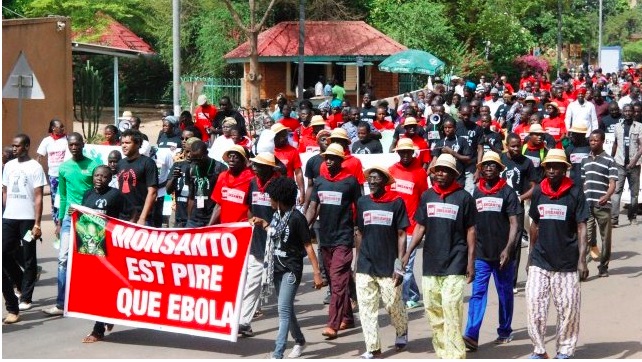
“Ideas alone do not change the world, to change the world we need mass struggles. We need to take a leap in the mass struggle and organize international struggle against a common enemy that includes Bayer, Monsanto and Syngenta, “he said.

17 de abril: El Campesinado de todo el mundo se moviliza para luchar contra los acuerdos de libre comercio y defender la soberanía alimentaria

. . DESAROLLO SUSTENTABLE . .

Un artículo de La Via Campesia

17 de abril de 2015- Hoy miles de hombres y mujeres del movimiento campesino internacional La Vía Campesina se movilizan mundialmente para mostrar su desacuerdo con las empresas transnacionales (TNCs) y los acuerdos de libre comercio (FTAs), que afectan a la agricultura campesina y minifundista así como a la soberanía alimentaria nacional.  Desde 1996[1], La Vía Campesina celebra cada 17 de abril el día mundial de acción global por las Luchas Campesinas de la mano de aliados y amigos.

April17

Los acuerdos de libre comercio fomentan las empresas transnacionales y un modo de producción industrializado capitalista que depende en gran medida de los agroquímicos. Además han aumentado los desalojos, la expulsión y la desaparición de campesinos. Los acuerdos de libre comercio anteponen el lucro frente al resto de derechos e intereses. Actualmente, los FTAs más importantes de la historia se encuentran en fase de negociación entre la Unión Europea, los Estados Unidos y Canadá. Estos acuerdos, si llegan a finalizarse, liberalizarán el comercio y los mercados de valores a favor de las empresas transnacionales  (ver tv.viacampesina.org/April-17th).

Siendo cientos las acciones tanto a nivel local como mundial que se llevan a cabo en todos los continentes (consulta nuestro MAPA actualizado regularmente),  La Vía Campesina reafirma la importancia de la lucha local al tiempo que subraya la necesidad de una resistencia y una organización  global entre las ciudades y las áreas rurales.

Hasta final de mes se realizarán acciones como  ocupaciones de tierras,  intercambio de semillas, manifestaciones, marchas, ferias de soberanía alimentaria, eventos culturales, giras de cabildeo y debates, como parte de las actividades previstas para esta Jornada de Acción Global.

Este año se están organizando varias acciones en Europa contra la Asociación Transatlántica para el Comercio y la Inversión (TTIP), el Acuerdo Económico y Comercial global (CETA) y el Acuerdo sobre el Comercio de Servicios (TiSA) en Alemania, Suiza y Bélgica. En Asia, tendrá lugar una manifestación masiva en Japón y Corea del Sur contra la negociación del Acuerdo de Asociación Transpacífico (TPP) por parte del gobierno japonés. En América del Sur, se ha organizado una gran marcha (con cerca tres mil  campesinas y campesinos) en Buenos Aires, Argentina, donde se realiza también el VI Congreso CLOC-Vía Campesina (Coordinadora Latinoamericana de Organizaciones del Campo).

La Vía Campesina denuncia las leyes y los intereses que afectan al modo de vida del campesinado, una herencia de vital importancia de las personas que están al servicio de la humanidad. El movimiento fomenta la soberanía alimentaria para poner fin al hambre en el mundo y aboga por la justicia social. En lugar de un futuro sombrío basado en el libre comercio y en las grandes empresas, La Vía Campesina cree que ha llegado el momento de apoyar una economía basada en la justicia social que restaure el equilibrio entre la humanidad y la naturaleza.  La reforma agraria y la agricultura campesina son claves para un modo de vida basado en la soberanía alimentaria de los pueblos.

Para concertar entrevistas, contactar con:

Ndiakhate Fall, CNCR – Senegal (francés): + 221 77 550 89 07

Marina dos Santos, Movimiento de  Trabajadores Rurales Sin Tierra, MST, Brasil (español) +5492615717585

Yudhvir Singh, BKU, India (inglés)+54 92615717585

( Clickear aquí para la version francês o clickear aquí para la version inglês)

Question for this article:

17 avril : les paysans du monde entier se mobilisent pour la souveraineté alimentaire et contre les traités de libre-échange

. . DEVELOPPEMENT DURABLE . .

Un article par La Via Campesina

17 avril 2015: aujourd’hui, des milliers de paysannes et paysans membres du mouvement international La Via Campesina se mobilisent de par le monde contre les multinationales et les traités de libre-échange. Ceux-ci touchent durement les petits paysans et leur agriculture, ainsi que la souveraineté alimentaire. Depuis 1996, La Via Campesina et ses alliés célèbrent le 17 avril comme étant la journée internationale des luttes paysannes.

April17

 Les traités de libre-échange sont au service des multinationales et de leur mode de production capitaliste et industriel qui dépend lourdement des intrants agrochimiques. Ils entraînent des vagues de déplacement, d’expulsion et de disparition des paysannes et des paysans. Les traités de libre-échange font du profit leur priorité absolue au détriment de tout droit et de toute autre préoccupation. Un important traité de libre-échange est actuellement en cours de négociation entre l’Union européenne, les Etats-Unis et le Canada. Ces discussions, si elles aboutissent, auront pour effet de libéraliser les échanges commerciaux et les investissements en faveur des multinationales ( voir les vidéos).

A travers de centaines d’actions locales et globales (voir la carte régulièrement mise à jour), La Via Campesina rappelle l’importance des luttes locales et, par la même occasion, souligne le besoin d’une alliance entre les communautés urbaines et rurales. Parmi les actions qui auront lieu jusqu’à la fin du mois, citons des occupations de terres, des échanges de semences, des manifestations, des séances de promotion de la souveraineté alimentaire, des événements culturels, des actions directes et des débats.

Cette année, en Europe, notamment en Allemagne, en Suisse et en Belgique, des manifestations sont organisées contre le Partenariat transatlantique de commerce et d’investissement (Transatlantic Trade and Investment Partnership – TTIP), l’Accord économique et commercial global (AECG, ou en anglais Comprehensive Trade and Economic Agreement – CETA) et l’Accord sur le commerce des services (ACS, ou en anglais Trade in Services Agreement – TiSA). En Asie, au Japon et en Corée du Sud, un important rassemblement est prévu pour forcer le gouvernement japonais à refuser les négociations de l’Accord de partenariat transpacifique (Trans-Pacific Partnership – TTP). En Amérique du Sud, une grande marche rassemblant plus 1 500 personnes venant du monde entier se déroulera en Argentine pendant le congrès de la CLOC-Via Campesina (Coordination des organisations paysannes d’Amérique latine) à Buenos Aires.

La Via Campesina a pour objectif de dénoncer les lois et les forces qui affectent la vie paysanne, un précieux héritage des peuples au service de l’humanité. Le mouvement fait la promotion de la souveraineté alimentaire afin d’éradiquer la faim dans le monde et d’instaurer la justice sociale.

Face à ce sombre tableau où le libre-échange et les profits juteux dominent, La Via Campesina propose une économie fondée sur l’équité qui rééquilibrerait les rapports entre l’homme et la nature. La réforme agraire et l’agriculture durable sont au centre de ce mode de vie fondé sur la souveraineté alimentaire des peuples.

Porte-paroles pour la presse:

Ndiakhate Fall, CNCR, Sénégal (en français): + 221 77 550 89 07

Marina dos Santos, Landless movement, Brésil (en espagnol et portugais): +54 9261571785

Yudhvir Singh, BKU, Inde (en anglais): +54 926115717585

(Cliquez ici pour la version anglaise de cet article ou ici pour la version espagnole)

Question for this article:

April 17: Farmers mobilise around the world against Free Trade Agreements and for food sovereignty

. SUSTAINABLE DEVELOPMENT .

an article by La Via Campesina

April 17, 2015: today thousands of women and men farmers of the international peasant movement La Via Campesina mobilize worldwide against Transnational Corporations (TNCs) and Free Trade Agreements (FTAs) which affect peasant and small-scale agriculture and national food sovereignty. Since April 17, 1996 La Via Campesina celebrates this day as a global day of action with allies and friends.

April17

Free Trade Agreements promote TNCs and a capitalist industrialised mode of production heavily reliant on agrochemicals. These have increased the displacement, expulsion, and disappearance of peasants. Free Trade Agreements put profit over all other rights and concerns. Currently, the most significant FTAs in history are being negotiated by the European Union, the United States, and Canada. These agreements, if finalised, will liberalize trade and investment markets in favour of transnational companies (see tv.viacampesina.org/April-17th).

With hundreds of actions at local and global level (see our regularly updated MAP) in all continents, La Via Campesina reasserts the importance of local struggles and at the same time underlines the need of a global resistance and organization between the cities and the rural areas. Actions such as land occupations, seed exchanges, street demonstrations, food sovereignty fairs, cultural events, lobby tours and debates will be carried out until the end of the month as part of these global days of action. This year in Europe, various actions are being organised against Transatlantic Trade and Investment Partnership (TTIP), Comprehensive Trade and Economic Agreement (CETA), Trade in Services Agreement (TiSA) in Germany, Switzerland and Belgium; in Asia, a mass rally to reject the negotiation of Trans-Pacific Partnership (TTP) by Japanese government is being organised in Japan and South Korea; in South America, a big march (over 1,500 people from all continents) is being organised in Argentina during the CLOC-Via Campesina (Latin American Coordination of Rural Organizations) congress in Buenos Aires.

La Via Campesina denounces laws and interests that affect the peasant way of life, an important heritage of the people at the service of humanity. The movement promotes food sovereignty to end hunger in the world and promote social justice.

Instead of a gloomy future based on free trade and big business, La Via Campesina believes the time has come for an economy based on equity that will restore the balance between humanity and nature. Agrarian reform and sustainable agriculture are at the heart of this way of living based on peoples’ Food Sovereignty.

For Interviews please contact:

Ndiakhate Fall, CNCR – Senegal (French): + 221 77 550 89 07

Marina dos Santos, Landless movement, Brasil (Spanish) +54 92615717585

Yudhvir Singh, BKU, India (English) +54 92615717585

(Click here for the French version of this article or here for the Spanish version)

Question for this article:

Mozambique: Maputo Declaration of African Civil Society on Climate Justice

. SUSTAINABLE DEVELOPMENT .

An article by Antonio C. S. Rosa, editor – TRANSCEND Media Service

Climate justice advocates, community peoples and mass movements’ representatives met in Maputo, Mozambique from 21-23 April 2015 to consider the roots, manifestations and impacts of climate change on Africa and to consider needed responses to the crises.

Maputo
Click on photo to enlarge
Photo by Radio Mundo Real

At the end of the deliberations it was agreed that Africa is disproportionately impacted by the climate crisis although she has not significantly contributed to the problem. The conference also noted that the climate crisis is systemic in nature and is a result of defective economic and political systems that require urgent overhaul. In particular, the meeting considered that Africa has been massively plundered over the centuries and continues to suffer severe impacts from resource exploitation and related conflicts.

The meeting noted that the Africa Rising narrative is based on the faulty premises of neoliberalism using tools like discredited measures of GDP and is presented as a bait to draw the continent deeper into extractivism and to promote consumerism.

The meeting further noted human and environmental rights abuses on the continent, as well as the ecological, economic, financial crises, all adversely affect her peoples and impair their capacity to adapt to, mitigate impacts and build collective resilience to climate change.

The meeting frowned at the widening gap between our governments and the grassroots and the increasing corporate capture of African governments and public institutions. These constitute obstacles to the securing climate justice for our peoples.

The long walk to climate justice requires mass education of our populace, as well as our policy makers, on the underpinnings of the climate crisis, the vigorous assertion of our rights and the forging ahead with real alternatives including those of social and political structures and systems. It also demands collective and popular struggles to resist neo-colonialism, new forms of oppression and new manifestations of violence including criminalisation of activists and social movements, and xenophobia. We recognise that as climate change worsens, it will increase the resource crunch and migrations and will lead to more conflicts between people. We also recognise that the exploitation of migrant labour by corporations often leads to conflicts between neighbouring countries.

With justice and equality as the irreducible minimum, the conference further noted and declared as follows:

All nations must act together to ensure that global average temperature rise does not go beyond 1.5 degrees Celsius above preindustrial levels as anything beyond that will mean a burning of Africa.

In Paris COP21, we demand that African governments defend positions that benefit Africans not the World Bank or corporations.

We reject carbon markets, financialisation of land and natural resources, consumerism and commodification of nature, and all forms of carbon slavery.

We reject all false solutions to climate change including, Reducing Emissions from Deforestation and forest Degradation (REDD), industrial tree plantations, genetic engineering, agrofuels and geoengineering, noting, for example, that clean coal does not exist.

We reject the false notion of “green economy” that is nothing but a ploy to commodify and hasten the destruction of nature.

Renewable energy that is socially controlled must be promoted across the continent.

We call for the creation of financial systems that promote and facilitate clean energy options including by supporting subsidies, facilitated loans, research and development.

We demand an end to financial systems built on extensive subsidies, externalisation of costs, over-optimistic projections, and corruption.

We resolve to work towards reclaiming energy as a public good that is not for profit and reject corporations-driven energy systems.

We say no to mining as we lived better without extreme extractive activities.

Our land is our present and our future livelihood and we reject land grabbing in all its forms including particularly for so-called “investment” projects that are setting the path beyond land grabbing to a full continent grab.

(Continued on right side of page)

Question for this article:

What is the relation between the environment and peace?

(Article continued from left side of page)

There must be full, transparent and prior informed consent of communities before the use of their lands for any sort of projects.

In all cases the welfare of local communities and our environment must come be prioritised over the profits of investment companies.

In line with the above and through other considerations, the conference demands as follows:

Governments must ensure that the energy needs and priorities of local households, local producers and women – including with regard to social services, transport, health, education and childcare – should be privileged over those of corporations and the rich.

We demand that no new oil exploration permits or coal mines should be granted in order to preserve our environment and to keep in line with demands by science that fossil fuels be left in the ground if we are to avoid catastrophic climate change.

We call for and support public and social control of the transition to renewable energy, including by community-based cooperatives, civil society collectives and the provision of local level infrastructure.

Governments must dismantle the barriers of privilege and power including those created and reinforced by financial institutions such as the International Monetary Fund (IMF) and the World Bank.

We demand urgent technology transfer for clean energy production, the abolishment of intellectual property and increased research and development funds to tackle climate change.

We demand full recognition of local community knowledge of forests, food production, medicinal and cultural uses of land and forests; funding of research in this area and use as part of the public education system.

We demand an urgent transition from dirty energy forms to clean energy systems while ensuring that workers are properly equipped and provided with new healthy jobs created by this shift.

Governments must support agro-ecological food production in the hands of small scale producers, prioritise food production over cash crops in order to promote food security in the context of food sovereignty.

Governments to ensure the protection and recognition of farmers’ rights to save, sell and exchange their seeds while rejecting genetic engineering and synthetic biology, including of those seeds manipulated and presented as being climate smart.

Ensure access, security, control, and right to use land for women. We recognise land as a common good.

Tree plantations must not be misrepresented as forests and trees must not be seen simply as carbon stocks, sinks or banks.

Community forest management systems should be adopted across the continent as communities have a genuine stake in preserving the health of forests.

The right to clean water should be enshrined in the constitutions of all African countries.

Governments must halt the privatisation of water and restore public control in already privatised ones.

Governments should halt the building of big dams, other mega structures and unnecessary infrastructure.

Governments should be responsible for holding corporations accountable for all environments degraded by ongoing or historical extractive and other polluting activities. Corporations who have created this contamination must pay to clean it up, but their payment does not constitute ownership of these environments.

Governments to ensure the cost of social and health ills by using energy derived from fossil fuels are not externalised to the people and the environment.

Governments must take up the responsibility of providing hospitals, schools and other social services and not leave these for corporations to provide as corporate social responsibility or other green washing acts.

Conference participants resolved to work with other movements in Africa and globally for the overturning of the capitalist patriarchal system promoted and protected by the global financial institutions, corporations and the global elite to secure the survival of humans and the rights of Mother Earth to maintain her natural cycles.

Signed by: All the civil society organisations, representatives of social movements and communities from Mozambique and southern Africa, and students present at the meeting.

A Century of Women Working for Peace

. WOMEN’S EQUALITY .

Amy Goodman, Truthdig (reprinted according to terms of fair use)

One hundred years ago, more than 1,000 women gathered here in The Hague during World War I, demanding peace. Britain denied passports to more than 120 women, forbidding them from making the trip to suppress their peaceful dissent. Now, a century later, in these very violent times, nearly 1,000 women have gathered here again, this time from Africa, Asia and Latin America, as well as Europe and North America, saying “No” to wars from Iraq to Afghanistan to Yemen to Syria, not to mention the wars in our streets at home. They were marking the 100th anniversary of the founding of WILPF, the Women’s International League for Peace and Freedom.

wilpf
click on the photo to see the video of the WILPF conference: Shown from left to right: Nobel laureates Mairead Maguire, Leymah Gbowee, Shirin Ebadi and Jody Williams

Dr. Aletta Jacobs, a Dutch suffragist who co-founded the group a century ago, said the purpose of the original gathering in 1915 was to empower women “to protest against war and to suggest steps which may lead to warfare being an impossibility.”

Among the women here were four Nobel Peace Prize winners. Shirin Ebadi was awarded the prize in 2003 for advocating for human rights for Iranian women, children and political prisoners. She was the first Muslim woman, and the first Iranian, to receive a Nobel. Nevertheless, she has lived in exile since 2009, and has only seen her husband once since then. “Had books been thrown at people, at the Taliban, instead of bombs, and had schools been built in Afghanistan,” Ebadi said in her keynote address to the WILPF conference this week, “3,000 schools could have been built in memory of the 3,000 people who died on 9/11—at this time, we wouldn’t have had ISIS. Let’s not forget that the roots of the ISIS rest in the Taliban.”

She was joined by her sister laureates Leymah Gbowee, who helped achieve a negotiated peace during the civil wars in Liberia; Mairead Maguire, who won the peace prize in 1976 at the age of 32 for advancing an end to the conflict in her native Northern Ireland; and Jody Williams, a Vermonter who led the global campaign to ban land mines, and who now is organizing to ban “killer robots,” weapons that kill automatically, without the active participation of a human controller.

These four world-renowned Nobel laureates were joined by nearly a thousand deeply committed peace activists from around the globe. Madeleine Rees, the secretary-general of WILPF, recalled the history of the first gathering in 1915, and how it was organized: “It wouldn’t have happened, but for the suffrage movement,” she told me, “because you don’t just start a mass movement. You actually have to have an organizational structure to make that happen. That had started with the suffragette movement. … Every single one of those women who went to The Hague … were demanding the right to vote. They saw, quite rightly, that the absence of women in making decisions in government meant a greater likelihood of war.”

(Continued on right side of page)

Question for this article

Do women have a special role to play in the peace movement?

(Article continued from left side of page)

Kozue Akibayashi is WILPF’s new president. After World War II, the U.S. required that Japan’s Constitution explicitly forbid it from pursuing war to settle disputes with foreign states. “The majority of people in Japan support the peace constitution,” Akibayashi explained. President Barack Obama, however, like George W. Bush before him, is pressuring Japan to eliminate the pacifistic Article Nine from the Japanese Constitution. He hosted Japan’s prime minister, Shinzo Abe, in Washington this week, celebrating Abe as he works to restore Japan’s military to its former offensive capacity. Akibayashi and thousands of others also are protesting the planned expansion of the U.S. military presence on Okinawa.

Africa activist Hakima Abbas was also in The Hague. I interviewed her hours after mass graves were reported in Nigeria, containing victims of the militant group Boko Haram. The story of Boko Haram, she told me, “is an intersection with violent Islamist fundamentalisms, with global capitalism and with militarization … fundamentalisms, though, don’t start and end with Islamic fundamentalisms in Africa. We’ve seen Christian fundamentalisms in Uganda, and the persecution of LGBTQI people.” She then made a connection to the street protests in Baltimore this week: “In your own country,” she told me, “the white supremacist and Christian right fundamentalisms are exacerbated by the gun culture and the promotion of an armed police force, which is killing black women, men, trans people and children. … So fundamentalisms is really something that we have to address globally.”

I asked Shirin Ebadi if she had advice for the people of the world. She replied with a simple yet powerful prescription for peace, laying out the work for WILPF as it enters its second century: “Treat the people of Afghanistan the same as you treat your own people. Look at Iraqi children the same as you look at your own children. Then you will see that the solution is there.”

Premios de educación concedidos a líderes de Irak y Filipinas

. . EDUCACIÓN PARA LA PAZ . .

Un artículo del Internacional de la Educación

La Internacional de la Educación ha concedido a dos dirigentes de sindicatos docentes de Irak y las Filipinas los premios de derechos humanos y educación por su compromiso, participación y valor extraordinarios en la promoción de la educación para todos/as.

educationinternational

Luisa Bautista-Yu, Filipinas, y Ahmed Jassam SalihAl-shiblawi, Irak, han sido seleccionados por el Consejo Ejecutivo de la Internacional de la Educación (IE) para recibir el Premio Albert Shanker de Educación y el Premio Mary Hatwood Futrell de Derechos Humanos y Sindicales respectivamente. Estos dos premios solidarios internacionales se entregan cada cuatro años durante el Congreso de la IE y se han convertido en uno de sus momentos más destacados.

La Sra. Bautista-Yu ha tenido una carrera de éxito marcada por el desarrollo de la educación en las Filipinas. Ha trabajado en el sector de la educación durante décadas, al principio como profesora de enseñanza primaria hasta convertirse en coordinadora regional de las Visayas orientales, puesto que ocupa actualmente. Su compromiso y valor fueron decisivos durante la misión de recuperación después de que el tifón Haiyan azotara las Filipinas en 2013, devastando infraestructuras y dejando a miles de niños/as sin escuela.

El Sr. SalihAl-shiblawi Ahmed Jassim Salih, presidente nacional del sector técnico del Iraqi Teachers Union (ITU), ha mostrado una valentía y determinación inmensas en la promoción de los derechos humanos y sindicales en su país. A pesar de las amenazas y ataques constantes contra él, su familia y sus compañeros/as, continúa dirigiendo el sindicato con destreza, pericia y valor.

Los premios se entregarán en el 7º Congreso Mundial de la IE en julio en Ottawa, Canadá.

( Clickear aquí para la version francês o aquí para la version inglês)

Question for this article:

What is the relation between peace and education?

Letter from Mohatma Gandhi to Maria Montessori

To Madame Montessori

Even as you, out of your love for children, are endeavoring to teach children, through your numerous institution, the best that can be brought out of them, even so, I hope that it will be possible not only for the children of the wealthy and the well-to-do, but for the children of paupers to receive training of this nature. You have very truly remarked that if we are to reach real peace in this world and if we are to carry on a real war against war, we shall have to begin with children and if they will grow up in their natural innocence, we won’t have the struggle, we won’t have to pass fruitless idle resolutions, but we shall go from love to love and peace to peace, until at last all the corners of the world are covered with that peace and love for which, consciously or unconsciously, the whole world is hungering.

Les Prix de l’Education seront décernés à des dirigeants syndicaux irakien et philippin

. . EDUCATION POUR LA PAIX . .

Un article par Internationale de l’Education

L’Internationale de l’Education a sélectionné les responsables syndicaux irakien et philippin pour l’attribution des prix des droits humains et de l’éducation, afin de récompenser leur engagement, leur dévouement et leur courage exceptionnels en faveur de la promotion de l’éducation pour tou(te)s.

educationinternational

Le Bureau exécutif de l’Internationale de l’Education a sélectionné Luisa Bautista-Yu des Philippines pour recevoir le Prix Albert Shanker de l’Education et  Ahmed Jassam Salih Al-shiblawi d’Irak) pour le Prix Mary Hatwood Futrell des droits humains et syndicaux. Ces deux prix internationaux de solidarité sont décernés tous les quatre ans à l’occasion du Congrès de l’IE et sont devenus l’un des moments forts de l’événement.

La brillante carrière de Bautista-Yu est marquée par son engagement en faveur du développement de l’éducation aux Philippines. Active dans le secteur de l’éducation depuis plusieurs décennies, elle a commencé sa carrière en tant qu’enseignante dans le primaire et occupe actuellement le poste de coordinatrice régionale d’Eastern Vinyasas. Son engagement et son courage ont été déterminants dans la mission de reconstruction après le passage du typhon Haiyan qui a balayé les Philippines en 2013, détruisant les infrastructures et entraînant la déscolarisation de milliers d’enfants.

M. Salih Al-shiblawi Ahmed Jassim Salih, Président national du département technique de l’Iraqi Teachers Union (ITU), a fait preuve d’un courage et d’une détermination immenses pour défendre les droits humains et syndicaux dans son pays. Bravant les menaces et les attaques dirigées contre lui, sa famille et ses collègues, il a continué à diriger le syndicat avec courage et expertise.

Les deux Prix seront remis lors du 7e Congrès mondial de l’IE, qui se tient cette année à Ottawa, au Canada.

(Merci à Janet Hudgins, la reporter pour cet article.)

(cliquez ici pour la version anglaise) de cet article ou ici pour la version espagnole

Question pour cet article:

What is the relation between peace and education?

Letter from Mohatma Gandhi to Maria Montessori

To Madame Montessori

Even as you, out of your love for children, are endeavoring to teach children, through your numerous institution, the best that can be brought out of them, even so, I hope that it will be possible not only for the children of the wealthy and the well-to-do, but for the children of paupers to receive training of this nature. You have very truly remarked that if we are to reach real peace in this world and if we are to carry on a real war against war, we shall have to begin with children and if they will grow up in their natural innocence, we won’t have the struggle, we won’t have to pass fruitless idle resolutions, but we shall go from love to love and peace to peace, until at last all the corners of the world are covered with that peace and love for which, consciously or unconsciously, the whole world is hungering.

Education awards go to Iraqi and Filipino leaders

EDUCATION FOR PEACE .

An article by Education International

Education International has named two teacher union leaders from Iraq and the Philippines to be awarded human rights and education prizes for their outstanding commitment, engagement and courage in promoting education for all.

educationinternational

Ms Luisa Bautista-Yu, from the Philippines, and Ahmed Jassam SalihAl-shiblawi, from Iraq, have been selected by Education International (EI)’s Executive Board to receive the Albert Shanker Education Award and the Mary Hatwood Futrell Human and Trade Union Rights Award, respectively. These two international solidarity prizes are given out every four years during EI’s Congress, and have become one of its biggest highlights.

Ms. Bautista-Yu has had a successful career marked by her engagement for the development of education in the Philippines. She has been involved in the education sector for decades, starting as a primary teacher and attaining the position of regional coordinator of Eastern Vinyasas, which she currently holds. Her engagement and courage were decisive during the recovery mission after Typhoon Haiyan hit the Philippines in 2013, devastating infrastructures and leaving thousands of children out of school.

Mr. SalihAl-shiblawi Ahmed Jassim Salih, National President of the technical sector of the Iraqi Teachers Union (ITU), has shown immense courage and determination in the promotion of human and trade union rights in his country. Despite constant threats and attacks on himself, his family and co-workers, he continues to lead the union with skill, expertise and bravery.

The awards will be presented at EI’s 7th World Congress this July in Ottawa, Canada. 

(Thank you to Janet Hudgins, the CPNN reporter for this article.)

(click here for the French version) of this article or here for the Spanish version

Question for this article:

What is the relation between peace and education?

Letter from Mohatma Gandhi to Maria Montessori

To Madame Montessori

Even as you, out of your love for children, are endeavoring to teach children, through your numerous institution, the best that can be brought out of them, even so, I hope that it will be possible not only for the children of the wealthy and the well-to-do, but for the children of paupers to receive training of this nature. You have very truly remarked that if we are to reach real peace in this world and if we are to carry on a real war against war, we shall have to begin with children and if they will grow up in their natural innocence, we won’t have the struggle, we won’t have to pass fruitless idle resolutions, but we shall go from love to love and peace to peace, until at last all the corners of the world are covered with that peace and love for which, consciously or unconsciously, the whole world is hungering.

Boletín español, el 01 de mayo 2015

.. PRIMAVERA ANTI-AUSTERIDAD ..

Hace unos años tuvimos la Primavera árabe. Este año se podría decir que tenemos la “Primavera anti-austeridad.”

La impresionante victoria electoral del partido Syriza en Grecia ha sorprendió a los medios de comunicación. Como historiadora Frances Fox Piven nos recuerda, esta victoria no es sólo un reflejo de un partido político, sino también la de un movimiento social contra las políticas de austeridad del gobierno. En sus palabras: “A diferencia de muchos izquierdistas americanos, Syriza no dice que hay dos caminos diferentes – por un lado el camino de los partidos políticos y por el otro el camino de los movimientos. Sin embargo, ellos trabajan juntos… vemos una dinámica en la que los movimientos pueden crear espacio para un partido político, sobre todo para un partido político de la izquierda”.

El éxito electoral de Syriza alentó otros partidos políticos europeos luchar contra la austeridad. En España, el partido Podemos se ha convertido rápidamente en una fuerza política importante. Como Ryan Rappa e Irene Fernández Pañeda explican, “Podemos como Syriza, nació de la frustración desarrollado con la austeridad fiscal, la corrupción endémica y el fracaso de los partidos políticos ya establecidos desde hace mucho tiempo que no hicieron nada”.

Como Syriza, Podemos ha surgido de un movimiento social, el movimiento de anti-austeridad “15-M” de 2011. En Francia, el nuevo partido político de la lucha contra la austeridad Nouvelle Donne, surgió de un movimiento social llamado “Roosevelt Colectiva”, en referencia al New Deal de los años 1930 del presidente estadounidense Franklin Delano Roosevelt. Un artículo muy interesante describe una reunión en París con el Nouvelle Donne, donde los representantes de los partidos Syriza y Podemos explicaron sus tácticas a una audiencia de jóvenes activistas.

En Irlanda, nació otro partido político de la lucha contra la austeridad, el AAA (Alianza de Irlanda para el anti-austeridad). Como Syriza (Alexis Tsipras, 41) y Podemos (Pablo Iglesias, 37), su líder es un dinámico joven activista, Paul Murphy, que es aún más joven, tiene 32 años.

Piven establece que los partidos políticos deben hacer concesiones, mientras que los movimientos sociales siguen siendo militantes. En la misma idea, CPNN publica los informes de los movimientos sociales de lucha contra la austeridad procedentes de Alemania y Canadá. En Frankfurt, Alemania, hubo manifestaciones llamadas “Blockupy”, inspirados en el ‘Occupy Wall Street’ hace unos años en los EE.UU. En Montreal, Canadá, los estudiantes han organizado y pusieron en marcha una importante huelga contra las políticas de austeridad.

Por último, Raffaele Morgantini y Tarik Bouafia nos recuerdan que los países de América Latina, especialmente Argentina, Bolivia, Ecuador y Venezuela se han vuelto en contra de las políticas de austeridad impuestas por el Banco Mundial y el FMI desde hace años. En consecuencia, fueron condenados por los principales medios de comunicación que siguen la línea de los grandes bancos internacionales y sus socios de gobierno, y fueron saboteados por las mismas fuerzas imperialistas que controlaban su país hace unas décadas.

En conclusión, hacemos esta pregunta: “¿son los movimientos contra la austeridad fiscal del gobierno parte del movimiento global hacia una cultura de paz?” Esperamos que los lectores respondan a CPNN.

Teniendo en cuenta las inversiones que siguieron a la Primavera Árabe y el aplastamiento del movimiento Occupy Wall Street en los Estados Unidos, los movimientos anti-austeridad pueden no tener un camino fácil por delante de ellos. Pero teniendo en cuenta la iniciativa tiene a la cabeza América Latina, el movimiento puede seguir fuerte. Si es así, proporcionará un buen modelo para el movimiento global para una cultura de paz.

      
DERECHOS HUMANOS

teheran

Premio WACC-SIGNIS de Derechos Humanos 2014 a “Taxi”

WOMEN’S EQUALITY


International Conference: Building Global Support for Women Human Rights Defenders

DISARMAMENT AND SECURITY


London: Confronting a world at war conference

SUSTAINABLE DEVELOPMENT


Latin America in perspective: Between successes and new challenges

FREE FLOW OF INFORMATION


World Social Forum in Tunis: Another world is possible, without the 1%

PARTICIPACIÓN DEMOCRATICA


Ecuador: 19 jueces de Paz trabajan en 12 provincias del país

TOLERANCE AND SOLIDARITY


USA: Discipline Reformers Get A “Restorative” Lesson

EDUCATION FOR PEACE


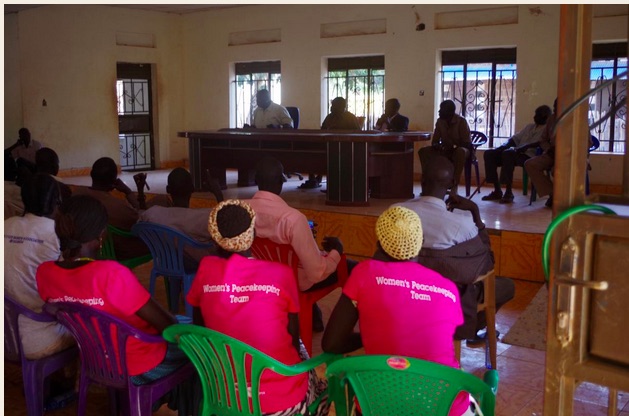
Nonviolent Peaceforce: Women’s Peacekeeping Teams incorporated into South Sudan communities