Category Archives: EDUCATION FOR PEACE

Northern Ireland School Receives Evens Prize for Peace Education 2017

EDUCATION FOR PEACE .

A press release from the Evens Foundation

New-Bridge Integrated College in Loughbrickland, Northern Ireland, is the laureate of the Evens Prize for Peace Education 2017. For this year’s biennial European prize, the Evens Foundation looked for strategies implemented in secondary schools for dealing with ‘hot topics’ in a constructive way. 13 high quality projects from all over Europe were selected for the shortlist.

According to the international jury of experts, New-Bridge Integrated College developed an impressive and strongly embedded project that continues to break new ground in relation to integrated education in Northern Ireland, and of which the approach is very transferable to other EU countries and contexts. The project arose in the polarized education system in Northern Ireland, but also integrates more recent problematics (social and cultural mix, mixed-ability students). It helps teachers to respond to everyday diversity as well as to transform controversial subjects into a learning opportunity.

The project is steered by the school and has strong leadership, both from the Senior Leadership Team and the Community Relations, Equality and Diversity team. It also has a solid peer-learning dimension: the project was developed by teachers for their colleagues. It focuses on both knowledge and skills development, and works with teachers, pupils and families. The cross-curricular approach to controversial issues is being mainstreamed into formal education processes across the school, and is accepted by all stakeholders.

To ensure a consistent approach to teaching controversial issues, the project offers teachers specific training, ideas, tools and activities to work positively with controversial or sensitive issues when they arise, as well as material to prepare lessons on controversial subjects. It does not expect teachers to follow extensive training courses but rather to start working and build their competences and confidence to deal with such topics step by step, at their own pace.

(continued in right column)

Question for this article:

Peace Studies in School Curricula, What would it take to make it happen around the world?

(continued from left column)

The laureate will receive a cash award of €25,000, of which some is to be used to share their vision and good practices with colleagues in other European countries.

The prize‐giving ceremony will take place on 9 November 2017 in London in the framework of the next Conflict Matters conference. On this occasion, all shortlisted candidates will also be invited for an exchange seminar in order to share experiences and good practices.

Jury members for Evens Prize for Peace Education 2017

Tomas Baum (BE), Director of the Flemish Peace Institute

Maria Carme Boqué Torremorell (ES), Head of Teaching, Department of Education, Ramon Llull University, Barcelona

Christel De Jonge (BE), DG Education and Culture, European Commission

Jonathan Even-Zohar (NL), Director of Euroclio (European Association for History Educators)

Joanna Grzymała-Moszczyńska (PL), researcher and PhD. student, Institute of Psychology, Jagiellonian University, Krakow

David Kerr (UK), Head of Initial Teacher Training, University of Reading; Consultant Director of Education, Citizenship Foundation

Claudia Ruitenberg (CA/NL), Associate Professor, Philosophy of Education, Department of Educational Studies, University of British Columbia

Africa: In a World of Turbulence, Writers Reaffirm Their Role for Enlightenment and Information

EDUCATION FOR PEACE .

An article from the Senegalese News Agency

Members of the Writers’ Union of Africa, Asia and Latin America (AAAWU) can play the role of “literary enlightenment and information” in a turbulent world . “Literature can play a very important role not only by interpreting but also by information,” said Lamine Kamara, president of the Writers’ Association of Guinea, at the opening on Monday in Dakar of the meeting of the AAAWU.

Former Guinean Foreign Minister, Kamara stressed the need “to open a space of debate through writing, so that the different points of view can confront each other.” According to him, we must “invite the reader and especially the general public to have more tolerance and intercomprehension and to avoid the spirit of violence, hatred and intolerance”.

“Facing this world of turbulence and particularly in Africa, writers have much to say,” adds Chadian poet Samafou Diguilou, president of the Association of Friends of Literature in Chad.

“I come from Chad (where), we have a very dramatic situation with the Boko Haram, a group of terrorists that is rampant in Chad and in neighboring countries such as Cameroon and Mali … the Chadian or African writer must take his pen to denounce this injustice, “continued Mr. Diguilou. The Chadian writer says he still finds it hard to understand the rationality of the members of this group. “You attack people who did not do anything to you, you come, you kill, you explode bombs, you take lives away from innocent people,” he criticized. In the face of this, “the writer, whether Chadian, Senegalese or even African is called upon to intervene.”

(continued in right column)

(Click here for the original version of this article in French)

Question for this article:

Do the arts create a basis for a culture of peace?, What is, or should be, their role in our movement?

(continued from left column)

“We do not have weapons or explosive devices like them, but we have our pen, and with this we can appeal to major international organizations like the UN, the African Union to support the actions of our countries that are concerned,’ explains the Chadian poet.

Taking as an example the role played by the first African poets in the struggle against slavery and colonization or the march towards independence, Chadian Samafou Diguilou considers that the author can use all literary genres to be hear.

Aware of the fact that literacy has been an obstacle to access to books in African countries, he proposed that we privilege works translated into local languages ​​or interpreted by artists.

The Senegalese writer Aissatou Cissé advocates “readings of peace in this world context of turbulence, verbal and physical violence”. “Every morning, when we get up, we read on the Internet, or through a newspaper or a book, and what we read does not promote the culture of peace, it disrupts even more and creates zizanie [discord], “she said.

“Children, adolescents and adults who read us need to read positive things that can boost their creativity, and it is in peace that we can create,” said the Special Advisor to the President of the Republic, Macky Sall.

The president of the club “Poetists, essayists and novelists” (PEN), Colonel Moumar Guèye invites “writers and journalists to have a responsible pen, to ensure to safeguard national cohesion and social peace”.

Ecuador: Students from schools commit to fostering a culture of peace

EDUCATION FOR PEACE .

An article by El Universo – Guayaquil

Officials and teachers of the Movement for Integral Popular Education and Social Promotion “Fe y Alegría”, from the coast region, have pledged to resolve conflicts based on honesty, peace and equality and promote respect for human rights and harmonious coexistence. This is part of the Semilleros de Convivencia program, promoted by the Council of the Judiciary.

The managers of eight establishments held on Monday May 22 took part in a symbolic planting of the first seed, through which they commit to implement this methodology in the educational community of 3,641 students.

Authorities and teachers committed themselves to provide tools for students and parents to resolve conflicts peacefully, through dialogue and consultation.

Iván Machado, deputy director of Centers for Mediation and Justice for Peace, said that the project “is a way of involving a whole society, schools, colleges, social groups, to forge a culture of peace.”

(continued in right column)

(Click here for the original version of this article in Spanish)

Question for this article:

Peace Studies in School Curricula, What would it take to make it happen around the world?

(continued from left column)

For the implementation of this methodology in educational establishments, motivational workshops will be held for teachers and student advisors, in topics such as harmonious coexistence, respect for the environment, teamwork, non-violence, and respect for oneself and for others..

Iván Pinchevsky, rector of the Father Francisco García Jiménez Educational Unit, stressed that this program seeks to educate children and adolescents in values ​​to promote cultural change and achieve social transformation.

In Guayaquil, the following institutions will participate in the Semilleros de Convivencia: the Francisco Garcia Jiménez Educational Unit, the José Antonio González de Durana School, the Fe y Alegría “40 y la C” Education Unit, the Francisco Gárate Elementary School. the Fiscomisional María Reina Basic School of Education, the Our Lady of Health Basic School of Education, the Esteban Cordero Borrero School, and the San Pablo Educational Unit.

The Council of the Judiciary indicated that ten other establishments of “Fe y Alegría” – costa region, will also join the project.

Argentina: Participants and Themes Announced for the IV Meeting of the International Peace Observatory

EDUCATION FOR PEACE .

An article from El Siglo (translated by CPNN)

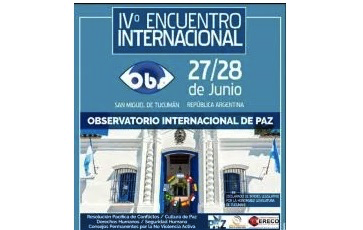
The IV International Meeting of the OIP (International Peace Observatory) will be held in Tucumán, Argentina. It is being organized by the CERECO Foundation (Center for Conflict Resolution) in conjunction with the CPNVA (Permanent Councils for Active Nonviolence). The Meeting will be held on June 27 and 28 in the facilities of the Faculty of Law and Social Sciences of the National University of Tucumán, a co-organizer of the event.


Click on image to enlarge

The meeting has the support of the Consultative Council of the Civil Society and the Argentine , Ministry of Foreign and Religious Affairs.

Mariela Domenichelli, the president of CERECO, and Ricardo Anibal Lucero, a participant in the event, explained to El Siglo that the meeting aims to open the doors of dialogue, strengthen relations between social actors from different countries with different profiles and histories so that they can share experiences and find ways of working together for a more just, united world. The meeting will make available to governments and civil society the updated state of the art in training methods for conflict prevention and resolution, as well as face-to-face and virtual training for violence prevention.

Participants include delegates of the Observatory from 9 countries (Argentina, Peru, Ecuador, Brazil, Chile, Spain, Uruguay, Mexico, Bolivia):

– Diana de la Rua (Buenos Aires) Eugenio President of the Association Respuesta para la Paz (ARP), President of International Peace Research Association Foundation (IPRAF) and Council Member of International Peace Research Association (IPRA);

(continued in right column)

(click here for the Spanish version)

Question for this article:

Mediation as a tool for nonviolence and culture of peace

(continued from left column)

– Patricia Pérez (Buenos Aires) Coordinator of the Committee on Culture of Peace and Citizenship of the Consultative Council of the Civil Society of the Argentine Chancellery;.

– Ricardo Anibal Lucero (Buenos Aires), veteran of 25 years of fieldwork for the International Organization “The Community for Human Development” in cities of Bombay and Calcutta (India), Morocco, Milan, Madrid, New York, Bogotá, Rio de Janeiro and Chile;

– Susana Bartolomeo (Buenos Aires) Trainer and Academic Coordinator of ECO Civil Association (School of Ontological Communication) and Primary Education Coach at Dardo Rocha de Martínez School;

– Mg Walter Fernández Ulloa (Ecuador), Alternate Councilor of the Council for Citizen Participation and Social Control;

– Dr. Christian Amestegui Villafañi (Bolivia), Trainer in Mediation in the Judicial Branch of the Bolivia government;

– Dr José Benito Pérez Sauceda (Mexico), Doctor of Law, Master of Science at the Faculty of Law and Criminology of the Autonomous University of Nuevo Leon;

– Commissioner Jorge Martin Ortega and Dr. Daniel Arnaldo Tolaba (Jujuy, Argentina), community mediators and specialists in gender violence and in suicide prevention. Ministry of Security. Secretariat of Community Relations, Government of Jujuy.

The Observatory sets out three main axes of work:

 – Alternative Methods of Conflict Resolution – Culture of Peace

– Human Rights and Human Security

– Active non-violence – Three ways for change

Registration is available on the website of eventowww.cerecotucuman.wixsite.com/observatoriodepaz, along with further information for the meeting. You may also write to programa.obspaz@gmail.com.

Nonviolence Charter: Progress Report 10 (Apr 2017)

EDUCATION FOR PEACE .

An article by Robert J. Burrowes, Anita McKone & Anahata Giri for the Transcend Media Service (abbreviated)

Dear fellow signatories of the Nonviolence Charter, How are you all? And welcome to our most recent signatories and organizations!

This is the latest six-monthly report on progress in relation to ‘The People’s Charter to Create a Nonviolent World’ together with a sample of news about Charter signatories and organizations.

Our collective effort to build a worldwide consensus against the use of violence in all contexts continues to make progress, even against rather overwhelming odds!

charter

Since our last report on 18 October 2016 – which Antonio C. S. Rosa kindly published in the TRANSCEND Media Service Weekly Digest – we have gained our first individual signatories in another five countries – Azerbaijan (Nigar Rasulzade), Paraguay (Fernando Juan Cabrera Tarragó), Vietnam (Greg Kleven), Iran (Professor Manijeh Navidnia) and Venezuela (Antonio Gutiérrez Rodero) – a total of 101 countries now. We also have 109 organizations/networks from 35 countries. If you wish, you can see the list of organizational endorsements on the Charter website.

If you wish to see individual signatories, click on the ‘View signatures’ item in the sidebar. You can use the search facility if you want to look for a specific name.

The latest progress report article ‘International Collaboration to End Violence’ was recently distributed to many progressive news websites: it was published by a number of outlets in 14 countries, thanks to very supportive editors (several of whom are Charter signatories: special thanks to Antonio Rosa at TRANSCEND, Gifty Ayim-Korankye at ‘Ghana web Online’, Korsi Senyo at ‘Awake Africa’ and Pía Figueroa at ‘Pressenza’). If you like, you can read the article in English and Spanish, the latter translated by signatory Antonio G. Rodero in Venezuela, on ‘TRANSCEND’.

If you feel inclined to do so, you are welcome to help raise awareness of the Nonviolence Charter using whatever means are easiest for you: email, articles, Facebook, Twitter…. Thanks to Anahata, the Nonviolence Charter is on Facebook and it has links to some useful articles.

You may remember that in previous Charter progress reports we have reiterated our promise to report on those of you about whom we know less by asking you to send us some information about yourself and the reminder that you don’t have to be world famous to be valued here. Well, the good news is that, once again, a number of people responded and, in addition, we did some more research ourselves. However, as we continue to find, extraordinary people seem to invariably consider themselves ‘ordinary’. So, irrespective of how you consider yourself, we would love to hear about you for the next report!

In addition to those signatories mentioned in the article ‘International Collaboration to End Violence’ cited above, here is another (inadequate) sample of reports of the activities of ‘ordinary’ people and organizations who are your fellow Charter signatories.

So first: A couple of recent websites for those of you who are interested in nonviolent strategy for your campaign or liberation struggle (and now with photos of several Charter signatories):

Nonviolent Campaign Strategy

Nonviolent Defense/Liberation Strategy

(Article continued in right column)

Question for this article:

Can peace be guaranteed through nonviolent means?

(Article continued from left column)

[Editor’s note: Here are a few of the news items from individual signatories of the Charter. For all of the news items, go to the original article here

Sadly, Professor Glenn D. Paige, inspirational founder of the Center for Global Nonkilling in Honolulu passed away, after a struggle with declining health, on 22 January 2017. Communications with Glenn and Glenda in the final days revealed a man at peace with himself after a lifetime of effort to end killing. Rather than publishing a tribute written by someone else, you are welcome to read the text of Glenn’s acceptance speech when receiving an Honorary Doctorate of Humanities from Jagran Lakecity University in Bhopal, India in December. Your inspirational example will not be forgotten Glenn.

Our first signatory in Iran is Professor Manijeh Navidnia, professor of sociology at the Islamic Azad University in Teheran. The focus of much of Manijeh’s research is security studies. You can read a little about her and some of her research articles here. Welcome Manijeh! . . .

Antonio Gutiérrez Rodero is our first signatory in Venezuela. . . . ’In Venezuela we are now living a very hard time. I think we are really paying the price for having rebelled against the American-Zionist Empire interests and we are “guilty” of possessing and wanting to preserve for our people the largest oil reserve on earth, in addition to other mineral resources, water, climate, landscapes and biodiversity. Violence harasses us on all fronts, particularly the media. The opposition, in defense of the interests of US corporations, violently fights against the pro-socialist government of Nicolas Maduro.’ . . .

Sovannarun Tay has almost completed the Khmer translation of the Nonviolent Defense/Liberation Strategy website as part of his effort to raise awareness of the potential of nonviolent strategy to liberate Cambodia from its dictatorship. If you fancy your Khmer, you can see his translation here. . . .

We asked Greg Kleven, our first signatory in Vietnam, for some information about himself. Continuing the tradition of great people signing the Nonviolence Charter, here is what Greg wrote: ‘My name is Greg Kleven and I am a 68 year-old American living and teaching English in Viet Nam. I was 18 years old when I was here as a soldier in 1967 and thought that what I was doing was right. But after a few months in country I realized that I had made a huge mistake. The war was wrong and I should never have participated. After I went home I had a hard time adjusting back into society. I couldn’t get the war out of my mind. In 1988 I came back to Viet Nam as a tourist and realized I had a chance to make up for what I had done. For the next two years I helped organize return trips for veterans who wanted to go back and see Viet Nam as a country, not a war. In 1990 I started teaching English in Ho Chi Minh City and have been doing it ever since. I admire your work in trying to establish a nonviolence charter that can some day put an end to all wars and violence in the world. I have forwarded your website to some friends and hope that they will sign. Keep up the good work. Hoa binh (peace), Greg’. . . .

Working in extraordinarily difficult circumstances in the Democratic Republic of the Congo, Christophe Nyambatsi Mutaka is the key figure at the Groupe Martin Luther King. The group, based in Goma in the east of the country in Central Africa, promotes active nonviolence, human rights and peace. They particularly work on reducing sexual and other violence against women.

Also based in Goma, the Association de Jeunes Visionnaires pour le Développement du Congo headed by Leon Simweragi is a youth peace group that works to rehabilitate child soldiers as well as offer meaningful opportunities for the sustainable involvement of young people in matters that affect their lives and those of their community. . .

Togo: Minister Lorenzo Launches Support for master in “culture of peace and development”.

EDUCATION FOR PEACE .

An article from Alwihda Info (translated by CPNN)

The Minister of Communication, Culture, Sports and Civic Training, Guy Madjé LORENZO opened this Tuesday [March 28] in the premises of the Regional Institute of Higher Education and Research in Cultural Development (IRES -RDEC) in Lomé, the work of defense of the first promotion (2014-2016) of master in “culture of peace and development”.

During four semesters of training, students gained theoretical and practical skills on subjects such as conflict and the mechanisms of their resolution, preventive conflict management. They may also conduct projects related to peacebuilding.

For Minister LORENZO, “the establishment in the subregion of the Master in Culture of Peace and Development is the fruit of a new initiative to be welcomed”. The Minister of Communications also invited the recipients to serve as an example for future promotions.

It should be noted that 34 students from Benin, Niger and Togo attended the training. Of these, four graduated and five dropped out. The Regional Institute for Higher Education and Research in Cultural Development is a school for regional training and integration in culture related to development.

(Click here for the original version of this article in French)

Question for this article:

Mexico, Los Cabos, Baja California Sur: Theater show celebrated on Theater Day

… EDUCATION FOR PEACE …

An article from Sudcaliforniano (translated by CPNN)

The main theater of the Cultural Pavilion of the Republic “Nabor García Aguirre”, the highest cultural venue in Los Cabos and one of the most important in the state of Baja California Sur, was the venue for World Theater Day. It was marked on March 25 with staging, monologues, amateur theater, interactive activities and other allusive activities.


Grupo Mascaras with “Clowns of the West” / The Sudcaliforniano

The main theater of the Cultural Pavilion of the Republic “Nabor García Aguirre”, the highest cultural venue in Los Cabos and one of the most important in the state of Baja California Sur, was the venue for World Theater Day. It was marked on March 25 with staging, monologues, amateur theater, interactive activities and other allusive activities.

Different companies and theatrical groups participated in these activities, which were freely accessible to the public and where, above all, each one of those involved in art could know the work of the other and receive feedback.

The person in charge of summoning each of the companies and theater groups of this beautiful tourist destination was the actress Angie Ulloa, who managed to reunite them all in the same scenario and for the same purpose.

World Theater Day was created by initiatives of the International Theater Institute (ITI) in 1961; Is celebrated and commemorated annually on March 27. Several national and international theatrical events are organized to commemorate this occasion; One of the most important is the circulation of the International Message of World Theater Day through which, at the invitation of the ITI, a world-class figure shares his reflections on the theme of Theater and a Culture of Peace. [Editor’s note: this year it was Isabelle Hupert – see http://columnacero.com/cultura/2185/dia-internacional-del-teatro-con-el-mensaje-de-la-actriz-francesa-isabelle-huppe/.]

(For the original of this article in Spanish, click here.

(For an article about World Theater Day from the Philippines, click here)

Question for this article:

Philippines: Theater, a tool for international understanding

… EDUCATION FOR PEACE …

An article from the Manila Buletin

World Theater Day, instituted by the International Theater Institute (ITI) on March 27, 1962, to mark the opening of the Theater of Nations in Paris, France, has since been annually celebrated on March 27 to focus on the importance of theater as a diverse and complex art form that taps the creative work of the playwright, director, actors, artists, and composers. In musical theater, acting is combined with music, song, and dance.2

ITI, the world’s largest organization for the performing arts established in 1948 by UNESCO during the first world congress in Prague, Czech Republic, has a network of 100 national centers worldwide, including the Philippines, that promotes international exchange of knowledge and practice in theater arts, aiming to consolidate peace and friendship among peoples, deepen mutual understanding, and increase creative cooperation among people in the theater arts. An ITI center is made up of professionals active in the theater life of a country and representative of all branches of the performing arts.

The Philippines celebrates UNESCO-ITI World Theater Week every year on March 21-27, pursuant to Proclamation 1262 in 2007. The National Commission for Culture and Arts leads the weeklong celebration, in coordination with ITI-affiliated Philippine Center of the International Theater Institute. Events in Metro Manila and in the regions include the presentation of short plays, dance troupe performances, puppet shows, art exhibits and singing. NCCA encourages artists and culture enthusiasts to partner with the government towards the full flowering of theater arts among Filipinos.

On World Theater Day, events are held by theater communities all over the world, the most important of which is spreading an international message by a renowned personality on the theme of theater and a culture of peace. The first international message was written by French poet-novelist Jean Cocteau in 1962. For 2017, French theater and cinema actress Isabelle Huppert will deliver the World Theater Day message at a special show at the UNESCO in Paris.

Each year, the message is translated into more than 20 languages, read for tens of thousands of spectators before performances in theaters worldwide, released throughout the ITI network, and printed in newspapers.

(For an article on World Theater Day in Mexico, click here)

Question for this article:

Mexico: UAT teaches university students “Mediation for a Culture of Peace”

… EDUCATION FOR PEACE …

An article from Gaceta (translated by CPNN)

The Autonomous University of Tamaulipas (UAT) is offering its students the conference “Mediation for a culture of peace”, in which young people are introduced to a broader perspective of the subject, as well as tools essential for conflict resolution.

The lecture was given by the Master Jose Ives Soberón Mejía, in the auditorium of the Academic Unit of Social Work and Sciences for the Human Development (UATSCDH) of the Victoria Campus.

“Sometimes we think it is a subject foreign to us but there are many conflicts to solve in our university, in our community, and in all social spheres,” said the speaker, who has a Master’s Degree in Conflictology with Specialty in Family and Educational Mediation by The Universitat Oberta de Catalunya.

The UAT professor also stressed the importance of addressing the issue of mediation in the University, which allows the dissemination of tools and peaceful ways to resolve conflicts among young people.

“Throughout our life if there is something that we can not escape, it is the issue of conflicts. And when there comes a conflict in our life we ​​tend to solve it as it occurs, without benefiting by gaining a general scheme for conflict resolution, “he said.

He stressed that this is why the effort made by the University is praiseworthy, in order to instill in young people the tools to resolve conflicts in a systematic way.

“We have to learn to negotiate to solve our problems, which is the point of mediation, so that each problem will be solved in an appropriate way.”

“That is why mediation gives us the tools to solve conflicts and this in turn contributes to the culture of peace,” he concluded.

(click here for the Spanish version)

Question for this article:

258,000 Iraqi children back at school in eastern Mosul as battle rages in west of city

… EDUCATION FOR PEACE …

An article from Theirworld: A brighter future for every child (reprinted by permission)

At least 320 schools have reopened in eastern Mosul and nearby towns – allowing around 258,000 children to return to education while fighting continues in the west of the embattled Iraqi city. Some of the children had been out of school for more than two years, with girls largely banned from getting an education by the terror group Islamic State.


Heba, Noor, and Janna in a classroom at a recently reopened school in eastern Mosul, Iraq — UNICEF / Anmar

In February, UNICEF provided learning materials including science and maths kits to 87 of the East Mosul schools, reaching 73,780 children including 31,890 girls. The United Nations children’s agency said the need for furniture, teaching materials, and teacher training remains a challenge.

Concern about unexploded devices in and around schools is high. But with only a limited number of agencies authorised to deliver Mine Risk Education (MRE) sessions, the authorities are concerned. In Anbar province, MRE took place in 50 schools, with awareness and safety messages reaching an estimated 25,000 students, including about 45% of girls.

Paul St. John Frisoli, a senior education technical adviser on the Middle East region for the International Rescue Committee, said schools in Mosul can save children’s lives by giving student, teachers, school staff and parents crucial life-saving information about mine awareness.

In a blog for Refugees Deeply, he added: “IRC staff deployed into recently retaken villages and displacement camps around Mosul have observed high rates of distress among children and families.

(Article continued in right column)

Question for this article:

What is the relation between peace and education?

A culture of peace in Iraq, Is it possible?

(Article continued from left column)

“Education can help children cope with the consequences of conflict by providing a secure, predictable and nurturing environment. Having access to education offers children hope for and a sense of control over their future during crisis.”

Millions of children across the world miss out on school as a result of humanitarian emergencies including conflicts, natural disasters and health crises. Education can be lifesaving – not being in school in emergencies can leave children at risk of child labour, early marriage, exploitation and recruitment into child labour.

Military operations to retake western parts Iraq’s second largest city started on February 19 after Iraqi forces were successful in removing the terror group from the east.

The United Nations estimates that around 750,000 civilians remain inside the western section of the city.

Humanitarian groups are deeply concerned about the situation of civilians trapped there, including around 412,000 children.

Since February 19, more than 31,500 people – including 14,800 children – have been displaced from West Mosul. The majority of people have been sent to new IDP camps in south Ninewa.

In January, 70 schools reopened in Mosul. Hessam al-Din Abar, a representative at the Provincial Council in Nineveh, where Mosul is the capital, said schools had been turned into places for terrorists to train new recruits and promote extremism.

Many families would not allow their children to attend schools while ISIL – which seized the city in 2014 – was controlling them.

An estimated 3.5 million Iraqi children are missing out on education.

(Thank you to Janet Hudgins, the CPNN reporter for this article.)