Category Archives: DEMOCRATIC PARTICIPATION

Ashland (Oregon, USA): Culture of Peace Commission Launches with World Peace Flame and OSF Oracle

DISARMAMENT & SECURITY .

by David Wick

The Ashland Chief of Police, an Oracle from Oregon Shakespeare Festival, and the World Peace Flame from Wales come together to launch the Ashland Culture of Peace Commission. Monday, September 21st, the United Nations International Day of Peace is the introduction of the historic Ashland Culture of Peace Commission along with the hopes of many people around the world.

Ashland
Ashland Community Tiles for Peace Wall – Ashland Library Main street

Ashland’s 1st Annual Culture of Peace Festival and Peacebuilding Resource Fair are being held 4:00pm – 8:00pm at the Ashland Elk’s Lodge, Basement Level and alley entrance (Will Dodge Way). Mayor John Stromberg provides a welcome at 5:00 pm, to be followed by an introduction of the Commission members, a lighting ceremony from the World Peace Flame in Wales (bring a candle to participate), predictions for the future of the Commission by the OSF Head Over Heels Oracle (Michele Mais), and a dedicated performance by Dancing People Company.

The Ashland Culture of Peace Commission is unique in the United States, and the world, and is acknowledged and supported by the Global Movement for the Culture of Peace at the United Nations. This culminates two years of work by a local citizens group working with the community and the Ashland City Council to create this one year pilot Commission.

Members were invited through the use of the Pathways To Peace, Peace Wheel (www.ashlandcpc.org). This process attracted the current fourteen people from various sectors of the community and more will be added. This includes members such as Police Chief Tighe O’Meara, Amy Blossom Manager of the Ashland Library, Editor of the Daily Tidings Newspaper Bert Etling and Joanne Lescher, counselor in Non-Violent Communications. The Commission will soon include students from Ashland High School and Southern Oregon University.

The Ashland Culture of Peace Commission (ACPC), endorsed by the Ashland City Council, is a body of diverse citizens who have a goal of an Ashland that identifies itself as a culture of peace, both as a commitment to itself and a presentation to the world. Essential elements are working with City Government and the Community to maintain and enhance respectful and caring relationships between all sectors of society and the environment upon which they depend. The Commission will work with serious concerns that are facing the Ashland community now, and in the future.

The Peacebuilding Resource Fair will have information and demonstration tables focused on local Peacebuilding resources such as mediation, conflict resolution, Non-Violent Communication, Restorative Justice, Collaborative law, and inner peace practices. There will also be musicians, poetry, and a grand finale dance.

A press conference will be held at 12:00 pm, September 21st with Police Chief O’Meara, Legal Counsel Eric Sirotkin and other Commission members at the ACPC office 33 First St, Suite 1, Ashland (First St/Lithia Way across from the Post Office).

For additional information www.ashlandcpc.org or contact Executive Director, David Wick 541-552-1061, davidwick111@gmail.com.

Questions for this article:

Côte d’Ivoire: REPSFECO-CI promotes a peaceful electoral process

. DEMOCRATIC PARTICIPATION .

An article from News Ivoire

The REPSFECO-CI, Peace and Security Network for Women of ECOWAS – Ivory Coast Section – wants to contribute to civic education and culture of peace. This organization initiated, Wednesday, August 5, 2015 in Abidjan, the first edition of the “Rendez-vous du REPSFECO-CI” under the theme “Peaceful elections: responsibilities of political parties and organizations of the civil society”.

Cote d'Ivoire

The “Rendez-vous du REPSFECO-CI” is designed for organizations of civil society and political parties. Every actor involved in the democratic process should calmly prepare for future elections that guarantee stability and lasting peace, according to Mr. Diallo Géneviève, president of REPSFECO-CI. Côte d’Ivoire needs peace for its development. The upcoming elections are a test. The international community wants to see if our country really got into a democratic state. We think it is the political parties that determine the game. They have their supporters and activists. So it is important that political parties involved in these elections should speak in a different way because people are tired and they need to be reassured. We must not repeat the violent post-election crisis in 2010.

The highlight of “Rendezvous REPSFECO-CI” is a panel discussion moderated by M.Traoré Wodjo, vice president of the National Commission of Human Rights of Côte d’Ivoire (CNDH- CI) and Fernand-Julien Gauze, president of the NGO Action for Democracy, Justice and Freedom in Ivory Coast (ADJLCI) and member of the Network of organizations of civil society in Côte d’Ivoire (CCAP-Rosci ).

The communication of by M.Traoré Wodjo emphasized the responsibilities of political parties in promoting a peaceful electoral climate and effective participation in the electoral process. He noted that elections in Africa are often sources of serious social tensions. Witness the case of Côte d’Ivoire in 2010. That’s why the 2015 elections are a challenge to democracy for Ivorians. Hence the recommendation to the political parties to put a point of honor to the training and education of their supporters and especially to ask actions that promote a peaceful climate throughout the electoral process. “We want a civilized election in Ivory Coast,” he stressed. “Political parties that are conscientious and mature politicians with a high sense of democracy are the guarantee of a peaceful electoral process,” M.Traoré said.

Civil Society for peaceful elections was the theme of Fernand Julien Gauze, president of the ADJLCI, “Actions of CSOs in the objective monitoring of the electoral process and the consolidation of pre- and post-electoral peace” “Election monitoring” is an English expression which translates into French as “surveillance électorale” simply indicating the need to monitor the process of the election by civil organizations, citizens, political parties, media, trade associations, lobby groups etc. The purpose is to raise the alert. The expert in election monitoring has identified the crucial importance of monitoring in electoral processes in Côte d’Ivoire since it calls attention to the violence and incidents that may take place during an election. And, through informatics, the social networks and SMS. “The monitoring of violence is an essential civic activity in the electoral processes of countries that have experienced crises,” he concluded.

(Click here for the original version of this article in French.)

Question related to this article:

How should elections be organized in a true democracy?

CPNN receives more and more articles from Africa about initiatives that contest the European model of “winner-takes-all” elections, and demand that elections should only be part of a broader democratic process that seeks consensus and compromise.

This fits with the pre-colonial systems of justice in Africa, when there was no monotheism and no single supreme god, no single supreme law, no single “truth” provided by divine intervention, but rather a compromise among many different “gods,” perspectives and “truths” arrived at through a process of mediation, for example, the “palabra.”

Here are some of the articles:

Ghana Youth Coalition wants politicians to commit to peace in 2012

Women’s World in Nationwide Sensitization [Sierra Leone]

Varsities vouch for peace ahead of general elections (Kenya)

Zimbabwe: Christian denominations launch peace initiative

Rethinking Post-Election Peacebuilding in Africa

Nigeria: Why we facilitated Abuja peace accord —Ben Obi

Uganda: Government to Set Up Election Conflict Resolution Body

Côte d’Ivoire: Le REPSFECO-CI invite les acteurs à un processus électoral apaisé

Côte d’Ivoire: REPSFECO-CI promotes a peaceful electoral process

Uganda: Government to Set Up Election Conflict Resolution Body

. DEMOCRATIC PARTICIPATION .

An article by Stephen Wandera, All Africa

Plans are underway to set up a Conflict Resolution Authority with the mandate of settling post 2016 election disputes. The authority, compiled jointly by government and the Uganda Joint Christian Council (UJCC), is contained in the Uganda National Conflict Prevention and Peace-building Policy draft expected to be officially endorsed by government before the end of the year.

uganda
The Executive Secretary of Uganda Joint Christian council, Rev Silvester Arinaitwe Rwomukubwe, (L) with as Archbishop Stanley Ntagali (R) PHOTO BY ABUBAKER LUBOWA

“The policy aims at promoting a culture of peace among all Ugandans in successive generations,” UJCC executive secretary Sylvester Arinaitwe said, while addressing various stakeholders at a consultative meeting in Nsambya, Kampala, yesterday.

“The policy will be used to identify, prevent, manage and transform conflict and comprehensively for sustainable and equitable development and harmonious co-existence,” Fr Arinaitwe added.

“This honourable job will be executed by an authority either a council or commission depending what will be agreed upon.”

He said the document compiled jointly by government and the UJCC will act as a tool of reference for conflict resolution.

“We want to offer Ugandans a peace gift on the International Peace Day scheduled for September 21 by launching the policy,” Fr Arinaitwe.

“However, it will have to be endorsed by Cabinet before being tabled to Parliament as a Bill for consideration into law.” The draft is being advocated for by UJCC and the Office of the Prime Minister.

Ms Mary Adhiambo Mbeo, a programme specialist on Gender issues in the UN, backed the establishment of the authority, saying unresolved election conflict results into war, something that Uganda should avoid.

“I had first-hand experience during the Darfur war and I would not like such an incident to happen here in Uganda,” she said.

Question related to this article:

How should elections be organized in a true democracy?

CPNN receives more and more articles from Africa about initiatives that contest the European model of “winner-takes-all” elections, and demand that elections should only be part of a broader democratic process that seeks consensus and compromise.

This fits with the pre-colonial systems of justice in Africa, when there was no monotheism and no single supreme god, no single supreme law, no single “truth” provided by divine intervention, but rather a compromise among many different “gods,” perspectives and “truths” arrived at through a process of mediation, for example, the “palabra.”

Here are some of the articles:

Ghana Youth Coalition wants politicians to commit to peace in 2012

Women’s World in Nationwide Sensitization [Sierra Leone]

Varsities vouch for peace ahead of general elections (Kenya)

Zimbabwe: Christian denominations launch peace initiative

Rethinking Post-Election Peacebuilding in Africa

Nigeria: Why we facilitated Abuja peace accord —Ben Obi

Uganda: Government to Set Up Election Conflict Resolution Body

On Mandela Day, UN joins call to promote community service and inspire change

. DEMOCRATIC PARTICIPATION .

An article from the UN News Centre

The 70th anniversary of the United Nations’ founding provides the perfect opportunity to reflect on the life and work of Nelson Mandela with a call to action for helping others, Secretary-General Ban Ki-moon affirmed today as he joined the world gathers in marking Nelson Mandela International Day [18 Jully].

mandela
Photo United Nations/Pernaca Sudhakaran

“Nelson Mandela International Day is an annual call to action for people around the world to make a difference in the communities where they live and work by taking time to serve others,” the Secretary-General stated in his message for the Day.

“Nelson Mandela gave 67 years of his life to the struggle for human rights and social justice,” Mr. Ban continued. “The United Nations joins the Mandela Foundation in asking people around the world to devote at least 67 minutes of their time on 18 July – Madiba’s birthday – to a community service activity.”

The UN General Assembly declared 18 July ‘Nelson Mandela International Day’ in 2009 in recognition of the former South African President’s contribution to democracy, justice and reconciliation and to mark his birthday. Mr. Mandela passed away in December 2013 in Johannesburg at the age of 95.

The overall campaign slogan – Take Action, Inspire Change – seeks to inspire people around the world to take 67 minutes of time devoted to helping others and, in so doing, empower entire communities and build a global movement for good.

In the past, volunteers have helped to rebuild homes destroyed by hurricane Sandy in the New York, offered school supplies to children, prepared meals for the elderly, helped out in orphanages, cleaned up parks, and delivered computer literacy workshops.

This year’s commemoration comes a week before the UN is set to bestow its first-ever Nelson Rolihlahla Mandela Prize to two individuals – a man and a woman – for their service to humanity.

Dr. Helena Ndume, of Namibia, and Jorge Fernando Branco Sampaio, of Portugal, will receive the award at a ceremony to take place on 24 July 2015, at UN Headquarters in New York.

(Click here for the French version of this article or click here for the Spanish version.)

Latest Discussion

What is the legacy of Nelson Mandela for us today?

Comment by Rama Singh posted: Dec. 31 2013

ON MANDELA’S LASTING LEGACY

In death, as in his life, Nelson Mandela has captured the imagination of the world. Mourning mixed with celebration has electrified crowds all over South Africa and elsewhere. His life’s achievements and his lasting legacy are the topics of discussions. He has been described as a great warrior, a great liberator, the last giant in the fight against colonialism, forgiver, peace maker, and in many other ways.

All this week, Mandela’s lasting legacy has been on my mind. We tend to capture the legacies of great men and women in a word or two. A scientist becomes famous for an important discovery, a writer for a famous book, a musician for a great composition, and so on.

People like Mandela fall in a different category. He is in the category of Mahatma Gandhi and Dr. Martin Luther King. They are known for their fights on behalf of oppressed people; they are known for their personal sacrifice, and for their moral authority. If we are to look for words to associate with these men, it will be “nonviolence” for Gandhi and “love’ (beloved community) for Dr. King. But what about Mandela- how will we describe his legacy?

What were the important transformational changes in Mandela’s life?

Mandela the great warrior: Mandela has been described as a great warrior, but he was no ordinary warrior. All legendary warriors, mythical or real, are known for the destruction of their enemies. Mandela was different; he did not seek annihilation of his enemy; he transformed his enemy into his collaborator.

Mandela the resilient sufferer: I know of no other person living or dead who was forcefully made to disappear from the scene for this long (incarceration for 27 years) and who survived and made his triumphatic return. Gandhi said there is no other way to show your love for the suffering of your loved ones than to suffer yourself with them, for them. Mandela suffered the longest because his work was the hardest.

Mandela the great liberator: Colonial rulers are known for their ruthless treatment and putting down of citizens but South Africa was not a typical colonial rule. The rulers were Afrikaners, citizen of South Africa. I know of no other country, outside of the United States, where the blacks were so harshly treated by another segment of their own country. It was a true liberation. Thanks to Mandela, sad songs of seeking freedom through death were transformed into freedom in life.
Mandela the magnanimous forgiver: Gandhi’s nonviolence is a complete philosophy of life and it includes love of your enemy and forgiveness. Nonviolence had to be tested to show that it works and that it’s not just a philosophy. Dr. King tested nonviolence with his own suffering and love for his people. His passion for his “beloved community” became the brand of his civil rights struggle for which he paid with his own life. As Gandhi said, the only two places of non-action for such fighters are prison or death. Mandela went to prison, suffered longer, and tested his resolve to forgive his “enemy”. We can only imagine the blood bath had he not done that.

Mandela the peace maker: Gandhi, Dr. King and Mandela, together, constitute a shining trinity of peace and their contributions, respectively, nonviolence, love, and forgiveness provide a prescription for peace if the humankind needs to survive. Truth and Reconciliation will remain one of Mandela’s brilliant and innovative contributions for healing wounds between warring people, warring nations. Gandhi, King and Mandela, all tested nonviolence in their own way and they all came out with the same result: The path of peace and liberation goes through love, suffering, and forgiveness.
Mandela the spiritual father: We go through life with two sets of parents. Our own parents, of course, who brought us in this world, whom we owe our life, body and brain, whom we remain eternally grateful for their sacrifice and care to help us grow and to teach us how to live.

There are another set of parents, for a lack of a better word we can call them our “spiritual parents”. These are men and women whom the whole humanity owes gratitude because it is their discoveries, contributions and, teachings that we like fill our brain with, they make us human- kinder, gentler, and humane.

We call ourselves human because we made a pledge with destiny that we will become humane. It has been a long and arduous journey. With his love, suffering and forgiveness, Mandela has brought us further on the path and has warned we still have a long way to go.

Gandhi-King-Mandela, or Mohan, Martin and Matiba, are angels of peace. We are their descendents, the keepers of their dreams.

Rama Singh, is a professor in the department of biology, and member, Coordinating Council, Centre for Peace Studies, McMaster University.

This appreciation was originally published in the Hamilton Spectator in Canada.

African Women Mayors Join Forces to Fight for Clean Energy

. DEMOCRATIC PARTICIPATION .

An article by A. D. McKenzie, Inter Press Service (reprinted by permission)

When some 40,000 delegates, including dozens of heads of state, descend on Paris for the United Nations Climate Change Conference later this year, a group of African women mayors plan to be there and make their voices heard on a range of issues, including electrification.

mayors-english
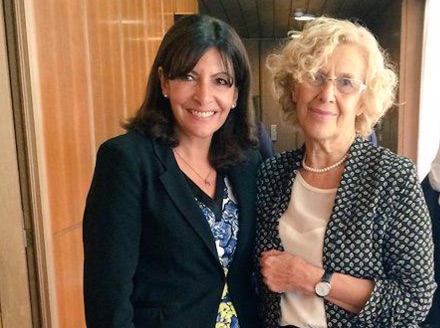
Paris Mayor Anne Hidalgo with African women mayors who are calling for greater attention to communities without electricity, given the inextricable link between climate change and energy. Credit: A.D. McKenzie

The mayors, representing both small and big towns on the continent, are calling for greater attention to communities without electricity, given the inextricable link between climate change and energy.

“In my commune, only one-fifth of the people have access to electricity, and this of course hampers development,” Marie Pascale Mbock Mioumnde, mayor of Nguibassal in Cameroon, told a recent meeting of women mayors in Paris.

Mbock Mioumnde was one of 18 women mayors at last month’s meeting, hosted by Paris mayor Anne Hildalgo and France’s former environment minister Jean-Louis Borloo, who now heads the Fondation Énergies pour l’Afrique (Energy for Africa Foundation).

Organisers said the meeting was called to highlight Africa’s energy challenges in the run-up to COP 21 (the 21st session of the Conference of the Parties to the 1992 United Nations Framework Convention on Climate Change), which will take place from Nov. 30 to Dec. 11 and which has the French political class scrambling to show its environmental credentials.

Mbock Mioumnde told IPS in an interview that clean, renewable energy was a priority for Africa, and that political leaders were looking at various means of electrification including hydropower and photovoltaic energy and, but not necessarily, wind power – a feature in many parts of France.

“We plan to maintain this contact and this network of women mayors to see what we can accomplish,” said Mbock Mioumnde. “As mayors we’re closer to the population, and when we work together, there’s hope.”

Hidalgo, the first woman to hold the office of Paris mayor, said she wanted to support the African representatives’ appeal for “sustainable electrification”, considering that two-thirds of Africa’s population, “particularly the most vulnerable, don’t have access to electricity.”

Currently president of the International Association of Francophone Mayors (AIMF), Hidalgo said it was essential to find ways to speed up electrification in Africa, using clean technology that respects the environment and the health of citizens.

The mayors meeting in Paris in April also called for the creation of an “African agency devoted to this issue” that would be in charge of implementing the complete electrification of the continent by 2025.

Present at the conference were several representatives of France’s big energy companies such as GDF Suez – an indication that France sees a continued business angle for itself – but the gathering also attracted NGOs which have been working independently to set up solar-power installations in various African countries.

“I’m happy that women are organising on this issue. We need solidarity,” said Hidalgo, who has been urging Paris residents to become involved in climate action, in a city that has come late to environmental awareness, especially compared with many German and Swiss towns.

(Article continued on right side of this page)

(Click here for an article in French about this event.)

Latest Discussion

How can culture of peace be developed at the municipal level?

(Article continued from left side of this page)

“The Climate Change Conference is a decisive summit for the planet’s leaders and decision-makers to reach an agreement,” Hidalgo stressed.

Climate change issues have an undeniable gender component because women are especially affected by lack of access to clean sources of energy.

Ethiopian-born, Kenya-based scientist Dr Segenet Kelemu, who was a winner of the 2014 L’Oréal-UNESCO Awards for Women in Science, spoke for example of growing up in a rural village in Ethiopia with no electricity, no running water and no indoor plumbing.

“I went out to collect firewood, to fetch water and to take farm produce to market. Somehow, all the back-breaking tasks in Africa are reserved for women and children,” she told a reporter.

This gender component was also raised at a meeting May 7-8 in Addis Ababa, where leaders of a dozen African countries agreed on 12 recommendations to improve the regional response to climate change.

The recommendations included increasing local technological research and development; reinforcing infrastructure for renewable energy, transportation and water; and “mainstreaming gender-responsive climate change actions”.

The meeting was part of a series of ‘Climate Vulnerable Forum (CVF)’ workshops being convened though June 2015 in Asia, Latin America, the Pacific and the Middle East.

The CVF was established to offer a South-South cooperation platform for vulnerable countries to deal with issues of climate change.

In Paris, Hidalgo’s approach includes gathering as many stakeholders as possible together to reach consensus before the U.N. summit. With Ignazio Marino, the mayor of Rome, Italy, she also invited mayors of the “capitals and big towns” of the 28 member states of the European Union to a gathering in March.

The mayors, representing some 60 million inhabitants, stressed that the “fight against climate change is a priority for our towns and the well-being of our citizens.”

Hidalgo’s office is now working on a project to have 1,000 mayors from around the world present at COP 21, a spokesperson told IPS. The stakes are high because the French government wants the summit to be a success, with a new global agreement on combating climate change.

Borloo, who was environment minister in the administration of former president Nicolas Sarkozy, used to advocate for France’s “climate justice” proposal, aimed at giving financial aid to poor countries to combat climate change.

Calling for a “climate justice plan” to allow poor countries to “adapt, achieve growth, get out of poverty and have access to energy,” Borloo was a key French player at COP 15 in Copenhagen in 2009, but that conference ended in disarray. The question now is: will a greater involvement of women leaders and mayors make COP 21 a success?

(Thank you to Janet Hudgins, the CPNN reporter for this article.)

Women in Parliament: 20 years in review

. DEMOCRATIC PARTICIPATION .

From a report by Inter-Parliamentary Union (excerpts)

The past 20 years have witnessed an impressive rise in the share of women in national parliaments around the world, with the global average nearly doubling during that time – and all regions making substantial progress towards the goal of 30 per cent women in decision making.

parliamentarians

In 1995, delegates to the United Nations (UN) Fourth World Conference on Women unanimously signed the Beijing Platform for Action. Described as a “new agenda for women’s empowerment,” its mission statement called for the removal of all “obstacles to women’s active participation in all spheres of public and private life”. The Platform set a 30 per cent target for women in decision-making, to be achieved through a wide range of strategies, including positive action, public debate, and training and mentoring for women as leaders.

Over the last 20 years, countries around the world have made substantial progress towards this 30 per cent goal. The global average of women in national parliaments has nearly doubled, from 11.3 per cent in 1995 to 22.1 per cent in 2015 (+10.8 points). 2014, however, saw little progress in the percentage of women in national parliaments worldwide, with the global average rising only by 0.3 points, begging the question: have we reached the glass ceiling?

Global highlights

• Worldwide, women’s average share of parliamentary membership nearly doubled between 1995 and 2015, from 11.3 per cent in 1995 to 22.1 per cent in 2015. Their share gained ground in almost 90 per cent of the 174 countries for which 1995 and 2015 data are available.

• Over the same period, the number of single and lower houses with more than 30 per cent women parliamentarians grew from five to 42, and those with more than 40 per cent from one to 13. By 2015, four houses of parliament surpassed the 50 per cent threshold, one moving beyond 60 per cent women parliamentarians.

• The world’s highest ranking countries have become more diverse: the top 10, dominated by eight European countries in 1995, now include four in Sub-Saharan Africa and three each in the Americas and Europe.

• Far fewer single and lower houses elect less than 10 per cent women, dropping from 109 in 1995 to 38 in 2015. The number of all-male single and lower houses fell from 10 to five.

• In addition to shifting political circumstances, a crucial factor driving these changes has been the adoption of electoral gender quotas, which have spread from a small number of States in 1995 to more than 120 in 2015.

• After notable increases in recent years, growth in women’s average share of parliaments worldwide levelled off in 2014, rising only 0.3 points to 22.1 per cent. Women won 2147 of the 10,265 seats up for election or renewal in 2014. .

The impact of women in parliament

Scholarly studies, supported by interviews with male and female parliamentarians in the IPU Equality in Politics survey, indicate that women’s presence has changed parliaments around the world in tangible ways. New issues like violence against women or women’s health concerns, which might not otherwise have received the attention they deserve, are making it onto the political agenda. Women in parliament also contribute, at least in some contexts, to a more collaborative political environment, both within and across parties. Their presence emboldens more women citizens to contact their representatives, enhancing democratic communication and accountability.

(Click here for a french version of this article.)

Latest Discussion

Women in parliaments. Do they enhance democratic communication and accountability?

Editor’s comment: The latest statistics on percentages of women in parliaments have been posted by IPU on their website. Here are the top fifteen:
Rwanda 63.8%
Bolivia 53.1%
Cuba 48.9%
Seychelles 43.8%
Sweden 43.6%
Senegal 42.7%
South Africa 41.9%
Ecuador 41.6%
Finland 41.5%
Iceland 41.3%
Namibia 41.3%
Nicaragua 41.3%
Spain 41.1%
Mozambique 39.6%
Norway 39.6%

The permanent members of the Security Council are far down the list:

36: United Kingdom 29.4%
44: France 26.2%
54: China 23.6%
71: United States 19.4%
95: Russian Federation 13.6%

Readers’ comments are invited on this question.

Yamoussoukro, Côte d’Ivoire: Opening of ISESCO Regional Centre for Culture of Peace

. DEMOCRATIC PARTICIPATION .

an article by Abidjan.net

The Minister of Higher Education and Scientific Research, Gnamien Konan presided Thursday [16 avril] at the official opening in Yamoussoukro of the regional center for education for a culture of peace (CRECP) in the presence of Mr Najib Rhiati representative of the Islamic Organization for Education, Science and Cultural Organization (ISESCO), initiator of the creation of CRECP in Côte d’Ivoire.

yamoussoukro

Click on the photo to enlarge

CREP is housed within the Félix Houphouët-Boigny peace foundation. It is intended to promote dialogue, human rights, justice and peace for a better world. It was conceived in 2008, and formalized by the signature of an agreement between the Republic of Côte d’Ivoire and ISESCO in October 2013.

(click here for the original French version of this article)

(Question for this article:)

How can we develop the institutional framework for a culture of peace?

The Houghouët-Boigny Foundation of Yamoussoukro: what is its contribution to the culture of peace?

“Its mission is to promote, in the French-speaking African states members of ISESCO, education for a culture of peace in educational systems and programs, to enhance the capabilities of their culture of peace trainers, and to facilitate the integration of education for a culture of peace in school and university curricula,” said Dr. Dieneba Doumbia, director of research for peace of FHB Foundation.

The current three-year plan of CREP provides an ongoing program of education in human values, according to the representative of the Director General of ISESCO Najib Rhiati.”This program aims to make the school a space of equality and human brotherhood, a space that will pave the way for the establishment of a common life based on the values ​​of peace and solidarity and established by children who will form a youth able to build the future, ” he said.

Gnamien Konan, for his part, explained that conflicts and tensions are born of lack of civic responsibility and lack of democratic participation. “The resulting violence destabilizes our economies, harms our education systems and destroys the legendary solidarity of African countries,” he lamented.

Also, he has hired CRECP facilitators to continuously conduct discussions in order to devise innovative and effective mechanisms and new attitudes that will educate people to the culture of peace, guaranteeing a harmonious development of our country.

Ecuador: 19 peace judges now working in 12 provinces

. DEMOCRATIC PARTICIPATION .

Redacción Justicia, El Telégrafo (abridged)

Peace judges are officials who help in solving conflicts in rural areas. This year the coverage will be extended to 6 more Ecuadorian cities. At least 20 people attend each week.

Ecuador
Click on the photo to enlarge
The first 19 peace judges were trained for 40 hours by the Judiciary. Photo by Cortesía

For example, early last year Berta Vaca acquired land of 2 acres in the Las Palmas province of Pastaza, but after a few months the Municipality of Puyo took about 10 meters from his property to build a country road in the direction of the area of Marianitas.

This action angered the woman who asked for clarifications to the original owner, Claudio Caicedo, who told him he would give the same extension in the rear of the property he bought her. That calmed her down.

However, the days passed and the procedusre was not done, Vaca put a rope across the road to prevent passage as a protest against what he considered to be an injustice.

This prompted the neighbors to approach Luis Alcócer, who was inaugurated in January as peace judge of Veracruz parish, province of Pastaza, where he has lived for 40 years.

The judge, well known by the 220 inhabitants of the area, immediately contacted the woman and the seller of the property, called them into his office, and after 30 minutes of dialogue the problem was solved.

The peace judge wrote up an agreement that Caicedo extended the property, which señora Vaca expected, and set down the new boundaries in writing. “It was not difficult to talk amicably, so we reached an agreement which avoided a legal dispute, and resolved the problem peacefully,” said Alcócer.

The director of the Justice Council of the Judiciary, Patricia Salazar, reported that as of December, 2014, there were 19 peace judges at work in 17 parishes in 12 provinces of the country. “Judges are appointed by the community of which they are resident and the Judiciary trains them how to reach amicable agreements that are essentially based on the will of the parties,” she said. . .

Peace judges are volunteers and are not paid, nor charge for their services to users, but the commitment is to meet eight hours a week with the inhabitants of their sector, which they can do at the offices of the parish. “The Judiciary helps with furniture, computer, printer and access to direct consultation with legal counsel of the organization,” said Salazar.

The official said the 19 judges are dealing with an average of 20 cases a week. “This has prevented those in conflict from having to go to court, which would have generated a waste of time and money for the citizen and the state,” she added.

This has encouraged the Judiciary to encourage the participation of more peace judges. “There are about 2,000 rural parishes in the country that we want to reach with this program and we believe that by the end of 2015 we will add another 80 judges to this initiative of spreading the culture of dialogue as a means of peaceful settlement of disputes”. ..

(click here for the original Spanish version of this article)

Other articles related to this one:

Ivory Coast: Music Festival from 21 to 26 April in Abidjan for “peaceful elections” in Africa

. . DEMOCRATIC PARTICIPATION . .

an article by Africatime

The Femua, a music festival bringing together ten renowned African artists will be held from April 21 to 26 in Abidjan in favor of “peaceful elections” on the continent, where several elections will be held this year, said the organization.

Abidjan
click on photo to enlarge

“We can not sit idly by when there are very controversial elections in both Congo (DRC and Congo -Brazzaville), Burkina Faso and Togo,” according to Salif Traoré (stagnate: A’Salfo) the leader of the Ivorian group Magic System.

“Music unites our vibrations, lowers our blood pressure and get across a message for peaceful elections”, said A’Salfo, who has been an Ambassador of Unesco for “Literacy and Culture of Peace” since 2012.

The festival of urban music in Anoumabo (Femua), created in 2008, brings together for the 8th edition ten renowned artists including Fally Ipupa (DRC), Freshlyground (South Africa), Joel Sebunjo (Uganda), Bracket (Nigeria), Philip Monteiro (Cape Verde), Habib Koité (Mali) and Smarty (Burkina Faso).

From 21 to 26 April, the Femua mainly take place in Anoumabo, a poor neighborhood of Abidjan with muddy streets, and both precarious dwellings and modern homes.

“We will launch a message from the ghetto, where the disputes arise that inflame the country,” insisted the singer, A’Salfo.

The ghetto of Anoumabo saw the birth of Magic System, star group of Ivorian music, which since its first success “Premier Gaou” , has been shown often on the screens of Africa and Europe.

Nigeria, the richest country in Africa has just experienced a democratic change applauded by the people and the international community, but the conduct and outcome of other African elections seem more uncertain.

The UN expressed its alarm Wednesday “about the directions being taken” by Burundi before its parliamentary and presidential planned in May and June. This is also an election year in Ivory Coast, Burkina Faso, Togo and Guinea.

(click here for the original French version of this article)

Latest Discussion

How should elections be organized in a true democracy?

What place does music have in the peace movement?

Latest reader comment:

CPNN receives more and more articles from Africa about initiatives that contest the European model of “winner-takes-all” elections, and demand that elections should only be part of a broader democratic process that seeks consensus and compromise.

This fits with the pre-colonial systems of justice in Africa, when there was no monotheism and no single supreme god, no single supreme law, no single “truth” provided by divine intervention, but rather a compromise among many different “gods,” perspectives and “truths” arrived at through a process of mediation, for example, the “palabra.”

Closing of the World Social Forum: Citizens of the world versus terrorism and oppression

. DEMOCRATIC PARTICIPATION .

an article by Sihem Oubraham, El Moudjahid, Algeria

The 13th edition of the World Social Forum (FMS) 2015, which took place over four days in the Tunisian capital, completed its work yesterday under the slogan of “all-out solidarity with all oppressed peoples.” The WSF 2015 was marked by a series of activities of participants at the Farhat Hachad campus in El- Manar Tunis.

moudjahid

I must say that this 13th edition was difficult to organize by the Tunisians since since it came barely a week after the terrorist attack on the Bardo Museum. In response, the WSF organizing committee reaffirmed that “terrorism can not win, and will not stop us in Tunisia.”

In fact, we can say that the 2015 WSF is a success.

We must also say that the WSF 2015 was marked by strong Algerian participation with no less than 1,200 participants. No less than 200 associations are involved in the WSF-2015 in Tunis, including the UGTA (General Union of Algerian Workers), student organizations, the Nada network for the defense of children’s rights, and the National Association of youth exchanges (ANEJ). “This is a mosaic, and that’s a first,” according to Ali Sahel, coordinator of the delegation and chairman of the ANEJ. Workshops were programmed by them. This is the promotion of youth activities in Algeria and lectures on the “right to self-determination of the Saharawi and Palestinian people”, “Interventions versus the right to national sovereignty” or “stopping the exploitation of shale gas” .

In the WSF work program, many different events were held, including debates between politicians and international cultural and musical events. Participants in the demonstration of the Youth Committee of the World Social Forum, which began last Tuesday with the slogan “A youth movement that works for change”, called for constitution of a front of young people.

“The 2015 edition of the WSF is an important step towards universal activism advocating socio-economic change through the participation of more than 50,000 people representing 5,800 organizations including 270 related to youth,” according to the coordinator of the Youth Committee of the WSF, Mr Makhlouf Zied. He welcomed the increase in the number of participants after the Bardo attack” which illustrates the great solidarity shown towards Tunisia by the international community.” In a statement to El Mujahid, on the sidelines of the closing of the 13th edition of the WSF, Makhlouf said that “the WSF will continue its commitment to this goal with began in Porto Alegre in Brazil.” The Forum has “helped accomplish a perceptible socio-economic change in Latin America, including Argentina, Venezuela and Brazil,” he said.

For his part, Dr. Louay Aoudi, representative of the Association Forum of Palestinian youth in the diaspora, said that “the Palestinian cause is limited now to geography, but concerns the whole of humanity, being a struggle against Zionism, the fascist capitalism and a spearhead for freedom. ” He also estimated that the WSF 2015 Tunis is “a tool for the unification of the world’s youth forces” “to get free from the clutches of Zionism and marginalization.”

Click here for the original French version of this article.

(This article is continued in the discussion board on the right side of this page)

Continuation of article

For Mac Caraminda Lorin, representative of the WSF organizing committee in Montreal in 2016, “The record participation in the 2015 WSF in Tunis reflects the great sympathy of the world’s youth in Tunisia after the latest attacks.” “We are also here to express the concerns of young Canadians with the strike by nearly 50,000 students in protest against the austerity policy. This space is a good opportunity to exchange experiences and views on these common problems of young pending the 2016 edition in Canada, “she said.

According to the organizers, considering the context of the WSF 2015, “the demand for climate justice, and beyond, an environmental justice, is the expression of a questioning of a system of production and consumption which has no future and an environmentally predatory relationship by man. Increasingly social movements and intellectuals worldwide, interpret this crisis not only as a financial crisis or as a failure of capitalism, but more deeply as a true crisis of civilization. The very foundations of the system, economic, social, environmental, cultural and political, are challenged by a large part of humanity who see them as the source of economic, social and political injustice in the world, and as the source of damage to the earth “.

Finally, it should be noted that the Assembly of Social Movements of the WSF 2015 called for strengthening solidarity with the peoples of the world who struggle daily against imperialism, colonialism, exploitation, patriarchy, racism and injustice.