Category Archives: FREE FLOW OF INFORMATION

Colombia: Juntos por la Paz, the youth collective that dialogues about peace in the Department of Cesar

FREE FLOW OF INFORMATION

An article from El País Vallenat (translated by CPNN)

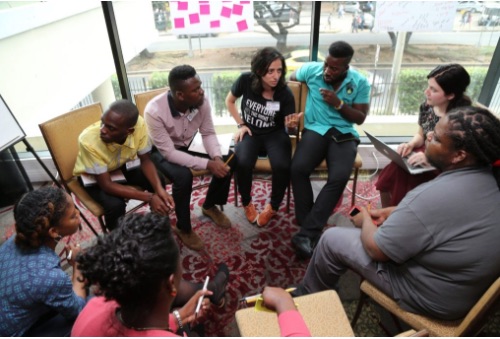
85 students from eight public educational institutions in La Jagua de Ibirico, Becerril and El Paso and two corregimientos, La Victoria de San Isidro and La Loma, held the 2016 closing event of the collective Juntos por La Paz, an initiative of the Prodeco Group that trains young students in peace issues in the context of the Colombia Postconflict peace process.

cesar

The closing event of the year was held at the auditorium Centro Virtua of La Jagua de Ibirico, and was attended by young students and the presence of Amaury Padilla, director of the Development and Peace Program of Cesar, who was in charge of a workshop on care and self-care in peacebuilding.

Throughout the year, students were formed into working groups for the production of a radio program to combat disinformation about the process of Peace Talks held between the FARC-EP and the National Government and to promote values ​​for peace.

In total, 20 radio programs were produced. They were broadcast on Energy 96.7 and half of these (10) in Caracol Radio Valledupar. For this, it was necessary to consult more than 15 sources of information, including Governors, Mayors; Representatives of National and Local Government and professionals in different social areas, such as psychologists, pedagogues and teachers. In their work as program reporters, a total of 25 interviews were conducted.

The students also held two days of reading and studying the first final agreement between the National Government of Colombia and the FARC EP. This promoted responsible and informed voting on the referendum.

Thanks to their participation in the group, the young people started activities to promote healthy coexistence inside and outside their educational institution, activities that included civic marches, socialization meetings with adults and parents and play for children.

(Click here for a Spanish version of this article

Question related to this article:

Colombia: Creating a model of Territorial Peace in the Valle del Cauca, supported by the United Nations

FREE FLOW OF INFORMATION

An article from the website of the Government of the Cauca Valley (translated by CPNN)

The United Nations and the Government of the Valley, have made final adjustments to what will be the territorial peace model in the Department, which is a joint commitment of the Governor, Dilian Francisca Toro and this international body.

cauca

During a meeting between representatives of the United Nations Development Program and the work team of the Secretariat of Peace of the Valley, headed by Fabio Cardozo, defined the criteria to develop programs and actions to be implemented within the component of Territorial peace, to be executed through a $ 6 million agreement, provided by the Department and UNDP.

Irina Marún Meyer, coordinator of territorial projects of the United Nations, highlighted the institutional work that will be done in municipalities and productive projects with victims of the armed conflict. She explained that “we are going to consolidate the Municipal Peace Councils, the Municipal Councils of Transitional Justice and the bodies that must be strengthened to form the network of peacebuilding strategy at the municipal level. Also we are identifying and characterizing organizations of victims that have a potential to develop productive projects “.

On the other hand, Mauricio Cas, UNDP territorial peace adviser, emphasized the institutional commitment of the Governor, Dilian Francisca Toro, to elevate the former Ministry of Peace of the Valley to the Secretariat, within the new organic composition of the Department.

“It seems to me a very important gesture of the Governor and the Departmental Government that will allow the Department to assume the commitment of the state in the face of the problem of victims and other types of problems arising from the situation of armed conflict,” said Cas.

On this issue, Secretary of Peace Fabio Cardozo said that “this strengthens our dialogue with communities, with institutions and with mayors.”

Considering the Territorial Peace initiative, he said that “it is one of the pillars of the Development Plan and has a strategy for investment, social, cultural processes, infrastructure and work articulated with the mayors.”

The Development Plan is the mandate that the Vallecaucans gave to the Governor, Dilian Francisca Toro, where attention to the victims is a priority. ” The United Nations Development Program and works for peace in 177 countries and territories and one of them will be the Valle del Cauca.

(Click here for a Spanish version of this article

Question related to this article:

Antioquia, Colombia: Young people united by a Territorial Peace!

FREE FLOW OF INFORMATION

An article from the Fundación Mi Sangre (translated by CPNN)

We welcome our new project “Young Builders of a Territorial Peace” supported by the Ford Foundation and executed by the Prodepaz Corporation, which will last for 3 years. Twenty municipalities of Antioquia will be part of this initiative which will empower young people as agents of change to actively contribute to the construction of a Territorial Peace.

antioquia

The municipalities that are part of the project are: In Zona Bosques; Cocorná, San Francisco, San Luis and Puerto Triunfo; In Zona Paramo; Sonsón, Algeria and Nariño; in Zona Porce Nus; Maceo, Caracolí, San Roque and Santo Domingo; and in the Zona Altiplano; Rionegro, La Unión, La Ceja, El Retiro, Carmen de Viboral, El Peñol, Concepción and San Vicente.

The purpose is to train 848 young people, 90 significant adults and 240 boys and girls. Participants will strengthen their leadership skills, through our PAZalobien Change Leadership methodology, and likewise receive knowledge for working in organizations. Young people will not only be trained to be leaders, but also trainers, since the idea is for them to replicate what they have learned in the methodology with the children of their municipalities. They will also learn about issues of digital communication and citizen journalism that will allow them to recognize problems in their territories and influence through alternative communication tools and the Network of Young Peace Builders.

At present, there have been closer ties with social organizations, youth secretaries, educational institutions, and public and private entities. 15 youth groups are already working on the methodology and are carrying out diagnoses of their territories.

(Click here for a Spanish version of this article

Question related to this article:

UN Adopts Cuban Resolutions on Peace and Rejection of Mercenaries

FREE FLOW OF INFORMATION

An article from Prensa Latina

The Third Committee of the UN General Assembly has adopted today [November 18] by large majority two draft resolutions submitted by Cuba, which advocate for the right to peace and reject the use of mercenaries.

resolution

The text of the Declaration on the Right to Peace was supported by 116 countries, 34 rejected it and 19 abstained, following a vote requested by the United States, despite Cuba’s call to adopt it by consensus, considering the importance of the issue for humanity.

As usually occurs here, given the marked difference in positions between the North and the South, the document has been supported by the nations of Africa, Latin America and the Caribbean and Asia. Australia, Canada, the United States, Israel, Japan, New Zealand, South Korea and the members of the European Union were opposed.

The initiative states that all people should enjoy the right to peace, in order to guarantee human rights and development, without exclusion.

It also calls on the States to respect, implement and promote equality, justice and non-discrimination; and defend tolerance, dialogue, cooperation and solidarity.

Several countries co-sponsored the text submitted by Cuba, among them Belarus, Bolivia, China, Colombia, Egypt, Ghana, Indonesia, Nicaragua, Syria, South Africa, Venezuela and Vietnam.

Cuba’s project has been already adopted at the Human Rights Council in Geneva in July, when the international community was called for the first time to declare the existence of the right to peace on a planet scourged by wars, conflicts and crises, which cause suffering to tens of millions of human beings.

The Cuban delegation defended in the vote the right of all inhabitants of the planet to live without the impact of the scourge of war.

[The other] draft resolution introduced by Cuba, with the co-sponsorship of Angola, Belarus, Bolivia, China, Chile, Ecuador, India, Nicaragua, Nigeria, Syria, Uruguay, Venezuela and other States, obtained 117 votes for, 51 against and 5 abstentions.

Cuba has presented a similar initiative every year at the Third Committee.

Both projects will be submitted next month to the decision of the UN General Assembly, in the context of its 71st Session.

(Click here for an article in Spanish)

Question(s) related to this article:

What is the United Nations doing for a culture of peace?

[Editor’s note: Here is information about the anti-mercenary resolution, drawn from the UN website: In other action, the Committee approved a draft resolution on the use of mercenaries as a means of violating human rights and impeding the exercise of the right to self-determination, by 117 votes in favour to 50 against, with 6 abstentions. Among other things, it would have the General Assembly call upon States to take legislative measures to ensure that territories under their control were not used for — and their nationals did not take part in — the recruitment, assembly, financing, training, protection or transit of mercenaries. Slovakia’s representative, speaking for the European Union, explained that the bloc had voted against the draft because it would add private security firms to the mandate of the Human Rights Council’s Working Group on those issues.]

Congress of Colombia to discuss new peace pact

FREE FLOW OF INFORMATION

An article from El Tiempo (translated by CPNN)

[November 20]:The Colombian Congress will discuss the new peace agreement reached between the government and the FARC guerrillas on Wednesday, President Juan Manuel Santos said on Wednesday, but he said it was not yet clear whether it would be up to Parliament to endorse that pact. “Former President Álvaro Uribe said last Thursday that discussion towards an agreement should take place in the Congress of the Republic, I agree,” said the Head of State.

colombia
Supporters of a new peace agreement in Colombia demonstrate on the streets of Bogota. EFE

“We are going to take up the issue next week, on Wednesday … after discussion with the FARC because that is part of the agreement on how they will endorse,” said the President in a statement at the Casa de Nariño before departing to Lima, where he will participate at the XXIV Summit of the Asia Pacific Economic Cooperation (APEC) Forum.

The government of Santos and the FARC renegotiated a week ago in Cuba, where they meet for four years, the peace pact that incorporated points proposed by the opposition after the original was rejected in a plebiscite last October 2 .

The Government has not defined the mechanism to endorse the new peace agreement but it is considering three possibilities: to call a new plebiscite, to have it adopted by the Congress of the Republic, or to be adopted through open municipal councils with direct participation of citizens.

Nobel Peace Laureate, Santos said this week that he is “determined to maintain this peace and bring this agreement through Congress” so that it can be implemented quickly.

Also Santos highlighted the participation and contributions of all sectors to achieve the new agreement he said, including the “international support” from the United States through Secretary of State John Kerry, from the OAS and from the European Union.

“We have seen in different areas of the country that illegal armed groups are wanting to fill the spaces that the FARC have been leaving.” Therefore, he also insisted on the “urgency to move forward quickly” in the peace accords.

He reiterated that “the cease-fire is fragile” and recalled the incident in which two FARC guerrillas died in the north of the country and is being investigated by the Tripartite Monitoring and Verification Mechanism, made up of members of the UN, Government of Colombia and the FARC.

(Click here for a Spanish version of this article

Question related to this article:

A Visit to Russia for “Life Extension” of the Planet

FREE FLOW OF INFORMATION

An article by Brian Terrell in World Without War (abbreviated)

[In October] I was in Moscow, Russia, as part of a small delegation representing Voices for Creative Nonviolence from the United States and United Kingdom. Over the next 10 days in Moscow and St. Petersburg, we saw nothing of the massive preparations for war there that are being reported in the Western media. We saw no sign of and no one we spoke to knew anything about the widely reported evacuation of 40 million Russians in a civil defense drill. “Is Putin preparing for WW3?” asked one U.K. tabloid on October 14: “Following a breakdown in communication between the USA and Russia, the Kremlin organized the huge emergency practice drill – either as a show of force or something more sinister.” This drill turned out to be an annual review that firefighters, hospital workers and police routinely conduct to evaluate their capacities to manage potential natural and manmade disasters.

russia

Over the past years I have visited many of the world’s major cities and Moscow and St. Petersburg are the least militarized of any I’ve seen. Visiting the White House in Washington, DC, for example, one cannot miss seeing uniformed Secret Service agents with automatic weapons patrolling the fence line and the silhouettes of snipers on the roof. In contrast, even at Red Square and the Kremlin, the seat of the Russian government, only a few lightly armed police officers are visible. They seemed mainly occupied with giving directions to tourists.

Traveling on the cheap, lodging in hostels, eating in cafeterias and taking public transportation is a great way to visit any region and it gave us opportunities to meet people we would not otherwise have met. We followed up on contacts made by friends who had visited Russia earlier and we found ourselves in a number of Russian homes. We did take in some of the sights, museums, cathedrals, a boat ride on the Neva, etc., but we also visited a homeless shelter and offices of human rights groups and attended a Quaker meeting. On one occasion we were invited to address students in a language school in a formal setting, but most of our encounters were small and personal and we did more listening than talking.

I am not sure that the term “Citizen Diplomacy” can be accurately applied to what we did and experienced in Russia. Certainly the four of us, me from Iowa, Erica Brock from New York, David Smith-Ferri from California and Susan Clarkson from England, hoped that by meeting Russian citizens we could help foster better relations between our nations. On the other hand, as much as the term suggests that we were acting even informally to defend or explain our governments’ actions, interests and policies, we were not diplomats. We did not go to Russia with the intention of putting a human face on or in any way justifying our countries’ policies toward Russia. There is a sense, though, that the only genuine diplomatic efforts being made between the U.S. and NATO countries at this time are citizen initiatives like our own little delegation. What the U.S. State Department calls “diplomacy” is actually aggression by another name and it is questionable whether the U.S. is capable of true diplomacy while it surrounds Russia with military bases and “missile defense” systems and carries out massive military maneuvers near its borders.

(Article continued in the right column.)

Question(s) related to this article:

Solidarity across national borders, What are some good examples?

(Article continued from left column)

I am conscious of the need to be humble and not to overstate or claim any expertise. Our visit was less than two weeks long and we saw little of a vast country. Our hosts reminded us continually that the lifestyles and views of Russians outside their country’s largest cities might be different from theirs. Still, there is so little knowledge of what is going on in Russia today that we need to speak the little we have to offer.

While we heard a wide variety of views on many crucial issues, there seems to be a consensus among those we met about the impossibility of a war between Russia and U.S./NATO. The war that many of our politicians and pundits see clearly on the horizon as inevitable is not only unlikely, it is unthinkable, to the Russian people we talked with. None of them thinks that our countries’ leaders would be so crazy as to allow the tensions between them to bring us to a nuclear war.

In the United States, Presidents Bush and Obama are often credited for “fighting the war over there so we don’t have to fight it here.” In St. Petersburg we visited the Piskaya Memorial Park, where hundreds of thousands of the one million victims of the German’s siege of Leningrad are buried in mass graves. In World War II, more than 22 million Russians were killed, most of these civilians. Russians, more than Americans, know that the next world war will not be fought on a faraway battlefield.

Russian students laughed at the joke, “If the Russians are not trying to provoke a war, why did they put their country in the middle of all these U.S. military bases?” But I ruefully told them that due to our nation’s professed exceptionalism, many Americans would not see the humor in it. Rather, a double standard is considered normal. When Russia responds to military maneuvers by the U.S. and its NATO allies on its borders by increasing its defense readiness inside its borders, this is perceived as a dangerous sign of aggression. This summer in Poland, for example, thousands of U.S. troops participated in NATO military maneuvers, “Operation Anakonda” (even spelled with a “k,” an anaconda is a snake that kills its victim by surrounding and squeezing it to death) and when Russia responded by augmenting its own troops inside Russia, this response was regarded a threat. The hyped up proposition that Russia might be conducting civil defense drills raises suspicion that Russia is preparing to launch World War III. Yet, a practice run, dropping mock nuclear bombs in Nevada, is not viewed in the West “as a show of force or something more sinister,” but only as an indication of a “commitment to ensure all weapon systems are safe, secure, and effective.”

The life extension of our planet needs to be a universal goal. To speak of, let alone pour a nation’s wealth into a program of “life extension programs for weapon systems” is nothing short of madness. Our Russian friends’ confidence in our collective sanity and the steadiness of our leadership, especially in the wake of the recent election, is a great challenge. I am grateful to new friends for the warmth and generosity of their welcome and I hope to visit Russia again before long. As important and satisfying as these “citizen diplomatic” encounters are, however, we must honor these friendships through active resistance to the arrogance and exceptionalism that might lead the U.S. to a war that could destroy us all.

USA: On Strip Searches and Press Freedom in North Dakota

FREE FLOW OF INFORMATION

An article by Amy Goodman & Denis Moynihan in Democracy NOW! (licensed under a Creative Commons Attribution-Noncommercial-No Derivative Works 3.0 United States License)

Monday was a cold, windy, autumnal day in North Dakota. We arrived outside the Morton County Courthouse in Mandan to produce a live broadcast of the “Democracy Now!” news hour. Originally, the location was dictated by the schedule imposed upon us by the local authorities; one of us (Amy) had been charged with criminal trespass for Democracy Now!’s reporting on the Dakota Access Pipeline company’s violent attack on Native Americans who were attempting to block the destruction of sacred sites, including ancestral burial grounds, just north of the Standing Rock Sioux Reservation.

goodman
Click on the image to enlarge

Pipeline guards unleashed pepper spray and dogs on the land and water defenders. Democracy Now! video showed one of the attack dogs with blood dripping from its nose and mouth. The video went viral, attracting more than 14 million views on Facebook alone. Five days later, North Dakota issued the arrest warrant.

When responding to an arrest warrant, one must surrender to the jail by about 8 a.m. if one hopes to see a judge that day and avoid a night in jail. So we planned to broadcast live from 7-8 a.m., then head to the jail promptly at 8 a.m. to get processed through the jail and fight the trespass charge in court.

To our surprise, as we landed in Bismarck on Friday, we learned that the prosecutor, Ladd Erickson, had dropped the trespass charge, but filed a new one: “riot.” We were stunned. In an email to both the prosecutor and our defense attorney, Tom Dickson, Judge John Grinsteiner wrote, “The new complaints, affidavits, and summons are quite lengthy and I will review those for probable cause on Monday when I get back into the office.” We were told by several lawyers familiar with North Dakota criminal law that judges almost never reject a prosecutor’s complaint. The arraignment was set for 1:30 p.m. local time, Monday.

(Article continued in the right column.)

Question(s) related to this article:

Free flow of information, How is it important for a culture of peace?

(Article continued from left column)

We spent the weekend reporting on the controversial Dakota Access Pipeline, with the threat of the riot charge never far from our minds. The 1,100-mile-long, $3.8 billion pipeline is designed to carry almost 500,000 barrels of crude oil from the fracking oil fields of North Dakota to Illinois, then onward to the Gulf of Mexico. That is why thousands of people have been at the resistance camps where the Dakota Access Pipeline is slated to cross under the Missouri River. If the pipeline leaks there, the fresh-water supply for millions of people downstream will be polluted.

Morton County Sheriff Kyle Kirchmeier runs the jail in Mandan and is responsible for how people are processed there. As the protests have mounted during the past six months, Kirchmeier and the local prosecutors have been leveling more and more serious charges against the land and water protectors, with an increasing number of felony charges. More than 140 people have been arrested so far. Those we spoke to told us a shocking detail: When getting booked at the jail, they were all strip searched, forced to “squat and cough” to demonstrate they had nothing hidden in their rectums, then were put in orange jumpsuits. The treatment was the same for Chairman of the Standing Rock Sioux Tribe Dave Archambault, to a pediatrician from the reservation, Dr. Sara Jumping Eagle, to actress Shailene Woodley, star of the films “Divergent” and “Snowden,” among others.

I asked Chairman Archambault if strip searching was common for low-level misdemeanors. “I wouldn’t know, because that was the first time I ever got arrested,” he replied. Dr. Jumping Eagle remarked, “It made me think about my ancestors, and what they had gone through.” Shailene Woodley told us, “Never did it cross my mind that while trying to protect clean water, trying to ensure a future where our children have access to an element essential for human survival, would I be strip searched. I was just shocked.”

As we prepared to enter the courthouse for the 1:30 p.m. arraignment on Monday, 200 people rallied in support of a free press, demanding the charges be dropped. A row of close to 60 riot police were lined up in a needless display of force in front of a peaceful gathering, threatening to arrest anyone who stepped off the curb. Then word came from our lawyer: The judge had refused to sign off on the riot charge. The case was dismissed, and we marked an important victory for a free press.

The free press should now focus a fierce spotlight on the standoff at Standing Rock—a critical front in the global struggle to combat global warming and fight for climate justice. Indigenous people and their non-native allies are confronting corporate power, backed up by the state with an increasingly militarized police force. Attempts to criminalize nonviolent land and water defenders, humiliate them and arrest journalists should not pave the way for this pipeline.

Mexico: Peace banners in the schools of Cobaem

FREE FLOW OF INFORMATION

An article from IMARX

Responding to the challenge by Governor Silvano Aureoles Conejo to inculcate a culture of peace, the College of Bachelors of the State of Michoacán (Cobaem) is distributing buttons to young people who have committed to become conflict mediators and peace promoters.

michoacan
Click on image to enlarge

This was launched in the context of the conference “Together We Build Peace”, featuring Claudia Torres Orihuela Bricia, national youth coordinator of the International Committee of the Banner of Peace which begins the “peace banners” initiative for 125 schools of Cobaem to take place in November.

She explained that next month the 50 thousand students will be pioneers in the “Together We Build Peace”, a project of the International Committee of the Banner of Peace.

In his speech, the director general of Cobaem, Alejandro Bustos Aguilar, said t students, parents, teachers, managers and administrative staff of the subsystem should advance towards recognition of diversity on a daily basis.

“In Cobaem we seek to build a way in which humans can live without violence, and I am sure that soon we will have to have a culture of peace, which will institutionalize and give another dimension to the educational system,” said Bustos Aguilar .

Finally, he announced that on 10 and 11 November there will be a “Youth Meeting for Peace” in Morelia to be attended by thousand students who will participate in conferences, debates and essay and story contests.

(Click here for a Spanish version of this article

Question(s) related to this article:

Goma, Democratic Republic of Congo: The commemoration of the International Day of Peace

FREE FLOW OF INFORMATION

Excerpts from a report sent to CPNN by Patrick Mulemeri, Congo Peace Network (translated by CPNN)

For the commemoration of the International Day of Peace, activities were held September 21, 2016, in the great hall of MWANGA college. 271 people attended, mainly composed young members of the CPN clubs [Congo Peace Network], their families, guests from partner organizations (Christian AID, UNJHRO, Counterpart International …), the delegation of the University students for peace and social sciences in Butare in Rwanda, as well as local authorities and young people from different local churches.

congo
Six young local musicians began the celebration
(Click on photo to enlarge)

After presentations of music, poetry and literature and accompanied by an exposition of artwork for peace, there were a series of speeches for peace.

Speeches by young university peace activists from Butare

The students from the Protestant University of Butare, which is in partnership with CPN, were represented by their delegate who spoke about peace in a regional context, as necessary for security, development and freedom. The benefits are not only for everyone at the present time, but above all for generations to come. They demand peaceful coexistance, because, as Gandhi liked to say, an eye for an eye will make us all blind.

(Article continued in the right column)

(Click here for the original version of this article in French)

Question for this article

What has happened this year (2016) for the International Day of Peace?

(Article continued from the left column)

Speech by youth from CPN clubs

The CPN youth speech criticized how young people are being manipulated and used by invisible players to destroy their own lives and society; instead, young people should be involved in the country’s development projects. They congratulated CPN for its training which makes them a vector of peace for development and rehabilitation of the country.

Speech for peace in English by a CPN youth.

A young CPN member read his speech in English. Beginning with decrying what happened in Kinshasa during the month of peace, he commented that while we commemorate the international day of peace, there are those in the refugee camps who suffer in all kinds of weather conditions after being forced to abandon their houses and their fields.

What we are living in the North Kivu province is far from “peace” because every second there are violations of human rights, murder, massacre, murder, kidnapping etc. Whole communities are being killed. We are told they are in conflict, although for decades they lived harmoniously together. Peaceful cohabitation between ethnic communities would not be a problem, were it not for invisible hands that work in the shadows to destroy peace.

Presentation of the book “1000 Youth Peace expressions of CPN”

The celebration of International Peace Day was also an opportunity for CPN to present the book “1000 Youth Peace expressions” which conveys the youth’s expressions of peace through drawings, essays, poems and music.

UN: Ban welcomes announcement of talks between Government of Colombia and National Liberation Army

FREE FLOW OF INFORMATION

An article from the UN News Centre

Welcoming the announcement that formal negotiations between the Government of Colombia and the National Liberation Army (ELN) will begin later this month, United Nations Secretary-General Ban Ki-moon today [October 12] expressed hope that the two sides will reach a sustainable peace agreement as soon as possible.

eln-un

    Secretary-General Ban Ki-moon speaks during the signing ceremony of the peace agreement between the Government of Colombia and the Revolutionary Armed Forces of Colombia – People’s Army (FARC-EP), in Cartagena. UN Photo/Rick Bajornas

“The Secretary-General welcomes the announcement that the Government of Colombia and the National Liberation Army (ELN) will begin formal negotiations […], following more than two years of exploratory conversations,” Mr. Ban’s spokesperson said in a statement.

“This is a source of encouragement to the Colombian people and all those involved in supporting a peaceful and comprehensive end to conflict,” the statement added.

“The Secretary-General hopes the Government and the ELN will work with determination to reach a sustainable peace agreement as soon as possible,” the statement said.

The announcement of the talks to begin on 27 October, in Quito, Ecuador, comes after Colombian voters last week narrowly rejected the historic peace agreement signed by the Government and the Revolutionary Armed Forces of Colombia-People’s Army (FARC-EP), the largest rebel group in the South American country.

Despite the outcome of the referendum, Mr. Ban has encouraged the Government and FARC-EP to stay the course for peace with a view to end Colombia’s 50-year conflict.

(Click here for a Spanish version of this article

Question related to this article: