Category Archives: FREE FLOW OF INFORMATION

United Nations General Assembly Adopts Three Resolutions on Culture of Peace

FREE FLOW OF INFORMATION

An article from the United Nations (abbreviated)

The General Assembly today (December 12) adopted three resolutions on the culture of peace, highlighting the need to foster interreligious and cultural dialogue, temper social media and bolster education in efforts to prevent future clashes between and within societies.


Bangladesh Ambassador Rabab Fatima introduced the culture of peace resolution

Introducing a draft on “Promotion of interreligious and intercultural dialogue, understanding and cooperation for peace”, the Philippines’ representative said the resolution aimed to promote interreligious and intercultural dialogue in achieving peace and stability as well as strengthen constructive dialogue across divergent divides.  The resolution also stresses the important role the United Nations Educational, Scientific and Cultural Organization (UNESCO) and the United National Alliance of Civilizations play in promoting interreligious and intercultural dialogue at all levels, he said.

Bangladesh’s delegate, introducing a text on “Follow‑up to the Declaration and Programme of Action on a Culture of Peace”, noted that it welcomes the High‑level Forum on Culture of Peace held on 13 September 2019, the twentieth anniversary of the adoption of the Declaration and Programme of Action.  The Declaration and Programme of Action on a Culture of Peace continues to find relevance across the three pillars of the United Nations in addressing contemporary global challenges, he said.

A final text designates 20 July as World Chess Day . . .

Addressing the drafts, delegates warned that clashing cultures are a growing reality in numerous societies, with antisemitism resurfacing and Islamophobia becoming more pervasive.  Libya’s representative pointed to waves of violence, displacement, death and destruction due to increases in violent extremism, terrorism and hatred.  “It is sad to see flagrant and daily violations of human rights,” he said.

They also observed that the international community today is facing more complex challenges undermining the culture of peace than in the past, including religious tensions and violence.  Kuwait’s representative observed that violent extremism is used as a mode of expression on social networks, stressing that the international community must ban content inciting extremism and terrorism.

Also arguing that social media platforms can threaten the culture of peace, Saudi Arabia’s delegate emphasized that using digital messages constructively can achieve the opposite result.  Echoing that sentiment, Ecuador’s representative emphasized that the more such media are used to disseminate hate speech the more people must use positive digital missives to counter them.

Several speakers emphasized the importance of quality education and dialogue as tools to forge peaceful understanding between countries and societies.  Interreligious and intercultural dialogues with faith leaders, civil society and academia are important for building intellectual and moral solidarity, India’s delegate said.  Home to a significant number of practitioners of practically every major religion in the world, his country is a narrative of conversations between different civilizations, he said. . . .

The Assembly had before it two reports of the Secretary‑General on “A world against violence and violent extremism,” (document A/74/195) and “Promotion of a culture of peace and interreligious and intercultural dialogue, understanding and cooperation for peace (document A/74/476).

Also speaking today were the representatives of Sweden, Saint Kitts and Nevis, Thailand (on behalf of the Association of Southeast Asian Nations), Venezuela, United Arab Emirates, Maldives, Cuba, Morocco, Panama, Pakistan, Brunei Darussalam, Azerbaijan, Canada, Nicaragua and United States, as well as an observer for the Holy See. . . .

Introduction of Draft Resolutions

RABAB FATIMA (Bangladesh), introducing the draft resolution titled “Follow‑up to the Declaration and Programme of Action on a Culture of Peace” (document A/74/L.23), said the text welcomes the High‑level Forum on Culture of Peace held on 13 September 2019, the twentieth anniversary of the adoption of the Declaration and Programme of Action.  Bangladesh appreciates that the Declaration and Programme of Action on a Culture of Peace continues to find relevance across the three pillars of the United Nations in addressing contemporary global challenges.  It further appreciates that the High‑level Forum provided an opportunity for Member States, United Nations entities, civil society, non‑governmental organizations and other stakeholders to exchange ideas and make suggestions on how to build on and further promote the culture of peace in the twenty‑first century.  Finally, the text notes its support for Member States in promoting the culture of peace at the national level. . . .

KIRA CHRISTIANNE DANGANAN AZUCENA (Philippines), introducing the draft resolution titled “Promotion of interreligious and intercultural dialogue, understanding and cooperation for peace” (document L/74/L.25), said that the international community is experiencing a growing trend of xenophobia and religious intolerance, underpinned by the politics of identity, as well as the emergence of extremist ideologies.  There was a time when terror was the weapon of the weak against the strong in fights for freedom and justice.  Today, terror is pursued for itself.  It is not a means but the end that terrorism seeks:  a society built on fear where every person is afraid of another.

(continued in right column)

Question(s) related to this article:

What is the United Nations doing for a culture of peace?

(continued from left column)

This annual resolution is more relevant than ever and has two aims:  to promote interreligious and intercultural dialogue to achieve peace and stability, and to strengthen the mechanism that promises constructive dialogue across the most divergent divides, she said.  The Philippines strived to use the objectives of this resolution by maintaining an open, inclusive and transparent approach during the negotiation process.  An example of this is operative paragraph 9, which appreciates the landmark initiative to open up the Kartarpur Sahib Corridor and welcomes the agreement achieved between Pakistan and India in record time.  The resolution also stresses the important role of United Nations Educational, Scientific and Cultural Organization (UNESCO) and the invaluable contributions of the United National Alliance of Civilizations in promoting interreligious and intercultural dialogue at all levels.

Statements

VITAVAS SRIVIHOK (Thailand), speaking on behalf of the Association of Southeast Asian Nations (ASEAN), said that ASEAN continues to advance the vision the association had when it was founded 52 years ago:  to have an integrated, peaceful and stable community throughout the region which enjoys prosperity, lasting peace and stability.  The association’s decision‑making process has been carried out in the ASEAN way:  completed with the consensus of all 10 member countries.  The ASEAN way has worked to expand peace and stability in the region, and it carries out the same process with its dialogue partners to within the region and beyond its borders.

ASEAN continues to engage in meaningful dialogue with its external partners through ASEAN‑led mechanisms, such as the Preventive Diplomacy and Confidence‑Building Measures under the ASEAN Regional Forum, he continued.  ASEAN also supports the Security Council’s women, peace and security agenda and multi‑stakeholder initiatives.  For example, the ASEAN Youth Volunteer Programme helps foster a culture of peace through the active participation of women and youth.  ASEAN believes that the promotion of cooperation on sustainable development also helps foster a culture of peace, he said.

CARLOS RON MARTÍNEZ, Vice Minister for Foreign Affairs for North America of Venezuela, said that building and strengthening a culture of peace calls for real commitment from the international community.  This must go beyond occasional speeches to real action.  Achieving solidarity with the most vulnerable people is essential in this regard.  “We must understand each other and recognize each other without judging each other,” he added.  A world of peace will only be possible when social justice, health, food and dignity are accessible to all people regardless of their social class, gender or any other construct.  Venezuela rejects xenophobia and discrimination.

Political will and dialogue without exclusion and under equal conditions will allow people to feel like real actors of change in the world, he continued. Venezuela has made major contributions to multilateralism, cooperation and solidarity.  This has been recognized by various States, social movements and academics.  The country remains involved in initiatives that promote economic solidarity, self‑determination and peaceful coexistence.  Venezuela is also dedicated to establishing a judicial system that strengthens peace, integrity and the rule of law.  He condemned the illegal implementation of unilateral coercive measures by the United States against his country.  “They are criminal and inhumane collective punishment,” he said, demanding such measures be lifted immediately. . . .

AHMED NASIR (Maldives) said that education is a key element in cultivating and nurturing a culture of peace.  Despite much progress in that regard, there are still some 262 million children worldwide who do not go to school.  Inequality remains one of the biggest obstacles to creating a culture of peace.  For decades, Maldivians who lived in islands outside of the greater Malé region have not had the same level of development or access to the same basic resources.  They have not been accorded the same level of priority in policymaking circles.  The current Government is committed to implementing a decentralization policy aimed at rectifying this.  The Declaration and Programme of Action on a culture of peace rightly identifies Governments, civil society, media and individuals as key actors for its effective implementation.  Moreover, he said that without adequate regulation, social media has become a tool to spread populist rhetoric, political extremism, racism, xenophobia and falsehoods.  “We call on social media companies to take more responsibility, especially in monitoring divisive content,” he said.

Mr. ALMABROK (Libya) said the world is witnessing waves of violence, displacement, death and destruction, due to an increase of violent extremism, terrorism and hatred.  The root causes are poverty, unemployment, impunity and marginalization. “It is sad to see flagrant and daily violations of human rights,” he said, calling on all countries to work together to provide greater resources and the courage to put an end to these violations.  Peace can only exist where there is justice.  He expressed concern that unregulated social media is exposing young people to extremist ideology.  Member States should demonstrate a collective will to resolve conflict and war and refrain from interfering in the internal affairs of sovereign States.  Respect for cultural and religious diversity is also important.

ANA SILVIA RODRÍGUEZ ABASCAL (Cuba), warning that the world today produces more bullets than books, stressed that so long as nuclear deterrence is used as a method to contain war, human beings will not enjoy a culture of peace.  There can be no peace without full respect for the sovereignty and territorial integrity of States and the self‑determination of peoples.  The use of unilateral coercive measures as a foreign policy tool must cease.  Ending the economic, commercial and financial blockade imposed by the United States against Cuba would be an action in favor of peace.  There is no culture of peace when the United States launches a new slander campaign to discredit Cuba, she stressed. . . .

YASHAR ALIYEV (Azerbaijan) said that the Baku Process has proved itself as one of the leading international platforms to foster dialogue and cultural diversity.  Its important role was emphasized by the Secretary‑General in his report to the Assembly’s seventy‑second session and most recently, in the outcome documents of the eighteenth Summit of Heads of State and Government of the Non‑Aligned Movement, held on 25 to 26 October in Azerbaijan.  An integral part of the Baku Process is the World Forum on Intercultural Dialogue, organized biennially by Azerbaijan since 2011 in partnership with UNESCO, the Alliance of Civilizations, the World Tourism Organization, the Council of Europe and the Islamic Educational, Scientific and Cultural Organization.  The fifth World Forum on Intercultural Dialogue, which took place this May in Baku, focused on dialogue as an instrument for action against discrimination, inequality and violent conflict.  In November, Azerbaijan hosted the second Summit of World Religious Leaders, which drew participants from about 70 countries, and adopted the Baku Declaration at its outcome.  The outcome emphasized the role of religious leaders in promoting inter-religious and intercultural dialogue. . . .

Groundswell of support for WikiLeaks publisher Julian Assange

FREE FLOW OF INFORMATION

An article by Oscar Grenfell from the World Socialist Web Site (abbreviated)

Over the past week [last week of November], a growing groundswell of opposition to the US-led persecution of Julian Assange has come to the surface of political life internationally.


WikiLeaks founder Julian Assange greets supporters from a balcony of the Ecuadorian embassy in London. (AP Photo/Frank Augstein, File)

Prominent public figures in Britain, Europe and Australia, including doctors, journalists, politicians and United Nations representatives, have condemned the WikiLeaks founder’s imprisonment in the UK’s maximum-security Belmarsh Prison.

They have demanded an end to the attempt to extradite him to the United States, where he faces charges of espionage and life imprisonment for publishing the truth.

Their statements, and a number of significant events in Assange’s defence, are a welcome blow to the conspiracy of silence that has surrounded his persecution, enforced by governments, official political parties around the world and the corporate media.

The expressions of hostility to the US-led vendetta against Assange come in the lead-up to extradition hearings next February in the UK. British authorities have trampled on Assange’s legal and democratic rights, including his ability to prepare a defence, and have dismissed warnings from medical experts that his health has deteriorated to the extent that he could die in prison.

The surge of support for Assange also follows the ignominious collapse of the attempts to frame him as a “rapist,” with Swedish prosecutors last week finally abandoning a nine-year “preliminary investigation” into sexual misconduct allegations.

The bogus Swedish investigation, characterised by a litany of procedural abuses and violations of due process, played a central role in undermining the mass support that Assange enjoyed in 2010. It was invoked by innumerable pseudo-left organisations, media pundits and self-styled civil liberties organisations to join the attacks on Assange or justify their refusal to defend him.

Now, however, it is clear to millions that Assange is, and always has been, a political prisoner. His “crime,” according to the US government and its allies, was to publish documents of historic significance revealing their war crimes, global diplomatic conspiracies and surveillance operations affecting billions of people.

The US attempt to prosecute him has opened the floodgates for an assault on press freedom and free speech, with the “Assange precedent” spurring government attacks on journalists in France, Australia and the US.

These factors have contributed to the following significant developments:

● Last weekend, more than 60 eminent medical doctors issued an open letter to the British home secretary, warning that, unless urgent action is taken, Assange may die in Belmarsh Prison. The doctors condemned Britain’s denial of adequate medical care to Assange and called for him to be immediately moved to a university teaching hospital. Their initiative was reported in dozens of publications around the world.

(Article continued in the column on the right)

Question related to this article:
 
Julian Assange, Is he a hero for the culture of peace?

Free flow of information, How is it important for a culture of peace?

(Article continued from the column on the left)

● On Monday, the inaugural meeting of a cross-parliamentary group of eleven Australian federal parliamentarians unanimously resolved to lobby for the US extradition request to be dropped and for Assange “to be allowed to return to Australia.” The statement breached years of silence on Assange by all of the official Australian political parties, including those represented within the grouping. Former Australian Prime Minister Kevin Rudd also warned that a US extradition of Assange would be “unacceptable.”

● On Wednesday, the French journalists’ union published an appeal for the government of Emmanuel Macron to oppose Assange’s persecution.

● On the same day, statues were unveiled outside Berlin’s Brandenburg Gate of Assange and the courageous whistle-blowers Chelsea Manning and Edward Snowden. UN Special Rapporteur on Torture Nils Melzer described them as “our dissidents,” whose cases were “the most significant test of our time for the credibility of Western rule of law and democracy.” Melzer, along with Assange’s father John Shipton and WikiLeaks editor Kristinn Hrafnsson, spoke at an event in the German Bundestag, where they were warmly received by a number of parliamentarians.

● On Thursday, an overflow crowd attended a public meeting in London rallying support for Assange. It was addressed by renowned investigative journalist John Pilger, former British diplomat Craig Murray, and other defenders of Assange, including the popular rapper Lowkey.

● That evening, the prominent Australian journalist Kerry O’Brien spoke strongly on the need to defend Assange in his keynote address to the Walkley Awards, Australia’s preeminent media event.

O’Brien warned of the turn toward “fascism” revealed in attacks on press freedom. He told the audience: “As we sit here tonight, Julian Assange is mouldering in a British prison awaiting extradition to the United States. This government could demonstrate its commitment to a free press by using its significant influence with its closest ally to gain his return to Australia.”

O’Brien recalled that Assange received the 2011 Gold Walkley Award for the very publications over which the US is seeking to prosecute him—in an implicit condemnation of those media organisations that had turned on the WikiLeaks founder. Paul Murphy, head of the Media, Entertainment and Arts Alliance, which has failed to date to mount any significant campaign in defence of Assange, a member of the union, also condemned the threatened extradition.

Underlying these significant statements is the broad support for Assange among ordinary people and widespread popular anger and concern over the threatened extradition, revealed in the fact that petitions demanding his freedom have been signed by hundreds of thousands of people.

The political parties in a position to intervene to secure Assange’s release, however, have either remained silent or rejected calls that they defend him. This includes the British Labour Party of Jeremy Corbyn, which has not even mentioned the WikiLeaks founder amid a general election campaign, and the Australian government, which is participating in the campaign against Assange despite the fact that he is an Australian citizen.

For their part, the pseudo-left organisations, taking their lead from the state authorities and representing the most affluent layers of the upper-middle class, have said nothing.

Behind the scenes, the intelligence agencies and governments that have spearheaded the campaign against Assange are doing everything they can to ensure that nothing disrupts his extradition and show trial. For the ruling elites, the attack on Assange is viewed as a crucial precedent for silencing government critics, suppressing anti-war sentiment and intimidating mass social and political opposition.

Over the past 18 months, the World Socialist Web Site and the Socialist Equality Parties have intensified their decade-long campaign in defence of Assange. The developments of the past week have substantiated the key political foundations of this struggle.

Gambia: Banjul Regional Forum 2019: Engaging Young African Leaders to Achieve the 2030 and 2063 Agendas

FREE FLOW OF INFORMATION

An article by Debbo Mballo in Vivafrik (translation by CPNN)

The third Regional Forum of the 2017 Banjul Forum action plan took place from 28 to 30 October 2019. It was supported by UNESCO and its partners in order to better appreciate the level of the involvement of young women and men in national processes of democratization, governance, national reconciliation and the construction of a social environment conducive to the culture of peace. It facilitated exchanges to find ways and means, modalities of action, and forms of expression the most appropriate for a better commitment.

The 2019 forum focused on the roles and place of young people in governance, democracy and human rights, as well as new forms of innovative expressions and demands by young people in these processes. It was a platform to catalyze and accelerate the implementation of the African Union’s roadmap for investing in youth, with a focus on youth civic participation and youth engagement. as co-creators of sustainable solutions for Africa.

These periodic meetings consolidate a tradition of reflection, discussion and action on the place of young Gambians and West Africans in the societal space, and to better understand their roles in the processes of transformation and democratization of society. .

(continued in right column)

(Click here for the original French version of this article.)

Question(s) related to this article:

Youth initiatives for a culture of peace, How can we ensure they get the attention and funding they deserve?

(continued from left column)

The overall goal of this initiative is to strengthen the capacity of young people to exercise transformational leadership at the community, national and continental levels in the democratization process of society.

This conference planned to achieve the following specific objectives:

1. Provide a platform for sharing experiences of lessons learned and reflections on the role of youth in democratic and peaceful transitions in Africa: (Allow young Gambians to learn from other countries’ experiences and enable African youth to benefit from the experience of young Gambians);

2. To secure a space for dialogue and action among the various sections of the youth (young academics, young activists, young humanists, young social entrepreneurs, etc.) on their own concerns and perspectives as well as those of their country, their region, the continent and the global world;

3. Secure a space of intergenerational dialogue where young people can exchange with “old young leaders” around important and / or topical issues such as the issues of governance, democracy, peace, violence and so on. as well as issues related to equality and equity (including gender), the enhancement of natural and cultural heritage, social inclusion, human rights etc. ;

4. Secure a space for dialogue and action between youth and authorities on the concerns and perspectives of countries, the region, the continent and the global world with a focus for each forum on particular themes.

5. Present, enrich and validate the results of the “MOST Policy Oriented Research” entitled: “Youth and spaces of freedom in Africa: emerging forms of expression for democratization and achievement of the SDGs”, conducted at the request of young people during the 2017 Banjul Forum.

USA: We Are Each a Precious Entity: The Activist Life of Caroline Bridgman-Rees

FREE FLOW OF INFORMATION .      

A tribute written by PJ Deak for the Unitarian Society of New Haven, reprinted by PAR New Haven

Caroline was born on New Year’s Eve, 1922 and grew up on Staten Island. Her father, a Yale graduate, was a history professor at NYU for 29 years. A decorated war veteran, he came home from WWI in 1918 traumatized by the horrors of war, its barbarism, death, and destruction.

As a result of her father’s experiences, Caroline became very aware of the toll and folly of war – and of the importance of working for peace.

In 1945, Caroline, 22, a Phi Beta Kappa and recent graduate of Smith College, joined the Red Cross. She sailed on a ship to the Philippines where she worked with the Red Cross until 1946 when she went to Korea. Why did she do it? To see the world and “to see life with the soldiers.”

She remembered the bombing of Hiroshima and Nagasaki with horror and condemnation – a bombing that in her words “was totally against moral and international law and which began a frightful new era that threatened all life on earth.”

In the 1960s, Caroline began her teaching career at Bradford College in Massachusetts – teaching Asian History and Philosophy. Caroline became increasingly concerned about the conflict between the US and both the Vietnamese liberation forces and all of Indochina.

(Article continued in the column on the right)

Questions related to this article:

Where in the world can we find good leadership today?

(Article continued from the column on the left)

She joined a number of prominent peace organizations: The American Friends Service Committee; Sane/Freeze – later known as Peace Action; The Women’s International League for Peace And Freedom; The War Resisters League; Mobilization for Survival; and because of her service in the Red Cross, Veterans Against The War.

“I felt then, as I do now, that non-violent direct action is a citizen’s responsibility when the government is committing major war crimes against humanity!”

In 1972 Caroline was one of 171 American peace leaders chosen to attend the Paris Peace Talks. Also in 1972, she was part of a team of women who traveled to India and conducted interviews with Indian women about the role of women in the world – Caroline even had the privilege to interview Ms. Ghandi. In 1973, Caroline, her husband and 10-year-old son traveled through India, Burma, Thailand, Hong Kong, Laos, Cambodia and Vietnam.

Caroline became involved with the United Nations as an NGO representative, and also was active with the Greater New Haven Peace Council. In 1991-1992 she spent a year in England giving 45 separate lectures on Nuclear Disarmament and attended an international peace conference in the Netherlands.

When the first Iraq War began, Caroline was active as the anti-war movement surged anew – seeking avenues for mediation and diplomacy rather than violence.

Caroline attended meetings to discuss and take action on the wars in Iraq and Afghanistan, spoke out about the size of the US military budget, the number of US military bases around the world (over 1,000) and the pollution they are allowed to create. She wrote letters to the editor that were published in the New Haven Register and participated in the New Haven Peace Council and the Unitarian Society of New Haven Peace Task Force.

“We need community, not guns. We must create a world with love, and caring and cooperation.”

Read Caroline Bridgman-Rees’ obituary on Legacy.com.

Chad: Women’s Ministry salutes community peace initiatives

FREE FLOW OF INFORMATION

An article from Al Wihda (translated by CPNN)

The Minister of Women, Early Childhood Protection and National Solidarity, Dr. Djallal Ardjoune Khalil, received in audience on Monday, the delegation of the National Union of Young Professionals for Consultation and Peaceful Coexistence (UNJCP), led by its secretary-general, Sidick Sougui Lony.

The exchange between the minister and the delegation focused on peace, the disarmament of the civilian population and peaceful relations between the different communities of the province of Ouaddaï.

(continued in right column)

(Click here for the original French version of this article.)

Question(s) related to this article:

Youth initiatives for a culture of peace, How can we ensure they get the attention and funding they deserve?

(continued from left column)

UNJCP Secretary General Sidick Sougui Lony briefly explained to the Minister the merits of the UNJCP mission in Ouaddaï province.

“We are working in Abeche to promote the culture of peace. We call on our civilian brothers to lay down their arms because it is useless for a civilian to own a weapon, “said Sidick Sougui Lony.

The minister congratulated UNJCP for this noble and patriotic initiative. She went on to point out that peace is an inestimable wealth. According to the minister, without peace, no society can evolve.

In addition, the Minister of Women, Child Protection and National Solidarity, Dr. Djallal Ardjoune Khalil urged the UNJCP to move forward in its quest for a united, strong and prosperous Chad . The ministry undertakes to accompany the National Union of Young Professionals for consultation and peaceful coexistence in all its actions.

The two sides agreed to combine joint efforts to intensify advocacy for peace and peaceful coexistence.

Gandhi 150: The Legacy of Peace

FREE FLOW OF INFORMATION .      

An event from Choose Chicago. For followup, see WBEZ

18th October 2019 – The Field Museum [Chicago] 6:30-9:00 PM
bringing the descendants of history’s greatest peace leaders to celebrate the 150the annivesry of Mahatma Gandhi

(Article continued in the column on the right)

Questions related to this article:

Where in the world can we find good leadership today?

(Article continued from the column on the left)

2019 is a once in a lifetime opportunity to celebrate 150 years since the birth of “Mahatma” (great soul) Gandhi. Gandhi changed the course of human history. His non-violent protest for freedom inspired civil-rights movements across the globe. The Gandhian philosophy influenced and changed the course of movements led by civil rights leaders such as Dr. Martin Luther King Jr in the United States of America, Nelson Mandela in South Africa and that of Cesar Chavez, a labor leader and Latino American civil rights activist who founded the United Farm Workers Union.

WBEZ’s Worldview, along with Gandhi Commemorative Stamp Initiative, India Development Service (IDS) and United for Peace (U4P) will bring together academicians and descendants of some of history’s greatest peace leaders who acknowledged Gandhi’s influence on their lives and social actions. Chicago welcomes Ela Gandhi granddaughter of Mahatma Gandhi, Anthony Chavez grandson of Cesar Chavez, MLK III son of Martin Luther King Jr.,  Maki Mandela daughter of Nelson Mandela, Prof. Carlson, and Dr. Prasad. For the first time in history, these individuals will be sharing the same platform to talk about non-violence, the need for peace, collaboration and how it influenced their parents’ fight for a just society.

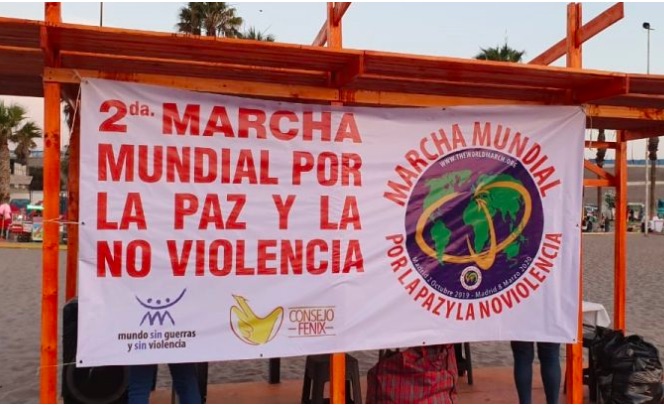
Launch of the Second World March for Peace and Nonviolence

FREE FLOW OF INFORMATION

Excerpts from an article in Pressenza

At the launch of the 2nd World March for Peace and Nonviolence in Madrid, on October 2nd, International Nonviolence Day that commemorates Gandhi’s birth, Rafael de la Rubia said:

“It should be said that this is not just a peripheral journey through the surface of the planet, through the surface of the earth. To this walking along roads, places, countries… you can add an internal journey, going through the depths of our existence, trying to match what we think with what we feel and with what we do, in order to be more coherent, gain more meaning in our lives and eliminate internal violence.” . . .


In Chile, with Parliamentarian Tomas Hirsch: “Active Nonviolence is the Force that will transform the world”

The beginning of the March was celebrated in different points of the world

From Antonio Gancedo’s blog:

Chile: the beginning of the 2 World March was announced in the National Parliament By the humanist parliamentarian Tomás Hirsch. And Santiago de Chile stretched with a “Hug for Nonviolence” as a dissemination of the 2 World March for Peace and Nonviolence.

(continued in right column)

Question for this article:

How can we be sure to get news about peace demonstrations?

The World March for Peace and Nonviolence: What is its history and its effects?

(continued from left column)

From Seville and the Port of Santa Maria, in Spain to embark on the ferry journey to Tangier, Morocco the entry point of the WM in Africa where A Humanist Forum took place. In the Spanish cities of Seville and A Coruña, where the March was launched during a session in the Town Hall, different activities expressed the commitment to Peace and Nonviolence.

The World March in the Italian Parliament: The World March has among its objectives the dissemination of the culture of Peace and Non-Violence, disarmament – especially nuclear disarmament -, the defence of the environment and the enhancement of diversity. During the event “The beginning of the end of nuclear weapons” was projected, a work produced by the international press agency Pressenza on the occasion of the second anniversary of the approval of the UN Nuclear Disarmament Treaty (ICAN campaign, Nobel Prize of the Peace 2017). The documentary aims to contribute to the goal of reaching the end of the World March with the ratification of the TPAN  by 50 countries to make it binding.

Brazil: From Pernambuco, Brazil, accompanying the launch of the 2ª World March the first “Live EAD”Live from Nonviolence in schools  with 474 enrolled, 10 tutors in 20 states of Brazil, which connect on the website of the UFRPE (Federal Rural University of Pernambuco). A talk by Gunther Aleksander, of the Pressenza Agency, and Vinicius Pereira, of the Nonviolence in Schools Project, about the launch of the 2 World March for Peace and Nonviolence, giving the appropriate explanations on the free course of distance education for the formation of non-violence Centres in schools. Londrina also in Brazil connected with Peace and Nonviolence symbols.

Argentina: the documentary “The Beginning of the End of Nuclear Weapons” by director Alvaro Orus and producer Tony Robinson from Pressenza was shown in Cordoba. The film produced in the participants a very particular sensitivity that was expressed in the subsequent exchange. A campaign to collect signatures began to demand that the government of Argentina sign the treaty banning nuclear weapons and then ratify it.

Honouring the Me Too Movement with the 2019 Sydney Peace Prize

. . WOMEN’S EQUALITY . .

An article from the Sydney Peace Foundation

Starting with two words, ‘me too’, women around the world have united in solidarity to share personal experiences about sexual harassment. This global call for change – the Me Too movement – has played a game-changing role in destigmatising the experiences of survivors of sexual assault and harassment, and, indeed, has re-imagined a future free from pervasive sexual violence. In recognition of its impact, the movement will be awarded the 2019 Sydney Peace Prize, with Tarana Burke and Tracey Spicer accepting the Prize on behalf of Me Too. The 2019 Sydney Peace Prize Jury citation reads:


“For empowering survivors of sexual harassment and violence, and elevating their voices; for championing truth and justice; for highlighting the breadth and impact of sexual violence worldwide; and for launching a demand for change that is sweeping the world.”

Founder Tarana Burke began building the movement in 2006 in the United States to support survivors of sexual violence, particularly black women and girls, connect to resources for healing, and to build a survivor-led community of advocates against sexual assault. Her grassroots work has now expanded to reach a global community of survivors from all walks of life.

Me Too is a movement about the far-reaching power of empathy. It’s about the millions of people who have raised their hands to say ‘me too’. And their hands are still raised..
Tracey Spicer AM is a journalist, author and broadcaster who has spearheaded the Me Too movement in Australia. She has produced award-winning investigations into sexual harassment in workplaces and founded NOW Australia in 2018 to advocate for safe workplaces and to support those who have been sexually harassed at work.

A demand for change sweeping the world

Contrary to popular belief, the Me Too movement did not spontaneously burst into existence, spurred by allegations from Hollywood actresses against movie mogul Harvey Weinstein. While much of the mainstream media coverage of Me Too has centred around the entertainment industry and the downfall of powerful perpetrators, Tarana Burke is quick to bring the focus back to where it belongs – to the survivors.

“Me Too is a movement about the far-reaching power of empathy. It’s about the millions of people who have raised their hands to say ‘me too’. And their hands are still raised.”

In recounting the first sparks of Me Too, Tarana recalled her deep despair at witnessing rampant sexual assault in her community. Laying on the bed in her one-bedroom apartment in early 2006, Tarana pulled out a piece of paper and scrawled ‘me too’ across the top of the paper. But she didn’t stop there. Below ‘me too’, she began to build an action plan for a movement based on empathy between survivors that would allow the healing of deep wounds. From the idea of empowerment through empathy, Tarana built Just Be Inc., a not-for-profit and network with a mission to support and amplify the voices of survivors of sexual abuse, assault, and exploitation.

(article continued in right column)

Questions related to this article:

Where in the world can we find good leadership today?

Protecting women and girls against violence, Is progress being made?

(article continued from left column)

On our own shores, Australian broadcaster, journalist and author Tracey Spicer has been spearheading the Me Too movement, speaking out about prevalent sexual abuse and harassment in the workplace and seeking to build a support network for survivors. The spark which truly ignited the Me Too movement in Australia was a tweet from Tracey in 2017 to her 57,000 followings asking people to “contact me privately to tell your stories.” The tweet received more than 2,000 responses and propelled Me Too into the Australian public conscious and discourse. Following a flood of responses and harrowing stories from survivors, Tracey set up NOW Australia to support people across all industries who have been sexually harassed, assaulted or intimidated at work.

Commending Tarana for starting the movement, Tracey spoke of her optimism for a better future. “The Me Too movement has changed everything, it gives women a support base and information with which they can speak out and tell their stories.”

In our own backyard

The Me Too movement has kickstarted an outpouring of individual and collective voices shining a spotlight on the universal experience of women and some men with sexual harassment and abuse. And Australian society is unfortunately no exception. Statistics show that 1 in 5 Australian women will experience sexual violence in her lifetime, and that 1 in 2 will be subjected to sexual harassment. And these statistics only become more severe for indigenous women and women living with a disability. It is clear that we continue to have a very serious problem with attitudes towards domestic violence, consent, sexual abuse, and harassment.

The Me Too movement has revealed holes in our cultural norms and legal structures which must be addressed to better serve our communities and promote progress. Australian Sex Discrimination Commissioner Kate Jenkins announced in 2018 an Australian Human Rights Commission-led National Inquiry into Sexual Harassment in the Workplace. ‘Me Too has given us reason to be hopeful,’ says Jenkins.

Julian Burnside AO QC, 2014 Sydney Peace Prize Laureate, strongly supported Jury’s choice:

“It is a wonderful thing that Me Too is to be awarded the Sydn ey Ppppeace P“It is a wonderful thing that Me Too is to be awarded the Sydney Peace Prize…The Me Too movement has done a remarkable job drawing attention to a problem which was recognised by virtually all women and virtually no men. Since men are at the heart of the problem, it is a great thing that no man will now be believed if they say they are unaware of the problem Me Too has exposed.”

2019 Sydney Peace Prize

Without justice, peace is hollow and fragile. Every human being has the right to live their life in dignity, and when rampant sexual harassment and violence goes unchecked, we are all diminished and lose sight of our common humanity.

Me Too has changed the way we understand and talk about sexual harassment and violence, by highlighting the magnitude and impact of sexual harassment and violence around the world, in domestic, public spaces, and workplaces.

We owe future generations a world free of sexual violence. I believe we can build that world. Do you?”
To create spaces where survivors can speak truth to power in search of a better world requires courage, vision, leadership, and heart. Tarana, Tracey, and the many women and men raising their hands in unison to demand that their voices be heard challenge the societal structures and norms we have thus far accepted.

In Tarana’s words, “We owe future generations a world free of sexual violence. I believe we can build that world. Do you?”

The Sydney Peace Prize will be awarded on Thursday 14 November at Sydney Town Hall. Tickets available at bit.ly/SPPMeToo

Nipun Mehta and ServiceSpace to Receive the 2019 Goi Peace Award

FREE FLOW OF INFORMATION .      

An announcement from The Goi Peace Award

The Goi Peace Foundation will present the 2019 Goi Peace Award to Nipun Mehta and ServiceSpace, an incubator of projects that works at the intersection of volunteerism, technology and gift-economy.

The selection committee has chosen Nipun Mehta and ServiceSpace for the Goi Peace Award “in recognition of their collective efforts to transform the world through generosity. Through their exemplary acts and through various innovative projects, they have ignited the spirit of service in the hearts of many people around the world, demonstrating that ‘giftivism’ could shift our societies and economies.”

Nipun Mehta will receive the award at a ceremony during the Goi Peace Foundation Forum 2019, to be held at Nikkei Hall in Tokyo on November 23, 2019.

Nipun Mehta is the founder and Chief Inspiration Officer of ServiceSpace, an organization run entirely by volunteers. What started as an experiment with four friends in the Silicon Valley has now grown to a global ecosystem of over 600,000 members from 171 countries that has delivered millions of dollars in service for free. Nipun has received many awards, including the Jefferson Award for Public Service, Wavy Gravy’s Humanitarian award, and Dalai Lama’s Unsung Hero of Compassion. In 2015, President Barack Obama appointed him to a council on poverty and inequality. Nipun is routinely invited to share his message of “giftivism” to wide ranging audiences, from inner city youth in Memphis to academics in London to international dignitaries at the United Nations. One of his most formative experiences was a walking pilgrimage across India, with his wife of six months, whose profound lessons also became the subject of his widely-read address at UPenn commencement. Nipun’s mission statement in life reads: “Bring smiles in the world and stillness in my heart.”

(Article continued in the column on the right)

Questions related to this article:

Where in the world can we find good leadership today?

(Article continued from the column on the left)

ServiceSpace leverage technology to encourage everyday people around the world to do small acts of service. It was originally started in 1999 by volunteers to help non-profits with technical services. Over the past twenty years, without any paid staff, fundraising, advertising, or pitches for media coverage, the organization has grown to become an umbrella for many generosity-driven projects, ranging from a daily positive news service, to an acts-of-kindness portal, to a gift-economy restaurant. Regardless of the endeavor, members of ServiceSpace communities around the globe act in concert to create service opportunities for each other and to support each other’s service journeys. ServiceSpace aims to ignite the fundamental generosity in all people, creating both inner and outer transformation.
ServiceSpace website

About the Goi Peace Foundation and the Goi Peace Award

Based in Japan, the Goi Peace Foundation is a public benefit organization supported by members around the world working together to create a culture of peace. Our mission is to foster a sustainable and harmonious global society by promoting consciousness, values and wisdom for creating peace, and by building cooperation among individuals and organizations across diverse fields, including education, science, culture and the arts.

Established by the Goi Peace Foundation in 2000, the Goi Peace Award is an international award presented annually to honor individuals and organizations in various fields that have made outstanding contributions toward the realization of a peaceful and harmonious world as envisioned in the Declaration for All Life on Earth.

Desmond Tutu Announces the Winners of the International Children’s Peace Prize 2019

FREE FLOW OF INFORMATION .      

An announcement from Kids Rights

From an impressive 137 applicants from 56 countries, the KidsRights’ Expert Committee selected Divina from Cameroon and Greta from Sweden as winners. The International Children’s Peace Prize will be awarded on November 20th, on Universal Children’s Day in The Hague. The very special award ceremony, will also celebrate the fifteenth anniversary of the International Children’s Peace Prize which became a global phenomenon and reached 1.2 billion people last year.


Greta Thunberg and Divina Maloum

PERSONAL CONGRATULATIONS FROM ARCHBISHOP TUTU

Archbishop Tutu, who has been the patron of the International Children’s Peace Prize and KidsRights for more than a decade, said in a personal message to the winners: “I am in awe of you. Your powerful message is amplified by your youthful energy and unshakable belief that children can, no must, improve their own futures. You are true change-makers who have demonstrated most powerfully that children can move the world.”

INTRODUCING THE WINNERS

“The impact of both Greta and Divina for the future of many children is unmistakable, they are the rightful winners of the International Children’s Peace Prize 2019”, said Marc Dullaert, Founder of KidsRights and chairman of the Expert Committee.

(Article continued in the column on the right)

Questions related to this article:

Where in the world can we find good leadership today?

(Article continued from the column on the left)

DIVINA: Nominated by African Network of Young Leaders for Peace and Sustainable Development (ANYL4PSD)

Divina Maloum (14 years old, Cameroon, theme: Peace) – Since 2014, Cameroon has experienced terrorist attacks. When Divina visited the north of the country, she was horrified to see that children were the biggest victims of these terrorist attacks. She realized that many children do not know their rights, and so she created Children for Peace (C4P) to warn them about enrolment in armed groups and to reinforce the participation of children in peace-building and sustainable development. C4P is now a network of 100 children across the ten regions of Cameroon. She empowers them to be changemakers and to take part in peace initiatives in their communities. She has organized an inter-community children’s peace camp, established peace clubs in mosques, and together with other children, made a children’s declaration against violent extremism. Divina has big plans for the future and will not stop advocating for the right of children to live in peace.

GRETA: Nominated by Private Person: Jan van de Venis

Greta Thunberg (16 years old, Sweden, theme: environment) – Greta is a climate activist and a role model for international student climate activism. At the age of eight, when she first learned about climate change, she was shocked that adults did not appear to take the issue seriously. She could not understand why adults were not taking action against the climate crisis. Greta became depressed. She didn’t eat, go to school or speak for months. It was vital for Greta to take measures in her own life; she refrains from flying, eats no meat or dairy and she has a shop stop, meaning that she doesn’t buy new things. On August 20th 2018 Greta decided that it was time for her to take her efforts to the next level and speak out. She wanted more people to be aware and take action. Inspired by the 2018 International Children’s Peace Prize winners March for Our Lives, she sat down in front of Sweden’s parliament with a self-made banner skolstrejk för klimatet (school strike for climate).