Tag Archives: United Nations

UN Commission on the Status of Women – 2017

. WOMEN’S EQUALITY .

A press release from UN Women (abbreviated)

The sixty-first session of the Commission on the Status of Women will take place at the United Nations Headquarters in New York from 13 to 24 March 2017. Representatives of Member States, UN entities, and ECOSOC-accredited non-governmental organizations (NGOs) from all regions of the world are invited to attend the session.


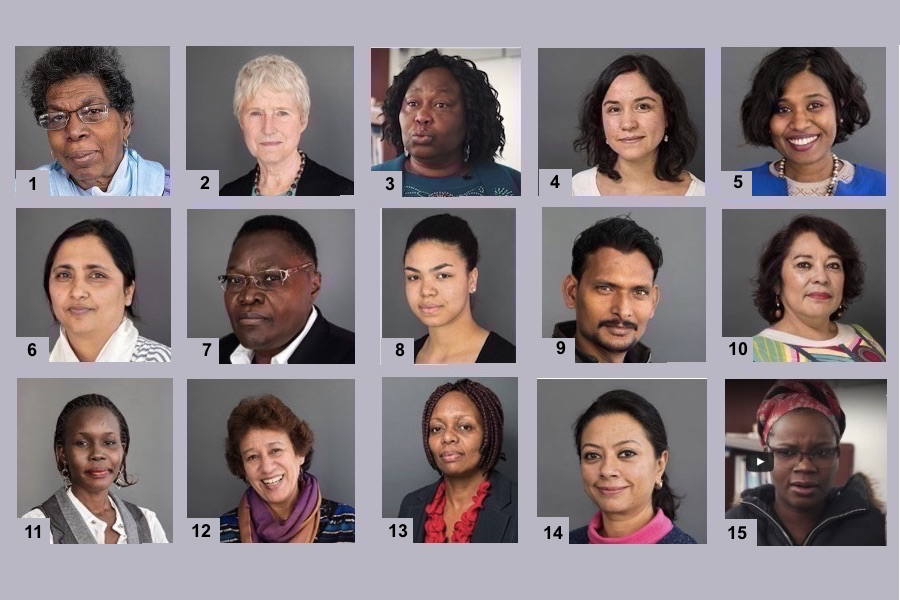
Click on the image to enlarge

Download the CSW61 Brochure for more information:
Arabic | English | French | Spanish

Themes

Priority theme: Women’s economic empowerment in the changing world of work

Review theme: Challenges and achievements in the implementation of the Millennium Development Goals for women and girls (agreed conclusions of the fifty-eighth session)

Emerging issue/Focus area:The empowerment of indigenous women

Preparations

Regional CSW61 Preparatory and Consultative Meetings

Multi-Stakeholder Forum On 30 January 2017, UN Women convened a forum to engage a range of stakeholders in the preparations for CSW61 at UN Headquarters in New York.

(continued in right column)

(Click here for a Spanish version of this article or here for a French version)

Question for this article

Does the UN advance equality for women?

(continued from left column)

Expert Group Meeting: In preparation for the sixty-first session of the Commission on the Status of Women, UN Women convened an Expert Group Meeting on the priority theme: “Women’s economic empowerment in the changing world of work.” The Expert Group Meeting was held with the technical contribution and support of the International Labour Organization (ILO) at ILO Headquarters in Geneva, Switzerland, from 26 to 28 September 2016.

Organization of the session

The Commission’s two-week session includes the following activities: Organization of work

Agreed conclusions

The outcome of the Commission’s consideration of the priority theme takes the form of agreed conclusions, negotiated by all States: Draft agreed conclusions

Official Documents

Official documents for the session

NGO Participation

Modalities of NGO participation

Eligibility

Registration

Opportunities for NGOs to address the Commission

Side events

Information about side events and activities organized outside the formal programme of the session

More information regarding the 61st session (2017) of the Commission on the Status of Women to be uploaded as it becomes available.

UN Security Council underlines need to halt proliferation of weapons of mass destruction

DISARMAMENT & SECURITY .

An article from The UN News Centre

Expressing concern over the threat of terrorism and the risk that non-State actors may acquire or use nuclear, biological or chemical weapons, the United Nations Security Council today [15 December 2016] called on all countries to establish national controls to prevent proliferation of such weapons as well as their means of delivery.

In a resolution adopted today, the 15-member Council also reiterated the need to continue to strengthen ongoing cooperation among various intergovernmental bodies and entities concerning terrorist groups such as Al-Qaida, the Islamic State of Iraq and the Levant (ISIL/Da’esh), as well as counter-terrorism, through enhanced information sharing, coordination and technical assistance.

The Council further called on all UN Member States to ensure the full implementation of its resolution 1540 (2004) on non-proliferation of weapons of mass destruction.

It also called for strengthening the UN Trust Fund for Global and Regional Disarmament Activities through additional funding so that it is able to better assist countries in implementing their obligations under resolution 1540. . . .

STATEMENT BY JAN ELIASSON

Prior to today’s adoption of resolution by the Council, Deputy-Secretary-General Jan Eliasson issued the following statement:

Mr. President of the Security Council, Mr. Minister, I am extremely grateful for your generous and warm words. I thank the Security Council and the Spanish Presidency for arranging today’s debate. I am honoured to be here before you today in what is my final appearance at the Security Council. Let me take this opportunity to thank all of your for your friendship and cooperation over the past almost five years. I have highly treasured our dialogue and many professional and personal exchanges.

I also want to thank the Resolution 1540 Committee and its Panel of Experts, under the leadership of Ambassador Roman Oyarzun, for their work on the important subject under consideration today.

Preventing non-state actors from acquiring and using weapons of mass destruction is among the most important responsibilities of the international community.

The Nuclear Security Summits, the International Convention on the Suppression of Acts of Nuclear Terrorism and the close engagement by this Council on allegations of chemical weapon use have all played an important role in keeping us safe.

The Secretariat has also played its part.

In 2012, the Secretary-General convened a high-level meeting to strengthen legal frameworks against nuclear terrorism.

And after the accident at Fukushima, he chaired a high-level event to emphasize the connection between nuclear safety and security.

In 2013, he launched the investigation into the use of chemical weapons in the Syrian Arab Republic.

Yet in our rapidly evolving global security environment, gaps will continue to open.

We have seen the rise of vicious non-state groups with no regard for human life. They actively seek weapons of mass destruction I am sure. And these weapons are increasingly accessible.

(Continued in right column)

(Click here for an article in french on this subject)

Question related to this article:

What is the United Nations doing for a culture of peace?

(Continued from left column)

We have seen this in the use of chemical weapons by Da’esh in Syria and Iraq.

There are legitimate concerns about the security of large stockpiles of weapons-usable fissile material outside international regulation.

Scientific advances have lowered barriers to the production of biological weapons. And emerging technologies, such as 3D printing and unmanned aerial vehicles, are adding to threats of an attack using a WMD.

We must also beware of the growing nexus between WMDs, terrorism and cyber security.

Malicious actions in cyberspace have real world consequences.

Non-state actors already have the capacity to abuse cyber technologies to create mass disruption.

The nightmare scenario of a hack on a nuclear power plant causing uncontrolled release of ionizing radiation is growing.

To stay ahead of this technological curve, the international community needs robust defences that are nimble and flexible.

Preventing a WMD attack by a non-state actor will be a long-term challenge that requires long-term responses.

Tools such as Resolution 1540 need to be fit for purpose.

I am pleased to see the Comprehensive Review, which has called for greater efforts to build the capacity of all States.

After all, this is a threat to our collective security.

We all need to boost our ability to respond.

A biological attack would be a public health disaster.

Yet there is no multilateral institutional response capability.

The Council also has a role to play in holding those that use chemical or other inhumane weapons accountable.

There can be no impunity.

This is a complex web of global threats and risks that requires a sophisticated global response.

We must take advantage of every opportunity to strengthen our collective defences.

In this regard, the Biological Weapons Convention Review Conference was in many ways disappointing.

I count on all States to work together to prevent potential disasters.

And I count on this Council to lead.

In closing, let me emphasize that it is not simply a case of letting these weapons fall into the wrong hands.

There are no right hands for wrong weapons.

And weapons of mass destruction are simply wrong.

There is only one sure way to prevent terrorists from acquiring weapons of mass destruction – that is their complete elimination.

We live in a world that is over armed.

A world where peace is under-funded.

I urge on behalf of the Secretary-General Ban Ki-moon all States to fulfil their commitment to building a world free of all weapons of mass destruction.

Thank you Mr. President.

Chinese diplomat calls for new security concept at UN debate

FREE FLOW OF INFORMATION

An arrticle from Global Times

A senior Chinese diplomat on Tuesday [January 10] called for forging a new security concept while attending the UN open debate on conflict prevention and sustainable peace. “No single country can achieve absolute security purely on its own, nor can any country harvest security from the insecurity suffered by others,” said Wu Haitao, China’s deputy permanent representative to the UN.


Wu Haitao, China’s deputy permanent representative to the UN

The international community must firmly uphold the purposes and principles of the UN Charter, and foster a common, integrated, cooperative and sustainable new security concept, he said.

It is important to build a global partnership based on dialogue instead of confrontation, partnership instead of alliance, to give full play to the crucial role of the UN and its Security Council in stemming war and maintaining peace, and to build a shared security architecture based on equity, justice, joint contribution and shared benefits, he said.

Wu also urged promoting common development “as peace and development are interdependent and mutually enforcing,” adding that causes of security and threats, such as war, conflicts and terrorism can all be traced back to poverty and backwardness.

Thus, relevant solutions are also to be found in development, he noted.

“It is important to effectively implement 2030 Agenda for Sustainable Development, forge a global governance concept based on the principles of achieving shared growth by pooling together our minds and strength,” he said.

Wu also said “preventive diplomacy and peace building” must be strengthened, adding peaceful solutions must be favored at all times in dispute settlement and confrontations should be resolved through political means.

While calling for respecting diversity of civilizations, Wu said “there is no superior civilization, culture or religion,” adding “there must be mutual respect, equal treatment among all civilizations, cultures and religions.”

“The United Nations should advocate a culture of peace,” he said.

By affirming harmony can be achieved through diversity and strength can be attained by embracing inclusiveness and differences, the UN should actively promote dialogue, mutual learning among different civilizations, cultures and religions, he said.

Question(s) related to this article:

Making history in the United Nations: the General Assembly adopts a Declaration on the Right to peace promoted by civil society organizations

FREE FLOW OF INFORMATION

An article by David Fernández Puyana from Elaph

On 19 December 2016, the plenary of the UN General Assembly (UNGA) ratified by a majority of its Member States the Declaration on the Right to Peace as previously adopted by the UNGA Third Committee on 18 November 2016 in New York and the Human Rights Council (HRC) on 1 July 2016 in Geneva. This Declaration was presented by the delegation of Cuba with the support of many other delegations and some civil society organizations.

Along the inclusive and transparent negotiation process of the Declaration, conducted by the Chairperson-Rapporteur of the Open Ended Working Group (OEWG) on the right to peace Ambassador Christian Guillermet-Fernández of Costa Rica, all delegations and some civil society organizations actively participated in the three consecutive sessions of the OEWG in Geneva (2013-2015).

Thanks to this consensual approach, a majority of Member States supported the Declaration on the Right to Peace, which is the clear result of a complex and difficult negotiation process. This positive approach was elaborated in light of the following elements: firstly, international law and human rights law; secondly, the mandate of the HRC in the field of human rights and thirdly, the human rights elements elaborated by the resolutions on the right of peoples to peace adopted by the HRC in the past years.

As indicated by a Group of Western States within the Third Committee, the Declaration has some value because it develops the New Agenda 2030 and also reinforces the three UN pillars – peace and security, development and human rights-. Also they pointed out that the Preamble of the Declaration additionally contains many elements that will benefit for the clarity and greater balance in order to ensure and to represent the full range of views among memberships.

In the adoption of the Declaration on the Right to Peace by the Third Committee and the plenary of the UNGA, the mobilization and strong voice of some civil society organizations was properly heard in its 71st session, when they openly called on Member States to take a step forward by adopting a declaration that can be meaningful for generations to come.

The UNESCO Chair on Human Rights, Democracy and Peace at the University of Padova (Italy) in a legal study about the Declaration adopted by the HRC concluded in November 2016 that «the conjunction of Article 1 with the very title of the Declaration presupposes that a human right to peace does already exist as implicitly proclaimed by Article 28 of the Universal Declaration of Human Rights: “Everyone is entitled to a social and international order in which the rights and freedoms set forth in this Declaration can be fully realized”.

As suggested by the Foundation Culture of Peace, this Declaration will pass to the UN history for being the first peace Declaration adopted by the General Assembly in this new Millennium. They also stressed in its statement that “the UNESCO initiative in which in 1997 Member States were invited to discuss a draft Declaration on the Human Right to Peace soon will be realized within the General Assembly”.

On 2 September 2016 the International Association of Peace Messenger Cities adopted the Wielun Declaration in Poland by which it welcomed the adoption by the HRC of the Declaration on the Right to Peace contained in the annex to its resolution 32/28 and called upon the General Assembly of the United Nations to adopt this Declaration by consensus.

An important group of civil society organizations, led by the International Association of Democratic Lawyers (IADL), Comunità Papa Giovanni XXIII (APG23) and the UN Network of United Network of Young Peacebuilders (UNOY), stressed in an Open Letter addressed to the diplomatic community of November 2016 that: “in today’s world, devastated by armed conflicts, hate and poverty, the recognition and declaration by an overwhelming majority of states that “Everyone has the right to enjoy peace”, would send to Humanity, and in particular to young and future generations, a very much needed message of peace and hope …. The adoption of the UN Declaration on the Right to Peace will represent a little step forward toward the fulfilment of the solemn promises we made in 1945”. This letter was supported by some 60 NGO with UN-ECOSOC Status and well-known peace and human rights activists.

(Article continued in right column)

Question(s) related to this article:

What is the United Nations doing for a culture of peace?

(Article continued from left column)

In parallel, the Chairperson of the Drafting Group on the right to peace at the Advisory Committee (AC) of the HRC, Ms. Mona Zulficar, and the Chairperson-Rapporteur of the OEWG at the HRC, Ambassador Christian Guillermet-Fernández, published in the Arab newspaper Elaph in December 2016 a reflection in which they stressed that the OEWG witnessed that the text presented by the AC was not properly supported by Member States. For this reason, the Chairperson-Rapporteur decided to promote the effective implementation of the Declaration and Programme of Action on a Culture of Peace, taking into account that all the main elements on the right to peace identified by the AC had been elaborated in the Programmes of Action on Vienna and Culture of Peace.

Finally, on 22 October 2016, Paz sin Fronteras (PSF), created by Mr. Miguel Bosé and Mr. Juanes, began the campaign called #RightToPeaceNow by which well-known personalities urged Member States of the Third Committee of the General Assembly to adopt a Declaration on the Right to Peace at the end of the 71th regular session. Throughout this campaign, several personalities of the world of culture and art raised their voices to demand a Declaration on the Right to Peace through their media and social networks. They expressed their support so that the process was definitively closed in New York with the adoption of a Declaration on the Right to Peace, such as occurred in this case.

It is strongly desirable for the promotion of peace worldwide to strengthen the positive trend on this matter already initiated by Cuba within the UN Commission on Human Rights in 2002 and after developed at the HRC in 2006. In particular, some Latin American, African and Asian States, which currently support the right to peace, abstained on this topic in both the Commission and the HRC. However, after many years of intensive work by different stakeholders, at present all the Latin American, the African and most of the Asian States positively support this notion. In addition, it should be taken into account that currently an important number of Western States abstained for the first time ever in the General Assembly.

In order to strengthen the positive trend and to move towards a more consensual and inclusive approach, the legislator desired to stress the idea that everyone has the right and is entitled to enjoy and access the benefits stemmed from peace, human rights and development, founding pillars of the whole UN system. Denying this access to the three pillars is to deny the same existence of the United Nations.

The three UN pillars have been recognized by the HRC as a fundamental element aimed to promoting the right of peoples to peace. In particular, resolutions 11/4 of 2009, 14/3 of 2010 and 17/16 of 2011 on the right to peace have constantly stressed these pillars in its operative sections. In this line, the resolution 60/251 of the HRC adopted by the General Assembly on 15 March 2006 recognized in its preambular paragraph 6 that “peace and security, development and human rights are the pillars of the United Nations system and the foundations for collective security and well-being, and recognizing that development, peace and security and human rights are interlinked and mutually reinforcing.”

In 1996, the General Assembly recognized by consensus in its resolution Resolution 48/126 the human rights approach of the right to in peace. In particular, art. 1.4 of the UNESCO Declaration of the Principles of Tolerance states that “human beings, naturally diverse in their appearance, situation, speech, behaviour and values, have the right to live in peace and to be as they are”.

And as indicated by Oscar Arias, Nobel Peace Prize Laureate and former President of Costa Rica, “Peace is a never ending process… It cannot ignore our differences or overlook our common interests. It requires us to work and live together”.

* Christian Guillermet Fernández, former Chairperson/Rapporteur of the Working Group on the Right to Peace (2013-2015)

* David Fernández Puyana, former legal Assistant of the Chairperson/Rapporteur (2013-2015)

(Thank you to the Global Campaign for Peace Education for calling our attention to this article)

Civil Society and the UN High Level Conference on Nuclear Disarmament

DISARMAMENT & SECURITY .

December 2016 Newsletter of UNFOLD ZERO

On December 3, 2016, the UN General Assembly adopted ground-breaking Resolution 71/71, supported by over 140 countries, calling for the start of negotiations on an international treaty to prohibit and eliminate nuclear weapons, and affirming its earlier decision to hold a High Level Conference on Nuclear Disarmament no later than 2018 to review progress on such a treaty.

The UN has previously held high level meetings on nuclear disarmament, but these were not much more than talk-shops.

In contrast, the 2018 event will be the first time the UN General Assembly has held a high level conference on nuclear disarmament. Such an event carries with it the expectation of deliberations to reach an agreement or agreements on concrete nuclear disarmament measures.

The 2018 UN Conference, and its preparatory process, provide a unique opportunity for civil society and like-minded governments to elevate the issue of nuclear disarmament globally and build political pressure on the nuclear-reliant States to agree to specific nuclear disarmament proposals at the conference.

(Continued in right column)

Question related to this article:

Can we abolish all nuclear weapons?

A UN High-Level Conference on Nuclear Disarmament: Distraction or progress?

(Continued from left column)

Similar UN high level conferences on other difficult global issues – such as sustainable development, climate change and refugees – have had considerable success engaging all relevant States and civil society to achieve concrete results.

The UN conference on nuclear disarmament could, for example, aim for:

• Non-nuclear States (and maybe others) to announce at the conference their ratification of the nuclear prohibition treaty which will most likely be negotiated by 2018 (see UN agrees to nuclear prohibition negotiations);

• Agreement by the nuclear armed and allied States that their sole purpose for nuclear weapons is to deter other nuclear weapons and that they would never use nuclear weapons first;

• A decision to convene a conference for the establishment of a Middle East Zone free from nuclear weapons and other WMD;

• A framework agreement (or political declaration) to achieve the prohibition of any use of nuclear weapons and the phased elimination of nuclear weapons.
 
UNFOLD ZERO is organising a number of private meetings on the UN High Level Conference with governments, as well as open consultation meetings with non-governmental organisations in Geneva, London, New York, Vienna, Washington and other locations in early 2017.

At these meetings we will discuss strategy and campaign activities to build success for the UN High Level Conference.

For more information see UN to hold High Level Conference on nuclear disarmament.

Over 100 countries sponsor annual resolution on the culture of peace at the UN General Assembly

FREE FLOW OF INFORMATION

The following is adapted from emails received from Ambassador Anwarul K. Chowdhury, Former Under-Secretary-General and High Representative of the UN

Dear activists — The 71st session of the UNGA has adopted its resolution on the follow up of the UN Programme of Action on Culture of Peace on 23 December by consensus with a final total of 102 co-sponsors.


(Click on image to enlarge)

Ever since the initiative taken in 1997 to include a separate agenda item on the culture of peace and the UNGA decision to do so allocating the item to the plenary of the General Assembly, every year the Assembly has adopted by consensus a comprehensive, self-standing resolution on the culture of peace.

The text of the draft resolution issued by the UN as an L. document is attached. Attached also is the full list of 102 Member States which joined Bangladesh as co-sponsors making it possible for crossing the century mark.

[Editor’s note: Conspicuously absent from the co-sponsors are the United States and its principal allies such as the United Kingdom, France, Germany, Canada, Japan, Australis.]
 
Please note additional elements and changes over the resolution (A/Res./70/20) adopted last year in  the following:

– preambular para 9 (adding the two UN proclaimed days in addition to International Day of Non-Violence at the proposal of Armenia);

– preambular para 17 (adding the increased interest, particularly of the Member States to make country statements in its Plenary segment of the High Level Forum and the President’s Summary issued for the first time in the Forum series);

– operative para 6 (adding reference to vulnerable children in the of the UNICEF’s Early Childhood Peace Consortium);

– operative para 8 ( adding “global citizenship” overcoming insistence by Myanmar and Cuba on referring to only “active citizenship”),

– operative para 12 ( adding the International Day of Non-Violence to the International Day of Peace requesting all to accord increasing attention to their observance); and

– operative para 13 (requesting the Secretariat to support the effective organization of the High Level Forum). 

Wishing you all the best for 2017 in every way

— Anwarul Chowdhury

Question(s) related to this article:

Building on gender promise, Guterres names three women to top UN posts

DISARMAMENT & SECURITY .

An article from the UN News Centre

The United Nations Secretary-General-designate, António Guterres today [December 15] announced that he will be appointing Amina J. Mohammed of Nigeria as the UN deputy chief, on his assumption of office as the ninth chief of the global Organization in January 2017.


Amina J. Mohammed of Nigeria. UN Photo/Mark Garten

Ms. Amina J. Mohammed is currently the Minister of Environment of Nigeria, where she steers the country’s efforts to protect the natural environment and conserve resources for sustainable development, read a statement issued by Mr. Guterres’s office.

She also served as Special Advisor to Secretary-General Ban Ki-moon on Post-2015 Development Planning, where she was instrumental in bringing about the 2030 Agenda for Sustainable Development, including the Sustainable Development Goals (SDGs).

Before joining the UN, Ms. Mohammed worked for three successive administrations in Nigeria, serving as Special Advisor on the Millennium Development Goals (MDGs). She is also an Adjunct Professor in Development Practice at New York’s Columbia University, and serves on numerous international advisory boards and panels.

Born in 1961, and educated in Nigeria and the UK, Ms. Mohammed is married with six children.

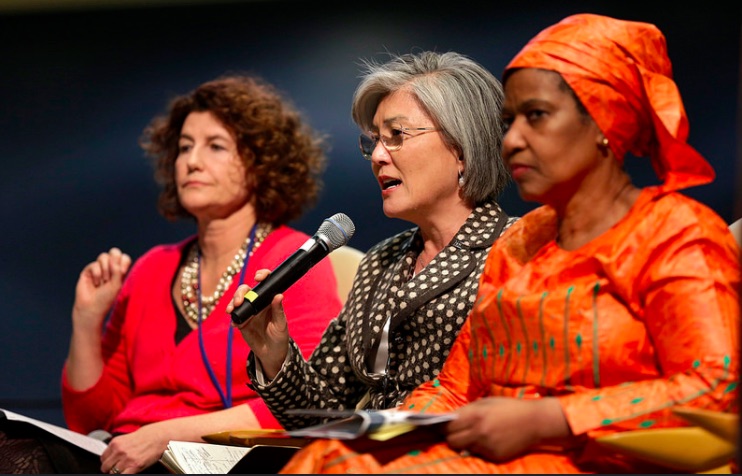
The Secretary-General-designate also announced the appointment of Maria Luiza Ribeiro Viotti of Brazil as his Chef de Cabinet and that he will create the position of Special Advisor on Policy, and appointed Ms. Kyung-wha Kang of the Republic of Korea to this new role.

“I am happy to count on the efforts of these three highly competent women, whom I have chosen for their strong backgrounds in global affairs, development, diplomacy, human rights and humanitarian action,” said Secretary-General-designate Guterres, in the statement adding:

“These appointments are the foundations of my team, which I will continue to build, respecting my pledges on gender parity and geographical diversity.”

Ms. Ribeiro Viotti is presently the Under-Secretary for Asia and the Pacific at the Brazilian Ministry of Foreign Affairs. A career diplomat since 1976, she served most recently as Brazil’s Ambassador of to Germany (from 2013 to 2016) and as Brazil’s Permanent Representative to the UN (from 2007 to 2011).

Ms. Kang is currently the Chief of the Secretary-General-designate’s Transition Team. She has served as Assistant Secretary-General for Humanitarian Affairs and Deputy Emergency Relief Coordinator since April 2013, and was Deputy High Commissioner for Human Rights from January 2007 to March 2013.

Question for this article:

Proposals for Reform of the United Nations: Are they sufficiently radical?

UN Women: 16 days of activism against gender violence

. . WOMEN’S EQUALITY . .

An article from UN Women

From 25 November, the International Day for the Elimination of Violence against Women, to 10 December, Human Rights Day, the 16 Days of Activism against Gender-Based Violence Campaign is a time to galvanize action to end violence against women and girls around the world. The international campaign originated from the first Women’s Global Leadership Institute coordinated by the Center for Women’s Global Leadership in 1991.

In 2016, the UNiTE campaign strongly emphasizes the need for sustainable financing for efforts to end violence against women and girls towards the fulfilment of the 2030 Agenda for Sustainable Development.
One of the major challenges to efforts to prevent and end violence against women and girls worldwide is the substantial funding shortfall. As a result, resources for initiatives to prevent and end violence against women and girls are severely lacking. Frameworks such as the Sustainable Development Goals, which includes a specific target on ending violence against women and girls, offer huge promise, but must be adequately funded in order to bring real and significant changes in the lives of women and girls.

(article continued in right column)

(Click here for a Spanish version of this article or here for a version in French.)

Question related to this article:

Protecting women and girls against violence, Is progress being made?

(article continued from left column)

To bring this issue to the fore, the UN Secretary-General’s campaign UNiTE to End Violence against Women’s call for the 16 Days of Activism against Gender-Based Violence in 2016 is ‘Orange the World: Raise Money to End Violence against Women and Girls’. The initiative provides a moment to bring the issue of sustainable financing for initiatives to prevent and end violence against women to global prominence and also presents the opportunity for resource mobilization for the issue.

Join us!

Share your photos, messages and videos showing how you orange the world at facebook.com/SayNO.UNiTE and twitter.com/SayNO_UNiTE using #orangetheworld and #16days. For more information about “Orange the world,” see this year’s Call to Action and download the fundraising toolkit. For more information about Orange Day, please contact Anna Alaszewski, UNiTE Campaign Coordinator,  anna.alaszewski[at]unwomen.org

(Thank you to Janet Hudgins, the CPNN reporter for this article)

‘Fascist Rhetoric’ Becoming Commonplace in US and Europe: UN

…. HUMAN RIGHTS ….

An article by Nadia Prupis for Common Dreams (reprinted according to provisions of Creative Commons)

The “rhetoric of fascism” is on the rise in the U.S. and Europe, a United Nations official warned on Thursday, a disturbing trend that puts “unprecedented pressure” on human rights standards around the world.

“Anti-foreigner rhetoric full of unbridled vitriol and hatred is proliferating to a frightening degree, and is increasingly unchallenged,” said Zeid Ra’ad Al Hussein, the U.N. human rights chief. “The rhetoric of fascism is no longer confined to a secret underworld of fascists, meeting in ill-lit clubs or on the ‘Deep Net.’ It is becoming part of normal daily discourse.”


People protest in the wake of Donald Trump’s election. (Photo: Ben Alexander/flickr/cc)
(click on photo to enlarge>

Speaking ahead of International Human Rights Day on December 10, Zeid warned that “if the growing erosion of the carefully constructed system of human rights and rule of law continues to gather momentum, ultimately everyone will suffer.”

The failure of global leaders to deal with complex social issues like the massive wealth gap, discrimination, and climate change have led to growing numbers of people to turn to “the siren voices exploiting fears, sowing disinformation and division, and making alluring promises they cannot fulfill,” he said, in a nod to U.S. President-elect Donald Trump.

“Discrimination, yawning economic disparities, and the ruthless desire to gain or maintain power at any cost are the principal drivers of current political and human rights crises,” he said.

(Article continued in the right column)

Question related to this article:

What is the state of human rights in the world today?

(Article continued from the left column)

Zeid’s warning came just before far-right Dutch politician Geert Wilders—who is widely expected to win the upcoming March election for Prime Minister—was convicted of inciting discrimination for saying the Netherlands would be better off with fewer Moroccans.

During a municipal election campaign in the Hague in March 2014, Wilders, leader of the Party for Freedom, asked a crowd of people attending a rally if they wanted “more or fewer Moroccans in this city and in the Netherlands.” The crowd chanted back, “Fewer! Fewer!” Wilders, smiling at the reaction, responded, “We’re going to take care of that.”

Friday’s verdict indicated that Wilders had planned the comments as a stunt, with the judges finding evidence that his team had coached the crowd how to respond, and saying that it was intended to be insulting to Moroccans.

Although Wilders was convicted of inciting discrimination, he was acquitted of hate speech charges, and the panel rejected prosecutors’ requests to fine or jail him. As the BBC reports, the verdict will have little impact on Wilders’ political aspirations.

Zeid has previously named Wilders, among other high-profile politicians such as Trump and the U.K.’s Nigel Farage, as demagogues whose rhetoric is poised to bring about “colossal violence” against minorities. He has also said Trump was “dangerous” for the international community. Under Zeid’s leadership, the U.N. human rights office is readying to condemn Trump if he puts any of his xenophobic or discriminatory policies into effect.

On Thursday, Zeid urged all people to “push back the violence and hatred which threaten our world.”

“Human rights are for everyone, and everyone will be affected if we do not fight to preserve them,” he said. “They took decades of tireless effort by countless committed individuals to establish, but—as we have seen all too clearly in recent months—they are fragile. If we do not defend them, we will lose them.”

UN Adopts Cuban Resolutions on Peace and Rejection of Mercenaries

FREE FLOW OF INFORMATION

An article from Prensa Latina

The Third Committee of the UN General Assembly has adopted today [November 18] by large majority two draft resolutions submitted by Cuba, which advocate for the right to peace and reject the use of mercenaries.

resolution

The text of the Declaration on the Right to Peace was supported by 116 countries, 34 rejected it and 19 abstained, following a vote requested by the United States, despite Cuba’s call to adopt it by consensus, considering the importance of the issue for humanity.

As usually occurs here, given the marked difference in positions between the North and the South, the document has been supported by the nations of Africa, Latin America and the Caribbean and Asia. Australia, Canada, the United States, Israel, Japan, New Zealand, South Korea and the members of the European Union were opposed.

The initiative states that all people should enjoy the right to peace, in order to guarantee human rights and development, without exclusion.

It also calls on the States to respect, implement and promote equality, justice and non-discrimination; and defend tolerance, dialogue, cooperation and solidarity.

Several countries co-sponsored the text submitted by Cuba, among them Belarus, Bolivia, China, Colombia, Egypt, Ghana, Indonesia, Nicaragua, Syria, South Africa, Venezuela and Vietnam.

Cuba’s project has been already adopted at the Human Rights Council in Geneva in July, when the international community was called for the first time to declare the existence of the right to peace on a planet scourged by wars, conflicts and crises, which cause suffering to tens of millions of human beings.

The Cuban delegation defended in the vote the right of all inhabitants of the planet to live without the impact of the scourge of war.

[The other] draft resolution introduced by Cuba, with the co-sponsorship of Angola, Belarus, Bolivia, China, Chile, Ecuador, India, Nicaragua, Nigeria, Syria, Uruguay, Venezuela and other States, obtained 117 votes for, 51 against and 5 abstentions.

Cuba has presented a similar initiative every year at the Third Committee.

Both projects will be submitted next month to the decision of the UN General Assembly, in the context of its 71st Session.

(Click here for an article in Spanish)

Question(s) related to this article:

What is the United Nations doing for a culture of peace?

[Editor’s note: Here is information about the anti-mercenary resolution, drawn from the UN website: In other action, the Committee approved a draft resolution on the use of mercenaries as a means of violating human rights and impeding the exercise of the right to self-determination, by 117 votes in favour to 50 against, with 6 abstentions. Among other things, it would have the General Assembly call upon States to take legislative measures to ensure that territories under their control were not used for — and their nationals did not take part in — the recruitment, assembly, financing, training, protection or transit of mercenaries. Slovakia’s representative, speaking for the European Union, explained that the bloc had voted against the draft because it would add private security firms to the mandate of the Human Rights Council’s Working Group on those issues.]