Tag Archives: Europe

Ukraine war: families of unhappy Russian conscripts could undermine Kremlin’s war effort

FREE FLOW OF INFORMATION

An article by Jennifer Mathers from The Conversation (republished under a Creative Commons license)

What do ordinary Russians think about the war that Vladimir Putin has unleashed on Ukraine? The Kremlin’s justifications: that Ukraine’s leadership has been subjecting ethnic Russians in that country to genocide  and that the government in Kyiv is led by neo-Nazis  appear far-fetched to most people outside Russia. So does the idea that Russia had to strike first to prevent Ukraine  from becoming a springboard for a Nato attack on Russia. But that’s what the Russian people have been told.


Distraught: Russian soldiers’ mothers with pictures of their sons killed in Chechnya, 1995. EPA/Sergei Chirikov

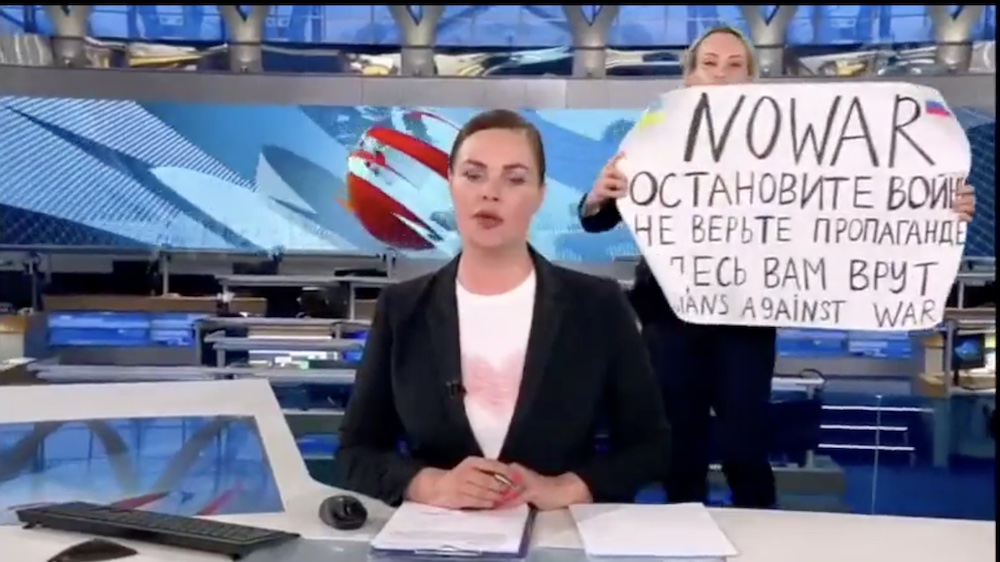
Some Russians certainly haven’t accepted these notions and oppose the invasion. Several thousand people have been arrested in cities  across the country for participating in protests. And a growing number of respected figures in Russia  have made public statements against the war in Ukraine, including celebrities  who are using their social media accounts to express their political views.

But while social media is providing young people with alternative explanations for this war, it is the older generations who represent the bedrock of Putin’s popular base of support. And older people tend to get their news from state-controlled television   rather than from social media or by seeking out Russia’s remaining independent news media that exist mainly online.

This support for Putin and his war is now at risk, however, as a direct result of the way that Russia treats its own soldiers and their families.

Within a few days of Russia’s invasion of Ukraine, the Russian independent news organisation Meduza published an article  highlighting the shock and anger of the families of Russian conscripts when they discovered that their sons had been sent into battle. Russian law prohibits the use of conscripts in combat, so these parents had no reason to believe that their loved ones were in the front lines of Putin’s “special military operation” in Ukraine.

According to the families that Meduza interviewed, conscripts are being coerced into signing contracts of voluntary service to change their status and provide some legal cover for sending them to war.

Changes to the status of conscripts is not the only information that Russia is keeping from soldiers’ families. According to a presidential decree that  Putin signed in 2015, all military deaths are a state secret. This means that frantic families who contact the Ministry of Defence asking for information about the welfare of their sons are routinely met either with silence or delaying tactics, such as advice to contact a unit commander directly or write to the Red Cross.

(Continued in right column)

Questions related to this article:
 
Can the peace movement help stop the war in the Ukraine?

(Continued from left column)

Ukraine has seemingly taken a very different approach. According to news reports, when Russian soldiers are captured they are allowed to phone their families , both to assure those back home that they are alive but also to convey to them the reality of this war.

If there is one thing that can effectively counter the Kremlin’s narrative about its use of force in Ukraine, it is personal knowledge  from trusted sources of information – such as the testimony of combatants delivered to their parents. And these parents will share this knowledge with their extended family, with neighbours, with co-workers, and with friends.

Committee of Soldiers’ Mothers

In fact, the news is already spreading , and families with sons in the army who have not heard from them directly are pleading with the only other source of information and advocacy in Russia about members of the armed forces: the Committee of Soldiers’ Mothers .

The Committee of Soldiers’ Mothers began during the Soviet war in Afghanistan as a network of locally based initiatives led by the families – principally the mothers – of soldiers to lobby the Kremlin for their safe return. The committee rapidly grew in size and moral authority and expanded its remit  to put pressure on Moscow to put an end to the practice of dedovshchina. This is “hazing” – routine physical abuse meted out by senior conscripts to new arrivals in the unit that sometimes ended in serious injury or even death.

The organisation came to prominence during Russia’s first war in Chechnya (1994-1996), when it organised the Mothers’ March for Life and Compassion . This involved hundreds of middle aged women travelling to the war zone to find their sons and bring them back home.

Outrage at the mistreatment of conscripts spread throughout Russia at the grassroots level and undermined the entire basis of staffing the armed forces. Advised by the Committee of Soldiers’ Mothers on legal ways to avoid military service  and supported by their families, young men of conscription age withdrew their labour from the state, sparking a crisis of recruitment  and retention that the Russian armed forces have only recently begun to recover from.

Failure of reform

The war in Ukraine is Russia’s first large-scale use of force since the start of a serious effort at  military reform  following Russia’s 2008 war in Georgia. Previous military operations either involved small numbers of highly trained forces (the annexation of Crimea in 2014 , the military intervention in Syria   since 2015) or covert support for proxies (the war in the Donbas , 2014-2022).

Despite a decade of reform  and a  significant increase in resources , what we have seen so far suggests that the attitudes in the Ministry of Defence towards the treatment of soldiers and their families have not changed much since the late Soviet period.

This could turn out to be a costly oversight. Putin’s tenure in the Kremlin is not necessarily dependent upon public opinion. But significant shifts in the mood of ordinary Russians will certainly undermine morale. This could cause some of the powerful figures that surround the president to question the wisdom of continuing down the current path, and perhaps also with the current leader.

The Conversation

Open letter of Russian mathematicians against the war in Ukraine

FREE FLOW OF INFORMATION

An article from TrV-science (Trojan variant – Science (translation by CPNN) (article later removed by Russian government censorship)

28.02.2022: The editors of the Trojan Variant have received an open letter from mathematicians working in Russia. The letter is open for signing (signatures are collected here). We publish the text of the appeal to the head of the Russian Federation.

To the President of the Russian Federation V. V. Putin

Mr. President!

We, mathematicians working in the Russian Federation, strongly protest against the military invasion of the territory of Ukraine launched by the Russian army on February 24, 2022.

The standard of living in a country and its position in the world are largely determined by the level of its science. Scientists all over the world are working on problems that are not restricted to national and territorial interests, but concern the well-being of all mankind. International cooperation, lack of borders for the dissemination of knowledge and humanistic values ​​are the foundation on which science is built. Our many years of efforts to strengthen the reputation of Russia as a leading mathematical center have been completely depreciated as a result of the unprovoked military aggression initiated by our country.

Mathematics has always been one of the few areas of fundamental science in which Russia has maintained a leading world position. As confirmation of this, Russia was supposed to host the most prestigious mathematical conference in the world, the International Congress of Mathematicians, in the summer of 2022. The International Mathematical Union canceled this decision in connection with the Russian attack on Ukraine. In a situation where our country has become a military aggressor and, as a result, a rogue state, Russia’s leading positions in world mathematics will be irretrievably lost.

In the instructions of the President of December 4, 2020, mathematics was named a priority area for the development of the Russian Federation; goals were set both in the field of fundamental science and in education. These goals, of course, cannot be achieved in the current conditions, when the lives of our closest colleagues – scientists in Ukraine, with whom we have been connected by many years of successful joint work, are daily in danger, the source of which is the Russian army. Russia finds itself in international isolation, without the possibility of intensive scientific exchange and cooperation with scientists from other countries.

We are convinced that no geopolitical interests can justify the sacrifices and bloodshed of war. It will only lead to the loss of the future of the country for which we work.

We demand an immediate cessation of hostilities and the withdrawal of Russian troops from the territory of Ukraine.

Signatures as of 13:50 March 1, 2022. The order of signatures is random. The collection of signatures continues. If you are a mathematician working in Russia, you can leave your signature here.

A backup email is available on Google Docs.

1.Iosif Krasilshchik, Doctor of Physical and Mathematical Sciences, Professor, IPU Russian Academy of Sciences
2.Petr Evgenievich Pushkar, Ph.D.
3.Andrey Dymov, Ph.D., Associate Professor, MIAN, Higher School of Economics
4.Yuliy Ilyashenko, Doctor of Physics and Mathematics, Professor
5.Alexander Guterman, Doctor of Physics and Mathematics, Professor, Moscow State University
6.Yana Belopolskaya, Doctor of Physics and Mathematics, Professor
7.Dmitry Filimonov, Ph.D., Associate Professor
8.Dmitry Itsykson, Ph.D.
9.Mikhail Feigin, Ph.D., Associate Professor, University of Glasgow and MGU
10.Irina Paramonova, Candidate of Physical and Mathematical Sciences, Associate Professor
11.Victor Vasiliev, Doctor of Physical and Mathematical Sciences, Academician of the Russian Academy of Sciences, Professor, Mathematical Institute named after V.I. V.A. Steklova
12.Leonid Rybnikov, MD
13.Ivan Dynnikov, Doctor of Physical and Mathematical Sciences, Professor of the Russian Academy of Sciences
14.Elena Kreynes, Ph.D., Moscow State University named after M.V. Lomonosov
15.Nadezhda Volodko, PhD, IM SB Russian Academy of Sciences
16.Igor Moiseevich Krichever, Doctor of Physical and Mathematical Sciences, Professor
17.Sergey Vladuts, PhD, professeur, Aix-Marseille Univ.
18.Leonid Chekhov, Doctor of Physics and Mathematics, Leading Researcher, MIAN V.A. Steklova
19.Sergey Smirnov, Ph.D., Associate Professor
20.Irina Bobrova, Postgraduate Student, Research Assistant, Faculty of Mathematics, National Research University Higher School of Economics, Moscow
21.Alexey Makarov, Ph.D., Professor
22.Ilya Sergeevich Vilkovisky, PhD student, Skoltech, Higher School of Economics
23.Gleb Koshevoy, Doctor of Physics and Mathematics, Chief Researcher
24.Marat Rovinsky, Doctor of Physics and Mathematics, Moscow
25.Vasily Goncharenko, Candidate of Physical and Mathematical Sciences, Associate Professor, National Research University Higher School of Economics
26.Nikolai Yurievich Reshetikhin, Doctor of Phys.-Math. Sciences, Professor, Tsinghua University, Beijing, China
27.Pavel Gvozdevsky, PhD student, St. Petersburg State University
28.Anton Sergeevich Khoroshkin, Candidate of Physical and Mathematical Sciences, Associate Professor, National Research University Higher School of Economics
29.Nina Sakharova, Ph.D., Associate Professor
30.Alexander Kuznetsov, Doctor of Physics and Mathematics, Corresponding Member Russian Academy of Sciences
31.Alexey Anatolievich Gorelov, MIAN im. V.A. Steklova, PhD student
32.Sergey Kryzhevich, Doctor of Physics and Mathematics, Associate Professor
33.Elena Gurevich, Ph.D.
34.Fedor Bakharev, PhD, Senior Researcher, Chebyshev Laboratory, St. Petersburg State University
35.Boris Feigin, Doctor of Sciences, Professor
36.Sergey Loktev, Ph.D.
Petr Akhmetiev, Doctor of Physical and Mathematical 37.Sciences, Professor at MIEM Higher School of Economics, IZMIRAN
38.Alexandra Shcheglova, Ph.D., Associate Professor, St. Petersburg Electrotechnical University
39.Stepan Kuznetsov, Candidate of Physical and Mathematical Sciences, Senior Researcher, Mathematical Institute. V. A. Steklov Russian Academy of Sciences
40.Ilya Shchurov, PhD, Associate Professor, National Research University Higher School of Economics
41.Ivan Sergeyevich Shilin, Ph.D.
42.Ekaterina Amerik, Doctor of Physics and Mathematics, Professor, Matfak Higher School of Economics
43.Mikhail Finkelberg, Ph.D., Professor
44.Boris Bychkov, PhD, Associate Professor, National Research University Higher School of Economics
45.Valentin Ovsienko, Ph.D., habilitation
46.Igor Lysenok, Doctor of Physics and Mathematics, Mathematical Institute. V.A. Steklova
47.Vladimir Gerdzhikov, Doctor of Physical and Mathematical Sciences, Professor, Institute of Mathematics and Informatics, Bulgarian Academy of Sciences
48.Andrey Solynin, Ph.D., St. Petersburg State University
49.Alexander Ivanovich Efimov, Candidate of Physical and Mathematical Sciences, Mathematical Institute. V.A. Steklov Russian Academy of Sciences
50.Artur Ryazano, Junior Researcher, St. Petersburg branch of the Mathematical Institute, Russian Academy of Sciences
51.Mikhail Anatolievich Tsfasman, Doctor of Physical and Mathematical Sciences
52.Lyubov Evgenievna Shenderova, Teacher
53.Sergey Nechaev, Doctor of Physics and Mathematics, Leading Researcher, Physical Institute of the Russian Academy of Sciences
54.Nikolai Kuchumov, National Research University Higher School of Economics
55.Ilya Shkredov, Doctor of Physics and Mathematics, Corresponding Member Russian Academy of Sciences, MIAN im.
56.V.A. Steklov Russian Academy of Sciences
57.Lev Lokutsievskiy, Doctor of Physics and Mathematics
58.Vasily Rogov, postgraduate student
59.Boris Kruglikov, PhD, Professor, UiT the Arctic University of Norway
60.Semyon Shlosman, Doctor of Physics and Mathematics
61.Alexander Kolesnikov, Doctor of Physics and Mathematics
62.Anton Sergeevich Trushechkin, Doctor of Physics and Mathematics, Mathematical Institute.
63.Evgeny Smirnov, Ph.D.
64.Vladislav Vysotsky, Ph.D.
65.Alexey Slinkin, PhD
66.Anton Tselishchev, Ph.D., place of work: St. Petersburg branch of the Mathematical Institute, Russian Academy of Sciences
67.Alexandra Skripchenko, Ph.D.
68.Evgeniy Stepanov, Doctor of Physics and Mathematics, Senior Researcher
69.Andrey Agrachev, Doctor of Physics and Mathematics
70.Anton Andreevich Aizenberg, Candidate of Physical and Mathematical Sciences, Associate Professor, National Research University, Higher School of Economics
71.Nikolai Mnev, Ph.D., St. Petersburg branch of the Mathematical Institute, Russian Academy of Sciences
72.Andrey Igorevich Karol, Candidate of Physical and Mathematical Sciences, Associate Professor
73.Mikhail Zhitlukhin, Candidate of Physical and Mathematical Sciences, Senior Researcher, MIAN im. V.A. Steklova
74.Tatyana Lazovskaya, Senior Lecturer, Peter the Great St. Petersburg Polytechnic University
75.Mikhail Bershtein, Ph.D.
76.Artem Avilov, PhD, Associate Professor, Research Fellow, Higher School of Economics
77.Natalya Vitalievna Pokhodnya, senior lecturer, mathematician
78.Maksim Beketov, Master, PhD student, assistant, FKN Higher School of Economics, MIPT
79.Sergey Mikhailovich Khoroshkin, Doctor of Physical and Mathematical Sciences, Professor, National Research University Higher School of Economics
80.Dmitry Gaifulin, Ph.D., Researcher, IPTP Russian Academy of Sciences
81.Valeria Shikheeva, Ph.D., Associate Professor
82.Konstantin Igorevich Pimenov, Ph.D., Department of Higher Algebra and Number Theory, St. Petersburg State University
83.Irina Maslyakova
84.Vadim Vologodsky, Ph.D., Professor, Higher School of Economics
85.Alexander Sinchukov, Ph.D.
86.Sergey Gorchinsky, Doctor of Physics and Mathematics
87.Yuri Malykhin, Ph.D., MIAN
88.Valentin Khrulkov, PhD, researcher, Yandex
89.Misha Verbitsky, Ph. D., Full Professor, IMPA – Instituto de Matemática Pura e Aplicada
90.Alexander Avdyushenko, PhD, Associate Professor, St. Petersburg State University
91.Stepan Denisovich Konenkov
92.Alexander Kiselev, Ph.D., St. Petersburg State University and ITMO
93.Daria Aksenova, St. Petersburg branch of the Mathematical Institute, Russian Academy of Sciences
94.Artyom Skvortsov, Student
95.Anastasia Stavrova, Ph.D.
96.Andronik Aramovich Arutyunov, Ph.D., Free University
97.Mikhail Lifshits, Doctor of Physics and Mathematics, Professor
98.Olga Petrovna Dalevskaya, Russian State Pedagogical University im. A. I. Herzen
99.Dmitry Korotkin, Doctor of Physics and Mathematics, Professor
100.Nina Nikolaevna Uraltseva, Doctor of Physics and Mathematics, Professor, St. Petersburg State University
101.Yulia Ershova, Candidate of Physical and Mathematical Sciences, Associate Professor
102.Mark Vinyals, Ph.D., Associate Professor, St. Petersburg State University
103.Alexey Ustinov, Doctor of Physical and Mathematical Sciences, Professor of the Russian Academy of Sciences
104.Nikita Aleksandrovich Nekrasov, Ph.D., Ph.D., professor
105.Sergey Komech, Ph.D., Russian Academy of Sciences
106.Viktor Lapshin, Ph.D., Associate Professor
107.Alexey Podobryaev, Ph.D.
108.Sergey Derkachev, Doctor of Physics and Mathematics, St. Petersburg branch of the Mathematical Institute, Russian Academy of Sciences
109.Alexander Smal, St. Petersburg branch of the Mathematical Institute, Russian Academy of Sciences
110.Sergey Gennadyevich Kazakov, postgraduate student, OmSTU
111.Yuri Burman, Ph.D.
112.Kostya Druzhkov, Ph.D., Moscow State University
113.Ilya Vorobyov, PhD, Skoltech
114.Yuri Zakharyan, PhD student, Faculty of Mechanics and Mathematics, Moscow State University
115.Alexey Milovanov, Candidate of Physical and Mathematical Sciences, National Research University Higher School of Economics
116.Konstantin Pravdin, Ph.D., ITMO University
117.Vladimir Vladimirovich Podolsky, Doctor of Physics and Mathematics, Leading Researcher, V.I. V.A. Steklova
118.Daniil Dmitrievich Rogozin, PhD student, IPTP Russian Academy of Sciences
119.Vladimir Ivanov, Ph.D.
120.Alexey Glazyrin, Ph.D.
121.Sergey Tikhomirov, Doctor of Physical and Mathematical Sciences, Professor, St. Petersburg State University
122.Anton Baranov, Doctor of Physical and Mathematical Sciences, Professor of the Russian Academy of Sciences
123.Alisa Sedunova, Ph.D., Associate Professor, St. Petersburg State University
124.Timur Mikhailovich Grozovsky, graduate, Faculty of Mechanics and Mathematics, Moscow State University
125.Andrey Marshakov, Doctor of Physics and Mathematics
126.Yulia Petrova, Ph.D., St. Petersburg State University
127.Alexey Golota, PhD student, trainee researcher
128.Aleksey Tokarev, Ph.D., Associate Professor, PFUR
129.Anastasia Sofronova, PhD student, St. Petersburg branch of the Mathematical Institute, Russian Academy of Sciences
130.Aleksey Sergeevich Gordeev, Junior Researcher, International Mathematical Institute named after A.I. L. Euler
131.Grigory Taroyan, Intern Researcher, Higher School of Economics
132.Anton Andreevich Shafarevich, Candidate of Physical and Mathematical Sciences, Associate Professor, Moscow State University M.V. Lomonosov, Faculty of Mechanics and Mathematics
133.Vladimir Sharich, Lecturer, Higher School of Economics
134.Ilya Kirillov, PhD student, University of Toronto
135.Pavel Zatitsky, Ph.D., Associate Professor
136.Elena Arsenyeva, PhD, Associate Professor, St. Petersburg State University
137.Tikhon Pshenitsyn, student, young scientist
138.Sergey Andreevich Sergeev, Candidate of Physical and Mathematical Sciences, Associate Professor, IPMech Russian Academy of Sciences
139.Natalia Netrusova
140.Alexey Elagin, Ph.D.
Pavel Petrov, Doctor of Physics and Mathematics, Professor, Institute of Mathematics 141.and Computer Technologies, FEFU
142.Grigory Ryabov, Ph.D., Senior Researcher, IM SB Russian Academy of Sciences
143.Roman Krutovsky, phd student, UCLA
144.Valentina Kuskova, PhD
145.Elena Rozhdestvenskaya, Ph.D., Lecturer, Omsk branch of the Higher School of Economics
146.Andrey Konyaev, Ph.D., Associate Professor, Mechanics and Mathematics of Moscow State University
147.Kirill Ryadovkin, Ph.D., St. Petersburg branch of the Mathematical Institute, Russian Academy of Sciences
148.Alexey Sosinsky, Ph.D., Professor, Vice-Rector, Independent Moscow University

(Continued in right column)

Questions related to this article:
 
Can the peace movement help stop the war in the Ukraine?

(Continued from left column)

149.Alexander Andreevich Polyansky, Candidate of Physical and Mathematical Sciences, Associate Professor
150.Natalia Chebochko, PhD, Associate Professor, National Research University Higher School of Economics
151.Alexander Kulikov, Doctor of Physics and Mathematics, Professor
152.Oleg Lychkovsky, PhD, Moscow
153.Alexander Shtern, PhD, Associate Professor, National Research University Higher School of Economics, Department of Mathematical Education
154.Ivan Andreevich Menshikov
155.Andrey Lavrenov, Ph.D., St. Petersburg State University
156.Alexander Mokeev, Candidate of Physical and Mathematical Sciences, Researcher, MIAN
157.Dmitry Malyugin, Ph.D.
158.Sergey Berlov, Ph.D., FML No. 239
159.Andrey Kupavsky, Doctor of Physics and Mathematics, Moscow Institute of Physics and Technology
160.Anna Ladneva, Ph.D., Associate Professor, Russian State University
161.Alexander Alexandrovich Gushchin, Doctor of Physics and Mathematics
162.Nikolai Mikhailovich Bogolyubov, Doctor of Physical and Mathematical Sciences, St. Petersburg branch of the Mathematical Institute, Russian Academy of Sciences
163.Alexander Chuikin, PhD, Leading Specialist, St. Petersburg
164.Anatoly Zaikovsky, St. Petersburg State University
165.Ekaterina Ponomarenko, Ph.D., Mechanics and Mathematics, Moscow State University (graduate)
166.Evgeny Nikolaevich Abramov, research engineer, St. Petersburg State University
167.Petr Petrovich Nikolaev, Ph.D.
168.Mikhail Rotkevich, Research Engineer, St. Petersburg State University
169.Viktor Andreevich Vyalov, Ph.D., St. Petersburg State University
170.Vyacheslav Borovitsky, Ph.D., St. Petersburg State University, St. Petersburg branch of the Mathematical Institute, Russian Academy of Sciences
171.Evgeny Feigin, Doctor of Physics and Mathematics, Professor
172.Ilya Zlotnikov, St. Petersburg branch of the Mathematical Institute, Russian Academy of Sciences
173.Yana Teplitskaya, Ph.D.
174.Nikita Kalinin, Ph.D., Associate Professor
175.Vladimir Sosnilo, PhD, Modern Algebra and Applications Laboratory
176.Denis Igorevich Savelyev, IPTP Russian Academy of Sciences
177.Ilya Bogaevsky, Doctor of Physics and Mathematics, Professor, Moscow State University
178.Nikolai Germanovich Moshchevitin, Doctor of Physics and Mathematics, Professor, Faculty of Mechanics and Mathematics, Moscow State University
179.Pavel Steiner, PhD student, Moscow State University
180.Alexey Gorinov, PhD, Associate Professor, National Research University Higher School of Economics
181.Alexey Pirkovsky, Candidate of Physical and Mathematical Sciences, Associate Professor
182.Boris Trushin, Ph.D.
183.Mila Trushchina
184.Elena Bashtova, Ph.D., Associate Professor, Mechanics and Mathematics of Moscow State University
185.Yuri Gennadyevich Zarkhin, Doctor of Physics and Mathematics, Professor, Pennsylvania State University (Penn State)
186.Maria Platonova, Ph.D.
187.Maxim Pavlov, Ph.D., Researcher, Physical Institute of the Russian Academy of Sciences
188.Alexander Mikhailov, Doctor of Physical and Mathematical Sciences, Professor
189.Gennady El, PhD, Professor, Northumbria University
190.Vladimir Nikolaevich Rubtsov, Ph.D., professor
191.Viktor Shcherbakov, Ph.D., ISIL SB Russian Academy of Sciences
192.Sergey Salishchev, Ph.D.
193.Michal Marvan, Ph.D., associate professor, postgraduate student of Moscow State University 1976 – 1981
194.Sergey Steiner, graduate of the Mekhmat of Moscow State University
195.Leonid Shalaginov, Candidate of Physical and Mathematical Sciences, Associate Professor, ChelGU
196.Petr Romanovich Kosenko, PhD student, National Research University Higher School of Economics/University of Toronto
197.Alexander Ivanovich Bobenko, Doctor of Physical and Mathematical Sciences, Professor
198.Maria Esipchuk, no, beginner topologist
199.Anatolij Karolevich Prykarpatski, Dr hab., PhD, Professor, Cracow University of Technology
200.Lev Sukhanov
201.Tatyana Shulman, Ph.D.
202.Egor Bryukhov, Ph.D.
203.Anton Pershin, Ph.D., associate professor
204.Yuri Belousov, PhD student, Higher School of Economics
205.Gleb Baksheev, student, NMU
206.Daniil Musatov, Ph.D., Associate Professor, Moscow Institute of Physics and Technology
207.Alexey Stepanov, Doctor of Physics and Mathematics, Associate Professor, St. Petersburg State University
208.Vasily Nekrasov, Student, Mechanics and Mathematics of Moscow State University
209.Dmitry Serkov, Doctor of Physics and Mathematics
210.Vladislav Degtyarev, Candidate of Cultural Studies, Senior Research Fellow, Russian State Pedagogical University. Herzen
211.Kirill Vedenev, PhD student
212.Vladimir Vyacheslavovich Sokolov, Doctor of Physical and Mathematical Sciences, Professor
213.Sergei Sergeevich Yakovenko, Ph.D. student, University of Bonn
214.Mikhail Goltsblat, Intern Researcher, Higher School of Economics
215.Larisa Stetsenko, Ph.D., Associate Professor, Institute of Plant Physiology
216.Konstantin Taranin, junior researcher, Lomonosov Moscow State University M.V. Lomonosov
217.Philip Uvarov, Ph.D.
218.Eldar AKHMEDOV, mathematician
219.Yuri Yakubovich, Ph.D.
220.Gleb Pogudig, Ph.D.
221.Vadim Gizatulin, student
222. Gavrilyuk, Ph.D., Expert
223.Sergey Akbarov, Doctor of Physics and Mathematics, Professor, National Research University Higher School of Economics
224.Dmitry Krekov, PhD student, Skoltech
225.Stepan Orevkov, Ph.D.
226.Ekaterina Lipacheva, Ph.D., Associate Professor
227.Nadezhda Khoroshavkina, Intern Researcher, Higher School of Economics
228.Alexander Veretennikov, Doctor of Physics and Mathematics, Professor
229.Andrey Lodkin, Ph.D., Associate Professor
230.Grigory Papaanov, postgraduate student
231.Anna Vladimirovna Gladkaya, Candidate of Physical and Mathematical Sciences, Associate Professor, St. Petersburg State University, National Research University Higher School of Economics
232.Elena Lebedeva, Doctor of Physics and Mathematics, St. Petersburg State University
233.Yuri Davydov, Doctor of Physical and Mathematical Sciences, Professor
234.Ilya Ponomarenko, Doctor of Physics and Mathematics, St. Petersburg branch of the Mathematical Institute, Russian Academy of Sciences
235.Alexander Vorotnikov, student
236.Olga Semenova, Ph.D., Senior Lecturer, Associate Professor, St. Petersburg State University, ITMO
237.Sergei Pustovoitov, PhD student, Moscow State University
238.Alexander Borisovich Pushnitsky, Ph.D., professor, member of the St. Petersburg Math. societies
239.Mikhail Arsenievich Semenov-Tyan-Shansky, Doctor of Physical and Mathematical Sciences
240.Vanya Karpov, Intern Researcher, MLTPMF Higher School of Economics-Skoltech
241.Alexander Zvonkin, professor emeritus, University of Bordeaux, France
242.Mikhail Denisov, Ph.D., Associate Professor
243.Maria Skopina, Doctor of Physics and Mathematics, Professor, St. Petersburg State University
244.Irina Kharcheva, PhD student
245.Vladimir Protasov, Corresponding Member of the Russian Academy of Sciences, Professor, Mechanics and Mathematics of Moscow State University
246.Dmitry Vasilevich, Doctor of Physics and Mathematics, Professor
247.Artur Vaganyan, Ph.D., Senior Lecturer, Russian State Pedagogical University named after A. I. Herzen
248.Alexander Vladimirovich Sobolev, PhD, Professor, University College London
249.Yaroslav Blagushin, Candidate of Physical and Mathematical Sciences (Docteur), Researcher, formerly Associate Professor, Branch of the Russian Academy of Sciences
250.Anna Kononova, Ph.D., St. Petersburg State University
251.Nikolai Kitanin, Ph.D., Professor, Université de Bourgogne
252.Alexandra Zvonareva, Ph.D.
253.Sergey Fedorov, Ph.D., Moscow State University Lomonosov, National Research University Higher School of Economics
254.Evgeny Statnik, PhD student, trainee researcher
255.Vladimir Fok, PhD, Professor, University of Strasbourg
256.Alexey Pastor, Ph.D., St. Petersburg branch of the Mathematical Institute, Russian Academy of Sciences
257.Yuriy Burago, Doctor of Physical and Mathematical Sciences, Professor
258.Vasilisa Alexandrovna Shramchenko, Ph.D., Professor, University of Sherbrooke
259.Dmitry Sergeevich Mokeev, Lecturer, Higher School of Economics
260.Daria Teplova, Ph.D., B. I. Verkin Institute for Low Temperature Physics and Technology of the National Academy of Sciences of Ukraine
261.Yuri Farkov, Doctor of Physics and Mathematics, Professor
262.Natalia Semenova, Mathematician, teacher by education
263.Artem Gureev, PhD student, University of Western Ontario
264.Andrey Shilnikov, Ph.D., Professor, Georgia State University
265.Roman Karasev, Doctor of Physics and Mathematics, Associate Professor, IPTP Russian Academy of Sciences
266.Alexey Zobnin, Ph.D.
267.Viktor Ginzburg, Ph.D., professor
268.Vasily Vasyunin, Doctor of Physics and Mathematics, St. Petersburg branch of the Mathematical Institute, Russian Academy of Sciences
269.Vladimir Stukopin, Doctor of Physics and Mathematics
270.Alexander Panov, Doctor of Physics and Mathematics
271.Vladimir Panov, Ph.D., Associate Professor
272.Alexander Tiskin, DPhil (Oxford), Associate Professor
273.Igor Igorevich Tagiltsev, post-graduate student of MMF NSU, junior researcher ISIL SB Russian Academy of Sciences
274.Boris Volkov, Ph.D., Associate Professor
275.Tsvyatko Rangelov, PhD, Professor, IMI, Bulgarian Academy of Sciences
276.Krutov Andrey, Ph.D., IMCAS
277.Egor Stepanov, PhD
278.Dmitry Chelkak, Ph.D.
279.Ksenia Dmitrievna Mukhina, Ph.D.
280.Mikhail Zvagelsky, Ph.D.
281.Valentin Skvortsov, Doctor of Physics and Mathematics, Professor, Moscow State University
282.Alexander Kalmynin, postgraduate student, research assistant, National Research University Higher School of Economics
283.Nikolai Nikolsky, PhD, professor emeritus, Ampère Prize 2010 of the French Academy of Sciences, IM Université de Bordeaux, France
284.Alexey Nikitin, Candidate of Physical and Mathematical Sciences, Associate Professor, Lomonosov Moscow State University M.V. Lomonosov
285.Maria Ronzhina, Ph.D., Associate Professor
286.Olga Aleksandrovna Ivanova, Mathematics teacher
287.Anna Kirpichnikova, PhD
288.Tatiana Svorovska, PhD, editor of the European Journal of Mathematics
289.Svetlana Puzynina, Ph.D.
290.Mikhail Vladimirovich Gubko, Doctor of Physical and Mathematical Sciences, Professor of the Russian Academy of Sciences, IPU Russian Academy of Sciences
291.Maxim Panov, Ph.D.
292.Vitaly Volpert, CNRS, France
293.Yuri Savateev, PhD, Birkbeck, University of London
294.Timofey Grigoriev, master
295.Mikhail Svintsov, ITMO University
296.Sergey Zyubin, Ph.D., Associate Professor
297.Dmitry Korikov, Ph.D., St. Petersburg branch of the Mathematical Institute, Russian Academy of Sciences
298.Elena Kirshanova, PhD, IKBFU I. Kant
299.Sergey V. Dyachenko, Ph.D., developer of science-intensive software (mathematical modeling)
300.Temirlan Ergalievich Abildaev, Master student, St. Petersburg State University
301.Ivan Sergeevich Khomich, Scientific Supervisor, Novosibirsk State University
302.Anastasia Andreevna Kuznetsova, Research Laboratory Assistant, Ural Federal University
303.Kirill Safronov, Senior Lecturer, SPbGMTU
304.Alexander Komlov, Ph.D., senior researcher, Mathematical Institute. V.A. Steklov Russian Academy of Sciences
305.Dmitry Yarotsky, Doctor of Physics and Mathematics, Associate Professor
306.Anastasia Matveeva, postgraduate student, Polytechnic University of Barcelona
307.Daria Rudneva, PhD student, Higher School of Economics/Skoltech
308.Nikita Ilyich Shamich, student, FEFU
309.Sofia Afanasyeva, Ph.D.
310.Sergey Gelfand, Ph.D.
311.Alexander Gavrilyuk, Doctor of Physics and Mathematics, Shimane University
312.Asiyat Abukova, Student, Faculty of Mechanics and Mathematics, Department of Second Higher Education, Lomonosov Moscow State University
313.Galina Sidorenko, Ph.D.
314.Sergey Alexandrovich Filyukov, postgraduate student, researcher
315.Mikhail M. Lopatin, Junior Research Fellow, IKBFU I. Kant
316.Alexander Samokhin, Ph.D.
317.Andrey Nikolaevich Subochev, Candidate of Physical and Mathematical Sciences, Associate Professor, Senior Researcher, National Research University Higher School of Economics
318.Sergey Rybakov, Ph.D., senior researcher IPTP Russian Academy of Sciences
319.Georgy Alfimov, Doctor of Physics and Mathematics, Associate Professor
320.Nikolai Pogodaev, Ph.D.
321.Yury Vasiliev, Senior Lecturer, St. Petersburg State University of Economics
322.Nikita Safonkin, Skoltech PhD Student, Research Assistant, Faculty of Mathematics, Higher School of Economics
323.Ruslan Garipov, Bachelor
324.Ilya Vladimirovich, MacSolutions
325.Sergey Yagunov, Doctor of Physics and Mathematics, Ph D., St. Petersburg Branch of the Mathematical Institute of the Russian Academy of Sciences
326.Maxim Staritsyn, Ph.D., ISDTU SB Russian Academy of Sciences
327.Ivan Burenev, PhD student, St. Petersburg branch of the Mathematical Institute, Russian Academy of Sciences
328.Sergey Sadovnichuk, Ph.D., Associate Professor, Omsk State University
329.Fedor Khandarov, Ph.D.
330.Daniil Rudenko, PhD, Assistant Professor, University of Chicago
331.Svyatoslav Gryaznov, St. Petersburg branch of the Mathematical Institute, Russian Academy of Sciences
332.Alexander Volochkov, Ph.D., Associate Professor
333.Vladimir Borisenko, Ph.D., researcher, Moscow State University
334.Maxim Kostyuchek, IPU Russian Academy of Sciences
335.Anastasia Makarova, Teacher, School
336.Eduard Lerner, Ph.D., Associate Professor, KFU
337.Vladimir Polyakov, Ph.D., Tula
338.Dmitry Golikov, Bachelor of Mathematics
339.Natalia Trofimova, Graduate of the Moscow State University, Entrepreneur
340.Anna Uryson, Doctor of Physical and Mathematical Sciences
341.Alexander Abramovich Davydov, Ph.D., IPTP Russian Academy of Sciences n. collaborator
342.Alexander Andreevich Podolsky, graduate of the Faculty of Mechanics and Mathematics of Moscow State University
343.Mikhail Gabdullin, Ph.D., MIAN im. Steklov, Moscow State University
344.Andrey Ryabichev, Ph.D.
345.Alexey Minabutdinov, PhD, ETH
346.Evgeny Varfolomeev, Ph.D.
347.Mikhail Minin, PhD student, St. Petersburg branch of the Mathematical Institute, Russian Academy of Sciences
348.Alexander Alexandrovich Agafontsev, M. Sc., Lecturer, St. Petersburg State University of Economics
349.Natalia Strelkova, Ph.D.
350.Ilya Binder, Ph.D., Professor, University of Toronto
351.Ivan Utkin, Ph.D., Faculty of Mechanics and Mathematics, Moscow State University
352.Yaroslav Bazaikin, Doctor of Physics and Mathematics

Peace appeal from leading chess players of Russia to the President of the Russian Federation

FREE FLOW OF INFORMATION

An article by Yana Metlyova in Championat (translation by CPNN)

Appeal to the President of the Russian Federation from Russian chess players.

We oppose military actions on the territory of Ukraine and call for an early ceasefire and a peaceful solution to the conflict through dialogue and diplomatic negotiations. It is unbearably painful for us to see the catastrophe that is happening these days with our peoples.


Ian Nepomniachtchi

We have always played for Russia in individual and, with particular pride, in team competitions. We believe that chess, like sports in general, should bring people together. The most difficult and prestigious international tournaments were held in our country at the highest level even in the midst of the pandemic.

Chess teaches responsibility for one’s actions; every step counts, and a mistake can lead to a fatal point of no return. And if this has always been about sports, now people’s lives, basic rights and freedoms, human dignity, the present and future of our countries are at stake.

In these tragic days, we think of all the people who found themselves in the center of this terrible conflict. We share the pain with our Ukrainian colleagues and call for peace.

The Ukrainian chess team is the reigning European champion, one of the best teams in the world along with ours. We played dozens of matches and hundreds of games. We have always put the game above politics – and the Ukrainians have responded to us in return. We ask you to give teams, players and ordinary people from both countries a chance for mutual respect.

We are for peace. Stop the war!

(Continued in right column)

Questions related to this article:
 
Can the peace movement help stop the war in the Ukraine?

(Continued from left column)

The petition is signed by:

Ian Nepomniachtchi, grandmaster, Honored Master of Sports of Russia, two-time Russian champion, European champion, vice-world champion, two-time world champion, European champion as part of the Russian team, winner of the FIDE Online Olympiad as part of the Russian team;

Alexandra Kosteniuk, grandmaster, Honored Master of Sports of Russia, 12th world champion, Russian champion, World Cup winner, three-time Olympic champion with the Russian team, two-time world champion and five-time European champion with the Russian team;

Daniil Dubov, grandmaster, world champion in rapid chess, European champion as a member of the Russian team and winner of two online Olympiads as a member of the Russian team;

Petr Svidler, grandmaster, Honored Master of Sports of Russia, eight-time champion of Russia, winner of the World Cup, five-time winner of the World Chess Olympiads as part of the Russian team, two-time winner of the World Team Championship as part of the Russian team, three-time winner of the European Team Championship as part of the Russian team;

Andrey Esipenko, grandmaster, winner of two online Olympiads as part of the Russian team;

Maxim Matlakov, grandmaster, European champion, European champion as part of the Russian team;

Kirill Alekseenko, grandmaster, participant of the Candidates Tournament, European champion in the Russian team;

Alexander Motylev, grandmaster, Russian champion, European champion, coach of the Russian men’s team;

Evgeny Naer, grandmaster, European champion, coach of the Russian women’s team;

Pavel Tregubov, grandmaster, European champion;

Anton Demchenko, grandmaster, European champion;

Mikhail Kobalia, grandmaster, senior coach of the Russian youth team;

Alexander Khalifman, grandmaster, FIDE world champion, two-time Olympic champion in the Russian team;

Valentina Gunina, Grandmaster, Honored Master of Sports of Russia, multiple champion of Russia and Europe in the individual competition, three-time Olympic champion with the Russian team, world champion, six-time European champion with the Russian team, winner of two online Olympiads with the Russian team;

Polina Shuvalova, International Master, World Junior Chess Champion, Russian Rapid Champion, World and European Champion as a member of the Russian team, winner of two online Olympiads as a member of the Russian team;

Alina Kashlinskaya, grandmaster, European champion, world champion and two-time European champion as part of the Russian team;

Igor Lysy, grandmaster, champion of Russia;

Dmitry Kryakvin, grandmaster, journalist;

Vladimir Barsky, international master, journalist;

Mark Glukhovsky, master candidate, organizer;

Maxim Notkin, international master, journalist;

Maxim Chigaev, grandmaster;

Anastasia Chigaeva, FIDE Master;

Olga Badelko, grandmaster;

Pavel Ponkratov, grandmaster;

Alexander Shimanov, grandmaster;

Igor Berdichevsky, grandmaster;

Ivan Rozum, grandmaster;

Ildar Khairullin, grandmaster;

Artur Gabrielyan, grandmaster;

Nikita Petrov, grandmaster;

Evgeny Gleizerov, grandmaster;

Artem Odegov, FIDE Master;

Konstantin Mesropov, International Master;

Svetlana Ershova, Women’s International Master;

Evgeny Egorov, international master;

Anna Volkova, organizer;

Eteri Kublashvili, FIDE Women’s Master;

Yana Sidorchuk, organizer;

Anna Burtasova, women’s grandmaster;

Denis Grigoriev, journalist;

Ilya Gorodetsky, candidate master, commentator;

Oleg Pervakov, grandmaster, multiple world champion in chess composition, journalist.

Russian regulator censors Ukraine war coverage, reporters told to toe Kremlin line

FREE FLOW OF INFORMATION

An article from Reporters Without Borders

Reporters Without Borders (RSF) supports the efforts of Russia’s independent journalists and media outlets to provide reliable news coverage despite the clampdown imposed by the Kremlin as a result of its war in Ukraine, which has increased the many obstacles they have already had to deal with.


Journalists work in the news room of the independent Dozhd (Rain) television channel in Moscow, Russia. © 2021 AP/Denis Kaminev, reprinted from Human Rights Watch

Читать на русском / Read in Russian

Russia’s media regulator, Roskomnadzor, has become a “Ministry of Truth,” as the independent Journalists and Media Workers Union courageously pointed out. The words “war,” “attack” and “invasion” are now banned  from the media. Only information from “official Russian sources” – the defence ministry – is now permitted. Information about military losses or troop moral had already been classified  since October. Any attempt to provide such coverage is liable to result in prosecution or inclusion on the “foreign agents” list.
 
Yesterday, Roskomnadzor blocked  access to at least six online media outlets because of their war coverage – Nastoyashchee Vremya, an online TV channel run by the Prague-based US broadcaster Radio Free Europe/Radio Liberty (RFE/RL), Krym Realii, an RFE/RL subsidiary in Crimea, the opposition media outlet The New Times, the student newspaper  Doxa , the Russian version of the Interfax-Ukraine news agency and the Ukrainian pro-government news site Gordon.

“The information war is in full swing in Russia,” said Jeanne Cavelier, the head of RSF’s Eastern Europe and Central Asia desk. “President Vladimir Putin needs to put all the media on a battle footing in order to justify the invasion of Ukraine to Russian citizens by concealing the war’s victims. But the Pravda era is over. We support independent media outlets that are providing reliable news coverage in this very fraught context.”
 
Prosecutions
 
Roskomnadzor has also initiated proceedings  against at least ten media outlets, including Radio Echo of Moscow, the popular news site Mediazona, Dozhd TV and the investigative newspaper Novaya Gazeta, for “disseminating false information.” Novaya Gazeta’s high profile editor, Nobel peace laureate Dmitry Muratov, posted a  video  calling for a major anti-war movement and published the newspaper’s 26 February issue in both Russian and Ukrainian in a show of solidarity. It was probably for posting his video – containing the word “war” – on its website that the trade magazine Journalist is also being prosecuted, although it later removed the video. 

(Continued in right column)

(click here for the article in French or click here for the article in Spanish.)

Questions related to this article:
 
Free flow of information, How is it important for a culture of peace?

How can we be sure to get news about peace demonstrations?

(Continued from left column)

Roskomnadzor accused these media outlets of publishing “false information about the shelling of Ukrainian cities and the death of civilians in Ukraine as a result of the actions of the Russian Army, as well as content in which the ongoing operation is called an attack, invasion or a declaration of war.”
 
After receiving warnings from Roskomnadzor, other media outlets deleted content that was not to the Kremlin’s liking because they feared that their websites could be blocked or they could be fined up to 5 million roubles (more than 50,000 euros). This was the case with Prospekt Mira, an online media outlet based in the Siberian city of Krasnoyarsk, which had to take down an article referring to explosions in Ukrainian cities.
 
Social media have also been targeted. Internet access providers have restricted  access to Twitter, while Roskomnadzor has begun restricting access to Facebook, as announced  on 25 February, after Facebook decided to reduce search engine result links to certain state-owned and pro-government media outlets. Pavel Durov, the founder of the encrypted messaging service Telegram, said he was planning   to restrict access to his platform in Ukraine and Russia because of the uncontrolled spread of fake news on many Telegram channels, but he later retracted.
 
Arrests of journalists
 
Journalists have been arrested over war-related reporting. Polina Ulanovskaya of the SotaVision website, and at least three other reporters from local news sites – 93.ru’s Valeria Dulskaya and Yuga.ru’s Valeria Kirsanova and Nikita Zyrianov – were summarily arrested while covering an anti-war demonstration in the southwestern city Krasnodar on 27 February. They were released  in the evening.
 
Three reporters with RFE/RL’s Russian service Radio Svoboda – Ivan Voronin, Artyom Radygin and Nikita Tatarskiy – were arrested while covering an anti-war protest in Moscow on 24 February, and spent six hours in a police station  before being released without charge when their lawyers intervened.
 
Novaya Gazeta journalists Ilya Azar and Ivan Zhilin, and two Radio Svoboda journalists, reporter Sergei Khazov-Kassia and cameraman Andrei Kiselev, spent more than two hours in a police station   on 26 February after being arrested while preparing to cover an anti-war protest in Belgorod, a city near the Ukrainian border.
 
When the two Novaya Gazeta journalists entered a hospital with a view to interviewing injured people who had been taken there, a guard asked them to leave, they reported in a story   published the same day. “Yesterday, a journalist from Belsat [a Belarusian exile TV channel based in Poland] was manhandled in this hospital and was forced to delete all of her photos,” they reported, added that “she says she saw more than we did.”
 
Harassment

As leading victims of the government clampdown, journalists have also protested, despite the risks. Some have been arrested while standing on their own with a sign criticising censorship – the only permitted form of protest. Pressure has been placed on others. For example, Elena Chernenko, the head of the business daily Kommersant’s foreign desk, was excluded from the pool of Kremlin-accredited reporters for publishing an open letter opposing the war that was signed by more than 300 journalists.
 
The state media are meanwhile moving into battle. The Rossiya 1 TV channel decided on 27 February to grant much more airtime to shows carrying government propaganda, such as the talk-show presented by Vladimir Soloviev, a star TV host who is the target of international sanctions . “In Russia, Russian officials and journalists should be purged if they don’t support Putin,” he said during his show  on 24 February.
 
Russia is ranked 150th out of 180 countries in RSF’s 2021 World Press Freedom Index.

Despite government crackdown, Russians continue to protest the war

FREE FLOW OF INFORMATION

A press survey by CPNN

CPNN has published several articles recently about Russian opposition to the war, including open letters from scientists, from cultural figures, and from the “Congress of Intelligentsia.”

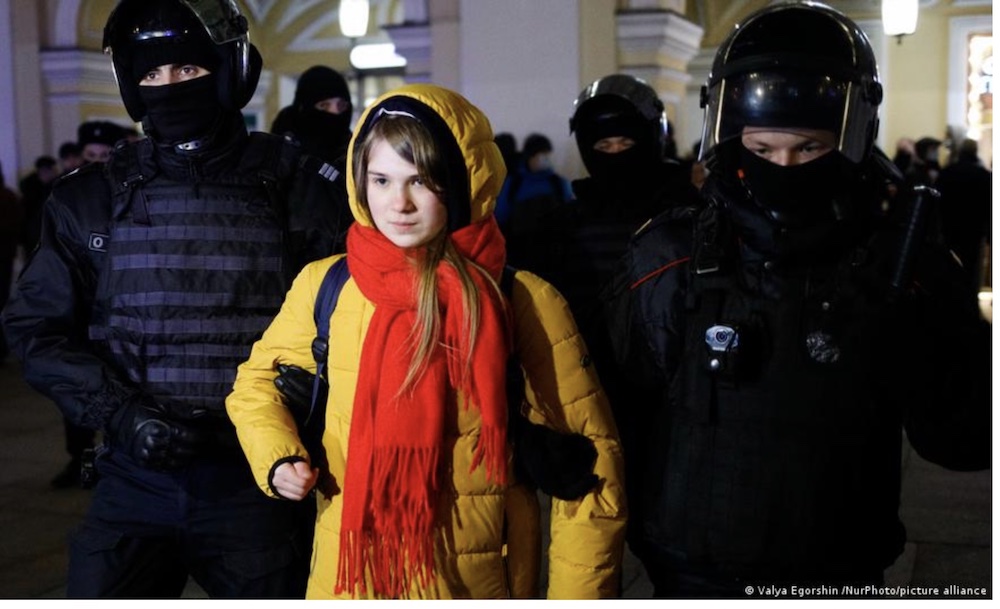
Opposition continues to grow despite draconian, even ridiculous, measures by the Russian government to stifle protest. Protesters risked arrest by massing in public in St. Petersburg, as shown the the photos below from Deutsche Welle.

As of February 26, the most comprehensive account of the antiwar movement and government crackdown comes from Moscow Times as follows

Russia’s Anti-War Lobby Goes Online

The head of Russia’s state-run RT television is in no doubt. If fellow citizens oppose President Vladimir Putin’s action in Ukraine then they are no longer Russians.

Margarita Simonyan, editor-in-chief of the English language international news network, is never one to mince her words and is used to making cutting remarks on Twitter in defense of Putin who she refers to simply as “leader.”

“If you are ashamed of being Russian now, don’t worry, you are not Russian,” was her summation of the anti-war movement at home.

Several thousand Russians demonstrated against the Russian invasion of Ukraine, but the police reaction was the usual one when it comes to Kremlin critics: hundreds of arrests.

So the anti-war movement has moved online, where it is beginning to make itself heard and to garner support, some of it high-profile.

Ukrainian flags adorn profile pictures and teary-eyed emojis are scattered liberally among the online statements. The hashtag #NoToTheWar was trending on Twitter on Saturday.

Since early Thursday, when the invasion of Ukraine began, various Russian celebrities, journalists and bloggers have expressed their horror and helplessness, pleading for an immediate end to the war.

The popular video blogger and documentary filmmaker Yuri Dud saw one of his online posts get a million “likes.”

“I write these words for a reason. When my children grow up and discover this moment in history… and ask me ‘Dad, what did you do?’, I want to have written proof that I did not choose this regime and did not support its imperialist rage,” he wrote.

‘This must be stopped!’

Elena Chernenko, a journalist with the Kommersant daily, said she was excluded from the pool of journalists covering Foreign Minister Sergei Lavrov because she started an anti-war petition among her colleagues. 

An open letter from the arts and cultural fields on Saturday had the support of more than 2,000 actors, directors and other creative figures. 

They dismissed Putin’s argument that the invasion is a “peacekeeping” operation to save Russian speakers in eastern Ukraine.

“Forcing peace through the use of force is absurd,” the letter said.

Just as many doctors, nurses and paramedics have signed their own online missive.

“No matter how you seek to justify the use of lethal weapons, they are still lethal,” they wrote. 

And an anti-war petition on the change.org website has gathered more than 750,000 signatures in two days. 

Among the celebrities making their voices heard, including regulars on loyal public television, is popular singer Valery Meladze.

“This must be stopped!” was his message on Instagram on the first day of the invasion.

‘Shame added to suffering’

Dmitry Muratov, the 2021 Nobel Peace Prize laureate and editor-in-chief of the opposition newspaper Novaya Gazeta, expressed his shame in an online video.

“We are suffering,” said Muratov. “Our country, on the orders of President Putin, has started a war against Ukraine. And nobody can stop it. Therefore, to our suffering is added shame.”

In a highly symbolic move, the founders of the “Immortal Regiment,” an organization dear to the Kremlin because it is responsible for preserving the memory of the dead of World War II, called on the Putin “to cease fire,” describing the use of force as “inhuman.”

Moscow’s Garage museum of contemporary art, founded by Kremlin-linked oligarch and Chelsea FC owner Roman Abramovich, announced it would close on Saturday, refusing to “maintain the illusion of normality.”

Also two communist MPs who voted for the recognition of the independence of pro-Russian separatists in eastern Ukraine, have denounced the invasion of Russia’s neighbor. 

“I voted for peace, not for war. I voted for Russia to be a shield [for the separatists]… not for Kyiv to be bombed,” wrote MP Mikhail Matveyev.

Addressing the celebrities and “thousands and thousands” of anonymous Russians denouncing the invasion, Ukrainian President Volodymyr Zelensky thanked them and asked them to stop those who “lie to the whole world.”

Putin has described Zelensky and his government as “terrorists” and “a gang of drug addicts and neo-Nazis,” urging the country’s military to topple him.

(Continued in right column)

Questions related to this article:
 
Can the peace movement help stop the war in the Ukraine?

(Continued from left column)


In addition to the article from Moscow Times, here is information from other media sources:

________________-

Appeal of Russian NGOs to end the war from Echo of Moscow

_____________

Science diaspora against war from TRV Science
______________-

Draconian and ridiculous government censorship from Al Jazeera

Russia’s communications regulator has ordered media outlets in the country to remove reports describing the continuing attack on Ukraine as an “assault, invasion, or declaration of war” – or face being blocked and fined.

In a statement on Saturday, Roskomnadzor accused several independent media outlets of spreading “unreliable socially significant untrue information” about the shelling of Ukrainian cities by the Russian army and civilian deaths.

Among those sent warning letters were Echo Moskvy, a popular radio station, and Novaya Gazeta, the country’s top independent newspaper whose editor-in-chief Dmitry Muratov was awarded a Nobel Peace Prize last year.

Citing a request from the Prosecutor-General’s Office, the regulator said media outlets, including independent television channel Dozhd, will be blocked unless they remove the “unreliable information”.
____________

More anti-war actions from Yahoo News

According to OVD-Info, rights group that tracks political arrests, at least 460 people in 34 cities were detained over anti-war protests on Saturday, including over 200 in Moscow.

Open letters condemning Russia’s invasion of Ukraine kept pouring, too. More than 6,000 medical workers put their names under one on Saturday; over 3,400 architects and engineers endorsed another while 500 teachers signed a third one. Similar letters by journalists, municipal council members, cultural figures and other professional groups have been making the rounds since Thursday.

An online petition to stop the attack on Ukraine, launched shortly after it started on Thursday morning, garnered over 780,000 signatures by Saturday evening, making it one of the most supported online petitions in Russia in recent years

Two lawmakers from the Communist Party, which usually toes the Kremlin’s line, spoke out against the hostilities on social media.

Oleg Smolin said he “was shocked” when the attack started and “was convinced that military force should be used in politics only as a last resort.” His fellow lawmaker Mikhail Matveyev said “the war must be immediately stopped” and that he voted for “Russia becoming a shield against the bombing of Donbas, not for the bombing of Kyiv.”

Russia’s state communications watchdog, Roskomnadzor, charged that reports about “Russian armed forces firing at Ukrainian cities and the death of civilians in Ukraine as a result of the actions of the Russian army, as well as materials in which the ongoing operation is called ‘an attack,’ ‘an invasion,’ or ‘a declaration of war’” were untrue and demanded that the outlets take them down or face steep fines and restrictions.

On Saturday, Russian internet users reported problems with accessing Facebook and Twitter, both of which have played a major role in amplifying dissent in Russia in recent years.

___________________

Stop the War message on Telegram from UPI

On Friday, daughter of Kremlin spokesman Dmitry Peskov, Elizaveta Peskova, posted a “stop the war” message on a Telegram verified account with more than 180,000 followers, which has since been taken down, according to CNN.

___________________

Protests by Russian athletes from Perez Hilton

Russian tennis star Andrey Rublev performed a quiet protest on the court after his win on Friday, writing a simple message on the camera: “No war please” Later in a press conference the Moscow native expanded on his message, being incredibly selfless: “In these moments, you realize that my match is not important. It’s not about my match, how it affects me. What’s happening is much more terrible… You realize how important it is to have peace in the world and to respect each other no matter what, to be united. We should take care of our earth and of each other. This is the most important thing.”

Fellow Russian tennis star Daniil Medvedev also spoke out, saying:
“By being a tennis player, I want to promote peace all over the world. It’s just not easy to hear all this news. I’m all for peace.”

Alex Ovechkin, a Russian athlete from a different arena — literally, he’s a hockey star playing for the NHL‘s Washington Capitals — weighed in as well, saying: “Please, no more war. It doesn’t matter who is in the war — Russia, Ukraine, different countries — I think we live in a world, like, we have to live in peace and a great world.”

Meanwhile Russian chess grandmaster Yan Nepomniachtchi tweeted on Thursday: “History has seen many Black Thursdays. But today is blacker than the others. #нетвойне #saynotowar”

Thousands of Russian cultural figures sign open letter against the war

DISARMAMENT & SECURITY .

Information from Echo of Moscow (website later blocked by Russian government)

Over 17,000 signatures were listed on the following google document as of March 2.

We, artists, curators, architects, critics, art critics, art managers – representatives of art and culture of the Russian Federation – have initiated and sign this open letter, which we consider insufficient but necessary action on the way to peace between Russia and Ukraine.

On February 24, 2022, the Russian Federation launched a sudden, aggressive and open military offensive throughout Ukraine. The reason for him was declared “protection of residents of the DPR and LPR”, while military operations are carried out throughout Ukraine and in its major cities: Kiev, Lviv, Kharkiv, Odessa and others. Among the residents of these cities are a large number of our relatives, friends, acquaintances and colleagues. We demand to stop this war with Ukraine, which has lasted since 2014, – a sovereign and independent state – and start negotiating with it on a respectful and equal basis.

The war in Ukraine is a terrible tragedy for both Ukrainians and Russians. It entails huge human casualties, jeopardizes the economy and security, and will lead our country to complete international isolation. At the same time, it is absolutely meaningless – any coercion to peace through violence is absurd. The pretext under which the deployment of the “special operation” took place is entirely designed by representatives of the Russian authorities, and we oppose this war being waged on our behalf.

Now, first of all, we are concerned about the fate of Ukrainians, their lives and safety!

However, on behalf of the professional community, it is also important for us to say that the further escalation of the war will have irreparable consequences for artists and cultural workers. This will take away our last opportunities to fully work, speak out, create projects, popularize and develop culture, take away the future. Everything that has been done culturally over the past 30 years has now been jeopardized: all international ties will be broken, cultural private or public institutions will be preserved, partnerships with other countries will be suspended. All this will destroy the already fragile economy of Russian culture and significantly reduce its importance both for Russian society and for the international community as a whole. It will be almost impossible to study culture and art in such conditions.

We, artists, curators, architects, critics, art critics, art managers – representatives of art and culture of the Russian Federation – express our absolute solidarity with the residents of Ukraine and say decisively “NO WAR!” We demand an immediate stop of all hostilities, the withdrawal of troops from the territory of Ukraine and peace negotiations.

You can sign the open letter here. The full list of signatories will be updated.

(Continued in right column)

Questions related to this article:
 
Can the peace movement help stop the war in the Ukraine?

(Continued from left column)

Here is the original letter in Russian:

Мы, художники, кураторы, архитекторы, критики, искусствоведы, арт-менеджеры — представители искусства и культуры Российской Федерации — инициировали и подписываем это открытое письмо, которое считаем недостаточным, но необходимым действием на пути к миру между Россией и Украиной.

24 февраля 2022 года Российская Федерация начала внезапное, агрессивное и открытое военное наступление по всей территории Украины. Поводом для него была объявлена «защита жителей ДНР и ЛНР», военные же действия ведутся на всей территории Украины и в ее крупных городах: Киеве, Львове, Харькове, Одессе и других. Среди жителей этих городов — большое количество наших родственников, друзей, знакомых и коллег. Мы требуем остановить эту длящуюся с 2014 года войну c Украиной — суверенным и независимым государством — и начать вести с ней переговоры на уважительных и равноправных основаниях.

Война в Украине — страшная трагедия как для украинцев, так и для россиян. Она влечет огромные человеческие жертвы, ставит под удар экономику и безопасность, приведет нашу страну к полной международной изоляции. В то же время она абсолютно бессмысленна — любое принуждение к миру с помощью насилия абсурдно. Предлог, под которым произошло развертывание «спецоперации», целиком и полностью сконструирован представителями российской власти, и мы выступаем против того, чтобы эта война велась от нашего имени.

Сейчас в первую очередь нас беспокоит судьба украинцев, их жизнь и безопасность!

Однако от лица профессионального сообщества нам также важно сказать, что дальнейшая эскалация войны обернется непоправимыми последствиями для работников искусства и культуры. Это заберет у нас последние возможности полноценно работать, высказываться, создавать проекты, популяризировать и развивать культуру, отнимет будущее. Все, что было сделано в культурном плане за последние 30 лет, сегодня оказалось поставлено под удар: все международные связи будут разорваны, культурные частные или государственные институции будут законсервированы, партнерские отношения с другими странами будут приостановлены. Все это разрушит и без того хрупкую экономику российской культуры и существенно снизит ее значимость и для российского общества, и для международного сообщества в целом. Заниматься культурой и искусством в таких условиях будет практически невозможно.

Мы, художники, кураторы, архитекторы, критики, искусствоведы, арт-менеджеры — представители искусства и культуры Российской Федерации — выражаем свою абсолютную солидарность с жителями Украины и говорим решительное «НЕТ ВОЙНЕ!». Мы требуем немедленной остановки всех военных действий, вывода войск с территории Украины и проведения мирных переговоров.

Подписать открытое письмо вы можете по ссылке. Полный список подписавших будет дополняться.

An open letter from Russian scientists and science journalists against the war with Ukraine

DISARMAMENT & SECURITY .

Published on the Russian website TrV-science (Trojan variant – Science) (translated from Russian by google translator)

Also published in Russian on the following Russian websites as of February 25: Colta; Polit; Postimees; Echomsk radio; TJournal; Dozhd TV Rain; Ostro b; MIGNEWS; KO ; Vesma Today; News2.


Illustration from Postimees

And in Russian on other websites:

Ekho Kavkaza; Exclusive, Kazakhstan; Delfi, Italy; Natali-Ya Live Journal Digest No. 349; Exler blog; Kalakazo Live Journal; ZDG, Moldova; Palestinets 1977 Live Journal; Yulkar Live Journal.

With 502 comments and over 370 signatures as of 24.02.2022
Over 1800 signatures as of 26.02.2022.
Almost 5000 signatures as of 28.02.2022.

We, Russian scientists and scientific journalists, declare a strong protest against the hostilities launched by the armed forces of our country on the territory of Ukraine. This fatal step leads to huge human losses and undermines the foundations of the established system of international security. The responsibility for unleashing a new war in Europe lies entirely with Russia.

There is no rational justification for this war. Attempts to use the situation in Donbass as a pretext for launching a military operation do not inspire any confidence. It is clear that Ukraine does not pose a threat to the security of our country. The war against her is unfair and frankly senseless.

Ukraine has been and remains a country close to us. Many of us have relatives, friends and scientific colleagues living in Ukraine. Our fathers, grandfathers and great-grandfathers fought together against Nazism. Unleashing a war for the sake of the geopolitical ambitions of the leadership of the Russian Federation, driven by dubious historiosophical fantasies, is a cynical betrayal of their memory.

We respect Ukrainian statehood, which rests on really working democratic institutions. We treat the European choice of our neighbors with understanding. We are convinced that all problems in relations between our countries can be resolved peacefully.

Having unleashed the war, Russia doomed itself to international isolation, to the position of a pariah country. This means that we, scientists, will no longer be able to do our job normally: after all, conducting scientific research is unthinkable without full cooperation with colleagues from other countries. The isolation of Russia from the world means further cultural and technological degradation of our country in the complete absence of positive prospects. War with Ukraine is a step to nowhere.

It is bitter for us to realize that our country, which made a decisive contribution to the victory over Nazism, has now become the instigator of a new war on the European continent. We demand an immediate halt to all military operations directed against Ukraine. We demand respect for the sovereignty and territorial integrity of the Ukrainian state. We demand peace for our countries.

Signatures continue to come, we add as much as we can. (Now there are more than 370):

(Continued in right column)

Questions related to this article:
 
Can the peace movement help stop the war in the Ukraine?

(Continued from left column)

Here is the original Russian version:

Открытое письмо российских ученых и научных журналистов против войны с Украиной
 
24.02.2022 /  502 комментария

Мы, российские ученые и научные журналисты, заявляем решительный протест против военных действий, начатых вооружёнными силами нашей страны на территории Украины. Этот фатальный шаг ведёт к огромным человеческим жертвам и подрывает основы сложившейся системы международной безопасности. Ответственность за развязывание новой войны в Европе целиком лежит на России.

Для этой войны нет никаких разумных оправданий. Попытки использовать ситуацию в Донбассе как повод для развёртывания военной операции не вызывают никакого доверия. Совершенно очевидно, что Украина не представляет угрозы для безопасности нашей страны. Война против неё несправедлива и откровенно бессмысленна.

Украина была и остаётся близкой нам страной. У многих из нас в Украине живут родственники, друзья и коллеги по научной работе. Наши отцы, деды и прадеды вместе воевали против нацизма. Развязывание войны ради геополитических амбиций руководства РФ, движимого сомнительными историософскими фантазиями, есть циничное предательство их памяти.

Мы уважаем украинскую государственность, которая держится на реально работающих демократических институтах. Мы с пониманием относимся к европейскому выбору наших соседей. Мы убеждены в том, что все проблемы в отношениях между нашими странами могут быть решены мирным путём.

Развязав войну, Россия обрекла себя на международную изоляцию, на положение страны-изгоя. Это значит, что мы, учёные, теперь не сможем нормально заниматься своим делом: ведь проведение научных исследований немыслимо без полноценного сотрудничества с коллегами из других стран. Изоляция России от мира означает дальнейшую культурную и технологическую деградацию нашей страны при полном отсутствии позитивных перспектив. Война с Украиной — это шаг в никуда.

Нам горько сознавать, что наша страна, которая внесла решающий вклад в победу над нацизмом, сейчас стала поджигателем новой войны на европейском континенте. Мы требуем немедленной остановки всех военных действий, направленных против Украины. Мы требуем уважения суверенитета и территориальной целостности украинского государства. Мы требуем мира для наших стран.

Подписи продолжают приходить, добавляем по мере сил (сейчас их более 370):

German petition against war in the Ukraine

DISARMAMENT & SECURITY .

An article by CPNN based on multiple sources as indicated

According to one source, peace activist Willi van Oyen, who was one of the initiators of the call, said: “We spontaneously developed the call with active friends from the peace movement because we believe that a clear statement in the current situation will help us to move forward”. According to another source,  Willi van Oyen is co-organizer of the Easter Marches for 50 years and parliamentary group leader of the Left Party in the Hessian state parliament.

The petition is published along with the first two hundred signatories on the website of Nie wieder krieg which translates as “Never again war.”

The signatories include  Left Party politicians Sahra Wagenknecht, Sevim Dağdelen, Gregor Gysi and Oskar Lafontaine, as well as religious theologian and peace activist Eugen Drewermann and Reiner Braun of the International Peace Bureau.

(Continued in right column)

Questions related to this article:
 
Can the peace movement help stop the war in the Ukraine?

How can the peace movement become stronger and more effective?

(Continued from left column)

Here is the petition as translated from the German by the Chrome browser.

The Ukraine crisis has escalated into a serious threat to peace in Europe.

A one-sided blaming of Russia, as practiced by some Western governments and in the major media, is unjustified  and is increasingly taking on the character of war propaganda.

Despite military maneuvers near Ukraine , Russia has no interest in a war that would have catastrophic consequences for all sides. A similar number of soldiers are on the Ukrainian side and are threatening areas in eastern Ukraine controlled by pro-Russian rebels. In view of the tense situation, there is a risk that a provocation will trigger sparks that will explode the powder keg, even if there are no intentions of war.

It is in Moscow’s legitimate security interest that By unanimous UN Security Council decision, Minsk II also has binding international law status . However, the implementation is mainly blocked by Ukraine. Sanctions will not change anything in the conflict. They are pointlessly damaging both Russia and other European countries.

Forces fueling tensions with aggressive nationalism and revanchism must be pushed back on all sides.

Propaganda wars, saber rattling, sanctions and rearmament must stop. Instead, we need de-escalation and diplomacy. All the more so as the global threat of climate and environmental disasters can only be averted through international cooperation.
 
We demand:

– Concrete steps to de-escalate, no military supplies to Kiev,

– No more war rhetoric, confrontational politics and sanctions against Russia;

– Active advocacy for the implementation of the Minsk II agreement, which is binding under international law ;

– Negotiations with Russia based on a clear commitment to detente and the principle of common security;

– Active advocacy for arms control and disarmament negotiations.

Statement of Ukrainian Pacifist Movement

DISARMAMENT & SECURITY .

A statement from February 2 on the Facebook page of the Ukrainian Pacifist Movement (translatied from Ukrainian by Facebook)

The people of our country and the entire planet are in mortal danger because of the nuclear confrontation between the civilizations of the East and West. It is necessary to stop the building of troops, the accumulation of weapons and military equipment in and around Ukraine, the insane throwing of taxpayers money into the war machine instead of solving acute socio-economic and environmental problems, stop the asshole a tribute to the cruel parishioners of military commanders and oligarchs who profit from bloodshed.


Illustration from Pravdoiskatel – Truth seeker

The Ukrainian Pacific Movement condemns the preparations of Ukraine and NATO member states for the war with Russia.

We demand global deescalation and disarmament, the dissolution of military alliances, the elimination of armies and borders dividing people.

(Continued in right column)

Questions related to this article:
 
Can the peace movement help stop the war in the Ukraine?

How can the peace movement become stronger and more effective?

(Continued from left column)

We demand an immediate peaceful settlement of the armed conflict in eastern Ukraine, around Donetsk and Lugansk based on:

1) complete ceasefire by all pro-Ukrainian and pro-Russian combatants and untouchable compliance with the Complex of measures for the Minsk Agreements approved by the UN Security Council resolution No. 2202 (2015);

2) withdrawal of all troops, suspension of all supplies of weapons and military equipment, suspension of total mobilization of the population for war, propaganda of war and hostility of civilizations in the media and social media;

3) Conducting open, inclusive and comprehensive negotiations on peace and disarmament in the format of a public dialogue between all state and non-state participants of the conflict with the participation of the peaceful public;

4) constitutional strengthening of Ukraine’s neutrality;

5) to guarantee human rights to ideological refusal of military service, including refusal of training in military service (military training) in accordance with Article 18 of the International Pact on Civil and Political Rights and paragraphs 2, 11 Notes on another order No. 22 of the UN Human Rights Committee.

War is a crime against humanity. Therefore, we strongly refuse to support any kind of war and try to eliminate all causes of war.

(Editor’s note: See also a similar statement by Yuriy Shelyazhenko, Executive Secretary of the Ukrainian Pacifist Movement published on the website of Pravdoiskatel – Truth seeker

Statement of Peace Supporters against the Party of War in the Russian leadership

DISARMAMENT & SECURITY .

An open letter published on the website of Echomsk radio (translated from the Russian by CPNN) (website later blocked by Russian government)

The flow of disturbing information about a possible Russian invasion of Ukraine is intensifying. There are reports of intensive recruitment of mercenaries in Russia and the transfer of fuel and military equipment to the territory of the Donetsk and Lugansk regions of Ukraine. In response, Ukraine is intensively arming, NATO is sending additional forces to Eastern Europe. The tension does not subside, but on the contrary, it only grows.


In fact the citizens of Russia are becoming hostages of the criminal adventurism of Russian foreign policy.  They not only live in uncertainty if a big war will begin, but also observe a sharp rise in prices and a fall in the value of the national currency. Do we need such a policy in Russia? Do we want war, and are we ready to bear its burden? Did we give the authorities the right to play such a game with our destinies?

But no one asks the citizens of Russia. There is no public discussion. Only one point of view is presented on state television, and that is the point of view of the supporters of the war.  We hear about military threats and aggression concerning Ukraine by America and Western countries. But the most dangerous thing is that war is being presented as an acceptable and inevitable course of events. People are trying to deceive, corrupt, impose on us the idea of a holy war with the West instead of developing our country and raising our standard of living. The question is not discussed, but it is ordinary people who will have to pay this price – a huge and bloody price.

We, responsible citizens of Russia and patriots of our country, appeal to the political leadership of Russia, and we issue an open and public challenge to the War Party, which has been formed within the government.

We express the point of view of that part of Russian society that hates war and considers even the use of a military threat and criminal style in foreign policy rhetoric to be a crime.

We hate war, while you think it is acceptable. We stand up for peace and prosperity for all citizens of Russia, while you put ourr lives and destinies on the line in your political game. You are deceiving and using people, and we are telling them the truth. We are speaking on behalf of Russia, and not you, because the peoples of Russia, having lost millions of people in the wars of the past, for many decades live by the proverb “let there not be war.” Have you forgotten about it?

Our position is extremely simple: Russia does not need a war with Ukraine and the West. Nobody threatens us, nobody attacks us. A policy based on promoting the idea of such a war is immoral, irresponsible and criminal, and should not be carried out on behalf of the peoples of Russia. Such a war can have neither legitimate nor moral goals. The diplomacy of the country should take any other position than the categorical rejection of such a war.

War does not correspond to the interests of Russia, and it poses a threat to our very existence. The insane actions of the political leadership of the country, pushing us to this point, will inevitably lead to the formation of a mass anti-war movement in Russia. Each of us naturally becomes a part of it.

We will do everything possible to prevent, and if necessary, stop the war.

(Continued in right column)

Questions related to this article:
 
Can the peace movement help stop the war in the Ukraine?

How can the peace movement become stronger and more effective?

(Continued from left column)

Congress of Intelligentsia collects signatures here
The full list of signatories is available here.

Lev Ponomarev*, human rights activist

Valery Borshchev, human rights activist

Svetlana Gannushkina, human rights activist

Leonid Gozman, politician

Liya Akhedzhakova, actress, People’s Artist of the Russian Federation

Andrey Makarevich, musician

Harry Bardin, director

Viktor Shenderovich*, writer

Tatyana Lazareva, TV presenter

Andrey Zubov, historian, politician

Andrey Nechaev , politician

Alina Vitukhnovskaya, writer

Alexander Belavin, physicist

Nikolai Rozanov, corresponding member of the Russian Academy of Sciences

Natalia Evdokimova, executive secretary of the Human Rights Council of St. Petersburg

Efim Khazanov, academician of the Russian Academy of Sciences

Ilya Ginzburg, physicist, professor

Zoya Svetova, journalist

Grigory Yavlinsky, politician

Lev Shlosberg, politician

Boris Vishnevsky, politician

Lev Gudkov, sociologist, Doctor of Philosophy, Professor

Igor Chubais, philosopher

Tatyana Voltskaya*, poet, journalist

Boris Sokolov, historian, writer

Mikhail Krieger, civic activist

Veronika Dolina, poet

Vladimir Mirzoev , director

Ksenia Larina, journalist

Andrey Piontkovsky, publicist,

Mark Urnov, HSE professor

Mikhail Lavrenov, writer

Nikolai Prokudin, writer

Elena Fanailova, poet, journalist

Grigory Mikhnov-Vaitenko, clergyman

Lev Levinson, human rights activist

Sergei Germann, writer

Vladimir Alex, civil activist

Yuri Gimmelfarb, journalist

Yuri Samodurov, human rights activist

Yevgeny Tsymbal, civil activist

Vitaly Dixon, writer

Natalia Mavlevich, translator

Ashraf Fattakhov, lawyer

Viktor Yunak, writer

Valeria Prikhodkina, human rights activist

Elena Grigorieva, children’s poet

Vera Shabelnikova, editor

Mair Makhaev, philosopher, linguist

Amnuel Grigory, producer, director, publicist, politician.

Sergei Krivenko, human rights activist

Yaroslav Nikitenko, environmental and civil activist, scientist

Tatyana Yankelevich Bonner, human rights activist

Nikita Sokolov, historian

Anatoly Golubovsky, historian

Nikolai Rekubratsky, researcher

Vitold Abankin, human rights activist

Elena Bukvareva, Doctor of Biology

Igor Toporkov, human rights activist
Yevgeny Kalakin, director

Lyudmila Alpern, human rights activist

Nina Katerli, writer

Vladimir Zalishchak, municipal deputy

Olga Mazurova, doctor

Oleg Motkov, director

Natalya Pakhsaryan, professor of Moscow State University

Elena Volkova, philologist, culturologist

Valery Otstavnykh, director, journalist

Georgy Karetnikov, civic activist

Marina Boroditskaya, writer

Sergey German, member of the Writers’ Union of Russia

Sergey Lutsenko, animation supervisor

Alexey Diveev, programmer

Tatyana Vorozheikina, lecturer at the Free University of Moscow

Tatyana Kotlyar, human rights activist

Anatoly Barmin, pharmacist

Valentin Skvortsov, professor at Moscow State University

Lev Ingel, physicist

Mikhail Mints, historian

Leonid Chubarov, professor

Katya-Anna Taguti, artist

Elena Efros, civic activist

Anna Shapiro, director

Tatyana Dorutina, member of the Human Rights Council of St. Petersburg

Arkady Konikov, programmer

Sergei Pechenkin, civic activist

Anatoly Razumov, historian

Alexander Sannikov, retired Colonel of the Armed Forces of the Russian Federation

Anatoly Tsirlin, Professor

Karen Hakobyan, Doctor of Philosophy, Professor

* These signatories are recognized by the Russian government as “foreign agents.”