Tag Archives: Mideast

Dismantle Israel’s carceral regime and “open-air” imprisonment of Palestinians: UN expert

. . HUMAN RIGHTS . .

An article from the United Nations Human Rights Commission

Israel’s military occupation has morphed the entire occupied Palestinian territory into an open-air prison, where Palestinians are constantly confined, surveilled and disciplined,” a UN expert said today (July 10).

“Over 56 years, Israel has governed the occupied Palestinian territory through stifling criminalisation of basic rights and mass incarcerations,” said Francesca Albanese, UN Special Rapporteur on the situation of human rights in the Palestinian Territory occupied since 1967, in a new report to the Human Rights Council.


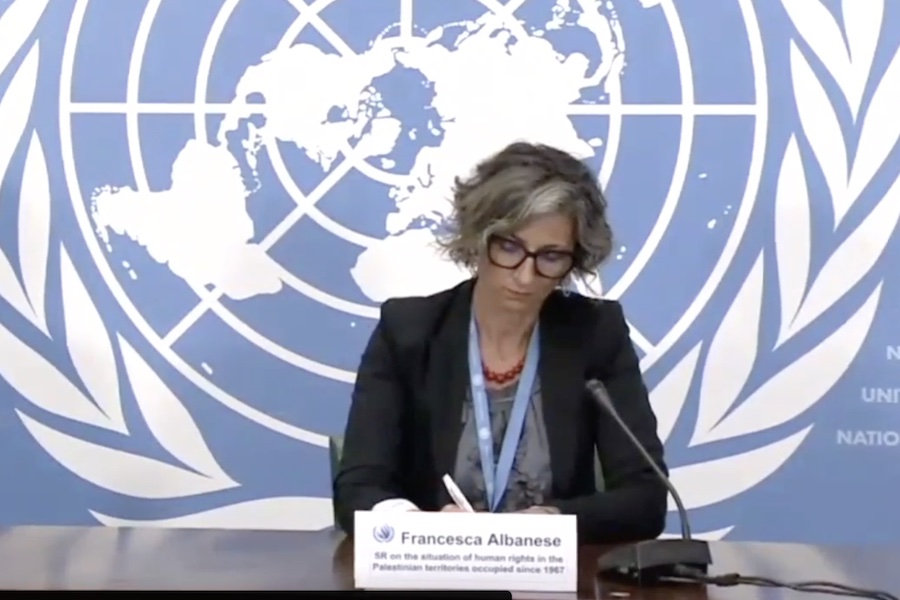
Frame from UN video of the Albanese press conference

“Under Israeli occupation, generations of Palestinians have endured widespread and systematic arbitrary deprivation of liberty, often for the simplest acts of life and the exercise of fundamental human rights,” Albanese said. Without condoning violent acts that Palestinians may have committed during decades of Israel’s illegal occupation, most of their criminal convictions have resulted from a litany of violations of international law, including due process violations, that taint the legitimacy of the administration of justice by the occupying power.

The report finds that since 1967, over 800,000 Palestinians, including children as young as 12, have been arrested and detained under authoritarian rules enacted, enforced and adjudicated by the Israeli military. Palestinians are subject to long detention for expressing opinions, gathering, pronouncing unauthorised political speeches, or even merely attempting to do so, and ultimately deprived of their status of protected civilians. They are often presumed guilty without evidence, arrested without warrants, detained without charge or trial and brutalised in Israeli custody.

(continued in right column)

Question related to this article:

Presenting the Palestinian side of the Middle East, Is it important for a culture of peace?

(continued from left column)

“Mass incarceration serves the purpose of quelling peaceful opposition against the occupation, protecting the Israeli military and settlers, and ultimately facilitating settler-colonial encroachment,” the Special Rapporteur said.

“Bundling Palestinians as a collective “security threat”, Israel has used draconian military orders to punish the exercise of basic rights. These measures have been used as tools to subjugate an entire population, depriving them of self-determination, enforcing racial domination and advancing territorial acquisition by force,” she said. 

Albanese noted that Israel’s “carceral regime” haunts Palestinian life even outside prisons. Blockades, walls, segregated infrastructure, checkpoints, settlements encircling Palestinian towns and villages, hundreds of bureaucratic permits and a web of digital surveillance, further entrap Palestinians in a carceral continuum across strictly controlled enclaves.

“The widespread and systematic arbitrariness of the occupation’s carceral regime is yet another expression of the apartheid imposed on the Palestinians and strengthens the need to end it immediately,” the UN expert said.

“The mass and arbitrary deprivation of liberty that Palestinians have been collectively subjected to for decades aims to protect Israel’s annexation of Palestinian territory, a project with unlawful aims pursued by unlawful means,” Albanese said. “This macroscopic violation of fundamental principles of international law cannot be remedied by addressing some of its most brutal consequences. For Israel’s carceral regime to end, and its inherent apartheid with it, its illegal occupation of Palestine must end,” she said.

Albanese called on Member States to uphold their obligations not to aid or recognise Israel’s settler-colonial occupation and incremental annexation, and use all diplomatic, political and economic measures under the UN Charter to bring it to an end and make sure its architects are brought to justice.

Francesca Albanese is the Special Rapporteur on the situation of human rights in the Palestinian Territory occupied since 1967

The Special Rapporteurs are part of what is known as the Special Procedures of the Human Rights Council. Special Procedures, the largest body of independent experts in the UN Human Rights system, is the general name of the Council’s independent fact-finding and monitoring mechanisms that address either specific country situations or thematic issues in all parts of the world. Special Procedures experts work on a voluntary basis; they are not UN staff and do not receive a salary for their work. They are independent from any government or organisation and serve in their individual capacity.

(Editor’s note: Not surprisingly, Albanese is under vicious attacks by Israel and it supporters. This is described in detail in the an article from the Jordan News.

Comment by Mazin Qumsiyeh on Palestine: Hope, Present and Future

. . HUMAN RIGHTS . .

A blog in the Popular Resistance Blogspot

The past 30 hours, Israeli occupation and apartheid forces invaded the city of Jenin including the Jenin Refugee camp. They bulldozed streets and electricity and water infrastructure. They prevented ambulances and attacked he press. Thousands of people were forced to leave their homes. A second etic cleansing for them. Our people are refused international protection and as before, Israeli atrocities are done with western and Arab world complicity. The few “statements” issued by some governments to express “concern” are satisfactory to the Israeli oppressors. While the Western powers hypocritically give billions of aid to Ukraine against Russia for occupying part of its territory, the same powers support the occupiers of Palestine. They support apartheid and ethnic cleansing.


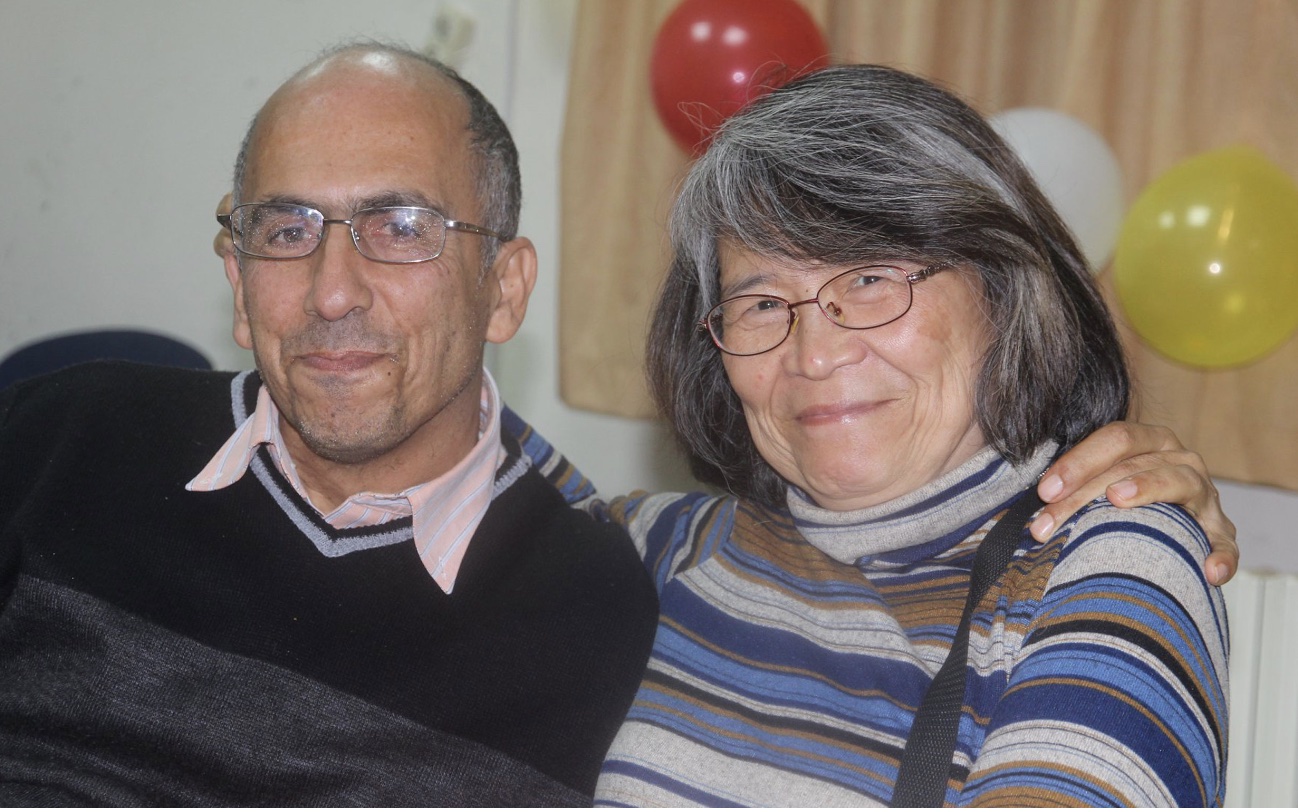
Mazin Qumsiyeh and Jessie Chang founded the Palestine Museum of Natural History and the Palestine Institute for Biodiversity and Sustainability. Photo from Dec. 19, 2018.

I would like to make a personal reflection here. I am 66 years old and has spent all my adult life working for the cause of freedom, A vision of sustainable human and natural communities. Hope is indispensable because we cannot afford despair. Empowerment is far more challenging because it implies work on conviction. We find it most challenging to get enough people empowered to effect the change needed. Once empowered people engage and use methods they deem most effective to get the desired results. I discussed hundreds of methods people used here, most of them not armed, in my book “Popular Resistance in Palestine: A history of hope and empowerment”. I also engaged myself in dozens of popular resistance methods. For the past 9 years my wife and I have been volunteering full time (and 7 days a week) building up from scratch a “Palestine Institute for Biodiversity and Sustainability. It is an oasis of hope and of sanity in the middle of mayhem. It is a candle in the darkness. I do not want you to have the illusion that we are 100% sure of our way.

(continued in right column)

Question related to this article:

Presenting the Palestinian side of the Middle East, Is it important for a culture of peace?

(continued from left column)

Doubts and uncertainty abound especially in difficult times which we face a lot and in times of crisis like this one with Jenin. For example, how certain are we (at a personal level) that our way is the right way when the Israeli regime has been bombarding us for 75 years, has caused 8 million refugees or displaced people? Was John F. Kennedy right to say “Those who make peaceful revolution impossible will make violent revolution inevitable”? Is there a survival of the meanest and the most wicked in this crazy world? Are the majority of Palestinians infected with mental colonization that immobilizes them (I wrote a chapter on this in a book on post-colonialism)? How many people have discipline and a work ethic and a commitment to make this a better world? How many people have “enlightened self interest” rather than narrow and foolish self-interest?  Are my expectations of myself and those around me higher or lower than it should be? Last night as I pondered these and other questions in a sleepless night, I realized that I do not have many answers and what answers I have, they can only apply to me (afterall, we can only change ourselves in reality).

Twenty years ago in my book “Sharing the Land of Canaan”  I articulated what I consider the rational way to stop the onslaught on people and nature in historic Palestine (now under the boot of Israel) I add the quote from Howard Zinn related to hope which I used in that book to remind myself:

“There is a tendency to think that what we see in the present moment we will continue to see. We forget how often in this century we have been astonished by the sudden crumbling of institutions, by extraordinary changes in people’s thoughts, by unexpected eruptions of rebellion against tyrannies, by the quick collapse of systems of power that seemed invincible. To be hopeful in bad times is not just foolishly romantic. It is based on the fact that human history is a history not only of cruelty, but also compassion, sacrifice, courage, kindness. What we choose to emphasize in this complex history will determine our lives. If we see only the worst, it destroys our capacity to do something. If we remember those times and places — and there are so many — where people behaved magnificently, this gives us the energy to act, and at least the possibility of sending this spinning top of a world in a different direction. And if we do act, in however small a way, we don’t have to wait for some grand utopian future. The future is an infinite succession of presents, and to live now as we think human beings should live, in defiance of all that is bad around us, is itself a marvelous victory.”

A blog I posted in late 2014 about life and how we live

B’Tselem Conquer and divide

Palestine video 1938

Who is the national security advisor Jake Sullivan, the man running US foreign policy?

Palestinians are in Israel’s cross hairs because they are not Jews

The Hindu Nationalists Using The Pro-Israel Playbook

Bill Clinton Lied—And So Did Everyone Else: A Mystery Solved in the Israel-Palestine Conflict

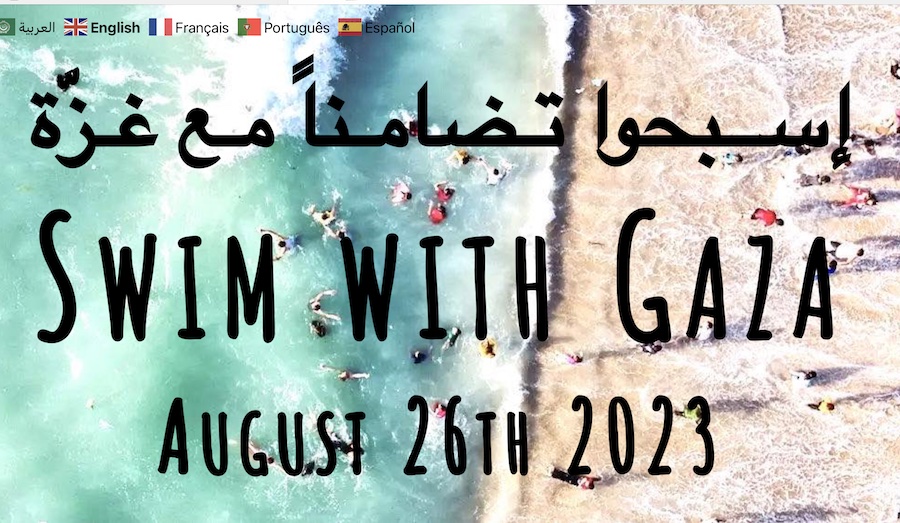
Solidarity with Palestine: Swim with Gaza

. . HUMAN RIGHTS . .

Mail received at CPNN from Paul O’Brien plus excerpts from the website of Swim with Gaza

Hi,

In your language see here: swimwithgaza.com

It would be lovely if you could join us on this international solidarity swim with children on Gaza beach on August 26th.

On that day hundreds of children who have learned to swim this summer with be streaming into the sea as part of the Gaza Swimming Festival.

Would you, your friends or family like to take to the water the same day in your own area, and send a video to us?

Maybe you could join the video live stream going to and from Gaza on the day.

See more here: swimwithgaza.com and use the form to leave your details.

Please pass this message onto others who might be interested.

It will be fun for all.

Paul O’Brien
Swim With Gaza

(continued in right column)

Question related to this article:

Presenting the Palestinian side of the Middle East, Is it important for a culture of peace?

(continued from left column)

Excerpts from website of Swim with Gaza

Since 2007 the people of Gaza have been imprisoned. They have no parks, no mountains, no valleys.

But they have the sea.

Their only free space for fun.

Let’s join them in the sea for a solidarity swim. Each year they have a swimming festival on Gaza beach. This is last year’s Gaza Swimming Carnival

This year the Swimming Festival will be held on 26th August.

The kids have already started training in Gaza

So join in wherever you are – Egypt, Lebanon, South Africa, Morocco, Spain, Ireland, Brazil or Chile.

Splash, and swim, and paddle and enjoy the sea, together.

Join them in a swim on August 26th, 2023.

Make it a festive day – bring friends and family..

TO SWIM IS TO FEEL

TO FEEL IS TO EXIST

TO EXIST IS TO RESIST

And as you are at it, why not send a message in a bottle to Gaza children, like they did recently in their Letters through the Waves campaign.

Appealing to the Waves: Children of Gaza Prisoners Make Their Case to the Mediterranean

If you would like to be involved, leave your contact details here.

Elders warn of consequences of “one-state reality” in Israel and Palestine

. . HUMAN RIGHTS . .

An article from The Elders

Following their visit to Israel and and Palestine, Mary Robinson and Ban Ki-moon warn that a ‘one-state reality’ is now rapidly extinguishing the prospect of a two-state solution.

The Chair and Deputy Chair of The Elders warned today (June 22) that a ‘one-state reality’ is now rapidly extinguishing the prospect of a two-state solution foreseen in the 1993 Oslo Accords to bring peace and security to both the Israeli and the Palestinian peoples. 

The Government of Israel’s intent to exercise sovereignty over all the territory between the Jordan River and the Mediterranean Sea undermines the democratic ideals of the Israeli state, denies the Palestinian people their right to self-determination, and risks an uncontrollable explosion of violence on both sides.
  
Mary Robinson, Chair of The Elders, former President of Ireland and UN High Commissioner of Human Rights, and Ban Ki-moon, Deputy Chair of The Elders and former UN Secretary-General, spoke out at the conclusion of a three-day visit to Israel and Palestine. They met a range of Israeli and Palestinian political leaders and civil society organisations, foreign diplomats, and former members of the Israeli military and diplomatic service. 

They also saw for themselves some of the facts on the ground, and heard from Israeli, Palestinian and international human rights organisations about the ever-growing evidence that the situation meets the international legal definition of apartheid: the expansion and entrenchment of illegal Jewish settlements in the West Bank and East Jerusalem, the establishment of dual legal regimes and separation infrastructure in the occupied territories, and the institutionalised discrimination and abuses perpetrated against Palestinians. 

They heard no detailed rebuttal of the evidence of apartheid. On the contrary, the declarations and policies of the current Israeli Government – whose Coalition Guidelines state that “the Jewish people have an exclusive and inalienable right to all parts of the Land of Israel” – clearly show an intent to pursue permanent annexation rather than temporary occupation, based on Jewish supremacy. Measures include the transfer of administrative powers over the occupied West Bank from military to civilian authorities, accelerating the approval processes for building settlements, and constructing new infrastructure that would render a future Palestinian state unviable.   

(continued in right column)

Question related to this article:

Presenting the Palestinian side of the Middle East, Is it important for a culture of peace?

Israel/Palestine, is the situation like South Africa?

How can war crimes be documented, stopped, punished and prevented?

(continued from left column)

Such a situation has profound implications for Israel’s proud status as a democracy, the two Elders warned. It also undermines the credibility of the international community as the guarantor of a rules-based global order. If the Israeli Government’s current trajectory is not reversed, countries who care about the international rule of law should consider serious enforceable measures to increase pressure on the Israeli Government to meet its international obligations. 
 
The two Elders also noted with alarm the highest level of violence since the end of the second intifada in 2005. They condemned the killings in the past week of Palestinian civilians by Israeli security forces in Jenin, of Israeli settlers by Hamas in the West Bank, and of a Palestinian civilian by Israeli settlers. The Palestinian leadership has a responsibility to do all it can to prevent the terror attacks that cause very real fears among Israelis. The two Elders warned such incidents will only escalate and multiply unless the root causes of the conflict are addressed. 

Mary Robinson, Chair of The Elders, former President of Ireland and former UN High Commissioner for Human Rights, said: 
“I am profoundly shocked by the changes I have seen on my first visit to this region for several years. The policies of successive Israeli governments have entrenched the oppression of Palestinians, and also jeopardise the security and democracy Israelis have fought so hard for. Meanwhile the Palestinian people have no confidence in their own leadership; elections are long overdue and the democratic vacuum and shrinking civic space allows extremism and violence to flourish. All parties, including the international community, must act urgently to avert a calamitous descent into uncontrollable violence.” 

Mary Robinson and Ban Ki-moon expressed solidarity with Israelis protesting against their government’s proposed plans to weaken judicial independence, and encouraged protesters to confront the corrosive impact of the 56-year occupation on Israeli democracy. 

They also challenged the international community to address double standards on violations of international law. The indictment of Russian President Vladimir Putin by the International Criminal Court (ICC) for war crimes in Ukraine stands in stark contrast to the lack of progress on the ICC’s investigation into alleged crimes committed in the occupied Palestinian territory, including East Jerusalem. Together with the case before the International Court of Justice and the work of the UN Commission of Inquiry, the ICC case is a litmus test for the credibility of an international system which should hold to account all those who break international law. 

Ban Ki-moon, Deputy Chair of The Elders and former UN Secretary-General, said: 
“I leave Israel and Palestine with a heavy heart. I have seen and heard compelling evidence of a one-state reality, with systemic impunity for violators of international law and human rights. There is a lack of political vision and leadership in Israel and Palestine and among Israel’s allies, who continue to revert to a short-term approach. The people of Israel and Palestine, and the world, deserve better. And they deserve it now, before it is too late.” 

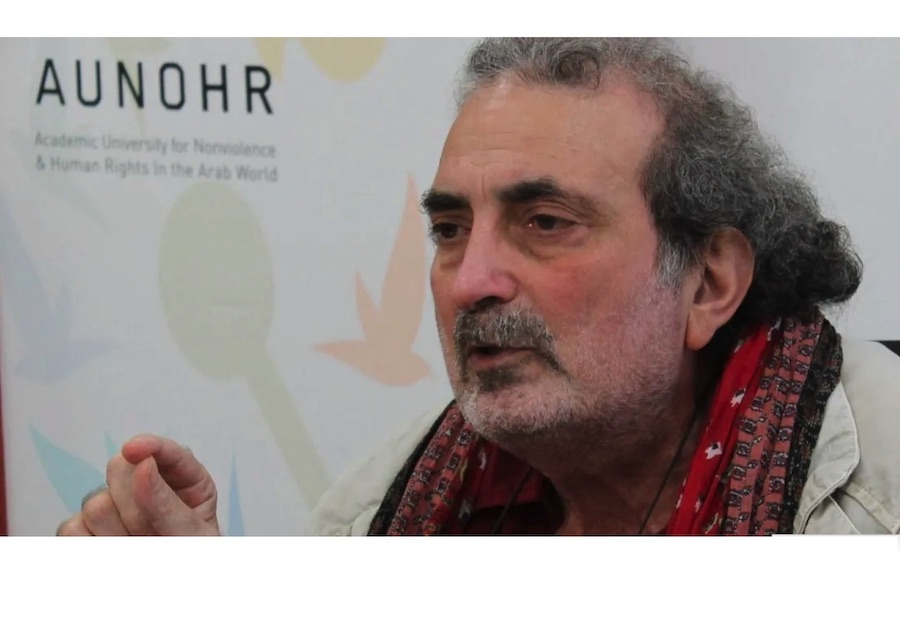
In memoriam: Walid Slaïby, co-founder Academic University College for Non-Violence & Human Rights (Lebanon)

FREE FLOW OF INFORMATION .

An article from the Global Campaign for Peace Education (translated by The Global Campaign for Peace Education from the original French version by Anne-Marie El-HAGE in L’Orient Le Jour , May 8, 2023)

He was one of those followers of non-violence who made Lebanese society and the Arab world better. A thought that he developed during the civil war, in the same way as secularism, in reaction to the destructive consequences of the Lebanese intercommunity conflict on the social fabric. Walid Slaïby is no more. He died on Wednesday, May 3 at the age of 68, overcome by a cancer that had been eating away at him for more than 20 years. His name, inseparable from that of his companion in life and struggle, the sociologist Ogarit Younan, will forever be linked to activism for the right to life within the framework of the fight for the abolition of the death penalty. Civil rights will also be at the heart of his fight for a Lebanese personal status law. Along with workers’ rights and social justice, from the early 1980s.


Walid Slaïby, follower of non-violence and death penalty abolitionist, died on May 3 at the age of 68. (Photo courtesy of Aunohr Media Services)
(Click on photo to enlarge)


An immense legacy

From his commitment to the service of Lebanon, he will leave an immense legacy. A multitude of books, publications, translations, bills, associations, tangible progress on the ground, always with Ogarit Younan. With the crowning achievement in 2015 of the Academic University College for Non-Violence & Human Rights (Aunohr), an educational institution dedicated to non-violence that continues to train generations of students, activists, trade unionists ready to take over. This course will see the duo rewarded several times, in particular by the Human Rights Prize of the French Republic in 2005, the Fondation Chirac Prize in 2019 and the Gandhi Prize for Peace awarded in 2022 by the Indian foundation Jamnalal Bajaj, named after the disciple of Mahatma Gandhi.

It is in his fight against the death penalty that Walid Slaïby initiated the most tangible progress. “He was a silent soldier against capital punishment. But his work was very important,” says Wadih Asmar, president of the Lebanese Center for Human Rights (CLDH). After federating several associations around the National Campaign for the Abolition of the Death Penalty, the activist rallied part of the political and judicial class to the cause, during shock events that were highly publicized. In 1998, when two burglars, one of whom had committed a double murder, were hanged in Tabarja in the public square, he openly proclaimed during a nocturnal sit-in “mourning for the victims of the crime and for those of capital punishment “. As a result, the last executions date back to 2004 in Lebanon, even if justice continues to pronounce the death sentence. “Lebanon is now classified as a de facto abolitionist country. In 2020, for the first time in its history, it spoke out for a moratorium at the UN General Assembly, alongside 122 other states. A position recently reiterated”, welcomes former minister Ibrahim Najjar, a committed abolitionist. The lawyer did not personally know the deceased, but he said he was “respectful and admiring of the courage of Walid Slaïby and his companion Ogarit Younan, who behaved as convinced abolitionists”. “Because the fight is not easy. It is so easy to confuse revenge with capital punishment,” he points out. for the first time in its history, it came out in favor of a moratorium at the UN General Assembly, alongside 122 other states. 

(Article continued in the column on the right)

(Click here for the original version in French)

Questions related to this article:

Where in the world can we find good leadership today?

How can we carry forward the work of the great peace and justice activists who went before us?

(Article continued from the column on the left)

A position recently reiterated”, welcomes former minister Ibrahim Najjar, a committed abolitionist. The lawyer did not personally know the deceased, but he said he was “respectful and admiring of the courage of Walid Slaïby and his companion Ogarit Younan, who behaved as convinced abolitionists”. “Because the fight is not easy. It is so easy to confuse revenge with capital punishment,” he points out. for the first time in its history, it came out in favor of a moratorium at the UN General Assembly, alongside 122 other states. A position recently reiterated”, welcomes former minister Ibrahim Najjar, a committed abolitionist. The lawyer did not personally know the deceased, but he said he was “respectful and admiring of the courage of Walid Slaïby and his companion Ogarit Younan, who behaved as convinced abolitionists”. “Because the fight is not easy. It is so easy to confuse revenge with capital punishment,” he points out. but he says he is “respectful and admiring of the courage of Walid Slaïby and his companion Ogarit Younan, who behaved as convinced abolitionists”. “Because the fight is not easy. It is so easy to confuse revenge with capital punishment,” he points out. but he says he is “respectful and admiring of the courage of Walid Slaïby and his companion Ogarit Younan, who behaved as convinced abolitionists”. “Because the fight is not easy. It is so easy to confuse revenge with capital punishment,” he points out.

For a Lebanese Personal Status Law

The personality of Walid Slaïby is no stranger to his great popularity. “Walid was a man of dialogue, attentive to his friends. It is through debate and acceptance of the other that he succeeded in laying the foundations of the culture of human rights in Lebanon, and in particular of non-violence”, affirms Ziad Abdel Samad, friend of the couple, engineer and teacher in political science. “Despite the divisions of Lebanese society, he managed to go beyond the militias and the borders to lead an avant-garde struggle and achieve remarkable progress”, he observes, referring to the efforts of the deceased to raise awareness among young people and bring closer Lebanese of different faiths and backgrounds. It is also in the institutionalization of the fight that Walid Slaïby drew his strength. “When I met him in the early nineties, he organized human rights training against religious discrimination, remembers activist Rima Ibrahim. Despite his illness, he never stopped dreaming of changing Lebanese society, to the point of institutionalizing the fight.

Several associations were then created, linked to the Lebanese Association for Civil Rights (LACR), notably Chamel and Bilad. In 2011, the militant couple launched their campaign to demand a Lebanese law on personal status which advocates, among other things, civil marriage. In Lebanon, family laws are governed by religious communities. They discourage inter-religious unions and discriminate against women. “For the occasion, we organized a sit-in and set up a tent for 10 months, place Riad el-Solh, in downtown Beirut. We have also prepared a bill,” recalls Rafic Zakharia, lawyer, teacher and member of the association. Signed by MP Marwan Farès, the text is presented to Parliament and transferred to the joint commissions. “The law has not been adopted. But our mobilization has never weakened”, assures the activist, whose “life has changed” since he met Walid Slaïby. “Non-violent thinking has become a way of life for me, not just a fight,” observes this death penalty specialist.

The happiness of having given hope to the Lebanese

The militant, the thinker, the humanist endowed with superior intelligence and a good dose of humor left with modesty and elegance, as he has always lived. “Walid Slaïby was both a great humanist and a man of science. Very solid in his convictions, he was flexible when it came to discussing. Never giving lessons, he was not a man to show off, but on the contrary was very discreet, ”describes the lawyer and former minister Ziyad Baroud, member of the board of directors of Aunhor, who knows him. for over 25 years. Multi-graduate, the disappeared was indeed a civil engineer (ESIB), a graduate in physics (UL) and in economics (AUB). Studies he completed with a DEA in social sciences (UL),

He will be missed by human rights defenders, starting with abolitionists around the world who pay tribute to him and his companion. “It was a star of light and reason in a world of shadow and madness”, sums up Raphaël Chenuil-Hazan, director general of the international association ECPM (Together against the death penalty). “With Ogarit, they formed this incredible duo who have devoted their lives for more than 40 years for a modern Lebanon”, he continues, congratulating himself on having had “the chance to send him love before his death of the abolitionist community around the world. Walid Slaïby will especially be missed by his alter ego, his soul mate, Ogarit Younan, with whom he was to celebrate 40 years of love and activism. “We were expecting the weather to improve a bit. We wanted a nice party. We didn’t think he was so close to death. He loved life so much. He had so much humor,” she regrets sadly. And if the disease occupied a good half of their life together, he will at least have had “the happiness of serving his country and giving hope to the Lebanese”. “Lebanon must be happy, we have served it, consoles Ogarit Younan. But if Walid had not fallen ill, without a doubt, Lebanon would have been different…”

Celebrating Rachel Corrie

TOLERANCE AND SOLIDARITY .

Excerpts from the website of the Rachel Corrie Foundation for Peace and Justice

Rachel Corrie, a 23-year-old American peace activist from Olympia, Washington, was crushed to death by an Israeli bulldozer on 26 March 2003, while undertaking nonviolent direct action to protect the home of a Palestinian family from demolition.

Her 44th birthday was celebrated on April 10, 2023 at the Rachel Corrie Foundation in Olympia with speakers and discussion to remember her and the commitment of the Foundation to continue her work for Palestine.

(continued in the right column)

Question for this article

Presenting the Palestinian side of the Middle East, Is it important for a culture of peace?

How can just one or a few persons contribute to peace and justice?

(continued from the left column)

Rachel’s parents, Craig and Cindy Corrie, who established the Foundation, were the special guests at a virtual discussion March 22 on their fight for justice fo Rachel over the decades.


Video of event Remembering Rachel 20 years later

(Editor’s note: In a related development, a new Gallup poll shows that for the first time more American Democrats sympathize with Palestinians than Israelis.)

Int’l Peace and Humanity Conference commences in Amman

. . WOMEN’S EQUALITY . .

An article from Jordan Times

The International Peace and Humanity Conference, organised by the Shobak Women’s Charity Association, commenced in Amman on Tuesday (March 7), assembling heads of delegations from several Arab countries.

The three-day conference will address several issues, the foremost of which concerns the role of women and female leadership in promoting a culture of peace, specifically in terms of empowering women and families, redressing family structure as it relates to gender norms, building a model civil society, and accentuating contemporary Arab female role model, the Jordan News Agency, Petra, reported.


Senator Fadel Hamoud speaks during the International Peace and Humanity Conference, organised by the Shobak Women’s Charity Association, in Amman on Tuesday (Petra photo)

(Article continued in right column)

Questions related to this article:

Do women have a special role to play in the peace movement?

(Article continued from left column)

The conference aims to uphold a culture of peace and peaceful coexistence at the national and global levels, engage all facets of peace and humanitarian efforts, support the democratic process, increase peace and humanitarian initiatives, ensure sustainable development, cooperate with national and international humanitarian organisations, and work cooperatively to provide consultations concerning rights, legal, medical and humanitarian issues.

Attending the conference on behalf of Senate President Faisal Fayez is Senator Fadel Hamoud, who stressed the importance of rejecting hatred and establishing instead a culture of love, compassion and peace – values that stem from the teachings of Islam and can be applied in opposition to obstacles hindering peace.

Chairperson of the conference Basma Habahbeh said the purpose of the event is to underscore the importance of peaceful coexistence between societies, which he noted is the key to security and developing human capital, culturally, economically and socially.

Several heads of participating delegations gave speeches indicating the importance of Jordan’s peace-building role in the region, also noting that His Majesty King Abdullah maintains a firm position in international forums that stresses peace as the only solution to international conflict.

Morocco: Launch from Essaouira of the Women’s World Forum for Peace

. . WOMEN’S EQUALITY . .

An article from Le Matin (translation by CPNN)

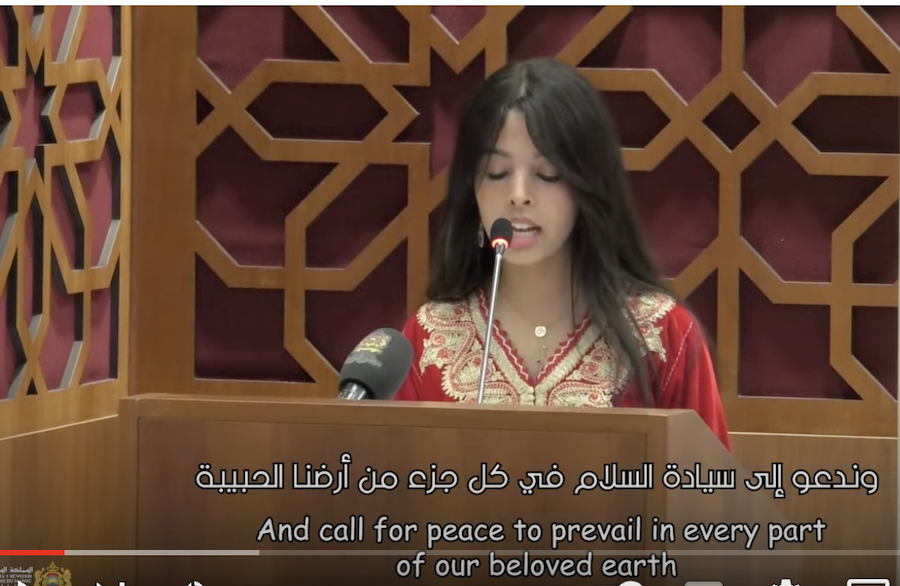
The Women’s World Forum for Peace was launched on Tuesday in Essaouira by the “Warriors of Peace”, a movement of Jewish and Muslim women for peace, justice and equality, on the occasion of international women’s dayl . The meeting took place in the presence of André Azoulay , Adviser to His Majesty the King and founding president of the Essaouira-Mogador Association , the governor of the province, Adil El Maliki, the president of the communal council of Essaouira, Tarik Ottmani, elected officials and other actors from various backgrounds, that the founding act of this World Forum has taken effect.


Video of forum which was sponsored by UNESCO and the UN. One of speakers was Shirin Ebadi, Nobel Peace Laureate from Iran.

Women from all over the world, activists for peace and committed to justice, emancipation and freedom, including Jessica Mwiza, activist for Memory (Rwanda), Huda Abu Arquob, president of the Alliance for Middle East Peace (Palestine), and Nuith Hagragh, Women Wage Peace (Israel) , together delivered a common message, a call for peace to the world. Speaking at this meeting, a dozen activists representing Morocco, Palestine, Rwanda, Senegal, Liberia and Israel , presented captivating testimonies in which they shared their respective experiences, their actions and peace initiatives.

(Article continued in right column)

(Click here for the original article in French.)

Questions related to this article:

Do women have a special role to play in the peace movement?

(Article continued from left column)

Speaking on this occasion, Hanna Assouline welcomed the organization of this conclave in “such a magical city, on African soil, in Morocco, a country which for years has opened a way, a path of lights” . “It is this recognition of otherness in itself that drives us all here. This is what Morocco has decided to reaffirm for years now, in particular with the inclusion in its 2011 Constitution of the plurality of Moroccan origins (Arab, Amazigh, Hebrew, African and Mediterranean), “she continued. , adding that this commitment by Morocco is a “precious message for the world”. 

This forum brings together women from all over the world, some of whom have never left their country, and who met in Essaouira , to jointly launch this appeal and challenge the world in favor of peace, in a city that “wonderfully embodies the values of dialogue and reconciliation,” Ms. Assouline explained in a statement to M24, MAP’s continuous news television channel. For her part, Fatima Bousso indicated that these women from various regions of the world “came to bring to Essaouira, this city of openness, culture and sharing, a common appeal to the world for peace”.

Subsequently, the participants in the forum gathered in front of the ramparts of the Sqala, in the center of the medina of Essaouira to execute “a human chain” in favor of peace . Previously, they paid a visit to Bayt Dakira , an opportunity for them to follow exhaustive explanations presented by Mr. Azoulay on this spiritual and heritage space for the preservation and enhancement of Judeo-Moroccan memory. On the menu of this event is also the screening, on Sunday, in Bayt Dakira, of the film ” The warriors of peace “, directed by Hanna Assouline ., and a march for peace that will depart from Bayt Dakira to the beach where a peace footprint will be left. 

Egypt, Jordan, Algeria, Palestine, Arab League reiterate commitment to supporting Al Quds

DISARMAMENT & SECURITY .

An article from Egypt Today

CAIRO – 12 February 2023: Al Quds support conference kicked off on Sunday at the Cairo-based Arab League HQ with the participation of President Abdel Fattah El Sisi, Jordanian King Abdullah II, Palestinian President Mahmoud Abbas, and Arab League Secretary General Ahmed Abul Gheit.


High-level representatives for presidents and kings of Arab League member states also attend the event alongside foreign ministers and representatives for international, regional and Arab organizations.


Al Quds is the Arabic name of Jerusalem

Spokesman for AL Secretary General Gamal Roshdi said the conference is meant to bring to limelight the Quds issue before world public opinion in view of Israel’s crimes and violations.


Al Quds Affiars Minister Fadi al-Hidmi said the conference is extraordinary, calling for a clear political Arab stand.

The conference focuses on three main axes; the political conditions in Quds, development and investment priorities in Quds and the Israeli illegal and racist measures against Quds people.

President Abdel Fattah El Sisi has reaffirmed Egypt’s firm stance towards the rejection of Israel’s measures to change the legal status of Al Quds and its sanctities.


President Sisi called on Arabs to support the Palestinian cause.


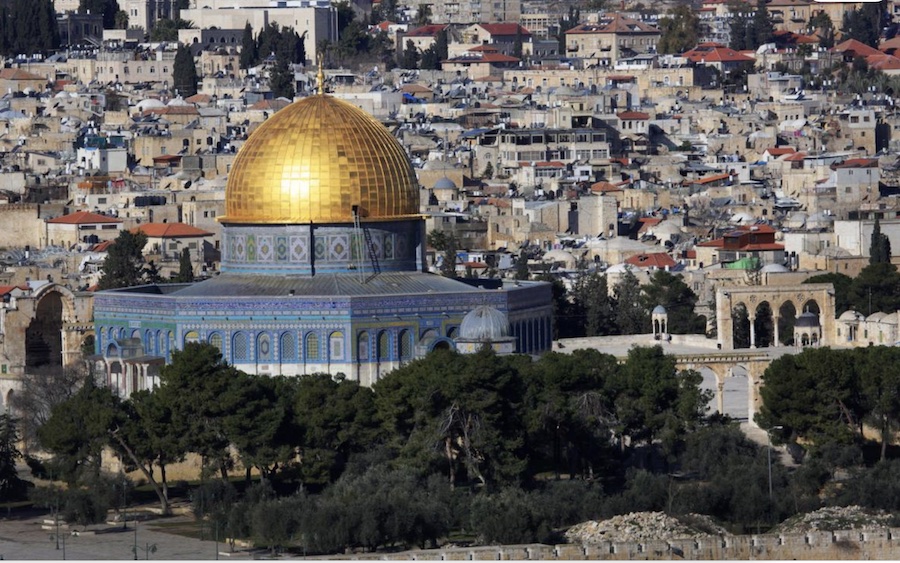
President Sisi welcomed the participants of the conference, saying that Al Quds, which hosts Al Aqsa mosque and the Church of the Holy Sepulchre, is the crux of the Palestinian cause.


The president said that Egypt rejects all Israeli measures to change the historical and legal status of Al Quds and supports the Hashemite custodianship of the Holy places of the City.

President Sisi said that Egypt, more than four decades ago, stretched its hands to Israel to achieve just and durable peace that restores the rights of the Palestinian people and establishes a Palestinian state on the 1967 borders.


He said today’s gathering coincides with extraordinary circumstances threatening regional security and the concept of coexistence.


President Sisi said Israel’s unilateral measures including settlement activities, demolition of houses, confiscation of lands, expulsion of the Palestinians from their homes and attempts to Judaize Al Quds, run counter to the international legitimacy resolutions and fuel congestion.


The president appealed to the international community to work on salvaging the two-state solution plan and pave the way for the resumption of peace talks, saying that Egypt will continue its efforts to reconstruct Gaza Strip 


Sending a message to the Palestinian people, the president said that their cause will remain on the top of the priorities of Egypt and the Arabs.


Sending another message to Israel, its government and people the president said “time is ripe for peace and coexistence among the peoples of the region.”
 
President Abdelmadjid Tebboune of Algeria warned that the racist policies adopted by Israeli occupation authorities in Al Quds and its attempts to obliterate its Arab, Islamic and Christian identity will only achieve imaginary gains that violate legitimacy and demography.

(article continued in right column)

Question related to this article:

How can a culture of peace be established in the Middle East?

(article continued from left column)


Addressing the conference, the Algerian President reiterated condemnation of repeated Zionist attempts to impose a fait accompli through falsifying facts in the holy city.


He reiterated Algeria’s full commitment to support the right of the Palestinian people to establish their independent state within June 1967 borders with Al Quds as its capital.


He reiterated Algeria’s appreciation for the positive steps that have been achieved recently at the diplomatic level, especially the adoption of a resolution by the UN General Assembly to activate the role of the International Court of Justice in consolidating the rights of the Palestinian people.


He said Algeria will continue endeavors aiming at strengthening Palestinian national unity to materialize the legitimate aspirations of the Palestinian people in obtaining their freedom and restoring their sovereignty.

Also, Arab League Secretary General Ahmed Abul Gheit stressed that Arabs should enhance the steadfastness of Palestinians to preserve the Arab identity of Al Quds in face of all attempts to Judaize it.

Abul Gheit said the issue of Al Quds is at the heart of all Arabs, warning that the holy city does not only suffer from occupation but also from attempts to obliterate its identity.


Al Quds is under occupation and no one can change this fact, Abul Gheit said, warning that all attempts to Judaize the city will lead to more violence.


He underlined the importance of preserving the historical status of Al Quds so that just and comprehensive peace can be achieved, saying today’s conference aims at sending a message to the entire world on the importance of protecting the holy city from violations committed by occupation forces.


He warned of attempts to divide Al Quds and erase its Islamic identity, saying such attempts would lead to more hatred and conflicts.


He made clear that Israel is adopting a systematic approach to undermine the two-state solution, urging all peace loving powers to join efforts to settle the Palestinian issue.

King Abdullah II of Jordan has called on the international community to work on achieving the legitimate rights of the Palestinian people to establish a sovereign and viable state on the 1967 borders with Al Quds (East Jerusalem) as its capital.


Addressing Al Quds support conference, King Abdullah said the current state requires intensifying efforts to support the Palestinian people.


He said his country continued efforts to protect the Islamic and Christian holy sites in Al Quds.


The king stressed the importance of maintaining peace on the basis of the two state solution and ending Israel’s storming operation of Aqsa mosque, pointing out that the Palestinian cause will remain on Jordan’s top priorities.

Palestinian President Mahmoud Abbas said supporting Al Quds and its people is a religious duty and vital at the humanitarian and national levels. Abbas said al Quds is in need for the support of Arab and Islamic countries.
Palestinian President Mahmoud Abbas said “we will go to the United Nations for a resolution protecting the two-state solution through granting Palestine full membership.”


He called on Arab funds and associations to perform their duty in defending al Quds and protecting its identity.


Abbas voiced deep appreciation for President Abdel Fattah El Sisi’s attendance of the conference, thanking Sisi and the Egyptian people for Egypt’s continued support for the Palestinian cause and the reconstruction of the Gaza Strip.


He also thanked King Abdullah II of Jordan for his support for the Palestinian cause and his efforts to protect Islamic and Christian sanctities in al Quds.


He called for putting into effect the decisions of the Arab summit that was held in Algeria last November.


Meanwhile, he lauded an initiative launched by the Qudsona Foundation and Al Quds empowerment fund and Al Quds endowment fund for mobilizing dlrs 70 million financing amid plans to up this number to dlrs 200 million within the coming five years.

How the Islamic Revolution Gave Rise to a Massive Women’s Movement in Iran

. WOMEN’S EQUALITY . .

An article by Behrooz Ghamari Tabrizi in Counterpunch

Let me start with a straightforward proposition that is everywhere on social and mass media these days: The Islamic Republic’s patriarchal repression of women reached a tipping point after the murder in custody of Mahsa (Zhina) Amini by the Guidance Patrol on September 16, 2022. A revolt, led by young women, engulfed the entire country under the banner of women, life, freedom. At the root of this movement is the anti-women core of the Islamic regime and the struggle of Iranian women against it since its very beginning in 1979.

The whole nation — inside and outside the country, the global community, the progressive Left as well as the hawkish Right, stand in solidarity with this movement. The protests that began against the compulsory hijab and the demand for abolishment of the Guidance Patrol, has now become a full-fledged intersectional revolt for regime change in Iran, led by women.


This indeed is true that the Islamic Republic instituted draconian patriarchal policies after the revolution on 1979 that stripped the very basic formal rights that women had been granted under the ancien régime. These measures formally reduced women to second-class citizens in matters of marriage, custody, inheritance, crime and judiciary, dress code, segregation, and many other spheres of social life.  Yet, despite all this, women’s social mobility and presence in public sphere grew exponentially in the past four decades.  Ironically, this is in part an effect of the unintended consequences of these policies. Women learned very quickly how to navigate the new terrain, push the boundaries of the new institutions, and in practice gain access to rights and privileges from which the Islamic Republic deprived them. The recent revolt could not materialize without the remarkable agentive presence and mobility of women who carved out a space for ceaseless social and political engagement during the past four decades. Women are revolting because they refuse to continue the struggle in a field the boundaries of which are drawn in the dilapidated spirits of patriarchy.  Their gains have reached a hard as well as a glass ceiling that needs to be overcome.

The Iranian revolution succeeded in ending the monarchy on February 11, 1979. On February 26, only two weeks after the victory of the revolution, Ayatollah Khomeini annulled the Family Protection Law of 1967 and its 1975 amended version, which had given women more rights in divorce and matters of custody under the Shah. Since its inception, the clergy by and large had opposed the law’s basic premises, which they believed violated the Islamic views on women’s role in family.  Khomeini knew that the unity and uniformity that his leadership afforded the revolutionary movement would not remain uncontested for long after the triumph of the revolution. He knew that the spirit of Islam and the symbolic revolutionary language with which it inspired millions of Iranians of many creeds and classes needed to be translated into a body of institutional projects of postrevolutionary state-building.  So, he seized the opportunity to put women under the control of their menfolk.

Despite such overt assaults on women’s rights, most political parties continue to address women’s issues in the frame of revolutionary politics, nationalism, class struggle, and anti-imperialism.  For the first few months after the revolution, except for the National Front, the oldest liberal organization in Iran, and small Trotskyist group, Left and liberal parties remained ambivalent about women’s issues. They failed to recognize the remarkable contribution of women to the revolutionary struggle and the need to check the assault on their rights.  At the time, most of the women’s organization operated as an appendix to different political parties to further the anti-imperialist struggle and tied women’s issues to greater demands for social justice.

The establishment of the Islamic Republic proved inconsistent with fundamental women’s formal and legal rights.  Despite earlier assurances, on the eve of March 8, 1979, less than a month after the triumph of the revolution, Ayatollah Khomeini called upon the Provisional Government to uphold Islamic dress codes in its offices.  His pronouncement scandalized many who played a significant role in the revolutionary movement, including several members of his own Revolutionary Council.  This was the second time, after the abrogation of the Family Protection Law, in three weeks that issues of women’s right had become a point of contention in the postrevolutionary power struggle. That was why the festive preparations for the first postrevolutionary International Women’s Day turned into a rally with specific women’s rights demands such as the recognition of women judges and, most importantly, a call against compulsory hejāb.  Thousands of women gathered in Tehran University and the next day in front of and inside the hallways of the Ministry of Justice chanting: In the Spring of freedom, absent is the rights of women.

Instituting compulsory hejāb even in the tightly controlled parliament and implementing it throughout the country was not an easy proposition. It took another four years for the mandate to become an enforceable law. Different factions inside the government as well as influential clerics in seminaries raised questions about the wisdom of such a law, its religious justification, as well as its feasibility. Nevertheless, the new law went into effect on August 9, 1983.

The institution of compulsory hejāb and other patriarchal measures in cases of travel, marriage, custody, inheritance, criminal laws, etc. all of which formally reduced women to second-class citizens, gave yet more credibility to feminist concerns that the Islamic republic would entirely force women out of the public sphere. Comparisons were made with Reza Shah.  Some argued that whereas he liberated Muslim women by the “unveiling law” that banned the hejāb in public spaces in 1936, the Islamic Republic was now forcing women back into the private sphere where they would be subjected to the repressive domestic patriarchy.  Yet curiously – these contrasting policies produced paradoxical results on the ground. Reza Shah’s “unveiling” did not liberate women, and the Islamic Republic’s repressive measures did not imprison women at home. Ironically, it was under Reza Shah’s “unveiling law” that a great majority of women in urban areas were forced to stay at home, either because they chose not to appear in public without a veil or were not allowed to leave their homes by their fathers or husbands. Under the Islamic Republic, despite the institution of repressive anti-women laws, rather than being imprisoned in their homes, women gained unprecedented mobility in the country and year after year increased their presence in the public sphere.

These were unintended consequences, but they were quite substantial. As a consequence of the restrictions imposed on women in public places, a new system emerged of what I call patriarchy by proxy. The new laws created the possibility for a great majority of socially conservative Iranian families who were previously reluctant to see women’s participation in social affairs, to trust the new “Islamized” public sphere as an extended domain of patriarchal/religious order. The state became the ultimate guardian of patriarchy and by becoming so, paradoxically, sanctioned an unprecedented mobility among rural and urban women. Despite barring women from entering key political and judicial positions of decision-making, women entered and shaped the conditions of those spheres in significant numbers.

(continued in right column)

Question related to this article:
 
Prospects for progress in women’s equality, what are the short and long term prospects?

(continued from left column)

In practice, gender politics and policy under the Islamic Republic have been far from the mere enactment of literal readings of the Qur’anic verses or a replication of women’s repression in Saudi Arabia. There is no doubt that the postrevolutionary regime instituted formal and legal apparatuses in order to constitute a homo Islamicus. But in its realpolitik, the Islamic Republic negated the anxieties that it would implement a literal reading of the Qur’an and expunge women from the pubic and restrict their lives to the domestic sphere. A quick look at the human development indexes in relation to women’s status in education, health, sports, artistic and cultural production, and civic engagement shows that the women in Iran have the most visible presence in public sphere in its history.  These changes were not the result of top-down state policies, but rather the consequence of a contentious engagement between different factions within the polity, women’s community and civic institutions, and political parties and activists.

From the time of revolution in 1979 to the latest reports in 2019, women’s literacy rate rose from 36% to 97.93%; share of women students in higher education rose from 15% to 60%; women’s life expectancy rose from 55 to 77; infant mortality decreased from 90 per 1000 to 10 per 1000. None of these could have been possible without a remarkable presence of women in public space and their involvement in policy planning and implementation.

The significant presence of women in the public arena created unanticipated shifts in gender relations in the country, conditions that forced even the most patriarchal factions in power to advocate unlikely propositions regarding women’s role in society. In 2006-2007 school year, women comprised 60% of incoming class of university students, and that trend continues. The conservatives of the 8th Parliament introduced legislation for affirmative action for men to catch up with women in higher education. The conservative parliamentarians, who otherwise insist that the place of women is at home to raise a virtuous family, argued that women who use resources of free public universities had to commit to a 10-year employment (public or private) after graduation. The paradox there is self-evident.

Another measure that contributed to the remarkable shift in family structure and gendered relations in public and private spheres was an aggressive family planning and population control program that was instituted in 1989. Although the Islamic Republic repealed the family planning and protection laws of the old regime soon after assuming power, in a significant shift, in 1988, the government introduced and carried out one of the most efficient family planning programs in the economically developing world.   Dictated by the perceived necessity of containing an unchecked rise in population, the program successfully reduced the population growth rate from the high of 3.4% in 1986 to 0.7% in 2007. During the same period, the number of children per family dropped from 6.5 to less than 2. Before his death in 1989, Ayatollah Khomeini endorsed the new program thus affording religious legitimacy to this ideological reversal.  As the Candadian-Iranian anthropologists Homa Hoodfar has shown, without national consensus-building, a massive mobilization of women, both by government agencies as well as non-governmental agents, promoted with effective religious justification, and offered through an efficient delivery service in birth control and contraceptives (such as distribution of free condoms), and premarital sex-education programs, this ambitious family planning project could not have been realized. Called by many “The Iranian Miracle,” the program was so successful that, fearing the emergence of an aging population, the authorities are now trying to encourage families to have more children.

The purpose of this brisk history is not to draw a sanguine picture of women’s conditions in contemporary Iran. The complexities of how government and non-governmental actors interact on these issues, how the expansion and containment of state power shape the social realities of women of different classes and ethnicities, or how religious doctrines and convictions hinder or facilitate women’s mobility cannot be fully detailed here.  Rather, I want to show that the Islamic Republic instituted policies and imposed patriarchal laws that produced unintended consequences in gender relations and women’s mobility. For an uprising to materialize, there needs to be a socially mobile, politically conscious, and subjectively free population. Iranian women have long been the fierce political actors we see on the street, not the oppressed, shadowy, veiled subjects that are the meat and potatoes of foreign misperception and paternalism. Yes, a mighty patriarchy shaped social order in Iran, like many other places in the world, but women were never its hapless captives. That image, the helpless veiled women, while effective in gathering support in global liberal feminist circles who believe that Muslim women need to be saved, does not correspond to the practice of those women’s everyday lives and fails to credit two generations of Iranian women for their political creativity.

At its core, Women-Life-Freedom is a movement for dignity and sovereignty of the subject.  It is a movement that has changed the political culture of defiance and expressions of dissent. Its radical creativity— posters, songs, graffiti, and imaginative forms of collective action, has opened in practice the possibility of thinking of politics anew. The transformative acts of insubordinate bodies and liberated souls has made party platforms and unruffled sermons ineffective and obsolete.

While Iranian women and their male allies fight against the state’s brutal crackdown, their aspiring revolt, with its novel singularities, faces instrumentalization by regional and global actors, facilitated through a misreading of Iranian women’s history of deliberate and agentive action. While the global reach of this movement through the media operates as an instrument of its effective dissemination, paradoxically, it also subjects it to a discursive violence.

We should not misread the core principles of Women, Life, Freedom as being a simple “desire for the west” by a population who are simply fed up.  Under such a misreading, a whole host of unsavory interests, from neocolonial expansionists to ethno-nationalist separatists, from delusional monarchists to all those who still lament being on the losing side of the 1979 revolution, try their best to claim ownership of this movement.  Yet Iranian women on the ground have been the very actors who historically have created the conditions of possibility for their protest.  They have opened space for themselves and their daughters in the face of a state desire for repressive patriarchy. Over decades they have succeeded to take advantage of the unintended consequences of state policies; they are not merely reacting—they are instead determined.

Today’s massive women’s movement in Iran represents one of the great achievements of the 1979 revolution—a revolution that generated hope-bearing, conscious subjects who have perpetuated themselves for more than four decades – despite and in the face of all manner of repression. The paradoxical effects of the Islamic Republic policies brought women to the centerstage of social transformation in Iran. Now that transformation has reached a point of frontal war with the state. Iranian women today hold key positions in journalism, artistic and cultural production, civic engagement, political organizing, higher education, scientific communities, local political offices, etc. Daughters of those women, irrevocably demand an extension and expansion of their mothers’ positions without any patriarchal restrictions, either by the state or inside their homes.

Those demands will only be realized through the transformation of the state, or by rethinking the meaning of the state. How this transformation will unfold and with what means is yet not known, but its inevitability is evident. How fortunate we are that these generations of women taking the lead.

– – – – –

Behrooz Ghamari-Tabrizi is an Iranian-born American historian, sociologist, and professor.