Category Archives: South Asia

Interview with Vandana Shiva: Why small farms are key to feeding the world

. . SUSTAINABLE DEVELOPMENT . .

An article by Anand Chandrasekhar, Swiss Info

Between 1990 and 2009 the number of small farms in Switzerland halved and the average farm size doubled. With family farming chosen as the theme for this year’s World Food Day, leading activist Vandana Shiva is calling for more support to small farmers.

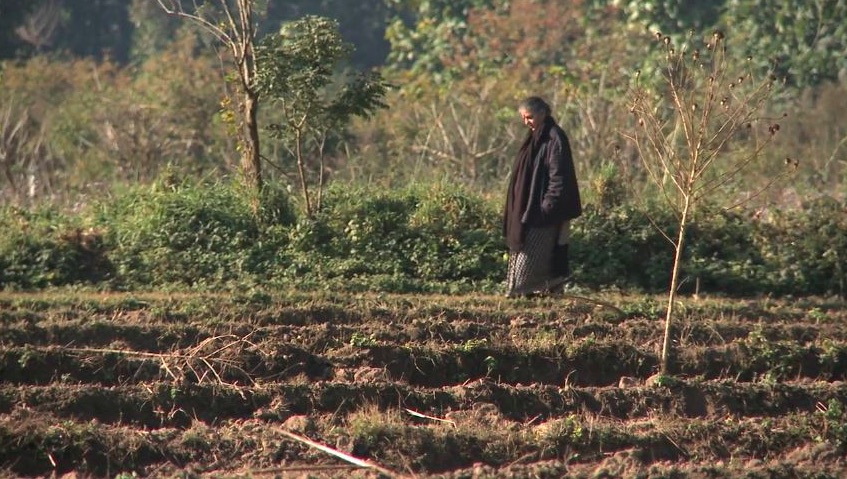
shiva
Photo Source: https://vimeo.com/103764529 (Becket films: http://vandanashivamovie.com/ – screenshot)

Shiva is an “earth democracy” activist and founder of the India-based NGO Navdanya, which works to protect biodiversity, defend farmers’ rights and promote organic farming. According to Shiva, Switzerland’s attempts at food self-sufficiency could show an alternative way for farming.

swissinfo.ch: Swiss farms are getting fewer and larger. How can Switzerland become more self-reliant and still retain the family-farm model that is an important part of the cultural identity of the country?

Vandana Shiva: The reasons farms are becoming fewer and larger is a highly twisted economy that punishes small farmers and rewards industrial agriculture. One reward is the $400 billion in global subsidies for large-scale farms. The other reward is that every step of law-making, such as regulations concerning standardisation of food, retail chains, and intellectual property laws, puts a huge burden on small farmers.

For 10,000 years small farmers have done the job. Why only in this century has small farming become unviable? It is because the trade-driven, corporate-driven economic model for agriculture has been designed for large-scale farming. It has been designed to wipe out small farms. Around 70% of the food eaten globally today is produced by small farms. Small farms produce more and yet there is mythology that large scale farming is the answer to hunger.

We need to revisit the subsidy question that destroys the planet and other peoples’ food economies. The moment policy internalises small farming, small farmers are going to flourish.

swissinfo.ch: Developed countries like Switzerland provide subsidies in the form of direct payments to farmers that are linked to activities like protecting the environment and maintaining the landscape. What is your opinion on this?

V.S.: I differentiate between subsidies and support. A nation should support the maintenance of its waterways, watersheds, soil, biodiversity and communities. Small countries in Europe like Switzerland and Norway have taken this path. If Switzerland supports its mountain farmers it is causing zero damage to dairy farmers in India. The subsidies that cause damage are the ones that are linked to agribusiness and exports because that is where dumping starts to happen.

So I would say that ecological payments to farmers are necessary because agriculture is not just the production of commodities for global markets. It is also about taking care of the land, biodiversity, soil and water. A good farmer who is ecological and organic is doing the work of a physician giving you healthcare, which then reduces national expenditure on diseases.

So, I would completely separate subsidies to agribusiness for grabbing markets from support to small farmers to maintain a society, its ecosystems and culture. However, I am glad about this discussion over reduction of subsidies, as it can then link to issues like transition to ecological agriculture, localised food systems and that issues like increasing self-reliance and food sovereignty are coming into the picture.

(Article continued on right side of page)

Question for this article:

What is the relation between movements for food sovereignty and the global movement for a culture of peace?

swissinfo.ch: In Switzerland, the Swiss Farmers Association has submitted an initiative that will be put to vote by Swiss citizens calling for more self-sufficiency in food production. Do you think this is realistic or idealistic for a rich but small country?

V.S.: I think if there is one country that could show another way for farming it is Switzerland. Even though Syngenta has its headquarters in Switzerland, it was the Swiss people who had the first national referendum to keep genetically modified organisms (GMOs) out. This shows that corporate power cannot take over citizen’s power in Switzerland because of the referendum system. Corporations can lobby the government to change a law but how do they get to every citizen in every canton?

Switzerland unlike the American Midwest is a mountainous area. Therefore industrial agriculture just doesn’t work there. Thus the advantages of a decentralised democracy and a mountain ecosystem makes it possible for Switzerland to even conceive such an initiative for more self-sufficiency. Mountain ecosystems and communities should be the basis for food reliance in healthy economies.

I would be very happy to this initiative grow and wish all strength to the Swiss people and Swiss farmers.

swissinfo.ch: Indian agriculture is often viewed as inefficient and backward. What can the world learn from Indian small farmers?

V.S.: India is after all supporting 1.2 billion people. We recently prepared a report called “Health per acre”. What we did was first measure the biological productivity of small, diverse farms and we converted this into nutrition per acre. A small, biodiverse Indian farm is so productive that if scaled up to all the available agricultural land in the country, we could feed twice the Indian population. Small, biodiverse farms also provide a higher net income.

The world should start seeing that these giant monoculture farms are producing commodities that are not feeding people but are transformed into biofuel and animal feed. More land for this would aggravate hunger and not reduce it. Whatever does go to human food is nutritionally empty or toxic.

Brazil has followed this path of large scale commercial production, whether it is soyabean or sugarcane, by basically destroying its campacinos [small farmers]. That is why you have the Landless Rural Workers’ Movement (MST) who are now occupying these large farms in Brazil.
The one thing no government can touch is the sanctity of the small farm and the dignity that goes with

WACC-SIGNIS Human Rights Award 2014 goes to “Taxi”

. HUMAN RIGHTS .

an article by Signis, World Catholic Organization for Communication

The WACC-SIGNIS Human Rights Award 2014 has gone to the film Taxi directed by Jafar Panahi (Iran, 2014), a feature-length documentary highlighting contemporary society in Iran.

teheran
click on the photo to enlarge

“Taxi”, by Jafar Panahi © Jafar Panahi Film Productions

An unusual and creative way of promoting the human right to communicate, challenging censorship and breaking the taboo of silence within and about Iran. A yellow cab driving through the vibrant streets of Tehran plays host to diverse passengers who express candid views while being interviewed by the driver, who is none other than the film’s director Jafar Panahi.

Taxi plays a dual role visually mediating freedom of expression while ironically showing how new technologies are part and parcel of life and social interaction today. The film underlines and critiques how media images often govern people’s understanding of what is official, authentic, and legal as opposed to what is unofficial, false or downright criminal.

Panahi achieved international recognition with his feature film debut, The White Balloon , which won the Caméra d’Or at the 1995 Cannes Film Festival, the first major award won by an Iranian film at Cannes. Although his films were often banned in his own country, he continued to receive international acclaim from film critics and won numerous awards, including the Golden Leopard at the Locarno International Film Festival for The Mirror (1997), the Golden Lion at the Venice Film Festival for The Circle (2000), and the Silver Bear for Best Director at the Berlin Film Festival for Offside (2006).

Panahi’s films are known for their humanistic perspective on life in Iran, often focusing on the hardships of children, the impoverished, and women. In his own words, “I’m a filmmaker. I can’t do anything else but make films. Cinema is my expression and the meaning of my life. Nothing can prevent me from making films. Because when I’m pushed into the furthest corners I connect with my inner self.”

Abbas Kiarostami, who made Iranian cinema world-famous, often set his protagonists in cars so that the audience sees what the actor sees. The car and the eyes of the viewer became one, a large moving camera, so that the film director shares observations and thoughts with the viewers.

Jafar Panahi uses a similar technique in Taxi , although the decision to do so was not entirely voluntary. Panahi is currently banned from making films in his home country and is not allowed to travel abroad. Although sentenced to a term in prison, his was freed as a result of pressure from abroad. However, he has chosen to disregard the work ban imposed on him.

Taxi is a courageous act of resistance. The director plays the taxi driver in his own film, making conversation with numerous passengers as he drives them around Tehran. Some of these passengers address Iran’s democratic abuses very directly. In this respect, Taxi is a politically committed film.

It is also fun. And the taxi driver and his passengers often talk about cinema. The resulting conversations are very insightful, resulting in a clever take on current events.

The criteria for the international WACC-SIGNIS Human Rights Award are a documentary film (rather than a feature film) from the year in question that seeks to throw light on a question of human rights reflecting the values and priorities of WACC [World Association for Christian Communication] and SIGNIS [World Catholic Organization for Communication].

(Click here for the French version of this article or here for the Spanish version.)

Question for this article:

The Self-Employed Women’s Association: Shining a light on India’s poor

. . SUSTAINABLE DEVELOPMENT . .

An article by William French, for The Elders (abridged)

India is an increasingly dynamic player in the modern digital economy, but many thousands of poor and rural communities still have their lives and work dictated by the rhythms of the sun and the moon. A lack of access to affordable energy means sundown equals shutdown, a loss of productivity, efficiency and valuable income.

BhattClick on photo to enlarge

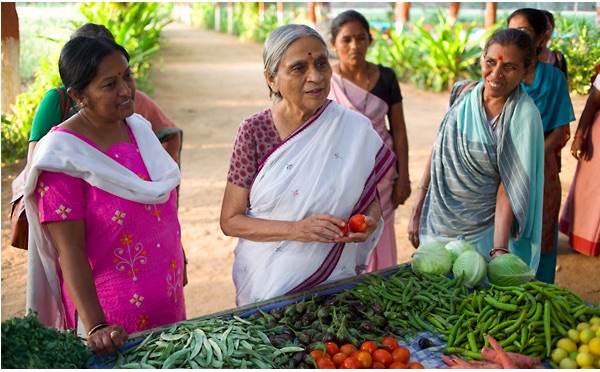
Ela Bhatt with members of the Self-Employed Women’s Association (SEWA). Photo: The Elders | Tom Pietrasik

“No light means we cannot continue to work after sunset. This means less income, and often we cannot afford to eat on the next day”, in the words of Santokben, an artisan from the village of Bakutra in Gujarat.

To break this cycle, the grassroots trade union SEWA (Self- Employed Women’s Association) has been working since 2009 to promote its “Green Livelihoods Campaign” – known as “Hariyali” in the local language – to provide cheap access to sustainable energy across India. SEWA, founded in 1972 by Elder Ela Bhatt, has argued for decades that access to energy is vital in emancipating communities and especially women who are otherwise marginalised both economically and politically.

“The Hariyali Campaign has been structured to deliver Energy Access, financial inclusion and gender empowerment for SEWA’s members,” said Ela Bhatt. “The key to success was in building a model which is sustainable, replicable and scalable.”

n practice, portable solar LED lanterns and clean cooking stoves are provided to SEWA members, paid for by instalments. SEWA has negotiated an unsecured bank loan of Rs 250 million ($4.2 million) from an Indian private bank to provide this service to its members.

The result has been electrifying – in the most literal sense. In the words of Kapilaben, a widow and small farmer from the Gujarat village of Rasnol:

When my husband died I had to bring up three daughters. Life was dark as we had no electricity and everything felt hopeless. How do I cope? Thanks to ‘Hariyali’ I now have a solar lantern and a cooking stove. Now I do all the work, send all my three daughters to school and am now a grassroots leader at SEWA!

Underlining the complex nature of its work in a country as vast and diverse as India, SEWA has identified three major challenges which highlight the importance of listening to local communities and learning from their own needs and experiences. It aims to raise awareness, for example of how to use more efficient and healthy cooking stoves; to determine availability so the right sort of stove is delivered to the right people (ie, the stove made for the South Indian population who mainly eat rice isn’t suited to those who eat roti in North and Central India); and guarantee affordability by closely working with local communities and financing partners.

SEWA has also developed “Project Urja” to provide solar lights to women’s self-help groups across the deprived Bihar-Mungar region using a special “energy loan product” in cooperation with India’s Ministry of Rural Development. By February 2013, 177 LED lights had been provided to seven villages, meaning that children could study after dark, the women could cook better meals at night and they could also charge their mobile phones.

For Ela Bhatt, this is a shining example of how innovation and cooperation can transform lives and raise communities out of poverty.

Question for this article:

Do women have a special role in poverty reduction?

According to the target articles (below), as well as many other economic analyses and reports, the key to poverty reduction is the education and employment of women and their actions for economic justice.

The Road Ahead: Strategies to Support Women Entrepreneurs in Latin America
In Cambodia, the women are saying, “No!”
The Self-Employed Women’s Association: Shining a light on India’s poor

The Peace Letters Project

EDUCATION FOR PEACE . .

an article by The Peace Letters Project

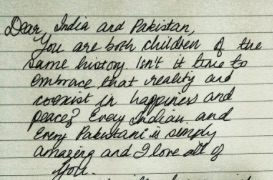
The PeaceLetters Campaign is a very simple way of showing your commitment to peace, and to build the value through bonds forged with unseen, unknown and unheard communities. It involves a very simple task that’s broken down into the following steps:

1. Choose a community / person / country that you want to send a message to.

2. Take a piece of paper and address the community / person / country and write your message of peace.

3. Take a photograph of the letter and submit it using the form below [click here]!

We will then put it up on this website! A few points to keep in mind, though, are:

1. We do not allow room for letters with content that is hurtful, offensive, discriminatory or defamatory.

2. We reserve the right to refuse to publish content that our team deems hurtful, offensive, discriminatory or defamatory.

3. We take your privacy very seriously, and undertake not to disclose any details you don’t want us to share.

Send us your Peace Letter Here!

Remember, just three simple steps:

1. Choose someone to send a message to.

2. Take a piece of paper and address the community / person / country and write your message of peace.

3. Take a photograph of the letter and upload it below [click here]!

[Thank you to Janet Hudgins, the CPNN reporter for this article.]

Question(s) related to this article:

Can children be involved in the peace process through literacy?,

Latest reader comment:

Students, especially children are easily moved when they hear about other children. Parents and teachers should take time to explain to students about world situations. Show them pictures or documentaries so that they will have a better understanding of how they can promote peace. Simple facts of life like living simply, recycling, protecting the environment can be shared with them so that they develop a different kind of maturity – be prepared to serve others than to be served. They will realise that peace is important if you want to improve the condition of the unfortunate. As they grow, they choose careers whereby they will be able to meet the needs of the unfortunate.

India: New Institute for Peace through Tourism (IIPT)

. SUSTAINABLE DEVELOPMENT .

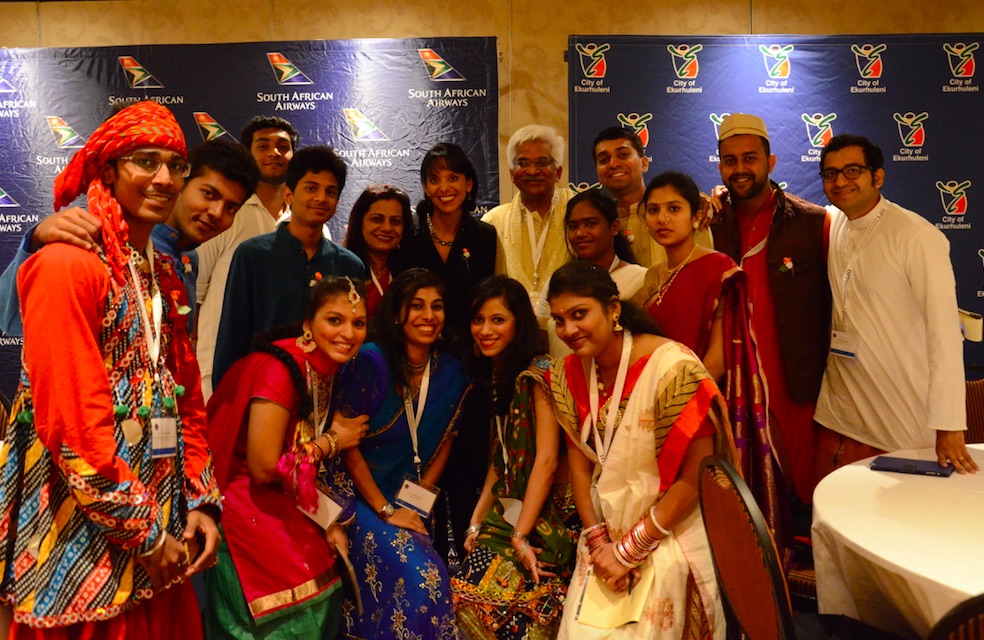
an article by Youth Delegates from IIPT India who came to IIPT Conference in South Africa

IIPT India is a new initiative which we need in India because our country has not realized in potential in tourism. We want people to come to India to experience its beauty.

india-2
click on photo to enlarge

We are students in management at SVIMS Mumbai University. Our professor Kiran Yadav together with one of his colleagues Ajay Prakash organized an initiative of IIPT (Institute for Peace through Tourism) in India earlier this year and told us about it. We had never before imagined how tourism could promote peace, so we like the concept.

We were pleased at the opportunity to come to this conference in Johannesburg (South Africa) on peace through tourism. We are 14 students, part of a youth leadership forum.

The new Prime Minister of India is now promoting tourism with an “incredible India” campaign. We spoke here with the head of the United Nations World Tourism Organization who told us that when he visited India in 2002 he found that the government was not very interested in tourism. Now that has changed.

Before coming here we mobilized about 500 students to sign the credo of the peaceful traveler developed by the international IIPT.

When we go back we will try to put into practice what we have learned here – especially community-based tourism.

For example, the Dharavi zone in the heart of Mumbai, traditionally considered as a slum, has thousands of small household industries. The entrepreneurs there want to invite tourists to visit them. So now we have guided tours of Dharavi where they show how small- scale industry can play an important part in the Indian economy.

We are inspired by the example we have heard here about climbing Mount Kilimanjaro in Tanzania, and we could do similar tours in the mountains in Maharashtra which is a popular site for trekking not too far from Mumbai.

We have made videos of speakers here at the conference, and we will show them to the students who couldn’t come with us, and to other whom we can interest in the future of IIPT India.

We are interested in internship possibilities for peace through tourism that we have heard about here. And then we can become ambassadors of peace.

Since Indians love the Bollywood cinema, maybe we can interest some actors and actresses to promote peace tourism.

For us tourism used to mean just seeing new places, but now we realize that it can be a chance to know new people and to promote peace.

Question related to this article:

How can tourism promote a culture of peace?

Comment by Liliana Mota, October 23, 2013

Why tourism?

Can tourism be seen as an instrument to achieve complicity between people’s minds?

“There is nothing better that connects two people’s mind than a good conversation” The above quote could be used to describe the effect which tourism has on people. Like a great conversation, tourism could be said to play a vital role amongst people all over the world. It fosters communication in all its senses, intercultural dialogue and mutual understanding.

In today’s world it is evident that there is a shortage of moral or ethical values amongst people across the different nations in this world, resulting in a globalised world lacking these morals and ethical values. Ignorance, the failure to consider the needs of others, and selfishness are a few of the ways which hinder us from embracing diversity and a common human perspective, which would result informal empathy, internal moral compassion, tolerance of differences, historical consciousness and interpretation. The above mentioned features are intrinsic, inherent and can be found in the practice of tourism.

Tourism has been emphasized as one of the most effective instruments which continue to tackle to tackle social and economical poverty, as well as encourage the culture of peace practice amongst people. In looking at the UN architecture, one is able to see the growing implications which the tourism sector has on the world and world policies. The touristic phenomenon has achieved a world record of 5% of world’s GDP contribution and is responsible for 235 millions jobs, according to the UNWTO’s data. Often the tourism sector counts more than 20% of the countries’ GDP.

On the negative side of this, it is evident that tourism focuses on economical matters, depriving any focus on the global implications of the constant interaction tourism encourages.

In the literal sense, tourism is nothing more or less than people meeting with the willingness to understand each other’s differences and point of view and simultaneously creating the opportunity for dialogue, mutual understanding and peace to take place.

Apart from tourism, various factors could be seen to play a role in encouraging integration and diversity amongst societies across the world. For example, the cultural segment has played an essential source of people’s integration and inclusiveness in developing countries.

Education has also played a significant role in encouraging integration, and incorporation amongst people all over the world. Education has been reconsidered and proposed to being the catalyst for exchange between countries, cultures and sectors, and most importantly for enhancing the lives of people by granting them the opportunity to leave their poverty stricken lives and societies in exchange a for better future which includes job and exchange opportunities.

In the tourism world, differences play the most essential role, differences among people represents the added-value. Being different is always a positive factor that usually motivates and encourages people to get to move and engage with each other and embrace the differences with the use of spiritual, religious and cultural meanings.

This notion of tourism needs to be addressed in multilateral governance discussions, where all the main actors, the international community, the ministerial and experts, private sector, local institutions and civil society engages are all present, and are all willing to work together in combined efforts and initiatives (from poverty alleviation to the promotion of awareness of sustainable development addressing special needs like regional development, urban planning and protection of natural and cultural landscapes). This combined approach of working at the local level within communities and at the national and international level, in order to reach and engage the poor, has been considered as potentially being the “one possible and effective answer” and effective approach towards the world’s poorest areas where it can make a difference.

In Nepal, Woman Radio Host Makes Big Splash over Airwaves

.. EDUCATION  FOR PEACE ..

an article by Jiyoung Han for Search for Common Ground (abridged)

Sanju Kumari Das is a petite, soft-spoken woman, but don’t let that fool you. Hailing from Siraha, a volatile district in Nepal’s eastern Terai, this formidable 26 year-old commands the attention of political giants, helps end nationwide strikes, and is one only a handful of female radio show hosts in Nepal.


Sanju Kumari Das

Sanju is a producer for the Farakilo Dharti franchise, one of Search’s peacebuilding radio talk shows in Nepal. . . . Sanju has undergone Search’s peacebuilding training and applies the common ground approach to disputes on the program.

“It’s challenging to get people of opposing sides to come to an agreement, but it’s truly rewarding when it happens,” explains Sanju. “Agreement is difficult to achieve and should be celebrated.” . .

Once when political parties enforced nationwide strikes over a disagreement on the future federal states, Sanju invited party reps on the show to talk it out. This set a constructive precedent for subsequent talks, culminating in a multi-party agreement to end the strikes.

Many of Sanju’s guests have praised her accomplishments and mediation skills. This is all the more striking in a region where women are expected to be silent before men, contrary to Sanju’s highly public profile as a peacemaker. However, Sanju believes her gender and youth are irrelevant to the quality of the show, however. She coolly explains that, as long as the proper conflict resolution models are maintained, hosts young and old, male and female, would see similar results.

“I used to think I was always right, that my opinions were the most accurate. But producing Khulla Dharti has shown me that I make mistakes, that alternative views have just as much merit as my own. I’ve learned to listen to others, which is a crucial part of resolving any conflict.”

Khulla Dharti has built a strong following, with listenership as high as 41% of all radio listeners in the eastern region of Nepal. Sanju credits the program’s emphasis on neutrality and constructive dialogue as the key to its appeal. Whether it’s critically or appreciatively, listeners are engaging with Khulla Dharti conversations. For now, they’re focused on getting Sanju back on air; the mother of two has been on maternity leave to look after her 8 month-old son. She plans on returning to Khulla Dharti soon.

Fourteen radio stations currently produce and broadcast Farakilo Dharti in three languages—Nepali (Farakilo Dharti), Maithili (Khulla Dharti), and Tharu (Chakkar Dharti)—tailoring their respective shows to the local context. Between April and June of 2013, 84% of FD episodes have led to an agreed solution between conflicting parties, while a 2013 listenership survey revealed that 80% of respondents continue the discussion with friends after listening to the show. Indeed, FD continues to have impact on its target communities, with marginalized groups across the country reporting that it gives their voices an otherwise unavailable platform.

Question related to this article:

Women and peace: an incomplete South Asian directory

.. WOMEN’S EQUALITY ..

an article by Vignesh Rajendran, Edited by Mitha Nandagopalan

This project originated in a quest to identify potential partners for peace-related projects. That quest shifted shape, but we kept the kernel of the work and expanded its scope to include all SAARC member countries.

We started with the question, “Which women’s organizations work on peace?” But given that feminists define peace as far more than the cessation of conflict and hostilities, the term was hardly a filter. After all, peace is also empowerment, engaged citizenship, good governance, sustainable development and a free flow of information and expression.

As we identified organizations across a spectrum of activities, we began to tag them with ‘keywords’:
• Peace and conflict transformation
• Women’s rights and empowerment
• Capacity building and community mobilization
• Governance and policy advocacy
• Gender, welfare, relief and sustainable development
• Information and communication

The keywords are simply intended to help in our search to identify resources and partners, not to narrowly define an organization’s work in any way.

The directory is the product of a desk-based Internet search. It is organised into country-specific volumes and a consolidated South Asia volume.

We invite you to email us with names and website addresses for organizations you think should be included. Email us at prajnyatrust@gmail.com.

The Prajnya Trust is a Chennai-based non-profit engaged in research, public education and network- building in areas related to peace, justice and security. This project is located at the intersection of its two initiatives—Politics, Security and Women and Education for Peace.

[Editor’s Note: Interested readers will find on their website extensive information on 175 organizations in Afghanistan (20), Bangladesh (32), Bhutan (3), India (38), Maldives (2), Nepal (29), Pakistan (28) and Sri Lanka (25)].


Question related to this article.

Would your organization like be included in this database?

Press Release from Global Peacebuilders

Building community capacity for peacebuilding worldwide

The Global Peacebuilders project managed by Springboard Opportunities Limited is going live soon. Comprising an innovative online information-sharing portal, unique best practice catalogue and an international conference located in Belfast, Northern Ireland, the Global Peacebuilders project will connect researchers, academics, practitioners and organisations working on peace and reconciliation, conflict resolution and peacebuilding worldwide, and will provide a platform for disseminating achievements and building capacity for the future.

While every conflict across the world is distinct, the underlying causes are often similar, and there is much to be gained by building bridges between practitioners and sharing in the positive work and successes that have taken place. Not only within the context of the island of Ireland, but also beyond, there is a need for a positive place in which all conflict resolution and peacebuilding organisations can come together, share strategy, build momentum and increase their capacity for transforming conflict and creating the conditions for sustainable peace.

The Global Peacebuilders project will help build such a platform for disseminating achievements and sharing strategies for the future. Specifically, a fully-searchable 5-language online database of individuals and organisations working in conflict resolution and peacebuilding will be developed. The database will bring together organisations from across the global north and south, and, stemming from this, a comprehensive catalogue of best practice examples in conflict resolution and peacebuilding from around the world will be produced.

By building new relationships and spanning continental divides, the project will enable organisations to ‘broaden their horizons’, offering inspiration and strategic direction, and affording them a portal through which to share and incorporate innovation and best practice. By offering a solid support network for conflict resolution, reconciliation and peacebuilding, Global Peacebuilders will help organisations to learn from one another, increase confidence, build capacity and ultimately make a more effective contribution towards stable and inclusive societies across the world.

Sign up and circulate

If you, your organisation, or any organisation you know would be interested in joining the online database of peacebuilding and conflict resolution organisations, contributing your best practice examples, or simply learning more about the Global Peacebuilders project, contact Sarah Maitland, the Global Peacbuilders Project Coordinator on +44 (0)28 9031 5111, sarah@springboard-opps.org or www.springboard-opps.org. A spirit of inclusivity, diversity and participation is at the very heart of this project, so we would be delighted to hear from you!

The Global Peacebuilders project is funded by the European Union’s Peace and Reconciliation Programme 2000-2006 under Measure 5.3 Developing Cross Border Reconciliation & Understanding and managed for the Special European Union Programmes Body by the Community Foundation for Northern Ireland.