FREE FLOW OF INFORMATION
A survey by CPNN
The following 53 actions in 17 Latin American countries include those listed in Google during the week of September 21-28 under the key words “International day of peace”, “Dia Internacional da Paz” and “Día Internacional de la Paz” The events also includes some listed on the event map for the International Day of Peace and on the facebook pages for the global feast and the International Cities of Peace.
About 50 actions are listed in One Day One Choir and Montessori schools singing for peace, but there is no indication which took place this year and which took place only in previous years.
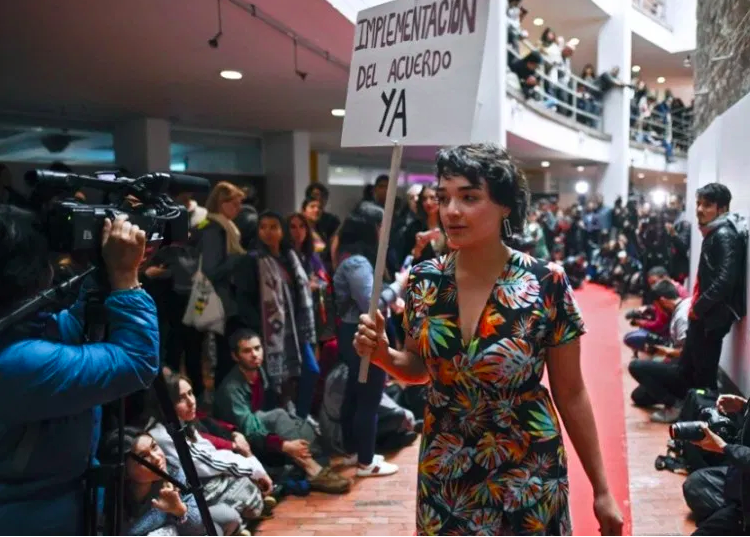
In Bogota a fashion show by former FARC guerillas. Former guerrilla Milena Reyes, parading with a flower dress, holds a placard demanding implementation of the peace agreement.
Here are excerpts from articles about the actions, many translated by CPNN.
BUENOS AIRES, ARGENTINA : Within the framework of the International Day of Peace celebrated on September 21, a symphonic concert will be held in the Cathedral Basilica Nuestra Señora de las Mercedes in Buenos Aires. “Mercedes sings to peace” is the name of the activity organized by “Music for Peace”, an association created in 2016 that performs itinerant musical cycles and aims to promote interreligious and multi-ethnic dialogue. The gala on September 21, the seventh that takes place in that temple, will begin at 8:00 pm and will feature the participation of the young talents of the School Orchestra conducted by Horacio Vivares. . . .
BUENOS AIRES, ARGENTINA : As a member of International Cities of Peace, Buenos Aires took part in the Global Feast.
JUJUY, ARGENTINA : There was a wide attendance at the celebration in this capital of the International Day of the Peace, that took place in the park “General Belgrano” of High Comedero . . .
MERCEDES, ARGENTINA : The International Day of the Peace was celebrated in the City of Mercedes with a concert composed of a classical and popular repertoire, on Saturday, September 21 from 8:00 p.m. to 9:00 p.m. It was an initiative of Music for Peace, an inter-religious, multi-ethnic and itinerant association.
QUILMES, ARGENTINA : Within the framework of the International Day of the Peace, the Municipality of Quilmes invites you to participate in the World Peace Festival, which will be held on Saturday, from 10 to 18, in the Historical Museum of Transportation (Laprida 2200), organized by the Quilmeña civil association Sueños y Sonrisas, who perform an important social work with judicialized children of Quilmes and Florencio Varela in homes, hospitals and canteens. The event, declared of Municipal Interest, also includes: One Thousand Millennials of Peace, Living Of Peace, Humanity Teams Argentina, International Cities of Peace, Mimes for your Eyes, Ong Dreams & Smiles, INDHYS, Pro Buenos Aires Foundation, FO. CA.VA , Radio Entrepreneur 92.5Mh, Rotary Club Solano, Club de Leones Quilmes, San Francisco Solano and SL Arte. There will be workshops, talks, recreations and a presentation by Valeria Swoboda, founder of the NGO Sueños y Sonrisas, which promotes the celebration with the intention of bringing the community together in different activities, raising awareness of unity and building peace.
SALTA, ARGENTINA : In commemoration of Peace Day, which is celebrated every September 21st students will plant trees in San Martin Park. The activities are organized by the Ministry of Government, Human Rights and Justice and the students of the Dr. Benjamín Zorrilla School of Commerce. The activity will be held on Monday 23 at 10, in the San Martin Park, behind the Natural Sciences Museum, with the participation of the prison band’s music band.
SAN LUIS, ARGENTINA : Last Saturday, in addition to celebrating the arrival of spring and the celebrations of Student Day, it also had other events, including International Peace Day, which some institutions waited for the first business day to commemorate, as It was the case of the school “San Buenaventura”, whose educational community made a march through the streets of Villa Mercedes.
SUNCHALES, ARGENTINA : “UMBRELLA FOR PEACE” is an initiative of the American artist Matt Lamb, who, after the September 11 attacks on the Twin Towers in New York, started a workshop as a way to help children who had lost their parents in the attack, getting each of them to express their feelings through colors and art painting the umbrellas. This project has multiplied in different parts of the world. It proposes people of all ages artistically intervene umbrella with children and display them in meetings as a symbol of the protection of positive values. Nucleado Kindergarten No. 274 “María Montessori”, in this year 2019, attributes to its traditional “Umbrella for Peace” Day a special imprint proposed from Casa Pax Cultura.
On September 21, the “International Day of Peace, the invited institutions, with their group of students with whom the subject worked, will carry the artistically intervened umbrella and a flyer with an explanation of what is represented in it. The umbrella will be part of an exhibition that day in the square and then in another public place to designate. For that same day, all participants are requested to bring their own umbrellas from home (without needing to be artistically intervened) to be used during the walk that will take place with everyone present.
During the same event we will join the proposal of Casa Pax Cultura by planting trees. Considering the problem of fires in the Amazon and African forests, this entity joins a Latin American network that requests that trees be planted as a way to begin to reverse that situation. The UMBRELLA that was initially taken as a symbol of protection of humanity and world peace, today can also be taken as a symbol of protection of nature and the environment.
USHUAIA, ARGENTINA : The action for the International Day of Peace that took place in the square located on Damiana Fique Street recalls the massacres of Hiroshima and Nagasaki, cities destroyed by atomic bombs. . . .The secretaries of Government Omar Becerra were present along with David Ferreyra; the secretary of the Woman, Laura Aviña; Councilor Hugo Romero, and Undersecretaries Graciela Navarro, Gabriel de la Vega and Gustavo Rodríguez. The Peace Bell Square was built in 2012 in line with the approval of national law 26819, which adheres to the commemoration every September 21 of the International Day of Peace.
ARUBA : Climate Action for Peace Walk hosted by UNESCO Aruba and JCI YALA – Young Active Leaders of Aruba. The United Nations has established “Climate Action for Peace” as the theme for this year’s International Day of Peace. The theme draws attention to the importance of combatting climate change as a way to protect and promote peace throughout the world. Join us for a Peace Walk in synchronicity with Mother Nature, starting form Bushiribana Gold Smelter Ruins towards Natural Bridge and back.
BAHIA, BRAZIL : To commemorate International Peace Day, the Saladearte Circuit, the Federal University of Bahia and the Peace Education Program promote the exhibition of lecture videos from one of the world’s leading references on the topic: Global Peace Ambassador and writer, Mr. Prem Rwat. The video presentations will be interspersed with moments for reflection.
CAMPINAS, BRAZIL : The Municipal Council of Culture of Peace (Compaz) of Campinas, with the support of the Municipal Secretariat of Social Assistance, People with Disabilities and Human Rights, will hold this Friday, September 20 until September 28, the Week. for Peace, with free activities open to different segments of the population. The program includes cultural, artistic activities on social inclusion, human rights and environmental preservation. There will be an immersion seminar in the Culture of Peace and, at the end, a Peace March and Cultural Dialogues.
The opening of the Week will take place this Friday, September 20th, with the Walk for Peace, with the “Rede Hug” and the “Sowers of Peace”.
On Saturday, September 21st, the activity “Planting Peace and Inclusion” is scheduled to commemorate the International Day of Peace,
The week of mobilization also includes a Seminar on Immersion in the Culture of Peace. The seminar will feature lectures on “Philosophical Thinking and its Influence on the Culture of Peace” with Professor and Doctor Álvaro César Iglesias, followed by “Progressive Revelations of Religions and the Culture of Peace” with Professor and Doctor Luis Henrique Beust in the morning, and in the afternoon, with two more presentations: “The Scientific Evolution and Culture of Peace”, with Professor Carlos Alberto Ferrari and “Culture of Peace in Artistic Expressions” with Professor and Doctor João Francisco Régis de Moraes. The lectures are free and open to the public.
On September 24, 25 and 26, from Tuesday to Thursday, there will be the “Culture of Peace at the 25th Exhibition of EJA-Fumec (Youth, Adult and Senior Education) Programs. It will be an exhibition of works done by the students. The works can be seen at Estação Cultura.
On Friday, September 27, from 1 pm to 5 pm, there will be the “Dialogue on Culture of Peace”, an open Compaz meeting for all those interested in dialogue, proposals and building Culture for Peace. It will be at the House of Councils , at Ferreira Penteado Street, 1331, Downtown.
To close the week, September 28th, from 9:30 am, there will be the March for Peace and Cultural Dialogues ”, at Marechal Floriano Square, in the Center extending with cultural and religious presentations at Rui Barbosa Square (behind Metropolitan Cathedral).
Compaz is linked to the Municipal Secretariat of Social Assistance, People with Disabilities and Human Rights. The council is in its second year of operation and is composed of counselors representing Civil Society Movements and Organizations and Councilors of the Municipal Public Power. The Peace Week activities are supported by the various segments of Civil Society that make up the Council, as well as the various Secretariats and Organs of the Campinas City Hall.
CAMPO GRANDE, BRAZIL : The weekend around the Interational Day for Peace includes the circus concert for Peace. . . Among the confirmed attractions for the event are the Children’s Orchestra Ueze Zahran Foundation, Choral Ueze Zahran Foundation, Young Orchestra of the Barbosa Rodrigues Foundation, Instrumental Sixth of the Municipal Symphony Orchestra, Manoel Bonifácio Martial Band, Mestre Galvão Show, Rick Bergamo Show, among other artists. . On the day, there will also be tsurus, Gibicycle, food-trucks, Kombeiros, Cycling (World Day without Car) Gilmar Bicycles, NGO Shelter of Bichos, exhibition of orchids and distribution of fruit tree seedlings.
CRICIUMA, BRAZIL : The Criciuma County Forum will host this Friday, the 20th, from 2 pm, the IV Meeting for the Culture of Peace promoted by the Criciuma Penal and Alternative Measures (CPMA). The meeting takes place in reference to the International Day of Peace, celebrated on the 21st, and is part of the Project Holding Hands For Peace, which seeks to promote reflection on the construction of a less violent society and the spread of the culture of peace. This year’s theme is Nonviolent Communication, the subject of the main lecture of the event, which will be conducted by psychologist Gesse Ávila. In addition to this, there will also be a talk about the Life Protection Network and cultural presentations by Cibele Mduai and students from the municipal school system. The meeting is open to the wider community and participation certificates will be provided.
FLORIANÓPOLIS, BRAZIL : Patinada Para a Paz – Skating for Peace – Mobilization and walk for awareness and peace in urban mobility
GUARULHOS, BRAZIL : The JB12 Institute celebrates today, 21 September, the International Day of Peace. The date, instituted by the United Nations (UN), aims to raise awareness in the world about the importance of attitudes against all forms of violence and ensure the human rights of all people. For this reason, the athletes of the Institute, together with the community ambassadors of Nike Guarulhos, wrote a set of messages through newspaper clippings, websites and writings, reporting violence ( machismo, homophobia, racism, etc.) caused to athletes who, daily, suffer from this disease, often still unnoticed culturally and socially. To these facts, the institute gave the title of “1 minute of silence”. The same work proposed “New rules”, whose clippings are actions for peace, made by people of civil society, athletes, associations and sports associations. The messages were shared with schools and spaces that develop sports activities with children and adolescents.
MATO GROSSO DU SUL, BRAZIL : International Peace Day was celebrated with a concert (click on link for video)
PORTO ALEGRE, BRAZIL : In 1981, the United Nations (UN) established the International Day of Peace, which is celebrated annually on 21 September. More than thinking about peace, the initiative aims to motivate peace actions. Engaged in this universal movement, Santa Inês College proposes, in 2019, a reflection on the 17 UN Sustainable Development Goals, which encompass issues such as economic and social development, human rights and world peace. Through the project “Hands that do good” an. inspired by the first two goals that highlight the importance of eradicating poverty and hunger in the world, we invite the school community to collect “1,000 Food Kits” that will be destined to the needy partner institutions. our college.
RECIFE, BRAZIL : To commemorate International Peace Day, the City of Recife, through the Secretariat of Social Development, Youth, Drug Policy and Human Rights (SDSJPSDDH), places the Community Conflict Prevention and Mediation team on the city’s streets to conduct awareness raising activities alluding to the date, celebrated next Saturday, September 21st. The first action will be held on Friday (20), with a Flash Mobi – distribution of white roses, symbolizing peace, and campaign material, with the participation of students from the Circus School. The program will be held at Derby Square, from 8 am to 11:30 am, following other forms of mobilization until the 27th.
RIBEIRÃO PRETO, BRAZIL : In honor of the International Day of Peace, celebrated on Saturday, 21, Ribeirão Preto University Center Moura Lacerda will hold a multidisciplinary roundtable to discuss the Culture of Peace from different perspectives. Based on the theme “Dialogues on Peace”, there will be a Meditation and Yoga instructor, a pedagogue, a specialist in Inclusive Education and a Master of Law. The event will take place this Thursday, 19, from 19h30, in the “Ilka de Moura Lacerda” Auditorium, in Unit I / Headquarters, in the Champs Elysees.
SANTA CATARINA, BRAZIL : There were actions in several counties of the State as part of the IV Meeting for the Culture of Peace promoted by the Centre of Sentences and Alternative Measures (CPMA). The meetings take place in reference to the International Day of Peace, celebrated on September 21, and are part of the Hand in Hand For Peace Project, which seeks to promote reflection on building a less violent society and spreading the culture of peace. This year’s theme is Nonviolent Communication and the theme of the main lectures that will take place. The keynote address will be conducted by the prosecutor, Amanda Aguiar. In the West, in the district of Chapecó, the program began with an artistic presentation by the Chapecó School of Arts. Students from a Municipal Early Childhood Education Center (CEIM) will distribute communication balloons made by the 134 CPMA partner entities and schools that receive convicts. The balloons have messages and images that address the theme Nonviolent Communication. Next, there will be a workshop given by representatives of 70 of these entities that will share actions focused on the theme. The activities started at 13h, in the Jury Court Hall of the Chapecó County Forum. In Joinville, the event will take place next Friday (27/9), from 14h to 16h, at the Plenary of the City Council. In addition to the lecture on nonviolent communication, there will also be presentation of works developed at partner institutions. Activities are also scheduled in the cities of Florianópolis, São José and Itajaí.
SANTOS, BRAZIL : The students of the municipal school Avelino da Paz Vieira (Vila Nova) made, on the morning of Friday (20), a walk for peace around the unit. The action marks the International Day of Peace (September 21). Holding placards and white balls, the students were accompanied by teachers, staff, management staff and representatives of the Municipal Restorative Justice Program and Education Secretariat. . . . Avelino has had a core of peace from the Restorative Justice Program since June this year. At the Palace of Justice, the students were received by the judge of the District Court of Santos, Evandro Renato Pereira. There they had a chat with representatives of the judiciary and the legislature, with the possibility of asking questions. The group then went to the Chamber to meet with the councilors and attend the 6th Extraordinary Session of 2019.
SAO PAULO, BRAZIL : Ibirapuera Park receives this Saturday, at 10am, an event that joins the meditation practice with various peace manifestations, to commemorate the International Day of Peace. The initiative unites the Open University of the Environment and Culture of Peace (UMAPAZ), responsible for the environmental education of the Secretariat of Green and the Environment (SVMA), Brahma Kumaris and UNIPAZ. Open to the public, the program begins at 10 am with a message from several representatives of peace-promoting organizations. Then there will be meditation for everyone who is interested in this practice. This public action honors International Peace Day, established in 1981 by a UN resolution. Since then, the entity has celebrated the date to remind that people should not only “think” about peace, but seek some practice that aims to achieve it, publicly and individually.
(Survey continued in right column)
What has happened this year (2019) for the International Day of Peace?
(Survey continued from left column)
BOGOTA, COLOMBIA : Gone are the boots and camouflaged uniform. Now theirs are the colorful fabrics with messages of peace. In fashion catwalks a handful of former FARC guerrillas are betting on their return to civilian life in Colombia. This parade consists of showing our garments that we are making, showing Colombia that we are committed to peace, says former combatant Gonzalo Beltrán, who exchanged weapons for the cutting of women’s garments. As a prelude to the International Day of Peace that is celebrated every September 21, the most important private university in Colombia opened its doors to exhibit the first fashion collection manufactured in one of the 26 areas for the reincorporation of ex-combatants of what was the most powerful guerrilla in America. . . . To the rhythm of electronic music, a dozen models, students and ex-guerrillas walked while raising a poster with messages alluding to the peace agreement signed in 2016 between the then FARC and the government of Juan Manuel Santos. . . These are the garments that we are making the men and women who bet on peace, that we left the gun and said no to war and want to continue here, said former guerrilla Milena Reyes, who paraded with a flower dress and the agreement implementation poster.
MEDELLIN, COLOMBIA : A group of 40 people, including communicators, filmmakers and barristas from the city of Medellín, were this weekend in the Territorial Space of Reintegration and Training of Dabeiba , western Antioquia, taking the project “To the court for the first time” to celebrate with the international combatants and their families on International Peace Day. Juan Mosquera, spokesman for the Pueblo Verdolaga bar, which brings together fans of Atlético Nacional, said that the activities are focused on several workshops and also on playing soccer tournament between military, ex-combatants and barristas. “There are workshops related to theater, photography, genre and performing arts, in which ex-combatants, their families and also with the population that lives in nearby villages participate.” added the spokesperson. Mosquera said that with these activities they seek to strengthen the reintegration processes of former FARC combatants.
TUMACO, COLOMBIA : In celebration of the International Day of Peace in Tumaco and Barbacoas on September 20 the play As the saints will be represented in the neighborhood of La Guayacana de Tumaco. You are invited to understand and defend the work of the leaders, leaders and defenders and to value their lives. It is a text based on the poem of the same name by Leonel Rugama, adapted by the members of the company and directed by Mary Cruz Cruel.
VALLEDUPAR, COLOMBIA : With an exhibition of 30 photographs that show the post-conflict from the Territorial Training and Reincorporation Spaces (ETCR) in Colombia, Valledupar began the commemoration of the International Day of Peace. On this occasion, the project ‘The Body as a scenario of memory’ carried out by Marcos Quintero, a former combatant who, from the Peace process – signed in 2016 – dedicated himself to recording stories from the ETCR Tierra Grata in Cesar (La Paz) and part of eastern Colombia. It seeks to show the scars that rest on the bodies of the reinserted who also knew ‘the dark side’ of the armed conflict with amputations and serious injuries. “The reinstated person who sees his scar or is asked about it immediately has memories of the moment, turning the person’s body somewhere else to tell the war (…) it shows where the bullet entered, the impact, the exacerbated power of the Colombian state when it was bombing dropping four or five bombs of 1,000 pounds of explosives.” . . . Anna Pont, Head of the Regional Office of the UN Verification Mission in the Caribbean Coast, expressed the importance of celebrating Peace and setting up scenarios for victims of both parties to socialize and learn about processes from different regions. “Many times the visual is easier to show the experiences of the other, and we want to generate these real stories from each protagonist.”
SAN JOSE, COSTA RICA : On Saturday about 250 people gathered at the Centro Cívico por la Paz de Desamparados to celebrate International Peace Day. This year, within the framework of the celebration, the award of the sixth edition of the “Song for Peace” contest was held, under the slogan “Heroines Without Capa” to work on the issue of women’s empowerment and break stereotypes.
“In this edition, the theme of the song inspires to recognize the role assumed by the true heroines that have led to better conditions for the development of women. There is still much to be achieved and it is fair in the education system, where we encourage the construction of new leadership among our young students, ”said Melania Brenes, Academic Vice Minister of the Ministry of Public Education. Mariana Ávila Guillén, student of the Nuestra Señora de Desamparados College and Margarita Fernández Borrero, student of the Nuestra Señora del Pilar College, San José, were winners of the contest with the song “Free” . . . In addition to the awards, the agenda included: traditional games, dance shows by OAK Breaking Moldes Dance Crew; and the youth group of the Poco Paredes Civic Center, artistic intervention by the Ministry of Public Education, the interactive bus of the Ministry of Public Security and an exhibition of elaborate photography young people of the Civic Center Without Helpless Walls.
. . . More than 100 young people from the seven provinces of the country participated in this celebration. Also, there was the presence of government authorities, private companies, non-governmental organizations, local government and the community.
HOLGUIN, CUBA : On the occasion of the date on which the International Day of Peace is celebrated, the Icap delegation in Holguin organized a meeting in the House of the Press, together with representatives of the Upec, the educational sector and the well-known “Tecla del Duende” that is very active in this province of Holguin. For Peace, this heroic and supportive town has made several manifestations of rejection of the current attacs of the United States government against Venezuela, Argentina, Bolivia, Nicaragua and Brazil; the fraternal embrace of Vietnam with the celebration of the 56th anniversary of the Solidarity Committee of Cuba with that brother town, this September 25; the just independence cause of Puerto Rico, and the struggle for the freedom of the former president and Brazilian labor leader, Luis Inacio Lula Da Silva.
QUITO, ECUADOR : In Quito the International Day of Peace is lived through mediations. The justices of the peace have the objective of promoting, executing the conciliation and reaching agreements in fairness of the parties, to fulfill this work they are recognized and chosen by their community, beyond their professional training, what is sought is that they are people conciliators who contribute to the resolution of the conflict quickly. Mario Ríos, provincial director of the Judicial Council, regarding the date, which is remembered today, the International Day of Peace, highlighted the importance of learning to live in community, respect the established rules and thus promote peace. In this context, he highlighted the work of the justices of the peace in each of their jurisdictions, where, being an instance of administration of justice, recognized in the Constitution, they have all the power to guarantee quick and effective access to services of justice by citizens who live in rural and marginal urban areas.
GUATEMALA : On September 21st, the International Day of Peace, there was a presentation of the work Qaloq’oq’ej qi ‘ (Tolerance, Appreciation, Protection, Care) of the Sotz´il Group at the Cultural Center of Spain in Guatemala City. The work was born from research on the historical, social and political causes of violence against women in the communities of the department of Sololá and Escuintla. A recognition will be given to the winner of the photography contest Various looks for Peace .
PORT-AU-PRINCE, HAITI : For the International Day of Peace, September 19- 21st FCH and U.S. Haiti Sister Nations will serve as catalysts- fostering musicians, disc jockeys, poets, artists, sports, school games, environmental clean-ups and cultural events throughout the Island spotlighting” Haiti’s Culture & Tourism Cinema Development. FCH’s goal is to reconcile all sectors of national life by grouping them together with fascinating people so their hearts will be opened to show paix and amour:
CIUDAD ESPAÑA, HONDURAS : Within the framework of the International Day of La Paz, this Saturday, September 21, starting at 9:00 in the morning, the residents of Ciudad España will meet in front of the Community Center, on the occasion of the realization of a Honduras Community Day Activate sponsored by the Secretariat of Security through the Office of Prevention and the National Police. For free, preventive health services will be provided, including nutritional counseling, weight control and measurement of vital signs by the medical staff of the “Honduras Activate” Program Clinics; Healthy cooking workshop, recreation, traditional games and artistic demonstrations. . . . Vice Minister Alejandra Hernández Quan said that with the involvement of churches, patronages and community leaders, more than a thousand people from the Amarateca Valley are expected to participate.
TEGUCIGALPA. HONDURAS : The American School of Tegucigalpa will celebrate the International Day of Peace with school assemblies in 2 different school divisions: Pre-school and Elementary. There will be music, dance presentations, and more. Students will plant their pinwheels for peace on the ground.
CAMARGO, MEXICO : With a ceremony that ended with the formation of the words “La Paz” by the students of the campus and the launch of dozens of white balloons, the commemoration of the International Day of the International was held at the Josefa Ortíz de Domínguez Elementary School Peace. Dr. Berenice de León Caro, director of the educational staff, stressed that this year the theme of the UN for this commemoration is to fight against climate change and above all to promote peace, so this 2019 the commemoration is called “Climate Action for Peace.” . . . Managers, students and teachers participated in this celebration where messages of peace were expressed, recommending to the students that these experiences be shared within the family so that together as a family they also promote peace worldwide.
CULIACÁN , SINALOA., MEXICO : The program of Building Spaces for Peace in conjunction with different groups and associations will organize the celebration for the international day of peace from Monday, September 23 with conferences and panels with specialists. On Thursday, September 26 from 4:30 p.m. in the framework of the International Peace Day festival, a mural for peace will be painted on the perimeter fence of the university stadium. The Building Spaces for Peace program invites citizens to participate and go to paint their part. The strokes will be marked by the local artist known as TaqHero and they are invited to go with comfortable clothes to paint and let their creativity go. It is a collaborative mural, many spaces will be left for everyone to participate, we expect many young people, also children and parents … to be a sample of what we can do in Culiacan.
ESCOBEDO and GUADALAJARA, MEXICO : On the International Day of Peace, +Peace, Pathfinders for Peaceful, Just and Inclusive Societies, and Impact:Peace launched the Peace in Our Cities Campaign, with 11 mayors and local officials representing over 15.8 million people from Colombo, Sri Lanka; Nairobi Municipality, Kenya; Cali, Colombia; Guadalajara, Mexico; Tripoli, Lebanon; Bangui, Central African Republic; Durban, South Africa; Escobedo, Mexico; Kumanovo, Macedonia; Kibera County, Nairobi, Kenya; and Chaguanas, Trinidad and Tobago, pledging to work towards halving violence in their cities by 2030. The campaign calls on mayors, local authorities, civil society, the private sector, and other partners to sign the pledge and join the growing movement to transform global violence.
MERIDA, MEXICO : Puerto Rican singer Ricky Martin closed the XVII Nobel Peace Prize Summit with an explosive concert full of sensuality and a call to live free from conditions. “There is room for everyone, but to achieve peace, we must first fight for our right to live in freedom,” said the artist Saturday night.
QUERETERO, MEXICO : The Municipality of Querétaro, through the Coordination of the “Querétaro for Peace” program, invites citizens to participate in activities to commemorate the International Day of Peace, which will take place from Friday 20 to Monday 23 September, in the 7 municipal delegations. David Castro Nieto, Coordinator of Querétaro for Peace, explained “It is a time to promote messages of peace, to spread the culture of peace, to publicize the activities that the municipality has been carrying out and those that it has next to carry out, and of course to make the citizens aware that there is a lot of work that It has been done and much more remains to be done, so it is important to carry out these activities in relation to the commemoration of the International Day for Peace.” The activities will begin on Friday, September 20 with the conference “A story not to repeat” by Juan Pablo Escobar, son of the late drug trafficker Pablo Escobar , which will be presented at the University of the Valley of Mexico Querétaro campus from 11 the morning. In the afternoon of Friday, the Peace Community Meetings will be held with varied activities where dance, dynamics for social life, sports and cultural dynamics, and even gastronomic shows stand out . The Meetings will be held in the Josefa Vergara and Hernández delegations, at 5:00 p.m. and in Santa Rosa Jáuregui from 6:00 p.m. For Saturday, the meetings will be verified at the Félix Osores delegation from 9:00 am; and in the Delegations of Carrillo Puerto and Epigmenio González at 10 in the morning. For Sunday, the activities will be held at Villa Cayetano Rubio at 6:00 p.m.The commemorative activities of the International Day of Peace will conclude on Monday 23, with the concert of Fernando Delgadillo from 19:30, at the Theater of the City.
PUERTO MORELOS, MEXICO : Puerto Morelos joined the commemoration of the International Day of Peace, which in 2019 has as its main theme the “Climate Action for Peace”, by organizing a Mayan ritual and a massive yoga class in which grandparents of the House participated of the Elderly “Nohoch Uinic” and citizens of Puerto Rico.
PUERTO VALLARTA, MEXICO : We will be working together as a community to clean up the surroundings of our school.
PURÍSIMA DEL RINCÓN, MEXICO : For the commemoration of September 21 International Day of Peace, the Municipal DIF of Purísima del Rincón, made speeches and activities with the participation of just over 170 students from Carlos A. Elementary School Carrillo from the Los Arcos neighborhood within the Prevention Area Conference.. . . For this commemoration, informative talks and didactic activities were held that strengthened the concept of peace among students, where they participated actively placing in a dove the commitment and meaning that the word Peace has, with the support of staff from different areas that make up the Municipal DIF.
TENABO, MEXICO : On the occasion of the activities to commemorate the International Day of Peace, students of the UNESCO Primary School together with the local authorities held a parade through the main streets of the municipal capital of Tenabo. Heading up this activity the mayor María del Carmen Uc Canul mentioned that today in different parts of the country and young people, children and adolescents are demonstrating the power of solidarity, respect, tolerance; This powerful impulse brings with it the possibility of creating a peaceful future.
TOLUCA, MEXICO : The City of Toluca invites the population to the International Peace Day memorial event, which will take place on Saturday, September 21 at 10:00 a.m. Morelos Theater. In order to sensitize and raise awareness among Toluqueños to generate a healthy coexistence and promote the Culture of Peace as a way of life, the General Directorates of Social Welfare and Promotion and Orientation for Social Coexistence join this worldwide celebration, The event will highlight Values, Conflict Resolution and Positive Attitude.
TULUM, MEXICO : With a Mayan ceremony held during the sunrise in Playa Maya, the City of Tulum celebrated the International Day of Peace, with the presence of the president, Víctor Mas Tah and the honorary president of the Municipal DIF, Celia Aguilar Mas, an activity that was held simultaneously in the eleven municipalities of the state of Quintana Roo. Before about 500 people gathered in Playa Maya, at about 6:20 on this Saturday, a group of children dressed as jaguars from the school of traditions of the House of Culture of Cobá conducted a ceremony that lasted just over an hour and served for the attendees to receive the first rays of the sun.
The president, Victor Mas Tah, highlighted the importance of performing the ceremony in front of the Tulum Sea. “Peace must be every day in the lives of human beings, if we all try to live in peace with our surroundings, family, peers, society and nature every day, I think the world would be different,” he said.
MANAGUA, NICARAGUA : Nicaraguan Children Celebrate International Peace Day with various cultural activities. The students from Byron Díaz preschool , District 2 of Managua , celebrated International Peace Day in advance . To symbolize Peace , the children of this educational center carried creative white doves made by their hands with the support of teachers and parents . They also dressed in folk costumes and the blue and white uniform, showing once again their love of country and peace.
LUQUE, PARAGUAY : Volunteers from the French school (kids and parents)club will plant for the second year in a row 100 trees to fight for climate and raise solidarity.
LIMA, PERU : The Library of the Ministry of Culture, within the framework of the International Day of Peace will offer a poetic-musical conference and recital this Thursday, September 19. The event will be held in the “Chancay” room of the headquarters of the Ministry of Culture, located in San Borja, this Thursday at 6:30 pm and admission is completely free. Also, the writer and historian, César Coloma Porcari will offer a talk about “Peru in World War II”. Then the poetic recital will begin, in charge of the poet and lawyer. Manuel López Rodríguez, who will read poems dedicated to peace, of great poets of the world, such as César Vallejo, TS Eliot and Louis Simpson. As a special guest, Percy Bravo del Pino, guitar concertist of the National Symphony Orchestra of Peru will participate, who, on this occasion, will offer the absolute premiere of arrangements for guitar, of his authorship, of traditional Peruvian music, such as “ Zaña ”and“ La Concheperla ”.
QUEBRADILLAS, PUERTO RICO : The public is invited to an International Peace Day celebration at Los Merenderos Park in Quebradillas, Puerto Rico. Date: Saturday, September 21, 2019. Time: 9:30 am. Suggested attire: white clothes.
CHAGUANAS, TRINIDAD AND TOBAGO : On the International Day of Peace, +Peace, Pathfinders for Peaceful, Just and Inclusive Societies, and Impact:Peace launched the Peace in Our Cities Campaign, with 11 mayors and local officials representing over 15.8 million people from Colombo, Sri Lanka; Nairobi Municipality, Kenya; Cali, Colombia; Guadalajara, Mexico; Tripoli, Lebanon; Bangui, Central African Republic; Durban, South Africa; Escobedo, Mexico; Kumanovo, Macedonia; Kibera County, Nairobi, Kenya; and Chaguanas, Trinidad and Tobago, pledging to work towards halving violence in their cities by 2030. The campaign calls on mayors, local authorities, civil society, the private sector, and other partners to sign the pledge and join the growing movement to transform global violence.
TRINIDAD & TOBAGO : As a member of International Cities of Peace, Trinidad & Tobago took part in the Global Feast.
PUNTA DEL ESTE, URUGUAY : International Day of Peace will be celebrated with shows in Sala Cantegril. The Chamberta de Cuerdas of the Departmental School of Music, the Punta del Este Quartet Jazz Proyect and the Gardeleando group will participate. The event, organized by Rotary Club of Punta del Este, will be held on Saturday, starting at 20 hours.