. DISARMAMENT & SECURITY.
A blog by Richard Falk
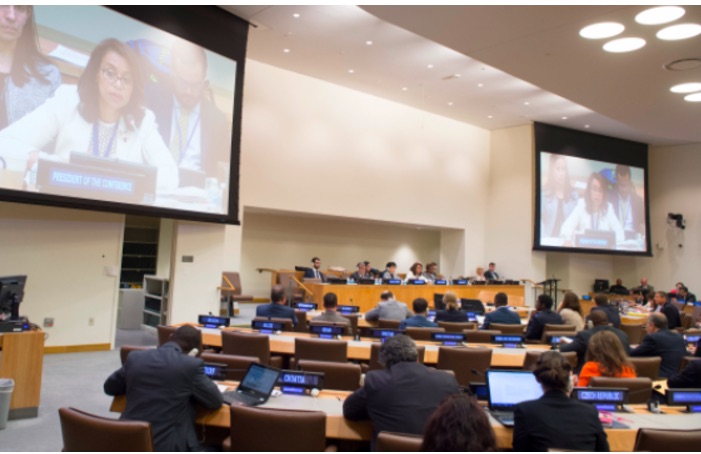
On 7 July 2017 122 countries at the UN voted to approve the text of a proposed international treaty entitled ‘Draft Treaty on the Prohibition of Nuclear Weapons.’ The treaty is formally open for signature in September, but it only become a binding legal instrument according to its own provisions 90 days after the 50th country deposits with the UN Secretary General its certification that the treaty has been ratified in accordance with their various constitutional processes.
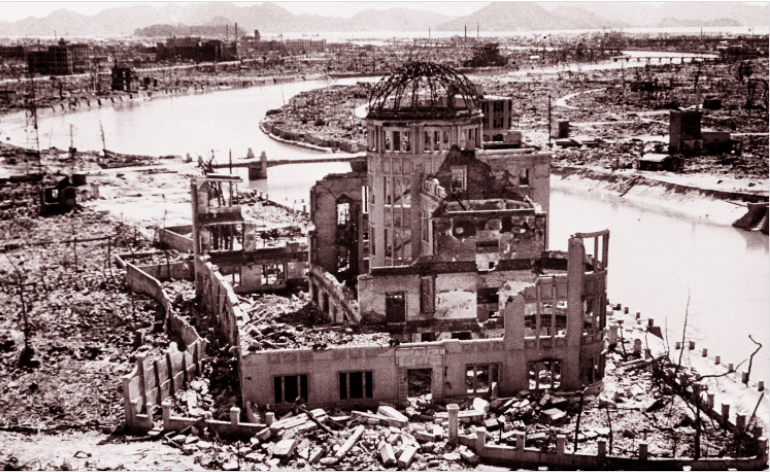
In an important sense, it is incredible that it took 72 years after the attacks on Hiroshima and Nagasaki to reach this point of setting forth this unconditional prohibition of any use or threat of nuclear weapons [Article 1(e)] within the framework of a multilateral treaty negotiated under UN auspices. The core obligation of states that choose to become parties to the treaty is very sweeping. It prohibits any connection whatsoever with the weaponry by way of possession, deployment, testing, transfer, storage, and production [Article 1(a)].
The Nuclear Ban Treaty (NBT) is significant beyond the prohibition. It can and should be interpreted as a frontal rejection of the geopolitical approach to nuclearism, and its contention that the retention and development of nuclear weapons is a proven necessity given the way international society is organized. It is a healthy development that the NBT shows an impatience toward and a distrust of the elaborate geopolitical rationalizations of the nuclear status quo that have ignored the profound objections to nuclearism of many governments and the anti-nuclear views that have long dominated world public opinion. The old reassurances about being committed to nuclear disarmament as soon as an opportune moment arrives increasingly lack credibility as the nuclear weapons states, led by the United States, make huge investments in the modernization and further development of their nuclear arsenals.

Despite this sense of achievement, it must be admitted that there is a near fatal weakness, or at best, the gaping hole in this newly cast net of prohibition established via the NBT process. True, 122 governments lends weight to the claim that the international community, by a significant majority has signaled in an obligatory way a repudiation of nuclear weapons for any and all purposes, and formalized their prohibition of any action to the contrary. The enormous fly in this healing ointment arises from the refusal of any of the nine nuclear weapons states to join in the NBT process even to the legitimating extent of participating in the negotiating conference with the opportunity to express their objections and influence the outcome. As well, most of the chief allies of these states that are part of the global security network of states relying directly and indirectly on nuclear weaponry also boycotted the entire process. It is also discouraging to appreciate that several countries in the past that had lobbied against nuclear weapons with great passion such as India, Japan, and China were notably absent, and also opposed the prohibition. This posture of undisguised opposition to this UN sponsored undertaking to delegitimize nuclearism, while reflecting the views of a minority of governments, must be taken extremely seriously. It includes all five permanent members of the Security Council and such important international actors as Germany and Japan.
The NATO triangle of France, United Kingdom, and the United States, three of the five veto powers in the Security Council, angered by its inability to prevent the whole NBT venture, went to the extreme of issuing a Joint Statement of denunciation, the tone of which was disclosed by a defiant assertion removing any doubt as to the abiding commitment to a nuclearized world order: “We do not intend to sign, ratify or ever become party to it. Therefore, there will be no change in the legal obligations on our countries with respect to nuclear weapons.” The body of the statement contended that global security depended upon maintaining the nuclear status quo, as bolstered by the Nonproliferation Treaty of 1968 and by the claim that it was “the policy of nuclear deterrence, which has been essential to keeping the peace in Europe and North Asia for over 70 years.” It is relevant to take note of the geographic limits associated with the claimed peace-maintaining benefits of nuclear weaponry, which ignores the ugly reality that devastating warfare has raged throughout this period outside the feared mutual destruction of the heartlands of geopolitical rivals, a central shared forbearance by the two nuclear superpowers throughout the entire Cold War. During these decades of rivalry, the violent dimensions of geopolitical rivalry were effectively outsourced to the non-Western regions of the world during the Cold War, and subsequently, causing massive suffering and widespread devastation for many vulnerable peoples inhabiting the Global South. Such a conclusion suggests that even if we were to accept the claim on behalf on nuclear weapons as deserving of credit for avoiding a major war, specifically World War III, that ‘achievement’ was accomplished at the cost of millions, probably tens of millions, of civilian lives in non-Western societies. Beyond this, the achievement involved a colossally irresponsible gamble with the human future, and succeeded as much due to good luck as to the rationality attributed to deterrence theory and practice.
NBT itself does not itself challenge the Westphalian framework of state-centrism by setting forth a framework of global legality that is issued under the authority of ‘the international community’ or the UN as the authoritative representative of the peoples of the world. Its provisions are carefully formulated as imposing obligation only with respect to ‘State parties,’ that is, governments that have deposited the prescribed ratification and thereby become formal adherents of the treaty. Even Article 4, which hypothetically details how nuclear weapons states should divest themselves of all connections with the weaponry limits its claims to State parties, and offers no guidance whatsoever in the event of suspected or alleged non-compliance. Reliance is placed in Article 5 on a commitment to secure compliance by way of the procedures of ‘national implementation.’
The treaty does aspire to gain eventual universality through the adherence of all states over time, but in the interim the obligations imposed are of minimal substantive relevance beyond the agreement of the non-nuclear parties not to accept deployment or other connections with the weaponry. It is for another occasion, but I believe a strong case can be made under present customary international law, emerging global law, and abiding natural law that the prohibitions in the NBT are binding universally independent of whether a state chooses or not to become a party to the treaty.
Taking an unnecessary further step to reaffirm statism, and specifically, ‘national sovereignty’ as the foundation of world order, Article 17 gives parties to the NBT a right of withdrawal. All that state parties have to do is give notice, accompanied by a statement of ‘extraordinary circumstances’ that have ‘jeopardized the supreme interests of its country.’ The withdrawal will take effect twelve months after the notice and statement are submitted. There is no procedure in the treaty by which the contention of ‘extraordinary circumstances’ can be challenged as unreasonable or made in bad faith. It is an acknowledgement that even for these non-nuclear states, nothing in law or morality or human wellbeing takes precedence over the exercise of sovereign rights. Article 17 is not likely to be invoked in the foreseeable future. This provision reminds us of this strong residual unwillingness to supersede national interests by deference to global and human interests. The withdrawal option is also important because it confirms that national security continues to take precedence over international law, even with respect to genocidal weaponry of mass destruction. As such the obligation undertaken by parties to the NBT are reversible in ways that are not present in multilateral conventions outlawing genocide, apartheid, and torture.
Given these shortcomings, is it nevertheless reasonable for nuclear abolitionists to claim a major victory by virtue of tabling such a treaty? Considering that the nuclear weapons states and their allies have all rejected the process and even those within the circle of the intended legal prohibition reserve a right of withdrawal, the NBT is likely to be brushed aside by cynics as mere wishful thinking and by dedicated anti-nuclearists as more of an occasion for hemlock than champagne. The cleavage between the nuclear weapons states and the rest of the world has never been starker, and there are absent any signs on either side of the divide to make the slightest effort to find common ground, and there may be none. As of now, it is a standoff between two forms of asymmetry. The nuclear states enjoy a preponderance of hard power, while the anti-nuclear states have the upper hand when it comes to soft power, including solid roots in ‘substantive democracy,’ ‘global law,’ and ‘natural law.’
(Continued in the right column)
Can we abolish all nuclear weapons?
(Continued from the left column)
The hard power solution to nuclearism has essentially been reflexive, that is, relying on nuclearism as shaped by the leading nuclear weapons states. What this has meant in practice is some degree of self-restraint on the battlefield and crisis situations (there is a nuclear taboo without doubt, although it has never been seriously tested), and, above all, a delegitimizing one-sided implementation of the Nonproliferation Treaty regime. This one-sidedness manifests itself in two ways: (1) discriminatory administration of the underlying non-proliferation norm, most unreservedly in the case of Israel; as well, the excessive enforcement of the nonproliferation norm beyond the limits of either the NPT itself or the UN Charter, as with Iraq (2003), and currently by way of threats of military attack against North Korea and Iran. Any such uses of military force would be non-defensive and unlawful unless authorized by a Security Council resolution supported by all five permanent members, and at least four other states, which fortunately remains unlikely. [UN Charter, Article 27(3)] More likely is recourse to unilateral coercion led by the countries that issued the infamous joint declaration denouncing the NBT as was the case for the U.S. and the UK with regard to recourse to the war against Iraq, principally rationalized as a counter-proliferation undertaking, which turned out itself to be a rather crude pretext for mounting an aggressive war, showcasing ‘shock and awe’ tactics.
(2) The failure to respect the obligations imposed on the nuclear weapons states to negotiate in good faith an agreement to eliminate these weapons by verified and prudent means, and beyond this to seek agreement on general and complete disarmament. It should have been evident, almost 50 years after the NPT came into force in 1970 that nuclear weapons states have breached their material obligations under the treaty, which were validated by an Advisory Opinion of the International Court of Justice in 1996 that included a unanimous call for the implementation of these Article VI legal commitments. Drawing this conclusion from deeds as well as words, it is evident for all with eyes that want to see, that the nuclear weapons states as a group have opted for deterrence as a permanent security scheme and nonproliferation as its management mechanism.
One contribution of the NBT is convey to the world the crucial awareness of these 122 countries as reinforced by global public opinion that the deterrence/NPT approach to global peace and security is neither prudent nor legitimate nor a credible pathway leading over time to the end of nuclearism.
In its place, the NBT offers its own two-step approach—first, an unconditional stigmatizing of the use or threat of nuclear weapons to be followed by a negotiated process seeking nuclear disarmament. Although the NBT is silent about demilitarizing geopolitics and conventional disarmament, it is widely assumed that latter stages of denuclearization would not be implemented unless they involved these broader assaults on the war system. The NBT is also silent about the relevance of nuclear power capabilities, which inevitably entail a weapons option given widely available current technological knowhow. The relevance of nuclear energy technology would have to be addressed at some stage of nuclear disarmament.
Having suggested these major shortcomings of treaty coverage and orientation, can we, should we cast aside these limitations, and join in the celebrations and renewed hopes of civil society activists to rid the world of nuclear weapons? My esteemed friend and colleague, David Krieger, who has dedicated his life to keeping the flame of discontent about nuclear weapons burning and serves as the longtime and founding President of the Nuclear Age Peace Foundation, concludes his informed critique of the Joint Statement by NATO leaders, with this heartening thought: “Despite the resistance of the U.S., UK and France, the nuclear ban treaty marks the beginning of the end of the nuclear age.” [Krieger, “U.S., UK and France Denounce the Nuclear Ban Treaty”]. I am not at all sure about this, although Krieger’s statement leaves open the haunting uncertainty of how long it might take to move from this ‘beginning’ to the desired ‘end.’ Is it as self-styled ‘nuclear realists’ like to point out, no more than an ultimate goal, which is polite coding for the outright dismissal of nuclear disarmament as ‘utopian’ or ‘unattainable’?
We should realize that there have been many past ‘beginnings of the end’ since 1945 that have not led us any closer to the goal of the eliminating the scourge of nuclearism from the face of the earth. It is a long and somewhat arbitrary list, including the immediate horrified reactions of world leaders to the atomic bomb attacks at the end of World War II, and what these attacks suggested about the future of warfare; the massive anti-nuclear civil disobedience campaigns that briefly grabbed mass attention in several nuclear weapons states; tabled disarmament proposals by the United States and the Soviet Union in the 1960s; the UN General Assembly Resolution 1653 (XVI) that in 1961 declared threat or use of nuclear weapons to be unconditionally unlawful under the UN Charter and viewed any perpetrator as guilty of a crime against humanity; the Cuban Missile Crisis of 1962 that scared many into the momentary realization that it was not tolerable to coexist with nuclear weapons; the International Court of Justice majority opinion in 1996 responding to the General Assembly’s question about the legality of nuclear weapons that limited the possibility of legality of use to the narrow circumstance of responding to imminent threats to the survival of a sovereign state; the apparent proximity to an historic disarmament arrangements agreed to by Ronald Reagan and Mikhail Gorbachev at a summit meeting in Reykjavik, Iceland in 1986; the extraordinary opening provided by the ending of the Cold War and the collapse of the Soviet Union, which should have been the best possible ‘beginning of the end,’ and yet nothing happened; and finally, Barack Obama’s Prague speech is 2009 (echoing sentiments expressed less dramatically by Jimmy Carter in 1977, early in his presidency) in which he advocated to great acclaim dedicated efforts to achieve toward the elimination of nuclear weapons if not in his lifetime, at least as soon as possible; it was a good enough beginning for a Nobel Peace Prize, but then one more fizzle.
Each of these occasions briefly raised the hopes of humanity for a future freed from a threat of nuclear war, and its assured accompanying catastrophe, and yet there was few, if any, signs of progress from each of these beginnings greeted so hopefully toward the ending posited as a goal. Soon disillusionment, denial, and distraction overwhelmed the hopes raised by these earlier initiatives, with the atmosphere of hope in each instance replaced by an aura of nuclear complacency, typified by indifference and denial. It is important to acknowledge that the bureaucratic and ideological structures supporting nuclearism are extremely resilient, and have proved adept at outwaiting the flighty politics of periodic flurries of anti-nuclear activism.
And after a lapse of years, yet another new beginning is now being proclaimed. We need to summon and sustain greater energy than in the past if we are to avoid this fate of earlier new beginnings in relation to the NBT. Let this latest beginning start a process that moves steadily toward the end that has been affirmed. We know that the NBT would not itself have moved forward without civil society militancy and perseverance at every stage. The challenge now is to discern and then take the next steps, and not follow the precedents of the past that followed the celebration of a seeming promising beginning with a misplaced reliance on the powers that be to handle the situation, and act accordingly. In the past, the earlier beginnings were soon buried, acute concerns eventually resurfaced, and yet another new beginning was announced with fanfare while the earlier failed beginning were purged from collective memory.
Here, we can at least thank the infamous Joint Statement for sending a clear signal to civil society and the 122 governments voting their approval of the NBT text that if they are truly serious about ending nuclearism, they will have to carry on the fight, gathering further momentum, and seeking to reach a tipping point where these beginnings of the end gain enough traction to become a genuine political project, and not just another harmless daydream or well-intended empty gesture.
As of now the NBT is a treaty text that courteously mandates the end of nuclearism, but to convert this text into an effective regime of control will require the kind of deep commitments, sacrifices, movements, and struggles that eventually achieved the impossible, ending such entrenched evils as slavery, apartheid, and colonialism.