Category Archives: Mideast

‘We’re taking responsibility’: Sixty teens announce refusal to serve in Israeli army

TOLERANCE & SOLIDARITY .

An article from Monthly Review Online (Reprinted according to Creative Commons Attribution-NonCommercial-NoDerivatives 4.0 International License)

Sixty Israeli teenagers published an open letter addressed to top Israeli officials on Tuesday morning, in which they declared their refusal to serve in the army in protest of its policies of occupation and apartheid.
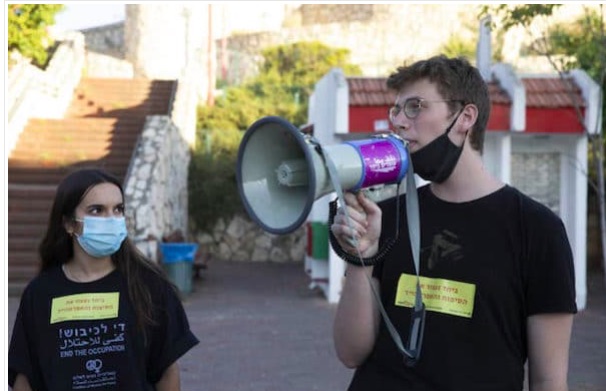
The so-called “Shministim Letter” (an initiative with the Hebrew nickname given to high school seniors) decries Israel’s military control of Palestinians in the occupied territories, referring to the regime in the West Bank, Gaza Strip, and East Jerusalem as an “apartheid” system entailing “two different systems of law; one for for Palestinians and another for Jews.”

“It is our duty to oppose this destructive reality by uniting our struggles and refusing to serve these violent systems–chief among them the military,” reads the letter, which was addressed to Defense Minister Benny Gantz, Education Minister Yoav Galant, and IDF Chief of Staff Aviv Kochavi.

Our refusal to enlist to the military is not an act of turning our backs on Israeli society,” the letter continues.

On the contrary, our refusal is an act of taking responsibility over our actions and their repercussions. Enlistment, no less than refusal, is a political act. How does it make sense that in order to protest against systemic violence and racism, we have to first be part of the very system of oppression we are criticizing?

The public refusenik letter is the first of its kind to go beyond the occupation and refer to the expulsion of Palestinians during the 1948 war:

We are ordered to put on the bloodstained military uniform and preserve the legacy of the Nakba and of occupation. Israeli society has been built upon these rotten roots, and it is apparent in all facets of life: in the racism, the hateful political discourse, the police brutality, and more.

The letter further emphasizes the connection between Israel’s neoliberal and military policies:

While the citizens of the Occupied Palestinian Territories are impoverished, wealthy elites become richer at their expense. Palestinian workers are systematically exploited, and the weapons industry uses the Occupied Palestinian Territories as a testing ground and as a showcase to bolster its sales. When the government chooses to uphold the occupation, it is acting against our interest as citizens– large portions of taxpayer money is funding the “security” industry and the development of settlements instead of welfare, education, and health.

Some of the signatories are expected to appear before the IDF conscientious objectors’ committee and be sent to military prison, while others have found ways to avoid army service. Among the signatories is Hallel Rabin, who was released from prison in November 2020 after serving 56 days behind bars. A number of the signatories also signed an open letter last June demanding that Israel stop the annexation of the West Bank.

‘Who are we actually protecting?’

Israelis have published a number of refusal letters ever since Israel took control of the occupied territories in 1967. While for decades the letters predominantly referred to opposing service in the occupied territories specifically, the last two Shministim Letters, published in 2001 and 2005, respectively, included signatories who refused to serve in the army altogether.

“The reality is that the army commits war crimes on a daily basis–this is a reality I cannot stand behind, and I feel I must shout as loud as I can that the occupation is never justified,” says Neve Shabtai Levin, 16, from Hod Hasharon. Levin, now in 11th grade, plans to refuse army service after graduation, even if it means going to prison.

“The desire not to enlist in the IDF is something I have been thinking about since I was eight,” Levin continues.

I did not know there was an option to refuse until around last year, when I spoke to people about not wanting to enlist, and they asked me if I was planning to refuse. I began to do some research, and that’s how I got to the letter.

Levin adds that he signed the letter “because I believe it can do good and hopefully reach out to teenagers who, like me, do not want to enlist but do not know about the option, or will raise questions for them.”

Shahar Peretz, 18, from Kfar Yona, is planning on refusing this summer. “For me, the letter is addressed to teenagers, to those who are going to enlist in another year or those who have already enlisted,” she says.

The point is to reach out to those who are now wearing uniforms and are actually on the ground occupying a civilian population, and to provide them with a mirror that will make them ask questions such as ‘who am I serving? What is the result of the decision to enlist? What interests am I serving? Who are we actually protecting when we wear uniforms, hold weapons, and detain Palestinians at checkpoints, invade houses, or arrest children?’

(article continued in right column)

Question related to this article:

Is there a renewed movement of solidarity by the new generation?

How can a culture of peace be established in the Middle East?

(article continued from left column)

Peretz recalls her own experiences that changed her thinking around enlistment:

[My] encounter with Palestinians in summer camps was the first time I was personally and humanly exposed to the occupation. After meeting them, I realized that the army is a big part of this equation, in its influence over the lives of Palestinians under Israeli rule. This led me to understand that I am not prepared to take a direct or indirect part in the occupation of millions of people.

Yael Amber, 19, from Hod Hasharon, is mindful of the difficulties her peers may encounter with such a decision.

The letter is not a personal criticism of 18-year-old boys and girls who enlist. Refusing to enlist is very complicated, and in many ways it is a privilege. The letter is a call to action for young people prior to enlistment, but it is mainly a demand for [young people] to take a critical look at a system that requires us to take part in immoral acts toward another people.

Amber, who was discharged from the army on medical grounds, now lives in Jerusalem and volunteers in the civil service.

I have quite a few friends who oppose the occupation, define themselves as left-wing, and still serve in the army. This is not a criticism of people, but of a system that puts 18-year-olds in such a position, which does not leave [them] too many choices.

While conscientious objection has historically been understood as a decision to go to prison, the signatories emphasize that there are various methods that one can refuse, and that finding ways to eschew military service can itself be considered a form of refusal. “We understand that going to jail is a price that not everyone has the privilege of paying, both on a material level, time, and criticism from one’s surroundings,” Amber says.

‘Part of the legacy of the Nakba’

The signatories note that they hope the political atmosphere created in recent months by the nationwide anti-Netanyahu protests–known as the “Balfour protests” for the street address of the Prime Minister’s Residence in Jerusalem–will allow them to talk about the occupation.

“It’s the best momentum,” says Amber. “We have the infrastructure of Balfour, the beginning of change, and this generation is proving its political potential. We thought about it a lot in the letter–there is a group that is very interested in politics, but how do you get them to think about the occupation?”

Levin also believes that it is possible to appeal to young Israelis, particularly those who go to the anti-Bibi protests.

With all the talk about corruption and the social structure of the country, we must not forget that the foundations here are rotten. Many say the military is an important process [Israelis] go through, that it will make you feel like you are part of and contributing to the country. But it is not really any of these things. The army forces 18-year-olds to commit war crimes. The army makes people see Palestinians as enemies, as a target that should be harmed.

As the students emphasize in the letter, the act of refusal is intended to assert their responsibility to their fellow Israelis rather than disengage from them. “It is much more convenient not to think about the occupation and the Palestinians,” says Amber.
[But] Writing the letter and making this kind of discourse accessible is a service to my society. If I wanted to be different or did not care, I would not choose to put myself in a public position that receives a lot of criticism. We all pay a certain price because we care.

“This is activism that comes from a place of solidarity,” echoes Daniel Paldi, 18, who plans to appear before the conscientious objectors’ committee. “Although the letter is first and foremost an act of protest against occupation, racism, and militarism, it is accessible. We want to make the refusal less taboo.” Paldi notes that if the committee rejects his request, he is willing to sit in jail.

“We tried not to demonize either side, including the soldiers, who, in all of its absurdity, are our friends or people our age,” he notes.

We believe that the first step in any process is the recognition of the issues that are not discussed in Israeli society.

The signatories of the latest Shministim Letter differed from previous versions in that they touched on one of the most sensitive subjects in Israeli history: the expulsion and flight of Palestinians during the Nakba in 1948. “The message of the letter is to take responsibility for the injustices we have committed, and to talk about the Nakba and the end of the occupation,” says Shabtai Levy.

It’s a discourse that has disappeared from the public sphere and must come back.

“It’s impossible to talk about a peace agreement without understanding that all this is a direct result of 1948,” Levy continued.

The occupation of 1967 is part of the legacy of the Nakba. It’s all part of the same manifestations of occupation, these are not different things.

Adding to this point, Paldi concludes: As long as we are the occupying side, we must not determine the narrative of what does or doesn’t constitute occupation or whether it began in 1967. In Israel, language is political. The prohibition against saying ‘Nakba’ does not refer to the word itself, but rather the erasure of history, mourning, and pain.

(Thank you to Azril Bacal for sending this article to CPNN.)
Israel to ban human rights groups from school visits

. . HUMAN RIGHTS . .

An article from the Middle East Monitor

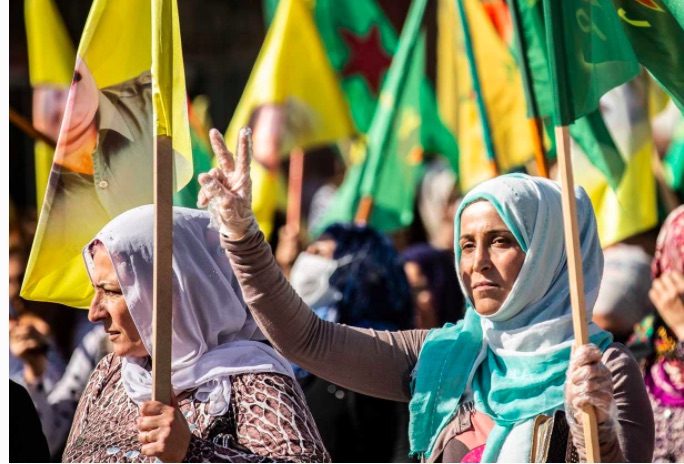
Israel’s education minister is banning groups that call the country an “apartheid state” from making schools visits to present information to students, CBS News has reported. Yoav Galant tweeted yesterday that he had instructed the ministry’s director general to “prevent the entry of organisations calling Israel ‘an apartheid state’ or demeaning Israeli soldiers from lecturing at schools.”

The move follows publication of a report last week  by the Israeli human rights group B’Tselem. The organisation branded Israel an “apartheid” state that “promotes and perpetuates Jewish supremacy between the Mediterranean Sea and the Jordan River.”

Echoing the UN’s 2017  report which concluded that Israel was practising apartheid, B’Tselem dismissed the popular misconception that it is a democracy within the Green (1949 Armistice) Line. It argued that after more than half a century of occupation, the state should be treated as a single entity guided by the core racist organising principle of “advancing and perpetuating the supremacy of one group – Jews – over another – Palestinians.”

(Article continued in the column on the right)

Question related to this article:
 
Free flow of information, How is it important for a culture of peace?

Presenting the Palestinian side of the Middle East, Is it important for a culture of peace?

Israel/Palestine, is the situation like South Africa?

(Article continued from the column on the left)

B’Tselem said that it will not be deterred by the minister’s announcement. Director-General Hagai El-Ad spoke at a school in Haifa earlier today.

“For many years we’ve exposed our students to a broad variety of opinions from across Israel’s political spectrum,” said the Hebrew Reali School. “We respect the students’ right to express their opinion and are proud of their involvement in issues at the heart of Israeli society. We hold respectful dialogues and intend to continue this tradition.”

Established in 1989 during the first intifada, B’Tselem  documents human rights abuses in the occupied West Bank, East Jerusalem and Gaza Strip. “B’Tselem is determined to keep with its mission of documenting reality, analysing it, and making our findings known to the Israeli public and worldwide,” it insisted.

Following peace deal, talks on Libya’s political future begin

DISARMAMENT & SECURITY .

An article from UN News

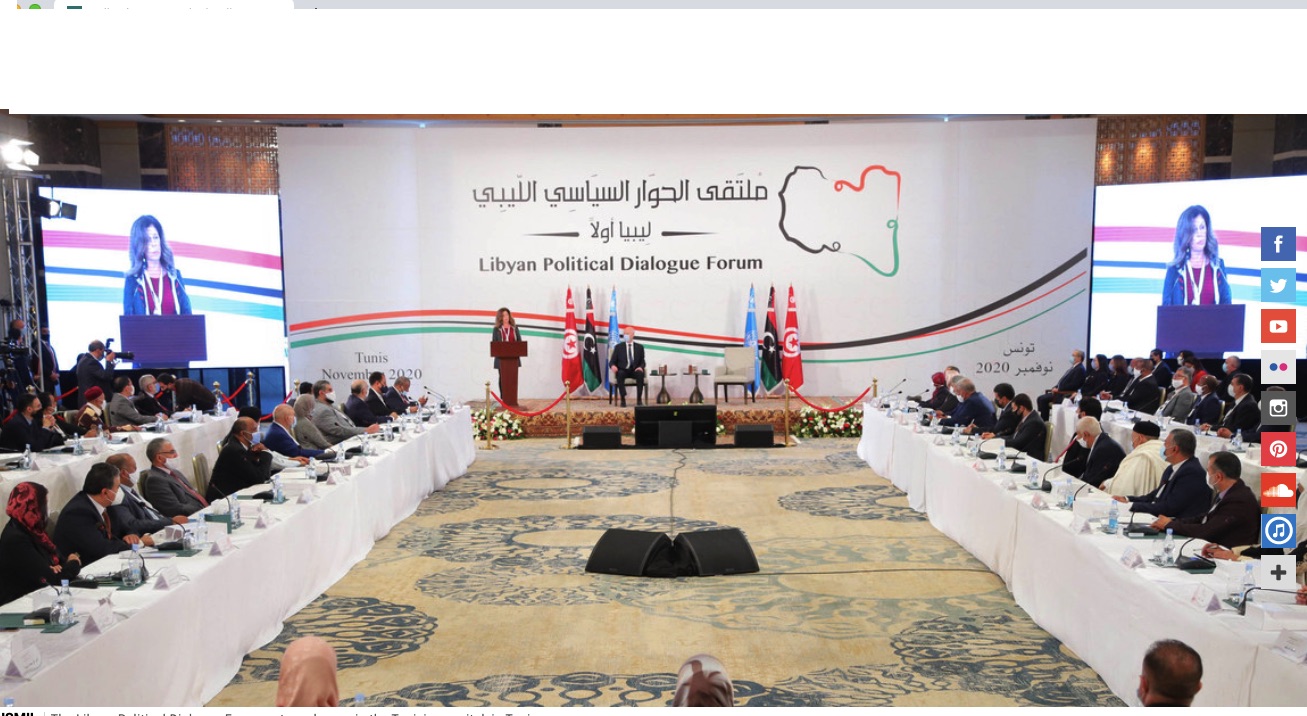
Talks to draw up a blueprint for a new political era in Libya began in Tunisia on Monday [November 9], following a peace deal struck by Libya’s warring sides last month [See CPNN October 17]


(Click on image to enlarge)

“You have gathered today to continue forging a new era of peace and stability for Libya. You have the opportunity to end a tragic conflict and create a future of dignity and hope”, UN Secretary-General António Guterres said in a video message to participants of the Libyan Political Dialogue Forum.

“Now it is your turn to shape the future of your country. Your commitment to this process will help restore Libyan sovereignty and the democratic legitimacy of Libyan institutions. As you engage in dialogue to resolve your differences, your determination will be tested.

Future ‘is now in your hands’

“However, compromise is the only approach that will pave the road to national unity”, he said. “The future of Libya is now in your hands.”

Tunisian President Qais Said, opening the meeting, said the talks would lead to a new legitimacy for Libya.

The country has been beset by chaos and conflict since the downfall of long-time Libyan leader Muammar Gaddafi in 2011, culminating in a civil war and the siege of the Libyan capital Tripoli which began in April last year.

(article continued in right column)

Question for this article:

What is being done for peace in Libya?

(article continued from left column)

The head of the UN mission in Libya, Stephanie Williams, told the meeting that it was a time of rare optimism, a glimmer of hope after many years of crisis.

New national vote

“The overriding aim of the National Political Programme is to renew political legitimacy by holding national elections, within an agreed timeframe”, she said.

Acting UN Special Representative Williams presided over a breakthrough peace agreement between five senior commanders from either side, at a meeting in Geneva last month. She arrived at the political talks in Tunis fresh from another successful round of military negotiations in the Libyan city of Ghadames, she said.

“Every day cooperation is increasing, and the transformation of the 5+5 into the ‘group of 10’ is more than just a slogan; it is a reality”, Ms. Williams said.

“The new government will launch national reconciliation, combat corruption, and restore public services. Its progress will be monitored; its work will be reviewed on a regular basis by mechanisms that can hold it to account.”

Executive body

In a statement released late on Sunday, Ms. Williams said that over the past two days she had been taking note of the participants’ suggestions about what the political talks should aim to achieve, including the creation of an executive authority capable of organizing elections and implementing the political, economic and military reforms necessary to bring some normalcy back to Libyans’ lives.

The participants had stressed the importance of designing a thorough roadmap for the political process and to develop a national charter based on the principles of accountability, justice and human rights and a firm commitment to a civilian state.

Morocco: Combating the radicalization of young people via the Internet

TOLERANCE AND SOLIDARITY .

An article by LesEco (translation by CPNN)

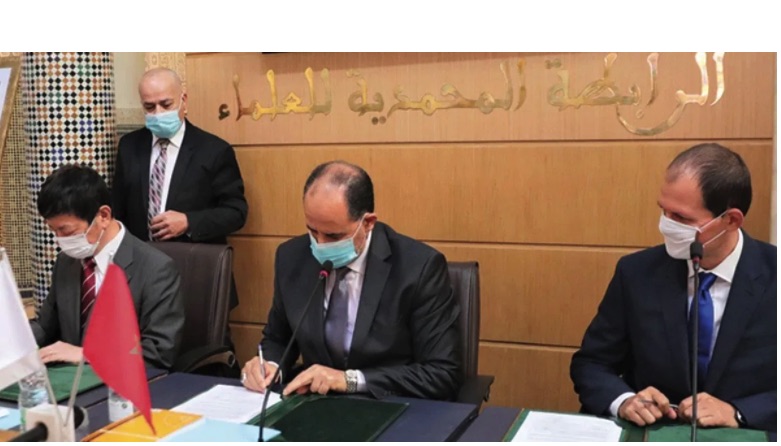
La Rabita Mohammedia des Oulémas has just launched a project to fight against the radicalization of young people online. Objective: fight against hate speech and make young people aware of the dangers that the Internet and social networks can present. Funded by the Government of Japan, in partnership with the United Nations Development Program, the implementation agreement for this project was signed by Takashi Shinozuka, Japanese Ambassador to Morocco, Edward Christow, UNDP Resident Representative in Morocco, and Ahmed Abbadi, secretary general of the Rabita Mohammedia des Ulemas.

According to Ahmed Abbadi, this project aims to protect adolescents and young people from the scourges of violent extremism, whether on the ground or in their digital dimension. It also aims to immunize them against hate speech by supporting them to become influential on the Internet in order to prevent and inspire their interlocutors. He added that the project was long-term in order to help young people acquire the tools and skills necessary to fight extremism of all kinds. The success of this project depends mainly on the preparation of attractive and catchy content for young people, says Ahmed Abbadi. La Rabita has launched several interactive Internet games with the aim of promoting the culture of peace and moderation, as well as the rejection of violence and extremism.

(Article continued in the right column)

(Click here for the original French version of this article.)

Question for this article

Islamic extremism, how should it be opposed?

(Article continued from the left column)

According to the same source, the Rabita is preparing a virtual influencer guide to help young people acquire the skills to become effective influencers on the Internet. The same source specifies that Japan and the UNDP, much more than donors, will also be partners in this project.

In this regard, the Japanese Ambassador to Morocco declared: “We believe that this project is also a response to a concern for the immunization of Moroccan society against the cybernetic threats which threaten the youth.” He added that the religious radicalism leading to violence is a universal problem. Takashi Shinozuka also indicates that this funding supports Morocco in its fight against the risks of online radicalization of young people, in particular by preventing and informing about the dangers that social networks can represent.

For his part, Edward Christow affirmed that this project was the fruit of several months of joint work between the Rabita Mohammedia of the Ulemas, the Embassy of Japan and the UNDP, adding that the three partners will continue their collaboration for the implementation of this project. He also said that this project, which aims to support the production and publication of video footage on social media, will depend on Rabita’s experience in this area. It will ensure an online presence through the social networks of the Rabita and the UNDP. In this context, a group of Rabita experts will be able to meet Japanese experts working in the field of conflict prevention and peace promotion, and organize an international workshop in Morocco on best practices in this field.

Funding for this project amounts to 454,545 USD, or more than 4 million MDH. It revolves around 4 main objectives, including carrying out a diagnosis of the risks associated with online radicalization content targeting young people, and supporting national stakeholders in the use of information and communication technologies and media to prevent violent extremism and hate speech. It is also about sensitizing young Moroccans through social networks on the importance of promoting an alternative discourse, the spirit of cooperation and the sharing of experiences in the prevention of violent extremism online. Spanning a period of one year, this project will have a major impact on young people and on Moroccan society as a whole, concludes Edward Christow.

Afro-Asian Peoples Solidarity Organization welcomes Morocco’s role in promoting the culture of peace and dialogue between the Libyan parties

DISARMAMENT & SECURITY .

An article from Le Matin (translation by CPNN)

The Afro-Asian Peoples Solidarity Organization praised the role played by the Kingdom of Morocco in promoting and disseminating the culture of peace and dialogue between the Libyan parties. The organization expressed, in a statement, “its congratulations to the Libyan parties for their approach to political dialogue, their search for consensus and their desire to pursue with determination and constancy the political path to overcome the armed conflict in order to consolidate the legitimacy of the Libyan national civil state, which expresses the unity of the people and guarantees the stability of the country ”.


(article continued in right column)

Question for this article:

What is being done for peace in Libya?

(article continued from left column)

In this regard, the statement referred to the results of the second round of interlibyan dialogue organized from October 2 to 6 in Bouznika [Morocco]. In the final declaration of this second round, the delegations of the High Council of State and the Parliament announced that this round was consistent with the criteria and mechanisms for occupying positions of sovereignty in Libya as called for in Article 15 of the Libyan Skhirate Political Agreement [See the 2015 agreement].

(Click here for a version of this article in French.)

Iranian film “Castle of Dreams” wins at Religion Today filmfest in Italy

EDUCATION FOR PEACE .

An article from the Tehran Times

The Iranian award-winning drama “Castle of Dreams” has won the award for best feature film at the 23rd Religion Today Film Festival in Italy.

<
Photo: “Castle of Dreams” by Reza Mirkarimi

Last Wednesday [September 30], Trento as the greenest Italian city hosted the closing ceremony of the festival, which selected the motto “Earth I Care”.

Directed by Reza Mirkarimi, the film is about two young children whose mother has just died, and their father, Jalal, after long years of absence, returns to sort things out, but he does not want to take the children with him.

(continued in right column)

Question for this article:

Film festivals that promote a culture of peace, Do you know of others?

(continued from left column)

In addition, “Ojagh” by Iranian filmmaker Ali Bolandnazar also won the award for best short documentary. It is a study of the rituals of the Qashqai Turkic tribe regarding fire.

In the documentary competition, Iranian filmmaker Hamid Jafari’s “The Wind” received a special mention, while “Mother Fortress” by Italian director Maria Luisa Forenza was named best.

“The Wind” is about the Zar traditional ceremony in southern Iran. Spirits ride the wind of the seas and spread illness into the bodies of human beings. Zar is synonymous with the wind which carries illness. The Zar ceremony can free the body from evil spirits with the assistance of music and song.

The Grand Prize in the Spirit of Faith went to “Order and Soul” by Hungarian director Suzsanna Bak.

Founded in 1997, the Religion Today Film Festival is organized every year by Associazione BiancoNero. The event has been the foremost international and itinerant film festival dedicated to cinema and religions for a culture of peace and dialogue between faiths, cultures, peoples and individuals.

Arab and Middle Eastern States: International Day of Peace

FREE FLOW OF INFORMATION . .

A survey by CPNN

The following 19 events in 10 Arab and Middle Eastern countries were listed in Google during the week of September 21-28 under the key words “International day of peace” “peace day”, “journee internationale de la paix” and اليوم الدولي للسلام , and including one on the facebook page for the International Cities of Peace.

About 20 events are listed on the maps of One Day One Choir and Montessori schools singing for peace, but there is no indication which took place this year and which took place only in previous years


A young volunteer paints a mural to mark the International Day of Peace in Mazar-i-Sharif, Afghanistan

MAZAR-I-SHARIF, AFGHANISTAN

Photo report from Xinhua News Service: A young volunteer paints a mural to mark the International Day of Peace in Mazar-i-Sharif, capital of Balkh province, Afghanistan.

ALGIERS, ALGERIA

The participants in the national conference on solidarity and constant support towards the Palestinian and Sahrawi peoples, stressed Monday in Algiers on the imperative to apply UN resolutions and decolonize Palestine and Western Sahara, emphasizing warns against the dangers of delay in ensuring both peoples their right to self-determination. Organized by the Algerian National Committee for Solidarity with the Saharawi People (CNASPS), in coordination with a network of Algerian journalists, the Mechaal E-chahid Association and the SADR embassy, ​​this national conference, celebrated on the occasion of The International Day of Peace, September 21 of each year, was an opportunity for speakers to advocate for the need to compel Moroccan and Israeli colonizers to conform to international legitimacy.

ARAB LEAGUE

The League of Arab States called on all nations and peoples, especially the Arab countries that are experiencing armed conflicts, to immediately cease fire and abide by the cessation of hostilities and resort to a political solution as it is the only way to settle conflicts and disputes. In a statement today on the occasion of the celebration of the International Day of Peace, which falls on the 21st of this month, the Arab League affirmed its full support for the efforts undertaken by the United Nations to promote sustainable peace, including its commitments to preserving and building peace and its keenness to establish a strategic partnership with the international organization to prevent the outbreak of Conflicts and resolution. The Arab League also called on all peoples to work on building and spreading a culture of peace by establishing a set of values and behavioral patterns based on respecting human rights, rejecting violence in all its forms and forms, strengthening the rule of law, adhering to the principles of democracy, freedom and justice, spreading the values of tolerance, acceptance of others, multiculturalism, and promoting dialogue.

HELIOPOLIS, EGYPT

Dr. Nabil Helmy, Secretary-General of the Heliopolis Association, said that the association participates in the celebration of the International Day of Peace, which falls on September 21 of each year, under the slogan “Forming Peace Together”, by launching it today, Monday, and through the page and website of Heliopolis Library, a photo gallery Hypothetically for the Interfaith Complex in Ancient Egypt, that part of the land where the three monotheistic religions come together to send a message of peace and love to the world.

EGYPT

Egyptian swimmers will try to beat Turkey’s obscure world record on International Peace Day: A cohort of 550 swimmers will try to break the Guinness World Record for the largest peace emblem during International Peace Day on 21 September, Ahram Gate reports. The current record was set by Turkey, which previously used 460 swimmers to form the symbol.

TEHERAN, IRAN

The Municipal Council in Tehran honors the International Peace Day tomorrow, Monday in the Hall of Iran, and at this ceremony, in addition to exchanging views on peace, the book “Women and Defending Peace in the Post-Corona Period” will be unveiled.

AMMAN, JORDAN

The Municipality of Amman lights the Abdoun Bridge in orange on the International Day of Peace – photos

BYBLOS, LEBANON

On the occasion of the International Day of Peace, the International Center for Human Sciences, UNESCO Byblos, in partnership with the German Hans Seidel Foundation, on Monday, September 21 and 22, held training workshops on the importance of dialogue and peace building with the aim of refining and developing personality and social responsibility towards others with the participation of academic and cultural figures and lecturers from various universities in Lebanon And lecturers from France. 

(Survey continued in right column)

Question related to this article:

What has happened this year (2020) for the International Day of Peace?

(Survey continued from left column)

NAQOURA, LEBANON

UNIFIL today marked the International Day of Peace during a ceremony at its headquarters in Naqoura, south Lebanon. Present at the ceremony were UNIFIL Head of Mission Force Commander Major General Stefano Del Col, Colonel George Toufik Toufik representing the Lebanese Armed Forces (LAF) Commander, local authorities, representatives of the Lebanese security agencies and fellow peacekeepers.

DARFUR, SUDAN

Department of the Joint Mission of the United Nations and the African Union (UNAMID) and the Center for Peace and Development Studies at the University of El Fasher on the occasion of the International Day of Peace, which falls today, signed a pledge to work together achieving the requirements of peace and democratic transition in Darfur. Professor Adam Saleh Muhammadin, Director of the University of El Fasher, addressed the opening session of the forum.

KHARTOUM, SUDAN

The Sudanese Council of Churches and the Council of Religious Coexistence organized today at the Council’s headquarters in Khartoum a solidarity stand on the occasion of the International Day of Peace, which falls on the twenty first of September of each year under the slogan (Blessed are the peacemakers because they are the children of God called) under the auspices of the Minister of Religious Affairs and Endowments Nasreddin Mufreh

SOUTH SUDAN

On the occasion of the International Day of Peace, celebrated on Monday, September 21, which coincides with the second anniversary of the Revitalized Agreement on Conflict Resolution in South Sudan (RARCSS), representatives of various faiths in Sudan of the South, in a collective statement, noted “with great concern” the slow pace of the implementation of RARCSS and expressed the need to “accelerate the implementation of the provisions of the agreement..

TUNISIA

On the occasion of the celebration on September 21 of the International Day of Peace, the theme of which 2020 is “Shaping peace together”, the National Heritage Institute (INP) and the agency for the enhancement of heritage and cultural promotion (AMVPPC) organize in collaboration with the friendly staff of the INP a series of activities and events in five museums in Tunisia.

ALEPPO, SYRIA

Video report: “Living in peace is our legitimate right” .. A peaceful pause in the city of Atarib in the countryside of Aleppo on the International Day of Peace

ADEN, YEMEN

The “Southerners for Peace” group commemorates the International Dy of Peace and finds this ocasion an opportunity to renew its demands for peace in Yemen.

TAIZ, YEMEN

Under the title “On This Land What Deserves Life”, the mural exhibition coinciding with the International Day of Peace was executed by a number of plastic artists on the wall of the Martyrs’ Stadium, located in the Jahmiliya neighborhood, which is the largest neighborhood that was destroyed.    Those in charge of the mural said that its aim is to deliver a message to the international community that Taiz is tired of the war and siege that it has been living for years, and that it seeks peace and coexistence.    Over the past two days, the organization has launched several activities in the governorates of Ma’rib and Hadramawt on strengthening the capacities of youth initiatives in peacebuilding, to celebrate the International Day of Peace, with the participation of 28 young men and women representing 14 youth initiatives in the two governorates.

SANA’A, YEMEN

We celebrate the international day of Peace and as participation in our community we always take care people whom has special case and the current situation in Yemen increased their suffering. Hence we performed our activity with autism children at the Charter for Compassion Yemen Autism Center in Sana’a and the team of United Religions Initiative. This is the first time that children with autism in Yemen celebrate this occasion.

YEMEN

On this international day of peace, let us shape peace together, recognizing and supporting the important role of local women mediators in community based conflict resolution efforts. In Yemen, women peacebuilders have used their conflict resolution skills to prevent local conflicts, promote social cohesion and women’s participation in community and social initiatives. PartnersGlobal and its affiliate, Partners Yemen, collaborated in a community-based conflict mitigation program to create sustainable mechanisms for local conflict resolution in Yemen’s tribal areas. The program supported local women peacebuilders in: coaching on mediation approaches to proactively address and reduce violent conflict, creating the space and opportunities for women to engage in conflict resolution, and building women’s knowledge and capacity in conflict management, mediation, arbitration, negotiation, and communication.

YEMEN

On the occasion of the International Day of Peace, a youth campaign calling for a ceasefire throughout Yemen has been launched. Under the hashtag #EnoughWar, the campaign uses social media to call for a cease-fire in Yemen. In line with the theme of this year’s International Peace Day, “building peace together”, the campaign is mobilizing young people to play a role in the peace process and amplifying the voices and opinions of young women and men calling for peace. The campaign kicked off with a vox pop video in which young people share their messages on peace:

Sudan: Darfur deal welcomed by UN chief as ‘historic achievement’

DISARMAMENT & SECURITY .

An article from the United Nations

A peace agreement between Sudanese authorities and key armed movements from Darfur could provide a path to national unity, the head of the joint UN-African Union Mission in Darfur (UNAMID) said on Monday. Secretary-General António Guterres later described it  as an “historic achievement” towards lasting peace.


UNAMID/Albert Gonzalez Farran. UNAMID, in collaboration with the North Darfur Committee on Women, organised an open day session on UN Security Council Resolution 1325 on women, peace and security (file photo).

Sudan’s transitional Government initialled the deal alongside the Sudan Revolutionary Front (SRF) and Sudan Liberation Movement–Minni Minnawi (SLM/MM), at a ceremony held in neighbouring South Sudan. 

Determination, courage and commitment 

“The Secretary-General congratulates the people of the Sudan for this historic achievement and commends the parties to the negotiations for their political will and determination in working toward the common objective of peace”, said the statement released on Monday night in New York.

“He also thanks the Government of South Sudan and President Salva Kiir for their important role in facilitating the talks. The Secretary-General calls on the Sudan People’s Liberation Movement–North–Abdelaziz Al-Hilu and the Sudan Liberation Movement–Abdul Wahid Al-Nur to join the peace process.”

(Article continued in right column)

Question for this article:

Can peace be achieved in South Sudan?

(Article continued from left column)

Mr. Guterres said he was fully committed to supporting the implementation of the agreement, “which marks the start of a new era for the people of the Sudan and for people living in Darfur and the Two Areas, in particular. This will require sustained commitment and collaboration between the parties and the people of the Sudan.”

Earlier, Jeremiah Mamabolo, the UNAMID Joint Special Representative who attended the ceremony, said  the deal was a “significant step” and commended in particular the signatory parties for their “determination, courage and commitment to lasting peace in Sudan”.

17 years of brutal fighting

It is expected that the peace agreement will end 17 years of often brutal conflict in Darfur. 

Fighting between the forces of former President Omar al-Bashir, backed by allied militia, and various rebel movements, left around 300,000 dead, according to UN estimates, and millions displaced. 

President al-Bashir was overthrown in April 2019 following unrest that began in December 2018. 

 “We hope that this agreement is perceived as the start of a process that includes all in a positive move towards peace, justice and national unity. This includes the full realization of the hopes, dreams and aspirations of all the people of Sudan, including Darfuris”, said Mr. Mamabolo. 

Praise for South Sudan mediation 

At the ceremony, the UNAMID chief conveyed greetings from UN Secretary-General António Guterres and the AU Commission Chairperson, Moussa Faki. 

He also applauded the South Sudanese mediation team for facilitating the negotiation process amidst challenges. 
Mr. Mamabolo hoped that those parties who remain outside will soon join the peace process to fulfill the hopes and aspirations of the Sudanese people and the objectives of the December 2018 Revolution. 

“To that end, the United Nations and the African Union remain committed to supporting this process to the very last day of UNAMID’s mandate”, he said. 

Palestine: 15 lessons from 15 years of BDS

TOLERANCE & SOLIDARITY .

An article by Alys Samson Estapé from the Electronic Intifada

July marked the 15th anniversary of the launch of the boycott, divestment and sanctions (BDS) movement.

Much has happened over those years. Here are 15 lessons I’ve learned on the journey to dismantle Israeli apartheid.

A grassroots movement is powerful because it is grassroots

Anyone who adheres to the BDS principles can join the movement. This empowers and enables everyone to effect extraordinary changes.

The BDS movement speaks directly to people of conscience who understand that by not acting they are allowing states, companies, artists, institutions, universities and businesses to remain complicit and fuel Israeli apartheid.

Joining and taking action allows each one of us to take responsibility and make sure we are at the very least not contributing to harming the Palestinian people. It allows us to speak out and mobilize others to take action too.

The power of the equality that grassroots mobilization brings to politics and the community is instrumental in making every single member give their best and take ownership. No single person in the movement is more important than anyone else. This powers collective leadership.

We don’t work with everyone who works on Palestinian freedom

Unfortunately, there are still those who stand up for freedom for the Palestinian people but do not care about the rights and dignity of other discriminated and oppressed groups.

Our deep commitment to anti-racism and intersectionality means we do not liaise with just anyone who agrees on Palestinian rights unless they also respect and support rights and dignity for all. We cannot build and fight for a new world while agreeing to oppress others.

Think small to win big

Every little success matters. Small victories can help in reaching a much larger aim.

Getting a small pension fund to divest from the weapons firm Elbit Systems  can contribute to discussion of the need for a military embargo against Israel. This small pension fund can encourage others to follow suit.

As we tackle local issues, we must remember the global picture and how being part of a global movement means that what happens somewhere can affect the movement as a whole, positively and negatively.

BDS is also about correcting the narrative

The BDS movement has already contributed to mainstreaming awareness of the fact that Israel is an apartheid regime.

Why is this so important? In a world with such biased media and even schoolbooks that are still deeply embedded in a colonial narrative, it is essential we take time to clarify reality.

When calling for a boycott or organizing a campaign, we must always remember how doing so helps to clearly explain what Palestinians are facing and how injustice is taking place. Even campaigns that may not reach their objective can contribute to explaining what is happening on the ground and what the Palestinian people are calling for, and to raising awareness about Israel’s regime of dispossession and colonization.

BDS supports the largest coalition of Palestinian civil society groups

The fact that we support Palestinian rights does not mean that we know best what Palestinians should do, and it does not give us a free pass to say whatever we want. Moreover, when facing attacks, we must defend our right to freedom of expression in a manner that centers Palestinians and keeps the focus on the crimes perpetrated by Israel against them.

We must remember that, by defending the right to freedom of expression, we are defending the right of Palestinians to make their experience and views heard – directly or through us – by the public and decision-makers in our country.

Privilege Palestinian voices.

Earlier this month, Rafeef Ziadah and Riya Al’sanah wrote  how “it is worth reflecting on why Palestinians are treated as mere spectators in debates concerning our daily lives.”

While the BDS movement calls on allies around the world to take action, Palestinians have a clear, pivotal role. When this isn’t happening, it means we are doing something wrong.

We must keep on decolonizing our actions and make sure Palestinians are being heard and that we take guidance from them while organizing in the BDS movement.

(article continued in right column)

Question related to this article:

Presenting the Palestinian side of the Middle East, Is it important for a culture of peace?

How can a culture of peace be established in the Middle East?

(article continued from left column)

BDS has to be part of the struggle for a just and free world

Our oppressors are more connected than ever.

At a time when the right and the far-right are gaining power in many institutions worldwide, the left and progressive groups and movements have the opportunity and duty to rethink themselves and to create stronger, more solid and inclusive movements. We must make sure Palestine is a part of that.

We also must be more connected than ever.

Everywhere you look you will find allies

We have often been surprised to find allies where we wouldn’t expect them. We usually have more allies than we think.

To connect to them we must consider different approaches, language and context-sensitivity. We must ask ourselves, are we helping the movement grow? Are we empowering others to join?

The world changes and so do we

“The BDS movement has shown itself to be highly adept at pivoting to new strategies and building influential alliances. There continue to be numerous arenas in which it faces little effective resistance.” These are the words of Asher Fredman, who used to work with Israel’s strategic affairs ministry.

We must learn from other liberation struggles while bearing in mind that times and political relations change.

While the BDS movement is highly inspired by the anti-apartheid movement in South Africa, the world is very different from how it looked 30 years ago.

We should not look for patterns to copy, but politically analyze the present and adapt to new times. This means continuing to learn, grow and use the best opportunities in a changing context.

Stick to the principles

Like all social movements, the BDS movement is facing severe and sustained attacks. Israel’s government and its lobby groups are regularly attacking and smearing us in an attempt to delegitimize our struggle.

We must not let their attacks shape our plans; strategizing and sticking to our anti-discrimination principles and our proactive and effective campaigning are what protect us the most.

While they seek to distract us from our target, the most powerful thing we can do is to keep on working for Palestinian rights. The best way to defend our right to boycott is to keep on boycotting while mobilizing mass support for our right to freedom of expression.

Supporting our allies is a matter of principle

Solidarity is not unidirectional. At all times we must take responsibility and reject any form of racism, sexism, LGTB-phobia, and any other form of discrimination or bigotry within the movement.

While we call on others to support Palestinian rights, we must show support for other struggles too. Palestine is an Indigenous, anti-racist, feminist, LGTBQAI+, anti-fascist and climate justice issue, and this makes all these struggles crucial to ensuring Palestinian self-determination.

Social movements have always been repressed

The Israeli government and its supporters spend hundreds of millions of dollars on criminalizing and persecuting the BDS movement and groups in solidarity with Palestine.

But this cannot be understood as something unique or isolated. Social movements have always been repressed by those seeking to maintain injustice and oppression.

Activists everywhere have been imprisoned for criticizing governments, and many calls for justice are being repressed in the streets and online. Let us not forget that those most oppressed by the Israeli government are always the Palestinians.

Never underestimate creativity

Using different tactics helps us reach a broader audience. As racism, sexism and disaster capitalism adapt and reconfigure, finding different ways to keep on oppressing, we must also keep on finding creative new ways to engage with others and accomplish our goals.

Political resistance can be beautiful  too.

The most important actions happen behind the scenes
Holding events, lectures, protests and public activities are crucial to show and visualize support for Palestinian rights. But talking to people, organizing, doing research, building alliances and strengthening relations all happen behind closed doors and are what enable us to then go public.

We should never forget how important it is to plan, foster relationships and carefully organize to then build our campaigns.

Hope is a political tool

It is incredible how many cities and cultural spaces have declared  themselves “apartheid free zones,” how many companies have divested from Israeli apartheid, how many artists have decided  not to play in Israel and how many academics have ended  relationships with Israeli institutions as a result of BDS campaigns.

Yet it is often difficult to keep our hopes up while knowing that Israeli apartheid is the cruelest it has ever been, knowing ongoing Palestinian pain and suffering, and seeing Israel maintain its impunity despite its televised crimes. But we keep on struggling and growing because we know that justice can and will prevail.

Fifteen years on, and during a time of global uprising against an entire system of racist exploitation and oppression, the BDS movement continues learning, adapting and growing, making connections, and exposing and challenging Israeli apartheid.

Dutch pension fund divests from two Israeli banks over settlements’ finances

DISARMAMENT & SECURITY .

An article from WAFA, Palestinian News and Info Agency

The ABP, the largest pension fund in the Netherlands, has decided to divest from Israeli banks, Hapoalim and Leumi, for their finance of construction projects in illegal Israeli settlements in the occupied West Bank, according to a statement attributed to the ABP’s spokesperson.

The spokesperson reportedly pointed out that the location where companies operate plays a role in investment appraisals and criteria, which include revenue, costs, risks, and sustainability.

(continued in right column)

Question related to this article:

Presenting the Palestinian side of the Middle East, Is it important for a culture of peace?

Divestment: is it an effective tool to promote sustainable development?

(continued from left column)

“We expect companies operating in areas with high risk of human rights violations to have a human rights policy,” said the spokesperson.

In January 2014, PGGM, the country’s second largest pension administrator, announced the divestment from five Israeli banks, citing their activities in the illegal Israeli settlements built in the West Bank.

The Netherlands and the European Union consider Israeli settlements as illegal.
Last April, the European Union issued a warning against the Israeli government’s intention to annex parts of the occupied West Bank, saying that such a move “would constitute a serious violation of international law.”

The EU’s foreign policy chief, Josep Borrell, said the 27-member bloc does not recognize Israeli sovereignty over the Palestinian territory and that it will “continue to closely monitor the situation and its broader implications, and will act accordingly.”