Category Archives: DEMOCRATIC PARTICIPATION

Guest Opinion: Why become an International City of Peace?

. . DEMOCRATIC PARTICIPATION . .

An article by Frank Thacker from The Westerly Sun

In early 2018 the Westerly Area Peace and Justice Group learned about the International Cities of Peace. After some discussion we decided to submit an applicate to become an ICP.

Why? As you can surmise there were more than a few reasons, but the major motivation was rooted in the well-known slogan “Think globally, act locally.” ICP is a global association of cities acting locally, and since Westerly Area Peace and Justice is a group acting locally and thinking globally, it seemed like good fit.

(article continued in right column)

Question related to this article:
 
How can culture of peace be developed at the municipal level?

(article continued from left column)

Even before BEOC was formed, Pittsburgh City Councilman Ricky Burgess, whose We were also very much aligned with their foundational vision of ensuring everyone’s right to safety, prosperity and quality, with their essential mission of building a scalable network of “in situ” teams committed to peace-building in cities around the world, and their essential goal of certifying and recommending thousands of self-organized municipalities as Cities of Peace in order to put in motion a tipping force for global peace.

In addition to the deep-rooted common values that motivated us to become an International City of Peace, there is an almost infinite array of resources available for members of ICP. These range from information of “how to” materials, to education including access to exhibits and teaching tools, to online learning via videos and documents. In addition, ICP provides a free website page for our community as well as a blog presence.

While the above is important and we are grateful for all the benefits of Westerly-Pawcatuck being an International City of Peace over the years, we have learned that the greatest benefit of being a member of ICP is the sense of hope and inspiration we have received as we learn about all the powerful work being done by hundreds of cities around the globe to create a culture of peace.

The writer is a resident of Westerly and a member of the Westerly Peace and Justice Group.

Fresno, California: Community commemorates Sudarshan Kapoor during 33rd annual Gandhi celebration

.. DEMOCRATIC PARTICIPATION ..

An article from Collegian CSU Fresno

Fresno State hosted the annual celebration of Mahatma Gandhi’s 153rd birthday while also honoring the work of Sudarshan Kapoor on Oct. 4 at the Fresno State Peace Garden.

The celebration, which served to spread the message of “Stop the Hate, Stop the Gun Violence, Build a Culture of Peace,” commemorated Kapoor’s efforts in spreading peace and anti-violence rhetoric. He was the founder and first director of the Peace and Conflict Studies Program and also served on Fresno’s Human Relations Commission for 12 years. 

To this, he said change was needed to achieve for development and added that Kapoor is currently a philosophy professor at Fresno State and founded the Peace Gardens project to fund the Peace Garden where the event was held.

The event featured speeches from guests such as Fresno State President Saúl Jiménez-Sandoval and Fresno Mayor Jerry Dyer, who emphasized the importance of building a culture and community of peace in Fresno.

“Our students and faculty come from all backgrounds and corners of the world, and it’s especially important that we promote Gandhi’s legacy of nonviolence,” Jiménez-Sandoval said. “Indeed, Mahatma Gandhi’s ideals of social concern and care for human dignity are more relevant today than ever.”

Kapoor is currently a philosophy professor at Fresno State and founded the Peace Gardens project to fund the Peace Garden where the event was held.

The event featured speeches from guests such as Fresno State President Saúl Jiménez-Sandoval and Fresno Mayor Jerry Dyer, who emphasized the importance of building a culture and community of peace in Fresno.

(continued in right column)

Questions for this article:

Can festivals help create peace at the community level?

(continued from left column)

“Our students and faculty come from all backgrounds and corners of the world, and it’s especially important that we promote Gandhi’s legacy of nonviolence,” Jiménez-Sandoval said. “Indeed, Mahatma Gandhi’s ideals of social concern and care for human dignity are more relevant today than ever.”

Dyer reiterated the necessity of a united community. 

“We have a vision today of being an inclusive, prosperous, beautiful city where people take pride in their neighborhood and their community,” Dyer said. “[We need] the message of nonviolence, peace, oneness and unity.”

Dyer announced that Oct. 4 would be recognized as Mahatma Gandhi Memorial Day in Fresno, presenting Kapoor with a plaque of the city’s proclamation to recognize the professor’s service to the community.

Kapoor was also awarded the Community Service Excellence Award by the Central California Society of India (CCSI).

Deepika Shiroy, the current president of the CCSI, presented Kapoor with the award and commending his devoted work in Fresno. 

“Community work sometimes can be [a] disheartening, back-breaking affair,” Shiroy said. “Every community needs a pioneer that inspires us to continue the good work day in and day out.”

During the event, Kapoor spoke about the hardships he experienced in his life. Having moved from India across the continent and then across the world to the U.S., he came to the San Joaquin Valley in 1967. 

“[My family and I] love Fresno. We have raised our children here,” Kapoor said. “ I belong to Fresno State, and Fresno State belongs to me. That’s the kind of relationship I have with this university.”

Songs and dances were performed during the celebration, including a performance by Fresno Unified School District students of “Raghupati Raghava Raja Ram,” a prayer song popularized by Ghandi. The event also featured a performance by the Raging Grannies, an activist group composed of older women who sing songs promoting social justice and peace.The celebration was part of a larger event known as “The Highway to Healing: Understanding the Ocean of Oneness.” The two-day program featured talks about Gandhian principles and Jain/Hindu Dharma traditions, discussing how they can help people find peace during times of disorder.

In Bolívar, Ecuador, the month of the culture of peace was commemorated with the event “justice, peace and art”

. . DEMOCRATIC PARTICIPATION . .

An article from Diario los Andes

With the purpose of commemorating the Month of the Culture of Peace, the Provincial Directorate of the Council of the Judiciary (CJ) of Bolívar, developed the event called “Justice, Peace and Art”, an activity that took place in the Theater of the House of Culture – Nucleus of Bolívar, with the participation of provincial authorities, Justices of the Peace, and citizens in general.

Bolívar province has 12 justices of the peace in the parishes: San José del Tambo, Régulo de Mora, La Magdalena, La Asunción, San Sebastián, San Vicente de San Miguel and San Lorenzo. At the national level there are 479 justices of the peace, who through conciliation and dialogue contribute to the peaceful solution of individual and neighborhood conflicts, generating savings for the state of 6,936,708, if we take into account that a conflict resolved by ordinary means generates a cost to the state of 613 dollars.

(Article continued in the right column)

(Click here for the original article in Spanish)

Discussion question

Restorative justice, What does it look like in practice?

(Article continued from left column)

The Provincial Director of Bolívar, Ab. María Soledad Solano, recognized the justices of the peace for their responsible and altruistic work, bringing justice services closer to citizens living in rural areas of the province. She highlighted the benefits of the Justice of the Peace System and reiterated the commitment of the #CJ to promote actions that promote equity, well-being and effective enjoyment of rights. During the event, a discussion was held, with the participation of important social actors of the province, in which the following topics were addressed: “Conciliation and Culture of Peace as an Alternative to Conflict and Construction of Social Justice”, “Justice of Peace as an Element of Social Peace” and Justice of the Peace in Urban Marginal Parishes”.

Within the framework of the event to commemorate the month of the Culture of Peace, a rug was delivered and donated to the Provincial Director of Bolívar, made by artisan weavers from the Salinas, Simiatug and Facundo Vela parishes, with the slogan “We are Art, Culture and Peace – Bolívar”.

Olivo Vargas, Justice of the Peace of the San José del Tambo parish, Zone 3, explained that justices of the peace know and resolve individual and community conflicts on the basis of conciliation and equity, since they know the social and cultural reality of their communities.

The “Justice, Peace and Art” event was complemented with the artistic intervention of the Chamber Group of the Guaranda Symphony Orchestra and the exhibition of handicrafts by the group of women artisans from the Salinas and Simiatug parishes.

The Justice of the Peace System is an instance of administration of justice, recognized in the Constitution of the Republic and in the Organic Code of the Judicial Function, it is oriented to guarantee quick and effective access to justice services by the citizens who live in rural and marginal urban areas of the country.

Gabon: Project to support the civic and political participation of young people

. DEMOCRATIC PARTICIPATION .

An article by Jerry Bibang, special to CPNN

The Pan-African Youth Network for the Culture of Peace, Gabon section (PAYNCoP Gabon) organized last weekend in Oyem, “A consultative workshop on the civic and political participation of young people in Gabon”. The activity took place on the occasion of the commemoration of the International Day of Democracy, celebrated on September 15 each year.

After Franceville in the province of Haut-Ogooué (East Gabon), Oyem in the province of Woleu-Ntem (North Gabon) was the second city to host these consultative workshops which are part of the initiative entitled “Project to support the civic and political participation of young people in Gabon.”

The activity was supported by the presence of the Provincial Governor, Mr. Jules NDJEKI, who officially launched the work, in the presence of about fifty participants, from civil society organizations and political parties, both majority and opposition.

(continued in right column)

(Click here for the original French version of this article)

Question related to this article:
 
Youth initiatives for a culture of peace, How can we ensure they get the attention and funding they deserve?

(continued from left column)

The initiative, supported by the United Nations Regional Office for Central Africa (UNOCA) in partnership with UNESCO, aims to encourage the civic and political participation of young people in Gabon, especially before, during and after the elections.

“Initially this workshop will make a diagnosis of the civic and political participation of young people in order to identify the challenges and obstacles relating to their participation. Then, it will be up to the participants to find possible solutions by making recommendations in order to improve the participation of young people in politics and also in civil society organizations. The objective is to place young people as ACTOR and not SPECTATOR in the life of their community and our country,” explained Jerry Bibang, project coordinator.

For Rachel Oyane, President of the Provincial Youth Council, “Holding this workshop coinciding with the celebration of the International Day of Democracy. It challenges us to see that democracy is not a completed process, but rather an evolving work. which involves all actors in society. In particular civil society organizations have an increasingly important role to play. It is in this sense that we welcome, once again, this project which gives voice to young people in order to reflect on the mechanisms and measures that can improve our civic and political participation”

After these consultation workshops, PAYNCoP is planning an advocacy campaign with public authorities as well as raising awareness on violence and hate speech during the election period. Training and capacity building are also planned for young people engaged in political life and in associations.

After this stage, Port-Gentil and Libreville are the next cities that will host these workshops.

Colombia: Peacebuilding in Viotá, a model that seeks to be replicated throughout the country

. . DEMOCRATIC PARTICIPATION . .

An article from Newslocker (translation by CPNN)

Former guerrillas, victims and public forces have created dialogue tables and worked together on local projects that provide reparation for the damages caused by the war. They are working on restorative actions in advance, before the JEP imposes its own trials. (The JEP, Jurisdicción Especial para la Paz, was established by the Peace Accords.)


Marker plaque completed in the cemetery of San Gabriel, Viotá. / Courtesy Dunna

The armed conflict in Viotá (Cundinamarca) left traces of terror that, over the years, have eaten away at the dreams of thousands of families. The 22nd and 42nd fronts of the extinct FARC settled there in the 1990s, making this municipality one of their most important strongholds in the Andean region around Bogotá. Entering the new millennium and for nearly four years, the Peasant Self-Defense Forces of Casanare also entered this area and tried to take control through extortion, murder and forced disappearance.

The result of the violence unleashed by these two armed groups was a balance of 12,903 victims registered by the Victims Unit. In the files of the Attorney General’s Office and the Justice and Peace courts themselves, the cases of more than 113 people considered missing were documented, of whom little or nothing was known over the years.

Even without knowing many truths about their loved ones and after a long time without being listened to by the State to seek justice, the people of Viotá have learned to forgive and see the construction of peace as the central element of their life in community. When the former FARC signed peace in 2016, the vast majority of ex-combatants who operated there stayed to complete their reincorporation process into civilian life, according to the Agency for Reincorporation and Normalization (ARN).

“The case of Viotá is rare, because the normal thing in other territories where thousands of people laid down their arms was for the former guerrillas to go to other departments where no one knew them from the past, to start a life from scratch. However, in Viotá they decided to face their crimes, live with their usual neighbors to whom they did so much harm and chose to show them that in their own home they could successfully advance a model of collective reconciliation,” said Natalia Quiñones, co-founder of the Dunna Corporation, an organization that accompanies innovative alternatives for peace in various areas of the country.

Dunna has been very close to the processes of dialogue and reconstruction of the social fabric in Viotá. There, with the support of the Embassy of the Netherlands, the Bolívar Davivienda Foundation, the Mayor’s Office and the Cundinamarca Agency for Peace and Coexistence, they managed to establish dialogue among those appearing before the Special Jurisdiction for Peace (JEP) of the ex-guerrilla with its victims, members of the public force and other inhabitants, in order to carry out restorative exercises and healing activities for the mind and body, in order to overcome the traumas and emotional discomfort left by the war.

“We have known each other forever. Now they are my neighbors and I sell them vegetables and pig feed. We do not forget what they did to us, but we accept their repentance,” said a resident of Viotá who has participated in the process.

“We have an interdisciplinary team of psychologists, yoga teachers, psychiatrists, political scientists, lawyers, sociologists and anthropologists who have been working on the development of the Viotá program to generate a reconciliation model that can be replicated at the national level. Our results there showed that 100% of those who received our attention had significant changes in trust, reciprocity, stigmatization and collective efficacy. The exercises of dialogue, restorative circle and mind-body strategies were able to reduce distrust and bring together the inhabitants of the community to address the present and the future that the community faces collectively.

In other projects with similar protocols, Dunna has obtained satisfactory results in terms of post-traumatic stress and mental health, showing that this type of model can help between 91 and 94% of the participants to successfully overcome mental health risks. derived from the trauma and to achieve emotional well-being”, added Quiñones.

In Viotá they learned to forgive with the formula of action without harm: nothing that is done on the ground or any gesture or word that is said in the spaces of dialogue and listening should re-victimize anyone. However, a feeling shared by the victims and perpetrators of the war in Viotá is that words alone are not enough to repair the many atrocities that were experienced.

(Article continued in the right column)

(Click here for the original article in Spanish)

Discussion question

Restorative justice, What does it look like in practice?

What is happening in Colombia, Is peace possible?

(Article continued from left column)

In Viotá, the encouragement to compensate crimes against humanity and give dignity to the survivors has been a constant. It has been channeled into collective reconciliation through cooperative projects of infrastructure and memory.

The voices of peace prevail and one of them is that of José del Carmen Viracachá, a peace signer who lives in this area. Ten years ago he was convicted of war crimes and he now understands that a custodial sentence is not the best way to pay tribute to those who have suffered so much in the past. He said in an interview, “We want to make and export peace through example. Forgiveness is valuable, but it must be accompanied by concrete actions that serve people and so that they see our repentance and our commitment not to repeat anything bad. Confinement almost never fixes anything; that’s why I think that the harshness of the past must be addressed directly.

New paradigm of justice

Prison as the ultimate goal for those who committed crimes in the context of an armed conflict according to the Statutory Law of the Special Jurisdiction for Peace (JEP), enacted three years ago, on June 6, 2019.

An acronym appears in the document that will be talked about frequently in the coming months: the TOAR (Works, Works and Activities with Restorative content).
The Peace Agreement stipulated two types of TOARs to be developed at different stages of the post-conflict. On the one hand, there are the TOARs that are a consequence of the imposition of the JEP’s sanctions; these do not yet exist, because the court has not yet issued any ruling. They will be imposed in the cases of macro-cases 01 (taking of hostages and other serious deprivations of liberty) and 03 (extrajudicial executions). In these cases restorative activities will be required, as long as those appearing comply with the conditions of the Statutory Law; that is to say, tell complete truths, give guarantees of non-repetition and dignify their victims.

On the other hand, and returning to the case of Viotá, there are the anticipated TOARs, which consist of carrying out restoration activities (infrastructure works, construction of monuments, demining tasks or literacy tasks, among others) in advance of any imposed sanctions. These anticipated TOARs honor the rights of the victims and obtain discount benefits from a restrictive sentence of freedom when it is imposed. These restorative activities must have the endorsement of the Executive Secretariat of the JEP. During 2021, the JEP jurisdiction followed up on 64 of these projects in various departments.

During the dialogue sessions that Dunna led with the actors of the conflict in Viotá, several options were discussed for collective work to promote the historical memory of the town. What do we need to see on our streets to feel represented and respected after the conflict? How to advance a work or activity that is not forgotten by future generations? Those were some of the questions raised among the people of Viotá, who also had to take into account in order not to be frustrated that any project they thought of had to be in harmony with the development plan of the town and subject to the economic capacities of the municipality, which ultimately must pay for the expenses.

“The most difficult task was to first seek funding before putting the TOARs on everyone’s lips. The priority, of course, is to choose something that the community wants and sees in it a symbolic and restorative content; Luckily, a consensus was reached and the people were able to prioritize projects that their municipal administration could afford to pay. Viotá’s dignity is the goal and remembering those who no longer with us was the most beautiful”, explained Natalia Quiñones.

That was how all eyes were directed to the path of San Gabriel. The Viotá cemetery is located there, to which paradoxically they could not take their dead, due to the precarious access roads. The surrounding streets were destroyed, so the cemetery was not accessible. This was a headache, especially during the years of conflict and in the covid-19 pandemic.
To address this situation, peace signatories, victims, public forces and citizens built a 68-meter-long path, with which they managed to give a new face to an iconic area for this town and a sign of honor to the dead who the war took and that for so many years they could not visit as they wanted.

On March 17, 2022, the United Nations Verification Mission in Colombia announced the completion and delivery of the work to open the path of San Gabriel. This marked the closure of a cycle in which Viotá does not want to repeat again, especially since it was a war that they never looked for and never understood, but that completely penetrated their homes.

“This project not only benefits the people of San Gabriel; it also serves for reconciliation. The cemetery has always had a special importance and thanks to this we know that those who previously made us suffer now help us feel good about ourselves and about what we can do together towards the future”, said a resident of Viotá who preferred not to be named.

Now that the Viotá process is completed, Dunna is working in Fusagasugá and Venecia to replicate this model in Cundinamarca. They hope to expand the TOARs to more regions of Colombia and demonstrate that any peace is possible if in the communities there is a robust sense of belonging and a genuine willingness to forgive and not repeat harm.

Chihuahua, Mexico: America García proposes initiative requiring all municipalities to issue regulations on the culture of peace

.. DEMOCRATIC PARTICIPATION ..

An article from Juarez Noticias

The local deputy for Morena, América García Soto, presented an initiative to urge the 67 municipalities of the State of Chihuahua to issue regulations on the culture of peace. With this Chihuahua would become one of the pioneer states in promoting these new public policies, since there are no precedents in the Supreme Court of Justice of the nation in relation to this issue.

(continued in right column)

(Click here for the Spanish original of this article)

Questions for this article:

How can culture of peace be developed at the municipal level?

Is there progress towards a culture of peace in Mexico?

(continued from left column)

“It is evident that we all want to live in a better, more equitable society, without violence, promoting a culture of peace, both theoretical and practical, where women and men can be assertive. That means respecting our needs, expressing our convictions, defending our rights, taking into account the other, not needing or violating, or submitting to the will of other people, “said the congresswoman in the State Congress session held this Monday (August 15).

The initiative was approved unanimously by all of the Congress members and referred for legal action.

In this regard, she recalled that just last week Ciudad Juárez witnessed one of the largest massacres in recent years, where unfortunately 11 people lost their lives, in addition to multiple damages to convenience stores, and armed clashes by of different criminal organizations.

The deputy for Morena clarified that the regulations that she proposes to be issued are based on the concept of “Culture of Peace” as defined by the United Nations “Declaration and Action Program on a Culture of Peace”, which was created with the purpose of promoting and guaranteeing equality, international citizen security, economic development and education.

Garcia Soto explained that “At the national level, there is a history of similar public policies, initiated by an elected representative and committing the different spheres of government to incorporate action plans.”

UK: Mayor of Winchester hosts peace event to mark the A-bombing of Nagasaki

. . DEMOCRATIC PARTICIPATION . .

An article from the Hampshire Chronicle

The Mayor of Winchester, Cllr Derek Green, hosted Winchester’s fourth Mayors for Peace event to commemorate the 77th anniversary of the atomic bombing of Nagasaki.

More than 40 guests were present at Abbey House on August 9, representing Winchester City Council, Hampshire County Council, the University of Winchester, community organisations and a number of faiths groups in the city.

Mayors for Peace is an international, non-political organisation with a membership of more than 8,500 cities and regions, including 85 in the UK. It aims to realise a world without nuclear weapons, support safe and resilient cities and promote a culture of peace. Winchester joined in 2020.

Cllr Green said: “I was delighted to host the Mayors for Peace event. I share the spirit of my fellow Mayor of Nagasaki in his message to the event, who stated, ‘I hereby declare to do the utmost to realise the abolition of nuclear weapons and everlasting world peace’.”

Presentations included an experience of living through the bombing, read by members of SGI-UK, who organised the event.

The University of Winchester showed the ginkgo saplings they are growing from seeds of trees that survived the atomic bombing, presented last year by the Mayor of Hiroshima to the Mayor of Winchester. These will be used in schools as part of a developing education programme.

(article continued in right column)

Question related to this article:
 
How can culture of peace be developed at the municipal level?

(article continued from left column)

PeaceJam spoke of their work to inspire young people for the future. Former PeaceJam director Sally Milne recalled working with Prof Sir Joseph Rotblat, a prominent nuclear physicist who renounced nuclear weapons and became a Nobel Peace Prize Laureate.

Winchester’s City of Sanctuary movement highlighted how conflict is driving refugee flows all over the world – and raised the frightening prospect of nuclear weapons being used in the current conflict in Ukraine.

The event ended on a positive note with a song from a Ukrainian choir and a determination among everyone present to work more closely together to do everything in our powers to ensure that the second atomic bombing of Nagasaki, will be the last experienced by humanity.

John Brackstone, director of faculty operations for Education and the Arts at the University of Winchester, said: “It is a great honour that the University of Winchester can help to nurture these saplings and create a suite of materials that bring the themes around the ginkgo tree’s survival of Hiroshima, global peace and environmental awareness into a format that is accessible and appropriate for primary school children.”

Caroline Millman of PeaceJam UK, said: “PeaceJam UK was grateful and proud to be part of such an inspirational and thought-provoking occasion and have the opportunity to connect with like-minded people who also have a genuine respect for humanity.”

Chair of Winchester City of Sanctuary, Both Flint, said: “Winchester City of Sanctuary’s vision is for Winchester to be a welcoming place of sanctuary for all, a peaceful space where people can feel safe and protected. We cannot do this alone which is why it is so important to work together, with partners and our wider community to promote peace and sanctuary and a world free from conflict. We stand in solidarity with Mayors for Peace and partners like SGI-UK and Peace Jam and look forward to working with both more closely.”

Paul Williams of event organisers SGI-UK, said: “I’m pleased that our Buddhist organisation for culture, education and peace was able to be an effective catalyst to bring together such a wonderful group of partners, working together under the Mayors for Peace banner”.

‘Dictatorship Never Again’: Massive Pro-Democracy Protests Sweep Brazil

. DEMOCRATIC PARTICIPATION ; .

An article by Brett Wilkins in Common Dreams ( licensed under Creative Commons (CC BY-NC-ND 3.0). Feel free to republish and share widely.)

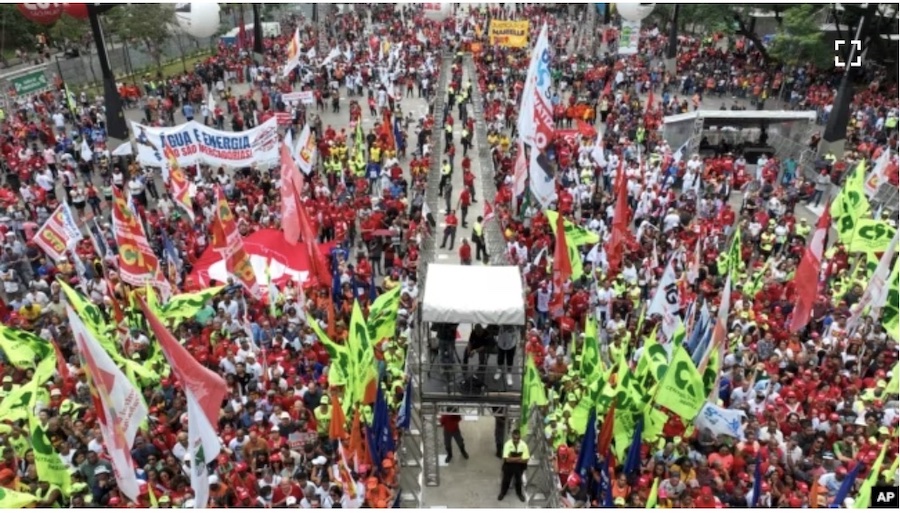
Protests—some of them massive—in defense of democracy and education and against far-right President Jair Bolsonaro’s coup-mongering were held in cities across Brazil Thursday, less than two months before the first round of the South American nation’s presidential election.


A massive pro-democracy demonstration takes place at the University of São Paulo School of Law in São Paulo, Brazil, on August 11, 2022. (Photo: Miguel Schincariol/AFP via Getty Images)
Click on image to enlarge

Demonstrations took place in at least 23 of Brazil’s 26 state capitals, as well as in the national capital of Brasília. Many of the protests featured readings of a pair of pro-democracy manifestos, including the “Letter to Brazilians in Defense of Democracy and Rule of Law.”  The missive, which has been signed by nearly one million people, was inspired by a similar 1977 document that helped bring down a 21-year, U.S.-backed military dictatorship admired by Bolsonaro, who served in its army.

During the reading event at the University of São Paulo (USP) School of Law—where large banners read “dictatorship never again” and “state of rights, always”—presidential candidates spoke out in defense of Brazil’s electronic voting system, which has been the target of baseless allegations of fraud by Bolsonaro and his allies. The right-wing president, who is pushing for paper ballots, has threatened  to reject the results of October’s first-round presidential election if he loses under the current electronic voting system.

(article continued in right column)

Question related to this article:
 
How effective are mass protest marches?

(article continued from left column)

“Defending democracy is defending the right to quality food, a good job, fair wages, access to healthcare, and education,” said Luiz Inácio Lula da Silva, the former leftist president who is running again representing the Workers’ Party and leads  Bolsonaro by double digits in aggregate polling.

“[This is] what the Brazilian people should have,” da Silva added. “Our country was sovereign and respected. We need to get it back together.”

Bolsonaro mocked the massive nationwide rebuke of his rule, tweeting  that “today, a very important act took place on behalf of Brazil and of great relevance to the Brazilian people: Petrobras once again reduced the price of diesel.”

A broad range of leftist activists spoke at and about the demonstrations across Brazil.

“Running over democracy is not as simple as the militiaman imagined,” tweeted Ivan Valente, leader of the Socialism and Liberty Party (PSOL) in Brazil’s Chamber of Deputies, the lower house of Congress. “Bolsonaro is much closer to jail than to the coup… Brazilian society does not accept setbacks or coup bravado.”

Beatriz Lourenço do Nascimento of Black Coalition for Rights—one of the few Black faces in the room during the USP reading—recited  her group’s anti-racist manifesto during the event.

“Brazil is a country in debt to the Black population,” she asserted. “We call on the democratic sectors of Brazilian society, institutions, and people who today show emotion over the ills of racism and claim to be anti-racist: Be consistent. Practice what you speak. As long as there is racism, there will be no democracy.”

Economist and social activist João Pedro Stédile, a co-founder of the Landless Workers’ Movement (MST), said  members of the group took part in Thursday’s “historic event” in “defense of Brazilian society.”

“We are in the process of building this broad front, representing all Brazilians who defend democracy,” he continued. “Democracy involves changing the government and eliminating neo-fascism, but above all, ensuring that the working class, the people, have the rights guaranteed in the Constitution. Right to work, income, land, education, health.”

“Today’s act is just the start of a great journey of activities centered around 200 years of Brazilian independence,” Stédile added, referring to Brazil’s bicentennial on September 7. “We are organizing to continue with demonstrations and mobilizations, especially in the week of September 7th to 10th, when we take to the streets to defend democracy, sovereignty, and the Brazilian people.”

Brazil : Peoples Committees to hold workshop on Culture of Peace and Militant Self-protection

. . DEMOCRATIC PARTICIPATION . .

An announcement from the website of the PT – Partido dos Trabalhadores (translation by CPNN)

The National Training School of the PT (Partido dos Trabalhadores -Workers Party) the PT National Secretariat for Political Training and the Executive Secretariat of the Popular Struggle Committees will offer this Thursday (14 July) the workshop Culture of Peace and Militant Self-protection.

(Article continued in right column)

(Click here for the original Portuguese version of this article.)

Question related to this article:

How can election violence be prevented?

(Article continued from left column)

Faced with the intensification of political violence in the country, the objective of the workshop is to analyze the current situation and the threats against the integrity of militancy and street demonstrations. The violence stimulated by the President of the Republic manifested itself in an extreme way last weekend with the assassination of comrade Marcelo Arruda, in Foz Iguaçu (Paraná,).

This scenario generates fears and anxiety than could leading to a possible state of paralysis. Understanding this logic of intimidation practiced by Bolsonarism is fundamental so that, in addition to establishing our practical and political response for the Culture of Peace and Solidarity, we can also advance in the preparation and organization of our Popular Committees of Struggles.

To be stronger and more united, with our heads held high for the important battles that lie ahead, we invite everyone to participate in the workshop.

🚩 Participate in the Workshop “Culture of Peace and Militant Self-protection”

🕐 Write it down on the agenda! Thursday, 14/7 19h in Brasilia time, by the Zoom App.

ATTENTION: Registration is open until 7/14, until 12:00 pm Brasília time

To register click here and fill in the form.

From the Editorial/Popular Struggle Committee

Medellin, Colombia: The Week for Disarmament 2022 involved more than 1,300 participants

.. DEMOCRATIC PARTICIPATION ..

An article from the city government of Medellin (translation by CPNN)

From June 30 to July 7, the Medellín Mayor’s Office held the now traditional Week for Disarmament. This year the slogan was “Because life is worth it “, as a way to contribute to the prevention of all kinds of violent attitudes, homicides and fatal accidents and, through pedagogy, to discourage the carrying, possession and use of weapons.

In this edition, more than 1,300 young people participated in activities in different parts of the city. For example in the Héctor Abad Gómez Educational Institution, 450 people from the student community were involved.


Photo from Mayor of Medellin

Another development was the “Culture to the park” initiative, with the discussion “Weaving from the word and the experiences on the Medellin Future for the prevention of armed violence, and how art has been a mobilizer for the transformation of the city.”

(continued in right column)

(Click here for the Spanish original of this article)

Questions for this article:

How can culture of peace be developed at the municipal level?

What is happening in Colombia, Is peace possible?

(continued from left column)

“We have carried out all kinds of interventions in the territory. We develop strategies according to the premise “Because life is worth it”. In Villa Hermosa we held a discussion about the experiences of our Medellín Future and the prevention of violence, in which other Secretariats participated. To close this week we have the youth camp with the happiness strategy and the Football Culture component”, said the Undersecretary of Local Government and Coexistence, Carlos Gutiérrez Bustamante.

On July 7, a camp was held for coexistence in the Altavista corregimiento sports area, in the village of Manzanares. The staff of the Coexistence Unit of the Security Secretariat participated in this strategy leading a space for learning and reflection for the community.

The Non-Violence Secretariat also joined the agenda with armed violence prevention strategies that led by the “Partners” and Non-Violence Schools programs in which prevention actions are carried out with boys, girls, adolescents and young people at risk of being used or recruited by armed groups.

“From the Secretariat we want to strengthen the message and the commitment to consolidate a culture of peace and Non-Violence in the city of Medellín, for this reason, our territorial work with a preventive approach focuses on generating scenarios for dialogue and conversation through art. as part of a commitment from the construction of territorial peace to deconstruct violent imaginaries”, said the Undersecretary of Construction of Territorial Peace, Carolina Saldarriaga.

During 2021 and so far in 2022, nearly 1,500 young people and children have benefited from pedagogical spaces through training and work opportunities, as well as artistic and cultural methodologies for peace with the themes of respect for life, rejection of armed structures and the change of attitudes about the use of weapons.