Category Archives: DISARMAMENT & SECURITY

USA: Meet The Students Who Dreamed Up Friday’s National School Walkout

DISARMAMENT & SECURITY .

An article by Cassandra Basler from National Public Radio (reprinted as non-commercial use)

April 19: When Lane Murdock, a high school sophomore, heard that 17 high school students and educators had been killed in a shooting in Parkland, Fla., she says she felt numb. To her, and so many others, mass shootings can feel all too common in the U.S. “In the time I’ve been in high school we’ve had the Pulse, Las Vegas and now, [the Parkland] shooting,” Murdock says.

So that same day, Feb.14, Murdock started a  Change.org petition  that so far has received more than a quarter-million signatures. Her ask? A walkout to protest violence in schools that she planned to coincide with the anniversary of the mass shooting at Columbine High School in 1999. Murdock was born in 2002.


Lane Murdock, a high school sophomore, says she felt numb after the school shooting in Parkland, Fla., and knew it was time for her to try to make some change.

On one of the last days of spring break, she and seven other students from her high school in Ridgefield, Conn., gather around a few tables at their town rec center. They have been working hard, even losing sleep, trying to get organized for the day. As Murdock says, “Success knows no sleep.”

This is, by far, the biggest event they have ever planned. She and her team have more than 2,500 walkouts across the country registered through their website. They’ve drafted a long to-do list, including everything from securing a stage for speeches for their local walkout, to reaching out to the national press.

“Prioritize,” Murdock tells her team, “We’re not going to be able to get 100 percent of these things, I can guarantee that, but it’s important that we get the important things.”

Murdock wants the walkout to go down in history but acknowledges that it won’t represent every student’s perspective. Some polls show that young people are no more liberal  than older generations on gun control.

And other students who live with gun violence regularly have said they don’t feel represented  in the social movements following the shooting at Parkland.

(Article continued in right column)

Question related to this article:

Do you think handguns should be banned?, Why or why not?

(continued from left column)

“There’s gun violence that’s been happening every day that isn’t a school shooting,” Murdock says. She wants the day to be inclusive. On the other hand, she knows it will be uncomfortable.

“We get hate comments online all the time because we’re angering people, and we’re angering people because we’re scaring them, and if we’re scaring them it’s because we’re doing something,” she says.

She wants people to know that she’s imagining this day to be very different than the March For Our Lives  or the 17 minutes of silence on March 14 in honor of the victims in Parkland, Fla. This walkout will last from 10 a.m. through the end of the day.

“People ask me, like, ‘Why? Why all day?’ ” Murdock says. That’s because “this is a topic that deserves more than 17 minutes.” Part of the plan for the day is to get students together in what they refer to as “a call to action,” registering voters or writing to elected representatives about the need for further gun control, for example.

These student organizers have gotten help from a national nonprofit called Indivisible, a group that says it aims to “fuel” young people to “resist the Trump agenda.” Paul Kim, a senior at Ridgefield in charge of communications for the event, says Indivisible helped the high school organizers map their outreach online.

“I got every chapter signed up in Texas,” Kim says, talking about all the walkouts they’ve registered. “And these people emailed back … I could like feel the Texas in the email. The accent, everything.” The group laughs.

To Murdock, the widespread support she says they’ve seen shows that sensible gun control doesn’t have to be partisan.

“It is not conservative or liberal. It is just about making sure our children don’t get harmed in school and we don’t live in a community and in a country that has institutionalized fear,” Murdock says. “I think we’re all sick of it. That’s why we’re doing this.”

She grew up with that fear. Her school had regular lockdown drills after 26 students and educators were killed in a shooting at Sandy Hook Elementary School when she was in fifth grade. It happened just 20 miles from her classroom.

She says there is a reason why she felt desensitized when she heard about Parkland. She and her team of fellow organizers at Ridgefield say that gun violence in the U.S. has gone on for too long.

“Change happens through patience and this fight does not stop after April 20,” Murdock says. “There is going to be a lot of work to be done after April 20 and that is going to include you guys and it’s going to include tons of students all across this nation,” she says talking to the group.

At 10 a.m. local time on Friday, thousands of students will march out of their classes wearing orange for gun safety and chanting for change.

“Our Dreams Are Coming True”: Peace Activists Celebrate as Korean Leaders Vow to Officially End War

DISARMAMENT & SECURITY .

An article from Democracy Now (reprinted under terms of  Creative Commons Attribution-Noncommercial-No Derivative Works 3.0 United States License.

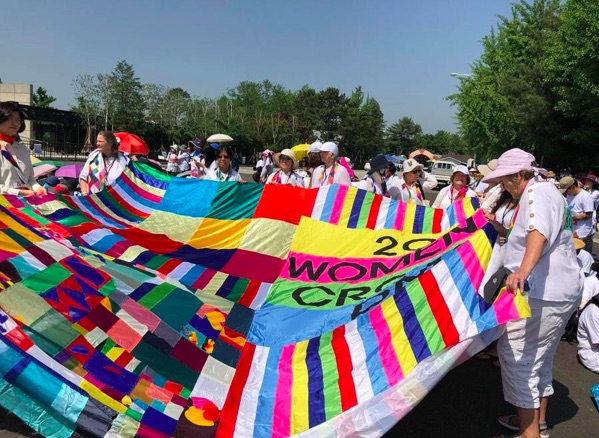
History has been made on the Korean peninsula today, as South Korean President Moon Jae-In and North Korean leader Kim Jong-Un shook hands at the Demilitarized Zone between the two countries and pledged to work to denuclearize the peninsula and to declare the official end to the Korean War. Today’s historic summit marks the first time a North Korean leader has ever set foot inside South Korea. During the meeting, North Korean leader Kim Jong Un said “I came here to put an end to the history of confrontation.” The North and South Korean leaders pledged to pursue talks with the United States aimed at negotiating a formal peace treaty to replace the uneasy 1953 armistice. For more we speak with Ann Wright, retired U.S. Army Colonel and former State Department diplomat. She is a member of Women Cross DMZ, a group of international peacemakers who have been calling for an end to the Korean War.


Video of program

AMY GOODMAN: This is Democracy Now!, Democracynow.org, The War and Peace Report. I’m Amy Goodman. History was made on the Korean Peninsula today.

MOON JAE-IN: Kim Jong-un and I declared together that there will be no more war on the Korean Peninsula and a new age of peace has begun.

AMY GOODMAN: Those were the words of South Korean President Moon Jae-in as he held a historic summit with North Korean leader Kim Jong-un. After shaking hands at the demilitarized zone between the two countries, the two leaders pledged to work to denuclearize the Peninsula and to declare the official end to the Korean War. Today’s historic summit marks the first time a North Korean leader has ever set foot inside South Korea. North Korean leader Kim Jong-un wrote in a guest book “a new history starts now. An age of peace, from the starting point of history.” Kim and his South Korean counterpart pledged to pursue talks with the United States aimed at negotiating a formal peace treaty to replace the uneasy truce that was brokered after the 1950-1953 Korean War. This is North Korean leader Kim Jong-un speaking today.

KIM JONG-UN: We will make efforts to create good results by communicating closely in order to make sure our agreement signed today before the entire world will not end as just a beginning like previous agreements before today.

AMY GOODMAN: Today’s breakthrough comes amidst a series of diplomatic developments regarding North Korea and its nuclear program. Last month, Kim Jong-un traveled to Beijing by armored train to meet with the president of China, Xi Jinping, in Kim’s first foreign trip since taking office in 2011. Kim is also slated to meet soon with President Trump, in what would be the first-ever meeting between a sitting U.S. president and a North Korean leader. Last week, North Korea announced it would stop testing nuclear weapons and ballistic missiles and would close a site where at least six prior nuclear tests were held. This is South Korean President Moon Jae-In speaking today.

MOON JAE-IN: It is very significant that North Korea took a measure of freezing nuclear first. It will be a valuable beginning for the complete denuclearization on the Korean Peninsula. I clearly declare that the South and North will closely cooperate for the complete denuclearization.

AMY GOODMAN: This morning, after President Trump tweeted against James Comey once again, he then tweeted, ”KOREAN WAR TO END! The United States, and all of its GREATpeople, should be very proud of what is now taking place in Korea!” We go right now to Hawaii, where we are joined by retired U.S. Army colonel, former State Department diplomat, Ann Wright. She is a member of Women Cross DMZ, a group of international peacemakers who have been calling for an end to the Korean War. Ann Wright, talk about your response to what has just taken place on the Korean Peninsula. Did you ever think you would see this day?

ANN WRIGHT: Holy smoke, no. This is just really remarkable. The last 12 hours have just stunned everyone, of the incredible, incredible work that has been done by the South Korean government with the North Korean government. And for them to have been able to come out with a communiqué, an agreement that is stunning, that has—I mean, I couldn’t have written it any better. All of the wants that we of the world who want peace for the Korean Peninsula, who could have written everything down—we couldn’t have added anything more to what they have come up with. It is really a beautiful, beautiful agreement, worked very hard by both governments. And I certainly hope the United States government will agree with all parts of it and that, indeed, the people of Korea will finally have peace on their Peninsula.

AMY GOODMAN: As you mentioned, this really has been pushed forward by the South Korean president, Moon Jae-in. He campaigned on this and he has pushed very hard for this meeting. What is actually in the document that they signed, from the economy to denuclearization?

ANN WRIGHT: Indeed, it is just—it’s breathtaking, the amount of things that are in this communiqué. Everything from denuclearization of the Korean Peninsula, to a peace treaty, to no more war on the Korean Peninsula. To establish a peace regime. To have family reunification starting on August 15th. To connect railroads and roads. To cease all hostile acts on land, air, and sea. To transform the DMZ into a peace zone. To have a maritime peace zone in the western, northern limit of the area. To hold military talks in May. That President Moon will go to North Korea in the fall. And to say there will be disarmament in a phased manner as tensions are alleviated. It is a really beautiful, beautiful document that will require a lot of work, that’s for sure, and a lot of commitment to make sure that this doesn’t get derailed in any way, but it is really a very comprehensive statement of peace for the Korean Peninsula.

(continued in right column)

Question for this article:

Can Korea be reunified in peace?

(continued from left column)

AMY GOODMAN: Now, you are a retired U.S. Army colonel. You quit the State Department over your opposition to the war in Afghanistan. You are a fierce critic of President Trump. But do you believe that President Trump deserves credit for some of what has taken place today?

ANN WRIGHT: Absolutely. Ninety-nine percent of the things that President Trump is doing, I don’t agree with, but even when he was running for office, when he said “I will talk to people. I will talk to Kim Jong-un,” it was like, “Well, that’s a very good statement.” And indeed, he has followed through, saying that he will. And I certainly hope that they do have a very good summit in late May or in June. It is very important that the United States follow through with what the South Korean government and the North Korean government have done. And I certainly wish President Trump goodwill for this, and I wish him goodwill if he would approach other aspects of our globe for peace, for the better environment, for keeping our planet safe for everyone. But yes, he deserves a little bit of credit for this, and I’ll give it to him.

AMY GOODMAN: As the Korean leaders embraced each other on the demilitarized zone, the White House released the photograph of Mike Pompeo, who was secretary of state nominee at the time—he has been approved—and Kim Jong-un in that secret Easter-day meeting. The significance of that, Ann Wright?

ANN WRIGHT: Well, as director of the CIA at the time, to have sent the intelligence chief of the United States instead of the secretary of state—although by that time, Tillerson I believe had already been fired. But President Trump having in mind the nomination, I guess, of Mike Pompeo to become secretary of state, it does put him in a position that he has at least met Kim Jong-un. Hopefully, they will develop some sort of a relationship so that the United States and North Korea can have a reasonable relationship. It is very important that we give credit where credit is due. I hope not only is he able to smooth out relations with North Korea, keep relations with South Korea, and I hope he is able to rebuild the State Department, which so desperately needs to have some attention from the Trump administration.

AMY GOODMAN: And what does this mean for the, what is it, something like 28,000 troops in South Korea, U.S. troops in South Korea, today?

ANN WRIGHT: Oh, I can imagine that those 28,000 troops are just breathing a sigh of relief. To have been assigned to North—to South Korea with all of the tensions, it must have been very, very difficult for all of the U.S. military there as well as the civilians of South Korea, having to live under all of the rhetoric that has been going on. But I feel quite certain that our U.S. military is breathing a great sigh of relief with this agreement between North and South Korea.

AMY GOODMAN: Ann Wright, you crossed the demilitarized zone as a member of Women Cross DMZ in 2015. Did you think this moment can come, and do you see a unified Korea in the future?

ANN WRIGHT: Well, indeed. In 2015, with Christine Ahn, with whom I was with this afternoon here in Honolulu as we watched the very beginning of the talks between the leaders of North and South Korea. And of course, this has been our dream, not just Women Cross the DMZ, but all of the people that have been working on the issues of the Korean Peninsula for decades. And indeed it is just—it is a remarkable occurrence today that our dreams are really coming true.

If this agreement is implemented in the way that it is written, it will really provide such a relief to both the people of North Korea and South Korea that they don’t have to live under the threat of potential military action, that indeed there can be cooperation on economic areas that will help North Korea.

The people in North Korea are not dummies. They are very smart people, and I think they will be able to use this opportunity very, very well to increase their standard of living. And the family reunification part of this, that the people of the Korean Peninsula who were artificially divided in 1945, that indeed they will be able to resume family relationships, and that the Korean Peninsula will become a safe place, a place of peace for the world.

AMY GOODMAN: We are currently showing live footage of the two leaders, South and North Korea, as they hold hands, continue to embrace each other. Do you think, Ann Wright, that the crippling sanctions that President Trump imposed against North Korea drove Kim Jong-un to this point? And what do you think we could see if North Korea is opened up?

ANN WRIGHT: Well, the pressure that the international community has put on North Korea definitely had to have had some effect on Kim Jong-un’s decision to be more open. However, I think the greater thing was that, indeed, because they have developed nuclear weapons, that they feel secure that they could defend themselves from any type of regime change, which is still the policy of the United States. Although, hopefully, by the tweet that President Trump did this morning, regime change is no longer our policy. But I think between the confidence that Kim Jong-un had because of the nuclear program and the increased sanctions that had to be hurting, those things combined put him in a position that, “OK, let’s deal with the West.” I think he is dealing very well with it.

And the numbers of or the amount of natural resources that they have in North Korea, the intelligence of the people of North Korea—I mean, with all of the sanctions and all of the things that the international community have done to them, they still developed nuclear weapons. They still put—they developed ICBMs. They put satellites into space. It’s not like under all those sanctions that they were just totally crippled. They are very smart people, and I think with a little bit of a chance, that we will see remarkable things happening for the people of North Korea.

AMY GOODMAN: Ann Wright, I want to thank you for being with us. Retired U.S. Army colonel, a member of Women Cross DMZ, speaking to us from Hawaii today about this historic development on the Korean Peninsula—the meeting of the South and North Korean leaders across the DMZ. We will continue to cover this. Tune in next week and over the weekend for the latest developments at Democracynow.org. 
This is Democracy Now! When we come back, we go to Capitol Hill, where the EPAAdministrator, Scott Pruitt, who many say has rolled back environmental regulations to an extent we have not seen in decades, was grilled on Capitol Hill. Stay with us.

U.S. student anti-gun activists to keep momentum alive over summer

DISARMAMENT & SECURITY .

An article from Reuters (reprinted by permission)

Leaders of the student-led anti-gun movement, who inspired classroom walkouts across the country on the 19th anniversary of the Columbine High School massacre, say they plan to maintain their activism through the long summer break.

This week’s protests [on April 20] marked the second mass student walkout since a 19-year-old man opened fire at a Parkland, Florida high school in February, killing 17 people. It signaled the emergence of a growing national campaign led by young people to lessen gun violence and toughen laws on firearms sales.


Youths take part in a National School Walkout anti-gun march in Washington Square Park in the Manhattan borough of New York City, New York, U.S., April 20, 2018. REUTERS/Brendan McDermid

But the movement faces a major early challenge as the traditional three-month summer break approaches for most U.S. public schools at a critical moment in their bid to be heard by politicians in their home states and Washington, D.C.

“The reason why this has been so huge (is that) we’re in school, we talk to our classmates, we spread it around, everybody’s around so it’s kind of easier to show up,” said Vivian Reynoso, 17, a junior at Tucson High Magnet School in Tucson, Arizona, who helped organize rallies for both nationwide demonstrations in the past month.

“Of course you fear (losing the momentum),” said Reynoso, who like her peers in the campaign was born a year or more after the Columbine shootings. “I’m pretty sure even the Parkland victims are afraid of that. That’s why we need to be pushing, even if it’s summer, to keep telling people to keep talking about the issue and not to forget to about it.”

In the nearly two decades since Columbine seniors Eric Harris and Dylan Klebold went on a shooting rampage in 1999, killing 12 students and a teacher before committing suicide, school shootings have become almost commonplace in the United States.

(Article continued in right column)

Question related to this article:

Do you think handguns should be banned?, Why or why not?

(continued from left column)

Students at Columbine, which has not held classes on April 20 since the massacre, did not take part in the walkout, and were encouraged to do community service instead.

Even as students prepared for Friday’s protests wearing orange, the color of the anti-gun movement, news began trickling out that a 17-year-old student had been wounded in a shooting at a high school near Ocala, Florida, some 225 miles northwest of Parkland.

SECOND AMENDMENT

The debate over guns in America, where the right to bear arms is protected under the Second Amendment of the Constitution, has raged nearly since the nation’s founding.

The students hope to succeed where other activists have failed in enacting stricter legislation on gun ownership, either at the state or federal level.

As anger fades over the Parkland shootings, the test for students will be in organizing for gun reform. Many of the protests featured voter registration drives, with students aiming to make it a major issue for midterm elections in November.

“Who knows whether they maintain the energy or not but there are historic examples of student-led movements that have played an important role in moving things forward, (for example) the Civil rights movements,” said Adam Winkler, a professor of constitutional law at the University of California, Los Angeles.

“We’ve seen these kids take a real leadership role on this issue,” said Winkler, author of a history of the debate over gun control in America. “Whether they can sustain it not remains to be seen.”

The March 24 “March For Our Lives” rallies in cities across the United States were some of the biggest U.S. youth demonstrations in decades, with hundreds of thousands of young Americans and their supporters taking to the streets.

Friday’s walkouts, though smaller in scale, signaled the determination of the students to press on with their movement.

“The way we’re viewing the summer right now is it’s really an opportunity to put in a lot of work on some really big plans we have going for the return to school in August,” said Gavin Pierce, 21, a college junior studying film in Los Angeles and an organizer of the “March for Our Lives” pro-gun control group.

    “Everyone is really eager to keep this going and to keep on organizing until we see real change,” Pierce said.

Reporting by Jon Herskovitz in Austin, Texas, Ben Klayman in Detroit, Zach Fagensen in Miami, Edgar Mendez in Oconomowoc, Wisconsin, Karen Dillion in Mission, Kansas and Dan Whitcomb in Los Angeles; Editing by Richard Chang

Culture of Peace: The World Peace Flame is coming to Ashland, Oregon

. DISARMAMENT & SECURITY.

An article by Irene Kai / Ashland Culture of Peace Commission in the Ashland Daily Tidings

This is a journey of pure magic and grace. I went with my daughter to the U.K. for an art exhibit in early September 2015, and on a whim we decided to tour the Snowdonia National Park in Wales. We drove deep into the mountains on a narrow two-lane road with hair pin turns on the “wrong” side of the road. As dusk fell, we decided to go back to town. The nearest turning outlet was behind the mountain, so I drove into a hidden nearby space to turn. As I turned, I suddenly saw a two story tall glass tower with a flame inside near the top of it. An inscription on the glass said: “The World Peace Flame.” I was awed. Deep in the mountains in the middle of nowhere, I was greeted by a living flame representing World Peace. At that instant, I felt as if the flame ignited the sacred flame in my heart. I realized World Peace begins with me.


World Peace Flame Monument, Snowdonia Mountain Lodge, Wales

I went into the building behind the monument where a woman told me the history of the World Peace Flame. In 1999, the princess of the Netherlands went to five continents to collect seven sacred flames, flew them via military and commercial jets and united them in Wales. The Asian flame was from the eternal flame that burns at Gandhi’s memorial. The monument in Wales is the original World Peace Flame Monument. I was invited to light a candle from the flame and I brought it back to Ashland.

I came to Ashland 20 years ago via Hong Kong, New York, London and Los Angeles, not knowing anything about Oregon. Over a decade ago, I was attracted to the local Native American culture, and became very involved with the Ashland Native American group and befriended Roy Hayes, Chief Joseph’s great-great grandson. 

(Continued in the right column)

Question related to this article:

How can culture of peace be developed at the municipal level?

(Continued from the left column)

I learned deeply about the culture of the Native American’s history in the Rogue Valley. 

Jacksonville was once a thriving Chinatown 200 years ago. Hundreds of Chinese migrants came to southern Oregon as laborers for the gold miners. The ditches they dug are still visible today. When the gold dried up, they were chased out and some were killed. They vanished without a trace. This group of migrants were from Toisan, southern China, the village of my family. They were my ancestral relatives.

On Sept. 21, 2015, the International Day of Peace, my partner David Wick and I launched the Ashland Culture of Peace Commission (ACPC). During the launch, I lit the candle I brought back from Wales. During the ceremony, I was inspired to bring the World Peace Flame monument to Ashland, to honor our ancestors and to heal their sufferings.

By bringing healing and peace to our ancestors, we, the descendants will be able to release the burden of the sufferings of our linage and learn to practice living in peace for ourselves, our children and their children. 

The physical official live eternal World Peace Flame on our city ground will become a beacon of light that represents hope, healing, forgiveness, unity and humility for all who see it. The only other World Peace Flame in the United States is in the Civil Rights Museum in the Lorraine Motel, Memphis, Tennessee, the assassination site of Dr. Martin Luther King, Jr.

For almost three years, I told anyone who had influence in the city of Ashland that I would like to install a World Peace Flame Monument in Ashland. Everyone thought it was a great idea, smiled and said: “Good Luck.” One day, David Wick and I wandered into the Southern Oregon University Sustainability Center. We walked into the old farm house and saw the architectural drawing of the “Thalden Pavilion — The Center of Outrageous Innovation” on the wall. I saw a tower next to the main structure and said to David, “That is the perfect place for the World Peace Flame!” 

Barry and Kathryn Thalden, strong supporters of ACPC, agreed to have the World Peace Flame installed at the base of the obelisk and informed us that it will be flanked by two 28 ft. cedar teaching poles, carved by Russell Beebe, a local Native American sculptor. How perfect!

ACPC is responsible for our part of the construction for the housing of the World Peace Flame. I invite you to join me on this magical journey of grace to bring the World Peace Flame to Ashland. With your generous donations, it will become a reality. Please visit our website at www.ashlandcpc.org.

Israel: “I’m going to prison rather than serve in the Israeli army”

. DISARMAMENT & SECURITY.

An article from Finalscape (translation by CPNN)

My name is Nattan Helman. I’m 20 years old, I come from Kibbutz Haogen.

On November 20, I will refuse to serve in the Israeli army for reasons of conscience. In the third year of college, I came across documents about the occupation and started asking: What are we doing there? How does this affect our society? How does it affect me?


Video of interview

(Continued in the right column)

Question related to this article:

“Put down the gun and take up the pen”, What are some other examples?

(Continued from the left column)

After doing some research, after reading books, articles and testimonies of soldiers, after seeing the territories, I concluded that Israeli policies were oppressing Palestinians and Israelis.

When I received my first call from the army, I knew I would not go. I told my parents. At first they took it very badly, then they understood and they supported me.

At first, I felt lonely and thought I was the only one to think so. I knew that my refusal was a violation of the law but in front of every law there is morality, a conscience, a limit.

In the past, there was a lot of social injustice that was legal. The Holocaust in Europe, apartheid in South Africa, slavery in the United States are all examples of legal injustice. A law requiring enlistment in an army that opposes an entire population is not an ethical law and I do not feel the obligation to obey it.

I spoke with former objectors about the conditions of life in prison, and I try to get used to the idea of ​​living there.

The situation is frightening and stressful, but I think if I continue to believe in my values, they will strengthen me and protect me there.

(Click here for the original French version of this article.)

USA: The Missing Link in the Gun Debate

. .DISARMAMENT & SECURITY. .

An article by Greta Zarro for Common Dreams (reprinted according to a Creative Commons Attribution-Share Alike 3.0 License)

America is up in arms about guns. If last month’s “March for Our Lives,” which attracted over one million marchers nationwide, is any indication, we’ve got a serious problem with gun violence, and people are fired up about it.  
But what’s not being talked about in the mainstream media, or even by the organizers and participants in the March for Our Lives movement, is the link between the culture of gun violence and the culture of war, or militarism, in this nation. Nik Cruz, the now infamous Parkland, FL shooter, was taught how to shoot a lethal weapon in the very school that he later targeted in the heart-breaking Valentine’s Day Massacre. Yes, that’s right; our children are trained as shooters in their school cafeterias, as part of the U.S. military’s Junior Reserve Officers’ Training Corps (JROTC) marksmanship program.  


Members of the Patch High School drill team compete in the team exhibition portion of the Junior Reserve Officer Training Corps drill meet at Heidelberg High School April 25. (Photo: Kristen Marquez, Herald Post/flickr/cc)

Nearly 2,000 U.S. high schools have such JROTC marksmanship programs, which are taxpayer-funded and rubber-stamped by Congress. Cafeterias are transformed into firing ranges, where children, as young as 13 years old, learn how to kill. The day that Nik Cruz opened fire on his classmates, he proudly wore a t-shirt emblazoned with the letters “JROTC.” JROTC’s motto? “Motivating Young People to Be Better Citizens.” By training them to wield a gun?  

I want to know why America isn’t marching against the military’s marksmanship programs. I want to know why millions aren’t knocking on their representatives’ doors and refusing to pay their taxes, until congressionally-approved firing ranges are removed from schools. Meanwhile, military recruiters hobnob with students during lunch break, then train them how to shoot in that same cafeteria and lure them to enlist. No doubt, the military’s pitch is slick, and economically enticing. That is, until the trainees turn on their classmates and teachers.

Perhaps what’s key above all, however, is that JROTC, and U.S. militarism as a whole, is embedded in our sociocultural framework as Americans, so much so that to question it is to cast doubt on one’s patriotic allegiance to this nation. To me, this explains why the Nik Cruz JROTC connection is not even an option on the table in the dialogue about gun violence. Why, at last month’s March for Our Lives in D.C., when my colleagues held up signs about the JROTC marksmanship program, marchers nodded in approval and bragged that they were JROTC trained.  

(Article continued in right column)

Question related to this article:

Do you think handguns should be banned?, Why or why not?

(continued from left column)

The culture of war is pervasive in our society, through military-funded Hollywood films and video games, the militarization of the police, and JROTC and ROTC programs in our schools. The Pentagon receives the names, addresses, and phone numbers of all of our children, unless parents tell their children’s schools to opt them out. Nearly all of us are culpable, wittingly or unwittingly, in supporting the spread of U.S. militarism through our silent complicity and our tax dollars.  

The average mass shooter in this country is, by and large, an American male with a history of mental illness, criminal charges, or illicit substance abuse, according to a recently released March 2018 report by the U.S. Secret Services. He is not an ISIS terrorist or Al-Qaeda plotter. In fact, findings show that, above any ideology, mass attackers are most often motivated by a personal vendetta. What the Secret Services report does not talk about, however, is the disproportionate number of mass attackers who have been trained by the U.S. military. While veterans account for 13% of the the adult population, the data shows that more than 1/3 of adult perpetrators of the 43 worst mass killings between 1984 and 2006 had been in the U.S. military. Further, a 2015 study in the Annals of Epidemiology found that veterans kill themselves at a rate 50% higher than their civilian counterparts. This speaks volumes about the damaging psychological impact of war, and, I would argue, the deleterious potential of the warlike “us vs. them” mentality that JROTC and ROTC programs instill in the minds of developing youth, not to mention the very real marksmanship skills that they teach.  

While military recruits with access to a gun pose a risk to Americans at home, meanwhile, our soldiers abroad are not much more effective at policing the world. As military spending has skyrocketed in recent decades, now accounting for over fifty percent of U.S. federal discretionary spending, according to the National Priorities Project, so has terrorism.

Despite our country’s endless state of military “interventions” in other nations, the Global Terrorism Index in fact records a steady increase in terrorist attacks from the beginning of our “war on terror” in 2001 to the present. Federal intelligence analysts and retired officers admit that U.S. occupations generate more hatred, resentment, and blowback than they prevent. According to a declassified intelligence report on the war on Iraq, “despite serious damage to the leadership of al-Qaida, the threat from Islamic extremists has spread both in numbers and in geographic reach.” With the U.S. government spending a combined $1 trillion annually on war and preparations for war, including the stationing of troops at over 800 bases worldwide, there is little left of the public purse to spend on domestic necessities.

The American Society of Civil Engineers ranks U.S. infrastructure as a D+. We rank 4th in the world for wealth inequality, according to the OECD. U.S. infant mortality rates are the highest in the developed world, according to UN Special Rapporteur Philip Alston. Communities across the nation lack access to clean drinking water and proper sanitation, a UN human right that the U.S. fails to recognize.

Forty million Americans live in poverty. Given this lack of a basic social safety net, is it any wonder that people enlist in the armed forces for economic relief and a supposed sense of purpose, grounded in our nation’s history of associating military service with heroism? 
 
If we want to prevent the next mass shooting, we need to stop fueling the culture of violence and militarism, and that starts with ending JROTC marksmanship programs in our schools.

Global Anti-war Protests Against US-led Aggression in Syria

DISARMAMENT & SECURITY .

An article from Telesur TV

Leftists and anti-war protesters took to the streets in many cities around the world over the weekend against to renounce and reject the U.S.-led assault against Syrian government structures with the support of France and United Kingdom.


Demonstrators protest after the missile strikes on Syria, outside the White House in Washington, U.S., April 14, 2018. Photo | Reuters

In the U.S. hundreds of protesters gathered in major cities, including New York City, Washington, Chicago and Portland. In Manhattan, people demonstrated in front of the Trump Tower to protest the president’s decision.

In Mexico City, activists met outside of the U.S. embassy and hung banners and flags on the protection fence to demand rights for everyone, regardless of their country of origin, and in rejection of the wall being built between Mexico and the U.S.

In Santiago de Chile demonstrators held a rally outside the U.S. embassy, waving Syrian flags and chanting slogans. They were confronted by the Chilean police and some protesters were arrested.

In London, members of the Stop the War Coalition (STWC) protested Friday outside Prime Minister Theresa May’s residence to demand she refrains from joining any attack on Syria. The protest was joined by people of several backgrounds, including Syrians residing in the United Kingdom.

The protesters read a letter signed by politicians, celebrities, academics and unionists, declaring that “further military intervention, as proposed by Trump, May, or Macron, is not the solution.”

Question for this article:

How can we be sure to get news about peace demonstrations?

In Greece, thousands of people showed up for a rally organized by the Greek Communist Party in Athens to protest the attack on the Syrian government.
According to Greek police, between 6,000 and 7,000 people marched from Syntagma Square to the U.S. embassy, chanting anti-imperialist slogans. Anti-riot police blocked access to the embassy and protesters painted “Americans, murderers of people” in front of it. No clashes were reported and protesters left peacefully.

Dimitris Koutsoumbas, the head of the Communist Party in Greece, criticized Greek politicians for believing the U.S.’s “flimsy excuses about the use of chemical weapons” by Bashar Assad in order to attack Syria.
“The imperialists once again spill the blood of the local people. They destroy and splinter states by using fabricated evidence,” said Koutsoumbas.

In India, members of the Socialist Unity Center of India-Marxist (SUCI-M) and anti-war activists met Sunday in Kolkata to protest the airstrikes, and burned an effigy depicting Donald Trump, with sketches of Macron and May sticked to it.

Protesters held signs reading messages such as “rise up, protest against U.S. missile attack against Syria” and “”in protests against US missile attack on Syria.”

In Cyprus, left-wing activists also protested Sunday at the gates of the RAF Akrotiri, a British royal air force military base in an “overseas territory” in the Mediterranean island, near Limassol.

The United States, United Kingdom and France fired early Saturday over 100 missiles into Syria according to the Syrian government, Russia and the U.S. military. The Syrian army said that more than 70 missiles of the 105 fired at its structures were intercepted by its air defenses.

The United Nations Security Council rejected Saturday a resolution proposed by Russia seeking to condemn the U.S.-led attack in Syria. Only Russia, Bolivia and China voted in favor of the resolution.

Meanwhile global chemical weapons watchdog OPCW inspectors arrived in Syria Saturday and were due to try to reach the site of a suspected poison attack in the Syrian town of Douma in eastern Ghouta.

UK: Protests: Trump & May – No More Bombs on Syria, 13-16 April, Nationwide

DISARMAMENT & SECURITY .

A natioal survey by Stop the War

All the anti-war movement activity has played an important part in ensuring the vast majority of the British people oppose the attack despite near blanket support from the mainstream. This is a huge achievement. Now we need to build on it.

The world is becoming more dangerous by the day. This is why it’s so important that we stay in the streets and that we make sure we have permanent anti-war organisations in every town, city and university.


Sheffield protest

> Fri 13 April – 17:00 | London

On Friday, Stop the War Coalition will be handing in a letter signed by MP’s, trade unionists, celebrities and academics to No.10 to urge Theresa May to refrain from joining Donald Trump in escalating the war in Syria.  Military interventions from external powers have failed to bring an end to the war. The only solution in Syria is a ceasefire on all sides and a political settlement. Join us at 17:00 on Whitehall to demand an end to the bombing of Syria.

> Fri 13 April – 17:00 | Manchester

Emergency protest – 5:30 Piccadilly Gds – Manchester – Don’t Bomb Syria

> Fri 13 April – 17:00 | Leeds

Leeds Coalition Against the War – LCAW – Demo on Monday, please bring placards, banners, candles

> Fri 13 April – 17:00 | Doncaster

Join us at Doncaster Mansion House to protest against the proposed bombing of Syria which could escalate into catastrophic international war. Be part of the coordinated protests happening at this time across the UK.

> Fri 13 April – 17:00 | Sheffield

Hundreds outside Sheffield Town Hall tonight opposing plans for Britain to join the bombing of Syria. Speakers highlighting the previous disastrous interventions in Iraq and Libya which led to chaos and suffering for millions of people. 

> Sat 14 April – 11:00 | Norwich

Stop the War is calling a demonstration in Norwich this Saturday, as set out above. Speakers will include former Norwich MP, Ian Gibson, who opposed the disastrous war in Iraq and sees similarities with the situation today.
Our stall will be collecting signatories for a petition stating:- “We oppose calls for further escalation of military intervention in Syria. Any western attack would lead to more death and destruction and would deepen the misery of the Syrian people. It would prolong the cycle of violence and risk direct confrontation between the great powers. The only solution in Syria is an end to all foreign intervention, a ceasefire on all sides and a political settlement.”

Question for this article:

How can we be sure to get news about peace demonstrations?

> Sat 14 April – 11:00 | Bournemouth

We oppose calls for further escalation of military intervention in Syria. Any western attack would lead to more death and destruction and would deepen the misery of the Syrian people. It would prolong the cycle of violence and risk direct confrontation between the great powers. The only solution in Syria is an end to all foreign intervention, a ceasefire on all sides and a political settlement’. Please bring placards and banners.

> Sat 14 April – 12:00 | Cardiff

No to Trump: Stop Bombing Syria
Aneurin Bevan Statue, Queen Street, Cardiff

> Sat 14 April – 12:30 | Edinburgh

6.30pm at Buchanan Street Steps Gather in protest against the bombing of Syria. Say loud and clear “Not in Our Name!’ No to War – Yes to Democracy.

> Sat 14 April – 13:00 | Nottingham

Don’t Bomb Syria – Nottingham Protest
Brian Clough Statue, King St, NG1 6 Nottingham, United Kingdom

> Sat 14 April – 14:00 | Liverpool

MP Dan Carden, Shadow Minister for International Development and MP for Walton will be speaking at this event.

No more bombs on Syria. Liverpool will send a resounding message to Theresa May and her allies that we say stop the rush to war. 
Not in Our Name!

> Mon 16 April – 17:00 | Bristol

— ASSEMBLE FROM 5PM, marching by 6PM —

We will protest en masse to call to halt the military intervention and demand that our MPs and parliament represent this opposition and stand against this potentially catastrophic move from our government and its allies. Let’s show them what democracy looks like. In recent days least 43% of the population were opposed and only 22% supportive of intervention according to a poll (YouGov). Please *lobby your MP* here : tinyurl.com/DontBombSyria18

> Mon 16 April – 17:30 | Exeter

Don’t Bomb Syria, Bedford Square, Exeter

> Mon 16 April – 17:30 | London, Parliament Square

We will be protesting on Monday when Parliament returns on Parliament Square from 5.30pm. Join us.

> Tues 17 April – 17:00 | Birmingham

Bull Ring Entrance

In pictures: ‘March for Our Lives’ Rallies Demand Stricter US Gun Controls

. .DISARMAMENT & SECURITY. .

A multimedia gallery from Telesur

Thousands demonstrated across the United States [on March 24] to demand gun controls in the wake of February’s school shooting in Florida, which killed 17 people. The nationwide March For Our Lives rallies, some led by student survivors, aim to break the legislative gridlock stymying efforts to restrict firearms in a nation where mass shootings like the one on Feb. 14 at Marjory Stoneman Douglas High School have become frighteningly common.


Across the United States and outside U.S. embassies, hundreds of thousands of campaigners took part in the ‘March for Our Lives’ anti-gun protests. Photo:Reuters


With slogans such as ‘If they choose guns over our kids, vote them out,’ protesters in Washington jammed Pennsylvania Avenue as students from the Florida high school where 17 people were murdered called on lawmakers and President Donald Trump to confront the issue. Photo:Reuters


Celebrities sang and survivors spoke, rallying the crowds with chants of ‘Never Again’ and promising that the Florida Parkland students would challenge congressmen and ‘Vote Them Out.’ Photo:Reuters


Students listen as Emma Gonzalez, a survivor of the Marjory Stoneman Douglas High School mass shooting in Florida, addresses crowds at the ‘March for Our Lives’ event. Photo:Reuters


Protesters hold photos of school shooting victims during a demonstration demanding stricter gun controls in New York City. Photo:Reuters


Parkland shooting survivor Emma Gonzalez addresses the ‘March For Our Lives’ event before pausing for a full 6 minutes and 20 seconds silence – the time it took for the gunman to kill 17 of her Marjory Stoneman Douglas High School classmates. Photo:Reuters

(Article continued in right column)

Question related to this article:

Do you think handguns should be banned?, Why or why not?

(continued from left column)


On Friday, Trump signed a US$1.3 trillion bill that includes modest improvements to background checks for gun sales and grants to help schools prevent gun violence. Photo:Reuters


“I have learned to duck from bullets before I learned to read,” said Edna Chavez, 17, a student at the Manual Arts High School in Los Angeles, who lost a brother to gun violence. Photo:Reuters


“Politicians: either represent the people or get out. Stand with us or beware, the voters are coming,” Cameron Kasky, a 17-year-old high school junior, told the crowd. Photo:Reuters


Student marchers filled streets nationwide, including in Atlanta, Baltimore, Boston, Chicago, Los Angeles, Miami, Minneapolis, New York, San Diego and St. Louis. Photo:Reuters


Shooting survivors from Marjory Stoneman Douglas High School in Parkland, Florida led the demonstration. Photo:Reuters


More than 800 demonstrations were scheduled, with events as far afield as London, Tokyo, Mauritius and Stockholm. Photo:Reuters

‘No more’ or we vote you out: students lead huge U.S. anti-gun rallies

.DISARMAMENT & SECURITY.

An article from Thomson Reuters

Chanting “never again,” hundreds of thousands of young Americans and their supporters answered a call to action from survivors of last month’s Florida high school massacre and rallied across the United States on Saturday [March 24] to demand tighter gun laws.

In some of the biggest U.S. youth demonstrations for decades, protesters called on lawmakers and President Donald Trump to confront the issue. Voter registration activists fanned out in the crowds, signing up thousands of the nation’s newest voters.


Frame from video on Reuters website

At the largest March For Our Lives protest, demonstrators jammed Washington’s Pennsylvania Avenue where they listened to speeches from survivors of the Feb. 14 mass shooting at Marjory Stoneman Douglas High School in Parkland, Florida.

There were sobs as one teenage survivor, Emma Gonzalez, read the names of the 17 victims and then stood in silence. Tears ran down her cheeks as she stared out over the crowd for the rest of a speech that lasted six minutes and 20 seconds, the time it took for the gunman to slaughter them.

The massive March For Our Lives rallies aimed to break legislative gridlock that has long stymied efforts to increase restrictions on firearms sales in a nation where mass shootings like the one in Parkland have become frighteningly common.

“Politicians: either represent the people or get out. Stand with us or beware, the voters are coming,” Cameron Kasky, a 17-year-old junior at Marjory Stoneman Douglas, told the crowd.

Another survivor, David Hogg, said it was a new day.

“We’re going to make sure the best people get in our elections to run not as politicians, but as Americans. Because this – this – is not cutting it,” he said, pointing at the white-domed Capitol behind the stage.

Youthful marchers filled streets in cities including Atlanta, Baltimore, Boston, Chicago, Los Angeles, Miami, Minneapolis, New York, San Diego and St. Louis.

More than 800 demonstrations were scheduled in the United States and overseas, according to coordinators, with events as far afield as London, Mauritius, Stockholm and Sydney.

‘Take Their Liberty Away’

Underlining sharp differences among the American public over the issue, counter-demonstrators and supporters of gun rights were also in evidence in many U.S. cities.

Organizers of the anti-gun rallies want Congress, many of whose members are up for re-election in November, to ban the sale of assault weapons like the one used in the Florida rampage and to tighten background checks for gun buyers.

On the other side of the debate, gun rights advocates cite constitutional guarantees of the right to bear arms.

(Article continued in right column)

Question related to this article:

Do you think handguns should be banned?, Why or why not?

(continued from left column)

“All they’re doing is asking the government to take their liberty away from them without due process,” Brandon Howard, a 42-year-old Trump supporter, said of the protesters in the capital. He had a sign saying: “Keep your hands off my guns.”

Wearing a red “Make America Great Again” sweatshirt, 16-year-old Connor Humphrey of San Luis Obispo, California, said: “Guns don’t kill people. People kill people.”

Humphrey, who was visiting Washington with his family for spring break, said he owns guns for target shooting and hunting and uses them responsibly. His school had a lockdown exercise last week.

“I think teachers should have guns,” he said, echoing a proposal made by Trump after the Parkland killings.

Still, rallies for tighter firearm restrictions also sprang up in rural, Republican-leaning communities ranging from Lewiston, Idaho to Logan, Utah where there is strong support for the Second Amendment constitutional right to own guns.

Among those marching next to New York’s Central Park to call for tighter gun controls was pop star Paul McCartney, who said he had a personal stake in the debate.

“One of my best friends was shot not far from here,” he told CNN, referring to Beatles bandmate John Lennon, who was gunned down near the park in 1980.

Taking aim at the National Rifle Association gun lobby, teenagers chanted, “Hey, hey, NRA, how many kids have you killed today?”

The young U.S. organizers have won kudos and cash from dozens of celebrities, with singers Demi Lovato and Ariana Grande, as well as “Hamilton” creator Lin-Manuel Miranda, among those performing in Washington. Actor George Clooney and his human rights attorney wife, Amal, donated $500,000 and said they would be at the Washington rally.

The U.S. football team the New England Patriots loaned its plane to Marjory Stoneman Douglas High School students and their families to travel to Washington.

At the march in Washington, an elementary school student from Virginia, Naomi Wadler, 11, captivated demonstrators when she spoke up for African American girls who were victims of gun violence but whose stories “don’t make the front page.”

White House deputy press secretary Lindsay Walters said the administration applauded “the many courageous young Americans” who exercised their free-speech rights.

“Keeping our children safe is a top priority of the president’s,” said Walters, noting that on Friday the Justice Department proposed rule changes that would effectively ban “bump stock” devices that let semi-automatic weapons fire like a machine gun.

Also on Friday, Trump signed a $1.3-trillion spending bill including modest improvements to background checks for gun sales and grants to help schools prevent gun violence.

Former President Barack Obama said on Twitter that he and his wife Michelle were inspired by all the young people who made the marches happen.

“Keep at it. You’re leading us forward. Nothing can stand in the way of millions of voices calling for change,” Obama said.

(Reporting by Ian Simpson, Lacey Johnson, Katanga Johnson and Lauren Young in Washington, Alice Popovici in New York, Phoenix Tso in Los Angeles, Zachary Fagenson in Parkland, Robert Chiarito in Chicago, Jim Oliphant in West Palm Beach and Andrew Hay in Taos; Editing by Daniel Wallis, James Dalgleish and Nick Zieminski)