Category Archives: HUMAN RIGHTS

Donald Trump Declared War On ‘Sanctuary Cities.’ They’re Already Fighting Back

…. HUMAN RIGHTS ….

An article with reports by Mollie Reilly, Cristian Farias, Elise Foley and Roque Planas in the Huffington Post (reprinted according to the principle of “fair use”)

One of President Donald Trump’s first major executive actions on immigration policy is facing massive political blowback and will almost certainly crash and burn under the Constitution once courts begin to scrutinize the fine print.


Video of press conference by San Francisco Mayor Ed Lee

During a visit to the Department of Homeland Security on Wednesday [January 25], Trump signed an executive order aimed at strong-arming so-called “sanctuary cities” into cooperating fully with his efforts to ramp up deportations. Threatening loss of federal funding and using shaming tactics for localities that refuse to comply, the order is styled as a call to obey existing immigration laws ― even though immigration experts and civil liberties groups are doubtful Trump even has the constitutional authority to enforce it.

Independent of the ultimate legality of the executive order, politicians from those sanctuary cities say they aren’t budging, and legal advocacy groups are gearing up for the coming legal fight.

The president is “in for one hell of a fight,” California state Sen. Scott Weiner (D), who represents San Francisco, said in a statement.

Boston Mayor Marty Walsh (D) said his city “will not retreat one inch” from its policy against holding undocumented immigrants it otherwise would not hold based on requests from Immigration and Customs Enforcement, and Seattle Mayor Ed Murray said his city “will not be intimidated by federal dollars and … will not be intimidated by the authoritative message from this administration.” San Francisco Mayor Ed Lee (D) said “nothing has changed” in his city, noting the lack of specifics in Trump’s order.

“We are going to fight this, and cities and states around the country are going to fight this,” New York Mayor Bill de Blasio (D) said at a press conference Wednesday.

New York Attorney General Eric Schneiderman (D) already began hinting at a legal challenge, releasing a statement that Trump lacks the constitutional authority for his executive order and that he will do “everything in [his] power” to push back if the president does not rescind it.

Washington state Attorney General Bob Ferguson (D) also warned of potential legal challenges to come, saying in a statement that the order “raises significant legal issues that my office will be investigating closely to protect the constitutional and human rights of the people of our state.”

There’s no exact definition of “sanctuary city.” Places like San Francisco and New York use the term broadly to refer to their immigrant-friendly policies, but more generally the term is applied to cities and counties that do not reflexively honor all of Immigration and Customs Enforcement’s requests for cooperation. Many of these localities do work with ICE to detain and hand over immigrants suspected or convicted of serious crimes, but they often release low-priority immigrants requested by ICE if they have no other reason to hold them.

“The reason that many local law enforcement officers don’t honor detainers is because courts have said that they violate the Constitution, and if they violate the Constitution, the localities are on the hook financially,” said Cesar Cuauhtemoc Garcia Hernandez, a law professor at the University of Denver who teaches on the intersection of criminal law and immigration.

Just on Tuesday, a federal court in Rhode Island joined several others that have ruled in recent years that certain ICE detainers can violate people’s constitutional rights ― even those of U.S. citizens.

But Trump’s executive order seems to overlook this legal reality, and instead frames sanctuary cities with the alarmist rhetoric he used on the campaign trail.

”Sanctuary jurisdictions across the United States willfully violate Federal law in an attempt to shield aliens from removal from the United States,” his order declares. “These jurisdictions have caused immeasurable harm to the American people and to the very fabric of our Republic.”

(Article continued in the right column)

Questions related to this article:

The post-election fightback for human rights, is it gathering force in the USA?

(Article continued from the left column)

Thomas Saenz, who heads the Mexican American Legal and Educational Defense Fund, said that on paper the order wouldn’t give Trump the authority to crack down on sanctuary cities, as Trump claimed.

“It’s hot air, but it’s extremely dangerous hot air,” Saenz told The Huffington Post. “It’s designed to intimidate community members.”

To force sanctuary jurisdictions to hold detained immigrants at the behest of ICE would require Congress to pass new legislation, but Congress in 2015 already rejected similar legislation, said Cecillia Wang, deputy legal director of the American Civil Liberties Union and a specialist in immigrants’ rights.

“The federal government and specifically the president is trying to coerce states and localities that have made the decision to protect constitutional rights and provide services without regard to immigration status,” she said.

“I’m not sure what Trump thinks he’s doing that’s different,” Saenz said. “The law is already being enforced. If they ― in practice or in intent ― go beyond existing law, it would be subject to challenge as it’s beyond his authority as president.”

As legal twists would have it, the constitutional source for such a challenge would be the Supreme Court’s landmark 2012 decision upholding the Affordable Care Act, in which the court rebuked the federal government for threatening loss of funding for states that refused to expand their Medicaid programs under the law. In his majority opinion, Chief Justice John Roberts said Congress couldn’t hold “a gun to the head” of the states.

Wang echoed those words and said she’d be monitoring what consequences befall sanctuary cities. “President Trump is holding a gun to their heads and forcing them to comply with his priorities,” she said.

But in California, where immigrants make up roughly one-third of the population, lawmakers said they aren’t waiting on challenges in court, vowing to take the fight into their own hands.

In a press conference Wednesday, state Senate President pro tempore Kevin De León said the legislature will fast-track bills in response to Trump’s orders, including a bill to prevent local law enforcement from using their resources for immigration enforcement.

“These are spiteful and mean-spirited directives that will only instill fear in the hearts of millions of people who pay taxes, contribute to our economy and our way of life,” he said of the orders. “We will have no part in their implementation.”

“We will not spend a single cent nor lift a finger to aid his efforts,” he added.

The legislature has already taken several pre-emptive steps to combat Trump’s policies. In December, the senate and assembly passed a resolution calling on Trump to abandon his promise to deport millions of undocumented immigrants. The chamber has also taken up a bill to establish a legal aid fund for those facing deportation, as well as a bill to create training centers to educate legal workers on immigration law.

“It’s sad Donald Trump thinks these executive orders make America safer, and it’s sad he thinks they make America,” said Assembly Speaker Anthony Rendon in a statement.

“Today is a shameful day for our country, but it only strengthens my resolve to stand up against the alarming bigotry and hatred emanating from the White House,” Weiner, the San Francisco state senator, said. “If President Trump believes signing a piece of paper will for one second change how San Francisco and California value and protect our immigrant neighbors, he is underestimating our strength and spirit.”

Their statements came just one day after Gov. Jerry Brown (D) dedicated a portion of his State of the State address to praising the contributions of California’s immigrants, a clear rebuke of Trump’s worldview.

“Immigrants are an integral part of who we are and what we’ve become,” he said. “Let me be clear: We will defend everybody ― every man, woman and child ― who has come here for a better life and has contributed to the well-being of our state.”

USA: Women’s marches fight back against inauguration of Trump

…. HUMAN RIGHTS ….

Information from various news services as indicated.

Only one day into the new administration in Washington, already the post-election fightback for human rights has gathered force in the USA. Here is a map showing the largest turnouts the Women’s Marches on Saturday, January 21.


Number of demonstrators in women’s marches by city
(click on image to enlarge)

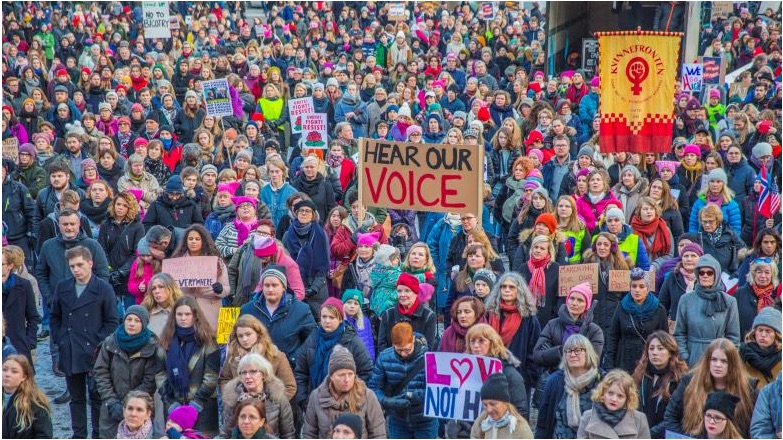
As described by the Mercury News: “In a striking sign of solidarity Saturday, more than 2 million people joined Women’s Marches from the nation’s capital to the Bay Area and beyond, promising to fight for a new era of civil rights in the age of President Donald Trump. Aerial images of buoyant, peaceful protesters clogging plazas and streets from cities as far flung as Sydney and Tokyo to San Jose, Oakland, San Francisco and Walnut Creek harkened to 1960s-era protests against the Vietnam War, bringing some nostalgic baby boomers to tears.”

According to the Washington Post , there were at least 500,000 in the Washington demonstration, 150,000 in Chicago and 125,000 in Boston.

There were huge turnouts in other American cities according to local news services:

Los Angeles 750,000

New York 400,000

Denver 200,000

Seattle 120,000

Oakland 100,000

Portland, 100,000

St Paul 90,000

Philadelphia 50,000

(Article continued in the right column)

Questions related to this article:

The post-election fightback for human rights, is it gathering force in the USA?

How effective are mass protest marches?

(Article continued from the left column)

To put this into perspective, compare the map showing the demonstrations above, with the map of election results (Trump states in red and Clinton states in blue) and the corresponding maps showing population density in the 50 states.


(click on image to enlarge)

Put quite simply, urban populations voted against Trump and demonstrated against Trump, while rural and small town populations voted for Trump.

According to at least one commentator, this huge schism betwen sections of the country seems dangerously close to the North/South divide that led to the American Civil War.

USA: Immigrants Prepped For Raids

…. HUMAN RIGHTS ….

An article by Michelle Liu from the New Haven Independent (Connecticut)

A half-dozen immigration officers enter a factory and demand identification. The workers inside look up from their sewing machines in horror. What would you do? What can you do?

This was the first scenario posed to a crowd of 50 at a “Know Your Rights” workshop hosted by Junta for Progressive Action Saturday morning, one of many workshops and rallies held across the country on a National Immigrant Day of Action.


Video of skit
(click on image to watch video)

The workshop, conducted mostly in Spanish at Fair Haven School, guided audience members through their constitutional rights in the face of immigration officials. It is the first in a series of workshops regarding immigration and deportation that the organization is holding in light of the presidential election.

With President-Elect Donald Trump set to begin his term in less than a week, New Haven’s immigrant community is gearing up for what advocates expect to be a tough four years ahead. In spite of the city’s “sanctuary” status, established protocol by local police not to assist in immigration raids and municipal identification cards, many worry about the reach of the federal government. Some who spoke reminded others of the .

So when the president-elect has talked candidly of deporting millions, preparing for ICE to come knocking on your door doesn’t seem unreasonable.

Junta’s Ana Maria Rivera-Forastieri and Mary Elizabeth Smith led a discussion through a video of various scenarios in which undocumented immigrants face police pressure: ICE officials knocking at your doorstep; getting pulled over by a cop; a raid at the aforementioned workshop.

The rights outlined are simple on paper: If cops show up at your home, don’t just open the door. Ask if they have a warrant, and make sure the warrant has 1) your name, spelled correctly and 2) the signature of a federal judge. Otherwise, don’t let them in.

If you’re pulled over, the only piece of information you have to give is your name. You don’t have to answer any other questions. And don’t carry fake papers —  or your passport —  on your body.

(Article continued in the right column)

Questions related to this article:

The post-election fightback for human rights, is it gathering force in the USA?

(Article continued from the left column)

While some attendees asked questions, others in the seats shared their own memories of close run-ins with immigration officials.

Fatima Rojas, the event’s translator, offered her own take culled from experience (though not the advice a lawyer would give you, she acknowledged): Don’t open the door, period. Even if the warrant is right.

Of course, in the moment, you might get nervous. You might forget your rights.

Smith flashed a small red, laminated card to the audience. On one side, the card reminds the holder of her rights; on the other are a set of statements to be presented to a police officer which exercises the holder’s Fourth and Fifth Amendment rights (see above). Everyone received a card.

Some of the workshop’s youngest teachers were in fact students themselves: seven Fair Haven 6th graders taught by David Weinreb, whose bilingual class consists of kids who’ve moved to the U.S. in the last three years.

The budding thespians played out three confrontational scenarios they themselves had written and staged, set in a car, a workplace and a courtroom. (Watch one above.)

In what Rivera-Forastieri referred to as the Theatre of the Oppressed, the students were acting out situations that could feasibly happen to them and their families. That is to say, they were working through the reality they live in. They’ve built up the skits through a nonfiction unit in class, learning about immigration law and visiting city hall.

Stacy Salazar, who played a lawyer in the courtroom skit, said through a translator that although she felt a little nervous, she was excited to be up on stage. Through her class, she’s learned that in the face of immigration officials, it’s important to remain calm and learn your rights — and she’s inspired to become a lawyer in real life, too.

These are lessons students bring home and share with their parents. “Parents listen to their kids,” Rivera-Forastieri said.

“This is one piece of the puzzle,” Weinreb said of the skits. “My students are working on all fronts … to be able to include them in adult conversations [and] have them be voices of expertise is extremely powerful.”

A second workshop, to be held on Feb. 4, will delve deeper into the logistical concerns of those who might be facing deportation — such as finding a lawyer and figuring out what to do with property or family in which the children are U.S. citizens.

Canada: teachers are victorious as bargaining rights acknowledged by Supreme Court

…. HUMAN RIGHTS ….

An article from Education International

After a hard-fought and divisive judicial battle, British Columbia’s educators are celebrating a Supreme Court decision that reaffirms collective bargaining rights and opens the door to the hiring of hundreds of teachers.All governments across Canada will now have to respect bargaining rights and collective agreements.


Photo © Kristian Secher/www.thetyee.ca
Click on photo to enlarge

The British Columbia (B.C.) government will likely have to hire hundreds of teachers and spend between $250 and $300 million CDN (roughly 170 to 205 million euros) more each year on education, after the Supreme Court of Canada overturned the B.C. Court of Appeal’s 2015 ruling in favour of the provincial government on 10 November. The decision restores the original decision in the union’s favour by B.C. Supreme Court Justice Susan Griffin. The financial estimate comes from Glen Hansman, President of the B.C. Teachers’ Federation (BCTF), affiliated to Education International’s member organisation the Canadian Teachers’ Federation (CTF), at the end of a union legal battle that began in 2002.

“Today’s win is a massive victory for our rights and vindication of all the years we have spent fighting the B.C. government’s unconstitutional legislation [that] allowed the B.C. government to underfund education” Hansman said. “Now, there is hope that those students coming up through the system will start to see classroom conditions and support levels improve,” and “for teachers that their teaching conditions will return to workable and fair levels.” 

(Article continued in the right column)

Click here for this article in French or here for this article in Spanish)

Question(s) related to this article:

The right to form and join trade unions, Is it being respected?

(Article continued from the left column)

This is the final step in a very long legal process, in which the BCTF has consistently argued that the governments’ actions in stripping teachers’ collective agreements and right to bargain in 2002, and their further refusal to address the situation, was unconstitutional. Canada’s highest court affirmed teachers’ bargaining rights and agreed with the arguments that the BCTF has been making since then Education Minister Christy Clark first stripped teachers’ collective agreements. 

“Kudos to the British Columbia Teachers’ Federation (BCTF) for its staunch commitment and determination to see justice prevail,” says CTF President Heather Smith. “This decision sends a message to any provincial/territorial government wishing to strip away teachers’ rights through legislation.”

BCTF pushes for immediate application of changes

The decision immediately restored clauses deleted from the teachers’ contract by the Liberal government in 2002 dealing with class size, the number of special needs students who can be in a class and the number of specialist teachers required in schools.

Hansman said it could take some time to restore class sizes to pre-2002 levels because the union has lost the equivalent of 3,500 full-time positions over the past 15 years, but highlighted that “the government should take immediate action to get those provisions back in effect so we can get back to a place where our teachers, schools, and students are properly funded and supported”.

(Thank you to Janet Hudgins, the CPNN reporter for this article)

Finland Becomes First Country to Provide Citizens Basic Income

…. HUMAN RIGHTS ….

An article from Telesur TV

Finland kicked off its basic income program Monday, giving US$587 per month to 2,000 of its citizens, an amount that — if extended to the entire adult population — will be guaranteed regardless of income, wealth or employment status.


Prime Minister Juha Sipila (Getty Images)

The trial program will run for a period of two years. Participants were randomly selected, but had to be receiving unemployment benefits or an income subsidy to be eligible.

The government said it had chosen the figure for an unconditional basic income in line with a manifesto pledge by centrist Prime Minister Juha Sipila, who took office late 2015. If the idea proves to be successful it will be expanded to all adults in Finland.

The idea of a universal basic income has been gaining traction around the world, as introducing such a system has been discussed in Canada, Iceland, Uganda and Brazil.

Advocates of the program point to the success of a basic income program currently in the Italian city of Livorno, where its 200 poorest families are currently receiving some US$500 per month.

The government hopes that the program will reduce unemployment, as people will be more inclined to take on odd or low-paying jobs with less worry about losing benefits.

“Incidental earnings do not reduce the basic income,” said Marjukka Turunen, the head of the legal unit at Kela, Finland’s social insurance agency. “So working and … self-employment are worthwhile no matter what.”

In June, voters in Switzerland decisively rejected a far more generous proposal to pay a monthly US$2,500 to each adult.

(Click here for a translation of this article into French)

San Francisco’s Official Response to the Election of Trump

…. HUMAN RIGHTS ….

An article from the San Francisco Bay Times

The San Francisco Board of Supervisors recently passed a resolution, introduced by Board President London Breed, in response to the election of Donald Trump. The resolution reads as follows:

WHEREAS, On November 8, 2016, Donald Trump was elected to become the 45th President of the United States; now, therefore, be it

RESOLVED, That no matter the threats made by President-elect Trump, San Francisco will remain a Sanctuary City. We will not turn our back on the men and women from other countries who help make this city great, and who represent over one third of our population. This is the Golden Gate—we build bridges, not walls; and, be it

FURTHER RESOLVED, That we will never back down on women’s rights, whether in healthcare, the workplace, or any other area threatened by a man who treats women as obstacles to be demeaned or objects to be assaulted. And just as important, we will ensure our young girls grow up with role models who show them they can be or do anything; and, be it

FURTHER RESOLVED, That there will be no conversion therapy, no withdrawal of rights in San Francisco. We began hosting gay weddings twelve years ago, and we are not stopping now. And to all the LGBTQ people all over the country who feel scared, bullied, or alone: You matter. You are seen; you are loved; and San Francisco will never stop fighting for you; and, be it

FURTHER RESOLVED, That we still believe in this nation’s founding principle of religious freedom. We do not ban people for their faith. And the only lists we keep are on invitations to come pray together; and, be it

(Article continued in the right column)

(Click here for a translation of this article into French)

Questions related to this article:

Is the post-election fightback for human rights gathering force in the USA?

(Article continued from the left column)

FURTHER RESOLVED, That Black Lives Matter in San Francisco, even if they may not in the White House. And guided by President Obama’s Task Force on 21st Century Policing, we will continue reforming our police department and rebuilding trust between police and communities of color so all citizens feel safe in their neighborhoods; and, be it

FURTHER RESOLVED, That climate change is not a hoax, or a plot by the Chinese. In this city, surrounded by water on three sides, science matters. And we will continue our work on CleanPower, Zero Waste, and everything else we are doing to protect future generations; and, be it

FURTHER RESOLVED, That we have been providing universal health care in this city for nearly a decade, and if the new administration follows through on its callous promise to revoke health insurance from 20 million people, San Franciscans will be protected; and, be it

FURTHER RESOLVED, That we are the birthplace of the United Nations, a city made stronger by the thousands of international visitors we welcome every day. We will remain committed to internationalism and to our friends and allies around the world—whether the administration in Washington is or not; and, be it

FURTHER RESOLVED, That San Francisco will remain a Transit First city and will continue building Muni and BART systems we can all rely upon, whether this administration follows through on its platform to eliminate federal transit funding or not; and, be it

FURTHER RESOLVED, That California is the sixth largest economy in the world. The Bay Area is the innovation capital of the country. We will not be bullied by threats to revoke our federal funding, nor will we sacrifice our values or members of our community for your dollar; and, be it

FURTHER RESOLVED, That we condemn all hate crimes and hate speech perpetrated in this election’s wake. That although the United States will soon have a President who has demonstrated a lack of respect for the values we hold in the highest regard in San Francisco, it cannot change who we are, and it will never change our values. We argue, we campaign, we debate vigorously within San Francisco, but on these points we are 100 percent united. We will fight discrimination and recklessness in all its forms. We are one City. And we will move forward together.

‘Fascist Rhetoric’ Becoming Commonplace in US and Europe: UN

…. HUMAN RIGHTS ….

An article by Nadia Prupis for Common Dreams (reprinted according to provisions of Creative Commons)

The “rhetoric of fascism” is on the rise in the U.S. and Europe, a United Nations official warned on Thursday, a disturbing trend that puts “unprecedented pressure” on human rights standards around the world.

“Anti-foreigner rhetoric full of unbridled vitriol and hatred is proliferating to a frightening degree, and is increasingly unchallenged,” said Zeid Ra’ad Al Hussein, the U.N. human rights chief. “The rhetoric of fascism is no longer confined to a secret underworld of fascists, meeting in ill-lit clubs or on the ‘Deep Net.’ It is becoming part of normal daily discourse.”


People protest in the wake of Donald Trump’s election. (Photo: Ben Alexander/flickr/cc)
(click on photo to enlarge>

Speaking ahead of International Human Rights Day on December 10, Zeid warned that “if the growing erosion of the carefully constructed system of human rights and rule of law continues to gather momentum, ultimately everyone will suffer.”

The failure of global leaders to deal with complex social issues like the massive wealth gap, discrimination, and climate change have led to growing numbers of people to turn to “the siren voices exploiting fears, sowing disinformation and division, and making alluring promises they cannot fulfill,” he said, in a nod to U.S. President-elect Donald Trump.

“Discrimination, yawning economic disparities, and the ruthless desire to gain or maintain power at any cost are the principal drivers of current political and human rights crises,” he said.

(Article continued in the right column)

Question related to this article:

What is the state of human rights in the world today?

(Article continued from the left column)

Zeid’s warning came just before far-right Dutch politician Geert Wilders—who is widely expected to win the upcoming March election for Prime Minister—was convicted of inciting discrimination for saying the Netherlands would be better off with fewer Moroccans.

During a municipal election campaign in the Hague in March 2014, Wilders, leader of the Party for Freedom, asked a crowd of people attending a rally if they wanted “more or fewer Moroccans in this city and in the Netherlands.” The crowd chanted back, “Fewer! Fewer!” Wilders, smiling at the reaction, responded, “We’re going to take care of that.”

Friday’s verdict indicated that Wilders had planned the comments as a stunt, with the judges finding evidence that his team had coached the crowd how to respond, and saying that it was intended to be insulting to Moroccans.

Although Wilders was convicted of inciting discrimination, he was acquitted of hate speech charges, and the panel rejected prosecutors’ requests to fine or jail him. As the BBC reports, the verdict will have little impact on Wilders’ political aspirations.

Zeid has previously named Wilders, among other high-profile politicians such as Trump and the U.K.’s Nigel Farage, as demagogues whose rhetoric is poised to bring about “colossal violence” against minorities. He has also said Trump was “dangerous” for the international community. Under Zeid’s leadership, the U.N. human rights office is readying to condemn Trump if he puts any of his xenophobic or discriminatory policies into effect.

On Thursday, Zeid urged all people to “push back the violence and hatred which threaten our world.”

“Human rights are for everyone, and everyone will be affected if we do not fight to preserve them,” he said. “They took decades of tireless effort by countless committed individuals to establish, but—as we have seen all too clearly in recent months—they are fragile. If we do not defend them, we will lose them.”

US Election: The fightback for human rights is already underway

…. HUMAN RIGHTS ….

A CPNN review

Americans (and the rest of the world as well) are deeply concerned for human rights in the wake of the election of Trump and his initial selection of cabinet officers and advisors. As expressed by the American Civil Liberties Union: Trump’s proposals “to amass a deportation force to remove 11 million undocumented immigrants; ban the entry of Muslims into our country and aggressively surveil them; punish women for accessing abortion; reauthorize waterboarding and other forms of torture; and change our nation’s libel laws and restrict freedom of expression . . . are not simply un-American and wrong-headed, they are unlawful and unconstitutional. They violate the First, Fourth, Fifth, Eighth, and Fourteenth Amendments.”

fightback
An unofficial map shows locations of schools that students want designated as sanctuary campuses – from CNN

Already, there are plans for a massive march of women to take place in Washington on the day after the inauguration: “This march is the first step towards unifying our communities, grounded in new relationships, to create change from the grassroots level up. We will not rest until women have parity and equity at all levels of leadership in society. We work peacefully while recognizing there is no true peace without justice and equity for all.”

The human rights of undocumented immigrants are being defended by universities, cities and states. On Wednesday November 16, thousands of students staged walk-outs on over 80 campuses nationwide, signalling their commitment to maintain “sanctuary campuses” to protect immigrant students. At the same time, the mayors of the largest American cities pledged to maintain their policy of refusing to work with federal deportations These include Boston, Chicago, Los Angeles and New York.

Entire states are part of the sanctuary movement: these include California and New York.

The movement is led by students and youth, something we have not seen in the United States since the 60’s.

In fact, it seems like Americans are reaching far back into their history in the struggle for human rights. For some, the leadership by youth reminds us of the revolutionary 60’s. For an older generation, it reminds them of the 30’s with its struggles between fascism, on the one hand, and the greatest movement for trade union and progressive organization, on the other hand. And there is even talk of “underground railways” to protect the persecuted, which hearkens back to the abolitiionists of the 19th century.

In these days, there are many wise counsels. Here is one of them, from Shamil Idriss, President of Search for Common Ground:

    “Breakthroughs usually only come out of crises, and we are in crisis. So there is no better time for We, the People, to build a new order: one based on mutual respect and care for our fellow citizens, a commitment to social justice, and a defense of the liberties that give us the power to build that order in the first place.

    So here are three steps that anyone can take and three insights from more than thirty years of peacebuilding that may help you build up the courage to take them.

    1. Whatever it is you are pursuing, think about who loses if you win.

    This may be pretty clear right now if you are a Trump voter – it is Clinton voters. But for an environmental advocate pursuing legal action against a polluting company, it may be the employees who will be out of work if the company goes out of business; for an opponent of the Affordable Care Act, it may be the 20+ million Americans who may end up without health insurance; for a supporter (or opponent) of affirmative action, it may be the people who won’t land the job or get the educational scholarship they might otherwise have gotten.

(Article continued in the right column)

Questions related to this article:

The post-election fightback for human rights, is it gathering force in the USA?

(Article continued from the left column)

    2. Decide you care what happens to them.

    This does not mean you need be any less principled or passionate in your beliefs, only that you are willing to consider whether there might be a place on the other side of those debates where your adversaries – your fellow citizens – can also have their basic needs met and dignity respected.

    3. Reach out across that divide to start a real conversation.

    A real conversation begins when you start by listening and asking questions so as to understand, and not only to convince. And it is when you discover what lies behind others’ positions – their aspirations, interests, and fears – that you not only find common ground, but establish a relationship that can create more of it.

    Insights from years of practical peacebuilding that can help you take these steps.

    Hate and bigotry almost always grow out of fear. Understanding this can reduce your own apprehension when you consider reaching out to people whose aggressive views offend or disturb you.

    Caring for those you disagree with is not the same as compromising your principles. In truly divided societies, there is a critical threshold through which people must pass in order to open up to dialogue: it is the experience of being heard and respected by those who disagree with them. You can still disagree with someone’s position, but if you reflect true care for the hopes and aspirations that have led them to it, transformative change becomes possible – not only in their outlook, but also in yours.

    Emotional connections change everything; rational arguments don’t. The experience of being respected – or its opposite: being ignored or humiliated – has a much more powerful influence on people’s opinions and behavior than do rational arguments. Indeed, if you present the same fact to two individuals with opposite worldviews, they will interpret it in ways that reinforce what they each already believe. Showering your adversaries with debate points may feel gratifying, but it almost certainly won’t change minds–and will in fact make them more obstinate if it comes at the expense of making them feel heard.

    So, please consider taking the first step with that police officer or community activist; with the Muslim, Jew, Evangelical or atheist who you don’t know, or think you know but don’t understand; with that political adversary whose views you can’t stand. Take it knowing you are not compromising your principles, but merely elevating the well-being and dignity of your fellow citizen to be as important as the causes that motivate you.

    If we Americans do this, we will come up with solutions to our problems that are more creative, sustainable, and healthier for us all. And we will set the example for our political leaders to follow, rather than waiting for them to do it for us.”

Shamil’s remarks remind us of Gandhi’s statement that we must have no enemies, but rather, opponents whom we have yet to convince. And as Gandhi said (as quoted by Martin Luther King): Nonviolent resistance is not a method for cowards: it does resist . . . Gandhi often said that if cowardice is the only alternative to violence, it is better to fight . . . while the nonviolent resister is passive in the sense that he is not physically aggressive toward his opponent, his mind and emotions are always active , constantly seeking to persuade the opponent that he is wrong.”

We are receiving many other similar wise counsels, for example those of John Dear of Pace e Bene, or Tiffany Easthom of Nonviolent Peaceforce.

As John Dear says, “Please take some new action.”

USA: ‘Sanctuary city’ mayors pledge to fight Trump’s threats to immigrants

…. HUMAN RIGHTS ….

An article from RT.com

In the wake of Donald Trump’s election to president and his threat to crackdown on illegal immigrants, Mayors in Boston, Chicago, Los Angeles and New York have re-affirmed their pledge to continue their policies to fight deportation efforts by the federal government under the description ‘sanctuary cities.’

sanctuary-cities
The mayor of Chicago says”Chicago always will be a sanctuary city.”

In a “60 Minutes” interview, his first as president-elect, Trump confirmed his campaign pledges to immediately deport 2-3 million illegal immigrants with a criminal record. “What we’re going to do is get the people that are criminal and have criminal records, gang members, drug dealers, where a lot of these people, probably 2 million, it could be even 3 million, we are getting them out of our country,” Trump told CBS.

Those remarks and threats made during his campaign to end “sanctuary cities” prompted city officials up and down the country to reiterate their roles to provide sanctuary for immigrants.

Los Angeles Mayor Eric Garcetti told the Los Angeles Times he avoids the phrase “sanctuary city” and argues it is “ill defined.” “We cooperate all the time with federal immigration officials when there are criminals that are in our midst and need to be deported,” Garcetti told the LA Times. “With that said, we’re a very welcoming city, where are law enforcement officers and LAPD don’t go around asking people for their papers, not should they.”

Los Angeles Police Chief Charlie Beck said on Monday his department had no plans to get involved in any deportation efforts and would continue its police against allowing officers to stop people solely to learn their immigration status.

Mayors in Chicago, Boston and New York have also reaffirmed their stance on federal immigration deportation.

“You are safe in Chicago. You are secure in Chicago. You are supported in Chicago,” Chicago’s Mayor Rahm Emanuel said on Monday, according to WGN News. “Now administrations may change but values and principles as it relates to inclusion do not.”

“Chicago always will be a sanctuary city,” he added.

(Article continued in the right column)

Questions related to this article:

The post-election fightback for human rights, is it gathering force in the USA?

(Article continued from the left column)

A city typically gains ‘sanctuary’ status upon passing an ordinance prohibiting city officials and police from inquiring about a person’s immigration status. Los Angeles became the first such sanctuary city in 1979.

Boston’s Mayor Marty Walsh said the day after the election he would work to protect the city’s illegal immigrants, and is “not letting anybody change the policies in the city of Boston” with regard to pathways to citizenship.

San Francisco went further and refused to cooperate with federal immigration officials. It declared itself a sanctuary city in 1989, and strengthened their stance in 2003 with its “Due Process for All” ordinance. The law declared local authorities could not hold immigrants for immigration officials if they had no violence felonies on their records and did not currently face charges.

According to the Center for Immigration Studies, a non-profit group that advocates for the strict enforcement of immigration laws, there are roughly 300 “sanctuary” jurisdictions around the country.

There are an estimated 11 million immigrants in the country without legal status.

Many took advantage of the Deferred Action for Childhood Arrivals (DACA) program which the Obama administration passed through executive action which provided a work permit and deportation reprieve to people who were brought to the US as children and stayed illegally.

Not everyone agrees with the stance taken by leading urban city mayors. “It’s no secret that these criminal illegal aliens and terrorists are looking for places to go where they are least likely to be caught,” Bristol County Sheriff Thomas Hodgson told CBS Boston. He says sanctuary cities are breaking federal law. “What’s really troubling about this is that any elected official in this country would suggest that there should be a certain class of people who do not have to abide by our laws,” Hodgson said.

On a federal level there were moves last year to penalize law enforcement and municipal governments for their stance on immigration. Democrats in the Senate blocked a bill by Senator David Vitter (R, Louisiana) which would have stopped law enforcement funding and community development grants to states and cities that didn’t hold immigrants for federal immigration officials.

USA: ‘Sanctuary campus’ protests demand universities protect immigrants

…. HUMAN RIGHTS ….

An article by Sarah Aziza for Waging Nonviolence

In wake of the Trump’s election and the president-elect’s renewed vows to deport 2 to 3 million immigrants, organizers across the country are mobilizing to create “sanctuary spaces” for those threatened by the proposed crackdowns. On Wednesday [November 16], thousands of students staged walk-outs on over 80 campuses nationwide, signalling their commitment to maintain “sanctuary campuses” to protect immigrant students. Demonstrators also presented their school administrations with specific demands, including commitments to refuse campus access to Immigration and Customs Enforcement officials, continued support of the Deferred Action for Childhood Arrivals, or DACA, program, and the protection of students regardless of documentation status.

sanctuary-campuses
(Facebook/Mazazikh)
(Click on photo to enlarge)

Cosecha organizer Carlos Saavedra was encouraged by the turnout on Wednesday, and says the coming weeks will be crucial for the movement. “The election of Trump has a lot of people angry and fearful, and many — both immigrant and non-immigrant — want to get involved,” he said. “The question for us now is how to channel that energy into an organization that doesn’t back down.”

Saavedra says that while many communities may be affected by the election of Donald Trump, many immigrants, particularly those in the undocumented community, feel “they may be first on the chopping block.” Saavedra worries about his own brother, a DACA “Dreamer,” who may be “one of the first to go” if Trump makes good on his promise to repeal the DACA program.

Cosecha’s long-term goal, says Saavedra, is to change the national narrative surrounding the immigrant community by combating xenophobia and promoting “permanent protection, dignity and respect” for all. The movement is structured horizontally as a network of “activist circles” that each consist of anywhere between 3 and 150 people across the country. Cosecha offers training and action plans for groups, schools and congregations wishing to join their movement, and encourages diversity and daring. “Our movement needs musicians, artists, dancers, creatives, mothers, daughters, workers, street-intellectuals, poets, academics, students,” reads their website. “We encourage risk-taking.”

(Article continued in the right column)

Questions related to this article:

The post-election fightback for human rights, is it gathering force in the USA?

(Article continued from the left column)

Cosecha has already overseen numerous direct actions to both combat anti-immigrant policies and to elevate the visibility of immigrants as a part of the American social fabric. Under the slogan #HechoPorInmigrantes, or “#BuiltByUs,” Cosecha launched a campaign to highlight the role of immigrant labor in the United States.

“We are the pillars of the economy,” Thaís Marques said in a statement released by the movement. “As immigrants, we feel a burning indignation when we listen to politicians, the media and Trump supporters give reasons why we should be deported; why our families should be separated; why our contributions to this country hold no value.”

Cosecha has taken particular aim against Donald Trump’s use of undocumented workers, including his employment of 200 unauthorized workers in the construction of Trump Tower for a wage of $5 a day.

In August, Cosecha members staged a direct action at Trump Tower in Manhattan in August by barricading themselves to the front door in nonviolent protest of Trump’s anti-immigrant rhetoric. The action resulted in several arrests, but the group was back a week later with another act of creative resistance, projecting images of undocumented workers on the gleaming walls of a building directly across the street. In the short film they produced of the action, the workers held signs reading “Sin manos, no hay obra,” or “Without hands, there is no work.”

More recently, Cosecha has worked to raise awareness about the “Buffalo 25,” a group of undocumented workers who — earlier this month — were abruptly rounded up and detained during a restaurant raid in Buffalo, New York. In early November, Members of Cosecha occupied Hillary Clinton’s campaign office in Pittsburgh to draw attention to the 25 detainees, calling on the then-presidential nominee to commit to protecting the rights of the detainees and their families.

Today, Cosecha is working to gather 100,000 signatures for its petition for a targeted boycott. Organizers hope that leveraging consumer power on a mass scale will “break the anti-immigrant consensus that has solidified after Trump’s victory.” Organizer Vera Parra told Hyperallergic “we trust that when the immigrant community uses its economic and labor power to show the broader public what this country would really look like without immigrants, legislation will follow.” Saavedra agreed, saying that while his community is shaken, “there’s also a real sense of resiliency. We’ve been through pain before, and if we can stay serious and organized, we will figure this out.” If done right, Saavedra said, “this could be an opportunity to redefine the country.