Category Archives: HUMAN RIGHTS

Peace Brigades International is recruiting field volunteers for Kenya

EDUCATION FOR PEACE .

An email from Peace Brigades International (PBI)

As you know, volunteers are the heart of PBI’s work. Canadians in the field act as our witnesses, voices, and peacekeepers. They deter violence against human rights defenders, advocate with our diplomats and government, and show the world that Canadians like you and I are watching and prepared to act when defenders are in danger.

The power of an international presence is profound. In the words of former PBI volunteer, Hans-Ulrich Krause: “There are two privileges attached to a foreign passport in a conflict area. You can use it to board the next flight out of trouble. Or you can use it as a tool to help protect human rights.”

Today, the situation for human rights defenders in Kenya is more alarming than ever. Our projects in KENYA is one of newest, but already many local defenders have told us just how desperate their needs for international protection are. And with your support and solidarity, we can respond.

One way is to volunteer! PBI is now recruiting new field volunteers for Kenya for placement in 2018. Information about the Kenyan recruitment campaign can be found here

Application deadline has been extended to: Friday 30th June 2017.

In Kenya, most attacks against human rights defenders continue to go unpunished. Click here to read the powerful story of Rahma Wako.

(Article continued in the right column)

Question for this article:

Can peace be guaranteed through nonviolent means?

(Article continued from the left column)

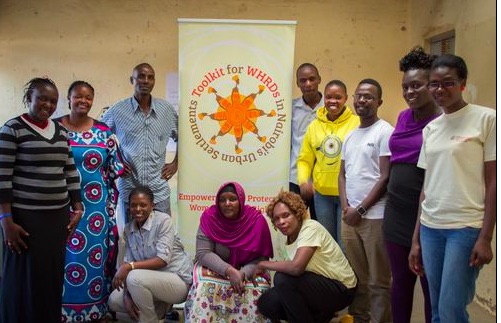
But the Kenyan project also creates great and original tools such as a toolkit for Women Human rights defenders.

Don’t let them stand alone. Please help us safeguard the lives of more human rights defenders with a gift today.

P.S. If you’re wondering what the day-to-day of a PBI volunteer looks like, watch the powerful video below by Sophia Kerridge, a volunteer in Colombia.

Sophia Kerridge has been a PBI volunteer in Colombia for a year. In this short video she explains what the team of volunteers do, her experience, and the situation for HRDs.

To become a PBI field volunteer is an incredible opportunity to provide protective physical and political accompaniment to at-risk defenders. You will help to deter violence, and you will create space for them to continue their critical work toward peace, justice and human rights.

Volunteers receive specialized training, return flights, room and board, medical insurance, and small monthly stipends. If you are selected for training, please contact PBI-Canada to discuss how we can support you!

Did you know that a $50 donation to one of our projects can enable a human rights defender to receive a PBI security training workshop? This knowledge saves lives. The Kenyan Project is in need of support.

(Thank you to Janet Hudgins, the CPNN reporter for this article.)

USA: A Call to Mobilize the Nation through 2018

…. HUMAN RIGHTS ….

An article by Rev. John Dear, published by Pace e Bene

While the media and the nation sit transfixed over the Trump scandals and attacks on democracy, those of us who work for justice and peace know that we have to keep working, resisting, and mobilizing people across the country if we are going to have the social, economic and political transformation we need for our survival.

In other words, we’ve only just begun. Instead of giving up, giving in, or throwing in the towel, instead of sitting glued to the tube, we’re going forward. The campaign for a new culture of nonviolence is on!

No, you may say, it’s too much, I need to take a break from the news, from the movement, from the struggle. There’s nothing we can do, anyway. We can’t make a difference. I give up.

That is not only not helpful, it’s simply not true. We have more power than we realize. If we mobilize together and resist, we can prevent injustices, wars and other horrors from occurring. Doing nothing because we are overwhelmed or too dispirited is not helpful to anyone and certainly not the poor, the victims of our wars, or Mother Earth. It’s also not helpful to ourselves. For the sake of our own humanity, our own integrity, our own sanity, we need to carry on the struggle now more than ever, with boldness, creativity and steadfast nonviolence.

To this end, my friends and I at Campaign Nonviolence have issued a new call inviting people to commit themselves to the struggle over the next eighteen months, from now through the Congressional elections of November, 2018, to building a movement of movements that connects the dots of violence and injustice for a groundswell of activism, organizing, marches, demonstrations, and political conversion we’ve not yet seen.

“The time has come for us to pool our nonviolent power to resist the tragedy we face and to signal, once and for all, our determination to build a world of peace, racial justice, economic equality, and a healthy planet for all,” the statement begins. “We call on you—and all people everywhere—to join us in training for nonviolent action, in creating community for nonviolent action, and in taking nonviolent action in this challenging time.”

This call to mobilize over the next eighteen months is not just an electoral strategy, we insist. What we want is “a referendum for a nonviolent future.”

Campaign Nonviolence proposes the following concrete steps:

First, join the September 16-24, 2017 national week of action, where over 1000 marches and rallies calling for an end to war, racism, poverty and environmental destruction and for a new culture of peace and nonviolence will take place across the nation covering all fifty states. (Register your event here!)

Second, take a nonviolence training and then organize nonviolence trainings in your community. We all need to brush up on our nonviolence, and these trainings offer principles and methods for nonviolent strategies and guidance and the hand’s on help of role-playing and practicing your nonviolent response. (Look for trainings and trainers on the Nonviolence Training Hub co-sponsored by Campaign Nonviolence and Pace e Bene at www.nonviolencetraininghub.org

(Article continued in the right column)

Questions related to this article:

The post-election fightback for human rights, is it gathering force in the USA?

(Article continued from the left column)

Third, form and join an affinity group. We are in deep water these days, and we cannot sustain our nonviolent resistance or build a movement on our own; we need one another. We encourage everyone to form or join an affinity group of just 5 to 10 people where you can support one another for public action, study nonviolence, reflect on the current situation and envision a way forward. Affinity groups have long played a part in our movements. In Latin America, where they are called “base communities,” they are practically a requirement for survival.

Fourth, join the Nonviolent Cities project and announce your city as a “Nonviolent City.” Based on the ground-breaking work of “Nonviolent Carbondale,” Illinois, the Nonviolent Cities project supports local leaders around the country who are envisioning their community as a city of nonviolence. With over forty cities currently exploring this vision, Campaign Nonviolence calls upon activists, organizers, students and religious and political leaders to use this tool as a way to organize locally, resist injustice, end violence, and set a new path for your community to one day become a culture of peace and nonviolence.

Fifth, plan a local or regional gathering or conference in the Spring, 2018, to build for the fall convergence, help spread the word, and mobilize the groundswell of public action. We encourage everyone everywhere to organize your own day-long planning sessions or retreats next spring so that we can stay focused on the task of movement building.

Sixth, mobilize thousands of local public actions across the nation during the Campaign Nonviolence national week of action next September 15-23, 2018, as well as come to Washington, D.C. for the Campaign Nonviolence Convergence, where we will cover nonviolence training, a day of lobbying for justice and disarmament on Capitol Hill, and a silent march from the Martin Luther King, Jr. Memorial to the White House. With the impending mid-term Congressional elections, we will call for a referendum for a nonviolent future.

“We are in new territory, and things will likely get worse before they get better,” our call declares. But they will definitely get worse if we all do not think big, take bold action, envision a new future, and join together across every divide in an unprecedented historic movement. We need to commit ourselves now to redoubling our efforts over these next eighteen months, to mobilize like never before. In the past, if we were peaceful people, we now also have to become activists. If we were activists, now we have to become organizers. We all have to step up to the plate in new mature ways and meet this time head on with boldness, love and determination.

Through the brilliant work of Erica Chenoweth and Maria Stephan in their book, Why Civil Resistance Works, we know that nonviolent strategies for social change are twice as effective as violent ones, that when people gather together to do the impossible through nonviolent movements, positive change usually occurs.

But we also know this: movements which activate 3.5% of the population are very likely to succeed. For us, that means 12 million people. I believe we can do that. Over the course of the next eighteen months, we can build an unprecedented movement of movements to challenge the violence of our country and lay new groundwork for a culture of peace and nonviolence.

“A culture of nonviolence is not an unattainable dream,” Pope Francis wrote last month in his open letter to Chicago, “but a path that has produced decisive results. The consistent practice of nonviolence has broken barriers, bound wounds, healed nations.”

I hope we can all spread the vision, continue to build up our grassroots movement of nonviolence, and mobilize the nation not just for steadfast resistance but the long haul transformation into a new culture of nonviolence.

To read the full text of the call click here!

The Palestinian Hunger Strike: “Our chains will be broken before we are..”

. HUMAN RIGHTS .

A blog by Richard Falk

On April 17th at least 1500 Palestinian prisoners launched a hunger strike of indefinite duration, responding to a call from Israel’s most famous Palestinian prisoner, Marwan Barghouti. It also happens to be that Barghouti is the most popular political leader, far more liked, trusted, and admired that the President of the Palestinian Authority, Mahmoud Abbas. Barghouti is serving a series of lifetime terms for his alleged role in directing an operation during the Second Intifada in which five Israelis were killed.


Palestinian activists stand around a mosaic portrait of political prisoner Marwan Barghouti near an Israeli military installation in the West Bank city of Ramallah. File photo: Nasser Shiyoukhi/AP

Barghouti who has been in prison for fifteen years, gave his reasons for the strike as “torture, inhumane and degrading treatment, and medical negligence,” as well as a failure to abide by international legal standards pertaining to prison conditions during a military occupation. Even the normally timid International Committee of the Red Cross acknowledged prisoner demands by issuing a public statement asserting that the denial of family visits and moving Palestinian prisoners and detainees outside of the occupied territory to Israeli jails were violations of international treaty norms set forth in the Fourth Geneva Convention governing belligerent occupation.

Because Barghouti expressed his grievances in an article somewhat surprisingly published by the NY Times on April 16th. Surprising because the Times, an influential media outlet, has over the years been reliably deferential to the Israeli rationalizations for Israeli contested policies and behavior. It turns out that the newspaper was nervous about this departure from its normal operating mode. Barghouti’s piece only appeared in its international edition, and had a qualifying editorial note appended: “This article explained the writer’s prison sentence but neglected to provide sufficient context by stating the offenses of which he was convicted. They were five counts of murder and membership in a terrorist organization. Mr. Barghouti declined to offer a defense at his trial and refused to recognize the Israeli court’s jurisdiction and legitimacy.” [italics in the original]

In retaliation for daring to publish this opinion piece Barghouti was severely punished. He was immediately placed in solitary confinement, has not been allowed to change his clothes for the past month, and is inspected by prison guards four times a day.

The notorious Canadian ultra Zionist media watchdog, Honest Reporting, explains on its website that its goal is “defending Israel from media bias.” Honest Reporting expressed its outrage by condemning the NY Times for opening its pages to a convicted Palestinian ‘terrorist.’ It is Orwellinan to so describe Barghouti, a political leader courageously defending his people against an unlawful and oppressive occupation that is approaching its 50th anniversary, and is now best understood as a crime against humanity taking the form of apartheid victimizing the Palestinian people as a whole, and not just those living under occupation. If the Honest Reporting was indeed honest it would expose the pronounced media bias in the West shielding Israel from international accountability and obscuring the severity of Palestinian grievances under international law and morality.

The world media treatment of this massive Palestinian strike is typical, although nevertheless disappointing. It gives meager attention to the dramatic character of such a prison protest that has continued for over a month, stimulating many solidarity demonstrations throughout occupied Palestine, a sympathy 24-hour hunger strike by South Africans including the prominent Deputy President Cyril Rhamaposa, and widespread shows of support throughout the Palestinian diaspora. The reaction of the Palestinian Authority has been evasive, with Abbas giving a token show of public support for prisoner goals, while letting it be known privately that he hopes the strike will end as soon as possible.

(Blog continued in right column)

Question for this article

Presenting the Palestinian side of the Middle East, Is it important for a culture of peace?

(Blog continued from left column)

The behavior of the Israeli Prison Service is an indirect confirmation of prisoner discontent. In a sadistic taunt, Israeli settlers were allowed to have a barbecue in the parking lot in front of one of the prisons, apparently mocking the hunger strikers with the pungent aroma of meat being grilled. Worse than this, a fake video was distributed by prison official purporting to show Barghouti having a snack in his cell. This effort to discredit the strike and its leader has been angrily denied. Khader Shkirat, Barghouti’s lawyer, explained that there was no way food could be smuggled to someone in solitary, especially with frequent room searches. It was finally conceded by prison officials that food was delivered to Barghouti’s cell by prison guards trying unsuccessfully to tempt him to break the fast. Barghouti on his side responded via his lawyer, “I plan to escalate my hunger strike soon. There is no backtracking. We will continue until the end.” Barghouti, 58, has according to the last report has lost 29 pounds since the start of the strike, and now weighs 119, planning to refuse even water.

Even if this dire commitment is not carried through to a potentially grim finality it will not tarnish the significance of what has been undertaken, and the great reluctance of the world to focus its attention on such a display of nonviolent martyrdom. This is not the first Palestinian prison strike motivated by abusive prison conditions and instances of administrative detention, arresting and jailing without any formal charges. But it appears to be the most consequential due to the participation of Marwan Barghouti along with so many other Palestinian prisoners as well as producing many displays of solidarity beyond the prison walls.

As Ramzy Baroud has pointed out in an Al Jazeera article published on May 10, 2017, the strike, although putting forth demands relating to prison conditions, is really a reflection of the underlying ordeal, what he refers to as “the very reality of Palestinian life”; it is above all “a call for unity against factionalism and Israeli occupation.” The distractions created by the Trump presidency, Brexit and the rise of the European right-wing, and turmoil in the Middle East have given Israel’s leadership the political space to push their expansionist agenda toward an imposed outcome of one Jewish state imposing its will on two distinct peoples. Such an endgame for this version of colonialist displacement and subjugation of the indigenous majority population will extend Palestinian suffering in the short-run, but will over time undermine Israeli security and stability, and bring the long Palestine nightmare to an end.

The British leadership finally appreciated their own interests, forging a political compromise in Northern Ireland in the form of the Good Friday Agreement, which while fragile and imperfect, has mostly spared Catholics and Protestants further bloodshed. Will the Israeli and U.S. leadership grow responsive to the moral and legal imperatives that call for a sustainable and just peace between these two peoples before the political imperative of such an essential outcome assume more menacing forms?

Against all expectations, the South African leadership did eventually become so responsive, but only after enough pressure was exerted internally and internationally. The South African leadership produced a new dawn by releasing its prime ‘terrorist’ inmate, Nelson Mandela, from prison, and the rest is history. Marwan Barghouti is clearly available to play such an historical role in relation to Israel. It will be a tragedy if Zionist ambitions and American led geopolitics preclude this from happening! The road to peace for Israel is the similar to the road to peace for apartheid South Africa: dismantle the apartheid regime that now dominates and discriminates against the Palestinian people on a systematic and totalizing basis. Such a projected future may seem a dream, but dreams can be made to come true through the dynamics of a struggle for justice. If so, we may look back on Barghouti’s hunger strike as the beginning of a winning Palestinian endgame.

It is important that we appreciate that a hunger strike is not only a pure form of nonviolence, but is also a self-inflicted sacrifice by those who seek to exhibit their opposition to the existing state of affairs in this manner, hoping to create conditions that produce change. It is an extreme type of resistance that in its essence is an appeal to the conscience and compassion of its opponents and public opinion generally. As Gandhi found out in racist South Africa, if that conscience and compassion are not sufficiently present within a given society such tactics are futile, and violent resistance becomes the only alternative to submission and despair. Israel has been repeatedly challenged by the Palestinians to do the right thing, but responds increasingly by treating all of its adversaries as ‘terrorists’ regardless of their behavior, while itself continuing to defy international law thereby denying the most fundamental rights to the Palestinian people and repeatedly relying on excessive force to safeguard its dominance.

Sanctuary city leaders vow to remain firm, despite threats from U.S. attorney general

…. HUMAN RIGHTS ….

An article by Ruben Vives and Cindy Carcamo for the Los Angeles Times

Leaders from so-called sanctuary cities across Southern California struck a defiant tone Monday, stating that they would continue to protect people who are in the country illegally despite threats by U.S. Atty. Gen. Jeff Sessions to cut off and even claw back grant funding from the Justice Department.


California Senate leader Kevin de León called U.S. Atty. Gen. Jeff Sessions’ move to cut federal funding from so-called sanctuary cities “nothing short of blackmail.”

“We will fight this vigorously and still continue to maintain services to provide for our high quality of life in Santa Ana,” Sal Tinajero, a city councilman in Santa Ana, which voted unanimously to become a sanctuary city shortly after Donald Trump was elected president.

During a brief appearance at the White House briefing room, Sessions repeated previous statements that the Trump administration would seek to deny sanctuary cities some Department of Justice grant funds, but offered no new policies.

Still, officials in sanctuary cities scrambled to touch base with attorneys and explore their legal options.

“We are going to look into every single legal action that we can take to protect ourselves from the Department of Justice’s plan,” Tinajero said.

He said city leaders had already prepared for possible funding cuts, adding that Santa Ana has more than $50 million in reserve, just in case.

Maywood Councilman Eduardo De La Riva said the issue will likely be settled by the courts.

“I am confident that when this latest move is challenged in the courts, this too will prove to be yet another loss for this administration,” De La Riva said.

Maywood declared itself a sanctuary 11 years ago, enacting a law that said local police could not enforce federal immigration law.

Monday evening, Pasadena city officials are expected to take up a resolution on whether to declare itself a sanctuary for people who are in the country without legal status.

For most cities, the move is largely a message of political support for immigrants in the country illegally. But some cities have specific policies tied to them, notably San Francisco, which has come under criticism from Trump and during Session’s briefing on Monday.

(Article continued in the right column)

Questions related to this article:

The post-election fightback for human rights, is it gathering force in the USA?

(Article continued from the left column)

Sessions cited a high-profile case in San Francisco where a 32-year-old woman was killed by man who had been previously deported multiple times despite a request by immigration authorities to continue his detention.

“Countless Americans would be alive today and countless loved ones would not be grieving today if these policies of sanctuary cities were ended,” Sessions said.

San Francisco Mayor Ed Lee could not be reached for comment, but he sent a tweet soon after Sessions’ announcement.

“#SF knows that #SanctuaryCities are safer, more productive, healthier places to live. We work for all our residents. #SFStandsAsOne,” he stated.

In a statement, a spokesperson for Lee said:

“San Francisco’s sanctuary city laws are in compliance with this federal law. If the federal government believes there is a need to detain a serious criminal they can obtain a criminal warrant, which we will honor, as we always have… As we have always asserted, sanctuary cities are safer cities. When immigrants can enroll their children in school, access healthcare for vaccinations, and report crimes, our City and County is safer.”

The statement added: “It is shocking that the U.S. Attorney General, the nation’s top law enforcement official, does not agree with this basic principle of public safety.”

Some state leaders denounced Sessions’ move.

“Instead of making us safer, the Trump administration is spreading fear and promoting race-based scapegoating,” California Senate leader Kevin de León said in a statement. “Their gun-to-the-head method to force resistant cities and counties to participate in Trump’s inhumane and counterproductive mass-deportation is unconstitutional and will fail.”

There is no neat definition of “sanctuary city,” but in general, cities that adopt the designation seek to offer political support or practical protections to people who are in the country illegally. For some cities, the sanctuary movement consists simply of encouraging people without legal status to get more involved in government. Other places, such as San Francisco, adopt far-reaching policies, such as taking steps to cut ties with federal immigration officials and refusing to fully cooperate with them.

Cudahy Councilman Cristian Markovich also said he will stick to his guns and support the city’s sanctuary policy. He called it a “safety issue.”

“We pay our taxes and I feel that the federal funding is rightfully ours regardless of the fact that we are a sanctuary city or not,” he said.

[Editor’s note: CNN published similar remarks from mayors and city officials in Madison (Wisconsin), Chicago, Boston, Cambridge, Newton and Somerville (Massachusetts), New York City, Philadelphia, San Francisco, Seattle, and Los Angeles.]

Amnesty: 8 women show us why International Women’s Day is the day to declare: We won’t wait for our rights!

…. HUMAN RIGHTS ….

An article by Shiromi Pinto for Amnesty International

People across the world are joining today’s Women’s Strike, demonstrating the consequences of A Day Without A Woman. Can we afford a day without women like these eight, whose refusal to wait is the key to reversing an increasingly regressive trend for women’s rights?


Photos of the 8 women described below in order upper left to lower right
(click on photo to enlarge)

If there’s one thing we’ve learned from January’s historic Women’s March, it’s that women are fed up of waiting. Today, that fervour hits the streets again in what looks set to be a historic women’s strike. Back at the beginning of 2017, more than 3 million people – of all genders – marched worldwide for women’s rights, and many intersecting rights besides. Those motivations remain true today – spurred by US President Donald Trump’s misogynistic remarks, discriminatory travel ban and directives that have far reaching and profoundly negative implications for migrants and other minorities. His policies also specifically put women’s health and lives at risk. But this is not unique to the USA, as demonstrated by the thousands of women worldwide who are striking today. They know that when it comes to the inequalities that still afflict so many women around the world, the statistics are undeniable.

The World Economic forum predicts it will take another 169 years for the gender pay gap to close. This is just one of many shocking figures showing how long we might have to wait before women and girls can achieve equality. Across the globe, some 225 million women are unable to choose whether or when to have children. Each year, about 47,000 women die, and another 5 million are disabled, as a result of unsafe abortions. An estimated 35% of women worldwide experience physical or sexual violence. More than 32 million girls around the world – compared with about 29 million boys – are not in primary school. And 700 million women alive today were married before they were 18 years old.

With so much left to be gained, women and girls around the world are saying enough is enough. Here are eight women who are battling on the frontline to claim their rights, refusing to wait in the face of injustice.

They won’t wait and neither will we.

How about you?

AFRICA

Dr Tlaleng Mofokeng – She won’t wait… while women are still denied abortions

A medical doctor in South Africa, Tlaleng is a force to be reckoned with. Not only is she a committed medical professional, but she also fearlessly advocates for sexual health as a radio presenter, spreading her message far and wide. “I won’t stop until ​the right of women to have an abortion is respected and provided for safely,” she says. “In South Africa, women die every year due to unsafe abortions, yet politicians think they can use women’s reproductive rights as a political ping pong ball.” Tlaleng is also challenging rape culture, and championing the drive to get health practitioners to treat patients with respect and without discrimination – a true human rights defender, like all the women featured here.

“The whole world thinks they have a right to tell women what to do with our vaginas and our uteruses. Women’s health seems to be a free-for-all for everyone to have an opinion on”.

AMERICAS

Connie Greyeyes – She won’t wait… for another sister to be stolen

Connie Greyeyes is an “accidental” activist. An Indigenous Cree woman living in the province of British Columbia in Western Canada, she realized that a shocking number of Indigenous women in her community had gone missing or had been murdered. She began organizing to support the families of these women and took the demand for a national inquiry to the Canadian capital in Ottawa. According to official figures, more than 1,000 Indigenous women have gone missing or been murdered in Canada in the last three decades. The efforts of Connie and many other Indigenous women across Canada have borne fruit, with the Canadian government finally announcing an inquiry in 2016.

“When we’re together, there’s so much strength. Being able to smile even after finding out that your loved one was murdered. How can you not be inspired by women who have been to hell and back over their children? You know, fighting, trying to find justice. How can you not be inspired and want to continue fighting?”

Karla Avelar – She won’t wait… while refugees are denied safety

Karla Avelar is a survivor. She’s made it through gang attacks, murder attempts and prison in El Salvador. Today, she heads Comcavis Trans, which supports Lesbian, Gay, Bisexual, Transgender and Intersex (LGBTI) people, all of whom face threats and violence in El Salvador. Their situation is so tenuous in the country that many flee as refugees. Through Comcavis, Karla provides information and other support to help them on what is often a treacherous journey that normally takes them to the USA or Mexico. But the US’s hardline stance on refugees and migrants entering the country has thrown these LGBTI refugees into even greater jeopardy – something Karla is now tackling with energetic defiance.

“The decisions Trump is making are affecting thousands of people, particularly LGBTI people who are victims of racism, discrimination and attacks. Instead of guaranteeing the human rights of migrant people, the government of the USA is stigmatizing and criminalizing them.”
(continued in right column)

(Click here for a Spanish version of this article or here for a French version)

Question for this article

Do women have a special role to play in the peace movement?

(continued from left column)

ASIA-PACIFIC

Su Changlan – She won’t wait … to reunite another child bride with her parents

Former school teacher Su Changlan’s story is not unique. One of her closest friends says that hers is the story of many women in China. She couldn’t stand by when she heard about girls trafficked as brides or parents whose children had gone missing. She did her best to help them and many others, her activism extending to land rights issues and support for pro-democracy protests in Hong Kong. She did all this knowing that she might have to sacrifice her freedom in the process. Sadly, this is just what happened. She has been detained by the authorities since 2015.

“I hope that parents do not despair about searching for their missing children. We, civil society, should work together to help them reunite with their children. The government should also invest more in these efforts instead of hindering our work!”

Samira Hamidi – She won’t wait… while women are excluded from government

Since 2004, Samira Hamidi has been blazing a trail for women in Afghanistan. As Chairperson of the Afghan Women’s Network (AWN) she has actively tried to ensure that women’s voices and concerns are represented at the highest levels of government. At the same time, she is a staunch advocate in the international arena, reminding governments and potential aid donors that promoting and securing women’s rights in Afghanistan must be part of any conversation they may have with the country’s leaders. She faces a steep road, but she remains undaunted, championing other women human rights defenders, ensuring that their concerns are amplified.

“Women should be given an equal opportunity to make a better Afghanistan.”

EUROPE

Jeanette John Solstad Remø – She won’t wait… for the right to be recognized as a woman

Until recently, she was John Jeanette, her name signifying the dual identity she was forced to accept every day in Norway. Although this former submarine commander felt her future could only be female, Norwegian law did not allow her to change her legal gender without undergoing a compulsory “real sex conversion”. This would have involved having her reproductive organs removed, as well as a psychiatric diagnosis. She refused to put herself through any of this. As a result, her driving license, passport, medical prescriptions, even her library card, still referred to her as male. She campaigned hard against Norway’s abusive law and her actions, alongside those of her supporters – including Amnesty – scored a huge victory. In 2016, Norway finally adopted a new law on legal gender recognition, which allows transgender people to choose their gender. Today, in acknowledgement of this milestone, she has changed her name to Jeanette John.

“Everyone deserves the right to express their gender.”

MIDDLE EAST AND NORTH AFRICA

Loujain al-Hathloul – She won’t wait… for the right to drive a car

Fearless and formidable, Loujain defied Saudi Arabia’s driving ban and faced the consequences. In November 2014, she was detained for 73 days for live-tweeting herself driving into Saudi Arabia from the United Arab Emirates. Released in February 2015, she went on to stand for election in November that year – the first time women were allowed to both vote and stand in elections in the state. However, despite finally being recognized as a candidate, her name was never added to the ballot. Today, she continues her fight to create a better future for her fellow Saudis – one where women enjoy their rights as full citizens of their nation.

“I will win. Not immediately, but definitely.”

Narges Mohammadi – She won’t wait… for another woman to be disfigured in an acid attack

A passionate advocate for women’s rights in Iran, Narges actively protested against acid attacks on women. This was just one of many efforts she has made to defend human rights, including calling for the abolition of the death penalty. She has paid dearly for her work and is now serving a total of 22 years’ imprisonment for daring to speak out. The “evidence” used against her at trial included her meeting with the European Union’s former High Representative for Foreign Affairs and Security Policy on International Women’s Day 2014. “In a land where being a woman, being a mother and being a human rights defender is difficult on their own, being all three is an unforgivable crime,” she recently wrote from prison. In 2016, Narges went on hunger strike because she was refused telephone calls with her two young children, who now live in France with their father. Today her children can speak to her once a week, but face the prospect of living without their mother for many years to come.

“I am, in my own homeland, convicted and imprisoned for the crime of being a human rights defender, a feminist and an opponent of the death penalty. [But] not only have my imprisonment and my recent 16-year sentence not made me feel any regret, they have actually strengthened my convictions and commitment to defending human rights more than ever before.”

(Thank you to Janet Hudgins, the CPNN reporter for this article.)

Philippine Catholics march against Duterte’s deadly war on drugs

…. HUMAN RIGHTS ….

An article from Deutsche Welle

Thousands of demonstrators marched alongside Catholic Church leaders in the Philippines capital of Manila on Saturday [February 18] to protest President Rodrigo Duterte’s deadly war on drugs and attempts to reinstate the death penalty.


(c) picture-alliance/AP photo/B.Marquez
(click on image to enlarge)

According to police estimates, at least 10,000 people joined the “Walk for Life” march, making it the largest rally yet against Duterte’s brutal crackdown against drug dealers and users. It also marked the largest show of opposition from the Roman Catholic Church against the government’s anti-drugs campaign, which has seen more than 7,600 mostly poor people killed in the past seven months.

“We have to stand up. Somehow this is already a show of force by the faithful that they don’t like these extrajudicial killings,” Manila bishop Broderick Pabillo said. “I am alarmed and angry at what’s happening because this is something that is regressive. It does not show our humanity.”

The Catholic Church is one of the Philippines oldest and most influential institutions in a country where about 80 percent of the population identifies as Catholic, a legacy of the country’s time as a Spanish colony.

(Article continued in the right column)

Questions related to this article:

How effective are mass protest marches?

(Article continued from the left column)

Duterte on a collision course with Catholic Church

As one of the nation’s most powerful institutions, the Catholic Church has in the past played a crucial political role in the Philippines. In 1986, it helped lead a revolution that toppled dictator Ferdinand Marcos. Then, in 2001, it supported an uprising against then- president Joseph Estrada before he was subsequently ousted over corruption charges.

The Church initially refused to voice its opposition to Duterte’s anti-drugs campaign but its opposition has grown increasingly vocal since the end of last year, with the number of casualties continuing to rise.

“It is obvious that there is a spreading culture of violence. It is saddening to see, sometimes it drives me to tears how violent words seem so natural and ordinary,” the country’s highest-ranking Church official, Manila Cardinal Luis Tagle, said. “In your surroundings, in your neighborhood, there are so many lives that must be saved. They will not be saved by mere discussion.”

Duterte was elected president in May on the back of a strong anti-crime and anti-drug platform, claiming he would save generations of Filipinos from the drug menace. Since being elected to office, he has often attacked the church, once describing it as “the most hypocritical institution” for speaking out against his campaign. The President has also scolded a number of local bishops, accusing them of corruption and sexual abuse.

Duterte has also asked Congress to revive the death penalty by public hanging, which has also put him on a collision course with the Church. “Execution is murder,” Archbishop Socrates Villegas, who heads the country’s bishops, said. “We cannot teach that killing is wrong by killing those who kill.”

Restaurants Will Test If The U.S. Can Stomach ‘A Day Without Immigrants’

…. HUMAN RIGHTS ….

An article by Carolina Moreno and Liz Martinez for the Huffington Post (reprinted according to the principle of “fair use”)

Restaurant owners across the country are hoping the way to the nation’s conscience is through its stomach as they prepare to close their businesses in solidarity with immigrants on Thursday.

The restaurateurs are doing their part to support the grassroots movement dubbed “A Day Without Immigrants,” which asks immigrants not to go to work, open their businesses or buy any products for a full day on Feb. 16. The goal is to impress on President Donald Trump the importance of immigration.


Newscast about Day without Immigrants

“I’m happy about it,” said Benjamin Miller, co-owner of El Compadre and South Philly Barbacoa restaurants in Philadelphia. “[I’m] glad to see that chefs are stepping up and taking agency and using their power to advocate for people who are more vulnerable. The most we as chefs risk are fines, but these people risk losing their families. They have a lot more to lose.”

Miller’s wife and business partner, Cristina Martinez, is especially invested in the cause because she is an undocumented immigrant currently unable to apply for a green card, despite being married to a U.S. citizen. The couple will close El Compadre on Thursday. (Their other restaurant opens only on weekends.)

It’s no surprise that restaurateurs are taking a stand against the Trump administration’s immigration crackdown, which has led to an uptick in raids by Immigration and Customs Enforcement authorities. An estimated 1.2 million undocumented immigrants work in food preparation and serving jobs in the United States, according to 2012 Pew Research Center data.

Some high-profile names in the restaurant business have signed on to the effort, including Spanish-born chef José Andrés, who was sued by Trump after he pulled out of plans to open a restaurant in the new Trump hotel in Washington, D.C. Andrés announced on Twitter that he will be closing all five of his D.C. area restaurants on Thursday in solidarity.

The Blue Ribbon restaurant group has also vowed to close seven of its restaurants in New York City.

“This is not a casual decision,” Blue Ribbon partner Eric Bromberg told Eater New York, adding that closing their doors will definitely impact their bottomline. “But there are times in life when money isn’t the most important thing.”

Two other notable chefs with Philadelphia locations, Stephen Starr and Ecuadorian-American Jose Garces, have not said they will shut down for the day, but they are promising not to fire or otherwise punish any employee who decides to participate in “A Day Without Immigrants.”

(Article continued in the right column)

Questions related to this article:

The post-election fightback for human rights, is it gathering force in the USA?

(Article continued from the left column)

“We recognize the immigrant community is an essential part of the hospitality industry. … We support the right for hospitality industry employees to have their voices heard,” Garces said in a statement to HuffPost. “We are in close communication with any employees who plan to participate Thursday and doing our best to mitigate against any potential impact to our guests’ experience. We will not take any adverse action with any employee who chooses to participate.”

Any decision not to open even for a day is particularly difficult for those who own small businesses. Melissa Silva-Diaz, CEO and owner of the El Burrito Mercado in St. Paul, Minnesota, decided to close her family-owned eatery on Thursday after hearing about the day of protest from customers and workers.

“We had employees and a couple of customers send us the image of ‘Un Día Sin Inmigrantes,’” Silva-Diaz, whose parents are from Aguascalientes, Mexico, said on Wednesday. “I began to ask around and I asked employees, and some said they were planning on not working. That triggered a conversation. We had a meeting yesterday. We had a healthy discussion about it. I asked each individually what they wanted to do. I reached out to other businesses. Everyone was talking about it. Then we took a vote and unanimously we decided to do it.”

She acknowledged that many of her customers aren’t happy about the decision. But she said, “That’s what we want to do, to bring people awareness and get them talking.”

Juan Ramirez, manager of Taquerias Los Jaliscienses in Austin, Texas, understands firsthand the struggles that many undocumented immigrants face. The 54-year-old worked in the fields harvesting potatoes and wheat when he arrived from Mexico decades ago and gained legal status after the Reagan administration granted a major amnesty in 1986.

“I feel we are nothing without immigrants,” Ramirez said. “We are all in the same boat. Why not row together to move forward?”

Ramirez said that his Austin restaurant will be closed on Thursday and that he supports his employees 100 percent. He also noted that many workers were concerned about having enough money to pay their bills, yet they were willing to make the sacrifice.

While mobilizing around immigrants is nothing new, Miller noted, the Trump administration’s immigration directives have lit a fire under the community.

“This is part of a movement that has a long history,” the Philly restaurant owner said. “I feel like this subject is not just about Trump. There were plenty of deportations under Obama. … This political climate is mobilizing more people.”

Miller also hopes consumers will do their part to ensure that “A Day Without Immigrants” makes a strong statement.

“As a patron tomorrow, don’t go to restaurants,” Miller said, addressing all Americans. “Don’t spend money in restaurants. If you go to a restaurant and it’s closed, don’t go to another one. Stay home tomorrow. Cook for yourself. Show solidarity with immigrants. Restaurants not participating, they will feel the impact that immigrants make every day.”

USA: Army veterans forming human shield to protect NoDAPL protesters at Standing Rock

…. HUMAN RIGHTS ….

An article from RT.com

US veterans are returning to Standing Rock to support and protect Native American protesters as the Dakota Access Pipeline continues to meet resistance despite President Trump’s executive order to continue construction of the $3.7 billion pipeline.

The veterans are gathering in Cannon Ball, North Dakota, with many on their way.


Veterans march with activists outside the Oceti Sakowin camp in December © Stephen Yang / Reuters
(click on image to enlarge)

“We are prepared to put our bodies between Native elders and a privatized military force,” Air Force veteran Elizabeth Williams told the Guardian. “We’ve stood in the face of fire before. We feel a responsibility to use the skills we have.”

The Standing Rock Sioux Tribe has vowed to fight the president’s order to push ahead with the pipeline despite the US Army Corps of Engineers stating it would cancel its planned environmental impact study and grant a permit for construction of the final phase of the pipeline beneath Lake Oahe to go ahead.

The protest camps are being prepared for flooding that is expected to come as temperatures increase. The veterans’ presence will present a challenge to law enforcement wishing to remove water protectors from the area.

(Article continued in the right column)

Questions related to this article:

The post-election fightback for human rights, is it gathering force in the USA?

(Article continued from the left column)

Previous clashes between security officials and protesters have been violent, with police deploying water cannons, rubber bullets and teargas at protesters. Private contractors also set dogs on the demonstrators.

The Veterans Stand group is fundraising for the protesters who continue to resist the pipeline being built by Energy Transfer Partners, and has raised close over $220,000 so far. It said the increase in “turmoil and uncertainty” at Standing Rock has inspired them to act.

More than 1,000 veterans came to Standing Rock in December. Whilst there, they apologized to Native Americans for the US government’s treatment of the country’s indigenous people. Veterans Stand doesn’t expect the same veteran presence as before, but it will provide support to the camps through its fundraising.

“The biggest misconception is that Veterans Stand wants to do anything aggressive in response,” Veterans Stand founder Michael Wood Jr told CNN. “People want to do something and they just don’t know what to do. We just want to give people a platform.”

“We’re not coming as fighters, but as protectors,” Jake Pogue, a Marine Corps vet, told the Guardian. “Our role in that situation would be to simply form a barrier between water protectors and the police force and try to take some of that abuse for them.”

“Finally, it’s the US military coming on to Sioux land to help, for the first time in history, instead of coming on to Sioux land to kill natives,” veteran Dan Luker said.

A Call to Address Identity-based Violence through Teach-ins at American Universities [and around the World]

…. HUMAN RIGHTS ….

A call from the International Institute on Peace Education

Dear Colleagues in Peace Education,

The rise in hate crimes experienced during these months of intense political is an assault on the fundamental rights of citizens integral to our constitutional democracy. They also pose a serious obstacle to the essential goals of peace education and peace studies, learning toward the achievement of a just and peaceful global order. While identity violence is not unique to the US it is in our own society that we have the opportunity and responsibility to take civic action toward overcoming it. Certainly, confronting the open manifestation of hatred toward any groups or individuals in this country is a responsibility to be taken up by all citizens, but most especially by peace educators who have committed themselves professionally and personally to educate for and to strive toward overcoming violence in all its manifestations. The public articulation of racial, religious and gender prejudice and hatred with the resulting discrimination and violence should be addressed by all realms of education, and most especially by university level peace studies.

American universities have a history of rising to such challenges. The struggle for civil rights, the Vietnam War, South African Apartheid, campus gender violence and climate justice, among other such challenges have produced responses of learning/action at colleges and universities across the country. We believe that this epidemic of hate, particularly Anti-Semitism and Islamophobia, should be similarly confronted by the academic community. Multiple possibilities and resources can be drawn upon, from holding campus-wide teach-ins that address the crimes and their causes, to introducing study of religious beliefs and practices into peace studies programs. The extreme ignorance about the religious beliefs, cultural practices and histories of the multiple faiths that profoundly influence the worldviews and ways of life of most peoples of the world has been a significant factor in the occurrences of hate crimes. This ignorance that facilitates such egregious violation of human rights is an issue that the peace studies community is well able to address.

Some of your campuses have partnered with Interfaith Youth Core (IFYC)** to train student leaders, develop curriculum, or advance a campus strategy focused on interfaith cooperation. Others have civically active campus ministries, representing multiple faiths. We call on peace educators to consider exploring with the IFYC-related group on your campus and/or your campus ministries to cooperate in organizing such a teach-in.

(Article continued in the right column)

Questions related to this article:

The post-election fightback for human rights, is it gathering force in the USA?

(Article continued from the left column)

While crimes against any and all groups might be considered as the focus of your efforts, those manifesting virulent Islamophobia and violent outbursts of Anti-Semitism combined with proposals for a Muslim registry, and the executive order banning entry to the US of some Muslim countries, as well the intense conflicts over BDS makes these especially acute problems. These crimes are not only assaults on American values of religious tolerance and the right to personal dignity and security, they are violations of international human rights standards that as stated in the UDHR are “the foundation of peace in the world.” The teach-ins might set the consideration of the crimes in terms of both these national values and constitutional rights and the relevant human rights standards with which all citizens should be familiar. They are essential knowledge for those seeking to become agents of peace.

Should you undertake to introduce this possibility, we would appreciate your sharing your plans and experience, so that we may pass them on to others in a series of posts via the Global Campaign for Peace Education news feed in April.

We would, as well, be glad to pass on and to suggest resources for teach-ins or for the inclusion of the study of various religious beliefs in peace studies courses. Especially relevant would be the teachings about peace and relations with others that are set forth by multiple world religions, including denominational statements on issues such as nuclear weapons, disarmament, nonviolence and the environment.

Please let us hear from you about your plans or what you may already be doing on your respective campuses. Please contact us at info@i-i-p-e.org.

We send our wishes and hopes that the year ahead will see some significant advances toward the tolerance of differences, appreciation of diversity so essential to a just peace on our campuses, in our communities, this country and the world,

The International Institute on Peace Education Secretariat:
Tony Jenkins, Georgetown University
Janet Gerson, IIPE
Dale Snauwaert, The University of Toledo
Betty Reardon, IIPE Founding Director Emeritus

*We welcome and encourage participation from universities and community groups from around the world!

**IFYC offers campus innovation grants, faculty development grants, free educational resources, and other tools to help you plan and implement events. Contact Julia Smith (julia@ifyc.org) to discuss opportunities that may be right for you and your campus.

(Thank you to Janet Hudgins, the CPNN reporter for this article)

Dutch to set up global abortion support fund to counter Trump’s cuts

. HUMAN RIGHTS .

An article from Reuters (reprinted by permission)

The Netherlands is launching a global fund to help women access abortion services to compensate for U.S. President Donald Trump’s ban on U.S. federal funding for foreign groups providing abortions or abortion support for family
planning abroad.


Protesters gather for the Women’s March in Oslo, Norway, January 21, 2017. The march is being held in solidarity with similar events taking place internationaly. NTB Scanpix/Stian Lysberg Solum via REUTERS
Click on image to enlarge

The Dutch government has held preliminary discussions on the initiative with other European Union members who have responded positively, a foreign ministry spokesman said on Wednesday. Governments outside the EU, companies and social institutions will also be approached to participate.

Trump on Monday reinstated a policy that requires foreign NGOs who receive U.S. global family planning funds to certify that they do not perform abortions or provide abortion advice as a method of family planning.

Dutch officials estimate that Trump’s restrictions will cause a funding shortfall of $600 million over the next four years. Women’s rights and health campaigners have reacted with anger at Trump’s move. They say restrictions on abortion endanger women’s lives. Trump has also pledged to withdraw funding from U.S. domestic abortion services.

The policy was announced on Tuesday by Liliane Ploumen, minister for international development cooperation, whose Labour Party – the junior coalition partner in the government – is traditionally staunchly in favour of abortion rights.

The Netherlands’s laws on reproduction and reproductive health are among the world’s most liberal. The Dutch vote in parliamentary elections in March.

Foreign ministry spokesman Herman van Gelderen said he was confident relations with the new U.S. administration would not be damaged by the measure.

“Where decisions are taken that are bad for women in developing countries we should help those women,” he said. “It’s not about the politics, it’s about those women.”

The policy also prohibits U.S. federal assistance for foreign groups that use non-U.S. funds for those abortion services or lobby foreign governments to legalise abortion, according to the Kaiser Family Foundation, which looks at U.S. global health policy.

Intermittently implemented by U.S. governments since 1984, Barack Obama lifted the measure at the start of his own presidency in 2009. It does not apply to abortion or abortion advice in cases where a pregnancy is a risk to the life of the mother or has resulted from incest or rape.

(Thank you to Janet Hudgins, the CPNN reporter for this article)

Question related to this article:

Abortion: is it a human right?

Janet adds the following to this article.

Dutch International Development Minister, Lilianne Ploumen, said earlier this week that as many as 20 countries had indicated their support for the effort to replace the $600 million U.S. in funding that will be lost because of Trump’s decision.

“Yes, we will support the [Dutch] effort,” Canada’s counterpart, Marie-Claude Bibeau said.

The US president carries through on campaign promises but apprehensive advocates and governments around the globe react with such engagement as we haven’t seen for a very long time.

Trump’s announcement that he will stop other countries from supporting family planning, that is, they must be certified as not providing abortions or lose funding, speaks to another of his misguided instincts for control. What with the power he holds now, he is in his element with this syndrome of many men. As women have the ultimate power—of populating the planet, or not—the Trumps of the world are driven to find a way to take it away and this performance exposes the US president as one of those by withdrawing support for global family planning to the tune of $600 million.

As Trump withdraws aid from and denounces countries providing abortions or support for abortions, Holland and Canada react with commitments to fill the gap. As well, discussions begin with other EU members and countries outside. This may result in the kind of weight of interest and aid that is so desperately needed.