Category Archives: HUMAN RIGHTS

Uruguay’s main trade union center plans massive mobilization to construct a culture of peace

…. HUMAN RIGHTS ….

An article from República

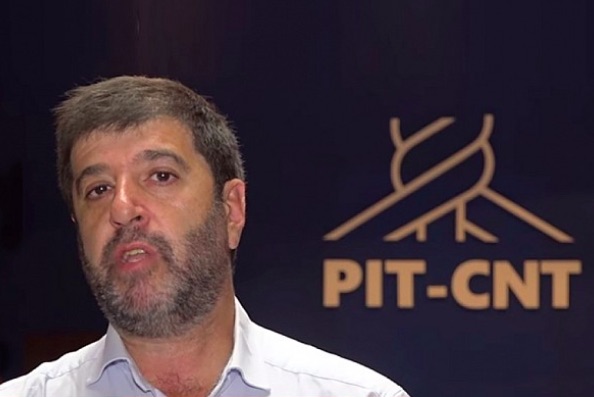
PIT CNT [Uruguay’s main trade union center] is planning a strike for the third week of February, with “massive” mobilization, where all social organizations will be called, not just trade unions, to demand the “construction of peace, tolerance and dialogue,” according to President Fernando Pereira.


Fernando Pereira

Hours before the stoppage in response to the acts of violence experienced in recent days, two femicides in four days of the year, the death of a police officer at the end of 2017, the brutal death of a taxi driver and the murder of a union leader, something that in Uruguay had not happened for a long time, President Fernando Pereira said that the society needs “a day of mourning and reflection. We are not asking others to reflect, we are going to reflect and we are mourning.”

(Continued in right column)

(Click here for a Spanish version of this article.)

Question related to this article:

What is the role of organized labor in the peace movement?

(Continued from left column)

“Given these events, the trade union movement decided to call for reflection and mourning as an immediate response,” he said. “We called for it immediately so no one could say we were trying to stretch a long weekend. The solution was to act immediately and to postpone the other proposals that are on the table “.

Among the measures to be taken, the first one is to convene the Extended National Representative Board of the Union in the first week of February, in order to plan a mobilization for the third week of that month.

“We hope to have organizations linked to human rights, to feminism, to different religious beliefs, to all the members of society that want to participate in a massive call to build a culture of peace, tolerance and dialogue, rather than settling conflict through violence,” said the president of the union.

He recalled that there were 33,000 complaints from women about violence, “which marks a problem we have as a society. We can not look with indifference at the things that are happening, when a teacher is being beaten by a mother, or when rural workers commit acts of violence towards workers who claim their rights.”

At the beginning of the general strike called by the PIT CNT, at the door of the company Viana Trasporte, where the trade unionist of the SUTCRA, Marcelo Silvera was assassinated in front of his partner and his son, dozens of people approached the facilities to make an escrache demonstration .

In front of the march, colleagues of the union carried a banner with an image of the victim, with the caption: “Marcelo Silvera Presente” and below the signature of the transport coordinator. The murderer of Silvera is serving a pre-trial detention while the trial against him is being prepared. Because it is an aggravated homicide, the person who fired the shots could receive a maximum penalty of 30 years in prison.

Martin Luther King Jr.’s Poor People’s Campaign Reborn

…. HUMAN RIGHTS ….

An article by Amy Goodman & Denis Moynihan in Democracy Now

Martin Luther King Jr. would have turned 89 years old this Jan. 15. Assassinated at the age of 39 on April 4, 1968, his much-too-short life forever changed America. Among the landmarks of his activism are the 1955 Montgomery bus boycott, ending segregation in public transportation; leading the 1963 March on Washington, where he delivered his famous “I Have a Dream” speech; the passage of the 1964 Civil Rights Act and the 1965 Voting Rights Act; and marching with sanitation workers in Memphis, where he declared in his last speech, delivered on the eve of his death, “I’ve been to the mountaintop.” Often overlooked are the increasingly radical policy positions King took in his last years, from speaking out against the Vietnam War to forging a multiracial Poor People’s Campaign that sought, as King said, “a radical redistribution of economic and political power.” Now, 50 years later, a coalition has formed anew to organize poor people in the United States into what King called “a new and unsettling force” to fight poverty and forge meaningful change.


Illustration from Nation of Change

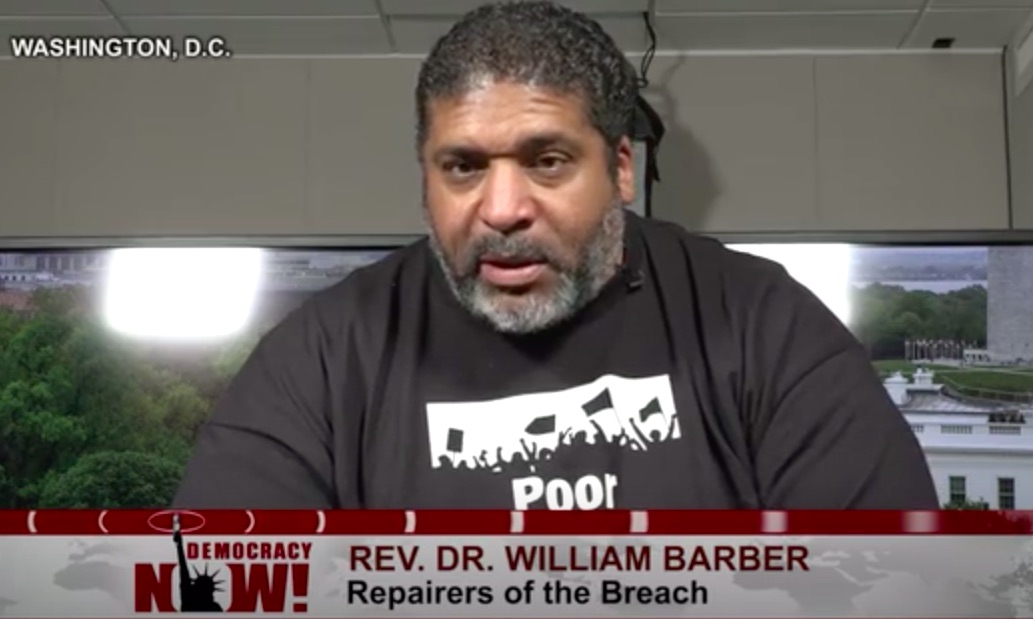
This renewal, called “The Poor People’s Campaign: A National Call for Moral Revival,” has an audacious agenda: “to challenge the evils of systemic racism, poverty, the war economy, ecological devastation and the nation’s distorted morality.” At the forefront is the Rev. Dr. William J. Barber II. Born just two days after the famous March on Washington, Barber grew up in the civil-rights movement. For over 10 years he served as president of the North Carolina NAACP, stepping down to lead this new campaign.

Back in 1968, King described the need for the Poor People’s Campaign, saying: “Millions of young people grow up in the sunlight of opportunity. But there is another America. And this other America has a daily ugliness about it that transforms ebulliency of hope into the fatigue of despair.”

(Article continued in the right side of the page)

Question for this article:

What’s the message to us today from Martin Luther King, Jr.?

(Article continued from the left side of the page)

Speaking this week on the “Democracy Now!” news hour, Rev. Barber reflected on how little has truly changed since King’s time: “Fifty years later, we have nearly 100 million poor and working poor people in this country, 14 million poor children. … Fifty years later, we have less voting rights protection than we had on August 6, 1965,” he said. “[Republicans] have filibustered fixing the Voting Rights Act now for over four years, over 1,700 days.”

“Every state where there’s high voter suppression,” Barber continued, “also has high poverty, denial of health care, denial of living wages, denial of labor union rights, attacks on immigrants, attacks on women.”

Barber says the answer is fusion politics: “We have black, we have white, we have brown, young, old, gay, straight, Jewish, Muslim, Christians, people of faith, people not of faith, who are coming together,” creating what he calls the “Third Reconstruction.” Part of this fusion includes reaching out to traditionally conservative Christians, like Minister Jonathan Wilson-Hartgrove. From a devout, white evangelical family, as a teen he served as a congressional page under South Carolina Republican Sen. Strom Thurmond, one of the fiercest segregationists of the modern era.

Wilson-Hartgrove heard William Barber preach, and has been a follower and a colleague ever since. The renewed Poor People’s Campaign is responding to poor, white evangelicals, Wilson-Hartgrove says: “These people who say, ‘Vote for me because I’m a good Christian leader’ are not serving your interests. You don’t have health care, you don’t have a living wage, because the same people who say they’re standing up for God and righteousness are, when they’re voting, voting against the interests of poor people, whether you’re black, white, brown or whatever.”

Barber sees transformation of the Deep South on the near horizon, but doesn’t claim it will be easy. Recent court victories against both racial and political gerrymandering in North Carolina will further empower African-Americans and other traditionally marginalized groups. But the real work will be done not in the courts, but in the streets.

Barber and Wilson-Hartgrove, along with the Rev. Liz Theoharis, co-director of the New York City-based Kairos Center for Religions, Rights, and Social Justice and co-chair of the modern-day Poor People’s Campaign, traveled to 15 states around the country in recent months, recruiting, organizing and training over 1,000 people. Barber said: “Our first action will be on the Monday after Mother’s Day. We’re going after 25,000 people engaging in civil disobedience over six weeks to launch a movement.” Their target: the U.S. Capitol and statehouses across the country.

Martin Luther King Jr. was robbed of life by a sniper’s bullet 50 years ago. But on this anniversary of his birth, this national holiday that people fought decades for, his vital work to empower the poor, lives on.

How Nonviolent Resistance Helps to Consolidate Gains for Civil Society after Democratization

…. HUMAN RIGHTS ….

An article by Markus Bayer, Felix S. Bethke, and Matteo Dressler for The International Center on Nonviolent Conflict

In July this year thousands of Polish citizens took to the streets to protest a judiciary reform they believed would threaten the democratic constitution of their country. During the protests, Solidarnosc leader and national hero Lech Walesa stated at a demonstration in Gdansk that it is now time to defend the democracy that they achieved through peaceful protests and civil disobedience in 1989. Consequently, President Duda felt compelled to use his veto and blocked the reform initiative put forward by the Polish conservative government: The Solidarnosc-Sheriff was back in town!


(click on image to enlarge)

Similarly, the people of Benin—who had initiated democratic change through civil resistance in 1990—acted as constitutional watchdogs in 2006 and 2016. Citizens rallied around the slogan of “don’t touch my constitution” when former presidents Kérékou and Boni tried to change the constitution to allow them to run for a third term in office.

In recent contributions to this blog, Maciej Bartkowski and Hardy Merriman discussed how nonviolent resistance (NVR) advances democratization and how it can assist to protect against democratic backsliding. This blog post, which offers a sneak preview of findings from a research project, focuses on if and how NVR campaigns can consolidate gains for civil society.

Civil Society Gains After Democratization

Our analysis, stemming from a research project on Nonviolent Resistance and Democratic Consolidation, is based on 101 democratic transitions that occurred within the time period of 1945 to 2006. Using data from the Varieties of Democracy Database we analyze improvements for civil society organizations (CSOs, i.e. interest groups, labor unions, religious organizations, social movements, and classic NGOs) after democratic transitions. We compare cases where democratization was induced by an NVR campaign (like Poland and Benin) with transition cases that did not feature an NVR campaign (i.e. violent or elite-led transitions). The four aspects of CSOs that we evaluate include: (1) independence from government, (2) freedom from repression, (3) consultation of CSOs for policymaking, and (4) participation in CSOs.

Figure 1 describes the results. The graphs show average scores for the different indicators across the two groups of cases (i.e. with NVR-induced transition and without) from one year before the democratic transition occurred until eight years after the transition. The indicators were standardized so that higher values indicate better prospects for CSOs.


(click on figure to enlarge)

As shown in figure 1, NVR-induced democratic transitions clearly help to advance CSOs’ independence from governments and limit considerably the amount of repression that CSOs are confronted with. In cases of democratization without NVR, CSOs operate less independently and must deal with higher amounts of legal harassment and restrictions than in the situations when society was nonviolently mobilized.

(Article continued in the right column)

Questions related to this article:

How effective are mass protest marches?

(Article continued from the left column)

NVR also seems to improve aspects of CSO consultation, i.e. their degree of involvement in policymaking. However, only during the first four years after transition is there a substantial difference between NVR-induced democracies and those where democracy came about by other means. Afterwards, the gap between the two groups diminishes. Finally, the results reveal that regarding participation in CSOs, there appears to be no substantial difference between NVR-induced democracies and societies that achieved democracy without NVR.

These preliminary results indicate that NVR creates long-term gains for civil society, by institutionalizing rights for CSOs, which grant them independence and limit governments in their ability to repress CSOs. Three mechanisms may explain these results.

First, democracies with transitions driven by civic forces usually strongly value an active and engaged civil society.

Second, as the examples of Poland and Benin in the introduction show, a public narrative reminiscing about past struggles for democracy can be a powerful symbol for people’s agency and a source to remobilize them in critical situations.

Third, in cases of NVR-induced democratization, civic forces are powerful and well-organized and thus have the capacity to influence institutional reform, e.g. involvement in drafting a new constitution. At the same time, it is difficult for governments to exclude civic forces from transitional reforms, since they often rely on this constituency in upcoming elections.

One example illustrating these mechanisms is yet again Benin. Because of a mobilized society that pushed for a democratic opening, political elites opted for a démocratie intégrale—an integrative democracy that was reflected, among others, in active CSO participation in the drafting process of a new constitution. As a result, the constitution highly values personal freedoms and encompasses the right to resist any unconstitutional behavior—a right the people assertively exercised in 2006 and 2016. At the same time, many armed liberation movements, such as the Namibian South-West Africa People’s Organisation, forced independent CSOs and labor unions to join their ranks and subdue their goals under the higher goal of independence and liberation. This tight control is typically upheld after the transition to prevent the emergence of an organized opposition.

Takeaways for Activists and Policymakers

Our findings show that when democratic transition was achieved by NVR, civil society is usually well-equipped to institutionalize enduring rights for CSOs that help to defend democracy against future threats. But this also highlights that deposing a dictator is only a first step towards a better future — or in the words of Amilcar Cabral, one of Africa’s foremost anti-colonial leaders, we should not claim easy victories! If movements dissolve and their members return to their everyday lives after achieving democratization, this often has two consequences:

First, lacking a constructive program to transform the society, these movements tend to achieve short-term successes but leave structural problems untouched. To address this challenge, movements should develop long-term goals which, according to Bartkowski, must integrate a long-term strategy of constructive resistance.

Second, since these movements mostly establish liberal representative forms of democracy but seldom transform into political parties, they often leave a vacuum, which is frequently filled by former corrupt political or economic elites. Possible ways to address this problem include:

* Training activists to become effective policy makers in the transition process;

* Advising movements on how to become winning political parties;

* Encouraging and pressuring transitional governments to allow for more deliberative forms of governance (e.g. participatory budgeting, ombudsman institutions, referenda for constitutional changes, etc.).

We suggest that by using these tactics, civil society and nonviolent movements can serve as important watchdogs or ‘sheriffs’ for alerting the rest of society when democracy is in danger. Further, as a recent ICNC monograph suggests, these actors serve still greater purposes in the short- and long-term democracy project: They embody the democratic values they wish will reign in their country during the next chapter of history and beyond.
 

(Thank you to Janet Hudgins, the CPNN reporter for this article.)

The Elders urge Indonesia to take bold steps to accelerate progress towards Universal Health Coverage

…. HUMAN RIGHTS ….

An article by The Elders

The Elders concluded a two-day visit to Indonesia with a call for the government to take bolder fiscal, political and social measures to accelerate progress towards Universal Health Coverage (UHC), building on impressive achievements in recent years.


Gro Harlem Brundtland and Ernesto Zedillo visit a health centre in Indonesia in November 2017 (Credit: Agoes Rudianto/The Elders)

Gro Harlem Brundtland and Ernesto Zedillo visited the Indonesian capital Jakarta on 28-29 November for meetings with President Joko Widodo (Jokowi) at the Presidential Palace, accompanied by Foreign Minister Retno Marsudi, Health Minister Nila Moeloek and Finance Minister Sri Mulyani.

They also visited the Kebon Jeruk Puskesmas (health centre) in west Jakarta, meeting patients, staff and local residents. The Elders also consulted with civil society organisations and held a briefing for local media.

Indonesia has the biggest single-payer health system in the world (covering 181 million people), and has committed to reaching full population coverage by 2019.

(Article continued in the right column)

(Article continued from the left column)

The Elders congratulated President Jokowi on Indonesia’s progress to date. However they also expressed their concern about the fact that Indonesia’s rightly ambitious plan to achieve UHC is significantly under-financed. They suggested that without fiscal revenues stemming from additional general taxation, progress towards effective UHC could prove too slow.

The Elders also conveyed to President Jokowi and other high level Indonesian officials their worries about the high rate of tobacco consumption in the country. Higher taxes on tobacco could both deter consumption and provide more resources for health financing. In the longer term, they urged a modification of Indonesia’s policies on tobacco production to promote alternative, less harmful crops.

Gro Harlem Brundtland, Deputy Chair of The Elders and former Director-General of the World Health Organization, said:

“Indonesia has taken significant steps towards improving access to healthcare in recent years, and I am convinced President Jokowi can reach his goal of covering all the people of Indonesia by 2019, if the government commits further resources to the health budget. The level of public health financing and the overall tax yield is still too low to deliver effective public services; increasing taxes on products harmful to public health such as tobacco would be a step in the right direction.”

Ernesto Zedillo, Elder and former President of Mexico, added:

“The healthcare debate in Indonesia stands in stark contrast to some countries in the world, notably in the United States, that are moving away from universal coverage. Here, President Jokowi, government ministers and civil society are all trying to find ways to increase coverage and bolster social protection. I am encouraged by the meetings we have had here, and urge the authorities to be even bolder in committing greater resources to the health system, taxing harmful products and promoting greater accountability.”

The Elders believe Universal Health Coverage is the best way to achieve the overall health Sustainable Development Goal, and will join with civil society organisations and activists worldwide on UHC Day, 12 December, to promote their campaign so no-one is denied the healthcare they need because of a lack of financial resources.

(Thank you to Janet Hudgins, the CPNN reporter for this article.)

Nobel Laureate leads historic march across India to keep children safe

. HUMAN RIGHTS .

An article from Education International

When Kailash Satyarthi commits there is no way of stopping him, which was evident as millions followed his call to end the sexual abuse and trafficking of children in what was the country’s biggest march.

Over the course of the past month Indians voiced their opposition to the abuse of children with their feet as they marched across the country in droves with estimates exceeding 10 million participants.


Launched by Nobel Peace Prize Laureate Kailash Satyarthi, the Bharat Yatra, A March to End Sexual Abuse and Trafficking of Children, covered more than 11,000 km across 22 States and Union Territories from 11 September to 16 October.   

(article continued in right column)

(click here for the Spanish version of this article or here for the French version.)

Question related to this article:

Rights of the child, How can they be promoted and protected?

(article continued from left column)

“What our children are facing is not an ordinary crime. This is a moral epidemic haunting our country as well as the rest of the world. We cannot accept it. We have to break our silence as a nation. We have to raise our voice and unite as a nation,” said Satyarthi.

Delhi was the final leg of the journey where Satyarthi spoke before thousands of students across the city as they pledged to support the campaign. Joining him for the end of the march was Education International General Secretary Fred van Leeuwen, a long-time friend and supporter. Together, Satyarthi, van Leeuwen and Sylvia Borren created the Global Campaign for Education (GCE).

Keeping children safe in India is an immense challenge. The campaign let it be known that every day 40 children are raped while another 48 are sexually abused and hundreds of thousands have been trafficked for nefarious reasons.

The campaign is focused on urging the government to take greater steps to ensure that children’s safety is a top priority. Together, people from all walks of life, from business and policy, teachers and women’s groups to faith leaders, children and parents have taken part.

(Thank you to Janet Hudgins, the CPNN reporter for this article.)

Indonesia’s Supreme Court Upholds Water Rights

…. HUMAN RIGHTS ….

An article by Andreas Harsono for Human Rights Watch

In a landmark ruling, Indonesia’s Supreme Court this week ordered the government to restore public water services to residents in Jakarta after finding private companies “failed to protect” their right to water.

The court ordered the government to immediately revoke its contracts with two private water utilities and hand responsibility for public water supply services back to a public water utility.


Inadequate water supply service caused by privatization of Jakarta’s water supply has forced residents of low-income areas to buy expensive drinking water from street vendors and bathe in polluted public wells. © 2015 Nila Ardhianie

(Article continued in the right column)

(Article continued from the left column)

The Supreme Court decision quoted residents of low-income areas in North Jakarta who blamed limited access to clean water and sanitation services on the failure of the private companies to adequately service their neighborhoods. Those residents described how the firms, PT PAM Lyonnaise Jaya and PT Aetra Air Jakarta, provided only sporadic water service, mostly limited to evening hours. The two companies were also implicated in denying water access services to residents unable to pay their bills. These residents were forced to buy expensive drinking water from street vendors and bathe in polluted public wells. “Disconnection of water services because of failure to pay due to lack of means constitutes a violation of the human right to water and other international human rights,” concluded three United Nations water experts in 2014.

Water privatization in Jakarta began in 1997 under then-President Suharto, who ordered the privatization in 1995, arguing it would improve service. Suharto ordered Jakarta’s public water utility to be divided into two operations, giving one half to a joint venture between British firm Thames Water and an Indonesian firm owned by his son. The government awarded the other privatized water operation to a joint venture between French firm Suez and Indonesia’s Salim Group, a company chaired by longtime Suharto friend Liem Sioe Liong.

The privatization contracts included guarantees that lower-income consumers would pay lower water tariffs. However, 12 residents and organizations that filed the class action lawsuit that led to the Supreme Court ruling argued that the companies deliberately underserviced lower-income consumers to prioritize higher-revenue service to wealthier consumers.

The onus is now on the government of President Joko “Jokowi” Widodo to implement the court’s decision and ensure lower-income residents are no longer deprived of their rights to water and sanitation. The government should also scrutinize similar water privatization contracts in other areas including Batam, Palembang, and Banten to determine if similar discriminatory abuses are occurring there.

Cape Verde: Youth take human rights to the streets

…. HUMAN RIGHTS ….

An article from Expresso das Ilhas (translated by CPNN)

The Youth for Peace group, in partnership with the National Commission for Human Rights and Citizenship (CNDHC), is carrying out a public reading of the universal charter of Human Rights. The initiative is part of the campaign “Human rights do not go on vacation”.

Through the public reading of Human Rights, the mentors of this initiative hope to make known and promote the practice among citizens and thus contribute to a “culture of peace and healthy coexistence between people.”

Taking advantage of the holidays – but asserting its motto “Human rights do not go on vacation” – a group of young people visited the beaches of Prainha and Quebra Canela on Saturday (12), International Youth Day and making use of this year’s slogan of (Peace Building Youth) tried to get their message across to the bathers.

(Article continued in the right column)

(Click here for the original version of this article in Portuguese)

Question related to this article:

What is the state of human rights in the world today?

(Article continued from the left column)

Coming soon, the market in Sucupira will receive the reading of some of the articles that appear in the letter of Human Rights and other neighborhoods and public spaces of the City of Praia will also receive this intervention of the group of Young People for Peace. In this way they want to make the Communities “more and better acquainted with Human Rights and young people with better mastery of reading and knowledge for the practical application of Rights”.

In 2016, on the occasion of International Human Rights Day, the United Nations adopted the slogan “Defend the Rights of Someone Today”, considering that “Disrespect for basic human rights continues to be widespread in all parts of the world. Our human values are under attack, and we must reaffirm our common humanity.”

At the end of July, the Youth for Peace group launched the “Life is Beautiful” program dedicated to children and aimed at promoting healthy lifestyles for children, contributing to the awareness of saying no to alcohol and other drugs.

Youth for Peace – JxP is a worldwide youth movement that was born in the Catholic community of Sant’Egidio, created in Rome and today present in several countries. It is an international movement that strives to promote peace and mediation of conflicts and promotes a culture of meetings and fraternity. The JxP group in Praia will complete this year its fourth year of existence.

Peace Clubs: Rwanda’s post-genocide search for renewal

… . HUMAN RIGHTS … .

An article by Valerie Hopkins, reprinted by the Global Campaign for Peace Education

Felix Kanamugire was a killer during the Rwandan genocide, when between 800,000 and one million people, primarily Tutsis, were killed over the course of three months in 1994.

For his crimes, he was among the 120,000 men and women imprisoned in the aftermath of the slaughter. Once released in 2011, he returned to his village in southern Rwanda, near the border with Burundi, and tried to keep a low profile.


Irene Mukaruziga, second from right, a genocide survivor whose husband was killed by her Hutu neighbour says forgiveness was a hard path for her (Photo: Valerie Hopkins / Al Jazeera)

For his crimes, he was among the 120,000 men and women imprisoned in the aftermath of the slaughter. Once released in 2011, he returned to his village in southern Rwanda, near the border with Burundi, and tried to keep a low profile.

“When I came out of jail and I reached home, I knew there were relatives of a lot of people I killed and property I looted. It was too much fear. How could I approach these people?”

Kanamugire, who is now 57, was worried about running into one neighbour, in particular, Irene Mukaruziga, because he had killed her husband and destroyed her house.

“I would hide or take a longer route so as not to see her,” says Kanamugire.

From truth to reconciliation

One day, his friend told him that he could discuss these things in a group, known as a Peace Club, that met once a week near the village of Muganza, close to his home, where perpetrators could discuss their guilt and move forward.

“There was good teachings in how to ask for forgiveness,” he says.
“Initially, we sat in separate groups, but we have to take a step. They told us, ‘Don’t fear them [the survivors], you know what you did’.”

Eventually, he says, he went to seek forgiveness from Mukaruziga, who had sought monetary compensation for her destroyed property during a community trial known as “gacaca”.

“I decided one morning to go to her. I went to her neighbour and asked him to escort me. I looked for 10,000 Rwandan Francs [about $12]. She gave us a place to sit. It was like coming from heaven. I said, ‘I’m here to ask for forgiveness.’ My heart was pounding. They said, give me 10,000 Francs. I felt someone was removing my burden when she said ‘OK.’”

Mukaruziga says forgiveness was a hard path for her.

“I lost almost everyone in the genocide,” she says. “My neighbour did a lot of bad things – destroyed my house, took everything. He went to jail, but his wife stayed at their house. All the time, I couldn’t bear to see his wife and kids.”

Slowly, she says, after sitting together in the same discussion group, she started to feel ready to forgive Kanamugire.

“Before, I would never step into his house. Even if it were raining, I would never dare,” says Mukaruziga. “We only started to speak because of the club. Because of those teachings, things came into my heart. Now, we have a lot in common. The teaching and the counselling has been helpful. They teach us how to identify hate and indicators of when things are going wrong.”

Kanamugire says that through these meetings, “I have uprooted that hatred that was inside of me”.

But, despite his transformation, he says the Monday unity exercises remain one of the most important parts of his week.

“We don’t pretend to think it is done. This has to be a continuous process.”

Fractured classrooms

The Peace Club attended by Kanamugire and Mukaruziga is supported by the London-based NGO International Alert. Hundreds of such clubs have sprung up across the country to bring together survivors and perpetrators of the genocide – with a special focus on those who were born in its aftermath.

In Rwanda, which today has a population of 11.6 million, more than 60 percent of the population is under 24 years old, too young to personally remember the genocide.

Since the end of the genocide, the government, led for 17 years by Paul Kagame, has pursued an official policy of unity and reconciliation, which emphasises Rwandan-ness rather than an affiliation as Hutu or Tutsi – categories imposed by Belgian colonial rulers that were arbitrarily based on a combination of factors including an individual’s wealth, skin tone, and nose size.

The Belgian colonisers had favoured Tutsis, and when they left in 1962, the Hutu-led government began persecuting the Tutsi minority. In seeking to close the circle, the government has made nationwide de-ethnicisation a priority and imposed strong restrictions on how the genocide can be discussed.

(Article continued in right column)


Question related to this article:

Truth Commissions, Do they improve human rights?

(Article continued from left column)

However, bullying based on a pupil’s family background is present in schools, where learning is especially difficult for orphans, the children of survivors, and those who have a parent in prison.

While survivors and the children of survivors often receive material support, sometimes the children of parents who are or were incarcerated do not receive assistance, which causes rifts between pupils, explains Evariste Shumbushuya, 24, whose father was in prison while he was in high school.

“Often, when you feel bad, you blame the kids [of survivors] for putting your parents in jail,” he says. But this changed when he joined a Peace Club in his second year of high school.

“Before I joined the club, there are a lot of things I had no idea about,” he recalls. “I realised they were getting this assistance because they had no parents. Most conflict you could see at school, it was because of these kinds of differences. It was tension that was not very open, but it was there. Some kids fought in the classrooms; there were bitter exchanges, like ‘Your parents killed my parents’.”

Lack of critical thinking

Shumbushuya now runs the club, called Urumuri Amahoro, which means “Light of Peace”. Its 71 members, who are between the ages of 15 and 25, assemble every Friday afternoon and share poems or act out plays that explore the themes of conflict and reconciliation.

“There are all kinds of narratives we get from our parents, some true and some not true. And this is the source of conflict between us. As we continued, we became aware how parents are poisoning their children,” Shumbushuya says.

He hopes to further bind his club’s members to one another through small cooperative projects, like pooling money to buy a goat that produces milk and cheese and will eventually bear offspring that they can share.

They also do farming and community service for the parents of impoverished members of their group.

“When we can change a child, their parents will also change.”
Silas Sebatware, who teaches history and geography at the village school, runs another Peace Club. In his club, like in so many others, they use scenarios, cartoons, and plays to discuss discrimination, prejudice, stereotypes and domestic violence.

“As a group, we interpret images which are not always straightforward to understand,” he says.

“This is important because it builds critical thinking.”

Sebatware says they also pay special attention to those who broke the mould of violence in genocide and rescued people, to teach students not to be bystanders.

“The clubs are also designed to provide information to younger generations who do not know the history of colonialism and the genocide,” says Jean Nepo Ndahimana, a former teacher who runs a training programme for educators with Aegis Trust, the organisation that runs the Kigali Genocide Memorial.

However, building societal change is tremendously difficult after generations of colonial rule and governments who privileged the majority Hutus over the Tutsis.

“Our parents were educated about violence by the government since the colonial period,” he says. “From 1962 until the genocide, the government emphasised discrimination and our curricula were designed to divide us. The government was doing what Trump is doing now in America – I mean, who is not an immigrant in America today?”

He says discrimination and hatred were incorporated into every subject. “An instructor in mathematics once put a question on a test: ‘If you have five Tutsis and you kill two, how many are left?’”

Now, he says, “efforts are being made in Rwanda to make people believe we do not have a different culture. We are trying to dig deep and find our roots.”

Before his organisation started training teachers in peace education in 2009, some teachers were apprehensive about discussing the genocide in the classroom, which left students reliant on their parents for information, which can be transmitted with bias.

“In an assessment developed in 2012, some teachers are scared to discuss the genocide, so sometimes they just skip it,” he says. As a result, when he would organise workshops for young people, he says, “students were not aware of what had happened”.

Since then, he and his colleagues have trained more than 940 teachers, each of whom has started a Peace Club in their schools. Moreover, in 2015, the Rwandan government overhauled its curriculum to include peace education in every subject, including mathematics and language classes.

“One of the factors that made the genocide possible was a lack of critical thinking skills,” explains Ndahimana. 

“Perpetrators say they committed crimes because ‘the government told us to kill’. But someone with critical thinking skills can ask themselves, ‘Why?’

The reporting of this story was made possible by a fellowship from the International Women’s Media Foundation (IWMF).

(Thank you to Janet Hudgins, the CPNN reporter for this article)

USA: A Victory March For Nury – and for immigrant rights

…. HUMAN RIGHTS ….

An article by Markeshia Ricks in the New Haven Independent

Hundreds of immigrant rights activists took to the streets of Fair Haven [Connecticut] to celebrate — rather than protest as planned — after a 43-year-old woman taking sanctuary in a neighborhood church won a stay allowing her to remain in the country.


Clergy join Chavarria in leading off Wednesday’s march (She is at the center of the line)
(click on photo to enlarge)

The news means that Nury Chavarria can leave Iglesia de Dios Pentecostal, where she took up residence last week. Last Thursday she had disobeyed an order from U.S. Immigration and Customs Enforcement (ICE) last Thursday and skipped a flight back to Guatemala, occupying with her 9-year-old daughter a back room of the “sanctuary” house of worship. (Federal policy forbids immigration agents from entering church grounds to make arrests.) Now Chavarria can return home to Norwalk to work and take care of her four children.

The news hit New Haven late Thursday afternoon as a rally on her behalf was beginning outside the church. The more than 300 people present took a victory lap that Kica Matos of Fair Haven, an organizer focused on immigration and race at the Center for Community Change, told the crowd would be loud and celebratory instead of the planned silent march.

Rabbi Herbert Brockman of Congregation Mishkan Israel sounded a shofar, a musical instrument made of a ram’s horn, to mark the victory for Chavarria and kick off the Jericho march around the block.

“I am very emotional grateful to God,” Chavarria told the crowd with the help of an English translator. “Now I can cry, but not as I did on the 20th when I was shedding tears because I had to leave. God has been my attorney.”

Chavarria’s attorneys won the stay at around 2 p.m. in U.S. Immigration Court in Hartford. Immigration and Customs Enforcement (ICE) then agreed not to seek custody of her. So she’ll be free to go home.

At 5:30, Chavarria and her attorneys and supporters came out to greet the rally and announce the news. The group, which had originally planned to stage a silent protest march, still paraded down to Grand Avenue and then around the block to the church past the Cool Breeze Music in the Park event that was taking place in Quinnipiac River Park, but in celebration.

(Article continued in the right column)

Questions related to this article:

The post-election fightback for human rights, is it gathering force in the USA?

(Article continued from the left column)

One of her attorneys, Marisol Orihuela, described how her team filed two motions: an emergency motion for a stay of deportation and a motion to reopen her case based on new evidence.

“Her story was so compelling that only one hour after filing, immigration granted her motion for a stay,” said Orihuela, a Yale Law School clinical associate professor affiliated with the school’s Worker and Immigrant Rights Advocacy Clinic.

Mayor Toni Harp also addressed the gathering. She said the city will continue to stand with Chavarria. “Oftentimes there are people who question the value of having Yale in our community,” Harp said. “But I cannot tell you how grateful I am for Yale’s immigration clinic.”

“ICE, the rest of those who mess with our neighbors, know better than to come to New Haven,” Harp added.

Elected officials who had taken up her cause — including Gov. Dannel P. Malloy, U.S. Sens. Chris Murphy and Richard Blumenthal, and U.S. Rep. Rosa DeLauro — issued statements commending the decision by a judge and the Immigration and Customs Enforcement (ICE) to grant Chavarria the stay. The senators vowed to continue working to win Chavarria, who has never encountered trouble with the law in her 24 years in this country as she raised her children as a single mother and worked for a housecleaning company, permanent permission to stay here.

“Today, reason and compassion have prevailed.  There was never a rational justification for Nury Chavarria to have been threatened with deportation and separated from her children,” Malloy’s statement read in part. “Members of the community had their voices heard.”

Chavarria was one of 13 undocumented immigrants taking sanctuary in U.S. houses of worship. She was the first to do so in New Haven. Her case became national news, and she warmed up to the role of spokesperson for a movement.

“I’m glad ICE finally listened to our calls for justice for Nury, and I’m grateful for all the community support she received,” Murphy was quoted as saying in a release issued by his office. “But this is just a temporary victory, and only when President Trump’s mean-spirited policy of tearing apart parents from their young children ends will meaningful justice be achieved.”

Pastor Hector Ortero said he was sad to see Chavarria head home, but happy for her victory. Iglesia de Dios Pentecostal Pastor Hector Ortero said he was sad to see Chavarria head home to Norwalk Thursday, but happy for her victory. He reminded the crowd that the language of heaven is not English, Spanish or French.

“The language of heaven is faith,” he said. “We still believe. I pray that God bless Nury and her lovely family, that God bless everyone and God bless the United States of America.”

USA: People’s Congress of Resistance

…. HUMAN RIGHTS ….

Announcement by the People’s Congress of Resistance

In the face of the assault waged against working class and poor communities and the environment by the Trump Administration a grassroots People’s Congress of Resistance will convene in Washington, D.C. on September 16 and 17, 2017.

The People’s Congress of Resistance will be the voice of the people – an expression of direct democracy of those who are left out and kept out of the Congress of plutocrats.

Real representatives

The People’s Congress of Resistance will bring together grassroots resisters from every part of the country. Delegates will come from

* the now impoverished and hollowed-out industrial communities of the Midwest;

* immigrant families being ripped apart by ICE raids

* African American communities that are being devastated by unemployment, poverty, gentrification, and police violence

* towns of devastated Appalachia where jobs left but millions of opioid pills were simultaneously pumped in by profit-driven pharmaceutical companies

* The Native community, on the frontline in the fight for Mother Earth, and in defense of Native sovereignty and self-determination

* educators and parents struggling to improve rather than destroy public education

* activists fighting to defend the lives and core rights of women

* environmental and community activists fighting to stop fracking and the corporate destruction of the planet

* LGBTQ organizers fighting back against bigotry

* health care workers and advocates who are demanding a Single-Payer national health program

(Article continued in the right column)

Questions related to this article:

The post-election fightback for human rights, is it gathering force in the USA?

(Article continued from the left column)

* the Muslim-American community which is being demonized and targeted by hate crimes and hatred

* organizers who have been fighting the Military-Industrial Complex as a self-perpetuating monster that incentivizes more and more wars and allows the biggest corporations to loot the national treasury under the pretext of national security.

This is the People’s Congress of Resistance that will meet on September 16 and 17 at the Blackburn Center at Howard University in Washington, D.C.

A platform and an action plan

The People’s Congress of Resistance will meet in large plenary sessions and in smaller break-out meetings.

It will chart a path of nationwide grassroots resistance and mobilization to defeat Trump’s reactionary program of unrestrained capitalism. This path will draw on the experiences of the grassroots, amplifying the voices and spreading the tactics of those who are already fighting back to defend their communities.

The People’s Congress of Resistance will also project its own platform and vision of what America should be if it is to be a society truly devoted to fundamental social and political rights.

That is a society that places political and economic power in the hands of “We, The People” rather than the plutocrats. Each individual needs not just the right to vote for politicians who serve the rich, but the rights to a job or basic income, health care, housing and education.

An independent path

The People’s Congress of Resistance will represent the real resistance, the grassroots. Trump’s reactionary agenda constitutes a fearsome assault against the rights and needs of the people.

But we also reject the Democratic Party elites, in Congress and outside, who have refused to fight the right-wing during the past decades and have instead embraced the wretched policies of neoliberal capitalism that have devastated communities and left one of every two Americans living in or near poverty while allowing the top one-tenth of 1 percent of Americans to own almost as much wealth as the bottom 90 percent.

History has shown that change comes from the bottom up, it comes from the dedication and determination and resolve of the grassroots. As we learned from the great Frederick Douglass: power concedes nothing without struggle! The People’s Congress of Resistance will be convened in that spirit and in that tradition.