Category Archives: WOMEN’S EQUALITY

Women’s Council for Peace in Colombia created by indigenous women

. . WOMEN’S EQUALITY . .

An article from FILAC – The Fund for the Development of the Indigenous Peoples of Latin America and the Caribbean

Seeking greater political participation and with the intention of working for peace, especially in their community, but also in the country, the indigenous women of Colombia have created a Council of Women for Peace.


(Click on photo to enlarge)

In Colombia, women belonging to the indigenous peoples of the region consider that they have had to face “armed conflict, psychological violence” and even “conflicts in their home”, according to Margarita Rodríguez, an indigenous representative.
 
The council in question was presented along with appropriate rituals and the name Conamic, National Council of Women of Colombia. The group includes representatives of the 10 Colombian indigenous peoples and will immerse itself in the world of politics with the intention of generating peace.

(Article continued in the right column)

Question for this article

Do women have a special role to play in the peace movement?

(Article continued from the left column)

In Colombia there are more than two million indigenous people belonging to 102 villages, according to the National Indigenous Organization of Colombia, known by its acronym ONIC.
 
Margarita belongs to the Sikuani people. During the meeting in which they made the council official, she revealed that they have been meeting since 2013 and emphasized that it is not a last minute decision, but something that they have been working for and thinking about for some time.
 
Nasa, Pasto, Tanacona, Sikuani, Misak, Emberá, Wayú, Arhuaco, Pijao and Yeral are the names of the ten peoples that make up this council of Colombian indigenous women.
 
For them, the participation and empowerment of women is important, considering the violent situations in which they have been involved, and especially if it is about achieving peace, said Ivonne González, director of human rights at the Ministry of Interior. She added that “having a group of indigenous women today is fundamental because the activism of women was what led to a gender subcommittee in the Havana agreements.”
 
For her part, a council representative present at the Conamic initiation ritual said that “respect for the life, integrity and security of all women is a fundamental duty of the country. We do not want women killed in our territories or outside them.”

(Click here for the Spanish original of this article.)

Gravatá, Pernambuco, Brazil: Combating violence against women now in the classroom

. . WOMEN’S EQUALITY . .

An article from the Prefeitura de Gravatá

A partnership between the Women’s Secretariat and the Department of Education will bring to debate the importance of the Maria da Penha Law to municipal schools, as well as raise students’ awareness of the need to combat violence against women, to prevent domestic violence and to build a culture of peace.


Project members: The City Secretary for Women, Taciana Medeiros, is in center dressed in dark blue

(article continued in right column)

Question related to this article:

Protecting women and girls against violence, Is progress being made?

(article continued from left column)

[Editor’s note: Maria da Penha, a victim of domestic violence by her husband, fought for her attacker to be condemned and is now a leader of the movement for the defense of women’s rights. As a result, on August 7, 2006, the president of Brazil Luiz Inácio Lula da Silva put into practice the Federal Brazilian Law 11340, now known as the Law Maria da Penha, in which the severity of punishment for domestic violence against women was increased.]

This morning (August 14), a meeting was held with managers and educators of the municipal school system to present the need to develop activities on the subject with children and adolescents and to elaborate a plan of action.

Entitled “Maria da Penha goes to School”, the project works on education as the best form of prevention. The City Secretary for Women, Taciana Medeiros, highlights the participation of students as fundamental for building a better future.

She affirms that “Educating children and adolescents, teaching to respect and live in harmony is the best way to combat violence, we need to invest in the training of conscious individuals.”

Schools must carry out activities by the end of September.

(Click here for the original version in Portuguese)

Africa: UN deputy chief says ‘messages of women’ vital to sustainable peace, development

. WOMEN’S EQUALITY .

An article from the United Nations

Urgent action is needed now towards the meaningful participation of women in peace processes, as well ensuring their voices are heard in all aspects of society, the United Nations deputy chief told reporters in Abuja today [20 July] as part of a first-ever UN-African Union trip focused on women, peace and security.


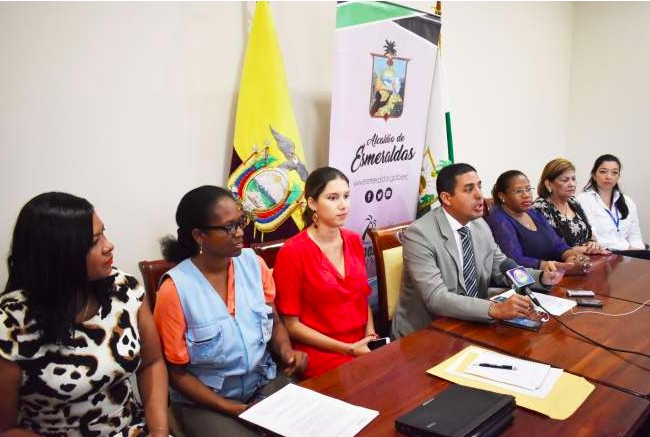
Video: UN Deputy Secretary-General Amina J. Mohammed (second from the left), alongside UN Women Executive Director Phumzile Mlambo-Ngcuka, Special Representative of the Secretary-General on Sexual Violence in Conflict Pramila Patten, and Minister of Women Affairs and Social Development of Nigeria, Aisha Alhassan, speaking to the press in Abuja
.

Urgent action is needed now towards the meaningful participation of women in peace processes, as well ensuring their voices are heard in all aspects of society, the United Nations deputy chief told reporters in Abuja today [20 July] as part of a first-ever UN-African Union trip focused on women, peace and security.

“It is about action. It is about implementation,” Deputy Secretary-General Amina Mohammed told the press in the Nigerian capital, where she also spotlighted the importance advancing gender equality as a precondition for sustainable development for all.

During the joint AU-UN high-level trip, which will move on from Nigeria to the Democratic Republic of Congo (DRC), Ms. Mohammed will be accompanied by UN Women Executive Director Phumzile Mlambo-Ngcuka, the UN Special Representative on Sexual Violence in Conflict, Pramila Patten, and the Special Envoy of the AU on Women, Peace and Security, Bineta Diop.

“It is a new era,” Ms. Mohammed continued, “a new era where we have many tools at our disposal.”

“We know that from the economy to stability and peace, we are not able to achieve our goals if we are only investing in half of the population. “Human resource is a major asset of a nation and a continent. Women often account for half. But they lack the investment we need,” she added, urging that women’s voices be heard in all aspects of society.

Ms. Mohammed cited various challenges, which went beyond abject poverty to encompass high maternal mortality rates, extremism and education gaps.

(continued in right column)

Question for this article

Does the UN advance equality for women?

(continued from left column)

“What we really want to do is to hear and bring the messages of women – women in decision-making, women who bear the brunt and carry the burden of many of the tragedies that we see – to see how we can come out of this, how we can be a constructive partner in finding the solutions to sustainable development,” she stressed.

According to Ms. Mohammed: “It makes economic sense. It’s not charity. It is about rights […] it’s a huge part of our economic development.”

Over the past two days, the deputy UN chief met with the acting President and key ministers on these and other issues that affect development.

nvesting in Sustainable Development Goals can help prevent conflict
From the activities of Boko Haram in Nigeria’s north-east to the conflicts between Fulani herdsmen and farmers, she said conflicts drain the country’s economy of resources that could be better used for development.

“Without peace we cannot have development. Whatever investments that we are putting into development we are seeing them eroded by the lack of peace,” she underscored.

Ms. Mohammed also spoke about meeting with young refugee girls, who, living in camps, fled tragedies, including some of the freed Chibok girls. “We heard stories that young girls should not have to tell, and these have been a tragedy for all of us,” she lamented.

However, the deputy UN chief was inspired by their spirit as they “refuse to be victims and are survivors with a future that is bright.”

“We saw girls […] who talked about their dreams – no longer their nightmares,” she said, adding that while challenges remain as there are many girls still left behind, “it shows that there is hope.”

Ms. Mohammed underscored the importance of strengthening partnerships with Nigeria and the African Union for a scaled-up response to support women and girls who face these tragedies.

Turning to the Sustainable Development Goals (SDGs), she emphasized that by investing in them, “we can look at the root causes […] we can prevent the conflict from happening.”

Also, as present conflicts are resolved, the SDGs provide an opportunity “to invest in the day after, to make sure that we are building back so that we don’t lose the dividend of peace.”

Eliminating sexual violence in conflict through the International Criminal Court

. . WOMEN’S EQUALITY . .

An article from the Coalition for the International Criminal Court

19 June marks the International Day for the Elimination of Sexual Violence in Conflict. It is the second time this International Day is celebrated, and this year’s theme “Preventing Sexual Violence Crimes through Justice and Deterrence” commemorates the advances that have been made through international justice, not in the least through the work of the International Criminal Court (ICC), to eradicate these heinous crimes.


The documentary “The Uncondemned” profiles the Rwandan women, lawyers and activists who helped bring about the first prosecution of rape as a war crime © The Uncondemned

SGBV: A conflict strategy

Conflict-related sexual and gender-based violence (SGBV) is a widespread weapon of war—seen in conflicts in the Central African Republic, the Democratic Republic of Congo, Mali, Darfur and Syria, to name but a few. It is used to terrorize, to degrade, to punish communities and to ethnically “cleanse.” Women and girls are predominantly the victims; but men and boys are also targeted and suffer. Survivors are often marginalized and stigmatized, with little hope of seeing their attackers brought to justice.

“Sexual violence is a threat to every individual’s right to a life of dignity, and to humanity’s collective peace and security. … Let us therefore use this day to rededicate ourselves, on behalf of every survivor, to ending sexual violence in conflict and providing peace and justice for all.” — UN Secretary-General, António Guterres

The Rome Statute: Prosecuting the perpetrators

Encouragingly, the past four years have seen much more visibility for SGBV on the international justice, peace and security agendas since the UN Security Council unanimously adopted Resolution 2106 in June 2013, which recognizes the centrality of ending impunity for the prevention of SGBV in conflict and encourages states to strengthen accountability at the national level.

Adopted in 1998, the Rome Statute was one of the first international treaties to extensively address conflict-related SGBV as crimes against humanity, war crimes and, in some instances, genocide. From the beginning of her term in office, ICC Prosecutor Fatou Bensouda has been proactive in addressing the gender-justice gap and made the investigation and prosecution of sexual and gender-based crimes a priority as witnessed by her Policy Paper on Sexual and Gender-Based Crimes, the first ever such document for an international court or tribunal.

(article continued in right column)

Question related to this article:

Protecting women and girls against violence, Is progress being made?

(article continued from left column)

“The message to perpetrators and would-be perpetrators must be clear: sexual violence and gender-based crimes in conflict will neither be tolerated nor ignored at the ICC. We will spare no effort to bring accountability for these crimes and in so doing, contribute to deterring the commission of such heinous crimes in the future. As a matter of policy, the Office will systematically include relevant charges in its cases on the basis of evidence of criminality.” – ICC Prosecutor Fatou Bensouda

The Rome Statute also contributes to accountability and redress for SGBV through its catalytic effect at the national level. This means that if a state ratifies the Statute and incorporates its far-reaching SGBV provisions into domestic legislation, these crimes can be prosecuted by national courts. By supporting the universality of the Rome Statute and the incorporation of Rome Statute crimes into domestic law, states and civil society can help ensure that the perpetrators of such crimes are held accountable. Many have argued the potential for such a shift in domestic legal culture to promote gender equality more broadly by strengthening women’s rights and increasing their access to justice.

The ICC: Inclusive gender justice

Another example of the Court’s catalytic effect is the vastly under-reported and misunderstood SGBV against men and boys in conflict. It is very difficult to even just talk about SGBV related issues in any culture, an issue that is exacerbated when such violence targets men and boys. The ICC’s Rome Statute, which is explicitly gender-neutral in its description of what constitutes sexual violence, is seen by many as a potential leader is bringing this conversation home to the domestic level.

While there are encouraging signs that conflict-related SGBV is finally getting the attention it so badly deserves, civil society will continue its efforts to ensure the eradication of sexual violence in conflict remains at the top of the international agenda. Commitments made at the UN and elsewhere need to turn into action and accountability. States need to provide greater support to stakeholders in addressing the root causes of gendered violence, strengthen efforts for redress for victim-survivors and ensure that women and gender perspectives are always part of prevention and peace processes.

And the ICC is doing its part. The Court handed down its first conviction for rape as a war crime and as a crime against humanity in March 2016 – against former Congolese rebel militia leader Jean-Pierre Bemba. By developing international jurisprudence on SGBV, the ICC is showing that sexual violence can no longer be treated as a collateral crime; helping destigmatize victims; and working to deter the future commission of such heinous acts.

(Thank you to Janet Hudgins, the CPNN reporter for this article.)

UN: New films on Global Goals spotlight women’s journeys of resilience

. WOMEN’S EQUALITY .

An article from UN Women

On 12 June, the Leave No One Behind Coalition, together with UN Women launched four new films that show how the Sustainable Development Goals (SDGs)—a set of 17 global goals unanimously adopted by governments worldwide—can truly transform the lives of women and girls.

The films show that notwithstanding the barriers, women and girls are finding ways to forge ahead.


Eunice and Josephine

Trapped in the informal sector, Eunice and Josephine had to leave their jobs working in the flower industry in Kenya because the chemicals used were making them ill. In the film, which focuses on economic empowerment, we witness their struggle to find work and feed their families.

Juddy’s story

Juddy talks about overcoming her disability to become an entrepreneur. She is now a leader in her community, teaching other women how they can empower themselves and overcome poverty. Her story shows what is possible when we tackle inequalities

Josephine and Cecilia

Josephine and Cecilia, made difficult decisions to flee their homes to avoid Female Genital Mutilation and early forced marriage. Their story shows the importance of education and tackling harmful practices. Josephine, who is now studying for a degree in law, is a role model for other girls in the community

(continued in right column)

Question for this article

Does the UN advance equality for women?

(continued from left column)

Tracy

Tracy grew up in one of the poorest areas of Nairobi, but is a talented clarinet player. Tracy joined an orchestra, which provided her with a scholarship and opened new doors for her, showing how quality education and opportunity can transform lives.

* * *

The SDGs can be achieved if policies are implemented to unlock the potential of women and girls. The films are intended to raise awareness and spark dialogues in the lead-up to the High-Level Political Forum on Sustainable Development in July 2017, in New York. Governments and the international development community will come together to review SDG progress.

The Leave No One Behind Coalition is urging governments to put the women and girls who are furthest behind first, to make sure that they have the same life chances as everyone else.

The 2030 Agenda and the SDGs present a roadmap for achieving gender equality and women’s empowerment over the next 13 years. The 17 “Global Goals” that are deeply interconnected, have the potential to end poverty, tackle climate change and other pressing challenges, and once and for all, close the gender gap in homes, schools, the economy and politics.

At the heart of the Global Goals is a commitment to ensure that ‘no one is left behind’. Too often, it is women and girls who are left furthest behind, with fewer opportunities to escape poverty, violence or restrictive cultural practices. Conversely, without empowering women and girls, the Global Goals cannot be achieved.

Kenya’s pastoralists look beyond patriarchy to property rights for women

. . WOMEN’S EQUALITY . .

An article by Wesley Langat for Thomson Reuters (reprinted by permission)

Norah Chepkulul, a single mother of two young sons, stands outside her home, a grass thatched hut surrounded by cactus-like euphoria trees on the dusty Maasai Mara road in Kenya’s Rift Valley. She has just finished milking her four cows and has asked the boys to keep an eye on the goats corralled in the little compound.

A few years ago, a single mother taking sole responsibility for her family would have been a rare sight among the pastoral Kipsigis and Maasai communities. Traditionally, the predominantly herder societies are patriarchal and men are the decision-makers and managers of land and stock. But over-grazing and the sub-division and privatisation of land and its transfer to agricultural use has forced herder communities to accept and adopt new land strategies, including applying for security of tenure and women in land transfer and inheritance.

“Getting married these days is no longer a priority,” Chepkulul told the Thomson Reuters Foundation. “I am not married and being a single mother is not easy. I stay at home with my four children as a mother – and as a father, too.”

Deeply-rooted obstacles in society, along with the big gap between new laws against gender discrimination and local custom and tradition however continue to be a problem for women.

Chepkulul, is one of the lucky ones. Her family acknowledged her daily battle to feed, house and educate her children and gave her a plot of land to work, flying in the face of cultural traditions.

“My family members saw the economic challenges I faced in bringing up my children, felt pity, and gave me a small portion of land to farm and put my house on,” she said.

“Sometimes when there is a financial challenge at home, for example hospital bills for the parents, you’re told to sell that cow and any other assets.

“For my brothers that is considered the last option – there is no equality at all. I wish they could realise that my children are the same as theirs.”

Local priest, Mathew Sigilai, believes that the combination of economic pressure and new gender equality laws in Kenya is slowly eroding deep-seated cultural beliefs.

“Things have changed and the population has grown and nowadays, getting married is not guaranteed,” he said.

(article continued in right column)

Question related to this article:

Can the women of Africa lead the continent to peace?

(article continued from left column)

CHANGING ATTITUDES

“As a parent, if my daughter is not married, I will not chase her away. Instead I give her a farm or a cow to earn a living and start off her life like a son.”

Chepkulul’s neighbour, 56-year-old Juliana, recalls her youth, a time when things were even tougher for unmarried women.

“When you were not married, it was difficult to find accommodation or a home. You would not be allowed to stay with your parents. Sometimes a neighbour sympathised with you and offered you an old house,” she said.

“But later, when they wanted it back, you had to leave and find another place … that was life for unmarried women, they were considered outsiders.”

A 2014 World Bank report, Gender at Work, showed that legal discrimination against women on inheritance and property rights remains common in many areas of the world, including the Middle East, North Africa, parts of South Asia, and sub-Saharan Africa.

However, between 1960 and 2010, the report said, Kenya had slashed the number of discriminatory laws against women’s property ownership and rights by more than half.

Purity Wawerua, a retired Kenya Wildlife officer who belongs to a different tribe agreed there had been important progress in women’s inheritance rights among the Maasai.

Land used to be a major source of disputes, particularly after long marriages ended in divorce, she said.

“When (the woman) goes back to her parents’ home, it becomes a problem,” she said. “Thanks to the new Kenyan constitution, equal rights are given to both genders.”

However, according to Mitchelle Oyuga, of the Federation of Women Lawyers in Kenya (FIDA-Kenya), there is still room for improvement.

“People have become quite aware that children are equal and it’s a provision in the new constitution,” she said.

“You are allowed to farm, to do any kind of work on that farm, but when it comes to selling the farm, women are given secondary rights,” she said.

At her home in the Rift Valley, Chepkulul agrees and says that speaking up for themselves remains the most difficult hurdle for many women.

“When you despair you feel like speaking out but no one can understand what you’re going through,” she said.

“Sometimes I have been thinking … that if God had really created human beings equally, there would be no discrimination on gender and all people would have been the same.”

(Thank you to Janet Hudgins, the CPNN reporter for this article)

Mozambique: Taking steps on the long road to ending violence against women

. . WOMEN’S EQUALITY . .

An article from Oxfam

In Mozambique, still building respect for women’s rights and working to end violence against them.

Aida Changuane needed help: She was constantly quarreling with her son and daughter in law. Since her husband passed away a few years ago, it seemed the younger generation in her household was disrespecting her, at times depriving her of food, and she says she was constantly criticizing them. They thought she was interfering in their relationship. They fought a lot.


Aida Changuane, 56, led her family to find ways to resolve conflict and live a happier life together. Photo by Brett Eloff/Oxfam America.

“I was suffering,” she told me, standing outside a community office for the ruling FRELIMO political party in her town, Boane, about an hour from Mozambique’s capital Maputo. “I was sorry my husband passed away, I cried day and night.”

Changuane learned about an organization called Nweti (it means “moon” in the local language, signifying a hopeful light in the night). She attended special community dialogue meetings with Nweti’s trained activists who helped her find ways of provoking dialogue instead of confrontation. “I learned the life we were living was not proper, it was too violent, and they taught me how to handle things…I learned there should be dialogue…when there are problems I now ask them to sit down and discuss them.”

She stressed over and over again that her family is now living peacefully, and that she is much happier, despite her sadness in the loss of her husband.

I never got the impression that the conflict in Changuane’s home ever became physically violent, but that was not the case for 34 year old Virginia Machuene, who lives nearby in a smaller town called Massaca, an hour and a half by car from the capitol Maputo on the road west to Swaziland and South Africa, only about 15 kilometers from the border.

(article continued in right column)

Question related to this article:

Protecting women and girls against violence, Is progress being made?

(article continued from left column)

Machuene says she and her husband fought about a lot of things, and he was frequently physically violent. She also attended the community dialogue meetings and learned how to defuse these violent encounters, and brought her husband materials to read that got him to change his behavior.

“I realized violent confrontation is not good,” she says, with a firm look on her face. “Now I am feeling like I am leading a better life than before.”

What’s really changing?

I just went to Mozambique to look at the ways Oxfam has been working on decreasing domestic and gender-based violence. We’ve funded organizations like Nweti for years, and helped others to research and push for new laws designed to bring better respect to women’s rights and decrease violence.

We (Oxfam and all our partners) have been on this road for more than 20 years, but getting people to respect new laws, and encouraging the police and judges to enforce them, is not easy.

The stories of two women like Changuane and Machuene cannot imply a trend in a huge country like Mozambique, but they give me hope anyway. I’m going to keep looking at the question of what is changing here, what we can do to support this work.

As I go, I’ll try to remember the words of Virginia Machuene:

“What the activists [at Nweti] teach us is that in cases of violence, we should report it to community leaders. They teach us that women should not keep quiet when they suffer violence.”

“Nowadays people are changing…I can’t say why. Maybe it’s the church, the activists working with us here, or maybe the laws are changing, or because we have brochures that people can read and people can change. But not so many people are going through this kind of violence.”

(Thank you to Janet Hudgins, the CPNN reporter for this article)

Togo: Women’s groups in the Plateaux region sensitized on social cohesion and the culture of peace in Atakpamé

. WOMEN’S EQUALITY .

An article from Television Togolese

The Minister of Social Action, Advancement of Women and Literacy, Tchabinandi Kolani Yentchare spoke on Thursday, 30 March in Atakpamé, to people from the Plateaux region, in this case women, regarding the involvement and role of women in the maintenance and culture of peace.

This meeting is part of the tour to raise awareness about the contribution of women to the promotion of social cohesion and a culture of peace coupled with support to the funds of women’s groups. This awareness-raising, initiated by the Ministry of Social Action, the Promotion of Women and Literacy, is a response to United Nations Security Council resolution 1325 (2000), which underlines the importance of full gender equality, conflict prevention and resolution, and peace-building and peace-keeping.

The objective of this session is to strengthen the capacity of women on their role in
culture and peacekeeping in their respective families and communities. It is a question of equipping them with the skills that are conducive to the promotion and culture of peace so that they can fully play their role as peace ambassadors.

(Click here for the original French version)

(Article continued in right column)

Question for this article

Can the women of Africa lead the continent to peace?

(Article continued from left column)

The Minister of Social Action, Women’s Development and Literacy underlined the UN peacekeeping strategies, which were adopted by the United Nations at a summit on the Sustainable Development Goals. The 16th objective of the Goals focuses on the promotion of peaceful and inclusive societies for sustainable development, access to justice for all and the strengthening of responsible and effective institutions at all levels . To this end, Togo has embraced this dynamic and has integrated the notion of gender in its development, social cohesion and peace promotion strategies to involve everyone in the Implementation of development policies. She urged women to take advantage of the opportunities offered by the government to develop skills in order to rise to the same level as men in positions of national and international responsibility. She finally invited everyone to pray for peace, solidarity, self-control and forgiveness.

In addition, Minister Tchabinandi Kolani Yentchare handed over to 15 women’s groups in the Plateaux region, specializing in the processing, preservation and sale of agricultural products, financial envelopes amounting to 400,000 CFA francs per group, ie a total of CFAF 6,000.00 for women’s groups in the region. This gesture is a gift from the government and aims to support and financially support these women’s groups in their income-generating activities in order to reduce poverty in rural areas. She also submitted, on behalf of the government, a batch of material consisting of 415 bundles of 0.15 cm metal roofing sheets; 415 bundles of 0.20 cm sheets and 50kg of roofing nails to aid in reconstruction for the victims of recent natural disasters in the Plateaux region.

The prefect of Ogou, Akakpo Edoh, on behalf of the beneficiaries expressed his gratitude to the government for these actions taken to promote the development of women in his region.

UN Commission on the Status of Women: Participant Voices

. WOMEN’S EQUALITY .

An article from UN Women

Every year thousands of activists from civil society organizations around the world come to New York to take part in the Commission on the Status of Women, the global intergovernmental body exclusively dedicated to the promotion of gender equality and the empowerment of women. More than 3,900 non-governmental representatives from 138 countries participated in 2017. See some of their messages and perspectives on women in the changing world of work below.


Click on image to enlarge

How has the world of work changed for women?

[1] Hazel Brown Executive Director of Network of NGOs for the Advancement of Women, Trinidad and Tobago

“I got married in 1962 and was told that married women who had jobs were required to give their earnings to their husbands. In 1962, the income tax law in Trinidad and Tobago considered an employed married woman in the same category of persons as children, imbeciles and people with insane mind. Eventually, we successfully advocated to change that law. But there remain other discriminatory laws that need to be amended. For example, domestic workers are not legally considered as workers and denied the benefits and the rights of all other workers, by law.”

[2] Diane Elsen, “Leontief Prize winner for Advancing the Frontiers of Economic Thought”, author, researcher and professor, United Kingdom

“Until recently, there was a rise in female labour force participation. Now that has levelled off and in some countries, it’s going down. But women’s share in unpaid and care work is not going down. In some countries there is a narrowing of the gender pay gap, and in others the progress on this has stalled. But gender pay gap only accounts for wages from formal employment; it does not factor in the earnings of millions of women who work in the informal sector or without proper contracts. When we looked at the gender earnings gap in UK, for example, it’s bigger than the gender wage gap.”

[3] Shirley Pryce, Former domestic worker, current Chair of the Caribbean Domestic Workers Network, Jamaica

“Before, only men used to sit on company boards, have the top jobs in Jamaica. Now that’s changing. More women are taking on management jobs. For domestic workers too, things have changed. We are more respected that we used to be; we are better aware of our rights and employers are more educated about our rights. But for domestic workers to be truly empowered, we need laws to protect their rights. Jamaica has ratified the ILO Convention on Domestic Workers, but now we are need to develop a national law. As the head of the Caribbean Domestic Workers Network, I am also advocating with other Caribbean countries to ratify the ILO Convention and then implement it through national laws.”

[4] Christian Mendoza Galàn, Coordinator on Economic, Social and Cultural Rights, Mexico

“In Mexico, we have social security linked with formal [waged] work, so that makes it harder for women who are not in formal labour force. We have more work, less money, and less labour rights for women. Adding women’s unpaid work to their paid work, women have more amount of work. This limits our opportunities to develop. The unpaid care work also is related to women’s sexual and reproductive rights, because if we have more children, we have more work at home. And, we need to engage in paid work too because we don’t have enough money to sustain the family.”

[5] Mariyam Mohamed Representative of Uthema, Maldives

“There are more women joining the workforce now, but 47 per cent of women are employed in informal sectors, in jobs where they don’t get pensions or other benefits. We have a new gender equality law but it doesn’t address the care work that women do. Since 1980s, we’ve been talking about state funded daycare but it has not happened. It does not endorse affirmative action or gender-responsive budgeting. We have laws, but no one knows about them. There is not enough budget allocated for the implementation of the laws.”

What will it take to bring women on equal footing with men in the world of work?

[6] Dr. Archana Integrator with Prada, India

“I am working with rural women and women farmers in India. For them, the pace of progress [in economic empowerment] is slower still. For women to have equal economic opportunities, men’s participation in the household chores and care work is essential. At the same time, women’s participation in the economic and political spheres must be promoted. There are many pro-women laws and policies in different countries, but they are not enforced.”

[7] Emma Kaliya Chairperson of FEMNET, Programme Manager of the Malawi Human Rights Resource Centre, and Equal Pay Champion, Malawi

“When it comes to bringing women equal to men, we have to make sure that the existing laws are enforced. The employment act in Malawi, for example, doesn’t allow for discrimination against women. It provides for maternity leave and other provisions. But when it comes to practice, employers may give only one week of maternity to women. Enforcement is important because if employers do not comply with the law, they can be punished and that would serve as a deterrence to others. As an Equal Pay Champion, I want to engage the minister of labour and other stakeholders in the private sector, and partner with trade unions to improve the situation of women in the informal sector. We also have to remove the barriers, such as sexual harassment at the workplace.”

(article continued in right column)

Question for this article

Prospects for progress in women’s equality, what are the short and long term prospects?

(article continued from left column)

[8] Marie Andrea Anick Jasmin, Young filmmaker, Haiti

“The biggest challenge for women in Haiti is to see themselves in decision-making positions, and in what they perceive as “male occupations’. In Haiti, girls don’t see themselves as presidents, engineers or leaders. We must change the mentality and change will come with education at primary, secondary and university levels, sexual and reproductive education, and education that improves women’s self-esteem.”

Our issues

[9] Roki Kumar Breakthrough, India

“It is not enough to say that women are working, so they are economically empowered. For a woman to be empowered, she should also be able to earn at the same level as a man. She should also have the right to spend her own money the way she wants. The biggest problem in my country is patriarchy. We cannot achieve gender equality without men playing a part.”

[10] Maria Eugenia Romero, Executive Director of Equidad de Género, Ciudadanía, Trabajo y Familia A.C., México

“In Mexico, we have free public health care. But when women try to see a doctor, there are no appointments available, or the clinic is too far away from them…or the medicines and contraceptives they need are missing. Providing healthcare to women is not seen as a right but as a luxury. We have found that generally women do not receive the contraceptive methods they want, but the one that is available.”

[11] Sandra Letio Youth entrepreneur, Uganda

“I was 23 years old and unemployed, looking for jobs, but finding none. I had USD 15 to invest and a basic recipe for making soaps. Today, my business is valued at USD 700,000. When I first started, many people refused to take me seriously, or give me contracts, because I was young. Some men even harassed me; said they would give me business if I married them. I am the ambassador for youth entrepreneurs in Uganda. We may be young, but we should be given equal opportunities.”

[12] Janneth Lozano Bustos Director of Community Support Corporation (Codacop), Colombia

“Most [indigenous] women work is in agriculture…Some of what they produce, they can sell. We work with women so that they learn to value that work as actual work. Before, they did not even recognize it as such. We are trying for women to have autonomy over their own resources. If she is the one who is raising the hen, and she is going to sell it, then she has the right to lead the negotiation and receive the money! Often it is her [male] partner who does that. If someone wants to buy something, [women] say, “I don’t know anything about that, talk to him”, and then it is the partner who would take the money, and she would never see a dime.”

[13] Patricia Munabi Executive Director of Forum for Women in Democracy, Uganda

“We need to first raise awareness about why it is important to look at a budget with a gender lens. When we began to work with citizens at grassroots levels on gender-responsive budgeting, we asked them what their actual needs were, and then taught them to track where the money is going. Because local women spoke out and said, ‘we need more funding for family planning,’ the government created specific budget lines for family planning. We’ve seen more girls going and staying in schools because communities demanded for separate toilets for boys and girls. Prior to the last election, the government promised to provide sanitary towels for girls, but then the Ministry of Education said there was no money in the budget for sanitary towels.”

[14] Dhitipriya Ghosh Head of Human Resource Management of Breakthrough, India

“Garment factories are the second largest employer for women in India. Women in garment factories are experiencing multiple tiers of violence. On the factory floor, they face rampant sexual harassment. We not only worked with the women, but also worked with the factory management, bringing the Human Resources Management team into the discussion. Once they realized that by making it a safe workspace for women, the productivity goes up, they enforced measures to make their factories safe workplaces. Within 3 years, we had a marked improvement in women’s safety in the workspace.”

[15] Lucia Makamure
Alliance and Partnerships Officer, Gender Links, South Africa

“In our part of the world, the biggest impact of climate change is access to water. Climate change has a woman’s face. It is mostly women, and young girls, who are affected. It’s girls and women who have to sacrifice the time they could use for studying and school, to go out to fetch water. They have to walk longer to find water. When it floods, it’s the women who have to now go out to look for food for the family. Gender must be at the heart of any climate change policy.”

UN report lays out concrete actions for accelerating progress towards women’s full and equal economic participation

. WOMEN’S EQUALITY .

An article from UN Women

The UN Secretary-General’s High-Level Panel (HLP) on Women’s Economic Empowerment has presented its second report with final recommendations to the UN Secretary-General António Guterres. In its report, the Panel lays out concrete actions for accelerating progress towards women’s full and equal economic participation. The report also acknowledges that gender inequalities remain stubborn across the world, but they can be overcome if systematic barriers are removed.


Click on the image to enlarge

The HLP follows up on the seven main drivers of transformation, introduced in its first report, that was published in September 2016. These are: tackling adverse norms and promoting positive role models; ensuring legal protections and reforming discriminatory laws and regulations; recognizing, reducing and redistributing unpaid work and care; building digital, financial and property assets; changing corporate culture and practice, improving public sector practices in employment and procurement; and strengthening visibility, collective voice and representation.

The second report, reflecting the work by expert groups including Panel members, identifies practical actions for taking the agenda forward. It elaborates on how economic policies, legal reforms and investments make up an enabling environment that can bring transformational change in the world of work and ensure that one billion women become economically empowered. As UN Secretary-General António Guterres has highlighted: “Women’s economic empowerment is at the heart of the 2030 Agenda. We will not achieve the Sustainable Development Goals if there is no accelerated action to empower women economically. We know that women’s participation in all spheres of life, including in the economy, is essential to sustainable and durable peace and to the realization of human rights.”

The High-Level Panel emphasizes the powerful role of public, private and civil society partnerships and encourages new collaborations, promoting new commitments that will carry this work forward. “With the second report we are also taking another step in building momentum within governments all over the world. We are about to launch a group of Champions with support from more than 20 governments who take the actions and recommendations from the panel further,” explains co-Chair Luis Guillermo Solis, President of Costa Rica.

(continued in right column)

Question for this article

Does the UN advance equality for women?

(continued from left column)

“Now is the time to act”, continues co-Chair Simona Scarpaleggia, CEO of IKEA Switzerland, and stresses the importance of demonstrating accountability. “The report is out and it shows how all sectors—public, private and civil society—can contribute to overcome systemic barriers for women’s economic empowerment,”, she says. “In IKEA Group, we are committed to doing our part by reaching gender equality in all leadership positions providing equal opportunities and equal pay by 2020.”

Individual Panel members and the many institutions they are associated with have already made significant commitments to take the agenda forward and more commitments were shared during the release of the second report, such as:

– MET Community’s commitment to promote the use of technology through [their] online platform to connect, train and provide visibility to female entrepreneurs in particular Latino rural women, Afro-American and indigenous women who want to start businesses;

– The OECD’s plans to support the G20 commitment to reduce the gender gap in labour force participation by 25 percent ahead of 2025 by setting normative standards through its gender equality recommendations on education, employment, and entrepreneurship, and public life;

– The Caribbean Domestic Workers Network’s continued advocacy across the region for the ratification of ILO Convention 189 setting labour standards for home workers and domestic workers;

– The Government of Finland’s continued support of daycare and early childhood education as essential parts of development programmes and a prerequisite for women’s economic and political empowerment and their ability to get decent work; and

Care International’s commitment to ensure that 30 million women will have greater access and control over their economic resources by 2020 through technological solutions and scaling of the its model of Village Savings and Loan Associations and the development of a new global partnership for ensuring access to financial services for the world’s poorest women.

About the UN Secretary-General’s High-Level Panel on Women’s Economic Empowerment

The HLP was established by the UN Secretary-General in January 2016 with the aim to place women’s economic empowerment at the top of the global agenda to accelerate progress of the 2030 Agenda for Sustainable Development. The HLP is supported by the Government of the United Kingdom. Its two reports will be supported by tool kits to guide the implementation of its recommendations, which are forthcoming. Link to download the report