All posts by CPNN Coordinator

About CPNN Coordinator

Dr David Adams is the coordinator of the Culture of Peace News Network. He retired in 2001 from UNESCO where he was the Director of the Unit for the International Year for the Culture of Peace, proclaimed for the Year 2000 by the United Nations General Assembly.

Mexico: The government of Zacatecas installs a fifth room for peace and juvenile restorative justice in the Sain Alto school of Cobaez

. . DEMOCRATIC PARTICIPATION . .

An article from the state of Zacatecas

The Bachilleres Schools of Cobaez in the State of Zacatecas already have rooms of Peace and Juvenile Restorative Justice in five establishments; The last of these spaces has now been established for the teaching and student community of the Sain Alto school.

According to Cobaez’s General Director, Juan Antonio Ruiz García, these spaces have been created by the State Government to meet the needs of young people so they can resolve conflicts through dialogue and consensus between the parties concerned.
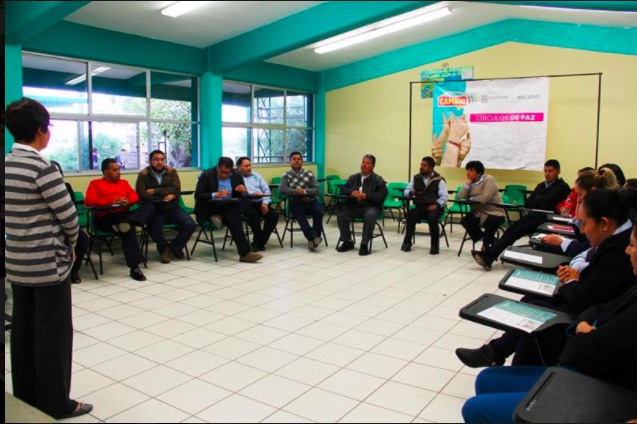
It is not a question of punishing an aggressor,” he added, “but of deterining the causes that have motivated the behavior and solving the conflict through the culture of peace. The victim, the teachers and the mothers and fathers are all part of the resolution of the problem.

The four other Peace and Juvenile Restoration Justice Rooms are located in the schools of Roberto Cabral del Hoyo, Víctor Rosales, Zacatecas and Luis Moya. Likewise, it is planned to install more spaces like these in Ermita de Guadalupe, Enrique Estrada and Valparaiso.

(Article continued in the right column)

(Click here for the original article in Spanish)

Discussion question

Restorative justice, What does it look like in practice?

(Article continued from left column)

Ruiz Garcia urged students to be promoters of what they learn in the Peace and Justice Room, to be transmitted in their homes and community; also invited them to practice tolerance and dialogue, because that means seeing beyond our differences.

For her part, Flor Morales Duke, Director of Citizen Orientation of the Secretariat of Public Security (SSP), said that these actions are part of a general peace initiative, and this room, intended to benefit young people, will be a place of training for peace and social skills.

Ricardo Isaac García Valerio, director of the Sain Alto campus, addressed the students to point out that in that space they can resolve disputes, eradicate discrimination, bullying and violent acts through the culture of peace.

As complementary actions to the program, the director of training of the Human Rights Commission of the State of Zacatecas, Luis Rincón Gallardo, gave a conference to 550 students on the Culture of Peace: Prevention of violence and promotion of values ​​for harmonious coexistence.

Within the framework of the Peace Circles and the Implementation Strategy of the Prevention and Attention to School Violence Program, the teachers of the School also participated in the workshop called Paradigms of Restorative Justice, taught by Myrna Ordaz Alarcón.

Finally, the Chief of the Department of Higher Education of the Ministry of Education, Victor Octavio Espinoza Lozano, assisted the members of the Unit of Peace and Restorative Justice; to unveil a plaque in the fifth room of Peace and Juvenile Restorative Justice of the Cobaez.

Ecuador: ‘Dedicated Lives’ at the Casa Carrión

FREE FLOW OF INFORMATION

An article from the Agencia Pública de Noticias de Quito

“Dedicated Lives”, a book on non-violence written by authors of the Press Association of Ecuador will be presented at the Casa Carrión this Wednesday, October 25th, at 7:00 p.m.

As part of its journalistic work, the Pressenza team in Ecuador conducted a series of interviews which are published in this book. The objective of this effort is to recover and disseminate the experience of 12 people who in Ecuador have dedicated their lives to a struggle, initiative, or task that contributes to the construction of a non-violent Ecuador. They are twelve testimonies, twelve examples for our future.


(Click on image to enlarage)

The book will be published under the label of Manthra Editores. The main characters will include: Leonor Bravo and her dream of promoting reading, Nila de Aguiar on the situation of Afro-descendants, María del Carmen Barros on the importance of community building, Pascale Laso and the formation of the group Mujeres de Frente, Luis Montaluisa and Catalina Álvarez for their struggle for the rights of indigenous peoples; emblematic figures of the Ecuadorian Culture of the XX century.

The press agency Pressenza has been operating for 9 years. Its initial motivation was to cover the World March for Peace and Nonviolence. Journalists and photographers from some countries joined in this cause. In 2014, Pressenza was legalized in Ecuador as an International Press Agency, with a focus on Peace and Nonviolence, and for three years it has been a member of APE (Association of Foreign Press in Ecuador). Pressenza has about 250 volunteers in more than 30 countries, specialized in communication, social activism, cultural and academic fields.

(Article continued in the right column.)

(Click here for the original version in Spanish.)

Question(s) related to this article:

Journalism in Latin America: Is it turning towards a culture of peace?

(Article continued from left column)

With a universalistic humanistic perspective, Pressenza is a space open to the expression of ordinary people. It works with issues related to humanism, non-violence, human rights, disarmament and discrimination, actively promoting collaboration agreements and alliances with other agencies, as well as links of reciprocity with portals, platforms, information and communication media, specific communities and cultures.

It has a wide network of news media that achieve worldwide dissemination of its local proposals, nourishing its information with the material provided by the agency. It is present in 30 countries and issues its information service daily in English, Italian, Spanish, French, Portuguese, German and Greek. It has columnists, reporters, photographers, graphics, video and translators on five continents, who contribute without profit their professional work, whose basic condition is their autonomy, independence and self-management.

In Ecuador, for 5 years, it has been promoting the Fair of Non-Violent Initiatives and, for 3 years, the October initiative for Peace and Non-Violence, whose activities are carried out jointly with groups, foundations and organizations that carry news about initiatives that promote non-violence and non-discrimination.

“Non-Violent October,” is a project of civil society, formed by a group of individuals and non-profit organizations, with the aim of promoting a humanistic and human rights approach, to motivate a culture of peace, active non-violence and non-discrimination, as life actions to contribute to the integration of individuals and their peoples.

“Non-Violent October,” carries out various activities throughout the year, especially in October, which begins with the International Day of Nonviolence. The work is collaborative and self-managing. It does not receive any kind of investment from a public or private entity, thus promoting the empowerment of individuals for individual and collective transformation.

Madrid will again host the World Forum for Peace in 2018

.. DEMOCRATIC PARTICIPATION ..

An article from La Vanguardia (reproduction strictly for non-commercial purpose)

The Spanish capital will host again in November 2018 the second edition of the World Forum for Education for Peace which it held in April this year, with the participation of over 400 international representatives who sought solutions to the different types of urban violence.


Manuela Carmena

Mayor Manuela Carmena, has announced that Madrid will once again host the event in remarks to journalists at the end of an event commemorating United Nations Day. She said that the Spanish capital has “identified with peace as a possible instrument of governance and development. ”

(continued in right column)

(Click here for the Spanish original of this article)

Questions for this article:

How can culture of peace be developed at the municipal level?

(continued from left column)

The forum, promoted by the mayor of Madrid and her Parisian counterpart, Anne Hidalgo, will stay for the second consecutive year in Madrid because “it is necessary to fix well” the forum, according to the mayor, who wants “Madrid to remain the capital of peace”.

In the first edition held between 19 and 21 April, experts from more than 70 countries, a hundred of them mayors, addressed solutions to various forms of interpersonal violence, which has generated between 2000 and 2014 the death of six million people, more than those killed in wars.

The King inaugurated the meeting in which local governments and civil society organizations signed the “Madrid Commitment of Cities of Peace” to promote “a culture of peace”, to create actions against violence that go beyond “punishment” and fight against corruption.

The meeting addressed different types of violence: youth gangs, racism, homophobia, gender violence, school bullying and urban inequality.

On this occasion, according to EFE municipal sources, the team of Manuela Carmena will work to include personalities of the highest level, and the Forum will be attended by the United Cities and Local Governments (UCLG).

The first edition was held in the impoverished district of Villaverde (in the south of the Spanish capital), which welcomes large numbers of emigrants and unemployed citizens.

Panama: CUMIPAZ promotes justice and democracy

DISARMAMENT & SECURITY .

An article written by Lineth Rodriguez for Metro Libre (translated by CPNN)

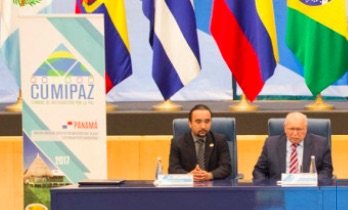
Panama is home to the third Summit of Integration for Peace, which tomorrow (21 October) will have its closing ceremony, and which has discussed issues of great importance, from scientific work for the preservation of Mother Earth and Humanity to diplomacy and education .


“We work for an altruistic cause, including sowing a culture of peace, building a culture of peace, promoting and defending human rights, respect for human dignity, tolerance for equality and peaceful resolution of conflicts,” said Magistrate Camilo Montoya Reyes.

(Article continued in right column)

(Click here for the original Spanish version of this article.)

Question for this article:

Proposals for Reform of the United Nations: Are they sufficiently radical?

(Article continued from left column)

He said that among its programs, the organizer, the World Embassy of Activists for Peace, seeks to strengthen justice and impartiality in the international arena, especially to strengthen the International Criminal Court, which is responsible for investigating international crimes.

Also, they seek to democratize the UN, so that the Security Council is enlarged to have not only the present five permanent members, but also a permanent member from Latin America.

The following are presentations in the morning session:

– Proposal for strengthening the autonomy and effectiveness of the Criminal and International Court by Dr. Ania Salinas Cerda;

– Challenges of International Justice in detecting alarm signals, and in preventing genocidal atrocities by Judge Rafaa Ben Achour;

– Introduction to the Peace and Democracy Panel in Latin America and Latin America as an Island of Peace by attorney Ernesto Samper Pizano, former president of Colombia.

Mexico: Expanding the Women’s Network against Gender Violence

. . WOMEN’S EQUALITY . .

An article from the Heraldo de Coatzacoalcos

As part of the program “Strengthening for Security” (Fortaseg) carried out by the City Council of Coatzacoalcos and the program Desarrollo Integral de la Familia (DIF), under the direction of its Gender Unit, 25 women from the Benito Juárez Norte colony received their certificates as members of the Women’s Network against Gender Violence.

(article continued in right column)

Question related to this article:

Protecting women and girls against violence, Is progress being made?

(article continued from left column)

The Director of Gender Unit of the DIF, Liliana Alonso Martínez, stressed that more women will be added to the network. Its purpose is outreach to women who have been victims of violence so that they know where to go to request assistance, whether legal, medical or psychological.

Within the framework of this accreditation, dozens of people gathered inside Plaza Forum, to add their signatures against gender violence and in favor of a culture of peace in Coatzacoalcos.

(click here for the original Spanish version of this article.)

USA: Ashland Culture of Peace Commission – A small town can play a big role

. . DEMOCRATIC PARTICIPATION . .

An article by David Wick for the Ashland Daily Tidings

From its inception, the Ashland Culture of Peace Commission (ACPC) has been a local–global initiative. Some people refer to this as, “think globally and act locally,” or vise versa. In the case of ACPC and the city of Ashland, the Culture of Peace model we are developing is of interest far beyond Southern Oregon and does have an impact on national and international levels.

For many months Bob Morse of ACPC has written articles which were developed through conducting interviews with people representing various sectors of our local community. Each article provided a different view of a Culture of Peace and hinted at a new emerging model. This has been informative and generated dynamic conversations and new thinking with article titles ranging from, “Nourishing our children and ourselves” and “Peace through feeding the hungry” to “Bringing peace to healing”.

Over the next several months ACPC will begin a new series of articles which focus on the national and international evolution of a Culture of Peace and the important role Ashland and ACPC play in this vital global initiative. The variety of authors have made important contributions toward shifting mindsets and behaviors in their spheres of influence. These leaders are also very aware of the developing peacebuilding activities taking place in Ashland and will reflect upon the importance of what we are doing from their perspective.

The authors currently include: Bangladeshi Ambassador Anwarul Karim Chowdhury, the United Nations; David Adams, Culture of Peace News Network; Dot Maver, National Peace Academy; Avon Mattison and Tezikiah Gabriel, Pathways To Peace; Fred Arment, International Cities of Peace; and David Hazen, Eugene Peace Team.
 
(article continued in right column)

Question related to this article:

 
How can culture of peace be developed at the municipal level?

(article continued from left column)

On May 16, 2017 the Ashland City Council joined the International Cities of Peace and proclaimed Ashland a City of Peace. This created a focus to work toward that goal. In part the proclamation states, “Official recognition of

Ashland as an International City of Peace will provide inspiration for all citizens to create an emerging, evolving, living model for thriving together as fellow humans. NOW, THEREFORE, the City Council and Mayor, on behalf of the citizens of Ashland, do proclaim that the City of Ashland, Oregon, is a City of Peace in perpetuity and encourage city and community leaders to work with concerned citizens to develop policies and procedures that promote a culture of peace in our region.”

What does this matter, one may ask; we have real problems at home, why look outside of Ashland? In the April 10, 2016 Daily Tidings article titled “Ashland Culture of Peace Commission: Does Ashland matter globally?” Fred Arment, executive director of the international Cities of Peace answered this question directly.

“I want to emphasize that Ashland is ahead of the curve. I have a lot of communication with cities around the world, and you guys are definitely ahead of the curve on all of this!” declared Arment. “You have basically made a very sophisticated approach involving political with grassroots organizations and done it in a way that has integrity and promise, unity and purpose. You guys are leading the pack, and I’m really interested in doing a case study of your city and your approach for the rest of the world to see.”

Arment continued, “Just the idea of your being in the United States — and for peace — gives encouragement and support to other cities around the world. So it’s not just Ashland that you are dealing with. When Ashland proclaims that it is a City of Peace, other cities in war-torn areas see that as a way forward. So it’s very powerful!”

Dedicated people, time, energy and money will be required to walk the pathway to co-creating a Culture of Peace in Ashland and elsewhere. We are not talking about a few changes here and there. We are talking about new models. In large part Buckminster Fuller identified our pathway when he said, “You never change things by fighting the existing reality. To change something, build a new model that makes the existing model obsolete.”

Ashland does matter globally. ACPC is planning to install the World Peace Flame in Ashland in 2018, and convene a global peace conference here in 2019. Let us be clear: There are positive leadership and economic implications for Ashland as our reputation grows as an innovative International City of Peace. Most important, a Culture of Peace is a living legacy which our children, grandchildren and future generations can build upon. Please join us!

— David Wick is executive director of the Ashland Culture of Peace Commission. Email comments and questions to ashlandcpc@gmail.com. The ACPC website is www.ashlandcpc.org; like the commission on Facebook at www.facebook.com/AshlandCultureofPeaceCommission; follow twitter.com/AshlandPeace on Twitter. All are welcome to join the ACPC’s Talking Circle at 11 a.m. each Tuesday and Community Meeting at 4 p.m. each Wednesday, both at the ACPC oice, 33 First St., Suite 1, diagonally across Lithia Way from the Ashland Post Oice.

World body of parliaments discusses nuclear-risk-reduction and disarmament

.. DEMOCRATIC PARTICIPATION ..

An article from Parliamentarians for Nuclear Non-Proliferation and Disarmament

Parliamentarians from around the world, who gathered in St Petersburg for the 137th Assembly of the Inter-Parliamentary Union from Oct 14-18, held a special session on Monday organised by PNND to discuss the role of parliamentarians in reducing nuclear dangers and supporting nuclear disarmament.

Bruce Blair, co-founder of Global Zero and a former nuclear missile controller, outlined the growing risks of a nuclear catastrophe due to increasing tensions and conflicts between USA & North Korea, Russia & the West, and India & Pakistan, combined with the high operational readiness of many of these countries to use nuclear weapons. He noted that the potential of nuclear-weapons-related conflicts escalating into war – and the possibilities of nuclear weapons being used by accident, miscalculation or even intent – are even greater now than during the Cold War.

Ambassador Elayne Whyte Gómez, President of the UN negotiating conference for the Treaty on the Prohibition of Nuclear Weapons, updated parliamentarians on the adoption of the treaty on July 7, the number of countries that have signed the treaty to date (53 countries) and the role that parliamentarians have in ratification of the treaty in national legislatures in order to ensure the treaty’s entry-into-force and implementation. She also called on parliamentarians from countries that have not yet signed the treaty, to call on their governments to sign in order to reach 100 signatories as soon as possible.

Alyn Ware, global coordinator of Parliamentarians for Nuclear Non-proliferation and Disarmament, highlighted the opportunity to advance nuclear risk-reduction and disarmament measures at the United Nations High-Level Conference on Nuclear Disarmament (UNHLC), which will take place at the UN in New York in May 2018. Such UN high-level conferences have been very successful in other areas (sustainable development, climate change, oceans and refugees), and could make a significant contribution to nuclear disarmament. (See UNHLC food-for-thought paper).

(continued in right column)

Questions for this article:

How can parliamentarians promote a culture of peace?

A UN High-Level Conference on Nuclear Disarmament: Distraction or progress?

(continued from left column)

Goals proposed for UNHLC could include: achieve 100 signatories to the nuclear ban treaty (many governments could sign at the UNHLC); renew the UN process for a Middle East zone free of nuclear weapons and other weapons of mass destruction; agreements by nuclear armed States to take all nuclear weapons off alert, make further cuts in nuclear stockpiles, give assurances to non-nuclear States that nuclear weapons will not be used against them, commit never to be the first to use nuclear weapons, and outline a framework to achieve a nuclear-weapon-free world.

A number of delegations took the opportunity to make comments and ask questions on various aspects of the issue, including: how to strengthen international criminal law against nuclear weapons regardless of whether its use or possession by terrorists or governments, how to engage youth and build a stronger civil society movement for nuclear abolition, how to maintain existing agreements (such as the Joint Comprehensive Plan of Action regarding Iran’s nuclear energy which is under threat from the new USA administration), how to reduce nuclear tensions and build confidence, and how to move the nuclear-armed States to phase out their reliance on nuclear weapons and negotiate a comprehensive agreement on the elimination of nuclear weapons.

The event also included the launch of a new publication – the Parliamentary Action Plan for a Nuclear-Weapon-Free World. The Action Plan, which has been developed by Parliamentarians for Nuclear Nonproliferation and Disarmament in consultation with the Inter-Parliamentary Union (IPU), includes 14 key nuclear disarmament actions that can be taken by parliamentarians.

Some of these are actions that parliamentarians from States Parties to the nuclear prohibition treaty can take to implement the treaty in their parliaments. These are all non-nuclear States, as the nuclear-armed and allied States do not currently support the treaty.

Other actions in the Plan are those that parliamentarians from nuclear armed and allied States can take to reduce the risks of nuclear weapons being used, and move their governments to adopt incremental disarmament measures, phase out the reliance on nuclear deterrence and negotiate for nuclear disarmament.

And some actions in the Plan are those that parliamentarians from all States can take to build public awareness and political will for the achievement of a nuclear-weapon-free world.

The plan draws from reports and resolutions on nuclear disarmament adopted by the IPU in 2009 and 2014, as well as resolutions of the Parliamentary Assembly of the Organisation for Security and Cooperation in Europe, and a series of consultations undertaken by PNND in key capitals and UN centres during 2016-2017.

Ecuador: Rumiñahui for a Culture of Peace

.. DEMOCRATIC PARTICIPATION ..

An article from the Associación de Municipalidades Ecuadorianas

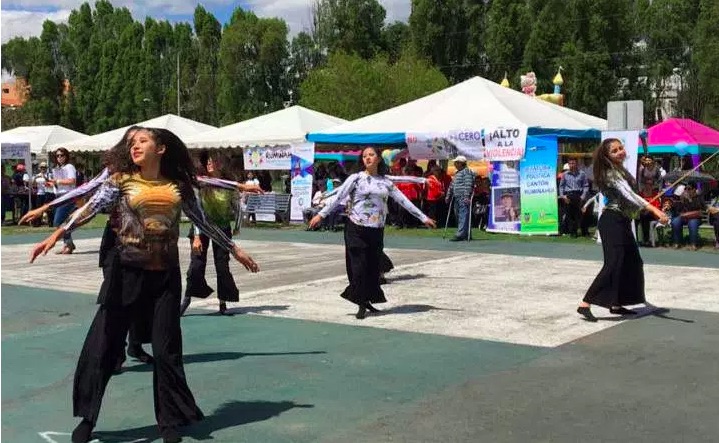
“Peace is not written with letters of blood, but with intelligence and heart,” is a phrase of reflection written on one of the many posters on the stands at the first “Nonviolent Initiatives Fair” held in the city of Rumiñahui on the initiative of the municipality of the town, on October 14, 2017.

The director of Citizen Participation of the municipal government, Angela Figueroa, thanked the inhabitants and the different entities for welcoming this initiative, which was born from hard work, from the grassroots of the community, little by little a culture of non-violence for the whole canton.

(continued in right column)

Questions for this article:

How can culture of peace be developed at the municipal level?

(continued from left column)

The Municipal Band of Rumiñahui, the Orquesta Patrulla 12, the Los Kitus Group and other artists were among those who participated in the event, which began at 10:00 am on boulevard Santa Clara.

The campaign was joined by the football team that is vice-champion of America, Independiente del Valle, Ambassador for Peace since 2016. Managers, coaches and players will join on October 18 during the match between Independiente and Delfin, corresponding to the National Football Championship, to send a message of peace to the country from the stadium of Rumiñahui Stadium.

This program was carried out within the framework of the national campaign “October for Peace and Nonviolence”, which calls on public and private companies, local governments and NGOs to raise the awareness of the community about respect for human rights.

The Municipality held the event for the second consecutive year with the promotion of activities including a cinema forum, assemblies, conversations and cultural caravans with themes of peace.

(Click here for the Spanish original of this article)

Spain: Melilla Unesco Center will host the presentation ‘Islam: Culture of peace and non-violence’

. TOLERANCE & SOLIDARITY .

An article from Islamedia (translated by CPNN)

The Unesco Center in Melilla announced yesterday [October 17] the celebration of the conference: ‘Islam: Culture of peace and non-violence’. The talk will take place in the Salón de Grados of the Campus of the University of Granada in Melilla, at 19:30 hours.


Amaruch Mohamed and Juan Antonio Vera (Photo: Christian Calvo)

The speaker, Amaruch Mohamedi Amaruch, is a doctor in the area of ​​Didactics of Language and Literature (University of Granada) and has obtained the Degree of Expert in Islamic Legislation by the European Institute of Human Sciences (in Chateau Chinoun, France).

Islamic religion

He also has linguistic competence in Tamazight and has completed the Higher Cycle of Arabic and French by the Official Language School of Melilla. He is currently a teacher of Islamic Religion on the staff of the Ministry of Education, Culture and Sport.

Common origin

In his presentation, the lecturer plans to delve into the common origin of the three major monotheistic religions of the world, the Jewish, Christian and Muslim faiths, in the figure of the prophet Abraham and religion in young people today.

This conference is an event organized by the Unesco Center of Melilla, with the sponsorship of the Institute of Cultures and with the collaboration of the University Campus of Granada in our city. Last week another conference was held in the series that addressed the melting pot of cultures that is Spain.

(Click here for the original Spanish version of this article).

Question related to this article:

Discussion concerning the question: A UN High-Level Conference on Nuclear Disarmament: Distraction or progress?

(Editor’s note: Since this discussion was posted, the UN High Level Conference on Nuclear Disarmament has been postponed, perhaps permanently. This appears to be the result of diplomatic pressure from the nuclear weapons states, as described in a more recent article by Alyn War: Nuclear Weapon States’ Long Arm Seen Behind Deferral of Landmark UN Conference).

Here is a response to the question from Alyn Ware. Although Alyn is a leading member of Parliamentarians for Nuclear Disarmament, this is written in his personal capacity, not in the name of the organization.

When a group of countries moved the United Nations General Assembly to commence negotiations on a Treaty on the Prohibition of Nuclear Weapons that only non-nuclear weapons countries supported, a number of the nuclear-armed and allied States announced that such an initiative was a distraction from the real business of nuclear risk-reduction and disarmament which they are actively pursuing in other forums such as the Nuclear Non-Proliferation Treaty (NPT) Review Process.

This argument was fallacious and self-serving.

It was clearly false, as the nuclear-armed and allied States had themselves agreed at the 2010 NPT Review Conference that “All States need to make special efforts to establish the necessary framework to achieve and maintain a world without nuclear weapons.” The non-nuclear States who were advancing negotiations on the Prohibition Treaty were merely doing their part to fulfill this agreement.

And the argument was self-serving, as it aimed to prevent progress on the prohibition of nuclear weapons in order to allow them (the nuclear armed and allied States) to continue indefinitely with their nuclear deterrence policies and practices.

The Prohibition Treaty has now been concluded and opened for signature. A good step, but the nuclear armed and allied States have reaffirmed that they will not join, so it won’t apply to them.

In 2018, there will be another process that could elevate the Prohibition Treaty (including by increasing the number of countries signing), as well as putting pressure on the nuclear armed and allied states to adopt incremental nuclear disarmament measures that will bring them closer to commencing negotiations on nuclear weapons elimination.

This is the UN High Level Conference on Nuclear Disarmament, which aims to build global attention and the necessary political will for nuclear disarmament in the nuclear-reliant States.

Similar UN High Level conferences on other core issues for humanity have been remarkably successful. The Sustainable Development Conference (2015) adopted the Sustainable Development Goals. The Climate Change Conference (2016) adopted the Paris Agreement. The Oceans Conference (2017) adopted the 14-point action plan ‘Our Oceans, Our Future’. The Refugees conference (2016) adopted the New York Declaration. One key aspect which ensured their success was strong cooperative action by civil society.

The 2018 UN High-Level Conference on Nuclear Disarmament has the potential for similar success, but appears thwarted by a lack of support and cooperation amongst civil society. Some of the same disarmament organisations that scorned the nuclear-armed States for calling the Prohibition Treaty a ‘distraction’, are now using those same fallacious arguments to undermine the UN High Level Conference calling it a distraction. To claim that the UN High-Level Conference is a distraction from the Prohibition Treaty is a use of ‘alternative facts’ as Orwellian as those of the US President. Here is a fact check: The President of the UN negotiating conference for the Prohibition Treaty has supported the UN High Level Conference as a way to advance both the ban treaty and incremental measures by nuclear-armed and allied States. Civil society should get on board, and not weaken itself and the nuclear abolition campaign through division.

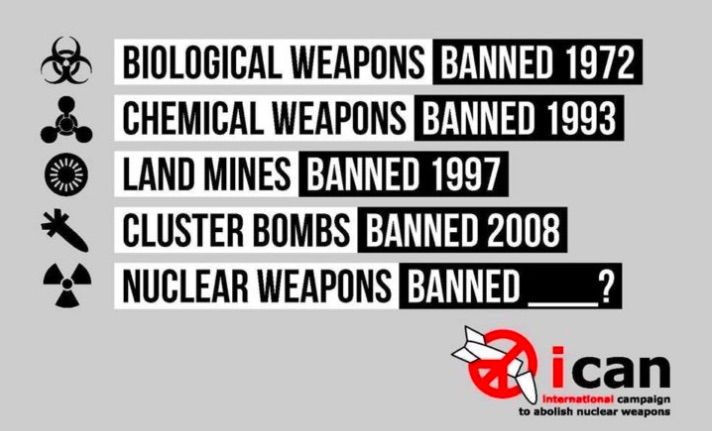
The manufactured ‘competition’ between nuclear disarmament initiatives is one of the key reasons that the nuclear disarmament movement cannot garner the political traction that has led to success in other areas – such as chemical weapons, biological weapons, cluster munitions and landmines – all of which have prohibition treaties which include (current and former) possessor States, and have been instrumental in changing policies of possessors and destroying actual weapons. If the ban treaty remains stuck in its competitive silo, then it will have next-to-no impact on the States who possess the weapons.

The High-Level Conference provides a forum which can bridge the differences and advance both the comprehensive ban treaty approach, and the incremental measures, i.e. those in which there is a possibility of being adopted by nuclear armed and allied States. Civil society should come in behind this and help make it work.

This question pertains to the following articles

Nuclear Weapon States’ Long Arm Seen Behind Deferral of Landmark UN Conference

Prague: International youth conference: Reaching High for a Nuclear-Weapon-Free World

World body of parliaments discusses nuclear-risk-reduction and disarmament

United Nations: Reaching HIGH civil society ‘virtual’ conference for nuclear disarmament proposals

Parliamentarians for Nuclear Nonproliferation and Disarmament releases Action Plan for a Nuclear-Weapon-Free World

Unfold Zero: Making Use of the New Nuclear Ban Treaty

Abolition 2000 Annual Meeting: Supports Women’s March. Calls for Nuclear Risk Reduction

UN commences nuclear abolition negotiations

Civil Society and the UN High Level Conference on Nuclear Disarmament

Banning Nukes: Divergence and Consensus at the UN Working Group on Nuclear Disarmament