Tag Archives: Mideast

Palestine’s Great March of Return: A New Defiance Campaign

TOLERANCE AND SOLIDARITY .

An article by By Iqbal Jassat for the Palestine Chronicle (the author is an Executive Member of the South Africa-based Media Review Network)

In a remarkably fresh approach in resistance to Israel’s seven decades of colonialism, Palestinians have geared up to mobilize en masse in what has been dubbed as Great March of Return.

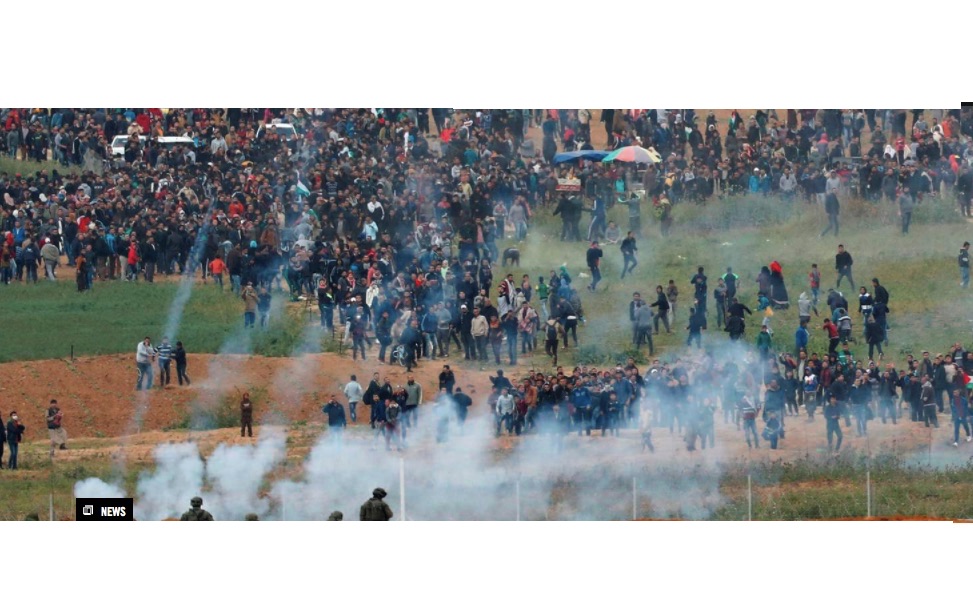
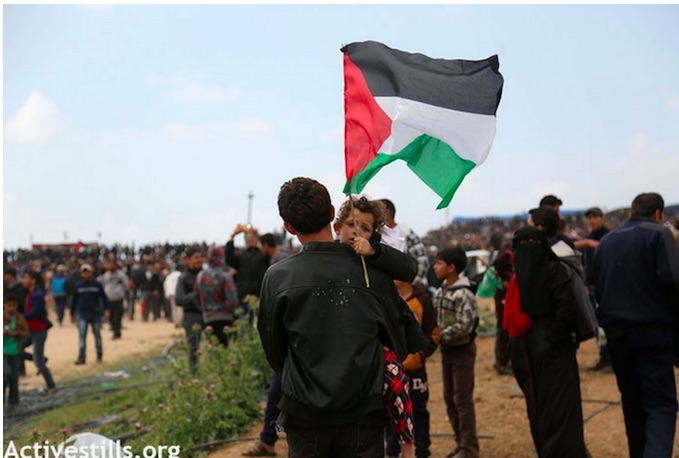
Starting Friday 30th March 2018, thousands upon thousands head towards homes and lands from which they were forcibly expelled. Victims of evictions and ethnic cleansing whose losses have never been admitted by Israel despite being acknowledged by the United Nations, have every right under International Law to reclaim the theft of their land.


Palestinians taking part in the Great March of Return. (Photo: ActiveStills.org)

Though month of March each year since 1976 has been commemorated as Land Day, this year sees it expanded in a very creative way.

The popular sentiment shared amongst Palestinians in the diaspora as indeed within the suffocating occupied territories is “Returning to our stolen lands and homes is legal under International Law and UN resolutions”.

The Great March of Return is thus an affirmation of this inalienable right guaranteed by a substantial number of international conventions.

Reports from the colonial regime reveal an aggressive and hostile military reaction is underway. Leaks from Netanyahu’s war-room point to threats to kill any and all  Palestinians who dare to approach the apartheid barriers or “fences” which bar the indigenous population from their homes and lands.

To the dismay of Israel, the Great March of Return is not planned to be a short lived one-day event. And to add to Israel’s PR nightmare, media coverage will in all likelihood revisit core issues at the heart of this March via extensive analysis and historic footage.

Expressing its displeasure at mainstream media and throwing tantrums alongside wailing and howling  – as Israel is accustomed to doing, will not assist the regime’s Hasbara (propaganda) campaigns. In fact it will be entirely counterproductive as the old Nats in apartheid’s heydays in South Africa learnt.

(Article continued in the right column)

Question for this article

Presenting the Palestinian side of the Middle East, Is it important for a culture of peace?

(Article continued from the left column)

Concealing the ugly reality of Zionism’s imposition of a foreign entity (Israel) and the consequences of the Nakba (catastrophe) which to date are eminently visible throughout the Occupied Palestinian Territories OPT, Palestine ’48 and refugee camps dotted across Lebanon, Syria, Jordan and elsewhere is not only not possible, but morally repugnant.

Equally it would be outrageous and utterly disgraceful for any media platform to ignore or downplay the enormous burden faced by Palestinians to free themselves from oppression and reclaim justice. The Great March of Return is thus a challenge to media to dislodge themselves from false Israeli narratives fed to them by highly resourced Hasbara campaigns.

It requires a return to an understanding of the enormity of losses suffered by the Palestinians at the hands of a racist colonial entity supported and facilitated by the British government a century ago. It means revisiting notorious historical details which certainly will be unflattering for those European powers who played central roles In the dispossession of Palestine.

The Great March of Return is a challenge to those in the media who’ve been cowed by intimidating threats of economic sabotage and fear being unfairly smeared as “antisemitic”, to get off their fences and jump into the fray. Robust introspection and fearless courageous reports on the reasons why Palestinians have embarked on this momentous peaceful defiance campaign should be par for the course for journalists who value integrity.

In keeping with its irrational conduct, Israel has imposed a “closure” on the Palestinian areas for the so called “Passover holidays”. In addition the settler colonial regime has enforced a “no go” zone on land adjacent to Gaza’s border.  Chief of staff of the military’s occupation forces has admitted that “more than 100 sharpshooters” primarily from elite special forces, have been deployed with permission to “open fire”.

B’Tselem, known for fearlessly challenging Israel’s violations of human rights, is justifiably concerned about threats by the regime to unleash lethal force on the demonstrators.

“Completely ignoring the humanitarian disaster in Gaza and Israel’s responsibility for it, they are couching the planned protest in terms of a security risk, framing the demonstrators as terrorists and referring to Gaza as a ‘combat zone.”

As the March unfolds, reports come through about injuries and deaths caused by the Occupation forces’ deadly weapons. As B’Tselem and other humanitarian organisations have warned, Israel’s war mongering displays blatant disregard for the sanctity of Palestinian life. Nor for any of its obligations under International Law.

The Great March of Return has the support of all the Palestinian factions – Hamas, Fatah, the PFLP and Islamic Jihad. Expected to continue until 15 May to coincide with the 70th anniversary of the Nakba, it’s demands will hopefully resonate across all corners of the world: Right of Return to their pre-1948 homes!

Eyeless in Gaza

TOLERANCE AND SOLIDARITY .

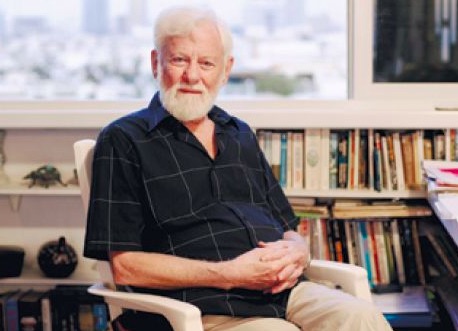
An article by Uri Avnery in Transcend.org

14 Apr 2018 – Write down: I, Uri Avnery, soldier number 44410 of the Israel army, hereby dissociate myself from the army sharpshooters who murder unarmed demonstrators along the Gaza Strip, and from their commanders, who give them the orders, up to the commander in chief.


A frame from the video of the sniper shooting a demonstrator

We don’t belong to the same army, or to the same state. We hardly belong to the same human race.

IS MY government committing “war crimes” along the border of the Gaza Strip?

I don’t know. I am not a jurist.

It seems that officials of the International Criminal Court believe that the acts of our soldiers do constitute war crimes. They demand an international investigation.

To prevent that, our army command proposes an Israeli military investigation. That is manifestly ridiculous – an army investigating itself about acts committed on direct orders of the Chief of Staff.

As was published in advance, sharpshooters were posted along the border fence and ordered to kill “ringleaders” of the unarmed protesters on the other side of the fence. The Gaza leadership had announced that these unarmed protests were to take place every week, after Friday prayers, until Naqba Day.

During the first two Fridays, 29 unarmed people were shot dead and more than a thousand wounded by sharpshooters.

For me this is not a judicial question. It is a crime, not only against the unarmed protesters. It is also a crime against the State of Israel, against the people of Israel and against the Israeli army.

Since I was a member of that army on the day of its foundation, I think that it is also a crime against my comrades and me.

THIS WEEK a short video, recorded by a soldier at the time of such an action, was widely seen in Israel [See link to video above].

It shows the action from the angle of a soldier who was obviously standing next to a sharpshooter. The sharpshooter sees the demonstrators from a distance of hundreds of yards. The hairs of his sights move at random, than settle on an individual. He shoots. The person drops on the spot.

A joyous cry “Yesh” is heard all around from unseen soldiers who have been watching. “Yesh” means “got him”, a jubilant yell, such as would accompany a hunter’s success in killing a rabbit.

Many hundreds of thousands of Israelis have seen this film by now, since it was shown for the first time on TV. Except for a few articles and letters to the editor (in Haaretz), there has been no protest.

This did not happen overseas, in some remote colony. It happened right next to us, 45 minute’s drive from my home.

The killer was not a hardened mercenary. He – and the joyous soldiers around him – were just ordinary youngsters, drafted at the age of 18 like most Jewish Israelis.

All of them were just “following orders”. (Remember?) We have not heard of one single case of a soldier refusing orders.

UNTIL TWO weeks ago, I had the highest respect for our highest officer, the Chief of Staff, Gadi Eizenkot. Surrounded by officers who are mere military technicians, he seemed an officer who, in spite of his unmilitary appearance, was well capable of upholding the dignity of the army against the punk who serves as Minister of Defense.

No more. Eizenkot has given the murderous orders. Why, for heavens sake?

(Article continued in the right column)

Question for this article

Presenting the Palestinian side of the Middle East, Is it important for a culture of peace?

(Article continued from the left column)

Like the British in India and the white racists in the US, the Israeli government does not know how to deal with unarmed protest. It has never encountered it. It does not exist in Arab tradition.

By chance this week I saw the classic movie about Mahatma Gandhi. The British tried everything – they beat him and myriads of others into pulp, they shot thousands of others. When Gandhi and his followers suffered this torment and did not hit back, the British eventually admitted defeat and went away.

So did the white racist opponents of Martin Luther King in Alabama. A Palestinian follower of his came to this country at the beginning of the occupation and tried to convince his countrymen to try this method. The Israel army opened fire, and the Palestinians reverted to the armed struggle.

Not this time. The (violent) Islamic Hamas in the Gaza Strip calls on the population to try unarmed protest, tens of thousands follow. This can lead to unforeseen results. One of them is the sharpshooters’ order to kill more or less at random.

WHEN I stated publicly that I am ashamed, a reader accused me of hypocrisy. He cited from my two books about our (1948) War of Independence, in which I had described atrocities to which I was a witness.

Sure, there were atrocities (as in every war). The perpetrators were soldiers of all ethnic and social groups. But they were denounced by some of their comrades (also of all ethnic and social groups). Most soldiers were in the middle, following the most persuasive.

Now the picture is different. Not only is the shooting of the unarmed protesters, far from the fence, done by order, but there seem to be no other voices. The military and political leadership is united. Even in civilian society, voices against the mass murder are very few.

HOW DO the Israeli media react? Well, they don’t. This momentous event in Israel’s history is almost ignored.

Fortunately for the perpetrators, there are plenty of events to take our minds off them and their actions. President Bashar al-Assad has apparently used chemical weapons against his rebels. The Israeli media are having a feast. How awful! How barbarous! How Arab!

Then there is the problem of the 36,000 “illegal” (meaning non-Jewish) African workers who have entered Israel. The government wants to throw them out. Decent Israelis very properly want to prevent this. That is a full-time job. No time for the Gaza Strip.

And there is, of course, Holocaust Memorial Day, which happens conveniently this week. One can write endlessly about this awful chapter in our history. What is Gaza compared to this horrible event?

WHAT ABOUT our media?

The sorrowful fact is that the Israeli media have reverted to what they were in the early days of the state: an instrument of the government. It took my news magazine dozens of years to break that habit. For many years we had a decent press, with some wonderful journalists and broadcasters.

No more. A few are left, but the great majority of the press is now coordinated with the regime (“gleichgeschaltet” in German). Two minutes on Gaza. 20 minutes on what’s happening in Syria. 10 minutes for the latest (imaginary) outbreak of anti-Semitism in the British Labor Party.

Most of the journalists and broadcasters, honest and well-meaning people all, are not even conscious of what they are doing (or not doing). They are innocent of any other thoughts.

WHERE IS the “Left”? Where is the so-called “Center”?

They have not disappeared, as some lament. Far from it. A shift of some percent or a move of one of the small parties would suffice to topple Binyamin Netanyahu.

But they all seem to be paralyzed. Nobody dares to speak out against the killing, apart from some faint whispers. Even the many admirable groups of youngsters who fight against the occupation, each on some special sector, are silent about the Gaza killings.

No mass demonstrations. No huge protests. Nothing.

So we, too, are to blame. And perhaps more than others.

Please write down: I am guilty!

Photos: #FreeAhedTamimi and #FreePalestine in Brussels, Berlin, Athens, Amsterdam, London, Jaipur, Manchester, Naples, Milan, Dortmund

TOLERANCE AND SOLIDARITY .

A photo essay from Samidoun, Palestinian Prisoner Solidarity Network

Dozens of organizations around the world joined a global call for actions to free Ahed Tamimi, fellow Palestinian child prisoners like Abdul-Khalik Burnat, her family members Nariman and Nour Tamimi, and all Palestinian prisoners on 22 December.


Brussels, Belgium – 22 December 2017 (Photo: Myriam De Ly)

This call coincided with the ongoing large demonstrations around the world in defense of Palestine and Jerusalem following U.S. President Donald Trump’s declaration that the U.S. is recognizing Jerusalem as the capital of Israel, and the upsurge inside Palestine against Zionism and U.S. imperialism. It was also marked by the 128-9-35 vote at the United Nations against the Trump declaration and Israeli colonialism in Jerusalem.

Protests around the world demanded freedom for the prisoners, joining the day of action, and stood with Jerusalem and Palestine. In addition to the photos below, protests also took place in Hamburg, Koblenz, Stuttgart, Gottingen, Kalmar, Brescia, Viareggio and Lodi.

Please email us at samidoun@samidoun.net or message us on Facebook to let us know about your protests to free Ahed Tamimi and Palestinian prisoners and to stand with Jerusalem and with Palestine!


New York City, US – 22 December 2017 (Photo: Bud Korotzer/Desertpeace)


Berlin, Germany – 22 December 2017 (Photo: Afif El-Ali)


London, UK – 23 December 2017 (Photo: Yaya Aurora- Facebook)

(Photos continued in the right column)

Question for this article

Presenting the Palestinian side of the Middle East, Is it important for a culture of peace?

(Photos continued from the left column)


Manchester, UK – 23 December 2017 (Photo: Mebz Malji)


Naples, Italy – 22 December 2017


Milan, Italy – 23 December 2017 (Photo: Francesco Emilio Giordano)


Dortmund, Germany – 23 December 2017 (Photo: Mahmoud Salem)


Jaipur, India – 22 December 2017 (Photo: Adv Kuldeep Vyas)


Amsterdam, Netherlands – 24 December 2017

Israel/OPT: Palestinian child activist Ahed Tamimi sentenced to 8 months in prison

. HUMAN RIGHTS .

An article from Amnesty International

The continued imprisonment of Palestinian child activist Ahed Tamimi is a flagrant attempt to intimidate those who dare challenge the circumstances of the ongoing occupation, Amnesty International said today after she was sentenced to eight months and a 5,000 shekels fine (around US$ 1,400) with a three year suspended sentence after entering into a plea deal at Ofer military court in the Israeli-occupied West Bank.

17-year-old Ahed Tamimi was accused of aggravated assault and 11 other charges after a video showing her shoving, slapping and kicking two Israeli soldiers in her home village of Nabi Saleh on 15 December 2017 went viral on Facebook.

“By sentencing Ahed to eight months in prison the Israeli authorities have confirmed yet again that they have no regard for the rights of Palestinian children, and have no intention to reverse their discriminatory policies. Under the Convention on the Rights of the Child, to which Israel is a state party, the arrest, detention or imprisonment of a child must be used only as a measure of last resort and for the shortest appropriate period of time,” said Magdalena Mughrabi, Amnesty International’s Deputy Director for the Middle East and Africa.

“Today’s sentence is another alarming example of the Israeli authorities’ contempt for their obligations to protect the basic rights of Palestinians living under their occupation, especially children. Ahed Tamimi is a minor. Nothing she did warrants her continued imprisonment and she must be released immediately.”

(Article continued in right column)

Questions related to this article:

Rights of the child, How can they be promoted and protected?

Presenting the Palestinian side of the Middle East, Is it important for a culture of peace?

(Article continued from left column)

Ahed was convicted on four of the 12 charges against her including incitement, aggravated assault and two counts of obstructing Israeli soldiers. Her mother Nariman was sentenced to eight months in prison in addition to a fine of 6,000 shekels (around US$ 1,780) and a three-year suspended sentenced for assisting in assaulting a soldier, obstructing a soldier and incitement. Ahed’s cousin, Noor Tamimi, was fined 2,000 shekels (around US$500).

“The Israeli authorities must stop responding to relatively small acts of defiance with such disproportionately harsh punishments. By ruthlessly targeting Palestinians, including children, who dare challenge Israel’s oppressive occupation, the authorities are neglecting their responsibilities under international law as an occupying force.”

Hundreds of Palestinian children are prosecuted every year through Israeli juvenile military courts. Those arrested are systematically denied their rights and subjected to ill-treatment including in some cases physical violence. There are currently approximately 350 Palestinian children in Israeli detention.

Background

Ahed Tamimi was arrested on 19 December 2017 after her mother, Nariman Tamimi, also a prominent activist, posted the footage of her altercation with Israeli soldiers online. Nariman Tamimi was arrested later that day, while Ahed’s cousin, Nour Tamimi, was arrested the following morning. Nour was released on 5 January pending trial, and was sentenced today to the time she had already spent in prison.

Ahed confronted the soldiers amid a demonstration in Nabi Saleh against US President Donald Trump’s recent decision to recognize Jerusalem as the capital of Israel.

The incident took place on the same day that one of Ahed’s other cousin, 15-year-old Mohammad Tamimi, was hit in the head at close range by a rubber bullet fired by an Israeli soldier and sustained serious injuries.

Ahed Tamimi and the Pathology of the Israeli Mind

TOLERANCE AND SOLIDARITY .

An article by Dana Visalli for Global Research

The trial of Ahed Tamimi—the sixteen year old Palestinian girl who slapped a fully-armed Israeli soldier who was standing in her front yard looking for Palestinian demonstrators to shoot—is supposed to reconvene in a few days. (Editor’s note: Her request that the trial should be public has been denied.) Israeli military courts have a 100% conviction rate, even of children. Ahed is one of several Palestinian youth who have become symbolic throughout the world for the 70-year old Palestinian struggle to regain and retain their own land and their basic rights as human beings. She has already been in prison for three months for attempting to protect her home and family from Israeli soldier-intruders. Her mother Nariman, who went to visit Ahed the day after she was taken to prison, was arrested upon her arrival and has also spent the last three months in jail. (See earlier CPNN article).

I traveled to Ahed’s village of Nabi Saleh a week ago, to learn more about problems confronting the village as Israelis appropriate their fields and water supplies for an ever-growing illegal (according to the United Nations) Israeli settlement nearby, and in hopes of meeting Ahed’s father Bassem and her cousin Janna Jihad Ayyad. Upon arrival no one was home so I took a seat on the front porch. Soon various people were coming and going, and one of them told me Bassem was away, but that Janna was around. We phoned her and she showed up a few minutes later.

Janna is a precocious eleven year-old who speaks English fluently and has been filming and reporting on the abuses of her people by the Israelis since she was seven. The deaths of two men in her village—her cousin, Mustafa Tamimi, and another uncle, Rushdie Tamimi—served as a trigger for her to begin documenting what was happening in Nabi Saleh. Mustafa was killed by an Israeli gas canister and Rushdie was fatally shot in his groin.

She has risked her own safety many times to document Israeli behavior in Palestine, which over the last 70 years includes driving a million Palestinians off of their land and from their homes, and appropriating for themselves the vast majority of what prior to 1947-48 had been the Palestinian homeland. To some degree she has an advantage over adult reporters, because as she puts it, “The soldiers catch the big journalists and take their cameras….The camera is stronger than the gun. I can send my message to many people, and they can send it to others.”

At this point she has a Facebook page with 280,000 followers and her own Youtube channel, well worth visiting. Children in Palestine are forced to grow up early and fast. Janna’s uncle Bilal explained, “We must teach our children not to accept humiliation and not be cowards. We are under occupation. We cannot teach our children silence; they must fight for their freedom.”

On the day I visited our conversation took a different direction. After briefly talking about life under occupation and how much she missed her best friend Ahed, I showed her a book I had brought with me, Wildflowers of the Mediterranean. She was quickly transformed from a serious journalist reporting on the disaster that has befallen her people into an animated, enthusiastic student of the natural world. She dashed around Ahed’s yard, bringing in the many spring blooms, searching in the book for the ones she did not recognize, and pointing out the ones she already knew.

(Article continued in the right column)

Question for this article

Presenting the Palestinian side of the Middle East, Is it important for a culture of peace?

(Article continued from the left column)

At one point she stood in the very spot in the entryway to the Tamimi household (see image on the right) where Ahed had confronted the Israeli soldiers three months before. Where Ahed had found young Israeli men armed with machine guns bent of perpetuating violence against Palestinians on Palestinian land, Janna was for that moment immersed in the beauty of the good earth. The contrast could not have been more stark. Foreigners arriving with guns and bombs are resisted. Arriving with peaceful intentions one is met with a cup of tea.

I spent two hours with Janna, wandering the hills above the village, identifying flowers and enjoying the impressive limestone geology. The ground everywhere is littered with tear gas canisters, spent concussion grenades and smoke bombs. The Israelis have been harassing the people of Nabi Saleh for 70 years, plenty of time for the spent ammunition to form windrows among the fields of flowers.

The cruelty exhibited by the Israelis in their hungering to imprison the young Ahed Tamimi, whose only wish was to protect her people and her home from intruders and whose only weapon was a mere slap—the inherent cruelty of those hungering to put her in a prison cell for years, or even forever, with some government officials calling for rape and further darker abuse—this display of pathological cruelty by an entire society has people throughout the world wondering what curse has befallen the people of Israel.

One possible answer is that they are obsessed with the hallucination that they are somehow a ‘chosen people,’ that they are somehow better than the rest of humanity, even that they are the preferred favorites of some mythological god. As prime minister Menachem Begin exulted after the Zionist slaughter of Palestinians at the village of Deir Yassin prior to the 1948 war, “God, God, Thou has chosen us for conquest.” According to the Israel Democracy Institute, approximately two thirds of Israeli Jews believe that Jews are the “chosen people”.

This sense of superiority over others is in fact a common human trait, mixed though it always is with a countervailing feeling of inferiority and fear. Albert Einstein in the wisdom of his old age addressed this pathology when he observed, “A human being experiences himself, his thoughts and feelings as something separate from the rest, a kind of optical delusion of his consciousness. The delusion is a kind of prison for us, restricting us to our personal desires and to affection for a few persons nearest to us.”

The obvious deeper truth made clear in our time through scientific inquiry is that all humans have the same long, deep and difficult history. All humans evolved together in Africa for 200,000 years before any left that continent. All human beings share 99.9% the exact same genetic code and 99.9% the same long, traumatic evolutionary journey.

The human family faces pressing ecological challenges at this particular locus along the course of our Big History, shared by all people, such as, for example, overshoot of the human population and diminution of the richness, beauty and diversity life on earth. None of our challenges are mitigated or even addressed by the mythologies spun by the human mind over the course of our our short-term, 3000-year Little History. Those working for a viable future for all of people and for the biosphere as a whole look forward to the Zionists and the Jews and all Israelis maturing out of their mythological hallucination of separateness and rejoining the family of humanity and the community of life on the journey towards a viable future.

The author, Dana Visalli, is an ecologist living in Washington State. He is currently volunteering in Palestine for a month. He can be reached at jdanavisalli@gmail.com, www.methownaturalist.com

14th Annual Israeli Apartheid Weeks of actions

DISARMAMENT & SECURITY .

Information from Apartheid Week website and twitter page

The 14th Annual Israeli Apartheid Weeks of actions will take place all around the world in March and April. Israeli Apartheid Week (IAW) is an international series of events that seek to raise awareness of Israel’s apartheid system over the Palestinian people and to build support for the growing Boycott, Divestment and Sanctions (BDS) movement.

A report released earlier this year by the United Nations Economic and Social Commission for Western Asia (ESCWA) proves beyond doubt that Israel has imposed a system of apartheid on the entire Palestinian people and calls for BDS measures to end Israel’s apartheid regime.

Inspired by the popular resistance across historic Palestine and struggles worldwide, IAW 2017 included a wide range of events from lectures, film screenings, cultural performances, and BDS actions, to postering in metro stations, setting up apartheid walls on campuses, and many more. These actions took place in more than 200 cities across the world.

The coming year (2018) will mark 70 years of Palestinian popular resistance against the ongoing process of dispossession and ethnic cleansing, since the 1948 Nakba.The Palestinian people’s resistance against colonization has in fact been longer than that. From the Balfour Declaration of 1917 to the present moment- Palestinians have fought for their dignity, their rights, and their lands. IAW is an opportunity to reflect on this resistance and further advance BDS campaigns for the continued growth and impact of the movement. Despite Israel’s legal and propaganda war on BDS internationally, IAW and the BDS movement continue to build linkages and solidarity with other struggles to achieve freedom, justice, and equality.

(continued in right column)

Question related to this article:

Presenting the Palestinian side of the Middle East, Is it important for a culture of peace?

Israel/Palestine, is the situation like South Africa?

(continued from left column)

If you would like to organize and be part of Israeli Apartheid Week on your campus or in your city, check out what events are already planned at apartheidweek.org, find us on Facebook and Twitter, register online http://apartheidweek.org/organise/ and get in touch with IAW coordinators in your region. For more information and support, please contact iawinfo@apartheidweek.org.

Ireland Palestine Solidarity Campaign (IPSC) 

To close #IsraeliApartheidWeek 2018, the IPSC held actions highlighting Helwett-Packard’s (HP) profiteering from Israel’s occupation and illegal colonisation of #Palestine.

In #Omagh and #Ennis we hosted information and petition collecting stalls, in #Dublin we staged a ‘mock checkpoint’ on Dublin’s busiest shopping street to give people an insight into the daily fear and humiliation faced by Palestinians living under Israel’s occupation, and in #Derry we brought the noise to the city’s famous walls.

Now we’re asking YOU to sign the pledge to boycott HP products, to refuse to buy their good in the future until they stop helping Israel oppress and colonise Palestine. Sign the #BoycottHP Pledge here: http://www.ipsc.ie/hp

Kenya na Palestine

#IsraeliApartheidWeek kicks off next Monday, March 12th with a great line-up of Palestinian films & discussions taking place across Nairobi, over the entire month. First stop Mathare!

Israeli Apartheid Week – Kingston, Ontario

Events beginning today [March 12] hosted by @SPHRQU in Kingston #Ontario, including a poetry night exploring parallels between Turtle Island and Palestine with @EricaVioletLee #IsraeliApartheidWeek

(Thank you to Janet Hudgins, the CPNN reporter for this article.)

International Women’s Day Celebration and Launching Ceremony of the “Libya for Peace” Campaign, 8 March 2018

. WOMEN’S EQUALITY .

Announcements from CNBC Africa and UNSMIL twitter

The “Libya for Peace” Campaign was launched on International Women’s Day held in cooperation with the General Authority for Culture and the support of the United Nations.


GhassanSalame addressing the launch of ‘#Libya for #Peace Campaign (photo from UNSMIL twitter)
.

(Article continued in the right column)

Question for this article

Do women have a special role to play in the peace movement?

(Article continued from the left column)

“Libya for Peace” Campaign aims at promoting a culture of peace and peaceful coexistence and highlighting the role of women in peacemaking.

This Campaign was initiated by a group of Libyan women after a series of meetings and conferences that resulted in the nomination of seven women from different regions of Libya as coordinators of the campaign.

This inaugural ceremony is the first of several activities to highlight the general plan of the “Libya for Peace” Campaign and the Women’s Peace Document that emerged from the Libyan Women’s Peace Conference held in Montreux, Switzerland, in September 2015.

Opening Remarks:

•       Coordinators of the “Libya for Peace” Campaign

•       Dr. Hassan Ewneis, Director of the General Authority for Culture

•       Dr. Asma Alosta, Minister of State for Women Affairs and Social Development

•       Dr. Ghassan Salamé, Special Representative of the Secretary-General in Libya.
Distributed by APO Group on behalf of United Nations Support Mission in Libya (UNSMIL).

Adyan Foundation in Lebanon to Get 35th Niwano Peace Prize

EDUCATION FOR PEACE .

A press release from the PR News Wire

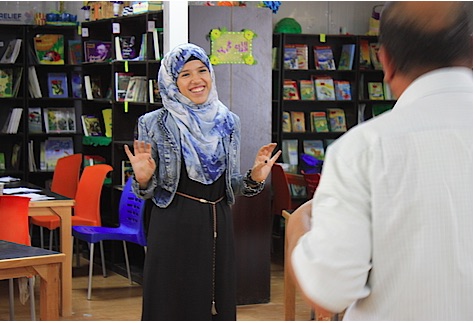
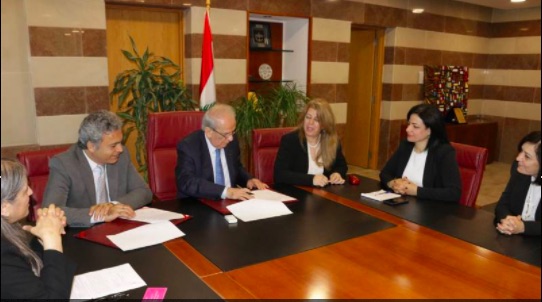
The Niwano Peace Foundation will award the 35th Niwano Peace Prize to the Adyan Foundation in Lebanon in recognition of its continued service to global peace-building, notably its development of a program for children and educators offering guidance to peace and reconciliation for those affected by the Syrian war.


caption:Photo from Asia News

An award presentation ceremony will take place in Tokyo on May 9 at 10:30 a.m. In addition to an award certificate, the foundation will receive a medal and a cash prize of 20 million yen.

In 2013, Adyan responded to the Syrian crisis by offering interfaith mediation dialogue and peace education to vulnerable Syrian citizens both in Lebanon and Syria. In 2016, Adyan started intensive work in Iraq to build the capacities of journalists and civil society activists in spreading the values of inclusive citizenship and inter-religious solidarity, and healing the society from its ISIS traumatism. 

In selecting Adyan as a recipient for 2018, the Niwano Peace Prize Committee said the foundation has been “a visible and committed actor for peace” in Lebanon and elsewhere in the Middle East region, focusing on both high-level and grassroots engagement, “demonstrating the inclusive and interfaith values/principles the Niwano Award seeks to recognize.”

Niwano Peace Prize: 


The Niwano Peace Foundation established the Niwano Peace Prize to honor and encourage individuals and organizations that have contributed significantly to inter-religious cooperation, thereby furthering the cause of world peace, and to make their achievements known as widely as possible. The foundation hopes in this way both to enhance inter-religious understanding and cooperation and to encourage the emergence of still more persons devoted to working for world peace. The prize is named in honor of the founder and first president of the lay Buddhist organization Rissho Kosei-kai, Nikkyo Niwano.

Urging Peace Talks, Open Letter From Taliban Asks American People to Recognize Total Failure of 16-Year War

DISARMAMENT & SECURITY .

An article by Andrea Germanos, staff writer, in Common Dreams (reprinted under terms of a Creative Commons Attribution-Share Alike 3.0 License)

Two and half weeks after President Donald Trump rejected  the idea of peace talks with Taliban, the militant group published an open letter to the American people urging them to pressure their government to end the occupation of Afghanistan, now in its 17th year, and engage in peace talks.


Children play inside the remains of an old Soviet hotel where they have been living for the past two years, on July 15, 2017 in Rodat District, Afghanistan. (Photo: Andrew Renneisen/Getty Images)

The letter, published on the group’s website, denounces the Bush administration’s justification for launching the invasion, as well as the Trump administration, which “again ordered the perpetuation of the same illegitimate occupation and war against the Afghan people.”

“No matter what title or justification is presented by your undiscerning authorities for the war in Afghanistan, the reality is that tens of thousands of helpless Afghans including women and children were martyred by your forces, hundreds of thousands were injured and thousands more were incarcerated in Guantanamo, Bagram, and various other secret jails and treated in such a humiliating way that has not only brought shame upon humanity but is also a violation of all claims of American culture and civilization,” the letter states.

(article continued in right column)

Question related to this article:

Is peace possible in Afghanistan?

(article continued from left column)

It goes on to illustrate in numerous ways how the occupation has failed. For example, “3546 American and foreign soldiers have been killed,” it states, and “this war has cost you trillions of dollars thus making it one of the bloodiest, longest and costliest war in the contemporary history of your country.”

It also references United Nations statistics finding that there was an 87 percent increase in drug production in Afghanistan in 2017 and, despite the uptick in airstrikes, the U.S. watchdog the Special Inspector General for Afghanistan Reconstruction (SIGAR) acknowledged that the Taliban is gaining, not losing territory.

Further, “tens of billions of dollars” in taxpayer money have been spent on various reconstruction projects, but the money “has been distributed among thieves and murderers,” the letter states. Through the occupation, “the Americans have merely paved the way for anarchy in the country,” referring to the rise in other militant groups.

“If you want peaceful dialogue with the Afghans specifically, and with the world generally, then make your president and the war-mongering congressmen and Pentagon officials understand this reality and compel them to adopt a rational policy towards Afghanistan,” the letter states.

Ongoing failure for U.S. troops is ensured, the group argues. “If the policy of using force is exercised for a hundred more years and a hundred new strategies are adopted, the outcome of all of these will be the same as you have observed over the last six months following the initiation of Trump’s new strategy.”

“Our preference is to solve the Afghan issue through peaceful dialogues. America must end her occupation and must accept all our legitimate rights including the right to form a government consistent with the beliefs of our people,” the group says.

The thrust of the message echoes what many peace groups have said—Trump is continuing  the failed strategies of his predecessors, and there is no military solution to the conflict in Afghanistan. 

The letter comes a day after U.S. intelligence agencies predicted  (pdf) that the “overall situation in Afghanistan probably will deteriorate modestly this year in the face of persistent political instability, sustained attacks by the Taliban-led insurgency, unsteady Afghan Nationa l Security Forces (ANSF) performance, and chronic financial shortfalls.”

Going the Distance for Peace: South Sudanese Educators and Policy Makers Focus on Youth by Training Secondary-School Teachers

… EDUCATION FOR PEACE …

An article from Relief Web

The majority of the population in South Sudan is under thirty years of age. However, ongoing conflict, high unemployment and lack of consistent access to education risks leaving the generation of youth without the skills to politically, economically, and socially grow the world’s newest nation. Peace and the stability it provides are paramount in South Sudan.

As one way of developing peace-builders and peaceful societies in South Sudan, the Ministry of General Education and Instruction (MoGEI) with the UNESCO Juba Office and UNESCO-International Institute for Capacity Building in Africa (IICBA), hosted a Training of Trainers (ToTs) on Transformative Pedagogy for Peace-Building. From 23-26 January 2018, 24 MoGEI staff and trainers of secondary-school teachers from selected Institutions such as Rombur Teacher Training Institution, Juba Teachers Training Center, Yei TTC, Loka National Secondary School, Malakal Elshabia Secondary School, just to mention a few, participated in the workshop. This ToT is a key element of UNESCO-IICBA’s Teacher Training for Peace-Building in the Horn of Africa and Surrounding Countries project, supported by the Government of Japan.

The overall goal of the project is to train 6,000 secondary-school teachers in South Sudan, Ethiopia, Kenya, Somalia, and Uganda and Eritrea through a Training of Trainers (ToTs) model. By training teachers, the project invests in youth, offering them skills that will help them to become peace-loving and economically and socially productive citizens.

Those trained in Juba, South Sudan will go on to train pre and in-service secondary school teachers to meet the country’s goal of training 1,000 secondary-school teachers.
At the opening ceremony, His Excellency Seiji OKADA, Ambassador Extraordinary and Plenipotentiary of Japan to South Sudan; Abdullahi Ali, Acting Undersecretary of Ministry of General Education and Instruction; Umar Alam, Head of Office of UNESCO Juba office and Yumiko Yokozeki, Director of UNESCO-International Institute for Capacity Building in Africa (IICBA) provided welcoming remarks. Mr. Umar Alam stated that UNESCO is advocating for giving utmost priority to the peace education initiative in South Sudan, and thanked the Government of Japan and MoGEI for their support. Dr. Yokozeki shared that IICBA is keen to know the needs of the teachers in the continent and believes that teachers carry the key to quality education.

Since 2016, with the support of Japan, IICBA has been working on peace and resilience building, one of the most important issues in South Sudan and the world. IICBA has also spearheaded Prevention of Violent Extremism (PVE) through education in Africa with two multi-country PVE training workshops in Addis Ababa and Dakar in 2017. Ambassador Okada spoke about the important role of teachers in peaceful societies. His Excellency noted that Japan development was a result of investing in people and education. The Honourable Dr. Nadia Arop Dudi, Minister of Youth, Culture and Sports, officially opened the workshop by strongly emphasizing the role of gender in peace education access.

During the weeklong workshop, participants were engaged in dynamic activities designed for teaching peace-building through Transformative Pedagogy. This unique method relies on active participation and deep reflection. It encourages youth to become social entrepreneurs and design community projects to reduce root causes of conflict. Sarah Charles Hakim, a tutor at Rombur National Teacher Training Institute shared that she ‘benefited greatly from the workshop and is eager to implement it in her institution.’

(Article continued in right column)

Question for this article:

What is the relation between peace and education?

(Article continued from left column)

Another participant, Angelo Gume felt that ‘peace-building education is needed in South Sudan to teach youth the skills of critical thinking, active listening, mediation and negotiation so that they can be peace-builders. There is a long way to go, but together teachers, youth, families and communities can create a peaceful society.’ In fact, South Sudanese educators have already gone the distance to learn for other countries experiences in implementing peace education.

As a key activity of the project, from 2-9 August 2017, Ms. Doru Joyce Ladu, a secondary school teacher in Juba joined Mr. Babu Emmanuel Ezibon, Senior Inspector in the Planning Department and Mr. Victor Dut Chol, Director for Research and Policy Documentation both from MoGEI, were part of the 18 policy makers, teacher trainers, and secondary school teachers from the six participating countries who travelled to Japan for training in Tokyo and Hiroshima.

The study tour participants also had the honour to be invited to the Peace Ceremony on 6 August 2017 in Hiroshima. The Japan study tour bridged cultures, histories, and educational experiences between the six African countries and Japan and provided opportunities to share experiences on teaching and peace-building among educators and policy makers.

At the closing ceremony for the workshop, Mr. Takanobu, who represented the Ambassador of Japan in South Sudan, was pleased to hear about the project’s study tour to Japan. He stated that the trainers were like ‘seeds who will generate peace-builders who will also go on to develop additional peace-builders.’ The Honorable Deng Deng Hoc Hai, the Minister of General Education and Instruction, officially closed the workshop by sharing that the new South Sudan National Curriculum had the four objectives of developing good citizens, life-long learners, and creative problem solvers, who were also environmentally responsible persons.

The ministry has a new mandate to have peace-clubs at every school beginning in February 2018. The Honourable minister shared that ‘the right to education is as important as the right to life; education impacts the quality of one’s life and it is the foundation for reaching all the other 2030 Sustainable Development Goals (SDGs).’ He indicated that the teacher trainers had a great deal of work ahead of them but that they were now well-prepared for the task. The honourable minister thanked the Government of Japan for supporting this training and project.

South Sudan has also been instrumental in other project activities, including the development of teacher guides and participating in the training of trainers from 4-8 September 2017. In March 2018, educators, MoGEI, NGOs, youth and UNESCO will also hold a policy dialogue to discuss how to make the project sustainable.

This UNESCO-IICBA initiative comes at a crucial time as conflicts, disorder, and natural disasters are severely impeding global and regional efforts to improve access to quality education while exacerbating violence and radicalizing youth.

With 42% of its population of 12.2 million under the age of 15, lessons learned from this trip have the potential for great impact of future South Sudanese generations.

Project goals and activities are aligned with Goal 4 and Goal 16 of the 2030 Sustainable Development Goals (SDGs) and the AU’s Agenda 2063. To quote Dr. Yumiko Yokozeki, Director of UNESCO-IICBA, “More young people are enrolled in school in Africa. Therefore, a teacher’s role must be emphasized in promoting peaceful cultures amongst the youth.”

(Thank you to the Global Campaign for Peace Education for calliing this article to our attention.)