. . WOMEN’S EQUALITY . .
An article on November 5 by Kimberly Hart from the Georgetown Institute for Women, Peace and Security
Last week, the UN hosted its annual debate on Women, Peace and Security (WPS). Here are our top five takeaways.
1. International commitment to WPS remains strong, but the gap between commitment and meaningful implementation of the agenda is widening.
Many nations affirmed the importance of the WPS agenda. As the president of the Security Council, Greece gave a particularly strong statement, noting that “as the toll of conflict on women continues to mount, as respect for their human rights erodes in many parts of the world, and as emerging technologies, including artificial intelligence, pose new risks to their participation in public and political life, we must redouble our efforts to make the implementation of the WPS agenda a reality for all women and girls.”
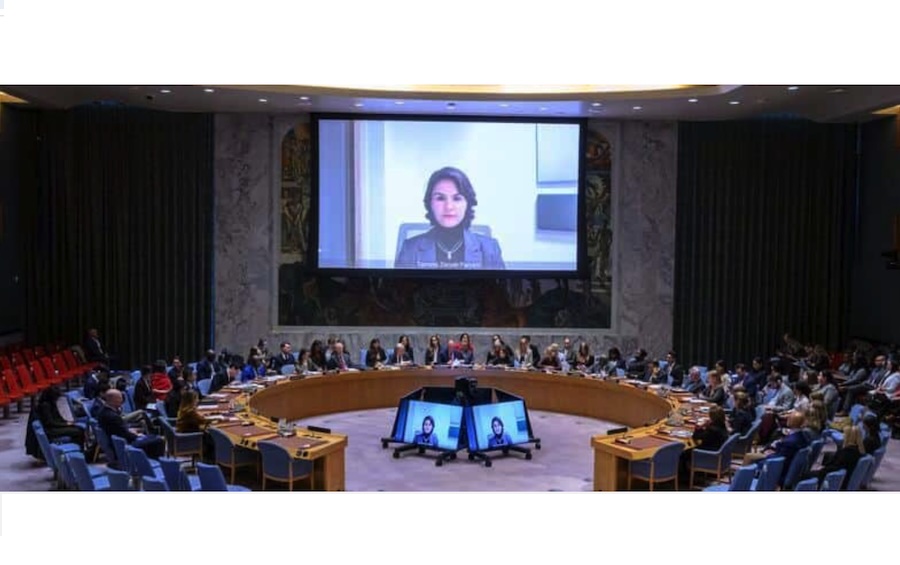
Photo of testimony by Afghan human rights activist Tamanna Zaryab Pariani on website of Working Group on Women Peace and Security
Indonesia’s representative noted: “For Indonesia, advancing the WPS agenda is not simply a policy choice; it is a strategic necessity to our contribution toward a more peaceful world.”
The African Union representative stated that peace “is measured not by the silence of guns, but by the dignity of communities.”
Even the United States said: “Consistent with the Women, Peace, and Security Act, which President Trump signed into law in 2017, [it] will continue to prioritize these issues in line with the objectives of UNSCR 1325.”
However, as Secretary-General Guterres noted in his opening remarks, “let’s face facts: too often, [the WPS agenda] has resulted in a lot of talk and not enough action. Despite the conferences, meetings, reports, and resolutions over the last few decades, the plague of gender inequality persists. And it persists when women are absent from negotiating tables. It persists when women peacebuilders are underfunded or not funded at all. And for women and girls caught within the hell of conflict, gender inequality reveals itself in horrific acts of violence, including sexual violence.” His annual report points to significant increases in the number of women and girls dying in conflict, women’s proximity to conflict, documented cases of conflict-related sexual violence, maternal mortality rates in conflict zones, and bombings of civilians in densely populated areas, among others.
UN Women Deputy Executive Director Nyaradzayi Gumbonzvanda emphasized that the low number of women mediators has declined even further, and “it is indefensible that nearly 80% of active negotiations last year took place without a single woman at the table.” She noted, “None, not one, of the 13 ceasefire agreements reached in 2025 included substantive references to women and girls. Not one prohibited sexual violence.” Indonesia’s representative made it clear: “Never in history has the women, peace and security agenda enjoyed such broad political support. And yet never has the gap between commitment and implementation appeared so stark.”
Despite all of this, women continue to do the work—often at great risk—and lead peace and security efforts around the world.
The strongest statement came from Afghan human rights activist Tamanna Zaryab Pariani.
“I continue to speak out because remaining silent is not an option. Especially for women in Afghanistan, speaking out is not easy. It means challenging systems designed to silence you. It means risking your freedom, your safety, and sometimes your life,” she said. “To those of you who believe you have no power to change the situation of women in Afghanistan, I ask you to remember my story. The Taliban have shot at me and my fellow protesters. We have been whipped, gassed, and beaten. And we have picked ourselves up and come back the next day to protest the Taliban’s cruel policies. That is because we know that rights are won through struggle. We know that we are the resistance to repression. Freedom is never guaranteed; it is won, and we will not stop until we win justice and equality for all women.”
(Article continues in right column.)
UN Resolution 1325, does it make a difference?
Does the UN advance equality for women?
(Article continued from left column.)
2. Technology intersects with the WPS agenda.
Delegates repeatedly cited technology during the debate. The representative of the Republic of Korea stated: “Protection must keep pace with technology. Women leaders, peacebuilders, and human rights defenders are increasingly targeted by technology-facilitated violence, from coordinated smear campaigns to sexually explicit deepfakes. We have been working to ensure that new technologies empower rather than endanger women.”
The representative from Greece noted: “The implementation of the WPS agenda over the next quarter century coincides with the era of digital revolution. Our shared responsibility is to ensure that all women and girls are equipped with the necessary tools to navigate these new challenges, that they are adequately protected, and that they are meaningfully included in all decision-making processes concerning their future and the future of the world.”
Kuwait noted: “As technology is advancing, we have to harness digital tools to ensure the participation of women in society and to build their capacities.”
3. Funding is an urgent and critical need.
Guterres highlighted, “At every step, funding reductions are making matters worse. While global military expenditure skyrocketed to almost 2.9 trillion US dollars last year, foreign aid continues to plummet. This political and financial retreat has real-life consequences: from the closure of clinics and safe spaces for women and girls; to reductions in UN peacekeeping and political missions, including gender and women protection advisers; to the loss of vital humanitarian support for women and girls; to life-saving women’s organizations being forced to cease operations due to lack of resources.”
Liberia’s representative stated: “Women-led organizations need predictable funding that preserves their independence. We cannot depend on their work while leaving their survival to uncertainty.”
The Special Envoy on WPS to the African Union added, “Women cannot be asked to be the peace on just goodwill. We need gender responsive budgeting and direct, flexible funding for African women-led organizations and all others around the world.”
4. Real political will is essential to the success of this agenda.
Panama’s representative noted, “The challenge of the next 25 years is also to transform decisions, resources, and structures that determine who participates in peacebuilding. The proof of our political will will be concrete and verifiable.”
Liberia’s representative stated, “We must ask whether our peace processes give greater political weight to those who can renew violence than to those working to prevent it. Mediation must engage those capable of sustaining peace. Women must help shape decisions about security, justice, public resources, and political authority.”
Brazil added, “The next quarter century of the WPS agenda must be defined not by new promises and commitments, but by their implementation; protecting women’s rights, upholding international law, and building lasting peace are mutually reinforcing responsibilities.”
5. Action is needed on women’s inclusion in peace processes, funding for women’s organizations, and an end to impunity for crimes against women.
UN Women said it well: “I join the Secretary-General in calling for action on three core priorities he has brought before this Council year after year, and even today.
First, ensure that any peace process supported by Member States meets the minimum one-third target for women’s participation. I urge all signatories to the Secretary-General’s common pledge to meet this minimum and to aspire to parity.
Second, earmark at least 15% of official development assistance to conflict-affected countries, specifically to advancing gender equality, including at least 1% for women’s organizations. I applaud all donors who are already doing this, and I call on all those who have not yet done so to follow their example.
Third, end impunity for crimes against women and girls. Sanction and hold accountable those responsible for the killing, rape, sexual and gender-based violence, and gender persecution against women and girls. Protect women peacebuilders, human rights defenders, and humanitarian workers from attacks and reprisals, uphold international law and apply this Council’s Women, Peace and Security framework consistently.”
– – – – – –
If you wish to make a comment on this article, you may write to coordinator@cpnn-world.org with the title “Comment on (name of article)” and we will put your comment on line. Because of the flood of spam, we have discontinued the direct application of comments.