To Hell and Back: How Rwanda’s Women Helped It Become a World Leader

. WOMEN’S EQUALITY .

An article by Shaya Tayefe Mohajer, Takepart (reprinted by permission)

The Swiss may be known for their mastery of clocks, perfecting fine chocolates, and running trains on time—but when it comes to running an efficient government, Rwanda has them beat. The small, landlocked Central African nation has topped the Swiss by two ranks to come in seventh in the world in government efficiency, according to the World Economic Forum. The U.S. doesn’t even make the top 10.

rwandaRwandan women react during the constitutional amendment debate in parliament in Kigali on July 14. (Photo: Cyril Ndegeya/Getty Images)

Through a rigorous look at dozens of factors, the nonprofit global organization credits Rwanda’s low level of waste in government spending and a factor called labor market efficiency for the country’s overall high ranking—noting that the nation of 10.6 million has seen dramatic improvements in economic life: A GDP that hovered at around $200 per capita in 2000 rose to nearly $700 in 2013. 

Something perhaps even more remarkable about Rwanda is buried in these stats: It ranks third out of the 144 countries scored for the ratio of women in the labor force. For every man working in Rwanda, 1.02 women are employed. To boot, Rwanda is also the only country on Earth where more women than men serve as elected officials. 

In part, that’s because the country created a constitutional quota in 2005 that women must make up at least 30 percent of leadership in decision-making organs. That means women compose about 64 percent of the nation’s lower parliament and 38 percent of its senate. By comparison, the U.S. has never elected a Congress that’s more than 20 percent women.

When President Barack Obama was in Kenya on a state visit last weekend, he gave a speech extolling the virtues of letting women lead.

“Any nation that fails to educate its girls or employ its women and allowing them to maximize their potential is doomed to fall behind in a global economy,” Obama told the audience.

Rwanda may be the best proof of just how right he is.

(Article continued in right column.)

Question for this article:

Can the women of Africa lead the continent to peace?

(Article continued from the left column.)

There’s a less uplifting reason, however, for the droves of women working and leading in Rwanda. They are a reflection of a de facto population—namely, those who survived the 1994 genocide. During several bloody months, Hutus laid waste to Tutsis, and nearly a million people were slaughtered, including the systematic and targeted killing of those who were educated, those who were leaders—those who were crucial parts of the social fabric. The bloodshed left behind a population that was 70 percent women and a country that was in desperate need of functional leadership at every level. 

By now, the male-female ratio has mostly evened out. Yet, the mark left by the genocide is as indelible as it is invisible, in many ways, according to Azeb Tadesse, the deputy director for the African Studies Center at the University of California, Los Angeles. Tadesse has visited Rwanda a number of times, spending most of her time in the capital city of Kigali—which she describes as a clean and modern place—as the U.S. director for the Women’s Leadership Project, a global effort to improve gender equality for women through advanced education and improved access.

The genocide doesn’t come up explicitly in conversation, but it’s an unspoken part of the national psyche. 

“I think when you go through such a traumatic experience as a society, you start questioning everything. And maybe one of the things is, ‘Has it really done us much good to keep women out of the leadership and the professional life of the nation?’ ” Tadesse said in an interview with TakePart. 

Rwanda’s rare moment of reckoning has, in some way, helped lead to a remarkable 20-year transformation since the genocide—something Tadesse attributes, in part, to the broad-minded conversation about how to move forward and shape a national identity that goes beyond inclusion for Hutus and Tutsis and also looks at men and women as equals. 

“Something that you would notice if you’re working in Rwanda is the number of female colleagues you will have at the different levels,” said Tadesse. “Not to say it has surprised me—but it is something to take note of.”

Rwanda’s authoritarian leadership, headed by President Paul Kagame, may also claim credit for the order and high efficiency ranking of the country. Though he counts among his fans globe-trotting philanthropists from Bill Clinton to Bill Gates, Kagame has been called a strongman. Still, he’s credited for rebuilding the broken country after the genocide. Perhaps it takes a very strong man to advocate for such a powerful female presence. 

Kagame isn’t alone in drawing criticism as far as human rights go. The countries that top the World Economic Forum’s list of most efficient nations are a mixed bag. Leaders in top-ranked Qatar have faced criticism for treatment of low-paid migrant workers since their successful bid to host the 2022 FIFA World Cup, and there is some domestic dissent over free expression. Singapore may rate highly for efficiency, but caning and corporal punishment are still common there.

Neither enjoys the stats that Rwanda does when it comes to the rights and inclusion of half the population—women.

(Thank you to Janet Hudgins, the CPNN reporter for this article.)

Morocco: World Summit for the promotion of peace

FREE FLOW OF INFORMATION

An article by Driss Lyakoubi, Le Matin (translation by CPNN)

No caption

The youth of Kenitra are mobilizig to promote the values ​​of peace and solidarity between peoples, through the World Summit for the promotion of peace and social development, organized by the Ibn Tufail University in partnership with the wilaya of Gharb Chrarda Beni Hssen and the association “Dar Lakbira “.

maroc

This event brings together nearly 120 participants from 32 nationalities from around the world. It is an opportunity for reflection and exchange between young international leaders on topics related to the values ​​of humanism and solidarity. According to its initiators, the World Summit for the promotion of peace and social development is a unique event, designed to broaden the perspectives of international youth on the most pressing issues of the world through positive dialogue, cooperative and constructive.

This is a vision shared by Zineb El Adaoui, the Wali (governor) of the region of Gharb Chrarda Beni Hssen, who reminds us of the supreme interest granted by the Kingdom to the universal values ​​of peace, tolerance, dialogue and solidarité. Azzeddine Midaoui, president of the University Ibn Tofail, paid tribute to the young academic leaders of the association “Dar Lekbira” for the work that led to the organization of this unique gathering in the capital of Gharb. He commended, in this regard, the ties of cooperation that link the university Ibn Tofail and “Dar Lekbira” to promote the values ​​of social solidarity and openness. He highlighted the role of the University in anchoring the values ​​of peace and otherness among youth.

The president of the association “Dar Lekbira” Zinelabidine Taoussi, for his part, said that Moroccan youth had followed the footsteps of his ancestors, that of the consecration of peace and development for the benefit of all countries and peoples of the planet. It should be noted that the World Summit for the promotion of peace and social development, as has been announced by the various stakeholders, is the ideal opportunity for participants to explore cooperation opportunities for project initiation promoting innovative culture of peace, non-violence and social justice in their respective countries and around the world. A charter of principles will also be developed during this global youth forum to strengthen the ideals of peace and social justice within and among all nations and peoples of the world. This reflected the common vision of all summit participants from the world they hope for future generations.

The World Summit for the promotion of peace and social development has set as its main objectives the promotion of the culture of peace and nonviolence in international youth and strengthening youth culture of leadership in areas related to the building of peace and social development. There is also question of strengthening the role of youth in building inclusive societies, peaceful and resilient and the establishment of an international network of young leaders with the ability to serve their communities through innovative community projects.

(Click here for the original French version of this article) )

Question for this article:

Maroc: Un Sommet mondial pour la promotion de la paix

LIBERTÉ DE L’INFORMATION

Un article de Driss Lyakoubi, LE MATIN

Les jeunes de Kénitra se mobilisent pour le rayonnement des valeurs de paix et de solidarité entre les peuples, à travers le Sommet mondial pour la promotion de la paix et du développement social, organisé par l’Université Ibn Tofaïl en partenariat avec la wilaya du Gharb Chrarda Beni Hssen et l’Association «Dar Lakbira». Cette manifestation regroupe près de 120 participants de 32 nationalités venus des quatre coins du monde. Elle constitue une occasion de réflexion et d’échange entre de jeunes leaders internationaux autour de sujets relatifs aux valeurs d’humanisme et de solidarité. Selon ses initiateurs, le Sommet mondial pour la promotion de la paix et du développement social est un événement unique, conçu pour élargir les perspectives de la jeunesse internationale sur les questions les plus pressantes du monde à travers un dialogue positif, coopératif et constructif.

maroc

Une vision partagée par Zineb El Adaoui, wali de la région du Gharb Chrarda Beni Hssen, qui n’a pas manqué de rappeler l’intérêt suprême accordé par le Royaume aux valeurs universelles de paix, de tolérance, de dialogue et de solidarité.Azzeddine Midaoui, président de l’Université Ibn Tofail, a rendu un vibrant hommage aux jeunes leaders universitaires de l’association «Dar Lekbira» pour le travail ayant abouti à l’organisation d’une rencontre unique en son genre au niveau de la capitale du Gharb. Il a salué, à cet égard, l’exemplarité des liens de coopération profondes liant l’université Ibn Tofail et «Dar Lekbira» pour la promotion des valeurs de solidarité sociale et d’ouverture. Il a également tenu à mettre en exergue le rôle de l’Université dans l’ancrage des valeurs de paix et d’altérité chez les jeunes.

Le président de l’association «Dar Lekbira», Zinelabidine Taoussi a, pour sa part, précisé que la jeunesse marocaine avait suivi la voie tracée par ses ancêtres, celle de la consécration de la paix, du bien et du développement au profit de son pays et de l’ensemble des peuples de la planète. Il est à préciser que le Sommet mondial pour la promotion de la paix et du développement social, comme cela a été annoncé par les divers intervenants, constitue l’occasion idoine pour les participants d’explorer les opportunités de coopération pour l’initiation de projets novateurs favorisant la culture de la paix, la non-violence et l’équité sociale dans leurs pays respectifs et à travers le monde. Une charte de principes sera également élaborée lors de ce forum mondial des jeunes pour renforcer les idéaux de la paix et de l’équité sociale au sein et parmi toutes les nations et les peuples du monde. Celle-ci traduira la vision commune de tous les participants au sommet par rapport au monde qu’ils espèrent pour les générations futures.

Le Sommet mondial pour la promotion de la paix et du développement social s’est assigné comme principaux objectifs la promotion de la culture de la paix et de la non-violence chez la jeunesse internationale, ainsi que le renforcement chez les jeunes de la culture du leadership dans les domaines liés à l’édification de la paix et du développement social. Il est également question du renforcement du rôle des jeunes dans l’édification de sociétés inclusives, pacifiques et résilientes et de la mise en place d’un réseau international de jeunes leaders ayant la capacité de servir leurs communautés respectives à travers des projets communautaires novateurs.

(Cliquez ici pour une version anglaise de cet article.) )

Question for this article:

San Agustin, Colombia to host International Biennial of Education and Culture of Peace

FREE FLOW OF INFORMATION

An article by the Editor of Diario del Huila (translation by CPNN)

The Faculty of Education of Surcolombiana University (USCO) will hold the first International Biennial of education and culture of peace from 13 to August 15 in the city of San Agustin.

Huila

The organizers of this academic event are the USCO, the Faculty of Education, the Masters Program of Education and Culture of Peace and the Peace Education Collective. The academic committee is composed of Myriam Oviedo, coordinator of the Master’s Program and teacher at the USCO; Marieta Quintero Mejía, national coordinator of the Peace Education Collective and professor at the District University; Diego Escobar, professor at the National University of San Martin (Buenos Aires); Miriam E. Kriger, a researcher at CLACSO, Conicet and University of Buenos Aires; Alexander Ruiz, director of the doctorate in Education at the Pedagogical University; and Monica Mazariegos (Guatemala, Universidad Internacional Tierra Ciudadana (UITC).

Participants may be leaders or members of social and training programs and projects, or initiatives related to education and culture of peace. Also invited are program managers and participants of training centers and university institutes specializing in peace studies, research groups, promoters of magazines and publications in the field, teachers, students, professionals, activists and social leaders.

“The First International Biennial of education and culture of peace is conceived to be a stage to share, discuss, disseminate, encourage and promote peace initiatives undertaken by institutions, communities, groups, associations, unions and groups. In this sense, the biennial is intended not only as a space to recognize the voices of the conflict, but also as an opportunity to unite our voices to build multiple possibilities of peace,” the organizers explained.

They added that this first version of the Biennial will be held in the municipality of San Agustin (Huila), “a land of art and peace located between the cold Massif of Colombia and the arid valley of the Magdalena. It was chosen to host this event in view of its ancestral, heterogeneous and multicultural “character

(Click here for the original Spanish of this aricle.)

Other articles related to this one:

San Agustín, Colombia: escenario de la Bienal internacional de educación y cultura de paz

. LIBERTAD DE INFORMACIÓN .

Un articulo por Redactor Diario del Huila

La Universidad Surcolombiana, a través de la Facultad de Educación, llevará a cabo la primera Bienal internacional de educación y cultura de paz. Del 13 al 15 de agosto se llevará a cabo este certamen en el municipio de San Agustín.

Huila

Los convocantes de este evento académico son la USCO, la Facultad de Educación, la Maestría en Educación y cultura de paz y el Colectivo Educación para la Paz. El comité académico está integrado por Myriam Oviedo, coordinadora de la maestría y docente de la USCO; Marieta Quintero Mejía, coordinadora nacional del Colectivo Educación para la Paz, docente de la Universidad Distrital; Diego Escobar, docente de la Universidad Nacional de San Martín (Buenos Aires); Miriam E. Kriger, investigadora CLACSO, Conicet y Universidad de Buenos Aires; Alexánder Ruiz, director del doctorado interinstitucional de Educación, Universidad Pedagógica; y Mónica Mazariegos (Guatemala, de la Universidad Internacional Tierra Ciudadana (UITC).

Los participantes podrán ser líderes o integrantes de programas sociales y de formación, proyectos, experiencias e iniciativas relacionadas con la educación y cultura de paz. También están convocados los directores de programas de formación y participantes, centros e institutos universitarios especializados en estudios de paz, grupos de investigación, promotores de revistas y publicaciones especializadas en este ámbito, profesores, estudiantes, profesionales, activistas y líderes sociales.

“La I Bienal internacional de educación y cultura de paz se constituye como un escenario para compartir, debatir, divulgar, fomentar y promover iniciativas de paz desarrolladas por instituciones, comunidades, grupos, asociaciones, gremios y colectivos. En este sentido, la bienal surge no solo como un espacio para el reconocimiento de las voces del conflicto, sino también, como una oportunidad de unir nuestras voces para construir múltiples posibilidades de paz”, expresaron los organizadores.

Añadieron que esta primera versión de la bienal se llevará a cabo en el municipio de San Agustín (Huila), “un territorio de arte y paz ubicado entre el frío Macizo Colombia y el árido valle del Magdalena, el cual fue escogido para acoger este evento por su carácter ancestral, heterogéneo y multicultural”.

( Clickear aquí para la version inglês.)

Question(s) related to this article:

What is happening in Colombia, Is peace possible?

This discussion question applies to the following articles:

Colombian villagers practice non-violent resistance
Legacy of a Nonviolent Political Leader: Governor Guillermo Gaviria of Colombia
Working for a Culture of Peace in the Valley of the Cauca, Colombia
Remise des Prix de la Fondation Chirac pour la prévention des conflits
Chirac Foundation Prize for Conflict Prevention
The University and the Peace Process in Colombia
La paz supera coyunturas y fronteras (Colombia y Venezuela)
Peace is not stopped by borders (Colombia and Venezuela)
Campesinos colombianos celebran primer acuerdo agrario de paz
Colombian Govt and FARC Reach Agreement on First Stage of Peace Talks
Colombia Campaña de la ONU “La Paz es mía”
UN Campaign in Colombia:
Presidente colombiano reactivará la Comisión Nacional de Paz
Colombian President to Reactivate National Peace Commission
FARC-EP y Gobierno colombiano avanzan en acuerdos para la paz
FARC-EP and Colombia Government advance in their peace accords
Colombia debe ser también la Nación más educada en derechos humanos: Presidente Santos
Colombia should also be the most educated nation in human rights : President Santos
Gabriel García Márquez and the peace process in Colombia
Colombia amanece con un presidente reelecto, esperanzada en la paz
Colombia awakens to hopes for peace with the re-election of their president
Mujer, ruralidad y memoria, entre los temas del congreso de paz (Bogotá, Colombia)
Women, rurality and historical memory among the themes of the Peace Congress (Bogotá, Colombia)
Sonia Ines Goéz Orrego on a speaking tour in the U.S. to share her experience building peace in Colombia
Pax Christi International Peace Award 2015: Women Collective for Reflection and Action (Colombia)
FARC-EP y Gobierno colombiano crearán Comisión de la Verdad
Planning for a Peace Assembly in the Colombian Caribbean
Inician construcción de Asamblea por la Paz en el caribe colombiano
Colombia: Ministerio del Trabajo acompañará, garantizará y facilitará Segunda Asamblea Nacional por la Paz
Colombia: The Labor Minister will provide full guarantees, facilitate and promote the Second National Assembly for Peace
San Agustín, Colombia: escenario de la Bienal internacional de educación y cultura de paz
San Agustin, Colombia to host International Biennial of Education and Culture of Peace

Colombia: The Labor Minister will provide full guarantees, facilitate and promote the Second National Assembly for Peace

FREE FLOW OF INFORMATION

An article from the Ministerio de Trabajo de Colombia (translation by CPNN)

The Minister, of Labor, Luis Eduardo Garzon, says that the Government will provide full guarantees, facilitate and promote the Second National Assembly for Peace, which seeks to contribute from the energy and mining sector a plural and participatory peace that is comprehensive, stable and durable.

ministerio
“I see here three organizations that differ in many ways, but are united in the quest for peace,” Lucho Garzón

Garzon referred to the participation of Ecopetrol and the Workers’ Trade Union of the Petroleum Industry (USO). He also highlighted the contributions made from the Academy of the National University of Colombia to the Second Assembly, which is conceived as a space for deliberative and purposeful construction at local, regional and national levels.

“I think it is extremely important for the country and the Ministry and the government itself are committed to help stimulate initiatives like this,” said the head of the Labor Ministry.

“I see here three organizations that differ in many ways, but are united in the quest for peace,” he said.

For the National President of USO, Edwin Castaño Monsalve, the issue of oil has an important role in keeping peace. “This union is betting on scenarios to build peace and we are fully committed to the peace process.”

In turn, the rector of the National University of Colombia, Ignacio Prada Mantilla added that “The university is fully committed to the peace proces, that is, we want contribute to it from all areas of knowledge.”

The National Assembly for Peace will include four conversations and 10 regional assemblies. they will take place in Antioquia, Barrancabermeja, Cartagena, Choco, Villavicencio, Neiva, Puerto Asis, Tibu, Arauca and Popayan. They will focus on three themes: 1) mining and energy policy; 2) regional development and peacebuilding and 3), culture of peace and followup to the peace accords.

(Click here for the orignal Spanish of this aricle.)

Other articles related to this one:

Colombia: Ministerio del Trabajo acompañará, garantizará y facilitará Segunda Asamblea Nacional por la Paz

. LIBERTAD DE INFORMACIÓN .

Un artículo del Ministerio de Trabajo de Colombia

El ministro del Trabajo, Luis Eduardo Garzón, dijo que el Gobierno Nacional ofrecerá plenas garantías, facilitará y promoverá la Segunda Asamblea Nacional por la Paz, que busca contribuir desde el sector minero-energético a la construcción participativa y plural de una paz integral, estable y duradera.

ministerio
“Hay aquí tres entes diferentes, pero con una voluntad verdadera, la paz, en la cual estamos jugados, porque creemos”, Lucho Garzón

Garzón, celebró la generación de este espacio de participación que auspicia Ecopetrol y la demostración que hace la Unión Sindical Obrera de la Industria del Petróleo, USO, dando una demostración de que además de la protesta, prioriza la propuesta.

Así mismo, resaltó los aportes que desde la Academia hará la Universidad Nacional de Colombia a la Segunda Asamblea, concebida como espacio de construcción deliberativo y propositivo desde lo local, territorial y nacional.

“Pienso que es un activo supremamente importante que se le hace al país y desde el Ministerio y el propio Gobierno estamos en el compromiso de ayudar a estimular iniciativas como esta”, precisó el titular de la Cartera Laboral.

“Veo aquí tres entes diferentes y en una misma línea, pero con una voluntad verdadera, la paz, en la cual estamos jugados, porque creemos”, agregó.

Para el presidente Nacional de la USO, Edwin Castaño Monsalve, el tema del petróleo tiene un papel preponderante en consonancia con la paz. “Este sindicato le apuesta a escenarios de construir paz y tiene todo el compromiso para que el proceso de paz termine bien”.

A su turno, el rector de la Universidad Nacional de Colombia, Ignacio Mantilla Prada, anotó “La universidad tiene todo el compromiso para que este proceso de paz termine bien, es decir, queremos sumarnos desde todas las áreas del conocimiento a contribuir”.

Durante la Segunda Asamblea Nacional por la Paz, se realizarán 4 conversatorios y 10 asambleas regionales en Antioquia, Barrancabermeja, Cartagena, Chocó, Villavicencio, Neiva, Puerto Asís, Tibú, Arauca y Popayán, las que girarán en tres ejes temáticos: Política Minero-energética, Desarrollo Regional y Construcción de Paz y el tercero, Cultura de Paz y Post acuerdos.

( Clickear aquí para la version inglês.)

Question(s) related to this article:

What is happening in Colombia, Is peace possible?

This discussion question applies to the following articles:

Colombian villagers practice non-violent resistance
Legacy of a Nonviolent Political Leader: Governor Guillermo Gaviria of Colombia
Working for a Culture of Peace in the Valley of the Cauca, Colombia
Remise des Prix de la Fondation Chirac pour la prévention des conflits
Chirac Foundation Prize for Conflict Prevention
The University and the Peace Process in Colombia
La paz supera coyunturas y fronteras (Colombia y Venezuela)
Peace is not stopped by borders (Colombia and Venezuela)
Campesinos colombianos celebran primer acuerdo agrario de paz
Colombian Govt and FARC Reach Agreement on First Stage of Peace Talks
Colombia Campaña de la ONU “La Paz es mía”
UN Campaign in Colombia:
Presidente colombiano reactivará la Comisión Nacional de Paz
Colombian President to Reactivate National Peace Commission
FARC-EP y Gobierno colombiano avanzan en acuerdos para la paz
FARC-EP and Colombia Government advance in their peace accords
Colombia debe ser también la Nación más educada en derechos humanos: Presidente Santos
Colombia should also be the most educated nation in human rights : President Santos
Gabriel García Márquez and the peace process in Colombia
Colombia amanece con un presidente reelecto, esperanzada en la paz
Colombia awakens to hopes for peace with the re-election of their president
Mujer, ruralidad y memoria, entre los temas del congreso de paz (Bogotá, Colombia)
Women, rurality and historical memory among the themes of the Peace Congress (Bogotá, Colombia)
Sonia Ines Goéz Orrego on a speaking tour in the U.S. to share her experience building peace in Colombia
Pax Christi International Peace Award 2015: Women Collective for Reflection and Action (Colombia)
FARC-EP y Gobierno colombiano crearán Comisión de la Verdad
Planning for a Peace Assembly in the Colombian Caribbean
Inician construcción de Asamblea por la Paz en el caribe colombiano
Colombia: Ministerio del Trabajo acompañará, garantizará y facilitará Segunda Asamblea Nacional por la Paz
Colombia: The Labor Minister will provide full guarantees, facilitate and promote the Second National Assembly for Peace

La Internacional de la Educación se centrará en los refugiados

. . EDUCACIÓN PARA LA PAZ . .

Un articulo de Internacional de la Educación (reproducido bajo los términos de Creative Commons)

La Internacional de la Educación (IE) debe trabajar y trabajará para garantizar el acceso a la educación de los niños desplazados, según lo acordado en el Séptimo Congreso Mundial de la IE celebrado en Ottawa, Canadá.

refugees
Michael Thomson, del Sindicato Nacional de Educación (NTEU, Australia), Foto: Gabriel Castro – IEAL

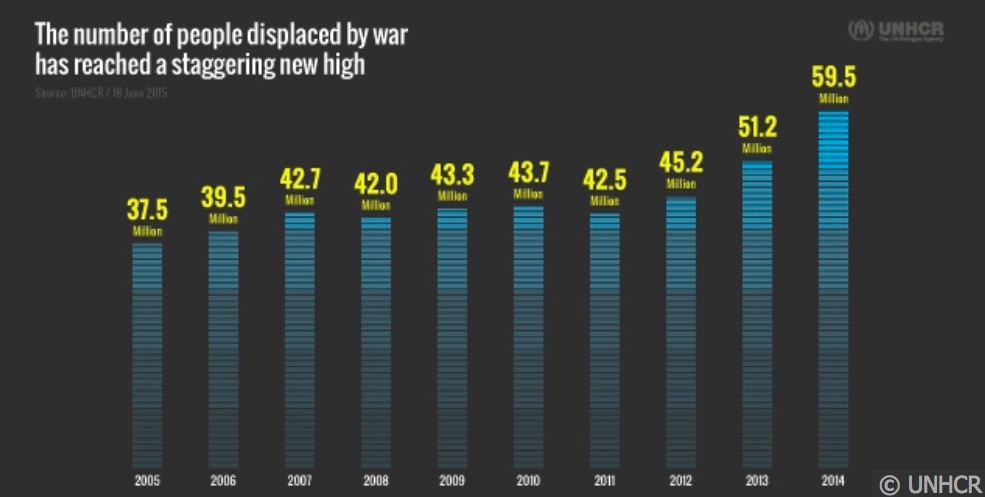
A finales de 2014 había en el mundo 60 millones de desplazados. Graham Dawson, de la Asociación Nacional de Sindicatos de Mujeres Docentes Directoras (NASUWT/Reino Unido) presentó estas estadísticas de la ONU en el Congreso y se propuso una resolución sobre el derecho a la educación para niños desplazados, refugiados y apátridas. Incidió en la grave situación por la que pasan los refugiados de Irak, Siria, Oriente Medio, el norte de África y otras zonas; además, afirmó que «no debemos dejar que luchen solos».

La Resolución destaca la determinación del Congreso de apoyar a las organizaciones miembro de países que acogen a grandes cantidades de niños refugiados y desplazados. También confirma la disposición del Congreso para presionar a los agentes nacionales e internacionales de modo que den prioridad al apoyo económico de la educación de los refugiados y desplazados internos.

Michael Thomson, del Sindicato Nacional de Educación (NTEU, Australia), afirmó que «el trato que se da a los refugiados es inaceptable» y que, desde los sindicatos, se debe trabajar para acabar con este «tratamiento inhumano hacia los niños».

La IE debería poner en marcha un protocolo adicional que declare a los causantes de las guerras responsables también de la educación, indicó Jean Kamdem, de la Federación de sindicatos de enseñanza e investigación (FESER/Camerún). Este hecho promovería la educación pública de calidad para todos, así como la educación en zonas de conflicto, afirmó.

También aportaron su vision al debate Michelle Olivier, SNUIPP-FSU (Francia), Rose Therese Magalie Georges, CNEH (Haití), Stephanie Ly, AFT (Estados Unidos), Aurelia Sarasin, SNES-FSU (Francia) y Abdelaziz Iouy, SNE-FDT (Marruecos).

(Gracias a Janet Hudgins, reportero CPNN deste artículo)

( Clickear aquí para la version francês o aquí para la version inglês.)

Question for this article:

L’Internationale de l’Education braque les projecteurs sur les réfugié(e)s

. . EDUCATION POUR LA PAIX . .

L’Internationale de l’Education (reproduit selon les termes de Creative Commons)

Comme l’a rappelé le 7e Congrès mondial de l’Internationale de l’Education réuni à Ottawa, au Canada, l’Internationale de l’Education doit œuvrer en faveur de l’accès des enfants déplacés à une éducation, et s’y attellera.

refugees
Michael Thomson, du National Tertiary Education Union/Australie, Photo Credit: Gabriel Castro – IEAL

Fin 2014, on dénombrait 60 millions de personnes déplacées. Ces statistiques des Nations Unies ont été rapportées au Congrès par Graham Dawson, de la National Association of Schoolmasters Union of Women Teachers (NASUWT, Royaume-Uni), qui a proposé une résolution sur le droit à l’éducation des populations déplacées et des enfants réfugiés et apatrides. Il a souligné le désarroi dans lequel se trouvaient les réfugié(e)s d’Irak, de Syrie, du Moyen-Orient, d’Afrique du Nord et de nombreuses autres régions du monde, en affirmant qu’on ne pouvait « les laisser livrés à eux/elles-mêmes dans ce combat ».

Cette résolution met en lumière la détermination du Congrès à soutenir les organisations membres engagées dans les pays qui accueillent un nombre considérable de réfugié(e)s et d’enfants déplacés. Elle vient également souligner la volonté du Congrès à faire pression sur les acteurs nationaux et internationaux, afin que ces derniers accordent en priorité leur aide financière à l’éducation des réfugié(e)s et des populations déplacées à l’intérieur d’un pays.

La façon dont les réfugié(e)s sont traité(e)s dans le monde entier est tout simplement inacceptable, a déclaré Michael Thomson, du National Tertiary Education Union (NTEU, Australie), avant d’ajouter que les syndicats devaient s’attaquer de pied ferme au « traitement inhumain des enfants ».

L’IE doit appeler à la mise en place d’un nouveau protocole afin que les responsables de la guerre assument également leur responsabilité envers l’éducation, a déclaré Jean Kamdem, de la Fédération des Syndicats de l’Enseignement et de la Recherche (FESER, Cameroun). Cette mesure permettrait non seulement de promouvoir une éducation de qualité pour tous, a-t-il indiqué, mais également de promouvoir l’éducation dans les zones de conflit.

Michelle Olivier, SNUIPP-FSU (France), Rose Therese Magalie Georges, CNEH (Haïti), Stephanie Ly, AFT (Etats-Unis), Aurelia Sarasin, SNES-FSU (France), et Abdelaziz Iouy, SNE-FDT (Maroc), figuraient au nombre des participant(e)s à ce débat.

(Merci à Janet Hudgins, le reporter de CPNN de cet article.)

(cliquez ici pour la version anglaise de cet article ou ici pour la version espagnole.)

Question pour cet article:

Education International to focus on refugees

EDUCATION FOR PEACE .

Education International (reprinted according to terms of Creative Commons)

Education International (EI) must – and will – work to ensure that education is made available to displaced children, according to Education International’s 7th World Congress in Ottawa, Canada.

refugees
Michael Thomson of the National Tertiary Education Union (NTEU/Australia), Photo Credit: Gabriel Castro – IEAL

At the end of 2014, 60 million people were displaced. These UN statistics were brought to Congress by Graham Dawson, of the National Association of Schoolmasters Union of Women Teachers (NASUWT/UK) who proposed a resolution on the Right to Education for Displaced People, Refugees and Stateless Children. He highlighted the plight of refugees from Iraq, Syria, the Middle East, North Africa, and elsewhere saying they “should not be allowed to struggle alone.”

The Resolution outlines Congress’ resolve to support member organisations in countries hosting large numbers of refugees and displaced children. It also outlined Congress’ resolve to pressure national and international agents to prioritise financial assistance for the education of refugees and internally displaced people.

The treatment of refugees all over the world is unacceptable, said Michael Thomson of the National Tertiary Education Union (NTEU/Australia), adding that the “inhuman treatment of children” must be tackled head on by trade unions.

EI should call for an extra protocol to make those responsible for war also responsible for education, said Jean Kamdem, Fédération des syndicats de l’enseignement et de la recherche (FESER/Cameroon). This would promote quality education for all, he said, and would also promote education in areas of conflict.

Contributions to the debate were made by Michelle Olivier, SNUIPP-FSU (France), Rose Therese Magalie Georges, CNEH (Haiti), Stephanie Ly, AFT (US), Aurelia Sarasin, SNES-FSU (France), and Abdelaziz Iouy, SNE-FDT (Morocco).

(Thank you to Janet Hudgins, the CPNN reporter for this article.)

(click here for the French version) of this article or here for the Spanish version

Question for this article: