Category Archives: DEMOCRATIC PARTICIPATION

Castilla-La Mancha, Spain: The Strategic Agreement for Peace and Coexistence seeks a consensus of civil society

.. DEMOCRATIC PARTICIPATION ..

An article from La Cerca: Castilla-La Mancha (translated by CPNN)

The second vice president of the regional government of Castilla-La Mancha, José García Molina, has appeared at a press conference on Wednesday [June 20] to report on the latest steps taken in the preparation of the Strategic Agreement for Peace and Coexistence which was presented to the parliamentary groups last May in the Cortes of Castilla-La Mancha.


José García Molina

Following the line of work of the participative processes in the elaboration of the Law of Participation and the Law of Guarantee of Income and of Citizen Guarantees; the project has been sent to organizations, unions and political formations so that they can participate in its elaboration.

“In a democratic society with a state of law that claims to be so, there is no room for radicalized attitudes, be they political, cultural or religious, that undermine or undermine those values ​​and those principles of democracy,” said José García Molina.

García Molina recalled the months of work developed in meetings with organizations and institutions working in different social and cultural spheres, with refugees, migrants or in a situation of vulnerability, who “have made their views known about what measures could be take to implement policies to prevent all processes of radicalization and stigmatization of these people.”

The draft has been sent to “all the organizations with which we have met, and that implement their daily work in Castilla-La Mancha, eleven representative unions of the region of different sectors, and a total of 53 political formations that have regional and even local and institutional implementation.”

(continued in right column)

(Click here for the article in Spanish)

Questions for this article:

The culture of peace at a regional level, Does it have advantages compared to a city level?

(continued from left column)

This follows the participatory processes such as those that have been carried out in the elaboration of the Law of Participation and the Law of Guarantees of Income and Citizen Guarantees, “which have favored the broader participatory processes in the History of the Community Board “and” to make civil society a participant in the policies that need to be implemented in our region “, García Molina explained that a basic document has been prepared” that gathers the contributions that generated the highest level of consensus regarding the problems we want to tackle “.

Strategic Plan for Peace and Coexistence

García Molina seeks the unanimous signature, “or at least majority”, on the document for the preparation and implementation of a Strategic Plan for Peace and Coexistence. The plan will follow the guidelines of the European Union, “which already work in other countries “, and that brings together three main axes: social cohesion projects, projects for interreligious coexistence, and projects for the promotion of the culture of Human Rights.

The first axe includes the universality of social policies, the promotion of educational, cultural and social actions for dissemination and awareness of the international problems of refugees; and the creation of a Regional Observatory on Human Rights and Equality Policies.

Second, among the interreligious coexistence projects are the creation of an interreligious dialogue agenda, the convening of an Interreligious Annual Forum; and training modules and / or teaching units that address respect for religious diversity in social and educational centers in our region.

And finally, there are projects to promote a culture of Human Rights including the promotion of diversity and respect for cultural differences, international conferences on multiculturalism and culture of peace, and cultural exchange programs.

“What we hope,” García Molina has concluded, “is that all those social, cultural, political and union organizations will answer us to set a date for the formal signing of that Agreement.” “Our desire,” he added, “is that the support be unanimous because it sends a good message of peace, of coexistence, and above all of rejection of any form of radicalization that can generate violence.”

US Conference of Mayors Resolution for Peace

.. DEMOCRATIC PARTICIPATION ..

A press release from Mayors for Peace received by email at CPNN

Today [June 11], at the close of its 86th Annual Meeting, the United States Conference of Mayors (USCM), unanimously adopted a sweeping resolution “Calling on the Administration and Congress to Step Back From the Brink and Exercise Global Leadership in Preventing Nuclear War.”

In the resolution, “the USCM welcomes the dramatic diplomatic opening between the U.S. and North Korea and urges President Trump to patiently and diligently work with North and South Korea for a formal resolution of the Korean War and normalized relations with a denuclearized Korean peninsula.”

The USCM also “reaffirms the importance and efficacy of the 2015 Joint Comprehensive Plan of Action negotiated by Iran, the U.S. and 5 other nations to limit Iran’s nuclear program in exchange for sanctions relief, and calls on [the] U.S. Administration to pursue diplomacy and normalized relations with Iran with the goal of establishing a zone free of nuclear, chemical and biological weapons in the Middle East.”

The resolution notes that tensions between the United States and Russia “have risen to levels not seen since the Cold War” and warns that “this is only one of many nuclear flashpoints, from the Korean Peninsula, to the South China Sea to the Middle East and South Asia, where all of the nuclear-armed states are engaged in unpredictable conflicts that could catastrophically escalate out of control.”

The resolution also warns that the February 2018 U.S. Nuclear Posture Review “manifests a commitment to an increasing and long-term reliance on nuclear arms, lowers the threshold for use of nuclear weapons”, proposes new warheads and missiles, and “endorses current plans to sustain and upgrade existing nuclear forces and infrastructure projected to cost well over a trillion dollars over the next three decades.”

(continued in right column)

Questions for this article:

How can culture of peace be developed at the municipal level?

(continued from left column)

Noting that “in 2017 the United States spent $610 billion on its military, more than two and a half times as much as China and Russia combined, amounting to 35% of world military spending”, and that this huge amount is slated to rise significantly in coming years ”the USCM “calls on the President and Congress to reverse federal spending priorities and to redirect funds currently allocated to nuclear weapons and unwarranted military spending to support safe and resilient cities” and to meet basic human needs.

The USCM resolution expresses deep regret that the United States and the eight other nuclear-armed states boycotted last year’s negotiations for a Treaty on the Prohibition of Nuclear Weapons (TPNW) and urges the U.S. government to “embrace the TPNW as a welcome step towards negotiation of a comprehensive agreement on the achievement and permanent maintenance of a world free of nuclear arms”.
 
Finally, “the USCM calls on the United States to lead a global effort to prevent nuclear war by renouncing the option of using nuclear weapons first; ending the sole, unchecked authority of any president to launch a nuclear attack; taking U.S. nuclear weapons off hair-trigger alert; cancelling the plan to replace its entire arsenal with enhanced weapons; and actively pursuing a verifiable agreement among nuclear armed states to eliminate their nuclear arsenals.”

The resolution was sponsored by Mayors for Peace U.S. Vice-President T.M. Franklin Cownie, Mayor of Des Moines, Iowa and 25 co-sponsors including USCM President Steve Benjamin, Mayor of Columbia, South Carolina and USCM International Affairs Committee Chair Nan Whaley, Mayor of Dayton, Ohio.

The USCM, the nonpartisan association of 1,408 American cities with populations over 30,000, has unanimously adopted Mayors for Peace resolutions for 13 consecutive years. Resolutions adopted at annual meetings become USCM official policy.

As noted in this year’s resolution, “Mayors for Peace, which is working for a world without nuclear weapons and safe and resilient cities as essential measures for the realization of lasting world peace, has grown to 7,578 cities in 163 countries and regions, with 213 U.S. members, representing in total over one billion people”. Mayors for Peace, founded in 1982, is led by the Mayors of Hiroshima and Nagasaki.

See full text of resolution with list of 26 co-sponsors: http://wslfweb.org/docs/USCM2018MfPres.pdf

Contact: Jackie Cabasso, Mayors for Peace North American Coordinator,
wslf@earthlink.net

Mexico: Congress Exhorts the City Councils to contribute to the culture of peace

.. DEMOCRATIC PARTICIPATION ..

An article from Guerrero Quadratin (translation by CPNN)

The Congress of Guerrero has exhorted the 81 city councils in the state to apply actions, programs and proposals to create a culture of peace and non-violence in their territories, in order to reduce the high rates of crime.

According to the Congress bulletin, when reading the proposal of the MC Parliamentary Group, the deputy Julio César Bernal Reséndiz highlighted that 2017 was one of the most violent in recent years, which makes it imperative that the three levels of government implement such actions.

(Continued in right column)

(Click here for a version in Spanish)

Questions for this article:

How can culture of peace be developed at the municipal level?

(Continued from left column)

He said that although municipal councils lack the infrastructure, budget and financing to contain violence in their municipalities, they do have channels for administrative, management and social participation that can hellp create a climate of peace in their territories.

Some of the actions and programs that are proposed include: create public policies of the municipalities that promote a culture of peace and nonviolence; disseminate through the municipal media the activities of local groups and the preparation of an annual program of awareness-raising activities to promote the values ​​of a culture of peace and non-violence; and make available publications on peace issues for libraries and municipal documentation centers.

Also, they should promote education for peace in schools, offering resources for students and facilitating specific training in peace and human rights for teachers, and budget an economic contribution for programs, projects and activities that promote the culture of peace organized by civil society.

Bernal Reséndiz emphasized that if each and every one of the aforementioned actions is carried out in the municipalities that make up the state of Guerrero, awareness will be created among the inhabitants to achieve peace and social harmony.

Spain: 100 Cities for Peace recognizes the town of Coria for its ties with Japan

.. DEMOCRATIC PARTICIPATION ..

An article from Canal Sur

The international movement 100 Cities for Peace has awarded Coria del Río (Seville) the Pax Urbis prize, considering it a model of a culture of peace and tolerance thanks to its links and its historical relations with Japan.

The prize is being given in the context of the commemoration of the 150 anniversary of diplomatic relations between Spain and Japan, according to the official notice sent of the City Hall.

(continued in right column)

(Click here for the Spanish original of this article)

Questions for this article:

How can culture of peace be developed at the municipal level?

(continued from left column)

The notice adds that the mayor of Coria del Río, Modesto González, has thanked 100 Cities for Peace for this recognition, assuring that “for all the Corians there can be no greater pride than being considered a people of peace and an example to follow. The prize should inspire us to make an even greater effort to deepen and spread Japanese culture with its many enriching values.”

The Pax Urbis award is granted annually as a prize that commits the winners to responsibility and continuity of their efforts for peace.

100 Cities for Peace has granted the Pax Urbis International Awards since 2007 to cities, people and institutions that have promoted the culture of peace and its fundamental values.

The award will be given to the mayor, as representative of the municipality, next October during the celebration of the Japanese Cultural Week.

The award aims to recognize all the efforts made by citizens and the government of Coria del Río to maintain and promote relations with Japan, relations that have intensified especially in recent years, bringing benefits to the municipality; tourism, business, cultural and educational agreements.

Alliance in Asia: A subsidiary for International Cities of Peace in China!

.. DEMOCRATIC PARTICIPATION ..

Excerpt from April newsletter of International Cities of Peace

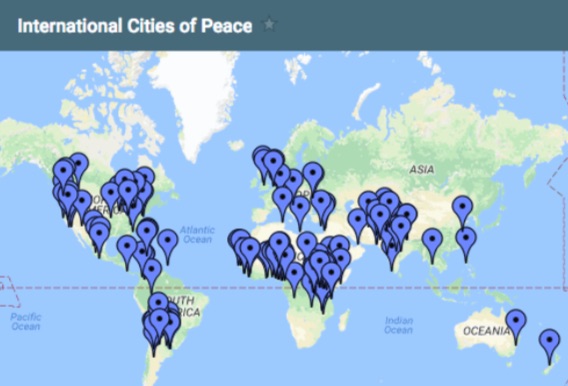
In January, Executive Director J. Fred Arment traveled to Nanjing, China, our 169th city of peace, to discuss forming an alliance to extend the reach of International Cities of Peace throughout Asia. The purpose of the alliance is to create a partnership with the UNESCO Peace Studies Chair of Nanjing University and the Director of the Memorial Hall of the Nanjing Massacre. This alliance is much like a subsidiary organization formed by for-profit corporations such as GM and AT&T.


We are pleased to report that there was great success as a result of the trip. Professor Liu Cheng, the only UNESCO Peace Chair in China and director of the Nanjing University Institute of Peace has formed an alliance to promote cities of peace in Southeast Asia. In September, the Mayor of Nanjing will host a week-long celebration of International Day of Peace. City of Peace leaders will be present for a Conference. Extremely wonderful news!

Questions for this article:

First Congress of World Leaders, International Cities of Peace, at the invitation of the Fundación El Sol

.. DEMOCRATIC PARTICIPATION ..

Notice from International Cities of Peace

You are invited as a world leader for peace to this Convention in order to share your experiences and those of other leaders about unique ways to create a community culture of peace.

Video of invitation

Questions for this article:

How can culture of peace be developed at the municipal level?

The grand event will be held from June 4 to 8, 2018, in the Plaza Mayor Convention and Exhibition Center. Green Room, Medellín, Antioquia, Colombia.

We thank the organizer of the Congress, Sol Mary Valencia Acevedo, founder of Fundación El Sol and leader of Medellín: City of Peace.

SCHOLARSHIPS ARE AVAILABLE. Support includes air travel, accommodations, meals, and transport to and from airport. Please send your inquiries to: mailto:arment@fredarment.com

FUNDACIÓN EL SOL, Sede administrativa Carrera 80C # 34A-71 Barrio Laureles. Medellin, Colombia.

Cell (+57) 3113427410 • (+57) 3176473933 e-mail: fundacionelsol.org@gmail.com

(Click here for a version in Spanish)

7th edition of the Thionck-Essyl International Dance and Music Festival: Culture for Peace in Casamance

. . DEMOCRATIC PARTICIPATION . .

An article from Le Quotidien

The 7th edition of the Thionck-Essyl International Dance and Music Festival opens this Friday [April 13]. This locality of Casamance will, during 5 days, vibrate with the rhythms of songs, dances and training workshops for batik, basketry, pottery, as well as colloquiums. The director of the company Bakalama, initiator of this festival, Malal Ndiaye defined the strong axes of the programming, as well as its ambitions to make this festival a lever of economic development of Casamance (through culture and tourism) and a way to cultivate peace.

Casamance has been in conflict for almost three decades. As the director of the Thionck-Essyl International Dance and Music Festival, Malal Ndiaye believes that where politics and the military have failed, culture can succeed in bringing peace. The 7th edition of its festival which is held from 13 to 20 April in Thionk-Essyl (a locality located in the department of Bignona) hoopes to be an opportunity to promote culture and peace. “We have already understood that culture can be a source of mutual understanding of peoples, and that is why we have set up the festival in Casamance and we call on all the localities to come to discuss, understand and move forward together. As a cultural actor, I think and remain convinced that it is only through culture that we can have peace in Casamance”, he argues.

(article continued in right column)

(Click here for the French version of this article)

Question related to this article:


Can festivals help create peace at the community level?

(article continued from left column)

Beyond this, it is for the initiators of this festival to promote cultural and tourism participation, as well as economic development of this region of Casamance. The artistic director of the company Bakalama and former manager of P-Froiss also recalls what guided the establishment of the International Festival of Dance and Music Thionck-Essyl “In 2004 we saw that the young people of this locality were passionate about making art. At Thionck-Essyl, there is a real artistic potential, so we decided why not create an artistic festival, but also a festival of development. A festival that can allow us to make a contribution, both in terms of tourism, economy and social . It is these young artists who are in Casamance, especially those in Thionck-Essyl who motivated us ” he informs. And since then, the festival has not departed from its original objectives. Once again this year, it will be an opportunity to address a theme so dear to the promoters of the festival: Culture and tourism leverage for economic development.

On the program side, director Malal Ndiaye reveals that a whole string of musicians, dancers, rappers will come from Dakar as well as regions of Casamance to take part in this festival. “45 artists will leave Dakar to join Thionck-Essyl and there they will find other dance companies such as the company Bakalama, the troupe Kalonkigne, Koubalang, Niaffrang … The Gran Jabel group will come from Guadeloupe to participate at the festival”, notes Mr. Ndiaye, who is pleased with the support of the municipal authorities. “The budget for this festival is 12 million, the 2 million are managed by the city council, and the Bakalama company which brings the artists participates for 1.5 million.” To make up the rest of the budget, Malal Ndiaye is counting on the support of the ministries in charge of Culture, Tourism and Crafts. “We have debts, we need transportation, accommodation, sound, we hope the support of the government,” he says.

New Peace Museum in Ramnicu Valcea, Romania

.. DEMOCRATIC PARTICIPATION ..

An article from the Newsletter of the International Network of Museums for Peace

On 19th January, a new peace museum – Peace Museum Valcea – was opened in Ramnicu Valcea, the capital city of Valcea County situated in the central-south area of Romania. The historic city, whose foundations go back to Roman times, has a population of 92,000. The museum, which is the first in Romania and in the whole of south-eastern Europe, was founded by Magdalena Cristina Butucca – a peace and human rights activist who is also founder and editor of two online newspapers, Diplomatic Aspects (2009) and Diplomatic Intelligence (2014). She worked as a volunteer at the Peace Museum Vienna in 2017 and was inspired to create a similar educational institution in her country.


Magdalena Butucea at the museum opening

(article continued in right column)

Question for this article:

Peace Museums, Are they giving peace a place in the community?

(article continued from left column)

The main purpose of setting up the museum is the widest possible dissemination of information on the concept of peace, and on peace education. The museum has started negotiations with high schools and universities with the aim of introducing courses about peace education.

Liska and David Blodgett, founders of the Peace Museum Vienna, and Ali Ahmad, its director, participated in the opening ceremony. The event was widely reported in the media, with many articles in the local, regional and national press, as well as reports on radio and television. A report by the Romanian National Press Agency can be seen here.

A report by Radio Romania (with a number of photographs) can be found here. Also a six-minute film (in Romanian) about the opening of the exhibition can by viewed by clicking here.

A few days after the opening the museum showed a photographic exhibition about social peace, titled Peace and US made by Andrew Niculescu. For more information, please see the museum’s website.

Mexico: Monterrey Installs Municipal Council of Social Prevention of Violence

.. DEMOCRATIC PARTICIPATION ..

An article from Posta (translation by CPNN)

As of this Thursday [March 22], the municipality of Monterrey has a Municipal Council for the Social Prevention of Violence and Crime comprised of representatives of academia, society and the business sector, as well as municipal officials. It will be responsible for coordinating public policies and coordinating with other government bodies on the issue of prevention of violence.

Mayor Adrián de la Garza addressed the Council, saying that, among its faculties, the members should formulate plans, programs and actions for the prevention of violence and crime and should start a diagnosis of the causes that generate this problem and evaluate the social impact of the plans they carry out, in addition to promoting training in this area.

“Reacting after violence has occurred may help to lower some incidence, and provide some feeling of justice, but in reality it does not alleviate the problem. What society is looking for that there is less violence, that there is less insecurity, that there is less criminal incidence. The key to this is preventive actions”, he emphasized.

(continued in right column)

(Click here for the Spanish original of this article)

Questions for this article:

How can culture of peace be developed at the municipal level?

(continued from left column)

After the Council took up the initiative, a collaboration agreement was signed with the Civil Association RENACE, to implement the project of “Psychosocial support to adolescents in conflict with the Law” with which they will give advice to young people detained for administrative offenses.
In addition, the group will support the Council to identify antisocial behavior and its causes, to generate preventive actions, to develop operating rules to achieve the objectives and to measure results.

* Pearl Leticia Guadalupe Montemayor García, Director of Citizen Services of the Center for Citizen Integration (CIC)
* Rosa Nelly Pérez Mares, Regional Coordinator of Youth Services A.C. (SERAJ)
* María del Consuelo Bañuelos Lozano, Director of Peace Promotion. Martín Carlos Sánchez Bocanegra, General Director of RENACE, A. B. P.
* Silvia Camarillo Vázquez, Director of the Monterrey Operational Unit of Youth Integration Centers A.C. (CIJ)

The Counselors of the academic community are:

* Juan García Rodríguez, Criminology Coordinator of the Faculty of Law and Criminology of the UANL [Universidad Autónoma de Nuevo León].
* Julia Leticia Neira Tijerina, Director of Management of the Urban Environment, Purísima-Alameda District of U-Erre
* Karla Guadalupe Samaniego Pérez, Coordinator of the Faculty of Law and Legal Sciences of the Metropolitan University of Monterrey.
* Rogelio Manuel Cortés Leal, Director of Citizen Planning of ITESM [Monterrey Institute of Technology and Higher Education]
* Julio César Treviño Leal, Professor at the José Martí University of Latin America.

Directors of the business sector:

* Dimas Padrón, In charge of Vial and Patrimonial affairs of Arca Continental S.A.B de C.V.
* Deassy Daniela Juangorena Hernández, Special Projects Advisor of the Senda Group.
* Reynaldo Osorio Fernández, National Head of Labor and Patrimonial Protection of OXXO.
* Estefany Elizabeth Mercado Cortés, Regional Manager of Human Resources of SEARS.
* César Alejandro Villarreal Treviño, president of the National Chamber of the Restaurant Industry and Seasoned Foods (CANIRAC)

(Thanks to Rogelio Cortés, the CPNN reporter for this article).

Mayors for Peace around the world

. . DEMOCRATIC PARTICIPATION . .

An article by CPNN based on the news flash of Mayors for Peace

The March 2018 news flash of Mayors for Peace describes initiatives around the world.

16 new members were added, bringing the total membership to 7,558 cities in 163 countries. Seven of these came from Iran where there are now 997 member cities. Six came from Italy, where there are now 504 member cities. Two new cities came from Germany and one from Japan.


(click on photo to enlarge)

(article continued in right column)

Question related to this article:

 
How can culture of peace be developed at the municipal level?

(article continued from left column)

Mayors for Peace is now running a project to distribute seeds from A-bombed trees to all member cities wishing to receive them. It is hoped that the acts of raising the second-generation A-bombed trees will help raise citizen’s awareness of peace. As of November 2017, seeds or seedlings had been distributed to cities in Belgium, Spain, Germany, Norway, Australia, Russia, Canada, UK, Switzerland, slovenia, Switzerland, France, Italy, USa, Bosnia and Herzegovina, Kazakhstan and Korea.

Youth are invited to apply for the 2018 Youth Exchange Programe for the “Hiroshima and Peace” course. Click here for details.

The UK & Ireland Mayors, Provosts and Leaders for Peace Chapter will hold its Chapter meeting on Friday, March 23, in Leeds Civic Hall. At the meeting, it is planned to encourage Mayors, Provosts and senior councillors that attend the meeting to also sign the ICAN pledge to work for a nuclear weapons free world that has been developed for local and national politicians.

Visit the following links for articles from the Hiroshima Peace Media Center of the CHUGOKU SHIMBUN:

. – A-bomb survivor Shigeaki Mori to visit U.S. for first time in May
31 officials from 9 nations attend training in Hiroshima
Hiroshima mayor criticizes new U.S. nuclear strategy
Criticism mounts against comment by Japanese foreign minister
A-bomb survivor donates late sister’s belongings to Peace Museum