Category Archives: WOMEN’S EQUALITY

Africa: CEDEAO: Women are called on to establish a durable peace

. WOMEN’S EQUALITY .

An article by Tata Sane for Le Soleil

Women have always been the fundamental actors in the search for peace. This was reiterated yesterday in the meeting organized by the Working Group, “Women, Peace and Security in West Africa”, in partnership with the United Nations Office for West Africa and the Sahel (Unowas). The activity is held in preparation for the International Day of Peace, edition 2016. It is, according to the representative of Senegal on the working group “Women, Peace and Security in West Africa,” a favorable opportunity to reflection and exchange on the mechanisms of action and intervention of women and youth to consolidate peace and sustainable security in the Sahel which has been strongly shaken recently by the threats of extremists.

cedeao
(Click on photo to enlarge.)

Diago Ndiaye believes that facing the terrorist threats that spare no nation, women must play their role in order to build a lasting peace. In his message issued on the occasion of this day, the Secretary-General of the United Nations stated that “peace can not be reduced to a simple truce. Peace means building on a global scale, a society in which people live free of poverty and everyone benefits from prosperity.” Therefore, sustainable development is essential for the establishment of a stable peace. Respect for human rights is also a prerequisite. “The lack of resources is often the cause of conflicts. Therefore, we must rely on the sustainable development program for 2030 to prevent conflicts by ensuring that no one is left behind,” added the Secretary-General.

(Article continued in the right column)

(Click here for the original French version of this article.)

Question for this article

What has happened this year (2016) for the International Day of Peace?

(Article continued from the left column)

A high-level panel on the role and position of women and youth in the processes and peace and security programs in Senegal was scrutinized. Considering the theme “Women’s Leadership, peace, security, conflict prevention, mediation and peacebuilding: What role for women? “Dr. Christiane Agboton Johnson recalled that the 17 sustainable development goals that have been chosen for this year all contribute to the building of peace.

The involvement of women and youth

Speaking of women’s role, Ms. Agboton remarks that all women have a role to play at different levels. However, she wondered how this can be done so that women become a force for change. “Today, after all is said and done, has this potential been realized? Women represent 50% of the population, but, nevertheless, conflicts persist. This is the meaning of my question about how they can become a force for change, “she said. The gender adviser to the United Nations Office for West Africa and the Sahel (Unowas) recalled Resolution 2250 of the United Nations on youth, peace and security.

Agathe Telou believes that this resolution comes at a time when all players require the involvement of young people in search of peace worldwide. “This resolution recognizes the efforts that young people provide to help establish peace and security in the ECOWAS space,” she advised. Mrs. Agathe Telou addressed the sub-theme “Youth, Peace and Security: Resolution 2250 of the UN Security Council.”

Hundreds of Thousands Join Saudi Women-Led Campaign to End Male Guardianship in the Kingdom

. . WOMEN’S EQUALITY . .

This article originally appeared on Global Voices on September 4 (reprinted here according to terms of Creative Commons)

As part of the efforts to end the draconian laws against women in the Gulf state, Saudi women launched a campaign demanding an end to male guardianship for basic practices such as work, property ownership and travel. Using the hashtag #TogetherToEndMaleGuardianship and its Arabic version #سعوديات_نطالب_باسقاط_الولاية (which translates to ‘Saudi women demand the end of guardianship’), hundreds of thousands of supporters worldwide took part in this campaign.

saudi
Video:”Trapped with abuse”

The campaign was sponsored by Human Rights Watch and follows the release of its lengthy report entitled “Boxed In: Women and Saudi Arabia’s Male Guardianship System”. In it, the international human rights organization explains that:

“In Saudi Arabia, a woman’s life is controlled by a man from birth until death. Every Saudi woman must have a male guardian, normally a father or husband, but in some cases a brother or even a son, who has the power to make a range of critical decisions on her behalf. As dozens of Saudi women told Human Rights Watch, the male guardianship system is the most significant impediment to realizing women’s rights in the country, effectively rendering adult women legal minors who cannot make key decisions for themselves.”

The report included three short videos illustrating the effects of the system on women’s lives, as well as statements from Saudi women’s rights activists and citizens who find the law to be socially and economically crippling.

Question related to this article:

Protecting women and girls against violence, Is progress being made?

As one Saudi activist and former school principal, 44-year-old Hayat, told Human Rights Watch on December 7, 2015:

“The guardianship system also impacts women’s ability to seek work inside Saudi Arabia and to pursue opportunities abroad that might advance their careers. Specifically, women may not apply for a passport without male guardian approval and require permission to travel outside the country. Women also cannot study abroad on a government scholarship without guardian approval and, while not always enforced, officially require a male relative to accompany them throughout the course of their studies.

It can mess with your head and the way you look at yourself. How do you respect yourself or how [can] your family respect you, if he is your legal guardian?”

Human Rights Watch also explained that the religious reasons supposedly justifying the male guardianship system have been repeatedly challenged:

“Saudi Arabia’s imposition of the guardianship system is grounded in the most restrictive interpretation of an ambiguous Quranic verse—an interpretation challenged by dozens of Saudi women, including professors and Islamic feminists, who spoke to Human Rights Watch. Religious scholars also challenge the interpretation, including a former Saudi judge who told Human Rights Watch that the country’s imposition of guardianship is not required by Sharia and the former head of the religious police, also a respected religious scholar, who said Saudi Arabia’s ban on women driving is not mandated by Islamic law in 2013.”

This is why, among many reasons, the guardianship system is being challenged — on Twitter and elsewhere — by Saudi women and their supporters. According to Vocativ, as of August 4, 2016, at least 170,000 tweets have been posted in both Arabic and English.

(Thank you to Janet Hudgins, the CPNN reporter for this article)

Peru: #NiUnaMenos: 50,000 protest violence against women in Lima

. . WOMEN’S EQUALITY . .

An article from Peru Reports

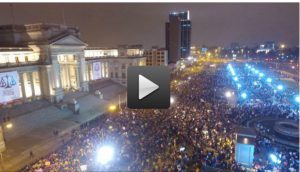
At least 50,000 people marched in the #NiUnaMenos protest against violence and abuse of women in downtown Lima on Saturday. The rally dubbed “Not One Less” was organized after reports that 54 women have been murdered so far in 2016. The protest started on Saturday afternoon in downtown Lima’s Campo de Marte park and passed Plaza Bolognesi and Plaza San Martin before ending at the Palace of Justice.

peru
Miles se congregan ahora frente al Palacio de Justicia tras marcha “Ni Una Menos”. (Aarón Ormeño/ El Comercio)

President Pedro Pablo Kuczynski and first lady Nancy Lange attended the event as well as actress Wendy Ramos, who has been an outspoken voice for the movement.

“We will march, we will break the silence,” said Ramos in a promotional video leading up to the event.

“We do not allow or want victims of violence,” second Vice President Mercedes Araoz told reporters. Araoz gave fiery rhetoric of standing up to ‘machismo’ in recent weeks. She said that she had been a victim of psychological abuse.

Under the slogan “if you touch one, you touch all,” the cry of songs and drums flowed down street after street, in a show of immense solidarity. Many daubed their faces with make-up bruises and bloody noses. Others donned pink and blew whistles. Children sat on shoulders waving “Ni Una Menos” flags.

(Article continued in the right column)

(click here for an article in Spanish about this event)

Question related to this article:

Protecting women and girls against violence, Is progress being made?

(Article continued from the left column)

There were processions of nurses and clergyman alongside men hooded in leggings pulling their beaten wives. Towering black crosses adorned with flags of other Latin American nations followed chants of “Respect.” Police and representatives from all political parties joined the march and throughout the country people gathered to demand harsher punishments for men who beat or murder women.

“It’s important we go today because inequality is terrible in Peru and too many girls I love are at risk,” one protester said.

“We will promote a culture of peace and tolerance, saying no to violence, no more violence against women and children,” event organizers and victims of domestic violence Arlette Contreras and Lady Guillen told reporters.

Interior Minister Carlos Basombrio told a group of protesters of his promises to “train police commissioners to have better protocols.”

Though brought together by a serious issue, celebration filled the air. Politicians took selfies and few failed to smile.

The fiercer chanters and placard wavers were blocked by police from entering Plaza Grau near the Palace of Justice. One large banner which read “No more sterilizations” hung from the railings outside the Palace of Justice. The songs faded at around 7 p.m. as the march dispersed. Signs were left up against walls and ribbons flickered from the railings.

Three women were murdered in Lima in the week leading up to the march. Two of the women were murdered by scorned lovers. The third, a 16-year-old minor, was forced to a hotel by a taxi driver, who died as he forced her to drink and raped her.

There were smaller marches in Peru’s other cities including Arequipa, Trujillo, Chimbote, Cusco, Juliaca, Tacna, Andahuaylas, Abancay and Ayacucho.

Beirut Int’l Conference Highlights Women’s Participation in Peace, Security Initiatives

. . WOMEN’S EQUALITY . .

An article from Women in China

An international conference on “prioritizing women, peace and security on the Arab agenda” called on Thursday for actions to ensure the participation of women in all aspects of peace and security initiatives across the Arab world.

Beirut

The conference was organized by the Institute for Women’s Studies in the Arab World at Lebanese American University and the United Nations Economic and Social Commission for Western Asia (ESCWA) from August 8 to 10 in Beirut.

According to a statement by the ESCWA, the conference concluded by launching the Beirut Call for Action and urged the Arab states, the UN, the League of Arab States, civil society, policymakers and practitioners to fulfill their commitments.

Participants called for “introducing a new paradigm that promotes a culture of peace, active protection of women from violence, as well as tackles issues of violent extremism, radical religious discourse and political repression,” the statement said.

The conference brought together more than 40 high level experts, academics and practitioners from the United Nations and 11 Arab countries to discuss women’s participation in regional peace and security initiatives.

(Click here for a version of this article in French)

Question for this article

Colombia Includes Gender Focus for a Stable, Lasting Peace

. . WOMEN’S EQUALITY . .

An article by Patricia Grogg for Inter Press Service News Agency (IPS)

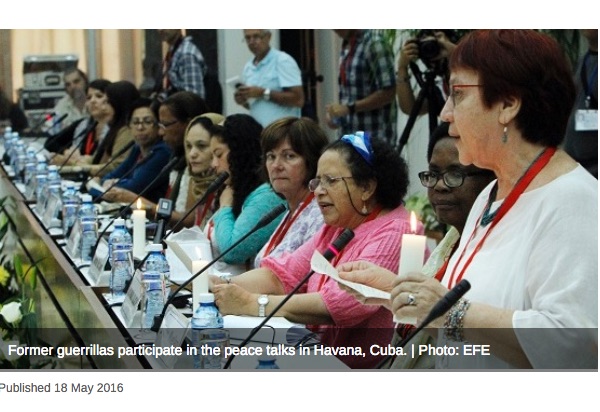
The novel inclusion of a gender perspective in the peace talks that led to a historic ceasefire between the Colombian government and left-wing guerrillas is a landmark and an inspiration for efforts to solve other armed conflicts in the world, according to the director of U.N.-Women in Colombia, Belén Sanz.

gender-1
(Click on photo to enlarge and to read caption)

In statements to IPS, Sanz described as “innovative and pioneering” the incorporation of a gender subcommittee in the negotiations between the administration of President Juan Manuel Santos and the Revolutionary Armed Forces of Colombia (FARC), which began in November 2012 in the Cuban capital and ended in late June with a definitive ceasefire.

She said the large proportion of women who spoke with the negotiating teams, in regional and national forums, and during visits by victims and gender experts to Havana showed the growing openness on both sides to the inclusion of gender proposals in the final accord and the mechanisms for its implementation.

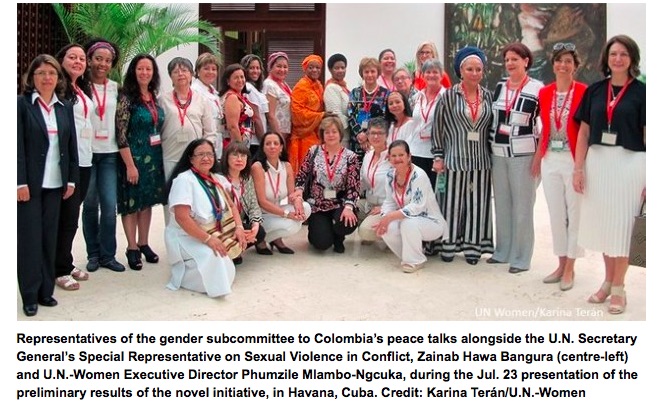
The results of the work by the subcommittee, made up of representatives of both sides, were presented in Havana during a special ceremony on Jul. 23, exactly one month after the ceasefire was signed, putting an end to over a half century of armed conflict.

Taking part in the ceremony were U.N.-Women Executive Director Phumzile Mlambo-Ngcuka; the U.N. Secretary General’s Special Representative on Sexual Violence in Conflict, Zainab Hawa Bangura; and Sanz, whose office has worked closely with the subcommittee.

Other participants were María Paulina Riveros, the Colombian government’s delegate to the subcommittee, and Victoria Sandino, the FARC’s representative, along with the rest of the members of the subcommittee, the delegates to the peace talks, and representatives of the countries that served as guarantors to the peace process.

The results of the subcommittee´s work, presented on that occasion, include the incorporation of a gender perspective and the human rights of women in each section of the agreement, starting with guarantees for land access and tenure for women in rural areas.

Other points agreed on were women’s participation in decision-making to help ensure the implementation of a lasting, stable peace; prevention and protection measures for a life free of violence; guarantees of access to truth and justice and measures against impunity; and recognition of the specific and different ways the conflict affected women, often in a disproportionate manner.

“These are some examples that can be illustrative and inspiring for other peace processes around the world,” Sanz said from Bogotá, after her return to the Colombian capital.

In her view, “these strides forward represent milestones in the promotion of women’s rights and the transformation of gender inequality during the construction of and transition to peace, which could be exported to other places in the world and adapted to their particular conditions and contexts.”

(Article continued in the right column)

Question for this article

Do women have a special role to play in the peace movement?

(Article continued from the left column)

The introduction of a gender focus also includes the search for ensuring conditions for people of different sexual orientations to have equal access to the benefits of living in a country free of armed conflict.

“For women and people with different sexual identities to be able to enjoy a country at peace is not only a basic human rights question: without their participation in the construction of peace and, as a result, without their enjoying the benefits of peace, peace and stability themselves are threatened,” said Sanz.

She cited a study commissioned in 2015 by U.N. Secretary-General Ban Ki-moon, 15 years after the approval of Security Council Resolution 1325, designed to promote the participation of women in peace processes.

The report showed that women’s participation increases by 20 percent the probability that a peace agreement will last at least 20 years, and by 35 percent the chance that it will last 15 years.

“So if women don’t participate in peace-building processes, not only as ‘beneficiaries’ but as drivers of change and political actors, it’s hard to talk about a stable, lasting peace,” said Sanz.

The U.N. study also shows the risks faced by women in the post-peace deal stages.

According to the report, women in areas affected by the conflict have fewer economic opportunities and suffer the emotional and physical scars of the conflict, without support or recognition – besides often facing routine violence in their homes and communities and shouldering the burden of unpaid care for children and the elderly and household tasks.

In a broader sense, “the structures of inequality remain in place and measures are needed to dismantle them, as well as a commitment by society as a whole,” said Sanz, who described a transition process like the one that Colombia is facing as “a key opportunity” to transform women’s status in society.

She said the continued work of the gender subcommittee is “crucial”, as well as that of women’s organisations, with the support of international aid, in order to incorporate provisions in the agreements to enable these situations of inequality to gradually be transformed, with a view to the period following the signing and implementation of the accords.

The inclusion of gender provisions in peace agreements “opens a window of opportunity for the transformation of existing structures of inequality and can also be an opportunity for other peace processes, during the signing of the agreements and the stage of implementation,” said the head of U.N.-Women.

According to estimates, women account for over 40 percent of the members of the FARC, whose exact numbers are not publicly known.

Overall, women represent slightly over half of the general population of 48 million. However, Colombia is one of the countries in Latin America with the lowest levels of female representation in politics.

In 2015, women represented only 14 percent of town councilors, 17 percent of the members of the lower house of Congress, 10 percent of mayors and nine percent of governors. These figures are still far below the parity that would do justice to the proportion of women in society, states a U.N.-Women report.

The Elders welcome new moves in Africa to end child marriage

. . WOMEN’S EQUALITY . .

Press release from The Elders

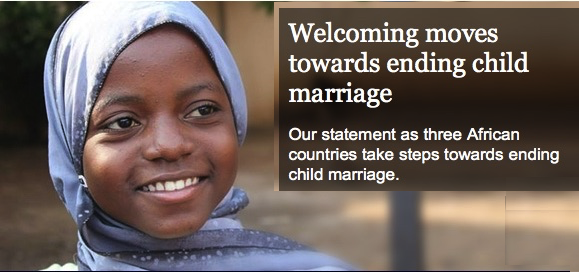
The Elders today welcomed recent moves by leaders in The Gambia, Tanzania and Uganda to end or curb child marriage, as part of the African Union’s continent-wide campaign to eradicate the harmful practice.

elders

In The Gambia, where almost a third of underage girls are married, President Yayha Jammeh has announced that anyone marrying a girl below 18 would be jailed for up to 20 years, with legislation due to by drawn up in the coming months. In Tanzania, meanwhile, parliament has declared that current child marriage laws are unconstitutional.

The Ugandan health ministry has also recently announced that it will provide more advice to girls and adolescents, and educate them on their sexual and reproductive health and rights, joining 10 other countries which have already adopted national strategies and action plans to end child marriage.

Kofi Annan, Chair of The Elders, said:

“It is encouraging to see more African leaders and legislators taking action to end the damaging and abusive practice of child marriage. This is an issue of rights, health, justice and protection that affects individual girls and women, their families and their wider community. Governments across the continent must now work hard to educate the wider population and eradicate this practice once and for all.”

The Elders have campaigned against child marriage since 2011, when they formed the global civil society alliance Girls Not Brides, now an independent organisation in its own right.

Mary Robinson added:

“As Elders, we are committed to promoting equality for women and girls and ending all forms of discrimination. Child marriage is cruel and harmful. It denies girls the chance of an education and economic independence. Their talents cannot then be tapped by communities which could benefit from their knowledge and resilience. These latest steps are welcome but much more still needs to be done to protect girls’ rights.”

(Thank you to Janet Hudgins, the CPNN reporter for this article)

Question related to this article:

Tunisia moves closer to achieving gender equality in politics

. WOMEN’S EQUALITY .

An article from UN Women

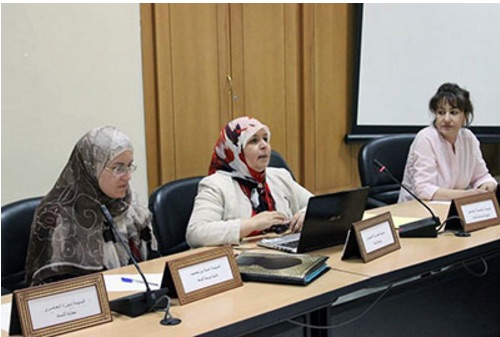
Tunisia’s Parliament has approved an amendment ensuring that women have greater representation in local politics. This amendment, which applies to both municipal and regional elections, includes a proposal for “horizontal and vertical” gender parity in Article 49 of the electoral law.

Tunisia
Plenary session in the Assembly of Representatives of the People (ARP), with UN Women. Photo: ARP
(click on photo to enlarge)

Horizontal parity requires that municipal election lists across Tunisia have equal number of both men and women, while vertical parity requires that men and women alternate within each list. Both were adopted by the Assembly of Representatives of the People (ARP), the Tunisian parliament, on 15 June 2016. Out of 134 representatives, 127 agreed to the new measure.

“The adoption of the new electoral law on parity aligns with the democratic path that the country has chosen to take,” said Bochra Belhaj Hamida, a parliamentarian and member of the Commission of Women, Family, Children, Youth and Seniors. “For the first time, 73 women parliamentarians, from different parties, backgrounds and political ideologies, voted unanimously and conducted their own lobbying in favour of the horizontal and vertical parity.”

UN Women joined forces with the advocacy efforts led by civil society for horizontal parity in local elections. On the eve of the plenary session in Parliament for this draft law, a specific session was held in partnership with the International Development Centre for Local Innovative Governance. Women parliamentarians presented arguments and evidence in favour of the adoption of horizontal and vertical parity.

(Continued in right column)

Question for this article

Prospects for progress in women’s equality, what are the short and long term prospects?

(Continued from left column)

According to the Gender Gap Report 2015, Tunisia is ranked 69th in terms of political empowerment out of 145 countries. Enshrining horizontal and vertical parity in the electoral law increases women’s chances of being elected in the upcoming local elections planned in March 2017, and will allow for better representation in municipal and regional councils. It constitutes significant progress towards inclusive government, equal opportunities and gender equality.

“Besides being a first in our region, the adoption of horizontal and vertical parity in electoral law is a timely achievement because it will guarantee effective participation of women in the upcoming decentralization process in Tunisia,” said Leila Rhiwi, UN Women Maghreb Representative.

In line with its efforts to support women’s leadership and political participation, in March 2016 UN Women initiated a project with parliamentarians in Tunisia that involved advocacy sessions around the legislative agenda, capacity building, networking and support for the implementation of the women’s caucus. This initiative, conducted with Members of Parliament, aims to improve the representation of women in both local and national politics. To date, four sessions have been held.

These efforts are in line with UN Women’s “Step It Up” initiative. At the Global Leaders’ Meeting on 27 September 2015, Tunisian Prime Minister Habib Essid pledged to expand women’s ability to participate in politics and public affairs, saying: “Our experience in democratic transition recently is witness to the fact that women should be represented in all legislative bodies. Hence, we enhance women’s ability to participate in politics and in public affairs. This is a commitment.”

Peace in Colombia Is Impossible Without Us, Women Declare

. . WOMEN’S EQUALITY . .

An article from Telesur TV

Colombian women, under the banner of “One Million Women for Peace,” are demanding a greater role in the peace talks between FARC insurgents and the government as negotiations wrap up.

Colombia women
Click on photo to enlarge and to read legend

The group has been growing its ranks in an effort to promote the signing of the peace deal and prepare for post-conflict stability, sociologist and human rights activist Gloria Florez told Prensa Latina on Wednesday.

According to the activist, the newly-formed bloc aimes to create a community movement to provide popular backing for the talks, which began in 2012, and promote implementation of the deal.

The movement brings together farmers, artists, journalists, youth and political representatives of indigenous and Afro-Colombian communities. On Tuesday, women at the U.N. Permanent Forum on Indigenous Issues insisted they be included in peace processes around the world because “women are pushing the culture of peace and not the culture of war.”

The decades-long conflict in Colombia has killed about 300,000 people, while six million remain displaced from their homes and another 45,000 remain missing. The “One Million Women for Peace” campaign argues that women are essential in building alternatives once the militarization is negotiated, said a former cabinet member of the Bogota municipality.

Question for this article

Do women have a special role to play in the peace movement?

The 40 articles in CPNN linked to this question make it clear that women indeed have a special role to play in the peace movement. See the following for an historical explanation of why this is true.

No Means No Kenya

. . WOMEN’S EQUALITY . .

An article from Ujamaa

NO MEANS NO KENYA works to provide simple, high impact Self- Defense training to as many women and children as possible worldwide. We believe prevention is key in the global rape epidemic. For far too long the overwhelming focus has been on aftercare strategies – this needs to change. It is believed that Self Defense training can raise a woman or child’s chance of prevailing in a sexual assault by up to 85%.

umamaa

It is our vision to mainstream self defense and end the fallacies and myths surrounding a woman or child’s ability to stop an assault. Our rape prevention efforts have appeared in over 40 media outlets including CNN, Huffington Post, MSNBC, Current TV, Daily Kos and Fox Sports.

No Means No Worldwide is a comprehensive rape prevention organization for girls and boys. We are a school based program that uses the IMpower system of violence prevention training. We teach classes in 6 week cycles, three times per school year, with the number of students ranging from 7000-9000 per cycle.

We believe the best response to the epidemic of sexual assault is to provide our male and female students with an awareness of the causes and effects of sexual gender based violence and the skills to intervene or prevent it.

Our research shows that in high schools where girls have taken our classes the incidence of rape drops from 20% annually to under 10%. Over half the girls in the intervention groups report having used the IMpower skills to avert sexual assault in the year after the training. Rates of disclosure increased in the intervention groups, but not in controls.

Preliminary research on our new IMpower boys curriculum shows that male students gender-negative attitudes towards women and girls were transformed to a more positive and supportive set of beliefs and behaviors. At 6-month follow-up, 334 of 676 respondents (49.4%) had witnessed a girl or woman being verbally harassed and 259 of 334 (77.5% had successfully intervened to stop the harassment. Similarly, 313 of 676 (46.3%) had witnessed a male physically threatening a girl or woman and 228 of 676 (33.7%) had witnessed a sexual assault. In these situations, 228 of 313 boys (72.8%) and 167 of 228 (73.2%) who witnessed these events, had successfully intervened to protect the victim.

(Thank you to Janet Hudgins, the CPNN reporter for this article)

Question related to this article:

Bahrain Women Association conducted a workshop on peace for Sitra Alahleya Society – Women club

. WOMEN’S EQUALITY .

Bahrain Women Association

As part of the activities of ‘Women embracing peace’ project to promote culture of peace in the community, BWA organized a training workshop on the culture of peace entitled ‘Sustainable peace .. from inside out’ at ‘Sitra Alahleya Society’ – Women Club on Wednesday, September 17th. The workshop aimed to introduce the concept of culture of peace and inner peace, and to discuss how to practice peace and finally to present ways and mechanisms to promote peace.

bahrain

The workshop explained the concept of peace in family and ways and means of applying it, and peace in community which explained that the relations between human beings are based on ground of peace and that the difference between people should lead to integration and development not to conflict and disharmony. The workshop emphasized on the importance of inner peace to achieve any other peace on the external level, be it the family or community.

At the end of the workshop, participants expressed their desire to participate in more events organized by BWA in the field of peace and tolerance, to enhance their role and their ability in promoting positive change in their communities.

Question for this article