All posts by CPNN Coordinator

About CPNN Coordinator

Dr David Adams is the coordinator of the Culture of Peace News Network. He retired in 2001 from UNESCO where he was the Director of the Unit for the International Year for the Culture of Peace, proclaimed for the Year 2000 by the United Nations General Assembly.

Ireland: AAA, An anti-austerity party in the footsteps of Syriza

. SUSTAINABLE DEVELOPMENT .

an article by Barthélémy Gaillard, Europe1 (abridged)

Anti-austerity parties are flourishing in Europe. After the victory of Syriza in Greece and the popular success of Podemos in Spain, it is the turn of the Irish anti-austerity Alliance (AAA). . .

Ireland
Click on photo to enlarge

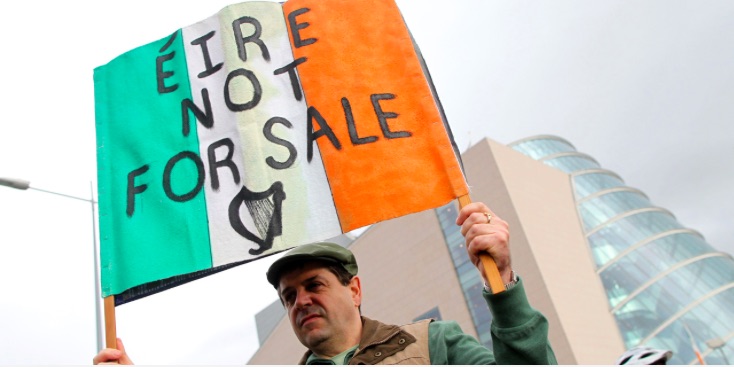
It must be said that the Irish radical left has found fertile ground in the economic policy of the current Prime Minister Enda Kenny in recent years. It is a strong and effective policy that has enabled the country to quickly get out of the circle of austerity. But at what price? This policy has aroused in the Irish population a protest sentiment crystallized in particular around payments for water. Traditionally, water was free, but now it must be purchased as one of the demands by the troika following the Irish bailout. There were immediate consequences throughout the country. There were 120,000 people who took to the streets in November to reflect a generalized dissatisfaction. “It is not only water, but what happened over the last five years,” a protester told Le Monde.

Politically, the first fruits of this resurgence of the radical left were felt during a by-election when 57% of voters voted for candidates who supported free water. It was a rejection of the government majority and its economic policy. This provided an ideal context for the AAA, repeating the same message carried by its young leader Paul Murphy: “The 99% of ordinary people” see the economic recovery as benefiting the 1% of the rich while the rest of the population continues to bleed ”

Like its Mediterranean counterparts, AAA has a charismatic young leader. While Podemos and Syriza have Pablo Iglesias (37) and Alexis Tsipras (41), the Irish Paul Murphy is even younger (32). This young politician won a surprise victory in legislative Dublin, in the style of a traditional left candidate. As Podemos relied on the dynamics of the Indignados in Spain, the AAA was born of a popular protest movement (against the water billing in Ireland), which the young leader applauds: “For the first time, the Irish people became aware of their strength, people organized themselves in their neighborhoods without being manipulated.” Murphy was himself involved in the struggle against the end of free water. He was arrested by police Monday, February 9, according to an article in the Irish Times, in solidarity with the protesters.

However, AAA says it does not want to imitate Syriza or Podemos and will have to find its own model. They have an additional challenge in the political landscape compared to their Greek and Spanish alter egos: Sinn Fein, the political wing of the Irish independence, highly installed, is already taking an anti-austerity position. And they are doing well in the polls. AAA is challenged to find its place on the Irish political spectrum and to find its identity within the European radical left. And they need to move quickly as the next general election will be held in just over a year, in April 2016.

(Click here for the original French version of this article)

Question for this article:

Movements against governmental fiscal austerity, are they part of the global movement for a culture of peace?

Readers’ comments are invited on this question.

Continuation de L’Amérique latine en perspective

(continuation de l’article)

L’Histoire est en train de s’inverser doucement mais surement. Ainsi, les ravages causés par les politiques d’austérité en Europe couplé aux réussites fabuleuses des politiques sociales au Venezuela, en Bolivie ou en Equateur ainsi qu’au poids important de pays émergents comme le Brésil ont permis à L’Amérique Latine de s’attirer la sympathie et l’admiration de ceux qui en Europe luttent pour un système économique alternatif et un monde multipolaire où chaque pays jouerait de manière égal sa partition dans le concert des nations libres. Alors bien sur, il ne s’agit pas de copier ou de calquer l’expérience latino-américaine en Europe, mais de s’en inspirer et de prendre exemple sur des pays qui ont vécu la même situation que celle que vit le vieux continent aujourd’hui et qui peuvent désormais se taguer d’avoir des taux de croissance important, une baisse significative de leur dette, une diminution spectaculaire de la pauvreté et, au Venezuela et en Bolivie, la disparition pur et simple de l’analphabétisme.

Lors d’une conférence donné en français en novembre 2013 à la Sorbonne, le président équatorien Rafael Correa avait très justement affirmé que « l’Europe endettée reproduit nos erreurs », sous entendu les erreurs commises par les gouvernements néolibéraux sud-américains comme Carlos Menem en Argentine ou Carlos Andrès Pérez au Venezuela. Les orientations révolutionnaires et progressistes prises par certains pays d’Amérique du sud depuis environ quinze ans ont été un sacré pied de nez à ceux qui proclamaient la « fin de l’histoire ». Les maux dont souffre l’Europe sont les mêmes dont a souffert l’Amérique Latine il y a 20 ans. Et pourtant, grâce à des présidents courageux et déterminés à mettre fin à cet état de fait, les choses ont beaucoup changé. Reconquête des souverainetés populaires, nouvelles orientations économiques, nouvelle vision de la politique et de la démocratie… L’Amérique Latine, malgré un passé symbolisé par l’exploitation et le pillage, décrit comme un continent violent emprunt aux dictatures, montré avec l’Afrique comme le continent où règne la misère, cette Amérique Latine là a depuis bien changé et l’Europe, et plus généralement l’Occident, devraient s’en inspirer au lieu de vouloir la déstabiliser par le biais d’un vieil outil qui reste toujours à la mode : l’impérialisme.

L’Amérique Latine, une menace pour l’idéologie dominante

Néanmoins, le moins que l’on puisse dire, c’est que les transformations qui ont eu lieu en Amérique latine n’ont pas fait que des émules outre Atlantique. En effet, si la gauche radicale européenne a salué les transformations latino-américaines, les principaux partis des gouvernements européens, ainsi que les médias, se sont eux lancés dans une guerre ininterrompue contre les présidents insoumis du sous-continent.

Depuis que le Venezuela, suivie d’autres pays de la région, ont commencé à tenir tête aux puissances impérialistes occidentales et aux multinationales, ces pays sont devenues les cibles récurrentes des médias dominants. Le Monde, Libération, El Pais, La Repubblica etc., tous ces puissants médias aux mains de richissimes hommes d’affaires ont tout fait pour donner une image désastreuses des nouvelles expériences qui jalonnent l’Amérique latine. La déontologie journalistique a été abandonnée pour laisser la place aux invectives, aux mensonges et aux caricatures ignobles. Les médias, redoutables professionnels de la propagande, ont ainsi tout essayer pour tenter de donner une image néfaste des présidents Chavez, Morales, Correa… Souvent, ils ont volontairement occultés les réussites en matière de politique économique et sociale des pays concernés, préférant traiter les présidents en question de « dictateurs » ou de « populistes ». Les puissances impérialistes ont de leur coté vivement soutenues l’opposition fasciste, d’abord au président Chavez puis à son successeur, Nicolas Maduro.

La même chose se passe dans les autres pays, avec le soutien financier nord-américain à l’oligarchie bolivienne ou équatorienne par exemple. On sait maintenant le rôle fondamental qu’ont joué les gouvernements occidentaux, notamment Washington, pour détruire la vague socialiste qui déferlait dans le continent de Bolivar. Mais pourquoi tant d’acharnement à vouloir s’en prendre à des pays démocratiques et souverains ? Pourquoi tant de médiamensonges ? Cette méfiance des nations occidentales envers ce qui se passe en Amérique latine s’explique par la peur que suscite une contagion régionale puis internationale des révolutions latino-américaines. Les maitres de l’économie mondiale tremblent face à une possible « théorie des dominos ». On en est bien sûr assez loin mais la violence avec laquelle les médias et les puissances occidentales traitent certaines nations latino-américaines en dit long sur le danger que celles-ci représentent pour l’ordre économique et géopolitique mondial. Après la disparition de l’URSS, les Etats-Unis étaient devenues les maitres du monde et se permettaient tout, dans la plus grande impunité. L’économie néolibérale était imposée un peu de partout et la « fin de l’histoire » était déclarée. Mais le réveil des peuples d’Amérique Latine est venu bousculer un système qui se croyait tout puissant et à l’abri des révoltes. Les tentatives d’expérimentation de système économique alternatif visant à dépasser le capitalisme et l’émergence de puissances émergentes ont donné à l’Amérique Latine un nouveau statut et un nouvel aura dans le monde. Désormais, le continent a son mot à dire et ne se soumet plus, du moins certains pays, à l’impérialisme et au néocolonialisme états-unien et européen. Le continent lutte jour après jour pour arracher son indépendance économique, sa « véritable et définitive seconde indépendance » tel que le proclamait le comandante Chavez.

Le chemin est encore très long et le combat contre les ennemis intérieurs et extérieurs ne se fera pas sans dommages. Les contradictions inhérentes au processus de changement qui touche le continent constitueront de grands défis pour le future.

Quels défis pour l’avenir de l’Amérique latine ?

Les difficultés, les contradictions et les défis restent à l’ordre du jour en Amérique latine et dans les pays concernés par ce processus de changement social historique. Dans ce sens, si l’on veut contribuer à faire évoluer le processus, si l’on veut voire la révolution des peuples latino-américains s’approfondir et se radicaliser pour dépasser pas seulement le système néolibérale mais le système capitaliste, il est nécessaire assumer ces difficultés et de s’en approprier.

De nos jours, dans une situation tellement désespérante en Europe, nous aurions tendance à idéaliser le processus d’intégration latino-américain. Et pourtant, les difficultés et les contradictions inhérentes à ce processus existent bel et bien. Elles sont naturelles et propres à tout processus de changement social. Les pays de Notre Amérique ont plus que jamais besoin de notre solidarité et d’un regard d’égal à égal. Une attitude amicale consisterait donc à signaler les risques et les défis existants sans le moindre trace du paternalisme et de l’arrogance si caractéristiques du passé colonial européen. Nous devons faciliter les conditions pour l’approfondissement des politiques pour la transition vers un nouveau paradigme post-capitaliste, vers le socialisme latino-américain du 21ème siècle. La responsabilité historique de la gauche européenne doit être celle d’interpréter quel est le besoin de solidarité concrète à chaque instant, dans un monde dominé par la désinformation, et de contrecarrer la propagande qui se développe au quotidien sous nos yeux. Notre but est simple : manifester au monde entier qu’en Amérique latine une révolution est en marche. Une révolution que oui, certes, présente des anomalies et parfois des incohérences, mais qui reste une révolution qui vise à bouleverser l’ordre économique et politique qui a détruit, au sens strict du terme, ce continent. Une révolution qui représente un espoir et une alternative pour tous les pays du Sud. Une révolution qui est en train de contribuer à un progrès social généralisé. Dans cette période de crise systémique du capitalisme mondiale, les politiques sociales latino-américaines devraient inspirer autres parties du monde en difficulté, notamment l’Europe et à l’Amérique du nord de l’austérité, de la précarité et de la dégradation sociale. Donc oui, s’approprier des défis et des contradictions de ce processus est un devoir fondamental pour nous tous. Cela pour en comprendre soigneusement les caractéristiques et être ainsi capables d’argumenter, de démontrer, à l’appui de bases et connaissances solides, que oui, une alternative est possible, que oui, la lutte contre l’impérialisme et le ravage néolibérale est en marche, pour la construction d’un monde de paix et justice sociale.

Fin de l’article:

Comme on a vu auparavant, la situation et les conditions socio-économiques dans les différents pays touchés par ce processus se sont assurément améliorées. Des importantes réformes politiques ont vu le jour dans la majorité de ces pays, favorisant l’accroissement de la participation des populations (notamment les populations indigènes) jadis exclues de la vie et de l’action politique et, aujourd’hui, finalement propriétaires d’une « conscience politique », leur permettant d’avoir une incidence majeure. La promotion de l’inter-culturalité et la plurinationalité ont aussi été une réalité, comme le témoigne l’instauration de L’Etat Plurinational de Bolivie et sa nouvelle Constitution politique.

Un nouveau modèle de développement est-il possible ?

La voie vers une nouvelle conception/paradigme de développement a tout de même commencé, avec l’introduction (au niveau normatif et des discours) de l’élément naturel (la Pachamama, la Madre Tierra, en espagnol) comme caractère de premier plan dans les stratégies de développement. C’est un bouleversement à ne pas sous-estimer. Malgré ce qu’écrivait Marx à propos du lien entre capitalisme et destruction de la nature, les expériences socialistes passées n’ont pas mis l’accent, pour des claires raisons historiques et stratégiques, sur la nécessité de placer la nature au centre des politiques de développement. C’est-à-dire que la conception dominante restait fondamentalement anthropocentrique au lieu de biocentrique. Les avances plus importantes dans ce sens on peut les observer en Equateur et en Bolivie, où l’introduction des droits de la nature au sein de la constitution représente une nouveauté pionnière. Néanmoins, à cause de l’état de dépendance de l’économie extractive, ces avances et ces discours restent sur la carte. Mais au moins, ils sont inscrits sur la carte. La concrétisation du processus de changement (avec notamment l’émancipation du système capitaliste, l’intégration économique au sein du bloc progressiste latino-américain, la création d’institutions supranationales latino-américaines dans les secteurs clés des économies et la mise en ouvre d’une stratégie économique nationale basée sur la diversification économique) aura le devoir de transposer ces discours et ces lois dans des politiques tangibles et effectives.

Or, tout ce qui brille n’est pas de l’or. Les hiérarchies et les structures de domination hérités des périodes précédentes (la période coloniale et celle néocoloniale) sont encore en place. Comme le dit François Houtart, sociologue belge, le processus latino-américain est aujourd’hui un processus post-néolibéral mais pas encore post-capitaliste. Pour lui, le caractère post-néolibéral est très affirmé, pour le fait de vouloir concrétiser la reconstruction de l’Etat, récupérer ses rôles et se libérer de l’ingérence hégémonique des chiens de garde du capital financier international : la Banque Mondiale et le Fond Monétaire Internationale. Néanmoins, à l’heure actuelle, on ne peut pas parler de tout cela comme d’une transformation post-capitaliste : les pays latinos (sauf Cuba) restent essentiellement dans une logique organisationnelle de leur économie qui est capitaliste, l’exploitation de la force travail est toujours une réalité même si, à différence des pays néolibérales, des politiques redistributives ont amélioré les conditions de vie des travailleurs. Au Venezuela par contre, la transition est allée plus loin, l’approfondissement de la révolution bolivarienne a contribué à créer des nouvelles formes d’organisation au sein des entreprises et des communes socialistes autogouvernés.

En outre, dans tous ces pays (aussi dans ce cas sauf Cuba et en moindre mesure au Venezuela) les multinationales continuent à dicter la loi pour ce qui concerne notamment l’extraction des ressources naturelles, hydrocarbures et produits miniers en primis. En Equateur, Chevron est toujours très influent dans les politiques extractives du pétrole amazonien. En Bolivie, malgré des importantes vagues de nationalisation dans l’industrie minière et des hydrocarbures, initiées par le gouvernement Morales en 2006, les multinationales sont encore sur place, puissantes, agressives comme d’habitude, en train de polluer les écosystèmes et asservir les populations locales. A l’est du pays, encore sous le contrôle de l’oligarchie blanche du pays, Monsanto dicte la loi dans les immenses plantations de soya. Inutile de discuter du cas du Brésil et de l’Argentine, pays encore plus en arrière dans ces processus de changement structurel.

Origine et nature de ces contradictions

Mais pourquoi, se demande beaucoup de monde, en dépit des discours des acteurs politiques de ces pays, le processus fatigue à prendre son essor ? Nous pensons que cette question est en effet mal formulée. Le processus ne fatigue pas à progresser. Le processus est, par sa même étymologie, quelque chose qui avance par étapes. Cela détermine des contradictions inévitables, des « tensions créatives au sein de la révolution », comme l’affirme le vice-président bolivien Alvaro Garcia Linera. Des tensions, inévitables, qui « d’un côté, menacent la poursuite (de la révolution) ; de l’autre, elles permettent d’imaginer les moyens de passer à l’étape ultérieure ». Comme on l’écrivait dans un vieil article de Investig’Action, « pour dépasser cette contradiction, le premier pas sera la démocratisation et puis l’appropriation par la société du processus juridique d’arbitrage. Il faut pousser une avant-garde garante de l’intérêt commun. Dans un premier temps, l’objet devrait être la réduction des inégalités par une redistribution des richesses. La deuxième étape, constituerait la transformation progressive du peuple en instance collective ».

Ces contradictions seront d’autant plus marquées dans le cas de pays comme ceux latino-américains à l’entrée dans le 21ème siècle, présentant des caractéristiques à prendre en compte. La Bolivie, L’Equateur et le Venezuela, par exemple, ont été probablement les pays les plus touchés par la dévastation néolibérale de l’Amérique latine, arrangée par les gendarmes du néocolonialisme occidental, la Banque Mondiale et le FMI, en accord avec les grandes puissances occidentales. Tout résidu de tissu industriel a été anéanti, les populations indigènes spoliés de leur droits, la pauvreté se trouvait à des niveaux catastrophiques (en 2005 la Bolivie était, après Haïti, le deuxième pays le plus pauvre de tout l’hémisphère occidental)… L’un des héritages les plus douloureux de la période néolibérale, dont on ne fait pas assez souvent mention, est sans doute la totale dépendance des économies de ces pays aux exportations de produits non-finis (notamment pétrole brut, produits miniers, gaz et autres hydrocarbures). Il faut considérer aussi le fait que cette dépendance se manifeste aussi de la côté du savoir technologique et administratif. Ce fait implique que au moment de leur entrée en jeu, les présidents progressistes latino-américains se sont trouvés dans un état de (totale) dépendance vers les marchés internationaux et le « jeu » du commerce international de matières premières. Sortir d’un jour à l’autre de ce « jeu » aurait signifié l’impossibilité, pour ces pays, de financer leurs politiques sociales et de soutenir leurs dépenses en général. Par conséquence, dans le court-terme, le maintien de liens des pays progressistes avec le système capitaliste international est une condition nécessaire pour leur survie.

Le processus d’intégration latino-américain et la route vers le socialisme du 21ème siècle s’inscrivent dans un processus long, complexe, trempé d’entraves et inéluctablement contradictoire. C’est justement pour ces difficultés, qui de surcroit s’accompagnent d’une intensification de la machine impérialiste à l’échelle globale, qu’on a la responsabilité de suivre et appuyer ce mouvement émancipateur depuis nos réalités. Ça relève de l’avenir de nous tous, de tous les peuples qui luttent pour la paix, la liberté et la justice sociale.

Cet article fait partie du “Journal de Notre Amérique n°1”, pour lire ce Journal cliquez ici.
L’Amérique latine en perspective : entre réussites et nouveau défis

. . DEVELOPPEMENT DURABLE . .

Un article par Raffaele Morgantini , Tarik Bouafia, Investig’Action

Après les décennies perdues des années 1980 et 1990 qui ont vu l’Amérique Latine sombrer dans la pauvreté extrême, le chômage de masse et l’explosion des dettes publiques, le continent a depuis relevé la tête et est aujourd’hui devenu un ambitieux laboratoire d’expérimentations de nouvelles politiques sociales et économiques. Venezuela, Bolivie, Equateur, Argentine…Les cures d’austérités imposées à certains pays de la région par le Fond Monétaire International (FMI) et la Banque Mondiale ont été abandonnés au profit de politique de relance où l’Etat a repris avec plus ou moins d’importance un rôle prépondérant dans la gestion de l’économie.

new latin

L’Amérique Latine, un espoir pour l’Europe.

Pendant que certains pays d’Amérique latine retrouvent leur dignité et leur souveraineté, en Europe en revanche, l’austérité fait des ravages. Irlande, Espagne, Portugal, Grèce… aucun pays n’est épargné. Le PIB s’effondre, la pauvreté et le chômage explosent et la dette ne cesse de s’accroitre. Ces politiques antisociales ont provoqué des soulèvements populaires qui ont ébranlé les pouvoirs en place. Les partis de la gauche radicale Syriza en Grèce et Podemos en Espagne (qui affirment vouloir s’inspirer des orientations prises par l’Equateur ou encore l’Argentine au sujet du fardeau de la dette), en tête dans les intentions de vote, sont en train de faire hurler les sirènes de Bruxelles et des marchés financiers. De plus, on ne compte plus les associations, syndicats, partis politiques, médias alternatifs qui en Europe ont applaudi les succès latino-américains. Une euphorie de la gauche radicale européenne qui contraste avec la vision réactionnaire, caricaturale, grossière et mensongère de ceux qui ont tout d’intérêt à que les choses ne changent pas.

Pendant très longtemps, beaucoup de latino-américains regardaient l’Europe avec admiration. Et aujourd’hui encore, l’Europe fascine. Ce regard porté vers le vieux continent provient de nombreux facteurs : culturelles, historiques, économiques. Certains souhaitent connaître leur « mère patrie » comme l’Espagne ou le Portugal. D’autres, comme en Argentine, veulent se rendre en Italie, dans le pays de leurs ancêtres. Enfin, certains associent l’Europe à son histoire, sa grande culture et son architecture.

Mais depuis quelques temps, les choses commencent à s’inverser en tout cas en ce qui concerne l’attrait économique de l’Europe. Même si il reste bien sûr des latino-américains qui tentent de rejoindre l’Europe pour de meilleures conditions sociales et économiques, la donne a changé depuis quelques années. Les changements politiques survenues dans de nombreux pays du continent bolivarien ont freiné l’exode massif qui caractérisait les années 1980-1990 et début 2000. Les politiques économiques et sociales novatrices impulsés par certains pays de la région dans le but d’apporter à leur peuple une vie plus digne ont incité de nombreux citoyens à rester dans leurs pays plutôt qu’à émigrer. D’autant plus que l’histoire s’est retournée et qu’aujourd’hui, c’est l’Europe qui pâtit des politiques d’austérité. Les forts taux de chômage que connaissent l’Espagne ou le Portugal ont rendu ces pays de moins en moins attrayants. Cette Europe qui avait tant dominé et s’était montrée si méprisante envers ses anciennes colonies est aujourd’hui malade et ne fait presque plus rêver. La situation est si dramatique que de nombreux citoyens latino-américains, notamment argentins, qui avaient émigré au début des années 2000 pour fuir la terrible situation économique du pays ont décidé de rentrer dans leur pays.

(cliquez ici pour la continuation de l’article)

(cliquez ici pour une traduction en anglais)

Question for this article:

Movements against governmental fiscal austerity, are they part of the global movement for a culture of peace?

Readers’ comments are invited on this question.

Continuation of Latin America in Perspective

(continued from main article)

History is being reversed slowly but surely. Thus, the devastation caused by austerity policies in Europe coupled with the fabulous success of social policies in Venezuela, Bolivia and Ecuador as well as the considerable weight of emerging countries such as Brazil have enabled Latin America to attract sympathy and admiration of those in Europe who are fighting for an alternative economic system and a multipolar world in which each country would play its partition so equal in the community of free nations. Of course they are not trying to copy or emulate the Latin American experience in Europe, but they are inspired and follow the example of countries are achieving significant growth rates, a significant decline in their debt, a dramatic decrease in poverty, and in Venezuela and Bolivia the outright elimination of illiteracy.

In a lecture spoken in French in November 2013 at the Sorbonne, Ecuadorian President Rafael Correa remarked that “Europe endebtedness reproduces our mistakes,” alluding to the mistakes South American neoliberal governments like Carlos Menem in Argentina and Carlos Andres Perez in Venezuela. The revolutionary and progressive direction taken by some countries in South America for about fifteen years have been quite a snub to those who proclaimed the “end of history”. The evils affecting Europe are the same that plagued Latin America 20 years ago. However, thanks to courageous Presidents determined to put an end to this situation, things have changed a lot. A reconquest of popular sovereignty, new economic policies, new vision of politics and democracy … Overcoming a past symbolized by exploitation and plunder, described as a violent continent ruled by dictatorships, considered with Africa as the continent where poverty reigns, Latin America has since changed Europe, and more generally the West should take inspiration instead of trying to destabilize it through an old tool always in fashion: imperialism.

Latin America, a threat to the dominant ideology

The least we can say is that the transformations that have taken place in Latin America have not been emulated across the Atlantic. Although the European radical left has praised Latin American transformations, the major parties of the European governments and the media have engaged in a continuous war against the rebellious Presidents of the subcontinent.

Beginning with Venezuela and then followed by other countries that have started to stand up to the Western imperialist powers and multinationals, these countries have become recurrent targets of the European mainstream media. Le Monde, Libération, El Pais, La Repubblica etc., all these powerful media in the hands of wealthy businessmen did everything to give a disastrous image of the new experiences that mark Latin America. Journalistic ethics was dropped to make room for invective, lies and vile caricatures. The media were professionals at propaganda, trying everything they could to give a negative image of the Presidents Chavez, Morales, Correa … Often they have purposely ignored successes in economic and social policy of the countries concerned, preferring to treat their presidents as “dictators” or “populist”. At the same time, the imperialist powers have strongly supported the fascist opposition, first to President Chavez and now to his successor, Nicolas Maduro.

The same thing happens in other countries, with the North American financial support for the Bolivian or Ecuadorian oligarchy for example. We now know the fundamental role played by Western governments, including Washington, to destroy the socialist wave that is sweeping the continent of Bolivar. Why do they attack democratic and sovereign countries? Why are there so many media lies? This distrust of Western nations to what is happening in Latin America is due to the fear aroused by regional and international contagion of Latin American revolutions. The masters of the world economy tremble in the face of a possible “domino theory.” Of course such a change is still far away, but the violence with which the media and the Western powers attack certain Latin American nations speaks volumes about the danger they pose to the global economic and geopolitical order. After the disappearance of the USSR, the United States had become the masters of the world and could act with full impunity. The neoliberal economy was imposed everywhere and the “end of history” was declared. But the awakening of the peoples of Latin America came as a shock a system that believed itself to be all powerful and immune to revolts. The experimental attempts in alternative economic systems to overcome capitalism and the rise of emerging powers have given Latin America a new status and a new will in the world. Now, the continent has its say and is no longer submissive, at least in some countries, to the imperialism and neocolonialism of the United States and European Union. The continent struggles day after day to ensure its economic independence, its “true and final second independence” as the commander Chavez proclaimed.

The road is still very long and the fight against internal and external enemies will not happen without damage. The contradictions inherent in the process of change that affects the continent constitute major challenges for the future.

Challenges for the future of Latin America?

Difficulties, contradictions and challenges remain on the agenda. In this sense, if we want to help the process of change, if we want the revolution of the Latin American peoples to deepen and radicalize and to overcome not just the neoliberal system but the entire capitalist system, it is necessary take on these challenges and to take ownership of them.

Today, considering the desperate situation in Europe, we tend to idealize the Latin American process of integration. Yet the difficulties and contradictions inherent in the process do exist. They are natural and suitable for any process of social change. The countries of Our America more than ever need our solidarity and to be regarded as equals. A friendly attitude would therefore be to point out the risks and challenges that exist without the paternalism and arrogance so characteristic of the European colonial past. We need to facilitate conditions for the deepening of policies for the transition to a new post-capitalist paradigm to the Latin American socialism of the 21st century. The historical responsibility of the European Left should be that of interpreting what is the need of concrete solidarity at every moment, in a world dominated by misinformation and propaganda that grows every day before our eyes. Our goal is simple: to show the world a revolution in Latin America is working. Yes, it is a revolution that is abnormal and sometimes inconsistent, but still it is a revolution that seeks to upset the economic and political order that destroyed their continent. It is a revolution that represents hope and an alternative for all the South, a revolution that is currently contributing to widespread social progress. In this period of systemic crisis of global capitalism, Latin American social policies should inspire other parts of the troubled world, including Europe and North America, to overcome austerity, insecurity and social degradation. So yes, to acknowledge the challenges and contradictions of this process is a fundamental duty for all of us. We need to understand the features and thus be able to argue, demonstrate, in support of a solid foundation and knowledge, that yes, an alternative is possible, yes, the struggle against imperialism and neoliberal havoc is on, to build a world of peace and social justice. As we saw earlier, the situation and the socio-economic conditions in the countries affected by this process have certainly improved. Important political reforms have emerged in most of these countries, promoting increased participation of the population (including indigenous people) previously excluded from the life and political action, and now possessing a “political consciousness”, enabling them to have a major impact. Promoting interculturalism and plurinationality were also a reality, as evidenced by the introduction of the Plurinational State of Bolivia and its new Constitution.

Last part of article:

A new development model: is it possible?

The path to a new design / development paradigm has already started with the introduction (at the normative level and in speeches) of the natural element (Pachamama, Madre Tierra in Spanish) as a leading character in development strategies. This is a revolution not to be underestimated. Despite what Marx wrote about the relationship between capitalism and destruction of nature, past socialist experiments have not emphasized, for clear historical and strategic reasons, the need to put nature at the center of policy development. That is to say the dominant design remained fundamentally anthropocentric instead of biocentric. The most significant advances in this direction can be observed in Ecuador and Bolivia, where the introduction of nature’s rights in the constitution is a pioneering new. However, because of the dependence of the extractive economy, these advances and the speeches remain on the drawing board. But at least they are being considered. Words and laws will have to be translated into tangible and effective policies if the change process is to achieved, including the emancipation from the capitalist system, economic integration within the Latin American Progressive Bloc, creating Latin American supranational institutions in key sectors of the economy and the implementation of a national economic strategy based on economic diversification.

But all that glitters is not gold. Hierarchies and power structures inherited from previous periods (colonial and neo-colonial one) are still in place. In the opinion of Francois Houtart, Belgian sociologist, the Latin American process is now a post-neoliberal processes but not yet post-capitalist. For him, the post-neoliberal character is achieved with the reconstruction of the State, recovery of its roles broken free from the hegemonic interference watchdogs of international finance capital: the World Bank and the International Monetary Fund. However, at present, we can not speak of it as a post-capitalist transformation. Latin countries (except Cuba) retain economies with capitalist exploitation of the labor force although, unlike in the neo-liberal countries, redistributive policies have improved the workers’ living conditions. In Venezuela the transition has gone further, deepening the Bolivarian revolution has helped to create new forms of organization within companies and self-governing socialist communes.

In addition, in all these countries (except Cuba and Venezuela to a lesser extent) multinationals continue to dictate the law to concerning the extraction of natural resources, oil and mining products. In Ecuador, Chevron is still very influential in the mining policies of the Amazonian oil. In Bolivia, despite major nationalization wave in mining and hydrocarbons, initiated by the Morales government in 2006, multinationals are still there, powerful, aggressive, as usual, trying to pollute ecosystems and enslave local populations. To the east of the country, still under the control of the white oligarchy of the country, Monsanto dictates the law in the vast soy plantations. It is needless to discuss the cases of Brazil and Argentina, as they are further back in the process of structural change.

Origin and nature of these contradictions

It is often asked, why, despite the discourse of political actors in these countries, does the process fail to take off? We believe that this question is poorly worded. The process is not failing to take off. The process is, by its very nature, something that advance in stages. This leads to inevitable contradictions, “a creative tension within the revolution” , as it is called by the Bolivian Vice President Alvaro Garcia Linera. There are inevitable tensions that “on one side, threaten the continuation (of the revolution); on the other, allow to imagine how to move to the next stage”. As we wrote in an previous article of Investig’Action, “to overcome this contradiction, the first step will be democratization and then the appropriation by the society through legal arbitration. You have to push a vanguard guarantor of the common interest. Initially, the object should be to reduce inequalities through redistribution of wealth. The second stage would be the gradual transformation of the people into a collective entity”.

These contradictions will be more marked in the case of countries such as those in Latin America entering the 21st century with characteristics to consider. Bolivia, Ecuador and Venezuela, for example, were probably the countries most devastated by the neoliberal policies of Western colonialism, the World Bank and the IMF, in agreement with the Western powers. Any remaining fabric of industry was annihilated, indigenous peoples were deprived of their rights, poverty was at catastrophic levels (in 2005 Bolivia was, after Haiti, the second poorest country in the Western Hemisphere) … One of the most painful legacies of the neoliberal period, which we do not often mention, is undoubtedly the total dependence of the economies of these countries on exports of non-finished products (including crude oil, mining, gas and other hydrocarbons). We must also consider the fact that this dependence is also evident from the side of the technological and administrative knowledge. This fact implies that when they entered the game, the Latin American progressive presidents have found themselves in a state of (total) dependency on international markets and the “game” of international trade in raw materials. To quit this game from one day to another would have meant the inability of these countries to finance their social policies and to support their spending in general. Consequently, in the short-term, maintaining links of progressive countries with international capitalist system is a necessary condition for survival.

The Latin American integration process and the road to socialism of the 21st century are part a long, complex process, tempered with barriers and inevitably contradictory. It is precisely because of these difficulties, which in addition are accompanied by an intensification of imperialist machine on a global scale, that we have the responsibility to monitor and support the movement for emancipation from the old system. It concerns the future of all of us, of all people who struggle for peace, freedom and social justice.

This article is part of the “Journal of Our America # 1” , to read the Journal click here. Source : Investig’Action

Latin America in perspective: Between successes and new challenges

. SUSTAINABLE DEVELOPMENT .

An article by Raffaele Morgantini , Tarik Bouafia, Investig’Action

After the lost decades of the 1980s and 1990s that saw Latin America falling into extreme poverty, mass unemployment and the explosion of public debt, the continent has since raised its head and has become an ambitious laboratory experiment for new social and economic policies. Venezuela, Bolivia, Ecuador, Argentina … austerity cures imposed on some countries in the region by the International Monetary Fund (IMF) and the World Bank have been abandoned in favor of stimulus policies where the state has taken up a key role in managing the economy.

new latin

While some Latin American countries regain their dignity and sovereignty, in Europe, it is the opposite: austerity has wreaked havoc. Ireland, Spain, Portugal, Greece … no country is spared. While the GDP is collapsing, poverty, unemployment, and exploding debt continue to increase. The anti-social austerity policies have provoked popular uprisings that have shaken the powers that be. The parties of the radical left, Syriza in Greece and Podemos in Spain (who say they want to follow the directions taken by Ecuador or Argentina about the burden of debt), are leading in the polls and producing alarm in Brussels and the financial markets. In addition, there are countless associations, unions, political parties and alternative media in Europe who are applauding the Latin American success. There is a new euphoria in the European radical left, which contrasts with the vision of reactionaries, grotesque, crude and misleading, wanting to ensure that things do not change.

In the past, many Latin Americans looked admiringly at Europe. And even today, Europe is fascinating. This regard towards the old continent comes from many factors: cultural, historical, economic. Some want to know their “motherland” such as Spain and Portugal. Others, such as Argentina, want to go to Italy, the land of their ancestors. Finally, some associate Europe with its history, its great culture and architecture.

But lately, things have started to reverse with regard to Europe’s economic attractiveness. While there are still some Latin Americans trying to reach Europe to better their social and economic conditions, the situation has changed in recent years. The political changes that occurred in many countries of the Bolivarian continent slowed the mass exodus that characterized the years 1980-1990 and early 2000. The innovative economic and social policies driven by some countries of the region in order to bring their people a more dignified life have prompted many people to stay in their country rather than emigrate. Especially now that the story has turned around and today it is Europe that suffers austerity policies. The high levels of unemployment experienced by Spain and Portugal have made ​​those countries less attractive. The Europe that once dominated and had been so contemptuous of its former colonies is now sick and now longer inspires. The situation is so dramatic that many Latin American citizens, including Argentinians, who emigrated in the early 2000s to escape the terrible economic situation have decided to return home.

(click here for continuation of article)

(click here for the original French version)

Question for this article:

Movements against governmental fiscal austerity, are they part of the global movement for a culture of peace?

Readers’ comments are invited on this question.

Germany: Street Notes From Blockupy Frankfurt

. SUSTAINABLE DEVELOPMENT .

An article by Victor Grossman, Counterpunch

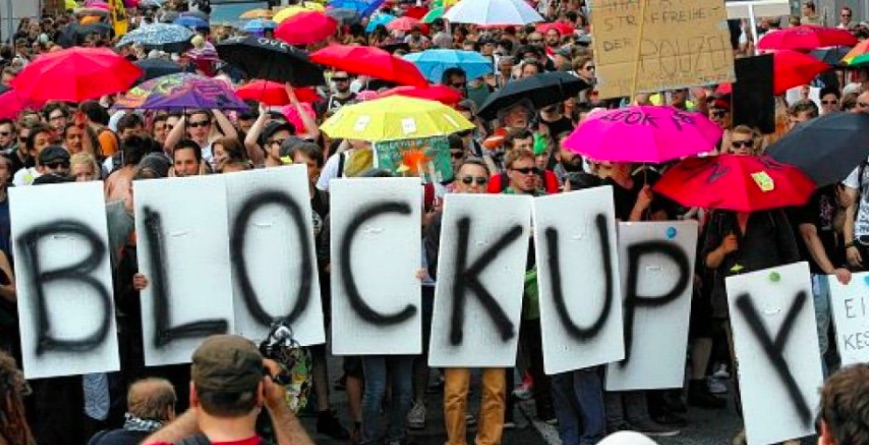
I defied my advanced age last week to board a  special train, with a thousand mostly young people, and join in the big “Blockupy” demonstration in Frankfurt/Main, Germany’s big banking city. The trip,  though not the usual 4 ½ but seven hours, retained till well into the night a spirit of happy anticipation.

Germany
Click on photo to enlarge

Photo from left-flank.org

Hardly one year old, Podemos is already vying for the top spot in Spanish polls. This precocious The occasion was the opening of a giant new European Central Bank building, over four years and $1.4 billion in the making, one more modernistic banking skyscraper to reshape the city’s skyline, with two adjacent towers reaching up 201 meters (660 ft.). Our aim was to protest and disrupt the ceremonies, the role of the bank and the entire policy of the European Union of forcing austerity policies on its members and especially trying to compel Greece’s new Syriza government to further bankrupt itself by paying excessive foreign  bank debts and thus abandoning its goal of relieving the misery of countless jobless, hungry citizens, their loss of even basic medical care and often enough of any livelihood whatsoever.

Our slow train’s midnight arrival caused my little group to miss the early hours of protest the next day, March 18th – which had in part been violent hours. The Blockupy organizers, from a wide variety of organizations, had planned to prevent normal ceremonies by means of non-violent actions, sitting or standing to blockade the entranceways to the bank, with street theater and waves of umbrellas with painted slogans.

About 6000 people did just that – and certainly spoiled the ceremonial show. Hardly more than a handful of prominent guests had been invited, with police escort, to slip past the demonstrators for a very subdued event – and only six journalists, not even one from Frankfurt’s main newspapers (to their great indignation). This was a big success – for Blockupy.

But, even earlier, about a thousand demonstrators, apparently from the masked “black bloc”, had come hunting for greater trouble. Ten thousand police, detachments from all over Germany, having prepared for months for an expected remmi-demmi (the German word sounds wilder and apter than hubbub or tumult), confronted them with water cannon and tear gas. Who started things off is in dispute, but the free-for-all battle erupted into hails of plaster stones and other hard objects, burning cars and emptied, burnt out dumpsters, clouds of various chemicals, many injuries on both sides, countless arrests and huge pillars of smoke darkening the sky.

Since our slow train from Berlin had arrived after midnight, my small group slept to long and didn’t get to the fenced-off area near the skyscraper until nearly 9 AM. The police units and water cannon vehicles, some resembling tanks, seemed now at rest. Our march though a downtown area moved along peacefully, with many at the windows in this largely Turkish neighborhood answering our waves with V signs.

All of a sudden, who knows why, we were halted by a tight police cordon. After a menacingly close face-off they came at us in a brief attack (and I nearly got knocked over by tough, visored, protectively-covered cops). Thanks perhaps to constant, clear appeals for calm by the loud-speaker voices on our side, the attack ended and the police withdrew – to great cheers.

(continued into discussion on right side of this page)

Question for this article:

Movements against governmental fiscal austerity, are they part of the global movement for a culture of peace?

Readers’ comments are invited on this question.

(continuation of article from left side of page:)

After that I saw nothing but great enthusiasm – and determination. In the afternoon, on Frankfurt’s historic Roemer square where German kings and Holy Roman Emperors were once elected, we heard speeches by representatives of organizations backing the Blockupy movement – and it is indeed a movement, three years old, inspired by Occupy in the USA. One spoke for the Greek Syriza Party; the Canadian Naomi Klein, in dramatic words, made it trans-Atlantic. Then the big parade started off. And it was big, seeming almost endless, with over 20,000 people, some from Spain, Italy and Greece but mostly from German peace groups, anti-imperialist and leftist groups of various persuasions, the Attac organization, which has long demanded taxes on financial speculation, and large numbers from the co-sponsoring Linke (Left) party. Also, quite significantly, the Hesse state section of Germany’s often stand-offish union federation, the DGB, whose originally separate parade then merged symbolically with the main group.

Countless signs aimed at the main proponents of European austerity, Angela Merkel and her foxy, arrogant and merciless Finance Minister Wolfgang Schäuble. Others denounced the anti-immigrant, anti-foreigner, Muslimophobic actions of PEGIDA and openly neo-Nazi or hooligan groups, stating instead, “We welcome asylum seekers”. Many were witty, like: “Not Austerity but Oysters“ (both words are spelled very similarly in German) and “Caviar for Everybody”. The so-called “Troika” group was often lambasted. Its members, the European Commission, the International Monetary Fund (IMF) and the European Central Bank (now with a new skyscraper), had attained notoriety by dictating to the former Greek government what austerity measures it must adopt. Currently, with a new name, it was trying to compel the Syriza government to buckle under in the same way, and many signs read “Hands off Greece”. One longer text said: “Stop Troika Austerity – It’s All for the Banks and the Top 1 Percent”.  Others attacked the banks on ecology issues, opposing the planned transatlantic version of NAFTA, gene-altered vegetables, antibiotics-stuffed meat (and on a few signs, meat at all).

Some slogans which reacted to the stern, unbending resolution of European leaders like Merkel never to let any member country ever move even inches towards socialism or any truly progressive policies, for fear that this could become infectious – in Spain, Portugal, even Italy or Ireland. Not a few signs called for just such socialist solutions to systemic downfall.

The masked “black bloc” marched along , too, though in a leaflet I was given, after a page full of super-rrrrevolutionary clichés, they ended with the  call: “Let Us Cease Protesting, Let Us Begin Destroying”. Who knows, their morning attacks (and a few in the evening after most people had left) would not be the first ones involving masked agents provocateurs from the powers-that-be? But perhaps they were not necessary for these plate-glass-smashing lovers of such remmi-demmis. Some of the sponsoring groups apologized for their actions, others answered that there seemed to be more anger over two hours of damage done here than over years of  evictions, hungry children and suicides in Greece – or drone killings in Afghanistan, Pakistan or Yemen. Most agreed, however, that these methods – and groups – should be  kept out of further actions if at all possible.

Of course the media rejoiced in the battle scenes and featured that cloud over Frankfurt, playing down the message of a truly great event. But its message was clear. The Merkel government had led the European Union in pressuring Greece, disregarding the terrible hardships there. For some years most of the media, led as always by the mass newspaper, BILD, had denounced the Greek people as lazy, pampered, neglectful of repaying their debts at the cost of German taxpayers. This pure chauvinism had been far too successful, in part because the unions had hardly opposed it and the left was not strong enough to have much influence in the matter. This Blockupy demonstration was an attempt to break through the fog – and point out that crushing the Greek people was one step towards crushing working people elsewhere, also in Germany, and that they needed not  disdain or worse but rather solidarity from Germans.

Blockupy was an attempt to gather disparate groups, despite their differences, into a solid force, not only on the question of Greece but against the highway robbery tactics of the powerful private German banks as well. Perhaps, hopefully, it might be the germ of a stronger, combined movement in relatively docile Germany against two menacing dangers. One was the PEGIDA movement and its allies, like the growing new party Alternate for Germany (AfD), which was steering dissatisfaction, distrust of politicians and worries about an uncertain economic future away from those really responsible forces but instead against the poorest, most disadvantaged group in Germany (and elsewhere), the immigrants and asylum-seekers, mostly Muslim, from the Near East or Africa. And too many from the governing parties had begun to dilute their abhorrence of this nasty bunch.

The other danger, also constantly stirred up by most of the media, was the “Hate Russia, Hate Putin” campaign, which could only increase the terrible danger of war over the Ukraine. Germany was leading the attacks against Greece. But in the question of Russia and the Ukraine it was still teetering between US pressure to build up NATO armaments and test them in insane maneuvers right along the Russian border and in the Black Sea, a policy with powerful supporters in Germany and other EU members or, instead, saner attempts, supported by other business interests, to help cool the scene and try to make the Minsk peace efforts succeed. Most Germans wanted urgently to maintain peace, but their voices were not easily audible. To alter this imbalance and help avoid the worst required giant efforts by many in  Germany, most importantly the LINKE party – not only with its 64 members in the Bundestag but far more importantly in the streets – as in Frankfurt. Would the Blockupy movement fade away – or grow to meet these needs, joining sister groups on a European level? The answer could be very crucial!

Why Podemos Is Good for Spain, and Europe

. SUSTAINABLE DEVELOPMENT .

an article by Ryan Rappa and Irene Pañeda Fernández, Huffington Post (Reprinted under terms of fair use)

With Greece’s newly elected ruling party, Syriza, bringing international attention to the damage wrought by Troika-imposed austerity, similarly situated parties have been gaining traction all over Europe. Most significant at the moment: the ascension of Podemos in Spain.

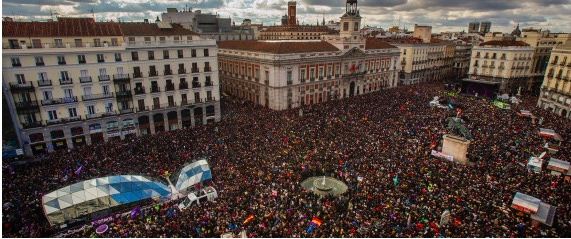
Podemos
Click on photo to enlarge

Hardly one year old, Podemos is already vying for the top spot in Spanish polls. This precocious party vows to throw Spain’s weight behind the tug-of-war Greece is already having with the European Union, further testing the limits of Eurozone coherence.

In short, the EU is facing a moment of truth. Its response to Podemos could validate or vitiate it for years to come.

Podemos’ Past and Present

Podemos, like Syriza, rose out of widespread frustration with fiscal austerity, endemic corruption, and the failure of longstanding political parties to do anything about it. After 2008, faced with upwards of 20 percent unemployment and not-all-that-much public debt, so-called debtor states like Spain were sold the pernicious fiction that they had to cut government spending in order to rein in debt and restore economic growth. Spain’s creditors, especially the “Troika” (the EC, ECB, and IMF), insisted on this austerity, and Spain’s leadership complied, only to see the employment and debt situation deteriorate further.

Ideologically rooted in the 2011 “15-M” anti-austerity movement (a forerunner of Occupy Wall Street), Podemos presented its first party platform in January 2014. Since then, Podemos has won seats in the European Parliament, Spanish regional legislatures, and is a serious contender in Spain’s upcoming general election.

In domestic politics, Podemos promises to increase democratic accountability and transparency – and its ideas are generally sound. They include keeping an up-to-date online account of government finances, imposing term limits and earnings caps on elected officials, and providing for recall elections, initiable by any citizen with enough signatures on a petition.

If elected at the national level, it will be interesting to see how Podemos follows through on these pledges. It has already faltered on the beta version of its first promise, providing up-to-date records of its own party finances.

As for economic policy, Podemos has mixed a few solid proposals with several unkeepable promises. Pablo Iglesias, the de facto leader of Podemos, now finds himself backpedaling on many of these, into vague middle-ground he used to lambaste opponents for occupying.
But who can blame him? It’s not his ideas per se that are (or were) untenable; it’s the ideas in relation to the prevailing institutional setup in Europe. Spain, like Greece, is caught between a rock and a hard place.

The (Il)logic of Europe

It would make sense to let Spain restructure or cancel some of its debt, and put an end to austerity, just as it would make sense to have tighter fiscal union for the long-term viability of the Eurozone. Austerity has clearly failed to relieve economic hardship, and even to meaningfully reduce indebtedness.

(continued into discussion on right side of this page)

Question for this article:

Movements against governmental fiscal austerity, are they part of the global movement for a culture of peace?

Readers’ comments are invited on this question.

(continuation of article from left side of page:)

However, the powers that be (Germany, France) have strong incentives to cede only the bare minimum of fiscal sovereignty necessary to keep the Eurozone intact. Simply put, Germans (and other relatively well-off Europeans) have mixed feelings about subsidizing other countries’ debts, and they’re going to explore every possible way to maintain the Euro while minimizing fiscal union, suffering southerners be damned. This means — Mr. Iglesias is quickly realizing — that Podemos can’t hope to fund all of its initial proposals (improved health benefits, education, pensions, salaries, etc.) without defaulting on some of Spain’s debt, or leaving the Eurozone — both of which are pyrrhic scenarios.

The best Spain can hope for, in all likelihood, is a Greece-like compromise. And this isn’t necessarily so bad, all things considered. If Podemos comes to power, the EU will probably give Spain more pecuniary wiggle room, in exchange for a clear plan detailing how Spain will still make good on its debts.

EU decision-makers, trying to balance their short-term political survival against Europe’s longer-term wellbeing, should concede enough to ensure that Spain (not to mention the entire Eurozone) can maintain positive growth and inflation. This is the only way to take control of debt and salvage the Euro in the long run. Podemos will certainly push things in this direction, Germans be damned.

On the other hand, if decision-makers bow to parochial interests and short-termism, Spain and Europe will suffer for it. Continued austerity, at the unnecessary expense of growth, threatens to undermine the entire European project. Anti-EU movements in France, Italy, and Britain are gaining traction like never before.

What Podemos Can Do

Europe’s vicissitudes notwithstanding, an empowered Podemos could go ahead with its other, relatively affordable economic reforms (which could, in turn, help fund the rest of its program). These include raising taxes on the wealthiest Spaniards, cracking down on tax evasion, and restoring competitiveness to Spanish industry.

Plans for the latter include shaking up oligopolies, electricity being perhaps the most stagnant. Currently, over 80 percent of Spain’s electricity is generated and sold by just five companies. These five make double the profits of their European counterparts, and the average electricity bill in Spain has nearly doubled over the last ten years, making Spain’s electricity the most expensive on the continent. The potential savings for consumers in this and other sectors are enormous, and could easily translate into more productive forms of spending throughout the economy.

What allowed this oligopoly to form, in part, is Spain’s sclerotic and considerably corrupt two-party system — which Podemos is also poised to shake up. Since the advent of Podemos, a number of other parties and grassroots movements have come to the fore, auguring increased accountability throughout Spanish politics (whatever the outcome of upcoming elections).

Finally, even if Pablo Iglesias never makes it to La Moncloa (Spain’s White House), Podemos and the other descendants of “15-M” should keep railing against the status quo. Whatever the results of this autumn’s general election, they will be a force in Spanish politics, drawing the entire political spectrum toward their policy goals. The draw might be slight, but it could still be significant. There’s a thin line between a unified Europe and a fragmented, dysfunctional one.

Why Are We Planning to Walk Across the Demilitarized Zone That Separates North and South Korea?

TOLERANCE AND SOLIDARITY .

an article by Mairead Maguire, Nobel Peace Laureate – TRANSCEND Media Service (abridged)

On May 24, 2015, which is International Women’s Day for Peace and Disarmament, 30 women peacemakers from 12 countries plan to walk across the demilitarized zone (DMZ) that separates North and South Korea. This will be an important first step in establishing a peace process and supporting Koreans who are working towards reconciliation and hoping to reunite their families.

Korea

Mairead Maguire

Some of the women who will be participating in this historic walk are Nobel Peace Prize laureate Leymah Gbowee, feminist author Gloria Steinem, retired U.S. Army Colonel Ann Wright, Suzuyo Takazato from Okinawa Women Act Against Military Violence, and American filmmaker Abigail Disney.

Last week, the government of North Korea agreed to support the walk, but officials from South Korea have yet to voice a decision. The United Nations Command at the DMZ has said it will facilitate the crossing once the South Korean government gives its approval.

In many countries around the world, women are walking and calling for demilitarization and an end to war. As the DMZ is the most highly militarized border in the world, women peacemakers believe it is only right that they should walk there in solidarity with their Korean sisters, who want to see an end to the 70-year-old conflict and reunite millions of Korean families.

Seventy years ago, as the Cold War was being waged, the United States drew a line across the 38th parallel – later with the former Soviet Union’s agreement – dividing an ancient country that had just suffered 35 years of Japanese colonial occupation. Koreans had no desire for their country to be divided, but had no say in the matter. Now, seven decades later, the conflict on the Korean peninsula threatens peace in the Asia Pacific and throughout the world.

In Korean culture, family relations are deeply important, and millions of families have been painfully separated for 70 years. Although there was a period of reconciliation during the Sunshine Policy years between the two Korean governments in which many families had the joy of reunion, the vast majority of families remain separated. Many elders have sadly died without ever seeing their families reunited. . .

The DMZ, with its barbed wire, armed soldiers on both sides, and thousands of explosive landmines, is a tragic physical manifestation of how much the Korean people have suffered and lost in war. Yet, from all my encounters with the Korean people, it seems all they wish for is to be reconciled and live in peace with each other.

On May 24, we want to walk for peace in North and South Korea, and hope that all governments will support our crossing of the DMZ, recognizing that we are doing this because we care for our Korean brothers and sisters. We want to plant a seed showing that Koreans, too, should be free to cross the DMZ in their work towards reconciliation, putting an end to the division and fear that keep them in a state of war.

Question for this article

Do women have a special role to play in the peace movement?

The 30 articles in CPNN linked to this question make it clear that women indeed have a special role to play in the peace movement. See the following for an historical explanation of why this is true.

Battered Women’s Support Services commemorates Prevention of Violence Against Women Week

. WOMEN’S EQUALITY .

an article by Battered Women’s Support Services (abridged)

Battered Women’s Support Services (BWSS) is committed to taking action and preventing violence against women. Each year we commemorate Prevention of Violence Against Women Week held during the third week of April. This year, during Prevention of Violence Against Women Week (April 12-19 2015), BWSS features the following events:

new battered
click on photo to enlarge

You Could Do Something to End Violence against Women – Bus Shelter Ads

Violence against women in intimate relationships is a learned behaviour so BWSS has launched an awareness campaign drawing attention on the effects witnessing abuse has on children. You Could Do Something To Prevent Violence Against Women bus shelter ads are positioned around the Vancouver, BC. People are invited to share photos of the ads through social media with the hashtag #BecauseYouCan.

YOUth Ending Violence Volunteer Training Program

Youth are powerful agents for change and BWSS successful Youth Ending Violence trains young women and young men to facilitate workshops on dating and sexual violence prevention. BWSS Youth facilitators learn differences between healthy and abusive relationships, dynamics of abuse, learn where and how to obtain help, understand the impact of media and social media on youth in dating relationships and how to be an empowered bystander. BWSS Youth Ending Violence program reaches 2,000 youth annually.

Boys will be Boys: Fighting Sexism in Media and Journalism

The Jian Ghomeshi scandal shocked the country, but maybe we needed to be shocked. Despite all the gains made over decades for women’s rights and gender equality, even our trusted public broadcaster had failed us.

Newsrooms have long been a man’s world, and while women are occupying positions as journalists, editors, producers, and broadcasters more than ever before, it’s clear that sexism, sexual harassment, and even sexual assault remains a problem in the industry. Whereas women remained silent for years, fearing they’d lose their jobs and ruin their careers if they spoke out about the misogyny they experienced working in media, they are finally beginning to speak out, buoyed by the courage and righteous anger of their female colleagues.

This panel [Vancouver April 11] features four prominent and courageous women who are experts on the issue of gender discrimination, violence against women, and sexism in the media. They will address the history of this insidious problem, the current climate, and the real-life impact of sweeping sexist practices and behaviour under the rug.

#BecauseYouCan Blog

Once again, we have convened a few serious feminist writers to contribute to our blog Ending Violence this year featuring violence prevention along with an old concept with a new name “A First Responder”. Ending Violence Blog is at www.bwss.org/endingviolence.

(Thank you to Janet Hudgins, the CPNN reporter for this article.)

Question related to this article:

Power and Resistance at the World Social Forum in Tunisia

FREE FLOW OF INFORMATION

an article by Hamza Hamouchene – Middle East Eye – Transcend Media Services

Despite the stormy weather and the tragic attacks that targeted foreigners at the Bardo Museum in Tunis the previous week, the World Social Forum (WSF), held between 24 and 28 March [2015], succeeded in gathering around 50,000 people from 125 countries representing all continents.

hamouchene

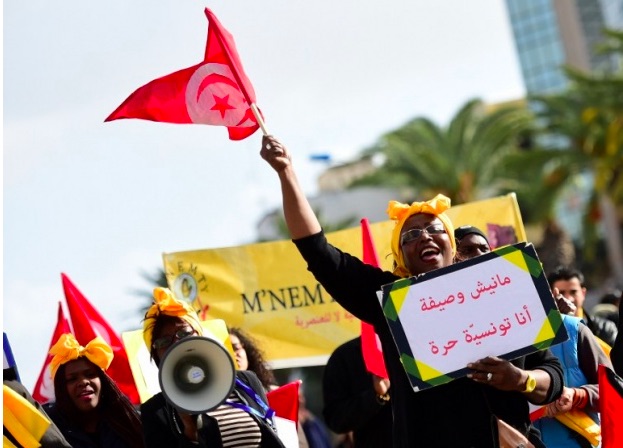
Photo: A woman holds a placard shouting slogans during a march at the end of the 2015 World Social Forum (WSF) in Tunis on March 28, 2015. AFP

That the anti-globalisation forum was vibrant, youthful and dynamic was a testimony to the still-burning flame of hope for a better world. This is the second time the forum has been held in Tunisia, illustrating its significance in the struggle for a just world more than four years after mass mobilisation across the country inspired uprisings across the region and further abroad.

The WSF is one of the few remaining places where tens of thousands of people from all over the world meet annually to discuss, debate, plan and organise under the banner of “Another World Is Possible”. Though participants may differ on the means to get there, a general consensus prevails on the ends, which include a world freed from injustice, oppression, authoritarianism, imperialism and the domination of a tiny minority that dictate its rule over the majority. More than a thousand workshops and activities were organised around a range of pressing issues, including corporate takeover of democracy, environmental and climate crises, racism and Islamophobia, women’s rights, migration and neo-colonialism.

Though the WSF continues to provide a space in which radical thinking, networking and organising can and does take place, it is not immune from power politics and attempts to neutralise, hijack and convert it to a status-quo agenda.

Valid and legitimate criticism has been directed at the insidious “NGO-isation” of resistance, in a way a symptom of the neoliberal state abdicating its traditional role to NGOs. Most of the latter operate in the neoliberal framework of “development” and “aid” and get their funding from many of the same Western governments, international financial institutions and multinational corporations that are at the heart of the power structures that the WSF was designed to counter.

In most cases, these NGOs end up addressing only some of the symptoms of injustice and oppression rather than looking at their structural causes. In doing so, they may contribute to the perpetuation of the system that generates poverty and suffering in the first place.

This phenomenon of NGO-isation has been analysed and addressed in several platforms but it is not the focus of this article, which will try to address two important points: a) how some dominant narratives that keep peoples from imagining and achieving “another world” creep and find their way into alternative forums that are supposed to challenge and deconstruct such narratives and not take them at face value, and b) how authoritarian governments in the region make their presence felt by sending big delegations representing their civil societies to pursue their propaganda and stifle dissent.

In its communiqué regarding the tragic events at Tunisia’s Bardo National Museum, the organising committee announced that the opening WSF march would come under the banner of “Peoples of the world united against terrorism.” This clumsy and ambiguous slogan ends up – intentionally or not – aligning itself with the discourse of the “War on Terror,” an endless war that has caused untold suffering and created more violence and instability in the world.

The global war on terror has been used to justify interventionism and maintain Western hegemony, which enforces the brutal neoliberal global order, the plunder of natural resources and support for repressive regimes.

(This article is continued in the discussion board on the upper right of this page)

Continuation of article

That the WSF preparatory committee adopted this language is unfortunate, but we need to bear in mind the local Tunisian context that facilitated such a decision. It is a context where key elements of the political elite – including partly re-incorporated sections of the old regime – have benefited from a so-called polarisation between “secularists” and “Islamists,” in which terrorism is often equated with the latter. Such battles have impacted the psyche of large sections of Tunisian society.

Former dictator Ben Ali’s “politics of fear” and “instrumentalisation” of “national security” for political purposes have ongoing ramifications for Tunisia’s contemporary political context. Not only have they often diverted attention from the socio-economic concerns expressed in the uprising, but they also have limited debates around alternative “conceptualisations of the state and state-society relations”.

In recognition of the past and present forms of the use of “security” discourses by various domestic and global power structures, several organisations and individual activists came together to critically reflect upon and challenge the WSF communiqué.

They called for a new slogan, more aligned with the mission and objectives of the WSF: “People of the world, united for freedom, equality, social justice and peace. In solidarity with the Tunisian people and with all victims of terrorism, against all forms of oppression.”

In a communiqué sent to the WSF organising committee, the signatory organisations stated that “The global justice movement cannot allow itself to be used for domestic and geopolitical agendas designed to manipulate public emotions and justify the further militarisation of societies in a way that ultimately benefits the security/military-industrial-complex.”

In an effort to follow up some of the discussions raised by the communiqué, several workshops specifically addressed this issue: the “Religion and Emancipation Convergence Meeting,” “Neocolonial Militarism and State Violence,” and “From Ferguson to Palestine: We Can’t Breathe.”

The purpose here is not to underestimate the very real effects of political violence, whether it occurs in Tunisia or elsewhere in the world, and regardless, as the statement puts it “of the perpetrator, whether state or non-state actors”. Rather it is to point to the ways the “War on Terror” has been used to shift the attention away from the way capitalist and imperial power works, as well as from the dire socio-economic and repressive political conditions that led to the uprisings in the first place.

The latest declaration by the octogenarian Tunisian President Béji Caid Essebsi that Tunisia will be a major non-member ally of NATO seems to confirm the concerns of the statement supporters that the “War on Terror” agenda ultimately contributes to a further militarisation of the region in a way that benefits the burgeoning “security-military-industrial complex”. Furthermore, the organisation of the “We are all Bardo” march on the 29 March, reminiscent of the “republican” march that was organised in Paris following the Charlie Hebdo massacre, is a reminder of how “national security” continues to be instrumentalised for domestic and geopolitical purposes.

It is not new or surprising that many of the region’s authoritarian regimes would send representatives from their loyal civil societies to the WSF to confuse, co-opt and disrupt truly independent and grassroots civil societies. Most notably, the 2013 WSF witnessed clashes between the pro and anti-Bashar al-Assad crowds. Sadly, there were several similar clashes between Syrian participants at the WSF this year.

In one, a group of pro-Assad baltaguia (state-linked thugs) attempted to violently disturb a meeting organised by the Global Campaign of Solidarity with the Syrian Revolution. Similar incidents occurred between some Algerian and Moroccan participants around the Western Sahara issue, which led the WSF organising committee to react in a press conference during the forum.

Even more striking this year is the significant presence of Algerian delegates, which reached around 1,500 people from 650 associations, the overwhelming majority of whom were not involved in organising any activity or workshop. This appears to mark a radical departure from the Algerian regime’s approach towards the WSF in 2013 when it barred 96 Algerian civil society activists from travelling to Tunisia, without giving any reason. According to several Algerian WSF participants, the government authorities adopted a different strategy this year.

Perhaps borrowing a page from the rulebook of their Syrian counterparts, it appears that the Algerian government this year decided to flood the event with its numerous clients and baltaguia. For example, there was one event organised in support of the exploitation of shale gas, clearly aimed at undermining a growing grassroots movement in opposition to the damaging environmental and social-economic effects of such procedures.

According to a petition signed by several well-known and respected Algerian civil society organisations, the Algerian state’s delegation were tasked with disturbing genuine meetings, intimidating dissidents and opposition activists, as well as creating chaos. Authoritarian regimes and their acolytes have no role to play in forums such as the WSF which aim to imagine, deliberate and create “another world”. It is incumbent upon activists who still believe in the radical potential of the WSF to question how this state of affairs was allowed to develop, and how such attempts to hijack the WSF can be halted in the future

Progressives all over the world consider the WSF as an alternative space whose raison d’être is to speak truth to power. Let’s not allow dominant narratives of state, capitalist and imperialist power as well as authoritarian regimes’ manoeuvres to derail us from this noble objective.

– – – – – –

Hamza Hamouchene is an Algerian writer, activist and co-founder of Algeria Solidarity Campaign (ASC). His writings appeared in The Guardian, Huffington Post, Counterpunch, Jadaliyya, New Internationalist and Open Democracy.