Tag Archives: North America

USA: Ashland Culture of Peace Commission explores peace education

. .DEMOCRATIC PARTICIPATION. .

An article by Patricia Sempowich for the Ashland Daily Tidings (reprinted according to Creative Commons)

Among the eight sectors of the Peace Wheel that define the outreach of the Ashland Culture of Peace Commission (ACPC), education is key to developing a culture that promotes peace. Maria Montessori believed education is the most powerful and universal way to reconstruct society and said, “Averting war is the work of politicians; establishing peace is the work of education.”

Ashland

Peace is a learned behavior. The process of learning to be peaceful is a path of discovery that never ends. Engagement with others in the community through caring, compassion and empathy provides an environment of trust in which peace education thrives.

Peace education promotes knowledge, skills, attitudes and values that create change. It encourages living in harmony with oneself, others and the natural world. The Ashland Culture of Peace Commission has joined a growing international movement of people and organizations who are bringing forward active peace-building programs.

The ACPC Peace Education Team consists of two educators, two mediation professionals and a filmmaker. We recently met with Patty Michiels, the Director of Instruction & Human Resources for the Ashland School District (ASD). We discovered that the ASD is dedicated to peace building through the use of MindUp, developed by the Hawn Foundation.

MindUP teaches social and emotional learning skills that link cognitive neuroscience, positive psychology and mindful awareness training utilizing a brain-centric approach. It is a research-based training program for educators and children. This program is composed of 15 lessons based in neuroscience. Students learn to self-regulate behavior and mindfully engage in focused concentration required for academic success (for more,go to thehawnfoundation.org).

(Article continued in right column)

Questions for this article:

Where is peace education taking place?

(Article continued from left column)

The MindUp curriculum supports social skills and emotional health through a framework known as Positive Behavior Support. PBS offers peace education tools that encourage listening and compassion and promote an environment of understanding. These tools, along with other strategies, teach students how to deal with difficult emotions and conflict.

Another peace-building expression found in area schools is brought by Medford-based Resolve Center for Dispute Resolution and Restorative Justice.

Resolve describes restorative justice as “a philosophy and practice based on a core set of principles that emphasize healing and repair over punishment, inclusion over exclusion, and individual accountability with a high level of community support.”

Restorative practices are increasingly being used to improve school climate and culture and to address student behavior. Resolve has been active in four area school districts this year, and the number of school-based projects will double next year. Students, staff and parents of the John Muir and Ashland Middle Schools benefit from these practices.

The ACPC Peace Education team meets twice a month to discuss strategies, develop programs and plan educational events. Current plans are to follow the lead of the StarShine Academy Charter School in Phoenix, Arizona, and establish Eleven Days of Peace in September. Beginning on 9/11 and culminating on the International Day of Peace 9/21, Ashland will celebrate peace in our community and in our schools.

Plans already in development for the Eleven Days of Peace include essays and poems by middle and high school students and singing, dancing, art and circle games for elementary students. The essays, poems and artwork will be collected into a book — a culture of peace treasure created by Ashland students.

In the coming months, the Education Team will be inviting special guests to share a variety of Peace Education programs, art and activities with the community. If you would like to participate, please contact Patricia at comco219@ashlandhome.net.

With active peace building programs in our schools and community, Ashland is working to help our young people understand and value a peaceful society. The powerful tool of peace education will help our youth resolve problems by developing self-responsibility and respect for others, which engenders leadership.

USA: Over Seventy Prominent Scholars and Activists Urge Obama to meet Hibakusha, Take Further Steps on Nuclear Disarmament

DISARMAMENT & SECURITY .

A letter published by Peace Action

To President Barack Obama, May 23, 2016

Dear Mr. President,

We were happy to learn of your plans to be the first sitting president of the United States to visit Hiroshima this week, after the G-7 economic summit in Japan. Many of us have been to Hiroshima and Nagasaki and found it a profound, life-changing experience, as did Secretary of State John Kerry on his recent visit.
letter
Click on photo to enlarge

In particular, meeting and hearing the personal stories of A-bomb survivors, Hibakusha, has made a unique impact on our work for global peace and disarmament. Learning of the suffering of the Hibakusha, but also their wisdom, their awe-inspiring sense of humanity, and steadfast advocacy of nuclear abolition so the horror they experienced can never happen again to other human beings, is a precious gift that cannot help but strengthen anyone’s resolve to dispose of the nuclear menace.

Your 2009 Prague speech calling for a world free of nuclear weapons inspired hope around the world, and the New START pact with Russia, historic nuclear agreement with Iran and securing and reducing stocks of nuclear weapons-grade material globally have been significant achievements.

Yet, with more than 15,000 nuclear weapons (93% held by the U.S. and Russia) still threatening all the peoples of the planet, much more needs to be done. We believe you can still offer crucial leadership in your remaining time in office to move more boldly toward a world without nuclear weapons.

In this light, we strongly urge you to honor your promise in Prague to work for a nuclear weapons-free world by:

Meeting with all Hibakusha who are able to attend;

Announcing the end of U.S. plans to spend $1 trillion for the new generation of nuclear weapons and their delivery systems;

Reinvigorating nuclear disarmament negotiations to go beyond New START by announcing the unilateral reduction of the deployed U.S. arsenal to 1,000 nuclear weapons or fewer;

Calling on Russia to join with the United States in convening the “good faith negotiations” required by the Nuclear Non-Proliferation Treaty for the complete elimination of the world’s nuclear arsenals;

Reconsidering your refusal to apologize or discuss the history surrounding the A-bombings, which even President Eisenhower, Generals MacArthur, King, Arnold, and LeMay and Admirals Leahy and Nimitz stated were not necessary to end the war.

Sincerely,

Gar Alperowitz, Professor of Political Economy, University of Maryland

Christian Appy, Professor of History at the University of Massachusetts,

Amherst, author of American Reckoning: The Vietnam War and Our National Identity

Colin Archer, Secretary-General, International Peace Bureau

Charles K. Armstrong, Professor of History, Columbia University

Medea Benjamin, Co-founder, CODE PINK, Women for Peace and Global Exchange

Phyllis Bennis, Fellow of the Institute for Policy Studies

Herbert Bix, Professor of History, State University of New York, Binghamton

Norman Birnbaum, University Professor Emeritus, Georgetown University Law Center

Reiner Braun, Co-President, International Peace Bureau

Philip Brenner, Professor of International Relations and Director of the Graduate Program in US Foreign Policy and National Security, American University

Jacqueline Cabasso, Executive Director, Western States Legal Foundation; National Co-convener, United for Peace and Justice

James Carroll, Author of An American Requiem

Noam Chomsky, Professor (emeritus), Massachusetts Institute of Technology

David Cortright, Director of Policy Studies, Kroc Institute for International Peace Studies, University of Notre Dame and former Executive Director, SANE

Frank Costigliola, Board of Trustees Distinguished Professor, niversity of Connecticut

Bruce Cumings, Professor of History, University of Chicago

Alexis Dudden, Professor of History, University of Connecticut

Carolyn Eisenberg, Professor of U.S. Diplomatic History, Hofstra University

Daniel Ellsberg, Former State and Defense Department official

John Feffer, Director, Foreign Policy In Focus, Institute for Policy Studies

Gordon Fellman, Professor of Sociology and Peace Studies, Brandeis University.
Bill Fletcher, Jr., Talk Show Host, Writer & Activist.

Norma Field, professor emerita, University of Chicago

Carolyn Forché, University Professor, Georgetown University

Max Paul Friedman, Professor of History, American University.

Bruce Gagnon, Coordinator Global Network Against Weapons and Nuclear Power in Space.

(letter continued in right column)

Question related to this article:

Can we abolish all nuclear weapons?

(letter continued from left column)

Lloyd Gardner, Professor of History Emeritus, Rutgers University, author Architects of Illusion and The Road to Baghdad.

Irene Gendzier Prof. Emeritus, Department of of History, Boston University

Joseph Gerson, Director, American Friends Service Committee Peace & Economic Security Program, author of With Hiroshima Eyes and Empire and the Bomb

Todd Gitlin, Professor of Sociology, Columbia University

Andrew Gordon. Professor of History, Harvard University
John Hallam, Human Survival Project, People for Nuclear Disarmament, Australia

Melvin Hardy, Heiwa Peace Committee, Washington, DC

Laura Hein, Professor of History, Northwestern University

Martin Hellman, Member, US National Academies of Sciences, Engineering, and Medicine Professor Emeritus of Electrical Engineering, Stanford University

Kate Hudson, General Secretary, Campaign for Nuclear Disarmament (UK)

Paul Joseph, Professor of Sociology, Tufts University

Louis Kampf, Professor of Humanities Emeritus MIT

Michael Kazin, Professor of History, Georgetown University

Asaf Kfoury, Professor of Mathematics and Computer Science, Boston University

Peter King, Honorary Associate, Government & International Relations School of Social and Political Sciences, The University of Sydney, NSW

David Krieger, President Nuclear Age Peace Foundation

Peter Kuznick, Professor of History and Director of the Nuclear Studies Institute at American University, is author of Beyond the Laboratory

John W. Lamperti, Professor of Mathematics Emeritus, Dartmouth College

Steven Leeper, Co-founder PEACE Institute, Former Chairman, Hiroshima Peace Culture Foundation

Robert Jay Lifton, MD, Lecturer in Psychiatry Columbia University, Distinguished Professor Emeritus, The City University of New York

Elaine Tyler May, Regents Professor, University of Minnesota, Author of Homeward Bound: American Families in the Cold War Era

Kevin Martin, President, Peace Action and Peace Action Education Fund

Ray McGovern, Veterans For Peace, Former Head of CIA Soviet Desk and Presidential Daily Briefer

David McReynolds, Former Chair, War Resister International

Zia Mian, Professor, Program on Science and Global Security, Princeton University

Tetsuo Najita, Professor of Japanese History, Emeritus, University of Chicago, former president of Association of Asian Studies

Sophie Quinn-Judge, Retired Professor, Center for Vietnamese Philosophy, Culture and Society, Temple University

Steve Rabson, Professor Emeritus of East Asian Studies, Brown University, Veteran, United States Army

Betty Reardon, Founding Director Emeritus of the International Institute on Peace Education, Teachers College, Columbia University

Terry Rockefeller, Founding Member, September 11 Families for Peaceful Tomorrows,

David Rothauser Filmmaker, Memory Productions, producer of “Hibakusha, Our Life to Live” and “Article 9 Comes to America

James C. Scott, Professor of Political Science and Anthropology, Yale University, ex-President of the Association of Asian Studies

Peter Dale Scott, Professor of English Emeritus, University of California, Berkleley and author of American War Machine

Mark Selden, Senior Research Associate Cornell University, editor, Asia-Pacific Journal, coauthor, The Atomic Bomb: Voices From Hiroshima and Nagasaki

Martin Sherwin, Professor of History, George Mason University, Pulitzer Prize for American Prometheus

John Steinbach, Hiroshima Nagasaki Committee

Oliver Stone, Academy Award-winning writer and director

David Swanson, director of World Beyond War

Max Tegmark, Professor of Physics, Massachusetts Institute of Technology; Founder, Future of Life Institute

Ellen Thomas, Proposition One Campaign Executive Director, Co-Chair, Women’s International League for Peace and Freedom (US) Disarm/End Wars Issue Committee

Michael True, Emeritus Professor, Assumption College, is co-founder of the Center for Nonviolent Solutions

David Vine, Professor, Department of Sociology, American University

Alyn Ware, Global Coordinator, Parliamentarians for Nuclear Non-proliferation and Disarmament 2009 Laureate, Right Livelihood Award

Dave Webb, Chair, Campaign for Nuclear Disarmament (UK)

Jon Weiner, Professor Emeritus of History, University of California Irvine

Lawrence Wittner, Professor of History emeritus, SUNY/Albany

Col. Ann Wright, US Army Reserved (Ret.) & former US diplomat

Marilyn Young, Professor of History, New York University

Stephen Zunes, Professor of Politics & Coordinator of Middle Eastern Studies, University of San Francisco

USA: Father Daniel Berrigan, z’l dead at 94

FREE FLOW OF INFORMATION

Distributed by email from Rabbi Michael Lerner, Tikkun Magazine

Daniel Berrigan was one of  the most inspiring figures of the anti-war and social justice movements of the past fifty years. He died on Saturday, April 30, 2016, and will be sorely missed by all of us who knew him. I was first introduced to him by my mentor Abraham Joshua Heschel in 1968 when he and Heschel and Martin Luther King had become prominent voices in the Clergy and Laity Against the War in Vietnam. He told me that he had been inspired by the civil disobedience and militant demonstrations that were sweeping the country in 1966-68, many of them led by Students for a Democratic Society (at the time I was chair of the University of California Berkeley chapter). . .

Berrigan

Over the course of the ensuing 48 years I was inspired by his activism and grateful for his support for Tikkun magazine. Heschel told me how very important Dan was for him–particularly in the dark days after Nixon had been elected and escalated the bombings in Vietnam, Cambodia and Laos. Those of us who were activists were particularly heartened by his willingness to publicly challenge the chicken-heartedness and moral obtuseness of religious leaders in the Catholic, Protestant and Jewish world who privately understood that the Vietnam war was immoral but who would not publicly condemn it and instead condemned the nonviolent activism of the anti-war movement because we were disobeying the law, burning our draft cards, disrupting the campus recruitment into the CIA and the ROTC, and blocking entrance into army recruitment centers and the Pentagon!

Here is a brief summary of Berrigan’s achievements as written for the Catholic magazine AMERICA   He co-founded the Catholic Peace Fellowship and the interfaith group Clergy and Laity Concerned about Vietnam, whose leaders included Martin Luther King Jr., Richard John Neuhaus and Abraham Joshua Heschel.

Berrigan regularly corresponded with Thomas Merton, Dorothy Day and William Stringfellow, among others. He also made annual trips to the Abbey of Gethsemani, Merton’s home, to give talks to the Trappist novices.

In Conjectures of a Guilty Bystander (1966), Merton described Berrigan as “an altogether winning and warm intelligence and a man who, I think, has more than anyone I have ever met the true wide- ranging and simple heart of the Jesuit: zeal, compassion, understanding, and uninhibited religious freedom. Just seeing him restores one’s hope in the Church.”

A dramatic year of assassinations and protests that shook the conscience of America, 1968 also proved to be a watershed year for Berrigan. In February, he flew to Hanoi, North Vietnam, with the historian Howard Zinn and assisted in the release of three captured U.S. pilots. On their first night in Hanoi, they awoke to an air-raid siren and U.S. bombs and had to find shelter.

As the United States continued to escalate the war, Berrigan worried that conventional protests had little chance of influencing government policy. His brother, Philip, then a Josephite priest, had already taken a much greater risk: In October 1967, he broke into a draft board office in Baltimore and poured blood on the draft files.

Undeterred at the looming legal consequences, Philip planned another draft board action and invited his younger brother to join him. Daniel agreed.

On May 17, 1968, the Berrigan brothers joined seven other Catholic peace activists in Catonsville, Md., where they took several hundreds of draft files from the local draft board and set them on fire in a nearby parking lot, using homemade napalm. Napalm is a flammable liquid that was used extensively by the United States in Vietnam.

Daniel said in a statement, “Our apologies, good friends, for the fracture of good order, the burning of paper instead of children, the angering of the orderlies in the front parlor of the charnel house. We could not, so help us God, do otherwise.”

(Article continued in the column on the right)

Question(s) related to this article:

Where in the world can we find good leadership today?

(Article continued from the column on the left)

Berrigan was tried and convicted for the action. When it came time for sentencing, however, he went underground and evaded the Federal Bureau of Investigation for four months.

“I knew I would be apprehended eventually,” he told America in an interview in 2009, “but I wanted to draw attention for as long as possible to the Vietnam War and to Nixon’s ordering military action in Cambodia.”

The F.B.I. finally apprehended him on Block Island, R.I., at the home of theologian William Stringfellow, in August 1970. He spent 18 months in Danbury federal prison, during which he and Philip appeared on the cover of Time magazine.

The brothers, lifelong recidivists, were far from finished.

On Sept. 9, 1980, Daniel and Philip joined seven others in busting into the General Electric missile plant in King of Prussia, Pa., where they hammered on an unarmed nuclear weapon—the first Plowshares action. They faced 10 years in prison for the action but were sentenced to time served.

In his courtroom testimony at the Plowshares trial, Berrigan described his daily confrontation with death as he accompanied the dying at St. Rose Cancer Home in New York City. He said the Plowshares action was connected with this ministry of facing death and struggling against it. In 1984, he began working at St. Vincent’s Hospital, New York City, where he ministered to men and women with H.I.V.-AIDS.

“It’s terrible for me to live in a time where I have nothing to say to human beings except, ‘Stop killing,’” he explained at the Plowshares trial. “There are other beautiful things that I would love to be saying to people.”

In 1997 he was nominated for the Nobel Peace Prize.

Berrigan’s later years were devoted to Scripture study, writing, giving retreats, correspondence with friends and admirers, mentorship of young Jesuits and peace activists, and being an uncle to two generations of Berrigans. He published several biblical commentaries that blended scholarship with pastoral reflection and poetic wit.

“Berrigan is evidently incapable of writing a prosaic sentence,” biblical scholar Walter Brueggemann wrote in a review of Berrigan’s Genesis (2006). “He imitates his creator with his generative word that calls forth linkages and incongruities and opens spaces that bewilder and dazzle and summon the reader.”

From 1976 to 2012, Berrigan was a member of the West Side Jesuit Community, later the Thompson Street Jesuit Community, in New York City. During those years, he helped lead the Kairos Community, a group of friends and activists dedicated to Scripture study and nonviolent direct action.

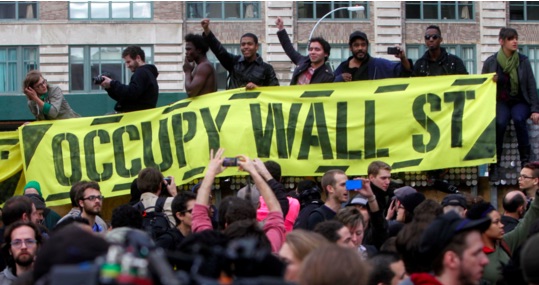
Even as an octogenarian, Berrigan continued to protest, turning his attention to the U.S. wars in Afghanistan and Iraq, the prison in Guantánamo Bay and the Occupy Wall Street movement. Friends remember Berrigan as courageous and creative in love, a person of integrity who was willing to pay the price, a beacon of hope and a sensitive and caring friend.

(This summary of one part of his achievements was written by Luke Hansen, S.J., a former associate editor of America, now a student at the Jesuit School of Theology of Santa Clara University, Berkeley, Calif.).

We at Tikkun magazine, the voice of Jewish progressives, liberals, radicals and anti-capitalist non-violent revolutionaries, will deeply mourn the loss of our brother Daniel Berrigan. Dan was a true spiritual progressive, and it was a great honor for us when he joined the Advisory Board of the Network of Spiritual Progressives. His memory will always be a blessing (z’l=zeycher tzadik liv’racha).
–Rabbi Michael Lerner

Democracy Spring: Thousands Descend on US Capitol, Over 400 Arrested

. . DEMOCRATIC PARTICIPATION . .

An article by Scott Galindez, Reader Supported News (reprinted by permission)

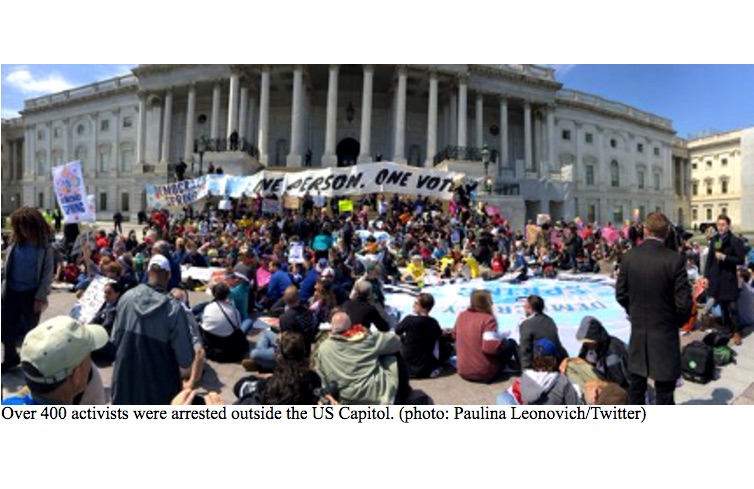
Thousands of Americans have descended on Washington to launch one week of civil disobedience [as of April 12] under the banner Democracy Spring. Over 400 people were arrested today, and over 3,000 have pledged to risk arrest over the next week. Their main demand is to get money out of politics. Before the marchers made their way to the Capitol, Cenk Uygur of the Young Turks thanked the 200 people who walked 140 miles over 10 days from Philadelphia. Uygur pointed out that the mainstream media has ignored Democracy Spring and explained that the reason is that they are part of the establishment. Uygur said that the media don’t want money out of politics, they depend on that money when it is used to buy campaign ads. Uygur declared that while this is just the beginning, they are no longer coming for us, but we are coming for them.

democracy
Click on photo to enlarge and to see photo credit

Kai Newkirk, a lead organizer of the event, told the crowd that if “we don’t have a democracy that represents all of us, we are in danger of losing what makes America great.” Newkirk went on to say, “We are here to send a message that there will be a political price to pay for siding with the moneyed interests over the people.” The organization’s website says: “This week we began the process of taking back our democracy, with hundreds arrested in our first mass sit-in at the Capitol on Monday, April 11. Now day after day through Saturday, April 16th, we will continue to reclaim the Capitol in a show of hope and for the truly representative democracy we see in our hearts. Over 3,500 people, coming to DC from near and far, have pledged to risk arrest this week.”

Thousands marched from Columbus Circle to the east side of the Capitol, where hundreds of people, including Cenk Uygur and Kai Newkirk, made their way to the Capitol steps. They sat down and received warnings from the Capital Police to move away from the steps or be arrested. Many heeded the warning and moved away from the building. Hundreds, in what is being billed as the largest civil disobedience action ever at the Capitol Building, remained and were arrested one by one over five hours.

Before the arrests were made, Uygur addressed the crowd with a bull horn and the people’s mic from the Capitol steps. “It’s time for civil disobedience. They think they have all the power, but we have the people. We are tired of the corruption. We want free and fair elections. We want our democracy back! We want our government back! We want our country back! We want our Constitution back! We want our Congress back! Thank you all for fighting back!

(Article continued in right column)

Question related to this article:

How should elections be organized in a true democracy?

(Article continued from left column)

Why Democracy Spring? And Why Now?

According to the group’s website:

Every American deserves an equal voice in government. That is our birthright of freedom, won through generations of struggle. But today our democracy is in crisis. American elections are dominated by billionaires and big money interests who can spend unlimited sums of money on political campaigns to protect their special interests at the general expense. Meanwhile, as the super-rich dominate the “money primary” that decides who can run for office, almost half of the states in the union have passed new laws that disenfranchise everyday voters, especially people of color and the poor.

This corruption violates the core principle of American democracy – “one person, one vote” citizen equality. And it is blocking reform on virtually every critical issue facing our country: from addressing historic economic inequality, to tackling climate change and ending mass incarceration. We simply cannot solve the urgent crises that face our nation if we don’t save democracy first.

But if the status quo goes unchallenged, the 2016 election – already set to be the most billionaire-dominated, secret money-drenched, voter suppression-marred contest in modern American history – will likely yield a President and a Congress more bound to the masters of big money than ever before. And our planet and people just can’t afford that. But there is another possibility.

Democracy Spring is calling on Congress to pass four bills:

– The Government by the People Act and Fair Elections Now Act

– The Voting Rights Advancement Act of 2015

– The Voter Empowerment Act of 2015

– The Democracy for All Amendment

As the week goes on, many more high profile activists will risk arrest, including Mark Ruffalo, Gaby Hoffman, Lawrence Lessig, Talib Kweli, and Zephyr Teachout. The coalition putting on the event is endorsed by groups like the AFL-CIO, National Organization of Women, and MoveOn.org. On April 16th, Democracy Spring will be joined by Democracy Awakening, a broad coalition of organizations representing the labor, peace, environmental, student, racial justice, civil rights, and money-in-politics reform movements. According to their website, they “share a firm belief that we will not win on the full range of policy issues we all care about until we combat attacks on voting rights and the integrity of the vote by big money.”

They are fighting to protect voting rights, get big money out of politics, and demand a fair hearing and an up or down vote on President Obama’s Supreme Court nominee. Speakers will include Jim Hightower, William Barber II, and Annie Leonard.

USA: Five Years After Occupy Wall Street, Bernie Sanders Continues Its Fight

. . SUSTAINABLE DEVELOPMENT . .

An article by Reno Berkeley in Inquisitr

On September 17, 2011, the Occupy Wall Street movement exploded onto the scene. Peaceful protestors set up tents and sleeping bags in New York City’s Zuccotti Park. The movement’s slogan was “We are the 99 percent.” Protestors railed against big banks, the growing foreclosure scandal, and political corruption. Five years later, the Occupy movement finally has the leader it never really had: Bernie Sanders.

occupy

In the years since the movement was squelched by a chillingly multi-pronged alliance between various U.S. government agencies and private enterprise, resentment toward those who retain a chokehold on power and money has simmered just below the surface, ready to boil over.

Enter Bernie Sanders, who has been widely embraced by those hungry for substantial change, unsatiated by simple platitudes. Did Occupy really fuel the fire of Sanders’ popularity? I asked asked members of various Bernie Sanders Facebook groups for their opinions. Approximately 20 people answered the question of whether Occupy Wall Street helped influence the election by making voters more ready to hear Bernie Sanders’ message.

Most of those who answered believed that the Occupy Movement had at least some impact in helping propel Bernie into the spotlight. Only three people did not believe the movement influenced his popularity at all. While some folks believed that Occupy didn’t change anything substantially in terms of government and policy, they did believe that it made the public more amenable to his message.

One Sanders supporter believed that Occupy is the only reason Bernie is running for president. Without Occupy to stir the pot and force a national conversation about income inequality, would the public be ready to listen to his message? Another user gave a little more detail as to why she believes it has influenced the primary race: “Occupy accomplished one thing, and that was making public dialogue out of part of the message Senator Sanders had been saying his whole career. I don’t think that the issues Occupy brought up (regarding Wall Street) would have been discussed without Bernie’s candidacy.”

When the Inquisitr interviewed Jordan Martin, the young woman behind Bernie Journey, we asked her about the Occupy Movement. She also believed that it helped raise awareness to the issues Sanders has advocated for his entire career: “Yes I do believe that the Occupy Movement has helped Bernie’s campaign. He’s the only candidate that stands against Wall Street and is not afraid to speak out against the corruption.”

(Article continued in right column)

Questions for this article

The peace movement in the United States, What are its strengths and weaknesses?

(Article continued from left column)

A December 2012, investigative story in The Guardian provided an Orwellian view of what happened with Occupy. In the first paragraph of Naomi Wolf’s piece, she reveals that the FBI, Department of Homeland Security, and local police coordinated together to crush the movement. What’s worse, the very banks the movement was protesting against were also behind it.

A document procured through the Freedom of Information Act by the Partnership for Civil Justice Fund shows just how wide the web of oppression spreads: “The document…shows a terrifying network of coordinated DHS, FBI, police, regional fusion center, and private-sector activity so completely merged into one another that the monstrous whole is, in fact, one entity: in some cases, bearing a single name, the Domestic Security Alliance Council.”

The well-oiled coordination between multiple agencies and businesses are exactly the kind of corruption Sanders has rallied against since he protested against racial segregation in the 1960s. And he continues to battle the machine, only this time, it’s corporate media outlets, chiefly, CNN, whose parent company, Time Warner, is one of Hillary Clinton’s top donors. Sanders has also had to battle the Democratic National Committee and Debbie Wasserman-Schultz, who not long ago told a news outlet the purpose for superdelegates was to prevent grassroots candidates from winning elections.

Bernie Sanders, is a grassroots candidate, but he’s become a powerhouse the likes of which the DNC can’t ignore. His most recent rallies in Utah and Arizona attracted tens of thousands of supporters waiting to hear his speeches. And Bernie might not have gotten very far if not for the attention Occupy brought to the very issues Sanders has held close to his heart since he chained himself to a young Black woman back in 1962.

Whereas the Occupy Movement lacked real leadership and cohesion, Bernie Sanders has essentially stepped forward to become the defunct movement’s de facto leader through his presidential campaign. Part of his appeal is that he hasn’t usurped the public sentiment against corruption in government and big business. Rather, his appeal stems from the fact that he has worked toward the very things the Occupy Movement symbolized: economic equality, racial equality, equality in educational access, immigration reform. The list goes on.

For five years, the movement’s fire was dimmed, never quite flickering out. Last year, Bernie Sanders stepped up to the glowing embers, added kindling to the fire, and began speaking to the proverbial empty room. Slowly, one by one, voters heard his message. Eleven months later, neither the government, the big banks, nor billionaires can can stop the fire that Bernie Sanders stoked. Indeed, Bernie’s political revolution has his supporters feeling the Bern.

Wilmington, Delaware, USA: Movement for a Culture of Peace hosts restorative practices forum

. . DEMOCRATIC PARTICIPATION . .

An article by Megan Pauly for Delaware Public Media

A community discussion Saturday hosted Wilmington’s Movement for a Culture of Peace focused on finding ways to deal with issues such as trauma that violent crime in the city is bringing into classrooms. Around 30 educators, activists and concerned community members participated in the event. Among them was Malik Muhammad, president of a restorative practices consulting group, Akoben, LLC. He says stressing connectedness and building positive relationships helps change behavior, not punishment.

Wilmington
Photo by Megan Pauly / Delaware Public Media

“The traditional approach to trauma has been one, individualized. So we’ve isolated those who’ve experienced trauma and attempted to deal with them on an individual basis,” Muhammad said. “That approach in and of itself isn’t necessarily a negative one, but we need to create environments of safety, connection, trust and bonding so that those who are facing trauma – whether it’s seen or unseen – are really feeling connected.”

Muhammad adds relying mostly on social workers and counselors to engage the students isn’t effective. He says teachers, administrators and even students themselves need to be involved.

In 2012, the state brought Muhammad’s organization in to hold four full-day workshops for around 145 education professionals. Since then, he’s worked with 16 of 19 Delaware school districts, tailoring workshops to their specific needs.

(article continued in right column)

Discussion question

Restorative justice, What does it look like in practice?

(article continued from left column)

Will Fuller, Principal at the Positive CHANGE Academy – the Red Clay School District’s alternative school – was initially skeptical of the broad “relationship building” concept, but has seen firsthand its positive effects.

“I thought hey, this is not going to work for our kids but what I noticed over the last two years is that the students really love the process. They’ve bought into the process, the culture has changed,” Fuller said. “The staff members have bought into the process; it hadn’t been overnight.”

Kelley Lumpkin, Success Interventionist at Baltz Elementary in Elsmere, says she’s also seen a positive shift in the school’s culture since these practices were implemented a few years ago.

But Lumpkin says she sees social media as a potential barrier to creating critical face-to-face connectedness.

“It’s not like the schoolyard where these arguments used to happen and they could see the effect, right there. And it might give them a cue to stop it,” Lumpkin said. “Now they’re doing it where they’re not even seeing the effect, they’re not seeing what happens to the child as they’re doing it and other kids tagging in. And then the come to school and the rumor mill has spread it to another 20 kids.”

Lumpkin says her approach to working with kids varies depending on the situation.

It could include a group discussion for 10-15 minutes, or an hour-long talk. For other school-wide issues, she’s even held them in the gym for the entire 5th grade.

Muhammad says his work in Delaware has largely been in New Castle and Kent counties. This year, he’s working with the Red Clay and Christiana school districts.

USA: Prisoners in Multiple States Call for Strikes to Protest Forced Labor

…. HUMAN RIGHTS ….

An article by Alice Speri in The Intercept

Prison Inmates around the country have called for a series of strikes against forced labor, demanding reforms of parole systems and prison policies, as well as more humane living conditions, a reduced use of solitary confinement, and better health care.

prisoners
Graphic from the pamphlet for the National Prison Strike

Inmates at up to five Texas prisons pledged to refuse to leave their cells today. The strike’s organizers remain anonymous but have circulated fliers listing a series of grievances and demands, and a letter articulating the reasons for the strike. The Texas strikers’ demands range from the specific, such as a “good-time” credit toward sentence reduction and an end to $100 medical co-pays, to the systemic, namely a drastic downsizing of the state’s incarcerated population.

“Texas’s prisoners are the slaves of today, and that slavery affects our society economically, morally and politically,” reads the five-page letter announcing the strike. “Beginning on April 4, 2016, all inmates around Texas will stop all labor in order to get the attention from politicians and Texas’s community alike.”

The Texas Department of Criminal Justice, which oversees the state’s prisons, “is aware of the situation and is closely monitoring it,” spokesperson Robert Hurst wrote in a statement to The Intercept. He did not comment on the prisoners’ grievances and demands. Prisoner rights advocates said at least one prison — the French Robertson Unit in Abilene — was placed under lockdown today, but Hurst denied any prisons in Texas were on lockdown because of planned strikes.

The 13th Amendment to the United States Constitution bans “involuntary servitude” in addition to slavery, “except as a punishment for crime whereof the party shall have been duly convicted,” thus establishing the legal basis for what is today a $2 billion a year industry, according to the Prison Policy Initiative, a nonprofit research institute.

Most able-bodied prisoners at federal facilities are required to work, and at least 37 states permit contracting prisoners out to private companies, though those contracts account for only a small percentage of prison labor. “Ironically, those are the only prison labor programs where prisoners make more than a few cents an hour,” Judith Greene, a criminal justice policy analyst, told The Intercept.

Instead, a majority of prisoners work for the prisons themselves, making well below the minimum wage in some states, and as little as 17 cents per hour in privately run facilities. In Texas and a few other states, mostly in the South, prisoners are not paid at all, said Erica Gammill, director of the Prison Justice League, an organization that works with inmates in 109 Texas prisons.

“They get paid nothing, zero; it’s essentially forced labor,” she told The Intercept. “They rationalize not paying prison laborers by saying that money goes toward room and board, to offset the cost of incarcerating them.”

In Texas, prisoners have traditionally worked on farms, raising hogs and picking cotton, especially in East Texas, where many prisons occupy former plantations.

(Article continued in the right column)

(Article continued from the left column)

“If you’ve ever seen pictures of prisoners in Texas working in the fields, it looks like what it is,” Greene said. “It’s a plantation: The prisoners are all dressed in white, they got their backs bent over whatever crop they’re tending, the guards are on horseback with rifles.” In the facilities Greene visited, prisoners worked all day in the heat only to return to cells with no air conditioning. “The conditions are atrocious, and it’s about time the Texas prison administration had to take note.”

In 1963, in an effort to reduce the cost of running prisons, Texas began employing inmates to manufacture a wide array of products, including mattresses, shoes, soaps, detergents, and textiles, as well as the furniture used in many of the state’s official buildings. Because of labor laws restricting the sale of prisoner-made goods, Greene said, those products are usually sold to state and local government agencies.

Although they comprise nearly half the incarcerated population nationwide — about 870,000 as of 2014 — prison workers are not counted in official labor statistics; they get no disability compensation in case of injury, no social security benefits, and no overtime.

“They keep a high conviction rate at any cost,” reads the letter circulated by prisoners ahead of today’s strike, “all for the well-being of the multimillion-dollar Prison Industrial Complex.”

The Texas action is not an isolated one. Prisoners in nearby Alabama and Mississippi, and as far away as Oregon, have also been alerted to the Texas strike through an underground network of communication between prisons.

“Over the long term, we’ll probably see more work stoppages,” said Gammill. “In prison, you think it’d be difficult to spread information, but it actually spreads like wildfire.”

On April 1, a group of prisoners from Ohio, Alabama, Virginia, and Mississippi called for a “nationally coordinated prisoner work stoppage against prison slavery” to take place on September 9, the 45th anniversary of the Attica prison riot. “We will not only demand the end to prison slavery, we will end it ourselves by ceasing to be slaves,” that announcement reads. “They cannot run these facilities without us.”

Prison protests and strikes have seen a revival in recent years after a slowdown resulting from the increased use of solitary confinement to isolate politically active inmates. In 2010, thousands of inmates from at least six Georgia prisons, organizing through a network of contraband mobile phones, refused to leave their cells to work, demanding better living conditions and compensation for their labor. That action was followed by prison protests in Illinois, Virginia, North Carolina, and Washington. In 2013, California prisoners coordinated a hunger strike to protest the use of solitary confinement. On the first day of that protest, 30,000 prisoners across the state refused their meals.

Last year in Texas, nearly 3,000 detainees demanding better conditions seized and partially destroyed an immigration detention center.

In March, protests erupted at Holman Correctional Facility, a maximum security state prison in Alabama, where two riots broke out over four days. At least 100 prisoners gained control of part of the prison and stabbed a guard and the warden. Those protests were unplanned, but prisoners there had also been organizing coordinated actions that they say will go ahead as planned.

“We have to strain the economics of the criminal justice system, because if we don’t, we can’t force them to downsize,” an activist serving a life sentence at Holman told The Intercept. “Setting fires and stuff like that gets the attention of the media,” he said. “But I want us to organize something that’s not violent. If we refuse to offer free labor, it will force the institution to downsize.”

“Slavery has always been a legal institution,” he added. “And it never ended. It still exists today through the criminal justice system.”

USA: University of Wisconsin receives UN chair for global work on gender, well-being and peace

. . WOMEN’S EQUALITY . .

An article by Ann Grauvogl, University of Wisconsin – Madison News

The University of Wisconsin—Madison has been awarded a UNESCO Chair on Gender, Well-being and a Culture of Peace, a first in the state of Wisconsin and a first for the university in any area. It creates a global platform for the Department of Gender and Women’s Studies and for the campuswide 4W (Women and Well-being in Wisconsin and the World) Initiative.

wisconsin
Araceli Alonso in Kenya, 2009. PHOTO COURTESY OF COLLEGE OF LETTERS & SCIENCE

“This recognition by the United Nations Educational, Scientific and Cultural Organization (UNESCO) affirms UW–Madison’s strength in addressing global issues,” says Chancellor Rebecca Blank. “The interdisciplinary ethic of our faculty, staff and students allows us to engage on complex issues from a host of perspectives. That’s a valuable asset to the UNESCO network around the world.”

UNESCO has designated more than 670 chairs worldwide to promote international cooperation and networking among universities. UW–Madison joins a network of 12 other chairs on gender around the world, connecting efforts of women in Europe, Latin America, Africa and the United States.

“The establishment of this chair is a testimony to the role that UW–Madison has played, locally and globally, to advance women in a broad array of fields, including human ecology, gender and women’s studies, nursing and education,” says Lori DiPrete Brown, director of the 4W Initiative and an associate director of the Global Health Institute (GHI). “The robust range of activities of 4W leaders from throughout campus was an important factor in determining the award.”

The Chair Selection Committee recognized UW–Madison’s plans to encourage innovation through technological databases, online portals, North-South collaboration and information sharing.

“The chair will be the first in North America to interrelate gender, well-being and culture of peace through researchers, practitioners and advocates for knowledge exchange and collaboration,” according to a statement from the committee.

(Article continued in right column)

Question related to this article:

Does the UN advance equality for women?

(Article continued from left column)

The chair will be housed in the Department of Gender and Women’s Studies and is created in partnership with the Foundation for a Culture of Peace in Madrid, Spain. The activities of the chair will be integrated with the 4W Initiative and will include an annual summit, a broad range of field activities, and publications related to gender, well-being and a culture of peace.
Araceli Alonso, a senior lecturer in gender and women’s studies and 4W director for Gender, Clinical Practice and the Health Sciences, and Teresa Langle de Paz, co-director of Women’s Knowledge International at the Foundation for a Culture of Peace, will jointly hold the chair.

Alonso also founded the Health by Motorbike Project in Kenya and co-leads 4W’s project to end sex trafficking and exploitation. She has collaborated with other UNESCO chairs on gender and development and welcomes the chance for further collaboration locally, regionally, nationally and globally.

Langle de Paz is also an honorary fellow for the Women’s Research Center at the Gender and Women’s Studies Department.

“The UNESCO chair can take our work at UW–Madison a step further into a global arena fostering transnational cooperation between feminist scholars, gender issues professionals, institutions, networks, policy makers and organizations,” Alonso says. “We expect to create a global learning community and a platform of leaders committed to gender equality and equity, human flourishing and well-being, and a culture of peace that respects all human rights and promotes sustainable development, thinking not only on present generations but also in future ones.”

Karl Scholz, dean of the College of Letters & Science, is thrilled to house the chair in Gender and Women’s Studies.
“This will enhance our efforts to improve the health, education and well-being of women all over the world,” Scholz says. “With this recognition, we will be able to engage more students and scholars from across campus, which truly epitomizes the Wisconsin Idea.”

The designation gives UW–Madison a voice on these issues at an international level, says Soyeon Shim, dean of the School of Human Ecology (SoHE) and 4W lead dean.

“The UNESCO Chair gives the university the credibility and prestige on gender, well-being and a culture of peace, a topic that’s also important to the United Nations,” Shim says.

The chair provides both the opportunity and responsibility for UW–Madison faculty, staff and students to continue their work on issues of gender and well-being. Through research, service, leadership and collaboration with partners from around the world, they are improving access to health care in Kenya and Ethiopia, empowering women farmers in Ghana, collaborating with artisans in Mexico and Ecuador, and working to stop sex trafficking both locally and globally.

“We’re not just dreaming this thing, we’re doing it already,” Shim says.

USA: Working on creating a culture of peace in Ashland

. .DEMOCRATIC PARTICIPATION. .

An article by David Wick in the Ashland Daily Tidings (reprinted according to Creative Commons)

    “My experience and research have convinced me that the world is on the verge of the greatest change in human history: The transition from the culture of war that we have had for tens of thousands of years to a new culture,” and that new development, states UNESCO Director David Adams, “is a culture of peace.”

A 1999 United Nation’s Culture of Peace resolution called for a transformation from a culture of war and violence to one of peace. Aligned with this and Margaret Mead’s notion that it’s only been small groups of thoughtful committed citizens that have changed the world, a group of eight inspired local thinkers collaborated for two years before creating a Culture of Peace Proclamation with the Ashland City Council in March 2015.

Ashland
Click on photo to enlarge

The city’s proclamation, unanimously adopted by the council, says “(we) strongly encourage residents to work toward development of a Culture of Peace community, and pledge to lend appropriate encouragement and support to that effort.”

Soon an independent, community and citizen-based Ashland Culture of Peace Commission was created. Commission members were chosen to represent many aspects of Ashland’s culture: education, business, the arts, science, environment, religion, law and habitat. An active community support team was also formed. On Sept. 21, 2015, the UN International Day of Peace, the Ashland Culture of Peace Commission was launched in a community-wide celebration.

The commission and the community support team’s first actions have been to define the Ashland Culture of Peace as a community-wide movement dedicated to transforming our attitudes, behaviors, and institutions into ones that foster harmonious relationships with each other and the natural world.

Initial focus areas being developed are:

1. The Peace Ambassador Program — Training volunteers to be a positive presence in our community and on our streets, engaging in person-to-person dialogues and arranging peace forums on topics important to our community.

2. Peace Education — Offering exciting, skill-based and peace-focused learning experiences to schools in the Ashland School District.

(Article continued in right column)

Questions for this article:

How can culture of peace be developed at the municipal level?

(Article continued from left column)

3. Community Resource Directory — Identifying, listing, and dialoguing with organizations and people in our community who are already contributing or want to contribute to a culture of peace for Ashland.

4. World Peace Flame Monument — Establishing the venue and financial support for Ashland to be the 12th site in the world for the World Peace Flame, a symbol of peace, unity, freedom and celebration that will draw visitors from around the world.

5. State of the Culture of Peace in Ashland Report — Writing an annual report that will be presented to the community and City Council to provide a view into how we are doing in co-creating a Culture of Peace in Ashland.

Cities are the real societal structural level where a Culture of Peace can take root. The individual person is always the essential component for building peace through his or her daily choices, but it is the city that has the reach, authority, responsibility and influence to set the positive tone and direction for so many. When the City Council and Mayor adopted the Culture of Peace Proclamation, they strongly encouraged residents “to work toward development of a Culture of Peace community” and pledged “to lend appropriate encouragement and support to that effort.”

With our unique approach, Ashland has the opportunity to become a model of this new culture for cities around the world. It is about shifting mindset and behavior in all aspects of our societies to embrace humanity’s interconnectedness as we move from force to reason, from discord and violence to dialogue and peace-building. For sustained change there must be a larger context, a vision that inspires and unifies citizens to move forward. This vision has launched the Ashland Culture of Peace.

This is the first of a regular series of articles by the ACPC on various aspects of creating a culture of peace, both here and elsewhere. Next time we’ll address the question, “What is a Culture of Peace?”

Current commissioners include: Amy Blossom, Ben Morgen, Bert Etling, Bill Kauth, Catherine McKiblin, David Wick, Eric Sirotkin, Greeley Wells, Jack Gibbs, Jeff Golden, Joanne Lescher, Joe Charter, Norma Burton, Pam Marsh, Patricia Sempowich, Richard Schaeff, Tighe O’Meara and Will Sears. The original developers included some of the current commissioners, plus Elinor Berman, Irene Kai and Kathleen Gamer.

Contact David Wick via email at ashlandcpc@gmail.com, or drop by the ACPC office at 33 First St., Suite 1, Ashland. The commission’s website is at www.ashlandcpc.org.

USA: Kids4Peace Boston summer programs

EDUCATION FOR PEACE .

Excerpts from website of Kids4Peace Boston

Each year, Kids4Peace Boston works with Muslim, Jewish & Christian youth from Boston, Israel, Palestine, and the United States. Among peace education efforts, Kids4Peace is unique in three ways:

kids4peace

1) We begin with 12 year olds, engaging their natural openness to live, learn, play, and make friends with others different from themselves. Because the children are young, their families also become involved in the program and get to know one another.

2) We focus on faith, getting close to what matters most in many people’s lives. We highlight our common heritage as children of Abraham and pay attention to each tradition’s impulse toward peace and justice.

3) We maintain and nourish the relationships made in this initial encounter of children and their families so that these young people become effective interfaith peace leaders by the time they graduate from high school.

We believe that it is our obligation to teach our children to be peacemakers, leading by our own example and learning from young people’s fresh perspectives on how to live together in friendship and peace.

SUMMER CAMP FOR 6th & 7th GRADERS

Kids4Peace Boston is looking for Muslim, Jewish, and Christian 6th and 7th graders to join us for 8 days of summer camp activities (swimming, boating, sports, hiking, camp fires, arts and crafts and more) on the shores of a crystal-clear lake in the mountains of New Hampshire

Who? We are looking for participants who live in the greater Boston area and are in sixth or seventh grade during the 2015-2016 school year. Kids4Peace campers are open-minded, like to try new experiences and make new friends, and are eager to share about their lives, cultures, and religious traditions.

When? July 31 – August 7, 2016 at Camp Merrowvista in Center Tuftonboro, NH

For additional questions, email info@kids4peaceboston.org

2016 SUMMER PROGRAMS – 8th GRADE

Service Learning Program in New Haven, CT Monday, July 25 – Tuesday, August 2, 2016

8th graders, with peers from North America and the Middle East (including Israelis, Palestinians, and Syrian, Iraqi, and Afghan refugees), will explore interfaith citizenship, identity, communication, leadership, and peace by participating in a nine-day service-learning program led by Jerusalem Peacebuilders (a K4PB partner). Activities will include: dialogues, sports, workshops, presentations at local faith communities and field trips to the United Nations HQ, the 9/11 Museum at Ground Zero in New York City, and historic Mystic Seaport and Aquarium.

Click here for more information and an application:

2016 SUMMER PROGRAMS – 9th & 10th GRADES

Kids4Peace International Global Institute in Washington, DC Wednesday, July 27 – Monday, August 8, 2016

9th and 10th graders will join their peers from Kids4Peace Jerusalem and from other K4P chapters in America to learn about social change movements, gain skills in advocacy and organizing, and interact with public policy and diplomatic leaders. They will return to Boston with a few of their Israeli and Palestinian friends to implement their new skills through an interfaith community action project.

For more information and an application: www.k4p.org/summer2016/.

(Thank you to Norma Shakun for proposing this article to CPNN.)

Questions for this article: