Tag Archives: Mideast

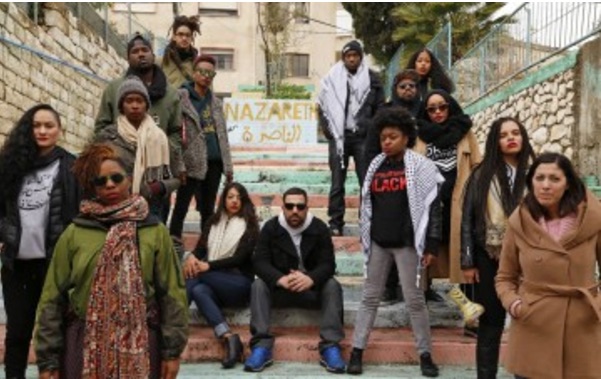
2015 Black Solidarity Statement with Palestine

. DISARMAMENT & SECURITY .

A statement by Black activist individuals and organizations

The following statement was signed by Black people in 25 different countries, 37 U.S. states, and the District of Columbia, including South Africa, Australia, Ghana, Nigeria, Ethiopia, Egypt, Palestine, & Puerto Rico. Of the 1,100+ signatories, there are 650 activists or organizers, 400 current students, 240 artists, 165 scholars or professors, and 22 clergy. 11 currently incarcerated political prisoners, at least 5 former members of the Black Panther Party for Self-Defense, and 6 professional hip-hop artists signed the statement. Nearly 50 organizations signed onto the statement:

blackforpalestine
Photo courtesy of Christopher Hazou

The past year has been one of high-profile growth for Black-Palestinian solidarity. Out of the terror directed against us—from numerous attacks on Black life to Israel’s brutal war on Gaza and chokehold on the West Bank—strengthened resilience and joint-struggle have emerged between our movements. Palestinians on Twitter were among the first to provide international support for protesters in Ferguson, where St. Louis-based Palestinians gave support on the ground. Last November, a delegation of Palestinian students visited Black organizers in St. Louis, Atlanta, Detroit and more, just months before the Dream Defenders took representatives of Black Lives Matter, Ferguson, and other racial justice groups to Palestine. Throughout the year, Palestinians sent multiple letters of solidarity to us throughout protests in Ferguson, New York, and Baltimore. We offer this statement to continue the conversation between our movements:

On the anniversary of last summer’s Gaza massacre, in the 48th year of Israeli occupation, the 67th year of Palestinians’ ongoing Nakba (the Arabic word for Israel’s ethnic cleansing)–and in the fourth century of Black oppression in the present-day United States–we, the undersigned Black activists, artists, scholars, writers, and political prisoners offer this letter of reaffirmed solidarity with the Palestinian struggle and commitment to the liberation of Palestine’s land and people.

We can neither forgive nor forget last summer’s violence. We remain outraged at the brutality Israel unleashed on Gaza through its siege by land, sea and air, and three military offensives in six years. We remain sickened by Israel’s targeting of homes, schools, UN shelters, mosques, ambulances, and hospitals. We remain heartbroken and repulsed by the number of children Israel killed in an operation it called “defensive.” We reject Israel’s framing of itself as a victim. Anyone who takes an honest look at the destruction to life and property in Gaza can see Israel committed a one-sided slaughter. With 100,000 people still homeless in Gaza, the massacre’s effects continue to devastate Gaza today and will for years to come.

Israel’s injustice and cruelty toward Palestinians is not limited to Gaza and its problem is not with any particular Palestinian party. The oppression of Palestinians extends throughout the occupied territories, within Israel’s 1948 borders, and into neighboring countries. The Israeli Occupation Forces continue to kill protesters—including children—conduct night raids on civilians, hold hundreds of people under indefinite detention, and demolish homes while expanding illegal Jewish-only settlements. Israeli politicians, including Benjamin Netanyahu, incite against Palestinian citizens within Israel’s recognized borders, where over 50 laws discriminate against non-Jewish people.

(Article continued in right column)

Question for this article:

Presenting the Palestinian side of the Middle East, Is it important for a culture of peace?

Are we making progress against racism?

(Article continued from left column)

Our support extends to those living under occupation and siege, Palestinian citizens of Israel, and the 7 million Palestinian refugees exiled in Jordan, Lebanon, Syria and Palestine. The refugees’ right to return to their homeland in present-day Israel is the most important aspect of justice for Palestinians.

Palestinian liberation represents an inherent threat to Israeli settler colonialism and apartheid, an apparatus built and sustained on ethnic cleansing, land theft, and the denial of Palestinian humanity and sovereignty. While we acknowledge that the apartheid configuration in Israel/Palestine is unique from the United States (and South Africa), we continue to see connections between the situation of Palestinians and Black people.

Israel’s widespread use of detention and imprisonment against Palestinians evokes the mass incarceration of Black people in the US, including the political imprisonment of our own revolutionaries. Soldiers, police, and courts justify lethal force against us and our children who pose no imminent threat. And while the US and Israel would continue to oppress us without collaborating with each other, we have witnessed police and soldiers from the two countries train side-by-side.

US and Israeli officials and media criminalize our existence, portray violence against us as “isolated incidents,” and call our resistance “illegitimate” or “terrorism.” These narratives ignore decades and centuries of anti-Palestinian and anti-Black violence that have always been at the core of Israel and the US. We recognize the racism that characterizes Israel’s treatment of Palestinians is also directed against others in the region, including intolerance, police brutality, and violence against Israel’s African population. Israeli officials call asylum seekers from Sudan and Eritrea “infiltrators” and detain them in the desert, while the state has sterilized Ethiopian Israelis without their knowledge or consent. These issues call for unified action against anti-Blackness, white supremacy, and Zionism.

We know Israel’s violence toward Palestinians would be impossible without the US defending Israel on the world stage and funding its violence with over $3 billion annually. We call on the US government to end economic and diplomatic aid to Israel. We wholeheartedly endorse Palestinian civil society’s 2005 call for Boycott, Divestment, and Sanctions (BDS) against Israel and call on Black and US institutions and organizations to do the same. We urge people of conscience to recognize the struggle for Palestinian liberation as a key matter of our time.

As the BDS movement grows, we offer G4S, the world’s largest private security company, as a target for further joint struggle. G4S harms thousands of Palestinian political prisoners illegally held in Israel and hundreds of Black and brown youth held in its privatized juvenile prisons in the US. The corporation profits from incarceration and deportation from the US and Palestine, to the UK, South Africa, and Australia. We reject notions of “security” that make any of our groups unsafe and insist no one is free until all of us are.

We offer this statement first and foremost to Palestinians, whose suffering does not go unnoticed and whose resistance and resilience under racism and colonialism inspires us. It is to Palestinians, as well as the Israeli and US governments, that we declare our commitment to working through cultural, economic, and political means to ensure Palestinian liberation at the same time as we work towards our own. We encourage activists to use this statement to advance solidarity with Palestine and we also pressure our own Black political figures to finally take action on this issue. As we continue these transnational conversations and interactions, we aim to sharpen our practice of joint struggle against capitalism, colonialism, imperialism, and the various racisms embedded in and around our societies.

Towards liberation,

International Peace Delegation to Syria 24-30 Nov. 2015

DISARMAMENT & SECURITY .

An article by Mairead Maguire for Transcend Media Service

Our delegation has just spent five days with the people of Syria visiting the cities of Damascus, Homs, Tartus, Qara and Ma’alula. We have been deeply moved by the kindness and warmth of the Syrian people whom we have had the privilege and joy of meeting. Although they have suffered unimaginable violence, they have inspired us by their vision of a peaceful Syria and deep commitments to solutions in their country. These are the findings of our delegation, consisting of eleven peace and human rights advocates from six countries. Over the course of five days, we met with internally displaced persons, refugees, affected communities, religious leaders, combatants, government representatives and many others in Syria.

maguire
Mairead Maguire

We call on the international community to protect the territorial integrity of Syria and to respect the fundamental rights of Syria as a sovereign State. We deplore any intent to breach the integrity of Syria’s frontiers or to damage the unity and rich diversity of the Syrian people.

We recognize the legitimacy of the aspirations of the Syrian citizens for change, reforms and an end to all violence and we support those working for the implementation of a democratic life that respects and protects the fundamental rights of all citizens and we believe that effective and lasting reforms can only be achieved through non-violent means.

Our primary appeal is that all countries stop their interference in Syrian affairs, more specifically, that they halt the supply of arms and foreign combatants. If foreign countries agree to stop the influx of arms and fighters, we are confident that Syrians can find their own solutions to their problems and achieve reconciliation.

We consider it beyond debate that the Syrian people have the right to determine their own government and their own future. Foreign interference is currently preventing the Syrian people from exercising their right to self-determination. We are concerned that such pernicious intervention is tearing apart the fabric of the country itself, with long-term consequences that can only be imagined.

The cautionary examples of Iraq, Libya, Yemen and other countries serve to remind us of the dire consequences of such international folly. This humanitarian crisis is already spilling into neighboring countries. A collapse of Syrian society will destabilize the entire region. We appeal to the international community that it can learn from history and make better choices in the case of Syria that will spare further tragedy for the courageous Syrian people.

(Article continued in right column)

Question for this article:

How can there be a political solution to the war in Syria?

(Article continued from left column)

Secondly we appeal to the international media to stop the flow of misinformation regarding the Syrian conflict. We believe that every Syrian should be given the right to be heard and we do not see this reflected in the international coverage of this crisis.

Thirdly, we urge the international community to review and reconsider the crippling sanctions that are taking such a heavy toll on Syrian people.

Fourthly, we urge the international community to take seriously the vast numbers of refugees and persons who have been internally displaced by this conflict.

We appeal to the entire religious community to call the faithful to nonviolence and peacemaking, and to reject all forms of violence and discrimination, and we express our admiration and respect for the many Syrian religious leaders who have refused to endorse the use of violence and have dedicated their lives to working for a peaceful solution to this conflict.

We pay tribute to the Patriarch Gregorios III Laham and Grand Mufti Ahmad Badreddin Hassoun for their inspirational work for peace and reconciliation for Syria and the Patriarch Gregorios III Laham for his kind invitation to our delegation. Our delegation would like to express to Mother Agnes Mariam and Sheik Sharif Martini our deep gratitude and appreciation for all their commitment to peace and reconciliation in beloved Syria.

As we leave Syria we are filled with hope that the Syrian people will have peace and so be a light of hope to the world.

The youth of Gaza in solidarity with the people of France

TOLERANCE AND SOLIDARITY .

Special to CPNN

On Tuesday, November 17, 2015, dozens of young students and some faculty and staff members of the Al-Aqsa University in Gaza gathered outside the French department, in solidarity with the people of France after the deadly bombings hit Paris last Friday.

gaza
Click on the photo to enlarge

The students participated in this solidarity rally
despite the rain, the weather and the exam period,

The rally was organized at the initiative of the French department at Al-Aqsa University in Gaza, and the University Peace Centre.

It was intended to show that young people in Gaza, despite their daily suffering, despite the inhumane Israeli blockade and the dramatic consequences of the latest Israeli military offensive in the summer of 2014, wish to express their solidarity with a country friendly to Palestine and to a population increasingly concerned with the Palestinian cause.

Participants came with placards that expressed the their solidarity with France.

They carried the following slogans:

– The Youth of Gaza solidarity of France

– Solidarity with Gaza Paris

– For Freedom and against hatred

– Long live Franco-Palestinian relations

– despite Their suffering, the Palestinians of Gaza are sending a message of support to France

– against Violence, for peace, justice and tolerance

– Love, Peace, fraternity, equality, freedom, justice, solidarity

The solidarity rally was well covered by national and international media.

Ziad Medoukh, director of the French department and Coordinator of the Peace Center, as well as some students gave interviews to radio and television present.

(Thank you to Phyllis Kotite for sending this to CPNN.)

(Click here for the original French version of this article.)

Nobel Peace Prize 2015: Lesson in Hope from Tunisia . . .

. DEMOCRATIC PARTICIPATION .

An article by Mounira El Bouti, Liberte Algerie

I take a step back and with a sweep of the left hand, I push aside my hair and start to write this article. With every gesture, every thought, every breath I am inspired to think of the Tunisian blood flowing in my veins, mixed with Algerian blood, but I’ve told you that before …

nobel
Video of Nobel Prize award

This blood makes me proud to belong to two countries whose great history and peoples can only make you proud.

It was just an hour ago that I heard the big news: the Nobel Peace Prize was awarded to the quartet sponsoring the national dialogue in Tunisia. And, like a cherry on the cake, there was a woman among them, the President of the Tunisian patronnât, Mrs Ouided Bouchemaoui. You don’t have to be a feminist to focus on this; it is enough just to be a woman . .

I have long written that women’s leadership is strong because of its value of consensus and its leadership by thoughtful dialogue which allows organizations to overcome the most difficult crises. Now here is the proof: evidence from Tunisia that confirms my research and responds to my detractors

So back to the events marking this day, not a week, not the century …

It’s an historic first: the 2015 Nobel Prize for Peace is awarded to Tunisia! What an amazing year! We’ve seen everything: promulgation of the first qualified democratic constitution in the Arab-Muslim world, election of a president by democratic and transparent means, the terrorist attacks on the Bardo museum aimed against Tunisia’s culture and history, and the bombing of the tourist center at Sousse aimed at the main sources of revenue of the country. Despite the attacks, neither history nor culture nor tourism have been affected.

Tunisia in crisis, shows us the way forward ..

In Chinese calligraphy, the word “crisis” has two ideograms. The first character means “danger,” and the second “opportunity.” This is right, because a crisis brings with it not only risks but also opportunities. When an organization is in crisis, the way it overcomes it, or even seizes opportunities, depends on the intelligence and competence of its management.

The crisis weighs heavily on Tunisia, but at the same time they show the world that their resistance is still there. They still have hope and creativity. Even in times of crisis, they can be awarded prizes. It all depends on our level of consciousness and our way of seeing things. If we believe in change, it will come ..

So.it’s a good example, praised by François Hollande, the French president, David Cameron, the British Prime Minister and hailed by millions of participants in social media.

(Article continued on right side of this page)

(Click here for the original article in French.)

Latest Discussion

The Arab Spring, Can Tunisia continue the momentum they started?

(Article continued from left side of this page)

But what does this prize really mean?

For me, this award is a strong and profound message of hope and a reminder of the poem by Abu Al Kasseem Echebi: ‘When the people one day want life, the force of fate is in their favor …”

Sometimes the force of fate responds very strongly, like today. After an attempted assassination of a known personality in Tunisia namely Charfeddine Ridha, chairman of the Etoile Sportive du Sahel, as well as the deputy from the ruling party, Nidaa Tounes, who narrowly escape from his car riddled with 30 bullets 30, is this not the force of fate?

This is a fate that protects, promises and reassures. I do not know what star it is that watches over Tunisia, but it is a good star. We have avoided the worst and we are all as excited as children on the eve of the school year to watch the news, the reactions of celebrities and the updates our news from FB and Twitter ..

Let me tell you the story of the dialogue that led to the prize. .

The Tunisian National Dialogue is a quartet which includes four groups: the Tunisian General Labor Union; the Tunisian Confederation of Industry, Trade and Handicrafts; the Tunisian Order of Lawyers; and the Tunisian Human Rights League.

Formed in the summer of 2013, at a time when the democratization process was in danger because of political killings and widespread social unrest, the quartet organized a long and difficult national dialogue between the Islamists and their opponents, getting them to agree to escape from an institutional paralysis.

This dialogue managed to avoid the worst in Tunisia which bordered on civil war, especially after the assassination of Chokri Belaid, Mohamed Brahmi, and the ambush of young soldiers at Mount Chaambi.

Here is one more reason to continue believing and dreaming and never lose hope. To love a person is to believe in her or him, even in the most difficult times and it’s the same thing to love a country. As I wrote you in my last note, the joy of life bursts forth, the desire for love is always there, as long as we believe ..

For me, this is not the Nobel Prize of peace but of hope and of love, lots of love in the heart and in the hands, the hands that have constructed liberty and that continue to work for change in the face of the opposing winds and tides …

I thank all of you who have come to support us, who have kept your promise to visit Tunisia. Thank you from my heart. Today I ask you to congratulate us, to be happy for us, to share our enthusiasm and to cultivate our growing hope.

Someday the prize should be awarded to all the peoples who aspire to freedom, to Palestine divided and bruised, to Syria agonizing, to Algeria lost between two shores, to the Gulf countries, anesthetized by money and the making of war, to Libya stolen, to Egypt sold out. These peoples also, despite appearances and despite oppression, should also have the right to feel joy, to be honored and to be thanked.

Before taking the last sip of my coffee that burns my mouth but has no effect, as I bubble with joy and pride, I ask you to congratulate us, praise us, envy us! This is not the world cup of football. This is not a scientific discovery. This is not winning the lottery, It’s even better: it’s the Nobel Prize …

One last thing, as always in times of crisis, we must prepare for a rain of criticism and comments from the kill-joys and the envious. The consequences will be heavy because this prize is indeed a great slap in the face to all the dictators in the Arab world.

Palestine: Breaking the Silence Tour in Hebron

DISARMAMENT & SECURITY .

An article by Jamie Stall, Holy Land Trust

Earlier this month, we had the chance to visit Hebron and participate in a city tour with Breaking the Silence, an organization founded by former Israeli combatants who served in the Occupied Territories. The aim of the organization is to raise awareness about the daily realities of those living under occupation and stimulate public discussion of these issues among Israelis.

hebron

We started off the tour near Shuhada Street, where we gathered in a hidden room behind a souvenir shop. Our tour guide, Shai, began by giving us a view into his personal experience as an IDF combatant in the West Bank. He recounted several of his experiences for the group, including being ordered to chase a young child while holding a loaded firearm because the kid was playing near a security fence, and searching Palestinian households at random for the purpose of “making the IDF’s presence felt” within the community.

After the introduction, we began walking through an almost entirely deserted “ghost town.” As it turns out, this abandoned street is called Al-Shuhada Street and was the bustling commercial center of Hebron until about 20 years ago. Shay explained that in 1994 all its businesses were closed by the army “for security purposes” following the murder of 29 Muslim worshipers at the Cave of the Patriarchs by the Israeli settler Baruch Goldstein. As we walked down the street, we encountered several placards that told a very different story about the street’s closure. According to the signs, “these stores were closed by the IDF for security reasons after the Arabs began the ‘Oslo War’ [aka The Second Intifada] in September 2000, attacking, wounding and murdering Jews on this road.” A quick fact check proves this to be false as the reason for the street’s closure, not to mention that The Second Intifada began six years after the stores were closed. There is no doubt that the Jewish settler community in Hebron did experience many detestable acts of violence, including several murders, but that does not change the fact that the sign’s claims are nonfactual propaganda meant to mislead its readers and evoke a negative opinion of the city’s Palestinians.

As we continued up Al-Shuhada Street, passing a military base and several settlements, we encountered a pedestrian checkpoint separating the settler communities and a Palestinian commercial area. As we were finishing our tour near the checkpoint, a young Palestinian man began to walk through the checkpoint while singing a song to himself. One of the Israeli soldiers on duty told him “shtok!” (“shut up!”), but he continued walking, singing to himself as before. At this point he was stopped, searched, questioned and prevented from leaving for about ten minutes, all because he was singing.

Seeing and listening to the history and present-day reality of this small slice of Hebron was not easy. Frankly, nothing in Palestine has been easy. There is so much suffering and resentment on both sides of the separation wall that it can put a damper on your hopes for a better future. But hearing courageous testimonies and messages of hope from people like Shai and Breaking the Silence bring some of that hope and optimism back. I’m so appreciative of what they are doing. May there be more people and communities like them, willing to speak out against the occupation and work for truth, peace and reconciliation.

Questions for this article:

Amman, Jordan: #youth4peace – Redefining Youth as Peacebuilders

TOLERANCE AND SOLIDARITY .

An article from Peace Is Sexy

There is a widespread perception that youth are trouble makers. Economists believe a large youth population to be problematic for a country. Police forces (notably in the US) distrust youth and often target youth. Youth are considered to be particularly susceptible to violent extremism. And even governments consider youth as too young and inexperienced to have any kind of value added in political participation.

amman
video of Global Forum

But there is a movement that is gaining traction to cast youth not as trouble makers, but as peace makers. And there is evidence to back it up. According to the 2015 Global Peace Index, “Poverty and youth bulges are typically considered risk factors for urban violence. However these factors were found not to be statistically significant in this study.”

Indeed, the Global Forum on Youth, Peace and Security which occurred on August 21 and 22 in Amman, Jordan was a watershed moment for shining light on how youth contribute to peace. The forum comes on the heels of Jordanian Crown Prince al Hussein bin Abdullah II, at the age of 20, being the youngest person to chair a UN Security Council meeting. Appropriately, the April 2015 session focused on discussing youth participation in peacebuilding and countering violent extremism.

The high point of the Global Forum was the adoption of the Amman Declaration which begins with the following:

We, young people from around the world, gathered here in Amman, Jordan on 21-22 August 2015 at the Global Forum on Youth, Peace and Security, express our commitment to live in a peaceful global society. Today, with more young people than ever globally, it is a demographic imperative to include us in working to achieve stability and security. […]

With this Declaration, we present a common vision and roadmap towards a strengthened policy framework to support us in transforming conflict, preventing and countering violence and building sustainable peace.

(article continued in right column)

Question for this article

Is there a renewed movement of solidarity by the new generation?

(article continued from left column)

This Declaration was developed by youth and is the outcome of an extensive consultation process with young people from all over the world to ensure an inclusive and integrated approach.

The Amman Declaration then builds upon existing frameworks including the UN Sustainable Development Goals and the Guiding Principles on Young People’s Participation in Peacebuilding. It goes on to list four key pillars for implementation and list specific action items under each one:

– Youth Participation and Leadership in Issues of Peace and Security

– Youth Preventing Violence and Building Peace

– Gender Equality

– Young People’s Socio-Economic Empowerment

While the Global Forum is a highly visible event, it barely encapsulates the decades of work that the conference’s organizers, Search for Common Ground, United Network of Young Peacebuilders and UN Peacebuilding Support Office, let alone all the other actors in the field, have put into peacebuilding and empowering youth. Nor does it show what has been happening since the Forum: participants sharing the Amman Declaration in their home countries, teams monitoring the implementation of the declaration, the effort to get a UN Resolution passed based on the contents of the Amman Declaration and all the programs that youth peacebuilders continue to implement around the world.

Some of those youth-focused and youth-led peacebuilding programs were highlighted during the Global Forum. Participants heard from Yousef Assadiq, a young Norwegian who converted to Islam, became radicalized and now works to de-radicalize Muslims in Norway and prevent them from joining ISIS. Seventeen year-old Brenda Torres Garcia discussed her work with the National Movement of Children in Colombia and Victor Ochen shared his story of going from a child refugee in Uganda to an advocate for reconciliation and inclusion.

Perhaps one of the greatest achievements of the Global Forum on Youth, Peace and Security was to bring together not only youth and policy makers, but also youth from around the world who might not otherwise have the chance to exchange and learn from colleagues. For some, this was the first time they traveled outside their country. But now, thanks to the Facebook groups and listserves that have been created, they are highly plugged into a global youth-led movement for peace.

Search for #youth4peace on Twitter and on Facebook to see what participants themselves and doing and saying about the Forum and the Amman Declaration.

Letter of appreciation to the Palestinian Youth Orchestra

EDUCATION FOR PEACE .

by Phyllis Kotite

“Music is the language of the spirit” –Khalil Gibran
 
May I express profound appreciation for the magnificent and outstanding performance of the PYO in Paris.  Having followed the evolution of these talented young musicians, ‘grace’ a Lena Saleh, have been astonished at the performances in the major European and Arab countries.  As a Lebanese Arab, and former United Nations staff inspired by classical music, am deeply proud of these creative young Palestinians whose talent enhances our great Arab heritage.  They were one of the best symphony orchestra’s I have ever heard !!  And the guest conductor was excellent also with his lively and harmonious style.

kotite

You and your colleagues are to be congratulated on this brilliant initiative which has brought joy and pride to our beleagured region.  It is indeed remarkable that such beauty emerges from the oppression of occupation and sorrow.  Recalling the great poet Mahmoud Darwish:
 
   “I have found an opening to inscribe the national into the universal,so that Palestine does not limit itself to       Palestine, but finds her legitimate esthetics in a more vast human space.  The Middle East is the birthplace of mazcivilizations.Sumerian, Egyptian, Canaanian,…Mediterranean identity is universal”.
 
Indeed, this universal spirit was skillfully demonstrated by the PYO’s superb performance of composers from different cultures.  Having cooperated with numerous international development projects for Palestine, am certain that your future, your civic values and manner of governance will be a model for our region.
 
Mabruk mitte murra, bravo and sincerest gratitude for this moment of beauty, during this dreadful times for our region.   I hope we will meet one day.


Question related to this article:

A gathering of young peace-builders towards a strengthened policy framework on Youth, Peace and Security

. . TOLERANCE AND SOLIDARITY . .

An article by Meg Villanueva, based on the Forum website

On 21-22 August 2015, the first ever Global Forum on Youth, Peace and Security will bring together around 500 participants, including government representatives, practitioners and experts in peace and conflict work, youth activists and young peacebuilders from more than 100 countries. The Global Forum is a turning point towards a new international agenda on youth, peace and security. It stems from the themes debated at the Security Council Ministerial Debate on the Role of Youth in Countering Violent Extremism and Promoting Peace, organized by the Hashemite Kingdom of Jordan during its presidency of the Security Council, on 23 April 2015. The forum will build on the on-going efforts by a multiplicity of actors to decisively step-up global attention to young people’s positive contribution to peace and chart a common agenda.

meg

For the first gathering of this kind, young people, youth-led organizations, non-governmental organizations, governments and UN entities will come together to agree on a common vision and roadmap to partner with young people in preventing conflict, countering violent extremism and building lasting peace. The Global Forum will be hosted by the Hashemite Kingdom of Jordan under the Patronage of His Royal Highness Crown Prince Al Hussein bin Abdullah II, and co-organized by the United Nations represented, on behalf of the Inter-Agency Network on Youth Development (IANYD), by Office of the UN Secretary-General’s Envoy on Youth, Peacebuilding Support Office, UNFPA and UNDP, in partnership with Search for Common Ground and the United Network of Young Peacebuilders.
One of the expected outcomes of this forum is the Amman Declaration, which will present young people’s vision and roadmap towards a strengthened policy framework in support of young people’s roles in preventing and transforming conflict, countering violent extremism and building peace. This Amman Declaration is entirely developed by young people, building on the Guiding Principles for Young People’s Participation in Peacebuilding (bit.ly/1Jz90F6 or bit.ly/1GPQ1QO). UNOY Peacebuilders is coordinating the drafting of the Amman Declaration, and has involved a lot of young people from all over the world, through written consultations, questionnaires and focus-group discussions.
The Forum will engage participants in conversations on key policy recommendations towards a new international agenda on youth, peace and security, which will be captured in a final Declaration. This forum will provide a platform for exchange of experiences, innovative ideas and programmatic frameworks that work. To learn more about the key topics to be discussed, as well as inspiring young speakers, please visit https://www.unteamworks.org/Youth4Peace.

Question for this article

Algeria: Seminar on Islam and rejection of violence on 12 and 13 August in Laghouat

TOLERANCE AND SOLIDARITY .

An article from the Algérie Press Service

Islam and rejection of violence, is the theme of the 10th seminar Abdeldjebbar Tidjani, scheduled for August 12 and 13 at the headquarters of zaouia Tidjania in Ain-Madhi (Laghouat). This was announced Thursday by officials of the zaouia. They indicated that the meeting will be attended by Shuyukh and teachers from different regions of the country, and it will be devoted to the path of Islam in the rejection of violence and the remedy of its causes.

algerie

The participants in this religious event will address several issues, including “violence: the phenomenon and its meaning”, “the clash of civilizations and violence”, “moderate religious discourse and awareness”, and “the media and their role in awareness and spreading the culture of peace and tolerance “, said the organizers.

The theme for this year’s Tidjani Abdeldjebbar seminar is motivated by the “alarming and disturbing proportion” taken by this phenomenon which is “alien to Muslim society.” Hence the need to alert and warn against its spread and infiltration in society, they said.

The objective of this seminar since its inception has been to “raise awareness and spread culture and knowledge in society,” according to organizers.

This seminar is named after Abdeldjebbar Tidjani, the 10th General Caliph of the tariqa (brotherhood) Tidjania over the period 1991 to 2005, who died at the age of 85.

Tariqa Tidjania was founded in 1781 in Boussemghoune by Sidi Ahmed Tijani (1737-1815), and it has millions of followers worldwide.

(Click here for the original French version of this article.)

Question for this article

Morocco: World Summit for the promotion of peace

FREE FLOW OF INFORMATION

An article by Driss Lyakoubi, Le Matin (translation by CPNN)

No caption

The youth of Kenitra are mobilizig to promote the values ​​of peace and solidarity between peoples, through the World Summit for the promotion of peace and social development, organized by the Ibn Tufail University in partnership with the wilaya of Gharb Chrarda Beni Hssen and the association “Dar Lakbira “.

maroc

This event brings together nearly 120 participants from 32 nationalities from around the world. It is an opportunity for reflection and exchange between young international leaders on topics related to the values ​​of humanism and solidarity. According to its initiators, the World Summit for the promotion of peace and social development is a unique event, designed to broaden the perspectives of international youth on the most pressing issues of the world through positive dialogue, cooperative and constructive.

This is a vision shared by Zineb El Adaoui, the Wali (governor) of the region of Gharb Chrarda Beni Hssen, who reminds us of the supreme interest granted by the Kingdom to the universal values ​​of peace, tolerance, dialogue and solidarité. Azzeddine Midaoui, president of the University Ibn Tofail, paid tribute to the young academic leaders of the association “Dar Lekbira” for the work that led to the organization of this unique gathering in the capital of Gharb. He commended, in this regard, the ties of cooperation that link the university Ibn Tofail and “Dar Lekbira” to promote the values ​​of social solidarity and openness. He highlighted the role of the University in anchoring the values ​​of peace and otherness among youth.

The president of the association “Dar Lekbira” Zinelabidine Taoussi, for his part, said that Moroccan youth had followed the footsteps of his ancestors, that of the consecration of peace and development for the benefit of all countries and peoples of the planet. It should be noted that the World Summit for the promotion of peace and social development, as has been announced by the various stakeholders, is the ideal opportunity for participants to explore cooperation opportunities for project initiation promoting innovative culture of peace, non-violence and social justice in their respective countries and around the world. A charter of principles will also be developed during this global youth forum to strengthen the ideals of peace and social justice within and among all nations and peoples of the world. This reflected the common vision of all summit participants from the world they hope for future generations.

The World Summit for the promotion of peace and social development has set as its main objectives the promotion of the culture of peace and nonviolence in international youth and strengthening youth culture of leadership in areas related to the building of peace and social development. There is also question of strengthening the role of youth in building inclusive societies, peaceful and resilient and the establishment of an international network of young leaders with the ability to serve their communities through innovative community projects.

(Click here for the original French version of this article) )

Question for this article: