FREE FLOW OF INFORMATION .
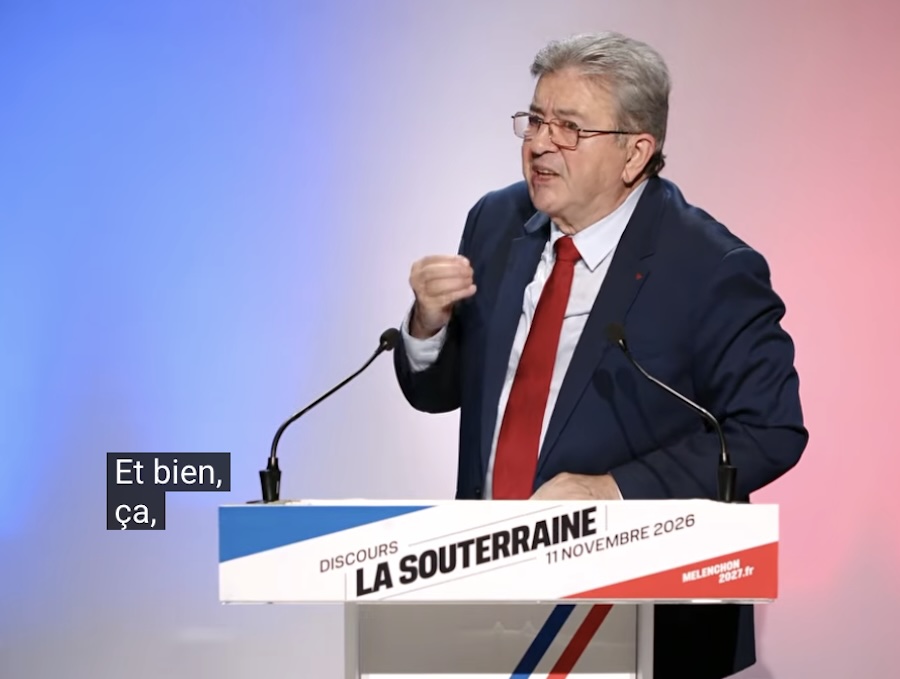
Excerpt from the video (transcribed by CPNN)
(Jean-Luc Melechon, the presidential candidate of the Insoumise Party gave this speech on Armistice Day in the French village of La Souterraine. Here is an excerpt with added sub-titles.)
. . . . This is where we stand. We shall be non-aligned. I am telling you all this on November 11th—Armistice Day. Like many of you, I am a peace-loving person. Perhaps not a “pacifist” in the strict sense—as some have the capacity to be—but certainly peace-loving; yet, I am not naive. I am prepared to do whatever is necessary for our people.
And to the younger generation: I ask you to make an effort—to read, to seek to understand, and to inform yourselves about how things unfolded in the past. Do not believe the simplistic notion that a world war was triggered merely because an archduke was assassinated. That war was the result of a long, downward slope—a path that led inexorably to conflict—and we are currently on that same slope.
Right now, nations everywhere have decided to shift toward a “war economy”—continuously manufacturing weapons. This is done because it jump-starts the capitalist economy; states make purchases in the billions. And as for bombs—well, once you drop them on a neighbor, you have to buy more. They have effectively become a mass-consumption product.
War is, first and foremost, the outcome of a systemic dead end—a system that finds its fulfillment in the creation of a war economy and its associated markets. That is the path we are currently on.
We will withdraw from NATO
This is why I want to issue a warning—and I want everyone to hear this clearly: we will withdraw from the NATO command structure, because we have no business participating in American wars. We will leave NATO because we intend to decide for ourselves what we do and how we act.
And we will remain committed to the agreements that have been signed within Europe—agreements to which we are a party. France’s word is good—provided that I know what is in the agreement.
Can you tell me what Macron agreed to this summer—since it seems he did make an agreement—with Saudi Arabia, regarding the protection of the area the Pope is traveling through? You know, that peninsula—the one between the coast where Iran lies and the Suez Canal? What is this about? He said we were going to install equipment there—who decided that? And equipment doesn’t operate on its own; you have to send military personnel along with it. We already have troops in Romania, and we have them in Estonia. Now we’re going to put them there, too—but for what purpose?
This means that, overnight, we could become a co-belligerent. Why? Because all it would take is for an adversary of Saudi Arabia—namely, Iran—to act.
There is a desire to see the regime in Iran fall. Personally, I have a very low opinion of that regime—and I, unlike other politicians, am willing to speak up for those sentenced to death there, as are all the deputies from the La France Insoumise party. We, at least, do that.
But this country [Iran] has been subjected to aggression. What do you expect? We can’t just go to war against anyone the United States—or Mr. Netanyahu—happens to dislike.
Don’t get involved in the start of a war
Well, if this country that has been attacked decides to defend itself by striking pipelines in other nations, we suddenly become co-belligerents. So, what do we do then? I ask you: what do we do? Do we just stand there with our arms crossed, waiting to be fired upon?
The last time something like this happened to us was in Lebanon. We had a building housing our military personnel—this was a long time ago—and someone blew it up. Fifty-four French soldiers were killed. What happened behind the scenes? Well, the French army struck in the Bekaa Valley.
There is no such thing as a conflict where you don’t retaliate; you can’t just deploy equipment capable of killing everyone while expecting that no one will be allowed to touch you. You shouldn’t get involved in the start of a war—or, if you do, you had better be absolutely certain about what you’re going to do next. I’d like to ask Macron this: if we come under fire, what will you do, Mr. President? What are you going to do? You have no idea. That’s unfortunate, because in a situation like this, things are irreversible. Once you’ve gotten yourself involved, you have to see it through to the end—because by then, it’s too late to back out.
And it is the same with Russia. I know the situation is precarious—walking a razor’s edge, as it were. But who could possibly agree to engage, in any way, in an armed conflict with the Russians—a nation spanning 11 time zones, possessing one of the world’s most capable militaries?
(Article continued in the column on the right)
Where in the world can we find good leadership today?
(Article continued from the column on the left)
This isn’t a video game, Mr. Jadot. Who are you to so boldly advocate for war here or there? I, for one, want no part of it; and if you are listening, know that I will do everything in my power to ensure we are not dragged into any war. We do not want war—we want an orderly world.
We are prepared to waive our veto
France will never surrender its seat on the UN Security Council to anyone—not even to other Europeans. We hold that seat, and we shall keep it until the UN is reorganized. In the meantime, however—joining more than 100 other nations, including Mexico—we have stated our willingness to waive our veto power in instances involving mass atrocities: specifically, war crimes or acts of genocide. It is simply intolerable that five nations, through their veto power, can block any response intended to protect innocent people being massacred by the thousands. That is the concession we are prepared to make.
And we will resume negotiations. You may not be aware of this, but in 1993, our country achieved a major diplomatic success by securing the signing of an international convention against chemical weapons here in Paris.
Do you understand what I am talking about? Chemical weapons—means of asphyxiating everyone, of deploying gases to kill. And what about when the Syrians used them? Or when Saddam Hussein used them? We all cried out, “What on earth is this horror?” Well, you should know that neither Russia, nor the United States of America, nor a number of other countries have signed these agreements. This means that they still haven’t destroyed their stockpiles, and we have no idea what they are doing with them.
That concerns chemical and biological weapons. You all understand what I mean by biological weapons, right? These are weapons—using bacteria, microbes, or viruses—that are cultivated specifically to be unleashed upon people, making them all sick and causing them to die. Such weapons exist. In 1993, they refused to sign the agreement we proposed, and the subject hasn’t been discussed since.
We will resume negotiations to abolish weapons of mass destruction
If you elect an Insoumis government, we will resume this work. I am certain that dozens of countries around the world will say, “Let’s join the French—we want no more of this horror that is the biological weapon.”
And then? You will see. In a single day, we will erase the shame we have had to endure—like when the President of our Republic mistreated African heads of state, or behaved with such flippancy, patting the Pope or touching goodness knows who else.
Suddenly, the French will once again become a great nation—a nation with a political agenda for the rest of the world, one that defends the common human interest: the abolition of weapons of mass destruction.
We will start from scratch in our discussions on the destruction of nuclear weapons, beginning with those who possess the most—namely, the Americans, the Russians, and so on.
Do not be taken in today. The United States of America holds the largest military budget—accounting for 80% of global military spending. It is the NATO countries [that dominate]; it is simply not true that other nations are armed to the teeth against us—that is not the truth. What is true is that we belong to a coalition that threatens everyone, and in the meantime, everyone has gone mad.
I mentioned this earlier: the Germans are set to double their troop numbers and, by 2030, will have increased their defense budget two- or threefold. Meanwhile, we in France—at the mere whistle of Mr. Trump—have agreed to raise our military spending to 5% of our GDP. That is a colossal, enormous sum—but for what purpose, pray tell? Is there any coherence in our strategic vision? Do you truly believe that the concept of nuclear deterrence is such a sound idea? Certainly, it offers protection—provided the adversary is sufficiently afraid of us. But are we capable of grasping that we, too, ought to fear an adversary who knows exactly where we stand?
The danger of civil nuclear plants
Do you all fully understand? The issue of civil nuclear energy is inextricably linked to military nuclear capabilities. Consider this: we build power plants—without any clear plan for how to fund the next ones—while claiming we will proceed regardless. We already have 59 reactors, including an entire plant—Nogent-sur-Seine—situated just upstream from the capital. There are many more throughout the Rhône Valley, an area that also houses our chemical industry. Does everyone realize that a single strike could effectively mean the end of France? In this sense, the way we utilize nuclear energy has, first and foremost, placed us in grave danger; in a world at war, no rules are respected. There are no limits to war—it immediately becomes total war.
And just look at how fortunate we have been—recall when I insisted that the nuclear power plants in Ukraine must be protected? Let’s start from that end—let’s at least protect that much, and it will be a beginning of peace. Because if there’s a problem at even one power plant, we’ll all suffer the consequences; after all, the radioactive cloud from Chernobyl didn’t stop at the border. And remember, thousands of Russians died to contain the Chernobyl disaster—they gave their lives to stop it. They could have just said, “We don’t care; let them deal with it themselves.”
Well, the current situation means that we—along with all the countries around the Mediterranean—are once again in danger . . . . .
– – – – – –
If you wish to make a comment on this article, you may write to coordinator@cpnn-world.org with the title “Comment on (name of article)” and we will put your comment on line. Because of the flood of spam, we have discontinued the direct application of comments.