DISARMAMENT & SECURITY .
Special to CPNN from Basu Gautam, Founder and President, Lumbini World Peace Forum
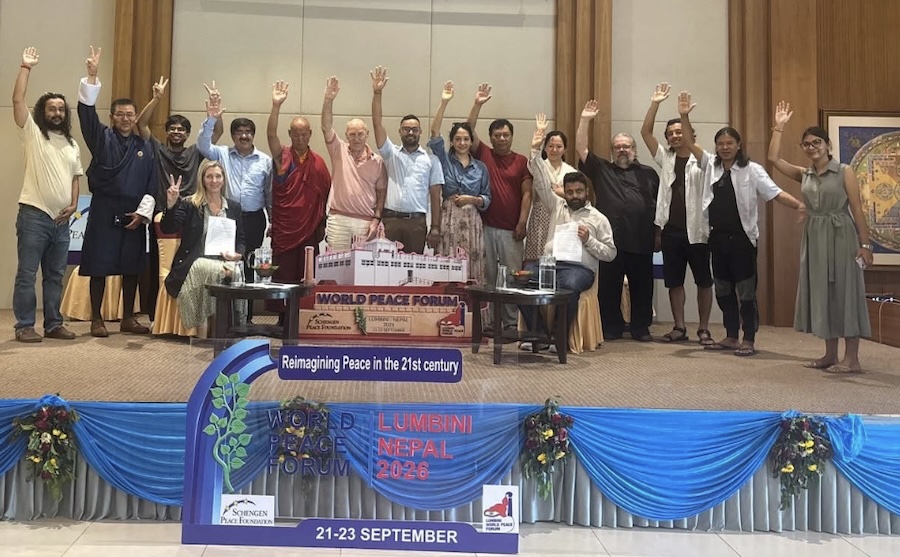
In September 2026, peace builders from many countries gathered in Lumbini, Nepal, the birthplace of Siddhartha Gautama, the Buddha. For three days (21-23 September) the 17th World Peace Forum met under the theme “Reimagining Peace in the 21st Century.” It was the first time the World Peace Forum had been held in South Asia.
How the Lumbini World Peace Forum began
The Lumbini World Peace Forum (LWPF) started in 2011 as an idea among a group of young Nepali professionals from different fields. We wanted Nepal, the land of the Buddha’s birth, to be known as a hub of world peace. In 2015 we formally institutionalized the organization.
Today LWPF is a non-governmental, non-profit organization registered in Kathmandu. It works for peace, social justice, equality, sustainable development and respect for the environment, and for a global network of peace activists and initiatives. We hope to establish chapters across Nepal, South Asia and beyond.
A forum that travels
The World Peace Forum was initiated by the Schengen Peace Foundation of Luxembourg, named for the open dialogue and cooperation across borders that Schengen symbolizes. Earlier forums were held in places such as Barcelona and South Africa.
The 17th forum was organized jointly by LWPF and the Schengen Peace Foundation, whose president, Vicki Hansen, co-led it with me. Participants included diplomats, policymakers, scholars, innovators and change-makers, among them Steve Killelea, founder of the Institute for Economics and Peace. The program also included Global Impact Awards recognizing peace work.
(Article continued in right column)
How can the peace movement become stronger and more effective?
(Article continued from left column)
More than speeches
Peace is lived as well as discussed, so the forum was not only panels. Delegates joined meditation sessions, cultural performances, tree planting and collaborative art. They also took part in a peace prayer at the Mayadevi Temple, which marks the Buddha’s birthplace. These shared experiences are where people from very different cultures and nations build the trust that a culture of peace depends on.
The Lumbini World Peace Declaration 2026
The forum closed with the unanimous adoption of the Lumbini World Peace Declaration 2026. Vicki Hansen and I issued it together. The declaration expresses deep concern about escalating geopolitical tensions, the threat of nuclear proliferation and growing polarization. It urges world leaders and international institutions to move away from hostility and toward inclusive diplomacy, dialogue and multilateral cooperation. Its roadmap rests on four pillars:
° Education for peace: integrating peace education, empathy, global citizenship and critical thinking into schools and universities, so that non-violence is learned from an early age.
° Climate justice: recognizing that environmental degradation drives instability and resource conflict, and calling for urgent global action.
° Ethical technology: calling for responsible governance of emerging technologies, including artificial intelligence, so they are not used to undermine human rights or security.
° Inclusive diplomacy: involving grassroots communities, marginalized voices, women and youth in peace-building.
Why Lumbini matters
The Buddha’s message of compassion and non-violence has never been more needed. Holding the forum in Lumbini reminded us that the culture of peace is not a new invention. It draws on the wisdom of many traditions, and today we must renew it for the challenges of the 21st century.
A declaration is only words unless people act on it. LWPF will continue to build partnerships among civil society, educators, young people and governments to carry its principles into communities. We invite readers of CPNN to join us, and to take the culture of peace into their own schools, cities and countries.
– – – – – –
If you wish to make a comment on this article, you may write to coordinator@cpnn-world.org with the title “Comment on (name of article)” and we will put your comment on line. Because of the flood of spam, we have discontinued the direct application of comments.