DISARMAMENT & SECURITY .
An article from Counterfire
As activists from across Europe and beyond met to oppose war, Jamal Elaheebocus and Lauren Simmonds report on the determination of delegates to build a massive international movement for peace.
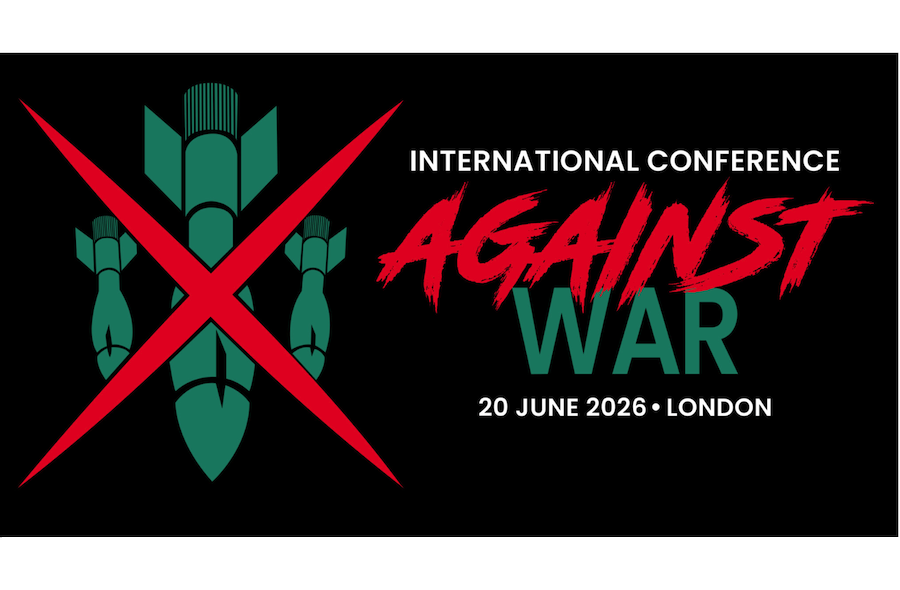
Over 3,000 delegates from across Europe gathered in Central Hall, Westminster for the second International Conference Against War on Saturday 20 June. Following the initial conference in Paris last year, this year’s conference organised by the Stop the War Coalition and supported by hundreds of trade unions and campaign groups marks a step forward for the international movement.
Video of Conference (starts at minute 12)
The day before, there was an excited buzz as around 200 delegates from Europe and beyond filed in to the NEU Headquarters at Hamilton House in London, for the pre-conference Action Planning Meeting. There was a short introduction to the meeting from a panel of speakers which included Daniel Kebede, NEU General Secretary, who welcomed us to the venue, and STW’s Lindsey German, who made the important point that the answer to the US imperial project does not lie with European rearmament and that the enemy for us all, is the one at home.
There was plenty of time for the duration of the meeting to hear from a wide range of speakers who had put their slips in for an opportunity to address the meeting. We heard from activists from both Ukraine and Russia, who made the case for solidarity with dissenters in both countries. Students from France and Germany, organising against conscription and Trade Unionists and organisations from multiple counties making the case for welfare not warfare, and mobilising opposition within the labour movement to the reoccurring issues of social cuts in favour of ever increasing military spending.
High on the agenda was of course the condemnation of the ongoing genocide in Palestine and the need for continued solidarity. We also heard from the chair of the Cuba Solidarity Campaign, Kevin Courtney, who highlighted the escalating crisis happening there as a result of the US blockade and the growing threat of US military intervention. The important issue of the situation in Sudan was also raised, and how it relates to Western imperialism.
It was a day of connection, conversation and vital networking, where people could share the important work and organising they were involved in, and where the anti-war message transcended language barriers. With the groundwork laid, the Anti-War Conference on Saturday was shaping up to be a truly historic occasion.
The main event
The Saturday morning session of the conference at Central Hall Westminster began with an assembly of trade unionists and activists from across Europe discussing the increasing militarism across their countries and how they are responding. Workers from Spain, France, Germany, Greece, Italy, Bahrain and more spoke and there was a consistent theme throughout the session: their governments were preparing for war and were doing so by decimating the living standards of working-class people.
(Article continued in right column)
How can the peace movement become stronger and more effective?
(Article continued from left column)
However, there were also stories of resistance, of huge protests in solidarity with Palestine, school students in Germany striking against conscription and the Global Sumud Flotilla which has sailed numerous times to break the siege of Gaza and attempted to deliver desperately needed humanitarian aid.
Sukana Rhawani, the mother of Filton political prisoner Fatema Zainab Rajwani, who was sentenced as a terrorist by a judge the previous week, spoke movingly about the increasing authoritarianism being unleashed against an effective and powerful Palestine solidarity movement in the UK.
Anti-conscription campaigns
Students and young people met to discuss the launch of a mass campaign against conscription, with German school striker Felix Kreklow Rojas addressing the meeting and relaying his experiences in organising school strikes against conscription in Germany. Students from France, Spain, Britain and the US spoke of their campaigns. There was a consensus that a coordinated international response is needed and that days of action against conscription will be held on 21-22 November.
The first of two main sessions in the impressive main hall discussed the global drive to war. Parliamentarians from across Europe spoke of their governments’ hikes in warfare spending. Numerous British MPs, including former Labour leader Jeremy Corbyn, spoke of the need to build opposition to welfare cuts and defence spending regardless of who replaces Keir Starmer as prime minister.
Lower your guns and raise our wages
The rally also heard from trade union leaders, including the BFAWU’s Ian Hodson, UCU’s Jo Grady and Fran Heathcote of PCS. All spoke of the effect of stagnant wages and falling living standards on their members and the need to oppose further declines to fund the ruling class’s wars. Jo Grady, who moved the successful ‘Wages not Weapons’ motion at TUC Congress spoke of the need for trade unions to up their campaigning against hikes in defence spending to reflect the current policy. She also reflected on the fact that this change in policy was a big win for the anti-war movement, considering the previous policy of unconditional support for increases in defence spending.
The highlight of the session was a powerful speech by Mustafa Barghouti, Palestinian physician and leader of the Palestinian National Initiative, which received a rapturous reception.
The second session discussed the drive to war in Europe. Among the speakers was La France Insoumise MP Jérôme Legavre, who had an instrumental role in organising the Paris peace conference, and spoke of the LFI’s opposition to Macron’s hikes in defence spending. French delegates, and others called for Macron to resign, chanting ‘Macron démission’. John Rees, national officer of Stop the War, gave a rousing speech calling on the working class of Europe to unite and fight back against our rulers’ class warfare.
The conference spilled out onto the roads outside Central Hall with an atmosphere of excitement and determination. Most importantly, coordinated action was agreed upon meaning that the powerful words spoken in the hall will become action in the autumn. An international day of Palestine protests will be held on 10 October in addition to a day of action in solidarity with the Genoa dockers in October (date to be confirmed), who refused to load arms bound for Israel, and the days of action – 21-22 November – against conscription.
– – – – – –
If you wish to make a comment on this article, you may write to coordinator@cpnn-world.org with the title “Comment on (name of article)” and we will put your comment on line. Because of the flood of spam, we have discontinued the direct application of comments.