. WOMEN’S EQUALITY . .
Sections on individual indicators from the Women, Peace and Security Index 2025-2026
Indicator performance has improved little since the 2023/24 WPS Index
Inclusion indicators
With the exception of some high performers, women’s average years of schooling
remain alarmingly low. The global average for the education indicator (average
number of years of schooling for women ages 25 and older) stands at 8.4
years, four years short of completing secondary education in most countries. The top performers, where women receive over 12 years of schooling on average, are countries classified as high income and with very high Human Development Index rankings. Low-income and low Human Development Index countries rank at the bottom on this indicator, with just over three years of schooling. The Sub-Saharan Africa region and the Fragile
States group score at the bottom, with an average of 5.3 years of schooling.
On average, girls in 33 countries receive less than five years of schooling.
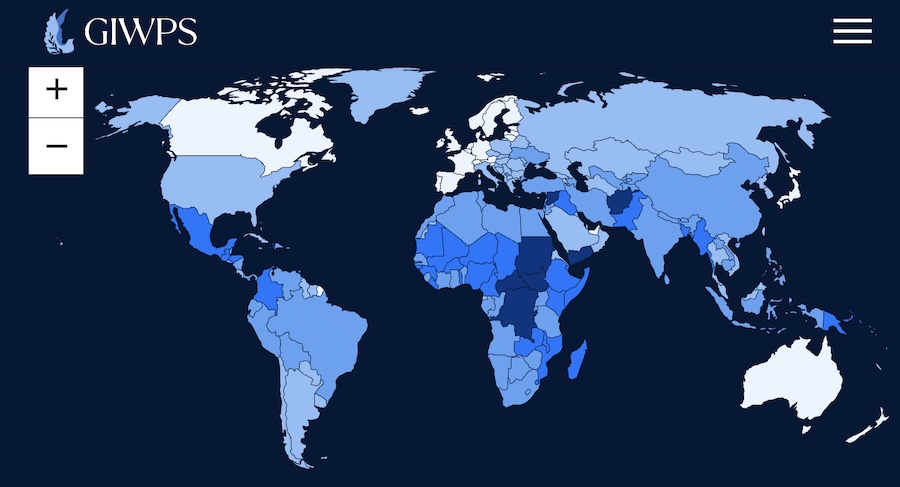
The United States and Germany are tied for the highest average years
of schooling, at 14, while Somalia, classified as a Fragile State, has the
lowest average, at 0.9 year. The Middle East and North Africa region has
the widest range of performance on this indicator, from 13.4 years in the
United Arab Emirates to 0.9 year in Somalia. Lebanon is the best performing among the Fragile States group, with roughly 13.1 years of schooling, the only country in that group to place in the top quintile for this indicator.
Sub-Saharan Africa performs exceedingly well on women’s employment, while
the Middle East and North Africa and South Asia perform poorly. The global
average for the employment indicator (the percentage of women ages 25–64
who are employed) is 56 percent, ranging from 24 percent of women
employed in the Middle East and North Africa region to 73 percent in
the Developed Countries group. A close second is Sub-Saharan Africa,
at 71 percent. Iceland is the only country in the Developed Countries
group that ranks in the top 10 on women’s employment. However, the
range across countries in the group is narrow, with most countries ranking
high on employment even if they are not in the top 10. Burundi, classified
as a Fragile State, is tied as the highest-ranking country in the world on this
indicator, with roughly 90 percent of women employed. Half of the 10 top-ranked countries on this indicator are in Sub-Saharan Africa (Burundi, Tanzania, Nigeria, Benin, and Togo), including two classified as Fragile States (Burundi and Nigeria). São Tomé and Principe is the only country in that region with fewer than a third of women employed.
While high rates of employment are an important indicator of women’s status, the global datasets we use do not capture working conditions and unpaid care burdens that women manage (see appendix 1 for details on the data sources we use). For example, highest-ranking Burundi has the largest share of women (roughly 95 percent) employed in the informal economy, especially in agriculture. Employment may also not translate
into higher standards of living; almost two-thirds of Burundi’s population
lives below the 2017 poverty line of $2.15 a day, nearly the same share as
eight years ago when the inaugural WPS Index was produced. While most
Burundian women work in small-scale farming jobs, men are more likely
to work in higher revenue-generating industrial agricultural enterprises.
Thus, the concentration of women’s employment in the informal sector is
evidence of the continuing need to improve women’s inclusion, even as
women’s high employment rates represent gains in their status and social
acceptance of women’s employment.
The Middle East and North Africa is the worst-performing region, with more than three in four women unemployed. Low labor force participation by women reflects a combination of structural and legal barriers— such as slow industrialization, male-dominated oil economies, discriminatory family laws, and lack of childcare or maternity support—that restrict both the supply of and demand for women’s labor. These barriers are reinforced by high unemployment among educated women, weak private sector job creation, and persistent patriarchal norms that discourage women’s employment. South Asia is the second-worst performing region and, along with the Middle East and North Africa, the only region where fewer than half of women are employed (39 percent). Despite some favorable laws, women’s low employment in South Asia reflects a lack of supportive infrastructure, such as childcare, eldercare, safe transport, inclusive workplaces, and re-entry opportunities, combined with education gaps, limited access to finance, and restrictive social norms.
Minor changes in other indicators of inclusion. The global average for cellphone
use (percentage of women and girls ages 15 or older who report having a
cellphone) increased from 80 percent in the 2023/24 WPS Index to 84 percent. The Developed Countries group is the best performing, at 96 percent, and South Asia is the worst performing, at roughly 65 percent, up from 55 percent in the 2023/24 WPS Index. In seven countries, less than half of women report having their own cellphone (Chad, Ethiopia, Niger, Afghanistan, Madagascar, Democratic Republic of the Congo, and
Pakistan). As mentioned, Pakistan is the only country in which fewer
than a third of women have their own cellphone.
Globally, average parliamentary representation (percentage of parliamentary seats held by women) declined slightly, from 26 percent in 2023/24 to 24 percent. The Latin America and the Caribbean region performs best, with women filling roughly 33 percent of parliamentary seats on average. South Asia is the worst-performing region, at roughly 16 percent, displacing the Middle East and North Africa, whose score improved from 15 percent in the 2023/24 WPS Index to 18 percent.
There are limited updates to the financial inclusion indicator (percentage of women and girls ages 15 years or older with an account at a financial institution). The Middle East and North Africa region performs worst on this
indicator, at 28 percent. The average rate for the Fragile States group, which
was the worst-performing region in the 2023 Index, has remained the same
(34 percent). In six countries worldwide, less than 10 percent of women have
access to their own bank account: South Sudan, Afghanistan, Yemen,
Burundi, Djibouti, and Central African Republic. South Sudan is the
lowest-ranking country globally on this indicator, with only 4 percent of
women having access to their own bank account. Eight of the ten bottomranking countries on this indicator are classified as Fragile States. The exceptions are Pakistan, at 14 percent, and Djibouti, at 9 percent.
Justice indicators
Mixed performances on barriers to justice. The global score on absence of legal
discrimination (a measure of the differences between men’s and women’s legal access to economic opportunities, from 0, worst, to 100, best)
improved slightly, from 75.7 on the 2023/24 WPS Index to 76.1. Fourteen
countries have a perfect score of 100, all except one (Latvia) in the Developed Countries group. Seven of the bottom dozen countries on this indicator are classified as Fragile States, and all except one of these Fragile States (Afghanistan) are in the Middle East and North Africa region, which is the worst-performing region on this indicator on the current WPS Index (as it was on the 2023/24 WPS Index).
Performance ranges widely on the related access to justice indicator (an ordinal measure of women’s ability to enjoy equal, secure, and effective access
to justice, from 0, worst, to 4, best). Denmark once again ranks highest on
the indicator, with a score of 3.958, more than 40 times higher than bottomranking Nicaragua, with a score of .097. Nicaragua displaced Afghanistan,
which was the lowest performer on this indicator in the 2023/24 WPS Index.
Nicaragua’s score plunged 85 percent from its score of .659 on the 2023/24
WPS Index, a large drop that may reflect the deterioration of judicial independence following the February 2025 constitutional reforms driven by President Daniel Ortega. These included eliminating the separation of powers and positioning the judiciary branch under direct executive influence of the new co-presidency of President Ortega and his wife. Key legal protections have been removed, including references to the Universal Declaration of Human Rights and the prohibition against gender-based wage discrimination. Women face heightened risks, and dissenters are threatened with loss
of citizenship. Afghanistan also deteriorated on the access to justice indicator, with its score falling from .372 on the 2023/24 WPS Index to .160.
Eight of the ten highest-ranking countries on the access to justice indicator are in the Developed Countries group, whose average score on this
indicator is 3.5. No other region has an average above 2.2. The second-best
performing regions are Latin America and the Caribbean and SubSaharan Africa, tied with an average score of 2.2. Latin America and the Caribbean’s improved standing may be explained by the almost 5 percent rise in its average score for this indicator from the 2023/24 WPS Index, together with declines in scores for Central and Eastern Europe and
Central Asia, East Asia and the Pacific, and South Asia. Countries in
the Latin America and the Caribbean region also have the widest range of
scores on this indicator, with best performing Costa Rica (3.540) scoring 36
times higher than worst-performing Nicaragua (.097).
The Fragile States group performs worst overall on the access to justice
indicator, with a score of 1.8, followed closely by the Middle East and
North Africa. The average score for the Middle East and North Africa,
the lowest ranked region on this indicator in the 2023/24 WPS Index,
rose from 1.7 to 1.9. The increase reflects improvements in several countries’ scores, including Egypt (up 37 percent), Algeria (17 percent), Qatar
(12 percent), Palestine (11 percent), Yemen (4 percent, and no longer in
the bottom 10 countries for this indicator), and Iraq (2 percent, and no
longer in the bottom 20).
It makes intuitive sense that the absence of legal discrimination and
access to justice indicators are strongly connected, since few formal legal
protections for women would typically mean that women also have a limited ability to safely pursue justice (and vice versa). Figure 6.3 visualizes
the normalized scores of these two justice indicators, with the overlapping
patterns reaffirming the positive relation between them. Nonetheless, there
are some outlier countries that score high on one indicator and low on
the other. As on the 2023/24 WPS Index, Nicaragua and El Salvador
have high scores on the absence of legal discrimination (86.3 and 88.8,
respectively) indicator but low scores on access to justice (.097 and .792,
respectively).
Worsening conflict and aid cuts threaten to undo gains in the maternal mortality ratio. The global average maternal mortality ratio (an indicator of mothers’ risk of death from a single pregnancy) improved from 212 deaths per 100,000 live births in 2023/24 to approximately 188. Nigeria has the highest maternal mortality ratio in the world, with 993 deaths per 100,000 live births.
Belarus and Norway continue to have the lowest maternal mortality ratio, improving to 1 death per 100,000 live births. The Developed Countries group performs the best on this indicator, with an average of 10 maternal deaths per 100,000 live births. The United States has the worst maternal mortality ratio among countries in the Developed Countries group (box 6.1).
The Fragile States group has the highest maternal mortality ratio among regions, with an average of 457 deaths per 100,000 live births. Seven of the ten lowest-ranking countries on this indicator are classified as Fragile States, and five of these are in Sub-Saharan Africa. Recent research also reaffirms that armed conflict is associated with increases in maternal and child deaths globally. For instance, research focusing on the Tigray region of Ethiopia found that maternal outcomes deteriorate severely in rural areas during wartime, likely due to disruptions in healthcare infrastructure.
(continued in right column)
Prospects for progress in women’s equality, what are the short and long term prospects?
(continued from left column)
However, since the 2023/24 WPS Index, maternal mortality ratios have
improved for both the Sub-Saharan Africa region (down from 507 maternal deaths per 100,000 live births to 437) and the Fragile States group
(down from 540 to 457). South Sudan, which was the worst-performing
country on this indicator in the 2023/24 WPS Index, with 1,223 maternal
deaths per 100,000 live births, has nearly halved that number to 692. South
Sudan’s improvement may be attributed to the gradual increase in midwife
training throughout the country, supported by organizational efforts such
as the establishment of the Catholic Health Training Institute in 2010
and UNFPA support of mobile health clinics and community outreach programs that provide perinatal care. Additional efforts are ongoing, with
the World Health Organization (WHO) and South Sudan’s Ministry of
Health collaborating in 2024 to develop guidelines and training resources
on maternal health for healthcare workers.
Despite substantial progress over the past two decades, the WHO reported
that Sub-Saharan Africa, grappling with high rates of poverty and multiple
armed conflicts, still accounted for about 70 percent of maternal deaths
worldwide in 2023. Recent maternal mortality data also reveal the detrimental impact of the Covid-19 pandemic, with an estimated 40,000 more
deaths in 2021 than in 2020, driven by health complications from Covid-19
and widespread disruptions to maternity services, underscoring the need
to maintain essential care during crises such as pandemics. Global maternal mortality ratios began to improve in the two years after the pandemic,
returning to the falling trend of earlier years.
Globally, maternal deaths dropped 40 percent between 2000 and 2023,
but progress has slowed notably since 2016, with almost one woman dying
every two minutes in 2023 from pregnancy- or childbirth-related complications. And now there is a risk of reversals, as deep cuts in humanitarian funding in 2025 are severely undermining maternal and child health
services. In many areas, maternal and child health facilities have closed,
the number of health workers has declined, and supply chains for lifesaving medicines have been disrupted.
Especially at risk are women in countries that are heavily dependent on
humanitarian assistance, such as those classified as Fragile States, where
maternal mortality ratios are already high. For instance, a 2025 UN report
estimated that the likelihood of maternal death is 400 times greater in
Sub-Saharan Africa than in Australia and New Zealand. The highest risks are in countries ranked the worst on the maternal mortality ratio
indicator: Nigeria (181st), Chad (180th), Central African Republic
(178th tie), South Sudan (178th tie), Liberia (177th), Somalia (176th),
and Afghanistan (175th). Researchers at Stanford University have estimated that reductions in development assistance to low-resource countries that last five years or longer can reverse 64 percent of the progress in
maternal mortality. Health and dignity are not only basic human rights,
but they are also central to women’s participation and protection under the
WPS Agenda. Urgent and sustained action is needed from all countries to
preserve and increase the gains in maternal mortality.
Security indicators
Despite some improvements, less than two-thirds of women worldwide report
feeling safe walking at night in their communities. Community safety (the percentage of women who report feeling safe walking alone at night in their
community) has improved slightly, rising from 64 percent globally on the
2023/24 WPS Index to 66 percent. But that means more than one-third of
women feel unsafe walking alone at night in their communities. Singapore is the highest-ranking country on this indicator, with 97 percent of
women feeling safe walking alone at night, while Syrian Arab Republic
is the lowest-ranking country at 17 percent—and the only country where
fewer than one in four women feels safe walking alone at night.
Among regions, East Asia and the Pacific again performs best, with
84 percent of women reporting feeling safe walking in their community at
night (compared with 83 percent in the 2023/24 WPS Index), while Latin
America and the Caribbean again performs worst, at 42 percent (40 percent in 2023/24). El Salvador is the only country in the Latin America and
the Caribbean region to score above the global average, with 85 percent
of women reporting that they feel safe walking alone at night. In 16 of 27
countries in the region, more than half the women report feeling unsafe
walking alone at night.
In 31 of the 37 countries classified as Fragile States, fewer than two-thirds of women feel safe walking alone at night. In a majority of countries
(23) in the Sub-Saharan Africa region, that share shrinks to fewer than
half. Syrian Arab Republic has the worst performance globally on this
indicator, with less than a quarter of women feeling safe walking alone at
night. The second-worst performers on the community safety indicator are
South Africa and Afghanistan, at 25 percent each. In Afghanistan, the
Taliban continues to restrict women’s mobility, including prohibitions on
visiting parks and even health centers.
Community safety is one of the few indicators on which the Developed Countries group does not perform best. Its score of 65 percent puts it behind the East Asia and the Pacific region, at 84. Nine countries in the Developed Countries group are below the global average of 66 percent: Israel (63 percent), Canada (63 percent), Belgium (63 percent), the United States (58 percent), Malta (56 percent), Australia (52 percent), Greece (51 percent), New Zealand (47 percent), and Italy (44 percent). Just behind the Developed Countries group are the Middle East and North Africa and South Asia regions, both at just under 65 percent. Eleven countries in the Middle East and North Africa score above the global average on community safety, with more than two-thirds of women
feeling safe walking alone at night.
Perceptions of community safety also vary within countries, with vulnerable groups often feeling more unsafe. For instance, a 2024 study for
Brazil found that perceptions of safety among women have deteriorated
more in rural areas than in urban areas, especially for non-White populations, a finding the study links to an erosion of trust in police services.
In the United States, there is a notable racial difference in perceptions of
safety, with fewer than half of Black women (46 percent) feeling safe walking alone at night, compared with 58 percent of women overall. Only
two-thirds of Black women in the United States believe they would be
treated fairly or with respect by local police, and one-fourth report having
experienced discriminatory treatment in the past year, higher than that of
Black men (one-fifth).
Political violence targeting women shows little improvement. Globally, political violence targeting women (violent and politically motivated events targeting women) improved from 0.080 event per 100,000 women in the 2023/24 WPS Index to 0.070 event in the current one. While this indicator captures “the use of force by a group with a political purpose or motivation” in targeting women (physical violence or attempt at physical violence), it does not capture the full scope of political violence targeting women. For instance, it does not include intimidation, threats, or online or technologyfacilitated gender-based violence, all of which can have serious implications for women’s safety and their ability to participate in politics and in peace and security efforts.
The Latin America and the Caribbean region continues to have
the highest rate of political violence targeting women, despite a reduction from 0.381 event per 100,000 women on the 2023/24 WPS Index to
0.338 on the current one. The region also has the second-highest share of
women living in proximity to conflict (up from 44 percent to 47 percent).
When considered along with the region’s performance at the bottom of
the regional rankings on community safety, these results reinforce the
relationship between feelings of safety at the local level and instability
at the societal level. The second-worst performing region on this indicator is the Fragile States group, at 0.212 event per 100,000 women. The
Middle East and North Africa and Sub-Saharan Africa regions performed slightly better, at roughly 0.130 event per 100,000 women. The
other country groups have an average rate ranging from 0.006 event
per 100,000 women (Developed Countries) to roughly 0.020 for three
regions (Central and Eastern Europe and Central Asia, East Asia
and the Pacific, and South Asia).
Seven of the ten bottom-ranking countries on the political violence targeting women indicator are in the Latin America and the Caribbean region,
and only one of those (Haiti) is classified as a Fragile State. Trinidad and
Tobago is the worst-performing country globally on this indicator, with
3.017 events per 100,000 women. The next lowest ranked country is Belize,
with 1.452 events, which makes Trinidad and Tobago an outlier on this
indicator. Trinidad and Tobago has a history of high rates of political violence targeting women, with 8 events per 100,000 women in the 2019/20
WPS Index, rising nearly fourfold to 23 events in the 2023/24 WPS Index.
That large increase may be related to the island country’s very small population, intensifying gang violence that led the government to declare a state
of emergency in December 2024, and the second-highest score worldwide
on a measure of the geographic diffusion of conflict.
Eleven countries in the Fragile States group have 0.000 reported events
of political violence targeting women, a hopeful sign that such violence
can be controlled even in contexts of fragility and conflict. Kosovo’s rate
of 0.000 events may reflect targeted interventions and women’s leadership. For instance, discussions on political violence targeting women and
its consequences for women’s representation were spurred in Kosovo by
initiatives such as the EmPOWER Local Women Politicians Program, a
capacity-building program sponsored by the Organization for Security and
Co-operation in Europe that offers leadership workshops, civic engagement
opportunities, and cross-party collaboration for women in politics. As a
result of such efforts, women parliamentarians led their fellow lawmakers
in developing and endorsing an official declaration in 2024 that calls for
accountability and the safeguarding of women’s full participation in electoral spheres.35
Despite these positive signs, women in 94 countries are still subjected
to political violence. They range from the United Kingdom, with 0.003
event per 100,000 women, to five countries (Palestine, Cameroon,
Jamaica, Belize, and Trinidad and Tobago) where events exceed 1 per
100,000 women.
Finally, political violence targeting women does not affect all women in
the same way or to the same degree, and a lack of reporting does not necessarily mean a lack of occurrence. The United States is an example of how
these limitations can affect our understanding of this indicator. The country’s score on this indicator fell from 0.025 event per 100,000 women in the
2023/24 WPS Index to 0.006 in the current one. However, a recent study
found high levels of political violence targeting women during the 2024
US election cycle, with Black women 7 times more likely to be targeted by
hate speech than Black men, 3 times more likely than White women, and
18 times more likely than White men.
(Editor’s note: Cuba was one of 18 countries that were not included in their report because data was lacking on several indicators. Elsewhere in the report, it is noted that Cuba, Mexico, Nicaragua, and Rwanda are the only countries with more than 50% women in parliament. Other countries not listed come from the Caribbean (6), Pacific Islands (2), tiny European states (4), tiny Asian states (2). Also North Korea, Eritrea and Equatorial Guinea.)
– – – – – –
If you wish to make a comment on this article, you may write to coordinator@cpnn-world.org with the title “Comment on (name of article)” and we will put your comment on line. Because of the flood of spam, we have discontinued the direct application of comments.