. . SUSTAINABLE DEVELOPMENT . .
An article from Minambiente, Colombia (translation by CPNN)
– April 29: In Santa Marta, Colombia, 57 countries met with 13 stakeholder groups, totaling more than 1,500 participants. The discussions focused on three key themes: reducing economic dependence on fossil fuels, transforming supply and demand, and advancing international cooperation.
The main conclusion of the conference is clear: this momentum must be sustained and efforts must be organized on a larger scale. This conference delivers five key outcomes that create a practical platform for working together and supporting one another to accelerate the transition away from fossil fuels:
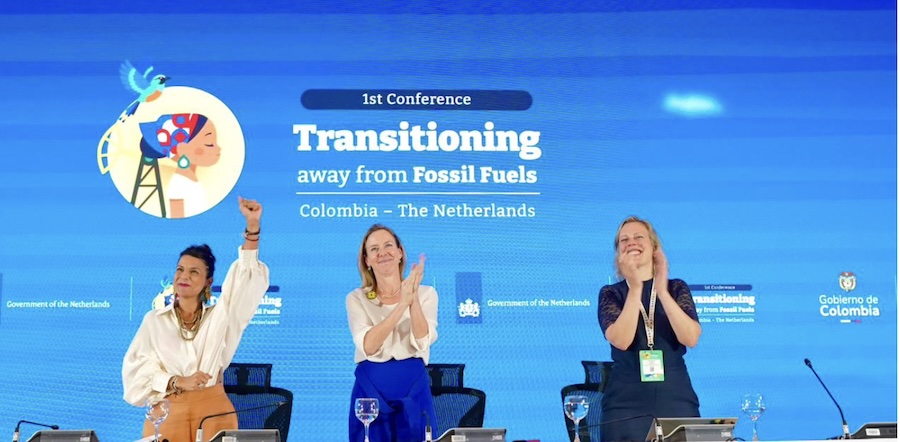
1. The second conference on transitioning beyond fossil fuels was announced, to be held in early 2027. It will be co-chaired by Ireland and Vanuatu.
2. A coordination group will be established to ensure continuity to the second and future conferences, strengthen links between initiatives, and avoid duplication. This group will bring together countries leading key transition efforts—such as the United Kingdom, Denmark, Brazil, France, and the Marshall Islands—along with the co-host countries Colombia, the Netherlands, Tuvalu, and Ireland, and will be advised by the COP30 Activation Group.
3. The results will be shared with the COP30 Presidency to inform its roadmap. They will also be aligned with the COP31 roadmap and Action Agenda, and will contribute to the second Global Stocktake.
4. Three lines of work have been established to identify concrete ways to reduce dependence on fossil fuels and strengthen cooperation. Their structure will be defined between the first and second conferences. They will remain open and flexible, allowing countries to join or lead, with the support of existing initiatives and experts from the Santa Marta process.
5. The Scientific Panel on the Global Energy Transition (SPGET) was launched to support countries in moving beyond fossil fuels. This panel will contribute to the development of roadmaps aligned with the 1.5°C target and will address legal, financial, and policy barriers.
(Click here for the original article in Spanish)
(article continued in right column)
Sustainable Development Summits of States, What are the results?
(Article continued from the left column)
“We succeeded in bringing the world together. We decided not to resign ourselves to an economy built on the destruction of life; we decided that the transition beyond fossil fuels can no longer remain a slogan, but must become a concrete, political, and collective effort. When people look back in the future, they will not only remember this conference. They will remember whether or not we rose to the challenge of our time,” stated the acting Minister of Environment and Sustainable Development of Colombia, Irene Vélez Torres.
For her part, the Netherlands’ Minister for Climate and Green Growth, Stientje van Veldhoven, stated: “I can confidently say that, in recent days, we have laid the groundwork for concrete action to move away from fossil fuels. With such a broad coalition of countries and representatives from the private sector, civil society, and beyond, this is a group capable of making a significant impact. The countries convened in Colombia represent approximately 30% of global energy demand and nearly 20% of global energy supply. Together, we have begun to organize on a large scale to meet this challenge, committing ourselves to sustained, long-term participation. This transition will require navigating a complex set of economic, social, and technical challenges. The message for addressing these was clear: let’s get to work and support each other throughout the process.”
Final list of participating countries: Angola, Antigua and Barbuda, Australia, Austria, Bangladesh, Belgium, Brazil, Cameroon, Canada, Chile, Costa Rica, Denmark, Dominican Republic, European Union, Finland, France, Germany, Ghana, Guatemala, Iceland, Ireland, Italy, Jamaica, Kenya, Kiribati, Luxembourg, Malawi, Maldives, Marshall Islands, Mexico, Micronesia, Mongolia, Nepal, New Zealand, Nigeria, Norway, Pakistan, Palau, Panama, Portugal, Saint Kitts and Nevis, Saint Lucia, Senegal, Singapore, Slovenia, Solomon Islands, Spain, Sri Lanka, Sweden, Switzerland, Turkey, Tuvalu, Uganda, United Kingdom of Great Britain and Northern Ireland, United Republic of Tanzania, Uruguay, Vanuatu, Vatican City – Holy See.
(Editor’s note: According to Greenpeace, “The landmark Santa Marta conference for the transition away from fossil fuels represents an important milestone on the road to long-term climate and energy stability.” And according to the World Wildlife Fund, “Santa Marta tackled the toughest climate hurdle – turning ambition into action, while bringing all stakeholders into the conversation”.
(Editor’s note 2: At last year’s COP30 in Belém, a group of 80 countries called for the design of a global roadmap to phase out coal, oil and gas, but it was blocked by large oil producers and consumers like Saudi Arabia, Russia, India and China.
– – – – – –
If you wish to make a comment on this article, you may write to coordinator@cpnn-world.org with the title “Comment on (name of article)” and we will put your comment on line. Because of the flood of spam, we have discontinued the direct application of comments.