Category Archives: North America

USA: Campaign Nonviolence Mounts Nationwide “Week of Actions” September 16-24, 2017

DISARMAMENT & SECURITY .

A press release from prweb

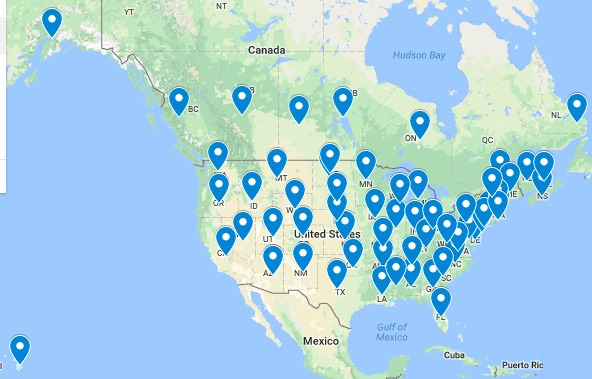
Over 1000 marches, actions, events and rallies will take place in all 50 states, as part of Campaign Nonviolence’s upcoming “Week of Actions” culminating on International Day of Peace. People nationwide are joining together to urgently insist on unity and peace.


Thousands will be participating in Campaign Nonviolence’s “Week of Actions” from September 16-24, 2017. This unprecedented nationwide campaign of grassroots activism calls for an urgent unifying peace that is free from racism, war, poverty, and environmental destruction.

“People across the United States are taking Campaign Nonviolence to the streets to immediately end violence and injustices, and begin peacemaking,” said Dr. Ken Butigan, cofounder of Campaign Nonviolence and professor at DePaul University. “This unified voice calls for policy shifts to build peace, economic justice, and environmental healing.”

Campaign Nonviolence has grown from 230 events in its inaugural year of 2014, to more than 1,000 events today.

Campaign Nonviolence is sponsored by Pace e Bene, a non-profit organization building a culture of peace through active nonviolence and shared understanding and partnerships that protect human rights, abolish war and nuclear weapons, end poverty, challenge injustice, heal the planet—and meet today’s profound spiritual task: to create a just, peaceful and nonviolent world. True to the vision of Dr. Martin Luther King, Jr., Campaign Nonviolence teaches how to resolve conflicts peacefully at home and abroad.

(Article continued in right column)

Question for this article:

The peace movement in the United States, What are its strengths and weaknesses?

(Article continued from left column)

“Americans need a positive vision of hope and peace for our country and our world,” said the Rev. John Dear, the nationally known peace activist and cofounder of Campaign Nonviolence who is Nobel Peace Prize nominee and author of 35 books. “During this week of national actions, we are mobilizing local grassroots initiatives to end today’s culture of violence, greed, and war. We are engaging the vision and tools for nonviolent change that Mohandas Gandhi, Dr. Martin Luther King, Jr., and many others have activated for personal and global transformation.”

Following are a sampling of planned events.

* Delaware Peace Week will hold more than 60 events from vigils and teach-ins to meetings statewide.

* Raleigh and Chapel Hill, North Carolina, have declared “Campaign Nonviolence North Carolina Week,” with events that will advance a peace free from racism and discrimination, poverty, war, and environmental destruction.

* The Chicago area will host 100 events in support of nonviolence and the environment.

* To date, 1,000 people are expected to join the Lancaster, Pennsylvania, Peace Fest in Binns Park on Sunday, Sept. 24. Featured will be four bands and speakers that include the Rev. John Dear.

* Marches, prayer services, vigils, workshops, teach-ins, and rallies nationwide will include major events in Little Rock, Arkansas; Memphis, Tennessee; Albuquerque, New Mexico; Clinton, Iowa; Huntington, Indiana; Bangor, Maine; Lansing, Michigan; and Erie, Pennsylvania.

For a list of peacemaking rallies, with states and cities, descriptions, organizations and contact information, please visit: actions.campaignnonviolence.org.

Campaign Nonviolence is sponsored by Pace e Bene, a nonprofit, tax-exempt organization founded in 1989 by the Franciscan Friars of California. Campaign coordinators Ken Butigan and Father John Dear teach that nonviolence most effectively characterizes Jesus’ way. “It is a way that combines both the unmistakable rejection of violence, and the power of love and truth in action for justice, peace, and the integrity of creation.” For more information please visit: http://www.paceebene.org/about.

From Europe to the United States, these cities oppose their governments to better accommodate migrants

TOLERANCE AND SOLIDARITY .

An article by Rachel Knaebel for Bastamag

In the United States, hundreds of municipalities have chosen not to contribute to the hunt against the undocumented launched by Donald Trump. In Europe, many municipalities have commited themselves to a welcome of migrants. “Sanctuary cities”, “refuge cities” … From Italy to Great Britain, from Barcelona to Grande-Synthe, these communes are trying to constitute a veritable counter-power against unworthy and xenophobic policies.


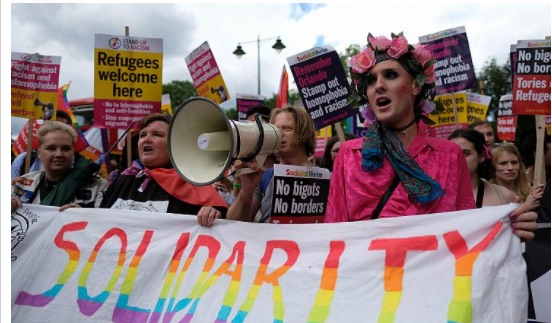
Photo: LGBT demonstration of solidarity with refugees in London, June 2016 / CC Alisdare Hickson
(Click on the photo to enlarge)

In the United States, hundreds of municipalities have chosen not to contribute to the hunt against the undocumented launched by Donald Trump. In Europe, many municipalities have commited themselves to a welcome of migrants. “Sanctuary cities”, “refuge cities” … From Italy to Great Britain, from Barcelona to Grande-Synthe, these communes are trying to constitute a veritable counter-power against unworthy and xenophobic policies.

Barely elected President of the United States, Donald Trump passed a decree to cut federal funds to the hundreds of municipalities that criticized his anti-migrant policy. Confronted with Trump’s program, his willingness to expel undocumented migrants irrespective of the number of years of residence, and his desire to erect a wall on the Mexican border, many cities quickly declared themselves “Sanctuary cities”. These municipalities “have adopted policies that promise to protect and serve all their residents, regardless of their migratory status,” says the powerful American Civil Liberties Union (ACLU).

In effect, these cities refuse to cooperate with the federal security forces, when they ask them to put undocumented migrants in detention. They do not necessarily require citizens to produce a birth certificate or to stay legally to access local public services. Some sanctuary municipalities even decide to recognize non-US identity papers as valid in their territory or to distribute their own municipal identity papers to all their residents, regardless of their nationality.

From New York to Milan, via Barcelona

Some of the most important cities in the United States, such as New York, Los Angeles, Chicago, Boston and Washington, have adopted this position. And they have not lost the battle against Donald Trump, since a federal judge blocked last April the decree of the president who wanted to cut off their resources.

In Europe too, faced with a historic crisis in the management of migration, local authorities are countering the closure policy pursued by the European Union states. Most European governments rely on safe management and agreements with undeveloped countries like Libya and Turkey (read our article Sending them to detention or to a dictatorship: this is how Europe “relocates” its refugees). However, in Milan on May 20, 100,000 people demonstrated at the initiative of the left-wing mayor of the city to promote the reception of migrants.

In February, it was the mayor of Barcelona Ada Colau, allied with the Podemos party, who called for a demonstration for the reception of migrants. Again, more than 100,000 people responded. The Catalan capital has also initiated an international network of cities committed to helping migrants, Solidarity Cities, intended to push the Spanish government to speed up the reception of refugees arriving in Europe, and to relocate them to Spain.

“France is not welcoming”

And in France ? There is the good example of Grande-Synthe, a northern town of 20,000 inhabitants, where the municipality has welcomed migrants en route to England (see our article Assuring migrants’ reception, ecology and social emancipation: the astonishing example of Grande-Synthe), notably by constructing a reception center with Médecin sans frontières with decent living conditions (taken over by the prefecture, the center was destroyed by a fire last April). Individual citizens also commit themselves, from Calais to the Italian border, and are sometimes taken to court for “Illegal acts of solidarity” (read our article At the Franco-Italian border, residents of the Roya valley risk imprisonment for helping migrants).

In Paris, thousands of migrants disembarked in the capital find themselves on the streets without any care and they are harassed by the police. Mayor Anne Hidalgo announced the opening of a first reception center in May. The center opened six months later. Scheduled for 500 people, it is too small and saturated permanently. According to the association France Terre d’asile, more than 1,000 migrants were still sleeping in the street in early July near the reception center. The association Gisti (Group of information and support to immigrants) also denounced the police violence against the migrants who were waiting in lines to enter the center. In spite of very real but dispersed initiatives (read here our article), “France is not welcoming”, regrets Filippo Furri. Will the French cities take over from a failing state?

(Article continued in right column)

(Click here for the original French version of this article)

Question for this article

The refugee crisis, Who is responsible?

(Article continued from left column)

Crisis of the Italian hosting model

“We must differentiate between networks of solidarity-based cities in Europe and the movement of sanctuary cities in the United States,” said Filippo Furri, a member of the Migreurop network and a doctoral candidate at the University of Montreal. In Europe, municipalities are forming a safe haven on the issue of asylum. In the United States, the movement has instead built itself to protect all undocumented immigrants who have lived in the country for a while. ”

Filippo Furri is well aware of the Italian case, in particular that of Venice: “With the Balkan war in the 1990s, there was a wave of refugees. In Venice, an initiative of citizen and NGO solidarity organized a dignified welcome. A reception system was set up at the beginning of the 2000s. Venice became a sort of prototype of the asylum system, which later developed in Italy, with the current emergency situation. ”

Along with Greece, Italy is one of the two main countries of arrival for the hundreds of thousands of people who land every year in Europe by sea, seeking asylum and security. More than 360 000 people have arrived by the Mediterranean Sea in Europe in 2016. More than 98 000 since the beginning of 2017 (more than 2000 migrants have already died in the Mediterranean Sea this year). Italy is therefore one of the countries that has to manage the reception of migrants in urgent and large numbers, in addition to sea rescues. In early July, its government called on other European countries to help care for newcomers. But instead of taking the side of hospitality, the Italian government also threatened at the same time to close its ports to the migrants.

Aid to development in the face of failing states

“Italy, like Greece, is becoming a real retention territory,” says Filippo Furri. There are forms of hospitality and hospitality in civil society. It is a response to state management, which is primarily aimed at controlling flows, sorting people, and scattering reception centers by imposing them on local governments. There is a conflict between the local reception of municipalities and the state control. In the same way that NGOs take over from the European states and authorities to save lives in the Mediterranean Sea, Italian municipalities are organizing to do what the Italian state refuses to do: to organize a dignified welcome and to encourage exchanges between the local population and newcomers.

The network of “Communes of the Earth for the World”, founded in 2003, today brings together more than 300 municipalities from all over Italy. For example, the association organizes an intercultural festival in Riace, a village in Calabria that has become one of the entry points for many migrants in the EU (see our article These villages that choose to welcome migrants). The association of municipalities also conducts international solidarity projects, such as a solar energy development project in the Sahel. “The Recosol network is organized on a logic of solidarity that goes beyond the issue of migration,” says Filippo Furri. It is a network of mutual assistance between local communities. ”

To constitute solidarity associations, beyond the sole objective of managing the emergency, this is surely the specificity of the networks of shelter cities in the face of the migration policies of the States. “The State leaves it up to the Italian municipalities to organize the reception of migrants. It is the municipalities that organize housing, language courses and local integration,” explained the coordinators of the network of municipalities Recosol. The Italian government’s policy suffers from the lack of a global vision and a national plan for the reception and integration of migrants. It is therefore the NGOs and the citizens, on the territory, who make the difference. ”

Sanctuary City in the UK

In Britain too, citizens and municipalities are countering the xenophobic policy of the Conservative government. “A Sanctuary City was created in Sheffield in 2005 by a small group of people who wanted to better accommodate the refugees,” said Forward Maisokwadzo, spokesperson for the British network. The Mayor of this city of 500,000 inhabitants in the north of England fully supported the initiative and made a public commitment to welcome asylum seekers and refugees in his city. “Then the movement became very important, in terms of the number of people and communes involved. It now includes a hundred municipalities. The idea is to work with everyone: citizens, associations, local authorities.”

For the movement “City of Sanctuary”, the key to hospitality is in this collective work. “The actions carried out by the movement vary from place to place. They can, for example, involve raising awareness of the issue of the reception of asylum seekers, says Forward Maisokwadzo. In Bristol, the city has tackled the problem of deprivation of asylum seekers, who receive very little financial support and are not allowed to work during their study. A dozen other cities are committed to the issue. Their job is also to push the government to address this issue.”

(Thank you to Kiki Chauvin, the CPNN reporter for this article.)

Canada: After three decades, Inuit achieve meaningful protections for Lancaster Sound

. . SUSTAINABLE DEVELOPMENT . .

An article from World Wildlife Fund – Canada

After more than 30 years of negotiations, one of Canada’s most wildlife-rich Arctic areas will be protected, with an extended boundary that will make it the largest marine protected area in Canada, Parks Canada announced today [August 14]. The proposed area’s boundaries have between extended twice on the way to becoming a National Marine Conservation Area (NMCA), and the expansion of the protected area would not have been possible if Shell Canada had not voluntarily relinquished 30 permits after a lawsuit launched by WWF-Canada in 2016. The final boundary is informed by traditional knowledge, as recorded and put forward by the Qikiqtani Inuit Association (QIA), who worked for years to convey the importance of protected the integrity of the entire ecosystem.

(Article continued in the right side of the page)

Question for this article:

If we can connect up the planet through Internet, can’t we agree to preserve the planet?

(Article continued from the left side of the page)

President and CEO of WWF-Canada, David Miller, said: “WWF-Canada has worked for decades to promote the protection and conservation of Lancaster Sound, which is home to polar bears, seals, sea birds, walrus, whales, and over 75 per cent of the world’s narwhal. The wildlife of this area, and the people who depend on them, will be better served by the larger boundary of the protected area, as it will better protect the integrity of the fragile Arctic ecosystem. We launched the lawsuit against Shell in 2016 to allow for an initial boundary extension. And today we’re celebrating the fact that the boundary has been further enlarged, informed by the recommendation of the QIA, to make it the largest marine protected area in Canada.”

About Lancaster Sound

● Known to Inuit as Tallurutiup Imanga, Lancaster Sound is the eastern entrance to the Northwest Passage.

● It is one of the most biologically diverse areas in the whole of the Arctic, and is home to polar bears, seals, sea birds, walrus, beluga and bowhead whales, and over 75 per cent of the world’s narwhal.

● The boundary for the NMCA was expanded after WWF-Canada launched a lawsuit in 2016, disputing the validity of 30 offshore exploration leases owned by Shell Canada. Shell relinquished the leases, allowing the boundary to almost double in size from Parks Canada’s original recommendation.

What is a national marine conservation area?

Under federal law, NMCAs provide protection from:
○ Energy exploration
○ Undersea mining
○ Ocean dumping
○ Overfishing

(Thank you to Janet Hudgins, the CPNN reporter for this article)

USA: A Victory March For Nury – and for immigrant rights

…. HUMAN RIGHTS ….

An article by Markeshia Ricks in the New Haven Independent

Hundreds of immigrant rights activists took to the streets of Fair Haven [Connecticut] to celebrate — rather than protest as planned — after a 43-year-old woman taking sanctuary in a neighborhood church won a stay allowing her to remain in the country.


Clergy join Chavarria in leading off Wednesday’s march (She is at the center of the line)
(click on photo to enlarge)

The news means that Nury Chavarria can leave Iglesia de Dios Pentecostal, where she took up residence last week. Last Thursday she had disobeyed an order from U.S. Immigration and Customs Enforcement (ICE) last Thursday and skipped a flight back to Guatemala, occupying with her 9-year-old daughter a back room of the “sanctuary” house of worship. (Federal policy forbids immigration agents from entering church grounds to make arrests.) Now Chavarria can return home to Norwalk to work and take care of her four children.

The news hit New Haven late Thursday afternoon as a rally on her behalf was beginning outside the church. The more than 300 people present took a victory lap that Kica Matos of Fair Haven, an organizer focused on immigration and race at the Center for Community Change, told the crowd would be loud and celebratory instead of the planned silent march.

Rabbi Herbert Brockman of Congregation Mishkan Israel sounded a shofar, a musical instrument made of a ram’s horn, to mark the victory for Chavarria and kick off the Jericho march around the block.

“I am very emotional grateful to God,” Chavarria told the crowd with the help of an English translator. “Now I can cry, but not as I did on the 20th when I was shedding tears because I had to leave. God has been my attorney.”

Chavarria’s attorneys won the stay at around 2 p.m. in U.S. Immigration Court in Hartford. Immigration and Customs Enforcement (ICE) then agreed not to seek custody of her. So she’ll be free to go home.

At 5:30, Chavarria and her attorneys and supporters came out to greet the rally and announce the news. The group, which had originally planned to stage a silent protest march, still paraded down to Grand Avenue and then around the block to the church past the Cool Breeze Music in the Park event that was taking place in Quinnipiac River Park, but in celebration.

(Article continued in the right column)

Questions related to this article:

The post-election fightback for human rights, is it gathering force in the USA?

(Article continued from the left column)

One of her attorneys, Marisol Orihuela, described how her team filed two motions: an emergency motion for a stay of deportation and a motion to reopen her case based on new evidence.

“Her story was so compelling that only one hour after filing, immigration granted her motion for a stay,” said Orihuela, a Yale Law School clinical associate professor affiliated with the school’s Worker and Immigrant Rights Advocacy Clinic.

Mayor Toni Harp also addressed the gathering. She said the city will continue to stand with Chavarria. “Oftentimes there are people who question the value of having Yale in our community,” Harp said. “But I cannot tell you how grateful I am for Yale’s immigration clinic.”

“ICE, the rest of those who mess with our neighbors, know better than to come to New Haven,” Harp added.

Elected officials who had taken up her cause — including Gov. Dannel P. Malloy, U.S. Sens. Chris Murphy and Richard Blumenthal, and U.S. Rep. Rosa DeLauro — issued statements commending the decision by a judge and the Immigration and Customs Enforcement (ICE) to grant Chavarria the stay. The senators vowed to continue working to win Chavarria, who has never encountered trouble with the law in her 24 years in this country as she raised her children as a single mother and worked for a housecleaning company, permanent permission to stay here.

“Today, reason and compassion have prevailed.  There was never a rational justification for Nury Chavarria to have been threatened with deportation and separated from her children,” Malloy’s statement read in part. “Members of the community had their voices heard.”

Chavarria was one of 13 undocumented immigrants taking sanctuary in U.S. houses of worship. She was the first to do so in New Haven. Her case became national news, and she warmed up to the role of spokesperson for a movement.

“I’m glad ICE finally listened to our calls for justice for Nury, and I’m grateful for all the community support she received,” Murphy was quoted as saying in a release issued by his office. “But this is just a temporary victory, and only when President Trump’s mean-spirited policy of tearing apart parents from their young children ends will meaningful justice be achieved.”

Pastor Hector Ortero said he was sad to see Chavarria head home, but happy for her victory. Iglesia de Dios Pentecostal Pastor Hector Ortero said he was sad to see Chavarria head home to Norwalk Thursday, but happy for her victory. He reminded the crowd that the language of heaven is not English, Spanish or French.

“The language of heaven is faith,” he said. “We still believe. I pray that God bless Nury and her lovely family, that God bless everyone and God bless the United States of America.”

USA: People’s Congress of Resistance

…. HUMAN RIGHTS ….

Announcement by the People’s Congress of Resistance

In the face of the assault waged against working class and poor communities and the environment by the Trump Administration a grassroots People’s Congress of Resistance will convene in Washington, D.C. on September 16 and 17, 2017.

The People’s Congress of Resistance will be the voice of the people – an expression of direct democracy of those who are left out and kept out of the Congress of plutocrats.

Real representatives

The People’s Congress of Resistance will bring together grassroots resisters from every part of the country. Delegates will come from

* the now impoverished and hollowed-out industrial communities of the Midwest;

* immigrant families being ripped apart by ICE raids

* African American communities that are being devastated by unemployment, poverty, gentrification, and police violence

* towns of devastated Appalachia where jobs left but millions of opioid pills were simultaneously pumped in by profit-driven pharmaceutical companies

* The Native community, on the frontline in the fight for Mother Earth, and in defense of Native sovereignty and self-determination

* educators and parents struggling to improve rather than destroy public education

* activists fighting to defend the lives and core rights of women

* environmental and community activists fighting to stop fracking and the corporate destruction of the planet

* LGBTQ organizers fighting back against bigotry

* health care workers and advocates who are demanding a Single-Payer national health program

(Article continued in the right column)

Questions related to this article:

The post-election fightback for human rights, is it gathering force in the USA?

(Article continued from the left column)

* the Muslim-American community which is being demonized and targeted by hate crimes and hatred

* organizers who have been fighting the Military-Industrial Complex as a self-perpetuating monster that incentivizes more and more wars and allows the biggest corporations to loot the national treasury under the pretext of national security.

This is the People’s Congress of Resistance that will meet on September 16 and 17 at the Blackburn Center at Howard University in Washington, D.C.

A platform and an action plan

The People’s Congress of Resistance will meet in large plenary sessions and in smaller break-out meetings.

It will chart a path of nationwide grassroots resistance and mobilization to defeat Trump’s reactionary program of unrestrained capitalism. This path will draw on the experiences of the grassroots, amplifying the voices and spreading the tactics of those who are already fighting back to defend their communities.

The People’s Congress of Resistance will also project its own platform and vision of what America should be if it is to be a society truly devoted to fundamental social and political rights.

That is a society that places political and economic power in the hands of “We, The People” rather than the plutocrats. Each individual needs not just the right to vote for politicians who serve the rich, but the rights to a job or basic income, health care, housing and education.

An independent path

The People’s Congress of Resistance will represent the real resistance, the grassroots. Trump’s reactionary agenda constitutes a fearsome assault against the rights and needs of the people.

But we also reject the Democratic Party elites, in Congress and outside, who have refused to fight the right-wing during the past decades and have instead embraced the wretched policies of neoliberal capitalism that have devastated communities and left one of every two Americans living in or near poverty while allowing the top one-tenth of 1 percent of Americans to own almost as much wealth as the bottom 90 percent.

History has shown that change comes from the bottom up, it comes from the dedication and determination and resolve of the grassroots. As we learned from the great Frederick Douglass: power concedes nothing without struggle! The People’s Congress of Resistance will be convened in that spirit and in that tradition.

USA: Israel-Palestine statement by the Mennonites takes a ‘third way’

. .DISARMAMENT & SECURITY. ,

An article from the Mennonite World Review

Mennonite Church USA delegates on July 6 overwhelmingly passed a resolution on Israel-Palestine, confessing “our own complicity in this web of violence, injustice and suffering” and vowing “concrete steps to address these wrongs.”

At the first business session of the denominational convention, the statement received 98 percent support, with 10 dissenting votes in a delegate body of about 550.


Anita Kehr, representing Western District Conference, speaks during open discussion time on the Israel-Palestine resolution. — Vada Snider for MWR

“Seeking Peace in Israel and Palestine” takes what supporters call a “third way,” opposing the Israeli military occupation while taking a stand against anti-Semitism and affirming the need to build stronger relationships with Jewish communities.

In 2015, delegates tabled an earlier version of the resolution, asking that it be rewritten and brought back in two years.

This time, delegates commended the statement as a humble call for justice that recognizes “the legacy of Jewish suffering is intertwined with the suffering of Palestinians.”

“I feel the resolution is a faithful response to conflict in that region,” said Heidi Regier Kreider, representing Western District Conference. “I believe it allows us to reach out to Jewish and Palestinian communities and be consistent in our call to be peace people.”

Regarding the movement known as BDS — boycott, divestment, sanctions — the resolution aims to offer a unique Mennonite position. It urges avoiding “the purchase of products associated with acts of violence or policies of military occupation.” It does not call for a boycott of all Israeli goods or for academic or cultural boycotts.

The resolution asks the financial agency Everence to convene representatives of Mennonite organizations to “review investment practices for the purpose of withdrawing investments from companies that are profiting from the occupation.”

It urges all church members to review their investments in a similar way.

(article continued in right column)

Question related to this article:

Presenting the Palestinian side of the Middle East, Is it important for a culture of peace?

How can a culture of peace be established in the Middle East?

(article continued from left column)

Making confessions

“[W]e confess and lament the ways we have supported the military occupation, which has grievously harmed and traumatized the Palestinian people and has not served the well-being and long-term security of Israelis,” the resolution states.

Specific points of confession include “embracing or tolerating Zionist theology,” accepting negative stereotypes of Palestinians based on “anti-Muslim and anti-Arab biases” and contributing tax dollars to military aid to Israel.

The resolution does not endorse either a one-state or two-state solution in Israeli-Palestine. “We hear a call from both Jews and Palestinians,” it says, “to have a state . . . that protects their unique cultures, civil rights, freedoms, security and dignity.”

Delegates overwhelmingly expressed support.

Emily Hedrick of Lima Mennonite Church in Ohio said she had been “looking for a peace witness in this generation,” which has not faced a military draft, “and I see that in this resolution.”

Ryan Ahlgrim of Richmond, Va., said the resolution was already forming Mennonite Church USA in a positive way by making members intentional about not being anti-Semitic and about caring for Palestinians.

Among concerns expressed, Tim Bentch of Souderton, Pa., felt the statement’s call to end the occupation was “political rhetoric” that hindered the ability of Israelis to hear what the statement is saying.

Michael Crosby of Champaign-Urbana, Ill., said the statement had already opened up new inter­faith conversations in his ongoing meetings with a local imam and a rabbi.

Two endorsements

Delegates heard endorsements of the resolution from a Jew and a Palestinian.
Rabbi Brant Rosen, representing the Rabbinical Council of Jewish Voices for Peace, read a statement from the council noting that “within North American Jewish communities, there is a growing desire to end our silence over Israel’s oppressive occupation of Palestine.”

Brant said that as “a Jew and rabbi and a person of conscience” he was deeply impressed with the resolution.

Alex Awad, a Palestinian Christian who has served as a pastor and professor in Israel-Palestine, told of speaking at numerous Mennonite events and visiting in Mennonite homes. He urged support for the resolution and said Christian leaders throughout the Holy Land, where Christianity is in danger of dying out, would be among those who affirm it.

U.S. Conference of Mayors Opposes Military-Heavy Trump Budget

.. DEMOCRATIC PARTICIPATION ..

An article from World Beyond War (abbreviated)

The U.S. Conference of Mayors on Monday [June 26] unanimously passed three resolutions opposing the military-heavy Trump budget proposal, urging Congress to move funding out of the military and into human and environmental needs rather than the reverse.

The three resolutions are numbers 59 and 60 found on this page.

and number 79 found on this page.

We are very excited that the entire US Conference of Mayors, from major metropoles such as New York City and Los Angeles to small rural townships, understand that the resources being sucked up by the Pentagon to wage endless wars overseas should be used to address our crumbling infrastructure, the climate crisis and poverty at home and abroad. Congress and the Trump administration should listen to these mayors, as they reflect the needs and hopes of their constituents, not the greed of corporate donors,” said Medea Benjamin of CODEPINK.

The Peace Council applauds the resolve of major city mayors to dramatically cut the U.S. military budget and to take the funds saved to provide money for jobs, education, housing, transportation, seniors, youth, rebuild our roads, bridges, public transportation much more,” said Henry Lowendorf of the US Peace Council. “The mayors understand how pouring the wealth of our great country into building war machines and waging wars around the globe does not make us more secure. To the contrary, this gigantic military budget is strangling our country and the many unnecessary wars only generate death, destruction and enemies. We fully support the mayors’ call both for inviting the public and city leaders to hearings expressing on how funds saved by cutting the Pentagon budget can be used in our cities and for passing resolutions to our members of Congress demanding that they respond to cities to begin prioritizing the needs of our residents over war profiteering.”

These three resolutions should be read carefully by every member of Congress,” said David Swanson, director of World Beyond War. “These are the considered statements of the mayors of this country, as prompted by the citizens of numerous cities that moved their city councils to pass similar resolutions and their mayors to support these.”

Information on a campaign to pass resolutions through city councils, and those that have been passed thus far, can be found here: http://worldbeyondwar.org/resolution

Over 20,000 people signed a petition similar to Resolution 59 here: https://actionnetwork.org/petitions/un-trump-the-budget

Resolution 59 was introduced by the mayor of Ithaca, NY, and had been passed by that city. . . [click here for the resolution]

Resolution 60 was introduced by the Mayor of New Haven, CT, and had been passed by that city. . . . [click here for the resolution]

Sponsors of Resolution 79 were:

The Honorable T.M. ‘Frank’ Franklin Cownie, Mayor of Des Moines
The Honorable Alex B. Morse III, Mayor of Holyoke
The Honorable Ardell F. Brede, Mayor of Rochester
The Honorable Chris Koos, Mayor of Normal
The Honorable Denny Doyle, Mayor of Beaverton
The Honorable Frank C. Ortis, Mayor of Pembroke Pines
The Honorable Geraldine ‘Jeri’ Muoio Ph.D., Mayor of West Palm Beach
The Honorable Helene Schneider, Mayor of Santa Barbara
The Honorable John Dickert, Mayor of Racine
The Honorable John Heilman, Mayor of West Hollywood
The Honorable Libby Schaaf, Mayor of Oakland
The Honorable Lucy Vinis, Mayor of Eugene
The Honorable Mark Stodola, Mayor of Little Rock
The Honorable Nan Whaley, Mayor of Dayton
The Honorable Patrick L. Wojahn, Mayor of College Park
The Honorable Paul R. Soglin, Mayor of Madison
The Honorable Pauline Russo Cutter, Mayor of San Leandro
The Honorable Roy D. Buol, Mayor of Dubuque
The Honorable Salvatore J. Panto Jr., Mayor of Easton

(continued in right column)

Questions for this article:

How can culture of peace be developed at the municipal level?

The post-election fightback for human rights, is it gathering force in the USA?

(continued from left column)

The resolution recognized some of the cities that have passed resolutions:

“The United States Conference of Mayors welcomes resolutions adopted by cities including New Haven, CT, Charlottesville, VA, Evanston, IL, New London, NH, and West Hollywood, CA urging Congress to cut military spending and redirect funding to meet human and environmental needs.”

It further resolved (at least as drafted; there were slight modifications):

“NOW, THEREFORE BE IT RESOLVED, that The United States Conference of Mayors (USCM) calls on the United States Government, as an urgent priority, to do everything in his power to lower nuclear tensions though intense diplomatic efforts with Russia, China, North Korea and other nuclear-armed states and their allies, and to work with Russia to dramatically reduce U.S. and Russian nuclear stockpiles; and

“BE IT FURTHER RESOLVED, that The United States Conference of Mayors welcomes the historic negotiations currently underway in the United Nations, involving most of the world’s countries, on a treaty to prohibit nuclear weapons, leading to their total elimination; and

“BE IT FURTHER RESOLVED, that The United States Conference of Mayors deeply regrets that the United States and the other nuclear-armed states are boycotting these negotiations; and

“BE IT FURTHER RESOLVED, that The United States Conference of Mayors calls on the United States to support the ban treaty negotiations as a major step towards negotiation of a comprehensive agreement on the achievement and permanent maintenance of a world free of nuclear arms, and to initiate, in good faith, multilateral negotiations to verifiably eliminate nuclear weapons within a timebound framework; and

“BE IT FURTHER RESOLVED, that The United States Conference of Mayors welcomes the Restricting First Use of Nuclear Weapons Act of 2017, introduced in both houses of Congress, that would prohibit the President from launching a nuclear first strike without a declaration of war by Congress; and

“BE IT FURTHER RESOLVED, that The United States Conference of Mayors calls for the Administration’s new Nuclear Posture Review to reaffirm the stated U.S. goal of the elimination of nuclear weapons, to lessen U.S. reliance on nuclear weapons, and to recommend measures to reduce nuclear risks, such as de-alerting, improving lines of communication with other nuclear-armed states, and ending nuclear sharing, in which Belgium, Germany, Italy, Netherlands, and Turkey host U.S. nuclear bombs; and

“BE IT FURTHER RESOLVED, that The United States Conference of Mayors calls on the President and Congress to reduce nuclear weapons spending to the minimum necessary to assure the safety and security of the existing weapons as they await disablement and dismantlement; and . . .

“BE IT FURTHER RESOLVED, that The United States Conference of Mayors calls on the President and Congress to reverse federal spending priorities and to redirect funds currently allocated to nuclear weapons and unwarranted military spending to restore full funding for Community Block Development Grants and the Environmental Protection Agency, to create jobs by rebuilding our nation’s crumbling infrastructure, and to ensure basic human services for all, including education, environmental protection, food assistance, housing and health care,

“BE IT FURTHER RESOLVED, that The United States Conference of Mayors urges all U.S. mayors to join Mayors for Peace in order to help reach the goal of 10,000 member cities by 2020, and encourages U.S. member cities to get actively involved by establishing sister city relationships with cities in other nuclear-armed nations, and by taking action at the municipal level to raise public awareness of the humanitarian and financial costs of nuclear weapons, the growing dangers of wars among nuclear-armed states, and the urgent need for good faith U.S. participation in negotiating the global elimination of nuclear weapons.”

USA: United National Anti-War Coalition (UNAC) conference

DISARMAMENT & SECURITY .

An article from Popular Resistance

We just returned from the weekend-long United National Anti-War Coalition (UNAC) conference in Richmond, VA. This is the fourth UNAC conference since its founding in 2010 to create a vibrant and active anti-war movement in the United States that opposes all wars. The theme this year was stopping the wars at home and abroad in recognition that we can’t end one without ending the others, that they have common roots and that it will take a large, broad-based and diverse movement of movements to succeed.


(Click on image to enlarge)

Speakers at the conference ranged from people who are fighting for domestic issues – such as a $15/hour minimum wage and an end to racist police brutality and ICE raids – to people who traveled from or represented countries such as Russia, Ukraine, Hungary, Korea, the Philippines, the Congo, Iran, Syria, Colombia and Venezuela, which are some of the many countries under attack by US imperialism. At the end of the conference, participants marched to an area of Richmond called Shockoe Bottom, which is an African cemetery close to a site that was a central hub for the slave trade, to rally with activists with the Virginia Defenders for Freedom, Justice and Equality who are fighting to protect the land from gentrification and preserve it as a park.

The War at Home

The “US Way of War” – a brutal form of war that requires the total destruction of populations, targets the most vulnerable and wipes out their access to basic necessities such as food and water – has raged since settlers first stepped foot on the land that is now the United States and brutalized the Indigenous Peoples in order to take their lands and resources to build wealth for the colonizers and their home countries using the slave labor of Africans and indentured servants. The US Way of War continues in the same form today on both domestic and foreign land.

There are daily reminders of the war at home, which overwhelmingly targets people of color, immigrants, Muslims, LGBTQ people, the poor and workers. Over 1,000 civilians are killed by police, security personnel or vigilantes every year in the US. Black young men are nine times more likely to be victims than any other group, but, as in the case of Philando Castile, few of the killers are held accountable. Despite clear evidence that Castile was murdered by Officer Jeromino Yanez in front of his girlfriend and her 4-year-old daughter during a traffic stop, Yanez was acquitted this week. Within hours of the verdict, thousands of local residents marched against the injustice and some shut down a major highway.

Black Lives Matter Chicago and other community groups filed a lawsuit this week asking for federal oversight of their police. They accuse the mayor of trying to cut a backroom deal with the Department of Justice to water down oversight of the police after a DoJ investigation “found widespread constitutional violations by the Chicago Police Department.” And recently, though Take Em Down NoLa was successful, after years of efforts, at removing several confederate statues in New Orleans, structural racism is still rampant in the school and law enforcement systems. Ashana Bigard explains, a DoJ investigation found “98.6 percent of all children arrested by the New Orleans Police Department for ‘serious offenses’ were black.”

Ralph Poynter, the widower of the great attorney-activist Lynne Stewart, spoke at the UNAC conference about the many political prisoners who have been jailed in the US for decades. He described the organizing efforts to release Stewart and the public sympathy that she was given, in part, for being a white woman. There are many people who deserve equal organizing efforts, such as Major Tillery who, after 33 years, is appealing his murder conviction. Indeed, many from the black freedom struggle of decades past remain imprisoned. Let us not forget them.

And the Trump administration is ramping up deportations. This week, ICE Director Thomas Homan asked Congress “for more than a billion dollars to expand ICE’s capacity to detain and deport undocumented immigrants.” Homan also indicated that he would increase deportations, saying “‘no population of persons’ in the country illegally is safe from deportation.” In this interview, Ingrid Latorre describes how the Sanctuary Movement is working to protect immigrants.

Juneteenth is a Time to End the War at Home

Juneteenth, the day in 1865 when black slaves in Texas learned they were freed – two and one-half years after the Emancipation Proclamation, is a little known holiday that is being celebrated this year through efforts to end racial disparities on many fronts of struggle. A coalition of organizations is working to raise awareness of the injustice of cash bail in the US. They raised over a million dollars and are using that to bail out black fathers and “black LGBTQ and gender-nonconforming people, who are overrepresented in jails and prisons and are likely to experience abuse while incarcerated.”

(Continued in the right column)

Question related to this article:

The peace movement in the United States, What are its strengths and weaknesses?

(Continued from the left column)

Other groups are organizing in cities across the country to “Take Back the Land” and call for reparations after centuries of oppression. They write:

“We are a people who have been enslaved and dispossessed as a result of the oppressive, exploitative, extractive system of colonialism and white supremacy. In this system, our labor and its products have been forcefully taken from us for generations, for the accumulation of wealth by others. This extraction of wealth – from our labor, and from the land – formed the financial basis of the modern globalized world economy and has led to compounded exploitation and social alienation of Black people to this day.”

Jessicah Pierre explains that despite more than 150 years of ‘freedom’, black people still have a long way to go. A report called “The Ever Growing Gap” found that if we continue on the current path, “black families would have to work another 228 years to amass the amount of wealth white families already hold today.”

Wealth inequality is growing globally. Paul Bucheit explains that the five richest men in the world have almost the same wealth as the bottom 50% of the world’s population, which means each one of them has the wealth of 750 million people. Bucheit also explains that they didn’t earn it, they effectively stole it. More and more, we view the US as a kleptocracy. One idea to recapture that lost wealth and share it more equally is a Citizen’s Wealth Fund . Stewart Lansley writes that they “operate like a giant community-owned unit trust, giving all citizens an equal stake in a part of the economy.”

Ending the Wars Abroad

It would be impossible to discuss all of the wars abroad in this one newsletter (our Memorial Day newsletter discusses war further), but it is important that people in the US understand how the US Way of War is being waged around the world and its domestic impacts. Much of that was discussed at the UNAC conference, which you can watch here. Here are a few items that we suggest checking out.

This week on Clearing the FOG, we spoke with FBI whistleblower Coleen Rowley and journalist Max Blumenthal about “Russiagate” and the way it is being used to trick progressives into supporting conflict with Russia. We also recommend watching Oliver Stone’s series of interviews with Vladimir Putin, even though the government and even Rolling Stone urge you not to watch these excellent interviews. Abby Martin of The Empire Files traveled to Venezuela to witness the protests firsthand and the violence being perpetrated by the right wing opposition that is funded by the US. And as President Trump sheds more of his responsibilities as Commander in Chief and hands them to generals such as Masterson and Mattis, who wants to send thousands more troops to Afghanistan, it is important to read this excellent analysis, “Afghanistan: From Soviet Occupation to American ‘Liberation“, by Nauman Sadiq.

At present, more than 130 countries are negotiating a treaty at the United Nations that would prohibit all nuclear weapons. The US, which holds the largest nuclear arsenal, is not participating but North Korea is. Diana Johnstone writes that the dangerous belief at the Pentagon is that in a nuclear war, the US “would prevail.”Will the rest of the world be able to prevent a nuclear war? A positive sign was the “Woman Ban the Bomb” marches that took place in more than 170 cities worldwide.

It’s up to us as people to organize a peace movement in our communities. People’s Organization for Progress in Newark, New Jersey and their allies are one example of what we can be doing. They are proposing monthly actions that educate the public about the connection between the wars at home and abroad.

Kevin Zeese spoke at the opening plenary of the UNAC conference about Moral Injury that is done to an individual and to a people who engage in war. He closes with this thought:

“If we do not awaken the US government and change course from a destructive military power to an exceptional humanitarian culture aiding billions who suffer – a heavy price will be paid. We should expect it.

Our job is to turn moral injury into moral outrage and transform the United States into an exceptional humanitarian nation that is a member of the community of nations that lifts people up, rather than creates chaos and insecurity around the world.”

There are opportunities right now to organize for peace in your community no matter what issue you work on. Let’s understand that the wars at home cannot end if we do not also end the wars abroad. As we build this movement of movements, let’s remember this fact and include the abolition of war and the creation of a peace economy in our list of demands.

U.S. Conference of Mayors to Vote on Resolution to Move Money from the Military to Human and Environmental Needs

.. DEMOCRATIC PARTICIPATION ..

An article from World Beyond War

New Haven, CT, Charlottesville, VA, Montgomery County, MD, Evanston, IL (see page 14 of linked document), New London, NH, and Ithaca, NY, have passed resolutions opposing the Trump budget’s moving of money from everything else to the military, urging that money be moved in the opposite direction.


(Click on image to enlarge)

Those passed by Ithaca and New Haven will be voted on by the U.S. Conference of Mayors. Ask your mayor to contact the U.S. Conference of Mayors now to endorse resolutions #59 and #60.

Your town or city or county can also go ahead and pass its own. For more tips and sample materials from Ithaca, NY, click here.

You can also watch/listen to this webinar done with Code Pink and U.S. Peace Council.

Steps you can take:

Contact mary@worldbeyondwar.org to ask for help

Form a coalition of local groups concerned about the cuts, the military increase, or both

Find out how to speak publicly at local government meetings and how to submit a proposal or get one on the agenda for a vote; or ask council members/ aldermen / supervisors to sponsor it.

Collect organizations’ or prominent people’s or lots of people’s names on a petition

Hold rallies, press conferences

Write op-eds, letters, go on radio, tv

Use http://costofwar.com to calculate local trade-offs

(continued in right column)

Questions for this article:

How can culture of peace be developed at the municipal level?>

(continued from left column)

Make use of this petition signed by many prominent people and over 20,000 people total

Revise the draft below:

Resolution Proposed for __________, ___

Whereas President Trump has proposed to move $54 billion from human and environmental spending at home and abroad to military spending[i], bringing military spending to well over 60% of federal discretionary spending[ii],

Whereas polling has found the U.S. public to favor a $41 billion reduction in military spending, a $94 billion gap away from President Trump’s proposal,

Whereas part of helping alleviate the refugee crisis should be ending, not escalating, wars that create refugees[iii],

Whereas President Trump himself admits that the enormous military spending of the past 16 years has been disastrous and made us less safe, not safer[iv],

Whereas fractions of the proposed military budget could provide free, top-quality education from pre-school through college[v], end hunger and starvation on earth[vi], convert the U.S. to clean energy[vii], provide clean drinking water everywhere it’s needed on the planet[viii], build fast trains between all major U.S. cities[ix], and double non-military U.S. foreign aid rather than cutting it[x],

Whereas even 121 retired U.S. generals have written a letter opposing cutting foreign aid[xi],

Whereas a December 2014 Gallup poll of 65 nations found that the United States was far and away the country considered the largest threat to peace in the world[xii],

Whereas a United States responsible for providing clean drinking water, schools, medicine, and solar panels to others would be more secure and face far less hostility around the world,

Whereas our environmental and human needs are desperate and urgent,

Whereas the military is itself the greatest consumer of petroleum we have[xiii],

Whereas economists at the University of Massachusetts at Amherst have documented that military spending is an economic drain rather than a jobs program[xiv],

Be it therefore resolved that the ____________ of ___________, ________, urges the United States Congress to move our tax dollars in exactly the opposite direction proposed by the President, from militarism to human and environmental needs.

[i] “Trump to Seek $54 Billion Increase in Military Spending,” The New York Times, February 27, 2017, https://www.nytimes.com/2017/02/27/us/politics/trump-budget-military.html?_r=0

[ii] This does not include another 6% for the discretionary portion of veterans’ care. For a breakdown of discretionary spending in the 2015 budget from the National Priorities Project, see https://www.nationalpriorities.org/campaigns/military-spending-united-states

[iii] “43 Million People Kicked Out of Their Homes,” World Beyond War, http://worldbeyondwar.org/43-million-people-kicked-homes / “Europe’s Refugee Crisis Was Made in America,” The Nation, https://www.thenation.com/article/europes-refugee-crisis-was-made-in-america

[iv] On February 27, 2017, Trump said, “Almost 17 years of fighting in the Middle East . . . $6 trillion we’ve spent in the Middle East . . . and we’re nowhere, actually if you think about it we’re less than nowhere, the Middle East is far worse than it was 16, 17 years ago, there’s not even a contest . . . we have a hornet’s nest . . . .” http://www.realclearpolitics.com/video/2017/02/27/trump_we_spent_6_trillion_in_middle_east_and_we_are_less_than_nowhere_far_worse_than_16_years_ago.html

[v] “Free College: We Can Afford It,” The Washington Post, May 1, 2012, https://www.washingtonpost.com/opinions/free-college-we-can-afford-it/2012/05/01/gIQAeFeltT_story.html?utm_term=.9cc6fea3d693

[vi] “The World Only Needs 30 Billion Dollars a Year to Eradicate the Scourge of Hunger,” Food and Agriculture Organization of the United Nations, http://www.fao.org/newsroom/en/news/2008/1000853/index.html

[vii] “Clean Energy Transition Is A $25 Trillion Free Lunch,” Clean Technica, https://cleantechnica.com/2015/11/03/clean-energy-transition-is-a-25-trillion-free-lunch / See also: http://www.solutionaryrail.org

[viii] “Clean Water for a Healthy World,” UN Environment Program, http://www.unwater.org/wwd10/downloads/WWD2010_LOWRES_BROCHURE_EN.pdf

[ix] “Cost of High Speed Rail in China One Third Lower than in Other Countries,” The World Bank, http://www.worldbank.org/en/news/press-release/2014/07/10/cost-of-high-speed-rail-in-china-one-third-lower-than-in-other-countries

[x] Non-military U.S. foreign aid is approximately $25 billion, meaning that President Trump would need to cut it by over 200% to find the $54 billion he proposes to add to military spending

[xi] Letter to Congressional leaders, February 27, 2017, http://www.usglc.org/downloads/2017/02/FY18_International_Affairs_Budget_House_Senate.pdf

[xii] See http://www.wingia.com/en/services/about_the_end_of_year_survey/global_results/7/33

[xiii] “Fight Climate Change, Not Wars,” Naomi Klein, http://www.naomiklein.org/articles/2009/12/fight-climate-change-not-wars

[xiv] “The U.S. Employment Effects of Military and Domestic Spending Priorities: 2011 Update,” Political Economy Research Institute, https://www.peri.umass.edu/publication/item/449-the-u-s-employment-effects-of-military-and-domestic-spending-priorities-2011-update

U.S. Conference of Mayors to Vote on Resolution to Move Money from the Military to Human and Environmental Needs

.. DEMOCRATIC PARTICIPATION ..

An article from World Beyond War

New Haven, CT, Charlottesville, VA, Montgomery County, MD, Evanston, IL (see page 14 of linked document), New London, NH, and Ithaca, NY, have passed resolutions opposing the Trump budget’s moving of money from everything else to the military, urging that money be moved in the opposite direction.

Those passed by Ithaca and New Haven will be voted on by the U.S. Conference of Mayors. Ask your mayor to contact the U.S. Conference of Mayors now to endorse resolutions #59 and #60.

Your town or city or county can also go ahead and pass its own. For more tips and sample materials from Ithaca, NY, click here.

You can also watch/listen to this webinar done with Code Pink and U.S. Peace Council.

Steps you can take:

Contact mary@worldbeyondwar.org to ask for help

Form a coalition of local groups concerned about the cuts, the military increase, or both

Find out how to speak publicly at local government meetings and how to submit a proposal or get one on the agenda for a vote; or ask council members/ aldermen / supervisors to sponsor it.

Collect organizations’ or prominent people’s or lots of people’s names on a petition

Hold rallies, press conferences

Write op-eds, letters, go on radio, tv

Use http://costofwar.com to calculate local trade-offs

Make use of this petition signed by many prominent people and over 20,000 people total

Revise the draft below:

Resolution Proposed for __________, ___

Whereas President Trump has proposed to move $54 billion from human and environmental spending at home and abroad to military spending[i], bringing military spending to well over 60% of federal discretionary spending[ii],

Whereas polling has found the U.S. public to favor a $41 billion reduction in military spending, a $94 billion gap away from President Trump’s proposal,

Whereas part of helping alleviate the refugee crisis should be ending, not escalating, wars that create refugees[iii],

Whereas President Trump himself admits that the enormous military spending of the past 16 years has been disastrous and made us less safe, not safer[iv],

Whereas fractions of the proposed military budget could provide free, top-quality education from pre-school through college[v], end hunger and starvation on earth[vi], convert the U.S. to clean energy[vii], provide clean drinking water everywhere it’s needed on the planet[viii], build fast trains between all major U.S. cities[ix], and double non-military U.S. foreign aid rather than cutting it[x],

(continued in right column)

Questions for this article:

How can culture of peace be developed at the municipal level?

(continued from left column)

Whereas even 121 retired U.S. generals have written a letter opposing cutting foreign aid[xi],

Whereas a December 2014 Gallup poll of 65 nations found that the United States was far and away the country considered the largest threat to peace in the world[xii],

Whereas a United States responsible for providing clean drinking water, schools, medicine, and solar panels to others would be more secure and face far less hostility around the world,

Whereas our environmental and human needs are desperate and urgent,

Whereas the military is itself the greatest consumer of petroleum we have[xiii],

Whereas economists at the University of Massachusetts at Amherst have documented that military spending is an economic drain rather than a jobs program[xiv],

Be it therefore resolved that the ____________ of ___________, ________, urges the United States Congress to move our tax dollars in exactly the opposite direction proposed by the President, from militarism to human and environmental needs.

[i] “Trump to Seek $54 Billion Increase in Military Spending,” The New York Times, February 27, 2017

[ii] This does not include another 6% for the discretionary portion of veterans’ care. For a breakdown of discretionary spending in the 2015 budget, see the National Priorities Project

[iii] “43 Million People Kicked Out of Their Homes,” World Beyond War, and “Europe’s Refugee Crisis Was Made in America,” The Nation

[iv] On February 27, 2017, Trump said, “Almost 17 years of fighting in the Middle East . . . $6 trillion we’ve spent in the Middle East . . . and we’re nowhere, actually if you think about it we’re less than nowhere, the Middle East is far worse than it was 16, 17 years ago, there’s not even a contest . . . we have a hornet’s nest . . . .” quoted in Realclearpolitics.

[v] “Free College: We Can Afford It,” The Washington Post, May 1, 2012

[vi] “The World Only Needs 30 Billion Dollars a Year to Eradicate the Scourge of Hunger,” Food and Agriculture Organization of the United Nations

[vii] “Clean Energy Transition Is A $25 Trillion Free Lunch,” Clean Technica. See also: solutionaryrail

[viii] “Clean Water for a Healthy World,” UN Environment Program

[ix] “Cost of High Speed Rail in China One Third Lower than in Other Countries,” The World Bank

[x] Non-military U.S. foreign aid is approximately $25 billion, meaning that President Trump would need to cut it by over 200% to find the $54 billion he proposes to add to military spending

[xi] Letter to Congressional leaders, February 27, 2017

[xii] See survey results

[xiii] “Fight Climate Change, Not Wars,” Naomi Klein

[xiv] “The U.S. Employment Effects of Military and Domestic Spending Priorities: 2011 Update,” Political Economy Research Institute