Category Archives: DISARMAMENT & SECURITY

33 Latin American and Caribbean states call for negotiations on a nuclear ban treaty

DISARMAMENT & SECURITY .

an article by International Campaign to Ban Nuclear Weapons

Latin American and Caribbean states have once again shown a united front and a clear vision for the future of nuclear disarmament.

celac

At the third annual summit of the Community of Latin American and Caribbean States (CELAC), heads of state of all 33 countries, issued a declaration fully supporting the outcomes of the Third International Conference on the Humanitarian Impact of Nuclear Weapons in Vienna last December and formally endorsing the Austrian Pledge. The Austrian Pledge, delivered by the deputy foreign minister of Austria at the end of the Vienna Conference, recognised the existence of a “legal gap” in the international framework regulating nuclear weapons and called on all states to join in efforts to fill this legal gap by pursuing measures which would stigmatise, prohibit and lead to the elimination of nuclear weapons.

CELAC is the first regional group of states to recognise that a treaty banning nuclear weapons is the best option to fill this gap:

“As has been demonstrated by the testimonies of survivors and evidence and scientific data, nuclear weapons constitute a serious threat to security, development of peoples and civilization in general. Being consistent with our declarations, in this purpose we reiterate our strong support to call made in Vienna and Nayarit to initiate a diplomatic negotiation process of an internationally legally binding instrument for the prohibition nuclear weapons.”

Carlos Umaña of IPPNW Costa Rica, an ICAN partner organisation, notes that, “With the CELAC Declaration, Latin American and Caribbean states have recognised they intend to remain at the forefront of efforts which bring us closer to a world without nuclear weapons. The Treaty of Tlatelolco, which established a nuclear weapons free zone across the region, was the first multilateral treaty to prohibit nuclear weapons in a region — now Latin American and Caribbean states intend to work to promote a similar process that bans nuclear weapons internationally.”

For decades, discussions on nuclear weapons have been dominated by the few nuclear-armed states – states that continue to stockpile and maintain over 16,000 warheads. The humanitarian initiative on nuclear weapons has prompted a fundamental change in this conversation, with non-nuclear armed states leading the way in a discussion on the actual effects of the weapons.

According to Daniel Högsta of ICAN, “the Austrian Pledge is a rallying call for states to demand action to fill an unacceptable legal gap. The momentum generated by the humanitarian initiative is paving the way for the commencement of a process to ban nuclear weapons. CELAC states have added their voices to the call. We expect other regions to do the same.”

Question related to this article:

Can we abolish all nuclear weapons?

30 August 2012 — The following opinion piece by Secretary-General BAN Ki-moon appeared in leading newspapers in Argentina, Bangladesh, Burundi, China, Germany, India, Iran, Italy, Japan, Lebanon, Malaysia, The Philippines, Republic of Korea, Russia, Serbia, Turkey, Ukraine and European weekly publications and has been translated into 10 languages.

‘THE WORLD IS OVER-ARMED AND PEACE IS UNDER-FUNDED’

Last month, competing interests prevented agreement on a much-needed treaty that would have reduced the appalling human cost of the poorly regulated international arms trade. Meanwhile, nuclear disarmament efforts remain stalled, despite strong and growing global popular sentiment in support of this cause.

The failure of these negotiations and this month’s anniversaries of the atomic bombings at Hiroshima and Nagasaki provide a good opportunity to explore what has gone wrong, why disarmament and arms control have proven so difficult to achieve, and how the world community can get back on track towards these vitally important goals.

Many defence establishments now recognize that security means far more than protecting borders. Grave security concerns can arise as a result of demographic trends, chronic poverty, economic inequality, environmental degradation, pandemic diseases, organized crime, repressive governance and other developments no state can control alone. Arms can’t address such concerns.

Yet there has been a troubling lag between recognizing these new security challenges, and launching new policies to address them. National budget priorities still tend to reflect the old paradigms. Massive military spending and new investments in modernizing nuclear weapons have left the world over-armed — and peace under-funded.

Last year, global military spending reportedly exceeded $1.7 trillion – more than $4.6 billion a day, which alone is almost twice the UN’s budget for an entire year. This largesse includes billions more for modernizing nuclear arsenals decades into the future.

This level of military spending is hard to explain in a post-Cold War world and amidst a global financial crisis. Economists would call this an “opportunity cost”. I call it human opportunities lost. Nuclear weapons budgets are especially ripe for deep cuts.

Such weapons are useless against today’s threats to international peace and security. Their very existence is de-stabilizing: the more they are touted as indispensable, the greater is the incentive for their proliferation. Additional risks arise from accidents and the health and environmental effects of maintaining and developing such weapons.

The time has come to re-affirm commitments to nuclear disarmament, and to ensure that this common end is reflected in national budgets, plans and institutions.

Four years ago, I outlined a five-point disarmament proposal highlighting the need for a nuclear weapon convention or a framework of instruments to achieve this goal.

Yet the disarmament stalemate continues. The solution clearly lies in greater efforts by States to harmonize their actions to achieve common ends. Here are some specific actions that all States and civil society should pursue to break this impasse.

* Support efforts by the Russian Federation and the United States to negotiate deep, verified cuts in their nuclear arsenals, both deployed and un-deployed.

* Obtain commitments by others possessing such weapons to join the disarmament process.

* Establish a moratorium on developing or producing nuclear weapons or new delivery systems.

* Negotiate a multilateral treaty outlawing fissile materials that can be used in nuclear weapons.

* End nuclear explosions and bring into force the Comprehensive Nuclear-Test-Ban Treaty.

* Stop deploying nuclear weapons on foreign soil, and retire such weapons.

* Ensure that nuclear-weapon states report to a public UN repository on nuclear disarmament, including details on arsenal size, fissile material, delivery systems, and progress in achieving disarmament goals.

* Establish a Middle East zone free of nuclear weapons and other weapons of mass destruction.

* Secure universal membership in treaties outlawing chemical and biological weapons.

* Pursue parallel efforts on conventional arms control, including an arms trade treaty, strengthened controls over the illicit trade in small arms and light weapons, universal membership in the Mine Ban, Cluster Munitions, and Inhumane
Weapons Conventions, and expanded participation in the UN Report on Military Expenditures and the UN Register of Conventional Arms.

* Undertake diplomatic and military initiatives to maintain international peace and security in a world without nuclear weapons, including new efforts to resolve regional disputes.

Hibakusha of Japan nominated for Nobel Peace Prize

DISARMAMENT & SECURITY .

an article by Colin Archer Secretary‐General, International Peace Bureau (IPB)

To the Norwegian Nobel Committee.

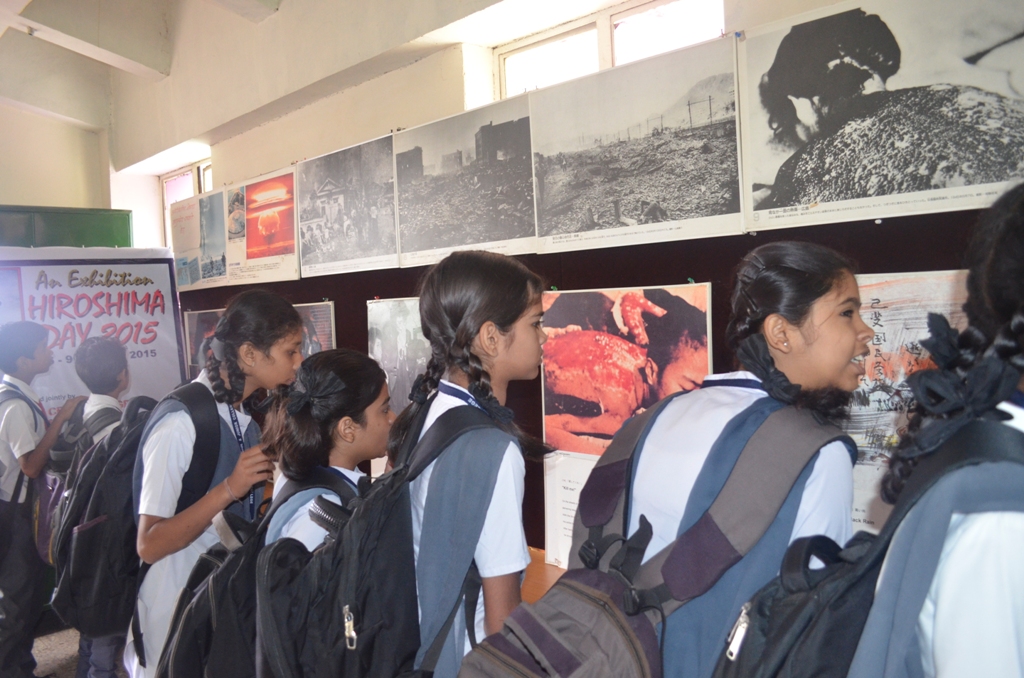
I am pleased to convey to you the IPB’s nomination for the Nobel Peace Prize 2015. A total ban and the elimination of nuclear weapons was the task set out by the very first resolution of the first General Assembly of the United Nations (January 1946), a task that remains unfulfilled. Yet, as seen in the success of the international conferences on the humanitarian impact of nuclear weapons, held in Oslo in 2013 and in Nayarit and Vienna in 2014, momentum is building up once more, and promises to turn this 70th anniversary of the tragedies of Hiroshima and Nagasaki into a milestone on the path to a world free of nuclear weapons.

hibakusha
click on the photo to enlarge

A hibakusha, a survivor of the atomic bombing of Nagasaki, tells young people about his experience and shows pictures. United Nations building in Vienna, during the NPT PrepCom 2007. Photo from Wikimedia Commons

For this reason IPB once again nominates for the Nobel Peace Prize the Hibakusha, those who personally suffered from the atomic bombings of the two cities. They are quite simply extraordinary human beings; not giving in to despair, they became convinced, through their struggle to survive the attacks and the subsequent long years of suffering, that their agonies must never be repeated anywhere. Over these 70 years they have made the choice of activism, unceasingly recounting their experiences and struggles, and working constantly for a total ban and the elimination of nuclear weapons, appealing to governments and peoples all over the world.

We nominate :

1) the Japan Confederation of A­- and H-­Bomb Sufferers Organizations (Nihon Hidankyo), a nationwide independent organization of the Hibakusha. Since its founding in August 1956, it has been working in unity, beyond the difference of beliefs and opinions, encouraging its members to help each other to promote the cause of a ban on atomic and hydrogen bombs, by making known their sufferings and struggles. Their activities are fully worthy of the name, “champion of peace”, in the light of the ideal of disarmament, for which Alfred Nobel established the Nobel Peace Prize.

2) (2) Mr. Sumiteru TANIGUCHI and (3) Ms. Setsuko THURLOW, outstanding representatives of the Hibakusha movement, who have been at the forefront of the efforts of the Hibakusha throughout their lives, calling for a ban and for the abolition of nuclear weapons, based on their own painful experiences.

Background details on all 3 nominees can be found at Annexes 1‐3, below.

IPB believes that the award of the Nobel Peace Prize to these courageous persons, and indeed to a courageous movement, would be a contribution of unique value and extraordinary importance to the worldwide community of nuclear disarmament advocates, itself 70 years old this year.

The continued existence of nuclear weapons threatens the very survival of life on earth. The Norwegian Nobel Committee has recognised this supreme threat in several of its previous awards. We urge the Committee, at this historic moment, to return to this theme and to itself make a courageous choice: to recognise and reward the Hibakusha.

(This article is continued in the discussion board on the upper right of this page)

(The following is continued from the article on the left.)


ANNEX 1: The Japan Confederation of A­ and H­Bomb Sufferers Organizations (Nihon Hidankyo) Address

Gable Bldg. #902 1‐3‐5 Shiba‐Daimon Minato‐ku Tokyo 105‐0012 Japan Phone: +81‐3‐3438‐1897
Fax: +81‐3‐3431‐2113
Email: kj3t‐tnk@asahi‐net.or.jp http://www.ne.jp/asahi/hidankyo/nihon/
Co­chairpersons
Sunao TSUBOI (Mr.) Sumiteru TANIGUCHI (Mr.) Prof. Mikiso IWASA (Mr.)
Secretary General:
Prof. Terumi TANAKA (Mr.)
Founding
August 10, 1956
Organization and Membership
NIHON HIDANKYO is the only nationwide organization of A‐bomb survivors of Hiroshima and Nagasaki (Hibakusha). It has member organizations in all 47 Japanese prefectures, thus representing almost all organized Hibakusha. Its officials and members are all Hibakusha. The total number of the surviving Hibakusha living in Japan is about 190,000, as of the end of 2014. Also there are Hibakusha living in Korea and other parts of the world outside Japan. HIDANKYO is cooperating with them in their effort to defend their living conditions and human rights.
Main Objectives
1) Prevention of nuclear war and the elimination of nuclear weapons, by way of an international agreement for a total ban and the elimination of nuclear weapons.
2) State compensation for the A‐bomb damages. The state responsibility of having launched the war, which led to the damage by the atomic bombing, should be acknowledged, and the state compensation provided.
3) Improvement of the policies and measures on the protection and assistance for the Hibakusha.
Major Activities
1) Telling stories of the Hibakusha to make known their experiences, actual damage and after‐effects of the A‐bombings both within and outside Japan; Sending A‐bomb sufferers to the U.N. and other international fora, nuclear‐weapon states and other countries;
2) Actions for the enactment of a Hibakusha‐aid law providing state compensation for the Hibakusha themselves and bereaved families; Running signature drives, marches, sit‐ins and other forms of action.
3) Providing counseling and other assistance to the Hibakusha in their difficulties on health and living.

Major Actions since the Founding
HIDANKYO has held dozens of petition actions every year to urge both the Japanese government and the Diet to take steps to make known to the world community the full dimension of the damage caused by the A‐bombings and take the lead in promoting public opinion for the prevention of nuclear war and the elimination of nuclear weapons. HIDANKYO also urges the Japanese government to admit Japan’s responsibility for having launched the war, which eventually led to the atomic bombing, and that it should provide state compensation for the bereaved families, as well as the sufferers on whom health damage was inflicted.
The “Hibakusha Aid Law” demanded by HIDANKYO, therefore, is to include a pledge that Japan would make every effort so that there would never be another Hibakusha anywhere.
HIDANKYO is playing a major role in the movement against A and H bombs. Not only taking part in a number of peace events during summer, HIDANKYO sends its representatives all over Japan, who bear witness to their A‐bomb experiences, helping to promote the public awareness on the need for a ban and the elimination of nuclear weapons. Internationally, HIDANKYO sends many Hibakusha overseas, to make heard their appeals for the prevention of nuclear war and the abolition of nuclear arms.
Hibakusha, sent by HIDANKYO, have made contributions to many important international forums, including two UN Special Sessions on Disarmament in 1982 and 1988, the NPT Review Conferences in 2005 and 2010 and its Preparatory Committee sessions, and the three International Conferences on Humanitarian Impact of Nuclear Weapons in March 2013 in Oslo, February 2014 in Nayarit, and December 2014 in Vienna.

Peace and Planet Events, April 24-26 in New York City

DISARMAMENT & SECURITY .

an article by Kim Stoner, Board of Directors, Promoting Enduring Peace

It was exciting for Promoting Enduring Peace to work with a broad coalition of environmental organizations in support of the Peoples’ Climate Mobilization last September in New York City. Now, we would like for environmental groups to join us in mobilizing a broad coalition in support of nuclear disarmament this April – again in New York City.

PEP
click on photo to enlarge

Specifically, we invite you to participate in the Peace and Planet International Conference for a Nuclear-Free, Peaceful, Just, and Sustainable World on April 24 and 25, and the following Rally and March on April 26. When representatives of the nations of the world gather at the United Nations for the 5-year Review of the Nuclear Non- Proliferation Treaty, we want to deliver the message to these representatives that the peoples of the world want good faith negotiations to eliminate nuclear weapons, as required by the Treaty since it entered into force in 1970. For the specific demands of the organizers, please go to the website www.PeaceandPla net.org.

Despite the end of the Cold War, and President Obama’s pledge in 2009 to seek a “nuclear-free world,” there are about 17,000 nuclear weapons in existence worldwide, including over 7,000 in the US and 8,000 in Russia. According to a recent federal report on modernization of the US nuclear arsenal, over $1 trillion will be spent to upgrade US nuclear weapons over the next 30 years. So, rather than eliminating our nuclear weapons, we will be “modernizing” them.

Proliferation of nuclear weapons also increases the likelihood of their use in regional conflicts, such as between India and Pakistan. This would, of course, result in tremendous human mortality and suffering and regional environmental effects from the blasts, the pressure waves, direct radiation and radioactive fallout. In addition, even a relatively small regional nuclear war (using 50 weapons on each side) would have devastating global environmental effects by sending vast amounts of smoke and soot into the atmosphere resulting in a nuclear winter lasting for a decade or more.

The continuing threat of nuclear weapons has, for many of us, been present our entire lives. As a result, it requires a big psychological step for us to realize that the nuclear war culture, like the reliance on fossil fuels, is an aspect of our civilization that can and must change.

Question related to this article:

Can we abolish all nuclear weapons?

30 August 2012 — The following opinion piece by Secretary-General BAN Ki-moon appeared in leading newspapers in Argentina, Bangladesh, Burundi, China, Germany, India, Iran, Italy, Japan, Lebanon, Malaysia, The Philippines, Republic of Korea, Russia, Serbia, Turkey, Ukraine and European weekly publications and has been translated into 10 languages.

‘THE WORLD IS OVER-ARMED AND PEACE IS UNDER-FUNDED’

Last month, competing interests prevented agreement on a much-needed treaty that would have reduced the appalling human cost of the poorly regulated international arms trade. Meanwhile, nuclear disarmament efforts remain stalled, despite strong and growing global popular sentiment in support of this cause.

The failure of these negotiations and this month’s anniversaries of the atomic bombings at Hiroshima and Nagasaki provide a good opportunity to explore what has gone wrong, why disarmament and arms control have proven so difficult to achieve, and how the world community can get back on track towards these vitally important goals.

Many defence establishments now recognize that security means far more than protecting borders. Grave security concerns can arise as a result of demographic trends, chronic poverty, economic inequality, environmental degradation, pandemic diseases, organized crime, repressive governance and other developments no state can control alone. Arms can’t address such concerns.

Yet there has been a troubling lag between recognizing these new security challenges, and launching new policies to address them. National budget priorities still tend to reflect the old paradigms. Massive military spending and new investments in modernizing nuclear weapons have left the world over-armed — and peace under-funded.

Last year, global military spending reportedly exceeded $1.7 trillion – more than $4.6 billion a day, which alone is almost twice the UN’s budget for an entire year. This largesse includes billions more for modernizing nuclear arsenals decades into the future.

This level of military spending is hard to explain in a post-Cold War world and amidst a global financial crisis. Economists would call this an “opportunity cost”. I call it human opportunities lost. Nuclear weapons budgets are especially ripe for deep cuts.

Such weapons are useless against today’s threats to international peace and security. Their very existence is de-stabilizing: the more they are touted as indispensable, the greater is the incentive for their proliferation. Additional risks arise from accidents and the health and environmental effects of maintaining and developing such weapons.

The time has come to re-affirm commitments to nuclear disarmament, and to ensure that this common end is reflected in national budgets, plans and institutions.

Four years ago, I outlined a five-point disarmament proposal highlighting the need for a nuclear weapon convention or a framework of instruments to achieve this goal.

Yet the disarmament stalemate continues. The solution clearly lies in greater efforts by States to harmonize their actions to achieve common ends. Here are some specific actions that all States and civil society should pursue to break this impasse.

* Support efforts by the Russian Federation and the United States to negotiate deep, verified cuts in their nuclear arsenals, both deployed and un-deployed.

* Obtain commitments by others possessing such weapons to join the disarmament process.

* Establish a moratorium on developing or producing nuclear weapons or new delivery systems.

* Negotiate a multilateral treaty outlawing fissile materials that can be used in nuclear weapons.

* End nuclear explosions and bring into force the Comprehensive Nuclear-Test-Ban Treaty.

* Stop deploying nuclear weapons on foreign soil, and retire such weapons.

* Ensure that nuclear-weapon states report to a public UN repository on nuclear disarmament, including details on arsenal size, fissile material, delivery systems, and progress in achieving disarmament goals.

* Establish a Middle East zone free of nuclear weapons and other weapons of mass destruction.

* Secure universal membership in treaties outlawing chemical and biological weapons.

* Pursue parallel efforts on conventional arms control, including an arms trade treaty, strengthened controls over the illicit trade in small arms and light weapons, universal membership in the Mine Ban, Cluster Munitions, and Inhumane
Weapons Conventions, and expanded participation in the UN Report on Military Expenditures and the UN Register of Conventional Arms.

* Undertake diplomatic and military initiatives to maintain international peace and security in a world without nuclear weapons, including new efforts to resolve regional disputes.

The Peace Centre organized a counseling session for Gaza’s children

DISARMAMENT & SECURITY .

an article by ziad medoukh

On Sunday, January 25, 2015, a team of seven youth from the Peace Centre: Ahmed Jamal, Baraa Abu Khussa, Hind Harazine Iman Ryach, Mahmoud Zaher, Ola Atta and Rawan Shawa, organized a counseling session for dozens of children of Gaza City.

palestine
click on photo to enlarge

The activity that lasted three hours took place in the “little angels” kindergarten in the poor neighborhood of Al-Tofah. The 60 little participants were very attentive and very interested.

The team trained at the Centre in September 2014, which deals with various centers of the Gaza Strip and which offered them several activities.

With school supplies, toys and various objects, the team conducted workshops and various activities: theater, drawing on the face, on notebooks and on the wall, contests, games, sports, songs, music, game role animations, drama and comic reading.

The children followed with great interest the various activities offered by the youth center. They forgot their shyness and integrated themselves into the group.

The Centre’s director thanked the speakers for their talent and creativity. She found that the children had changed a lot in their behavior after the animation session. She asked them to come back another time to ensure other activities for children and their mothers.

(Click here for a French version of this article)


Question related to this article.

Presenting the Palestinian side of the Middle East, Is it important for a culture of peace?

How are the Palestinians responding to the latest attacks?

CPNN has received the following Statement from the National Coalition of
Christian Organizations in Palestine on the situation: Support Gaza’s Right to Life

“Justice and security are two sides of the same coin. Israel’s security can never be an excuse for denying justice to the Palestinian people.”

In the spirit of the living God who sanctifies all life and in keeping with our faith and its teachings we appeal to all people across the world to work with their fellow citizens and governments to end Israel’s Operation Protective Edge and the brutal military siege that has been going on for the past seven years which includes a naval and economic blockade. Gaza has no port or airport thus no way to import or export its products.

This not a war. This is only vengeance and collective punishment. A responsible authority works to stop useless vengeance and violence. Instead, it fosters general atmosphere of incitement, in order to please a Palestinian hating population, and not knowing what to do, the irresponsible Israeli Authority, just kills Palestinians and demolishes their houses, in order to please their people. We acknowledge the voice and action of the few Israelis who expressed themselves against this policy of their government.

This is not an escalation or a war. Gaza has no military or ability to protect itself other than to fire some homemade rockets. The 1.7 million people, mostly children (2/3 of the population) are also mostly refugees (1.1 million) from areas of 1948 and 1967. Furthermore under the 4th Geneva Convention Palestinians, as a militarily occupied people, have the right to defend themselves.

Our justice loving God demands us to speak out on behalf of the security for all people. In the name of the Advocate Spirit, we ask you to speak out now to call a halt to this long term offensive operation which aims to wipe out a lonely, besieged and unarmed people. Whether you think the new unity government is viable or not, or if Hamas is a terrorist organization or not, or whether you think they might have been behind the death of the three Israeli teens murdered near Hebron, (which is not proven so far) it is against international law to collectively punish or target an already besieged 1.7 millon population. It is inhumane. It is a war crime.

As of July 10th, the date of this Appeal Israeli military struck 430 targets across the Gaza Strip. 77 people have been reported dead and more than 500 wounded.. The majority of the dead are civilians. 18 are children including a baby one month old.

We pray for the memory of those killed. Each of them has a name and a family who is suffering great loss. We also pray for all those wounded or injured in body, mind, or spirit. We pray for solace and comfort also for the families whose homes, businesses, agricultural fields, or fishing boats that have also been destroyed. We pray for the people of Gaza and ask that God be with them.

Support Palestinian’s right to life by joining with Christians throughout the world in their call for a just peace in this land that all call holy. We have been down this road one too many times and know what will happen if we fail to act. Please join us through letters and petitions to your government officials to raise awareness about this offensive military operation and Gaza’s ongoing siege. Ask them to pressure Israel to stop its
brutal assault or face sanctions from the international community.

Support Palestinian’s right to life, say with a loud voice: stop killing and demolishing houses. Join with Christians throughout the world in their call for a just peace in this land that all call holy.

Quote from article by Jeremy Corbynn,, “Who Mourns for Palestine”

NCCOP

Jerusalem
· Arab Catholic Scouts Group
· Arab Orthodox Society – Jerusalem
· Caritas- Jerusalem
· Department of Service to Palestinian Refugees- Middle East Council of
Churches
· Greek Catholic Sayedat AlBishara Association
· International Christian Committee
· Laity Committee in the Holy Land
· National Christian Association
· Pontifical Mission Palestine
· SABEEL – Ecumenical Liberation Theology Center
· Seeds of Better life
· Union of Arab Orthodox Club – Jerusalem
· Young Men’s Christian Association –YMCA
· Young Women’s Christian Association –YWCA

Gaza
NECC office

Bethlehem (NCOB)
Network of Christian Organizations in Bethlehem
· The East Jerusalem YMCA /Beit Sahour Branch
· The Arab Educational Institute,
· Holy Land Trust, Bethlehem
· Wi’am Center, Bethlehem
· Saint Afram Assyrian Society,
· Holy Land Christians Ecumenical Foundation, Bethlehem
· Al-Ihsan Arab Orthodox Society, Beit Jala
· Arab Orthodox Club, Beit Sahour
· Arab Orthodox Club, Beit Jala
· Arab Orthodox Club, Bethlehem
· The Arab Orthodox Charitable Society, Beit Sahour
· Bethlehem Bible College
· Siraj Center for Holy Land Studies
· Alternative Tourism Group, ATG, Beit Sahour
· Senior Citizen Charitable Society
· Environmental educational Center, Beit Jala
· Saint Vincent Charitable Society, Beit Jala
· Shepherds’ Children Society, Beit Sahour
and KAIROS PALESTINE