Tag Archives: North America

USA: Building New “Nonviolent Cities”

.. DEMOCRATIC PARTICIPATION ..

An article by John Dear in Common Dreams (reprinted according to provisions of Creative Commons)

Last year, I was invited to give a talk on peace in Carbondale, Illinois. I was surprised to discover that in recent years, activists from across Carbondale had come together with a broad vision of what their community could one day become—a nonviolent city. They wanted a new holistic approach to their work, with a positive vision for the future, so that over time their community would be transformed into a culture of nonviolence.

johndear
(Image: Nonviolent Carbondale/Facebook)

They created a coalition, a movement, and a city-wide week of action and called it, “Nonviolent Carbondale.” They set up a new website, www.nonviolentcarbondale.org, established a steering committee, set up monthly meetings, and launched “Nonviolent Carbondale” as a positive way to promote peace and justice locally. In doing so, they gave everyone in Carbondale a new vision of what their community could become.

From the start, the Carbondale activists held their local organizing meetings occasionally before city council meetings, which they then attended together as a group. At city council meetings, they started suggesting and lobbying ways their city could become more nonviolent. Their movement eventually became based out of the main Carbondale Library. Over the years, they have done positive work with their police department, local schools and the school system, religious communities, the library system, and local non-profits. As grassroots activists, they have lifted up a positive vision of their community and brought it into the mainstream.

Over the years, they put their energies into their “11 Days” program – 11 days in March filled with scores of actions and events for all ages across the city. Twice their 11 days focused on peace; twice on compassion, and last year the focus was on food. One of the outcomes from last year’s 11 Days, for example, was a new organic food market started in the poorest neighborhood in town.

“Nonviolent Carbondale” offers a model for activists, movements, and cities across the country. With their example in mind, the group I work with, Campaign Nonviolence, [www.campaignnonviolence.org] is launching the “Nonviolent Cities” project using “Nonviolent Carbondale” as an organizing model for other cities.

Taking the lead from friends and activists in Carbondale, Campaign Nonviolence invites citizens across the U.S. to organize a similar grassroots movement in their city, to put the word “nonviolent” in front of their city, and to help others envision, organize and work for a nonviolent local community. As far as we can tell, this organizing tool has never been formally tried anywhere in the U.S., except in Carbondale. This movement is a new next step in the visionary, organizing nonviolence of Mahatma Gandhi and Martin Luther King, Jr.

Perhaps the key aspect of “Nonviolent Cities” is that each city will be summoned to address its violence in all its aspects, structures, and systems; to connect the dots between its violence; and to pursue a more holistic, creative, city-wide nonviolence, where everyone together is trying to practice nonviolence, promote nonviolence, teach nonviolence and institutionalize nonviolence on the local level, to really build a new nonviolent community for itself and others. We want not just to undermine the local and regional culture of violence, and end all the killings, but to transform it into a culture of nonviolence.

(Continued in right column)

Questions for this article:

How can culture of peace be developed at the municipal level?

(Continued from left column)

This means that “Nonviolent Cities” organizers would promote the vision, teach nonviolence, and inspire people at every level in their community to work together for a new nonviolent community and a new nonviolent future. That would include everyone from the mayor and city council members to the police chief and police officers, to all religious and civic leaders, to all educators and healthcare workers, to housing authorities, to news reporters and local media; to youth and grassroots activists, to the poor and marginalized, children and the elderly. Together, they would address all the issues of violence and pursue all the angles and possibilities of nonviolence for their city’s transformation into a more nonviolent community. The first goal would be a rapid reduction in violence and an end to killing.

Nonviolent cities would work to end racism, poverty, homelessness, and violence at every level and in every form; dismantle housing segregation and pursue racial, social and economic integration; end police violence and institutionalize police nonviolence; organize to end domestic violence and teach nonviolence between spouses, and nonviolence toward all children; work to end gang violence and teach nonviolence to gang members; teach nonviolence in every school; pursue more nonviolent immigration programs and policies; get religious leaders and communities to promote nonviolence and the vision of a new nonviolent city; reform local jails and prisons so they are more nonviolent and educate guards and prisoners in nonviolence; move from retributive to restorative justice in the entire criminal justice system; address local environmental destruction, climate change, and environmental racism, pursue clean water, solar and wind power, and a 100 percent green community; and in general, do everything possible to help their local community become more disarmed, more reconciled, more just, more welcoming, more inclusive, and more nonviolent.

If Carbondale, Illinois can seek to become a nonviolent city, any city can seek to become a nonviolent city. This is an idea whose time has come. This is an organizing strategy that should be tried around the nation and the world. The only way it can happen is through bottom-up, grassroots organizing, that reaches out to include everyone in the community, and eventually becomes widely accepted, even by the government, media, and police.

Two international groups pursue a similar vision–International Cities for Peace (www.internationalcitiesforpeace.org) and Mayors for Peace (www.mayorsforpeace.org, which has 6965 cities committed in 161 countries)—but, as far as I can tell, no U.S. group has ever attempted to invite local communities to pursue a vision of holistic city-wide nonviolence or organize a grassroots movements of nonviolent cities.

On our website, www.campaignnonviolence.org, we have posted “Ten Steps Toward a Nonviolent City,” a basic initial list of organizing tasks for local activists which includes: creating a local steering committee; finding a mainstream institution that can serve as a base; organizing a series of public meetings and forums; studying violence in the community; meeting with the mayor and the city council; and organizing a city-wide launch.

Gandhi once remarked that we are constantly being astonished by the advances in violence, but if we try, if we organize, if we can commit ourselves, he declared, we can make even more astonishing new discoveries and advances in nonviolence. With the example of “Nonviolent Carbondale” before us, we have a way to organize every local community and city in the nation, a way to envision how we can all one day live together in peace with justice, and the possibility of new hope. If we follow the example of Nonviolent Carbondale, we can help transform our culture of violence into something completely new—a culture of nonviolence. That should always be our goal.

Guantanamo could be turned from a war facility to a peace park

FREE FLOW OF INFORMATION

Based on an article by Joe Roman and James Kraska in Science magazine

As US president Obama makes a visit to Cuba, the following opinion has been published by Science, the journal of the American Association for the Advancement of Science: “The United States should deliver on President Obama’s recent plan to close the military prison at U.S. Naval Station Guantánamo Bay and repurpose the facilities into a state-of-the-art marine research institution and peace park, a conservation zone to help resolve conflicts between the two countries. This model, designed to attract both sides . . . could unite Cuba and the United States in joint management, rather than serve as a wedge between them, while helping meet the challenges of climate change, mass extinction, and declining coral reefs.”

guantanomo
Mangroves dot Guantánamo Bay with the U.S. naval base airstrip seen in the distance. Photo by Luke Frazza/AFP/Getty Images

The authors are Joe Roman, a conservation biologist at Vermont University and James Kraska, a law professor at the US Naval War College.

They suggest it could become ” ‘a “Woods Hole of the Caribbean,” housing research and educational facilities dedicated to addressing climate change, ocean conservation, and biodiversity loss.”

Both Cuba and the United States have strong interests in preserving the marine environment. The Woods Hole Marine Biological Laboratory, located on Cape Cod in the United States, is recognized as one of the leading scientific institutions of its typle in the world. And, according to the authors, Cuba has taken strong measures to preserve its coral reefs and coastal waters since the 1992 Earth Summit in Rio de Janeiro, They have developed “extensive protected areas, a constitution with strong environmental provisions, and an aggressive stance on climate change, putting it at the center of Caribbean conservation efforts. It has established the largest marine park in the Caribbean, the Jardines de la Reina (Gardens of the Queen), with abundant sharks and groupers.”

Tha authors place their proposal in the context of peace parks: “The world’s first peace park is the Water-ton-Glacier International Peace Park on the border of Canada and the United States, a symbol of goodwill between the countries. There have been successful transitions from military bases and conflict zones in other countries. After the United States left Fort Clayton to Panama, for example, part of the base was transformed into Ciudad de Saber (City of Knowledge), a government-sponsored complex that has attracted international scholars and the United Nations Development Program. Although the future of land along the corridor of the former Iron Curtain is uncertain, the European Green Belt initiative could transform the continent and help species such as lynx, brown bears, and imperial eagles recover. Such international parks are signs that humans can respect each other, even after conflicts, and protect other species that share our planet.”

They conclude that “the Guantánamo peace park and research center would encourage nations to convert military bases and conflict zones into areas of creativity, cooperation, and biodiversity conservation. For the next generation, the name Guantánamo could become associated with redemption and efforts to preserve and repair international relations and the planet.”

Question(s) related to this article:

Peace parks: Are they promoting peace?

See also The Contribution of Transfrontier Peace Parks to Peace in Southern Africa.

Canada: It’s time to let Iraq War Resisters stay!

DISARMAMENT & SECURITY .

An article from the War Resisters Support Campaign

Following the federal election, there is hope that there can finally be a positive and speedy resolution to the cases of U.S. Iraq War resisters. Your help is needed to make sure they are allowed to stay in Canada. Watch our new video below and then take a moment to write a letter to your MP in support of war resisters. For more information, see our backgrounder on the situation of U.S. Iraq War Resisters in Canada.

resisters

Video for campaign

Canadians voted for change and expect the new government to do the right thing and let the war resisters stay. It was the strong response of Canadians that has kept most U.S. war resisters in Canada – and out of U.S. military prison – for the past ten years.

U.S. Iraq War resisters have lived through a decade of unfair political interference in their cases by the previous Conservative government. Some were deported by the Harper government, and received harsh jail sentences in the U.S. for opposing the illegal and immoral invasion of Iraq.

The new government should immediately heed the will of the majority of Canadians and stop any and all actions against U.S. war resisters, including halting the litigation against U.S. war resisters, as this litigation defends policies and decisions made by the previous Conservative government.

How you can help

1) Write a Letter to Prime Minister Justin Trudeau:

The Right Honourable Justin Trudeau
Prime Minister of Canada
Office of the Prime Minister
Langevin Block
80 Wellington Street
Ottawa, Ontario
K1A 0A2

2) Call, e-mail and write to your Member of Parliament:
To send a letter: address it to your MP, and send to House of Commons, Ottawa, Ontario K1A 0A6

To find out your MP’s email and phone number, you can email info@parl.gc.ca
or call toll-free (Canada): 1 (866) 599-4999.

MP contact details will be up shortly at www.parl.gc.ca, under ‘Members of Parliament’.

Key points to mention:

• Resolve this issue swiftly as part of the change promised by the new government

• It is time to fix this issue – end over 10 years of unfair and unjust legal and political actions by the Harper government

• Stop the deportations

• Stop pursuing war resister cases in court, as doing so defends decisions and policies made by the former Conservative government

• Rescind Operational Bulletin 202

• Implement a new Operational Bulletin that restores fairness for all war resister cases and reverses the harm done

3) Donate to the War Resisters Support Campaign

4) Please join and follow us – and share us on Social Media:
Facebook
Twitter
YouTube

(Thank you to Janet Hudgins, the CPNN reporter for this article.)

Question for this article:

Documentary Review: “Where to Invade Next” by Michael Moore

EDUCATION FOR PEACE .

A film review by Ulkar Alakbarova

Each country has its own issues. Some have more, some have less. But one country has more internal issues than any other country in the world – The United States of America. In Michael Moore’s WHERE TO INVADE NEXT, you will discover some interesting facts that will make you wonder as to how is it possible that the greatest country on Earth can’t make its own people achieve the dream life they should have had a long time ago?

Moore
(click on photo to enlarge)

The idea of Moore’s documentary film is to invade a particular country that has something that the Americans don’t have. Moore begins his first trip with Italy, where he meets a charming middle class Italian couple, who tell us their lifestyle. From them, you will find out that every Italian is entitled to 8 paid weeks of vacation, two hours of lunch break, 15 days of vacation for newly married for their honeymoon, and 5 months of fully paid maternity leave. Moore strongly emphasizes here how important it is for Americans to implement this idea in the U.S. where, by law, every American is entitled to have only ‘0’ paid statuary vacations.

The second country the filmmaker invades is France, where he shows the importance of educating children to eat healthy food. While he takes us to a rural, and if I can say, not to a rich city at all, the food children are given in the school is equal to 5 stars’ restaurant in the North America. Instead, Moore shows the meal American students eat in the school: defrosted pizza and strange meal that looks like it had been kept in the fridge for ages. Moore’s third country being invaded is Finland, which offers the best education in the world, while Slovenia offers free University education. Saying that, it certainly looks like the richest country in the world is way behind those who have the annual budget a hundred times less than the United States.

WHERE TO INVADE NEXT is a great example of what a single country must do in order to make the life of its own people less stressful. Moore’s aim here is not to insult or embarrass his fellow Americans, but rather, make them to admit the gaps they have, and the urgency to fill it as soon as possible. It compares the prison system of Norway against the U.S., where no longer the rule being invented by the founders of the Great Nation: “no cruel or unusual punishment” is being followed.

In the end, this film can make you laugh, while, it`s uncomfortable truth may some viewer`s feelings. it touches quite a serious subject matter that somebody must look into. It reveals the negative side of American society that could not learn from past lessons. However, the filmmaker still looks optimistic, hoping that the ideas he claimed from foreign countries will help his country to restore its name before its citizens. Saying that, this film may be about America, but in the meantime, it’s about every country in the world that must face the issues they have, and fix it, if they want our next generation to have a prosperous future. But before it happens, allow yourself to be invaded by Moore`s brilliant film, that must be seen by everyone.

Question(s) related to this article:

USA: New Haven Peaces Out. A Bit

. .DEMOCRATIC PARTICIPATION. .

An article by Aliyya Swaby, New Haven Independent (reprinted by permission)

The public schools “restorative justice” plan and the resettling of refugees in town strengthened New Haven’s “culture of peace” this past year, according to a new report.

swaby
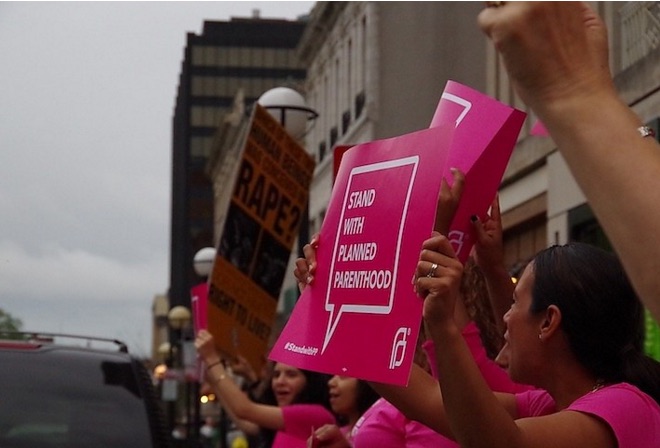
Almost 200 “pink out” for Planned Parenthood (Photo by Lucy Gellman, New Haven Independent).

Compiled by the New Haven Peace Commission, the third annual report — “The State of the Culture of Peace in New Haven” — incorporates anonymous statements from 15 local activists on the ways that the city is improving or stagnating in eight different categories.

The conclusion: New Haven is moving toward peace. But slowly.

The report judges peace in New Haven by eight categories based on the United Nations Culture of Peace initiative launched in 1989. Each category was developed as a contrast to a characteristic of the culture of war: sustainable and equitable development, democratic participation, equality of women, tolerance and solidarity, disarmament and security, education for peace, free flow of information, and human rights.

Report author David Adams was at UNESCO until 2001, where he worked on the “Culture of Peace Programme” for promoting peace efforts nationwide. Nations, Adams said, operate under cultures of war, dominated by armament, propaganda, economic inequality and authoritarian control. But cities need cultures of peace to be successful.

“Cities don’t have enemies. Countries have enemies,” he said. “If we want to change the world and make peace, we should work at the level of the city and not at the level of the state.”

The full report can be read here.

The activists spoke anonymously, so that they spoke honestly, Adams said. “What you see is that it’s not perfect, but the city does work for the culture of peace.” The adoption of restorative justice in New Haven Public Schools, allowing kids to work through their problems instead of suspending them for disciplinary issues, is a major step forward in promoting peace, he said.

The Peace Commission is working to set up meetings with the chairs of Board of Alders education and youth committees in order to push for permanent funding for the restorative justice program. “Restorative justice addresses fundamental problems in the culture of peace. If we can do it in the schools, we can do it in society as a whole,” he said.

(Article continued in right column)

Questions for this article:

How can culture of peace be developed at the municipal level?

(Article continued from left column)

New Haven’s Integrated Refugee & Immigrant Services (IRIS) jumped into the national media in November for welcoming a family of Syrian refugees after the governor of Indiana refused to accept them into the state. This is an example of a “solidarity program” promoting community despite inequality in the city, according to the report.

The report also tracks programs that have not lived up to expectations from past years. Though the first peace report in 2013 lauded jobs program New Haven Works when it was first created to address unemployment and under-employment, this year’s report calls those early hopes “largely unfulfilled.”

New Haven Works has found jobs for 500 people in 18 months. That number is a “drop in the bucket,” the report quotes an activist saying.

Another major area of stagnation in creating a culture of peace in the city, according to Adams, is lack of sustainable, equitable development. Though thousands of new apartments are being developed, many are luxury units, “far beyond the reach of those who are being forced out of Church Street South, not to mention families and individuals already homeless or in over-crowded housing,” the report reads.

The prominence of women in politics this year—including Mayor Toni Harp’s reelection and Board of Alder President Tyisha Walker’s election by fellow alders—is a good model for woman’s equality, according to the report.

And New Haven supported Planned Parenthood at a rally on the Green against nationwide attacks attempting to cut sexual health services for women, the report says.

But women are largely heads of their households among the urban poor and often employed part-time or for low wages without benefits, the report said. Many have husbands or boyfriends in prison or who cannot find jobs because of a record.

The first report in 2013 said it was too early to judge whether community policing would be effective in New Haven. The new report characterizes it as still a work in progress.

“It takes a while to change the police force,” Adams said. “Developing trust takes years … Hopefully it will continue to move forward.” In other cities, the police are seen as an “occupying army, not as the fabric of the city.”

Earlier this week, the Peace Commission met to discuss the report and consider issues to address next year. Adams said it will continue pushing for a permanent restorative justice program and will need to come to consensus on another task.

A half dozen people sit on the commission. “The problem is when a lot of people think of peace, they think of business between countries. But when you talk about a culture of peace and define it this way, it becomes clear that it’s something people can do in their daily lives,” Adams said. “It brings peace home.”

USA: Privacy Activists Rally Around Apple in ‘Most Important Tech Case in a Decade’

FREE FLOW OF INFORMATION

An article by Nadia Prupis for Common Dreams (reprinted according to provisions of Creative Commons)

Supporters are rallying around Apple in a watershed privacy rights case against the FBI, with activists, whistleblowers, and activists all lining up to express their support of the tech company in its refusal to hand over encrypted information to the intelligence agency.


apple
Dozens gathered at Apple’s flagship store on Wednesday to support the tech company in its privacy fight against the FBI. (Photo: Fight for the Future)

National Security Agency (NSA) whistleblower Edward Snowden said Wednesday in a series of tweets, “This is the most important tech case in a decade…The FBI is creating a world where citizens rely on Apple to defend their rights, rather than the other way around.”

Hours later, the Information Technology Industry Council, a trade group representing some of Silicon Valley’s most powerful companies—including Google, Facebook, Microsoft, IBM, Hewlett-Packard, and others—released a statement that read, “Our shared fight against terrorism must be grounded in principle. We worry about the broader implications both here and abroad of requiring technology companies to cooperate with governments to disable security features, or introduce security vulnerabilities into technologies.”

“Our fight against terrorism is actually strengthened by the security tools and technologies created by the technology sector, so we must tread carefully given our shared goals of improving security, instead of creating insecurity,” the Council continued.

(Article continued in the right column)

Question(s) related to this article:

Free flow of information, How is it important for a culture of peace?

(Article continued from the left column)

And dozens of people rallied at Apple’s flagship store in San Francisco on Wednesday evening in a rapid-response event organized by the digital rights group Fight for the Future, which is planning additional actions next Tuesday.

The FBI, with the help of a federal judge, is demanding that Apple unlock an iPhone belonging to one of the suspected San Bernardino shooters, which the tech company says is essentially a demand to build a backdoor to encryption, threatening all of its users’ privacy rights and enabling a dangerous expansion of the government’s authority.

“Governments have been frothing at the mouth hoping for an opportunity to pressure companies like Apple into building backdoors into their products to enable more sweeping surveillance,” said Evan Greer, campaign director at Fight for the Future. “It’s shameful that they’re exploiting the tragedy in San Bernardino to push that agenda.”

Other whistleblowers also expressed their support of Apple’s stance. Mark Klein, an AT&T technician who exposed the telecom company’s cooperation with the NSA in 2006, said Wednesday, “It’s nice occasionally to have a company that has the balls to stand up to the government. The government—especially people like [CIA Director John] Brennan—is trying to brow beat everybody using the threat of terrorism. This allows the government to continually expand its powers.”

And the San Francisco-based digital rights group Electronic Frontier Foundation (EFF), which is planning to file an amicus brief in support of Apple, released this statement: “We are supporting Apple here because the government is doing more than simply asking for Apple’s assistance. For the first time, the government is requesting Apple write brand new code that eliminates key features of iPhone security—security features that protect us all. Essentially, the government is asking Apple to create a master key so that it can open a single phone.

“And once that master key is created,” EFF wrote, “we’re certain that our government will ask for it again and again, for other phones, and turn this power against any software or device that has the audacity to offer strong security.”

USA: We come to the gates of Hancock Drone Base today to install a memorial of Jerry Berrigan.

….. HUMAN RIGHTS …..

An article from warisacrime.org

Jerry Berrigan, who died on July 26, 2015 at the age of 95, was a husband, a father, a brother, a teacher and someone who – like his brothers Dan and Phil – dedicated his entire life to Jesus’ command to love one another. Jerry came to the base on a bi-weekly basis whenever he was able, in Jerry’s words, “to remind the base commander of our government’s pledge under the Fourth Geneva Convention of 1949, a treaty to safeguard non-combatant’s well-being in any warzone in which U.S. forces are engaged in combat.” And further, “to register horror and indignation at reports of bombing missions by drones in Afghanistan and Pakistan which resulted in the deaths of many innocent civilians; men, women and children.”

drone protest

As more and more evidence mounts regarding the illegality of U.S. drone policies, from the “Drone Papers” published by The Intercept, to the four drone pilots who have come forward to speak out about what this policy is doing, we bring Jerry’s image here to the gates to remember that this is where he would be, speaking out and putting his body on the line to say a clear “NO” to killing. Because Jerry Berrigan knew that it matters where we put our bodies.

In 2008 Jerry was asked by The Syracuse Post Standard if there was anything he would change in his life. Jerry replied, “I would have resisted more often and been arrested more often.” In our memorial today we use an image of Jerry from The Syracuse Post Standard where he is being arrested for opposing the U.S. invasion of Iraq.

As we are installing this Jerry Berrigan Memorial Drone Blockade, we also remember Mary Anne Grady Flores who is serving a six month sentence here in the Onondaga County jail because the courts in this county believe that the colonel at this highly armed base needs protection from citizens calling attention to the drone killings. We challenge the courts to apply the law as it was meant to be applied; to protect victims not victimizers.

Syracuse has a great history of men named Jerry and resistance to injustice. We call to mind “The Jerry Rescue” memorial that stands across the street from The Federal Court house where Syracusans in 1851 literally got in the way of the illegal and immoral Fugitive Slave law and the officials who tried take a man named Jerry back to enslavement in the South. They opened the prison gates for him to go to freedom. Our intent for this memorial today in honor of Jerry Berrigan, is to get in the way of the illegal and immoral use of killer drones. And to stand in solidarity with all those resisting other injustice – from Black Lives Matter to those putting their bodies to halt climate change.

Thank you Jerry Berrigan for your life and example. Your Spirit lives on!

In peace,

Beth Adams (Leverett, MA), Bev Rice (Manhattan), Bill Ofenloch (NYC), Brian Hynes (Bronx), Charley Bowman (Buffalo), Ed Kinane (Syracuse, NY), James Ricks (Ithaca), Joan Pleune (Brooklyn), Joan Wages (Roanoke, VA), Pete Perry (Syracuse, NY), Ray McGovern (Arlington, VA), Steve Baggarly (VA)

(Thank you to David Swanson for sending this to CPNN)

Question for this article

USA: Albuquerque March and Rally Against Hate! Sunday, Feb. 21 at 2pm at Albuquerque Civic Plaza

….. HUMAN RIGHTS …..

by Susan Schuurman

JOIN US TO DEMAND:
– Stop the hate! Stop the violence! We are all together!
– Let’s stand together with our Muslim and Arab American neighbors!
– Let’s stand together with immigrant workers and families!
– Let’s stand together with the Black community fighting for justice!
– Let’s stand together with refugee communities!
– Let’s stand together with women who only want access to reproductive healthcare!
– NO to racist, sexist and anti-LGBTQ violence! 
-Let’s stand together with Native Americans against bordertown violence and attacks on Native sovereignty! 
Defend those that are under attack!

albuquerque
To enlarge, click on photo

There are growing efforts to whip up hatred against people in our community. We can’t stand by while people like Donald Trump use their power and money to spread hatred against Muslims, Arabs, Mexicans, immigrants, refugees, LGBTQ people, women or anyone. Enflaming hatred, scapegoating and racist rhetoric have no place in our society. Sickening acts of violence against Mosques, women’s healthcare clinics, and ordinary people everywhere are on the rise. We are united against acts of violence, including inflammatory statements against any group.

This march of hatred cannot be unopposed. This is a dangerous moment and that’s why we all have to unite! Preying on people’s fears requires us to say that immigrants, Muslims, refugees and other assailed communities are not the problem. Espousing hatred and violence is the problem! We are the majority. An injury to one is an injury to all!

Join the February 21 mobilization to Unite Against Hate! Join together with your neighbors, families, workers and everyone to stand up to Trump and all forms of bigotry!

CALLED BY: ABQ UNITED FRONT AGAINST HATE
Organized and endorsed by Albuquerque Center for Peace and Justice, Islamic Center of New Mexico, Blessed Oscar Romero Catholic Community, ANSWER NM, Party for Socialism and Liberation, The Red Nation, SouthWest Organizing Project, New Mexico Faith Coalition for Immigrant Justice, El Centro de Igualdad y Derechos, United Voices for Refugee Rights, Friends of Sabeel ABQ, Coalition to Stop $30 Billion to Israel, Veterans for Peace ABQ, Stop the War Machine, Jewish Voice for Peace ABQ, Bernie Sanders at UNM, Encuentro, La Plazita Institute, Mujeres Colectiva, ABQJustice, Burque Media Productions, People’s Lapel Camera of Albuquerque, UNM SOAP (Students Organizing Actions for Peace), Rock Against Racism, St. Mary Magdalene ECC, SURG-NM (Showing Up for Racial Justice), The Rev. Angela Herrera, minister of First Unitarian Church, Pastor Janet Norden, of University Heights United Methodist Church and First United Methodist Church, Bernalillo County La Raza Unida, Los Jardines Institute, Santa Feans for Justice in Palestine, Progressive Democrats of America Central New Mexico (PDA-CNM), and Theater Grottesco.

Call 505-268-9557 if your organization or group would like to endorse and to find out more info about how to participate. Everyone who endorses call to action is welcome to help plan this event. We meet weekly on Thursdays at 4pm at the Peace Center.

abqpeaceandjusticecenter@gmail.com
abqpeaceandjustice.org
http://www.facebook.com/pages/Albuquerque-Center-for-Peace-and-Justice/163970810300920

Question for this article

USA: ​United Methodist Kairos Response Welcomes Pension Fund Exclusion and Divestment of Israeli Banks

DISARMAMENT AND SECURITY .

Press release by Kairos Response

UM Kairos Response is pleased to announce that the $20-billion Pension and Health Benefits Fund of the United Methodist Church has declared the five largest Israeli banks off limits for investment and has divested from the two that it held in its portfolios. This is the first time a major church pension fund has acted to preclude investment in Israeli banks that sustain Israel’s illegal occupation of Palestinian land.

Kairos

The information has been posted on the Pension Fund’s website under Evaluating companies in our investment funds that pose excessive human rights risks. The banks are Bank Hapoalim, Bank Leumi, First International Bank of Israel, Israel Discount Bank, and Mizrahi Tefahot Bank. These banks are deeply involved in financing illegal settlements in the occupied Palestinian territories.

Bank Hapoalim and Bank Leumi were removed from the portfolios. The fund manager, known as Wespath, also divested from Shikun & Binui, an Israeli company involved with construction in the illegal settlements beyond Israel’s recognized borders. In addition, Wespath has placed Israel/Palestine on a list of regions where human rights violations occur.

UMKR is pleased to learn of these actions, while noting that Wespath still holds stock in ten companies located inside the illegal settlements and in several others that lend important support to Israel’s occupation. A list of those companies is available on the UMKR website.

According to UMKR Co-chair Rev. Michael Yoshii, “We commend the pension fund for taking this significant step in disassociating from the illegal occupation of Palestinian land. But as United Methodist policy opposes the occupation, this is only a first step towards ending our financial complicity in the ongoing oppression of the Palestinian people.”

Rev. John Wagner, a member of the UMKR Divestment Committee, added, “Since the church’s policy-making body, the General Conference, has called on all nations to boycott products produced in the illegal settlements, we urge our fund managers to maintain consistency and divest from all companies that profit from these same settlements.”

UMKR has submitted four proposals to the next General Conference, which will meet May 10-20 in Portland, Oregon. Three would require divesting from companies involved with the occupation and one would establish a screen to preclude investments in companies doing business in illegal settlements anywhere in the world.

United Methodist Kairos Response is a global grassroots group within the United Methodist Church seeking to respond to the urgent call of Palestinian Christians for actions that can end the Israeli occupation of their land. For more information, visit www.kairosresponse.org.

Question related to this article:

USA: Wilmington Peace Plan

. DEMOCRATIC PARTICIPATION .

Excerpt from the website of Pacem in Terris, Wilmington, Deleware

Pacem in Terris and other non-profits in the Wilmington area (Wilmington Peacekeepers, One Village Alliance, DE Coalition Against Gun Violence, etc.) want to develop a strategic vision, plan and resource document that will bring peace to Wilmington. The plan will deal with the actions needed to transform a culture of violence to a culture of peace. The plan would include input from civic groups, city and state governments and agencies, churches, students, the elderly, and general public.


wilmington
Video of March for a Culture of Peace

Building on the very successful September 2014 March for a Culture of Peace (and Rally and Call to Action) that we organized (45 co-sponsors, 400+ participants), and subsequent public forum events every month since then, we see the need and opportunity for a Wilmington Peace Plan that presents a clear vision of our desired goal, and the means for achieving it. The strategic plan would include needed actions by city and state legislators, divisions of the city, county and state government, neighborhoods, families, churches, schools, businesses, non-profit organizations and individuals.

The accompanying resource document would be printed as well as available on the web and via smartphone app. It would include organizations throughout our region that are engaged in what we call “building a culture of peace”, and include resources and information on a wide variety of topics– from anti-bullying strategies, civic engagement, domestic violence prevention, school to prison changes, financial literacy, management and violence, gun violence reduction,, gangs and violent street groups, safe havens for youth, juvenile justice system, mental health providers, mentoring, restorative justice, support groups for ex-offenders, service organizations, street level outreach, dating violence, workplace violence prevention and other topics.

Together, the Wilmington Peace strategic plan and Wilmington Peace Resources document will present a clear vision of a possible and attractive peace-filled future; the actions and means for getting there, and the resources needed to achieve the vision and implement the plan.

Click here for Tom Davis’ recap of the December 2014 event and click here for a video of the event. Also, on December 28th, Wilmington Friends Meetinghouse had a Memorial to the Lost. Click here for the video.

Questions for this article: