Tag Archives: Mideast

ICC judges order outreach to victims of war crimes in Palestine

DISARMAMENT & SECURITY .

An article by Ali Abunimah in The Electronic Intifada

Judges in The Hague have ordered the International Criminal Court to reach out to victims of war crimes in Palestine. It is a sign the court may be inching towards ending Israeli impunity.

On Friday, the ICC’s Pre-Trial Chamber 1 ordered court administrators to establish “a system of public information and outreach activities for the benefit of the victims and affected communities in the situation in Palestine.”


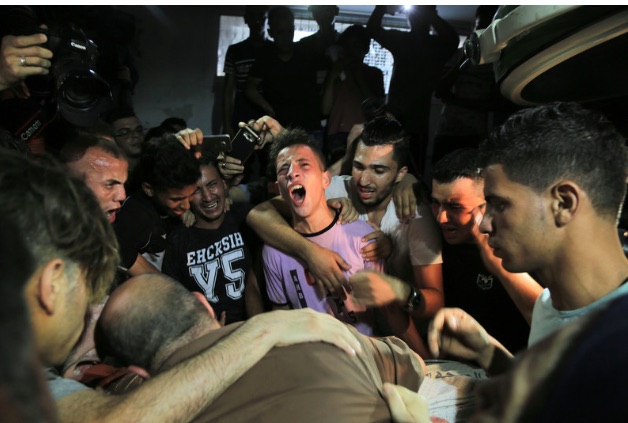
Relatives mourn over the body of Amir al-Nimra, who was killed in an Israeli airstrike in Gaza City on 14 July along with his friend Louay Kuhail. Both boys were 14 years old.Mohammed ZaanounActiveStills

The Pre-Trial Chamber is a panel of judges that supervises how the ICC prosecutor’s office carries out its investigative and prosecutorial activities. It has the responsibility to guarantee the rights of suspects, victims and witnesses during investigations by the prosecutor.

The court will also create a page on its website “especially directed to the victims in the situation in Palestine.”

The decision facilitates the gathering of evidence that could be used in indictments or trials of suspected war criminals.

Death threats

The order instructs the court’s public information and victims participation sections to “take a central role in the initial phase of approaching victims, nongovernmental organizations and intermediaries.”

Anticipating the dangers victims may face coming forward, the judges say that court officials “may consult with the Victims and Witnesses Unit regarding protection issues.”

Nongovernmental organizations, particularly the Palestinian human rights groups Al-Haq, Al Mezan and the Palestinian Center for Human Rights, have played a key role in collecting evidence of Israeli war crimes and crimes against humanity that they have handed over to the ICC prosecutor.

In September, the groups turned over dossiers detailing crimes of persecution, apartheid, the extensive theft, destruction and pillage of Palestinian property and evidence of the “wilful killing and murder” of hundreds of Palestinians since 2014 in the occupied West Bank, including East Jerusalem.

Previously, they gave the prosecutor evidence related to crimes committed by senior Israeli civilian and military officials during Israel’s 2014 attack on Gaza that left more than 2,200 Palestinians dead.

While doing this work, human rights defenders have faced death threats and harassment  likely perpetrated by Israel  or its surrogates.

Those death threats have been investigated  by authorities in the Netherlands, where the ICC is based.

In a joint statement, Al-Haq, Al Mezan and the Palestinian Center for Human Rights express hope that the Pre-Trial Chamber’s order “would be implemented in an effective manner.”

Worry in Israel

The decision to reach out to victims is causing worry in Israel, as a discussion on Israeli public television channel Kan indicates . . . .

In the discussion, translated and subtitled by activist Ronnie Barkan, a commentator calls the judges’ decision “outrageous” and “a dramatic statement advancing towards an investigation of Israel and Israelis.”

(continued in right column)

Question related to this article:

Presenting the Palestinian side of the Middle East, Is it important for a culture of peace?

Israel/Palestine, is the situation like South Africa?

How can war crimes be documented, stopped, punished and prevented?

(continued from left column)

Israel is refusing to comment  officially, but Alan Baker, a former senior Israeli diplomat, called the Pre-Trial Chamber’s decision “quite crazy” and claimed that the ICC was “openly turning itself into a Palestinian propaganda engine, similar to the [United Nations] Human Rights Council.”

Foot dragging

Yet the Pre-Trial Chamber’s decision does not by itself indicate that the ICC prosecutor’s office, headed by Fatou Bensouda, is about to issue indictments against Israeli war crimes suspects.

The Palestinian human rights groups note in their statement that the Pre-Trial Chamber’s order to reach out to victims was not taken by, or at the request of, the chief prosecutor.

The situation in Palestine has been under preliminary examination  by the prosecutor’s office since 2015.

A preliminary examination is the first step in the process to determine whether to open a formal investigation, which can then lead to indictments and trials.

But while a preliminary examination is carried out whenever a referral is made, it is open-ended and can continue for years, at the chief prosecutor’s discretion.

However in April, Bensouda issued an unprecedented warning  that Israeli leaders could ultimately face trial for the killings of unarmed Palestinians in the Gaza Strip during the Great March of Return  protests that began at the end of March.

The chief prosecutor’s warning was surprising given her foot-dragging on the preliminary investigation and her demonstrated reluctance in another case to hold Israel to account.

Late last year, Bensouda reaffirmed  there was a “reasonable basis to believe” that the Israeli military committed “war crimes” when it attacked an activist flotilla to Gaza in 2010.

But she claimed that there was “no potential case” of “sufficient gravity” under the court’s founding Rome Statute to proceed with a formal investigation.

Her insistence that the court did not need to act in the case of an extraordinary military attack on civilian vessels in international waters flew in the face of scathing criticism from the Pre-Trial Chamber.

In 2015, the ICC judges had ordered Bensouda to re-examine an earlier decision not to proceed with an investigation into the flotilla case.

In December, the law firm for the victims of the Mavi Marmara attack told The Electronic Intifada that it was “lamentable that the prosecutor has been considering only the question of whether to open an investigation for over four years now.”

The lawyers, who said they would once again appeal, added that Bensouda’s office “could have by now in actual fact investigated the case, instead of avoiding its responsibility to strive to end impunity for international crimes.”

The Pre-Trial Chamber’s decision to reach out to victims in Palestine now shows that even if Bensouda continues to drag her feet, the judges at least understand the urgent need for justice and the importance of hearing testimony from Palestinian victims.

In the meantime, Israel continues to create new victims.

On Sunday, Palestinians buried  Amir al-Nimra and Louay Kuhail, two friends who were playing on the roof of the unfinished al-Katiba building in Gaza City when they were killed in an Israeli airstrike  the previous day.

Al Mezan reported  that the boys were both 14 years old.

(Thank you to Phyllis Kotite, the CPNN reporter for this article.)

Flotilla bringing needed medical supplies to Gaza

TOLERANCE AND SOLIDARITY .

A news release from Right to a Just Future for Palestine

In the past 15 weeks, more than 130 Palestinians in Gaza have been executed by Israeli snipers, more than 4,000 have been wounded and 15,000 injured with tear gas. At least 43 people have had their legs amputated due to the types of bullets the Israeli Occupation Forces are using and hundreds more will have long-term debilitating injuries from these bullets. The medical system in Gaza is overwhelmed and urgently needs medical supplies.


(Click on image to enlarge)

TAlthough the Freedom Flotilla Coalition continues to see our mission’s goal as political solidarity rather than charity or aid, the need for medical supplies in Gaza is too urgent to ignore. As a result, our Right to a Just Future for Palestine flotilla that is on its way to Gaza will carry as many medical supplies as our four boats can safely hold. These are medical supplies that have been specifically requested by Palestinian medical authorities in Gaza – all of them are in short supply due to the blockade.

(Article continued in the right column)

Question for this article

Presenting the Palestinian side of the Middle East, Is it important for a culture of peace?

(Article continued from the left column)

We demand that the Israeli government does not interfere with our boats as they approach, dock and unload in Gaza, in order to deliver the  medical  supplies  directly to hospitals in Gaza City, less than one 1.6 km from the Gaza City harbour. Whatever happens to our boats, we hold the Israeli government accountable for the safe reception of these life-saving supplies by Palestinian medical authorities in Gaza.

As an occupying state that has placed a land, air and sea blockade on Gaza, international law mandates that Israel must allow medical supplies into Gaza. The Freedom Flotilla Coalition and its worldwide allies, including those in Israel, will keep the international community and governments informed of any delays in delivering these critical medical supplies to Gaza.

People anywhere who wish to contribute to towards the cost of these medical supplies can make donations through any one of our campaigns, designating your donation “Medical supplies for Gaza.” We will use your donations to purchase medical supplies close to our last port of call, Palermo (please do not send us medical supplies though as we do not have the capacity to move additional items to our departure point). Together, we can help end the illegal blockade of Gaza.

(Thank you to Phyllis Kotite, the CPNN reporter for this article.)

“Building peace from the inside out“ – course start in Jordanian refugee camps

… EDUCATION FOR PEACE …

An article from the Berghof Foundation

A powerful „su“ fills the library container of Relief International’s educational centre in the Jordanian refugee camp Azraq. Once the sound of their voices had faded, the 18 participants of the course conducted by Berghof Foundation shake out their arms and legs in relief. The joint exercise helps the Syrian women and men to release straining and stressful emotions, feelings, thoughts and experiences. All participants are Syrians volunteers working for various international organisations. The course supports them in their oftentimes challenging work. They are active in the fields of education, child protection and psychosocial support under a cash-for-work scheme in both Azraq and Zaatari camp.

Question for this article:

Where is peace education taking place?

During this first part out of four, the peace educational foundations are being laid. Following a joint discussion of basic terms and concepts such as peace, violence and conflict the participants explore the links between those and “the human being”, comprising body, mind, and emotions and feelings.  The combination of methods from peace education, theatre pedagogics, mindfulness and self-care has proved to be a viable approach that seems, for now, to be unique among offers of international support programmes for Syrian refugees active in the camps.

Organised by the Berghof Foundation’s programme Peace Education & Global Learning in cooperation with Relief International, the 12-days course takes place for the second time in the two Jordanian refugee camps Azraq and Zaatari between April and October 2018. The course is held by Dagmar Nolden together with a team consisting of Prof. Dr. Hannah Reich and Prof. Dr. Vladimir Kostic. As part of the project “Nonviolent education in Jordan” the activity is supported with means from the cultural unit of the German Foreign Office.

(Thanks to the Global Campaign for Peace Education for bringing this article to our attention.)

The culture of non-violence will take place in the heart of Lebanese school curricula

EDUCATION FOR PEACE .

An article by Anne-Marie El-Hage for L’Orient le Jour (reproduced by permission of the author)

An agreement signed between Aunohr University and the Ministry of Education plans to develop a culture of peace in the country’s schools.

For the first time in Lebanon, the culture of non-violence will be at the heart of the education system, public and private, classical and technical. Not only will it appear on the menu of the next school programs, as part of the development of these programs, from kindergarten to secondary classes, but the entire education system should be impregnated, teaching, management of schools, school life, playgrounds, school transportation, the relationship between students, that between students and teachers …


Signature of the agreement on the development of the culture of non-violence in schools. Aunohr photo.
Click on photo to enlarge

This is promised by the Memorandum of Understanding between the Ministry of Education and Academic University For Non-Violence & Human Rights – Aunohr. An agreement was signed on May 15 between the two parties, represented on the state side by Minister Marwan Hamadé, sponsor of the event, and by the president of the Center for Educational Research and Development (CRDP), Nada Oweijane, and on the academic side, by Aunohr’s founder, Ogarit Younan, and by university president, Issam Mansour.

(continued in right column)

(Click here for the original version of this article in French)

Question for this article:

Peace Studies in School Curricula, What would it take to make it happen around the world?

(continued from left column)

The initiative aims to “institutionalize non-violent culture,” says Ogarit Younan, to involve the State, in all its components, from the Ministry of Education and the CRDP. Because, she notes, “the needs are pressing at this level, given the increase in violence among young people and even among children.” This explains why Aunohr University is often asked by schools across the country to train their teachers in the culture of non-violence or to organize activities in this direction for students. “After the application of our methods, the results are palpable,” observes Younan, noting that children are quieter, that the educational life becomes easier. This prompted the Minister of Education, Marwan Hamadé, to say, after the signing of the agreement, that it is “one of the most beautiful agreements signed by the Ministry of Education. ‘Education and Higher Education’. And this in a desire to highlight the crucial nature of the culture of non-violence for Lebanon.

Establishing peace begins in childhood

The starting point of this mutual initiative lies in the Declaration of the Rights of the Child and the Universal Declaration of Human Rights. As a signatory to these two declarations, Lebanon faces another major challenge set by the United Nations, that of spreading a culture of peace and non-violence in the world, as part of the United Nations Program of Action for the Decade. 2001-2010. “Changing people’s minds, building peace, must start in schools and from childhood,” says Younan. To do this, the university (which obtained its license in 2014) has already developed complete curricula. It must now develop the appropriate teaching material, but also train the trainers who will go on the ground. Because the culture of non-violence goes through different learning, namely the management of anger, listening, the development of peaceful memory, the construction of the true self, the understanding of conflicts in relation to others, the language not violent, and many other things.

This is certainly not the first time that the concept of non-violence is privileged within the Lebanese institutions. In 1997, Ogarit Younan was already a civil society consultant to introduce this principle into school curricula. “But just a few chapters have been changed,” she notes, adding that at the time, “it was a first step”. Much later, on October 13, 2016, the Council of Ministers dedicated October 2 of every year as the national day for the culture of non-violence. With the signing of the new agreement, the hope of growing up in a non-violent environment is now at hand for the children of Lebanon. Provided, of course, that the initiative is put into practice.

(Thank you to Phyllis Kotite, the CPNN reporter for this article.)

Algeria: Civil society should inculcate the culture of peace in children

… EDUCATION FOR PEACE …

An article from El Moudjahid (translation by CPNN)

Participants in a meeting on the importance of peace in society, organized in Tissemsilt, called on civil society to help inculcate a culture of peace for children. In this context, Dr. Miloud Garden of the Tipaza University Center emphasized the role of associations in raising the awareness of the child about the importance of peace and accepting others. He called upon society to contribute, through initiatives, to anchor this culture in children. “Civil society is an essential and effective partner for the success of awareness-raising initiatives and events aimed at combating the phenomenon of violence in society by spreading the values ​​of peace and reconciliation among children,” he said.


Dr. Lakhdar Saidani

For his part, Dr. Lakhdar Saidani, Tiaret University, emphasized the initiatives of associations to contribute to the education of children, the rejection of violence and the establishment of a culture of peace. The speaker proposed joint initiatives between local associations and public authorities, including the Departments of Social Action and National Security to raise awareness about the phenomenon of violence and how to prevent it.

(Article continued in right column)


Question related to this article:

What is the best way to teach peace to children?

(Article continued from left column)

Abdelkader Khaled, a writer and researcher on children’s literature, said the UN’s decision to set up a World Day of Living Together in Peace is a recognition of Algeria’s efforts to achieve peace and security. reconciliation in society and in the world.

This meeting, initiated by the main public library as part of the celebration of the World Day of Living Together in Peace, brought together representatives of cultural associations, students and other researchers from the University Center of Tissemsilt.

(Click here for a French version of this article)

Uri Avnery (Israel’s peace movement Gush Shalom) on Israel’s Days of Shame

TOLERANCE AND SOLIDARITY .

An article by Uri Avnery in Tikkun

The Day of Shame.

ON BLOODY MONDAY this past week, when the number of Palestinian killed and wounded was rising by the hour, I asked myself: what would I have done if I had been a youngster of 15 in the Gaza Strip?
 
My answer was, without hesitation: I would have stood near the border fence and demonstrated, risking my life and limbs every minute.
 
How am I so sure?  Simple: I did the same when I was 15.

I was a member of the National Military Organization (the “Irgun”), an armed underground group labeled “terrorist”.
 
Palestine was at the time under British occupation (called “mandate”). In May 1939, the British enacted a law limiting the right of Jews to acquire land. I received an order to be at a certain time at a certain spot near the sea shore of Tel Aviv in order to take part in a demonstration. I was to wait for a trumpet signal.
 
The trumpet sounded and we started the march down Allenby Road, then the city’s main street. Near the main synagogue, somebody climbed the stairs and delivered an inflammatory speech. Then we marched on, to the end of the street, where the offices of the British administration were located. There we sang the national anthem, “Hatikvah”, while some adult members set fire to the offices.
 
Suddenly several lorries carrying British soldiers screeched to a halt, and a salvo of shots rang out. The British fired over our heads, and we ran away.
 
Remembering this event 79 years later, it crossed my mind that the boys of Gaza are greater heroes then we were then. They did not run away. They stood their ground for hours, while the death toll rose to 61 and the number of those wounded by live ammunition to some 1500, in addition to 1000 affected by gas. 
 
ON THAT day, most TV stations in Israel and abroad split their screen. On the right, the events in Gaza. On the left, the inauguration of the US Embassy in Jerusalem.
 
In the 136th year of the Zionist-Palestinian war, that split screen is the picture of reality: the celebration in Jerusalem and the bloodbath in Gaza. Not on two different planets, not in two different continents, but hardly an hour’s drive apart.
 
The celebration in Jerusalem started as a silly event. A bunch of suited males, inflated with self-importance, celebrating – what, exactly? The symbolic movement of an office from one town to another. 
 
Jerusalem is a major bone of contention. Everybody knows that there will be no peace, not now, not ever, without a compromise there. For every Palestinian, every Arab, every Muslim throughout the world, it is unthinkable to give up Jerusalem. It is from there, according to Muslim tradition, that the Prophet Muhammad ascended to heaven, after tying his horse to the rock that is now the center of the holy places. After Mecca and Medina, Jerusalem is the third holiest place of Islam.
 
For the Jews, of course, Jerusalem means the place where, some 2000 years ago, there stood the temple built by King Herod, a cruel half-Jew. A remnant of an outer wall still stands there and is revered as the “Western Wall”. It used to be called the “Wailing Wall”, and is the holiest place of the Jews.
 
Statesmen have tried to square the circle and find a solution. The 1947 United Nations committee that decreed the partition of Palestine into an Arab and a Jewish state – a solution enthusiastically endorsed by the Jewish leadership – suggested separating Jerusalem from both states and constituting it as a separate unit within what was supposed to be in fact a kind of confederation. 
 
The war of 1948 resulted in a divided city, the Eastern part was occupied by the Arab side (the Kingdom of Jordan) and the Western part became the capital of Israel. (My modest part was to fight in the battle for the road.)

No one liked the division of the city. So my friends and I devised a third solution, which by now has become a world consensus: keep the city united on the municipal level and divide it politically: the West as capital of the State of Israel, the East as capital of the State of Palestine. The leader of the local Palestinians, Faisal al-Husseini, the scion of a most distinguished local Palestinian family and the son of a national hero who was killed not far from my position in the same battle, endorsed this formula publicly. Yasser Arafat gave me his tacit consent.

If President Donald Trump had declared West Jerusalem the capital of Israel and moved his embassy there, almost nobody would have got excited. By omitting the word “West”, Trump ignited a fire. Perhaps without realizing what he was doing, and probably not giving a damn.
 
For me, the moving of the US embassy means nothing. It is a symbolic act that does not change reality. If and when peace does come, no one will care about some stupid act of a half-forgotten US president. Inshallah.

(Article continued in the right column)

Question for this article

Presenting the Palestinian side of the Middle East, Is it important for a culture of peace?

(Article continued from the left column)
 
SO THERE they were, this bunch of self-important nobodies, Israelis, Americans and those in-between, having their little festival, while rivers of blood were flowing in Gaza. Human beings were killed by the dozen and wounded by the thousand.
 
The ceremony started as a cynical meeting, which quickly became grotesque, and ended in being sinister. Nero fiddling while Rome was burning.
 
When the last hug was exchanged and the last compliment paid (especially to the graceful Ivanka), Gaza remained what it was – a huge concentration camp with severely overcrowded hospitals, lacking medicines and food, drinkable water and electricity.
 
A ridiculous world-wide propaganda campaign was let loose to counter the world-wide condemnation. For example: the story that the terrorist Hamas had compelled the Gazans to go and demonstrate – as if anyone could be compelled to risk their life in a demonstration.
 
Or: the story that Hamas paid every demonstrator 50 dollars. Would you risk your life for 50 dollars? Would anybody?
 
Or: The soldiers had no choice but to kill them, because they were storming the border fence. Actually, no one did so – the huge concentration of Israeli army brigades would have easily prevented it without shooting.
 
Almost forgotten was a small news item from the days before: Hamas had discreetly offered a Hudna for ten years. A Hudna is a sacred armistice, never to be broken. The Crusaders, our remote predecessors, had many Hudnas with their Arab enemies during their 200-year stay here.
 
Israeli leaders immediately rejected the offer. 
 
SO WHY were the soldiers ordered to kill? It is the same logic that has animated countless occupation regimes throughout history: make the “natives” so afraid that they will give up. Alas, the results have almost always been the very opposite: the oppressed have become more hardened, more resolute. This is happening now.
 
Bloody Monday may well be seen in future as the day when the Palestinians regained their national pride, their will to stand up and fight for their independence.
 
Strangely, the next day – the main day of the planned protest, Naqba Day – only two demonstrators were killed. Israeli diplomats abroad, facing world-wide indignation, had probably sent home SOS messages. Clearly the Israeli army had changed its orders. Non-lethal means were used and sufficed. 
 
MY CONSCIENCE does not allow me to conclude this without some self-criticism.
 
I would have expected that all of Israel’s renowned writers would publish a thundering joint condemnation while the shooting was still going on. It did not happen.
 
The political “opposition” was contemptible. No word from the Labor party. No word from Ya’ir Lapid. The new leader of the Meretz party, Esther Sandberg, did at least boycott the Jerusalem celebration. Labor and Lapid did not even do that. 
 
I would have expected that the dozens of our brave peace organizations would unite in a dramatic act of condemnation, an act that would arouse the world. It did not happen. Perhaps they were in a state of shock.
 
The next day, the excellent boys and girls of the peace groups demonstrated opposite the Likud office in Tel Aviv. Some 500 took part. Far, far from the hundreds of thousands who demonstrated some years ago against the price of cottage cheese.
 
In short: we did not do our duty. I accuse myself as much as I accuse everybody else.
 
We must prepare at once for the next atrocity. We must organize for mass action now!
 
BUT WHAT topped everything was the huge machine of brain-washing that was set in motion. For many years I have not experienced anything like it.
 
Almost all the so-called “military correspondents” acted like army propaganda agents. Day by day they helped the army to spread lies and falsifications. The public had no alternative but to believe every word. Nobody told them otherwise.
 
The same is true for almost all other means of communication, program presenters, announcers and correspondents. They willingly became government liars. Probably many of them were ordered to do so by their bosses. Not a glorious chapter.
 
After the day of blood, when the army was faced with world condemnation and had to stop shooting (“only” killing two unarmed demonstrators) all Israeli media were united in declaring this a great Israeli victory. 
 
Israel had to open the crossings and send food and medicines to Gaza. Egypt had to open its Gaza crossing and accept many hundreds of wounded for operations and other treatment. 
 
The Day of Shame has passed. Until the next time.

Note from Tikkun: Uri Avnery is chair of Gush Shalom, the pre-eminent peace activist organization in Israel.
 

The carnage against Gaza civilian protesters

. HUMAN RIGHTS .

A message received by email from Nonviolence International (info@nonviolenceinternational.net)

Dear Friends–

Jonathan Kuttab, our Treasurer and Co-Founder, has this to say in the wake of the dozens killed in peaceful protest this past weekend:

The carnage against Gaza civilian protesters in shocking and unconscionable. Over 40 people have been killed just today and over a thousand wounded by live fire. Palestinians have a right to protest peacefully, and Israel has no right to shoot at protesters except in self defense. No Israeli soldier or civilian has been hurt or endangered. There is absolutely no excuse for this carnage. We cannot be silent in the face of this massacre.

Our sorrow and pain at this human loss is tempered by our admiration for the protesters.

We are awed and impressed by the determined nonviolence of these Palestinians. They go to their protests knowing that Israeli deadly drones and snipers are awaiting them, yet they go ahead to make their voices heard and their demands, which have been ignored for far too long known to the world. This is a reminder of Gandhi’s Salt March in India and the Sharpesville massacre in South Africa, and we have no doubt that their legitimate demands will eventually be realized. Brute military force cannot ultimately prevail against the determined spirit of a people prepared to die for their beliefs.

(Article continued in right column)

Questions related to this article:

Rights of the child, How can they be promoted and protected?

Presenting the Palestinian side of the Middle East, Is it important for a culture of peace?

(Article continued from left column)

We denounce in the strongest possible terms the use of deadly violence against unarmed protesters and call on Israel to refrain from such murderous behavior which constitute a crime against humanity. We also call for the immediate lifting of the illegal siege of Gaza and the permission of the flow of civilian goods and people in and out of Gaza. Non-violent protests and attempts to break this siege will continue and Nonviolence International is proud to support such actions.

With this tragedy in mind, we are excited to introduce a new project into the Nonviolence International family. We Are Not Numbers, spearheaded by American journalist Pam Bailey, aims to humanize the victims of mass conflict through storytelling and mentoring. On their website, you can find dozens upon dozens of real-life accounts of the Palestinian struggle. From stories told by small children to octogenarians, We Are Not Numbers helps to provide faces to the statistics that are so widely spread.

You can read their tales here: https://wearenotnumbers.org/home/Stories, and, as always, you can donate here: http://nonviolenceinternational.net/wp/donate/.
With Peace,

Nonviolence International

Amnesty International: Israeli forces must end the use of excessive force in response to “Great March of Return” protests

. HUMAN RIGHTS .

An article from Amnesty International

The Israeli authorities must put an immediate end to the excessive and lethal force being used to suppress Palestinian demonstrations in Gaza, Amnesty International said as fresh protests have started today [April 13].


(Click on photo to enlarge)

Following the deaths of 26 Palestinians, including three children and a photojournalist, Yasser Murtaja, and the injuring of around 3,078 others during protests on the past two Fridays, Amnesty International is renewing its call for independent and effective investigations into reports that Israeli soldiers unlawfully used firearms and other excessive force against unarmed protesters.

“For the past two weeks, the world has watched in horror as Israeli forces unleashed excessive, deadly force against protesters, including children, who merely demand an end to Israel’s brutal policies towards Gaza and a life of dignity,” said Magdalena Mughrabi, Amnesty International’s Deputy Director for the Middle East and North Africa.

“The Israeli authorities must urgently reverse their policies and abide by their international legal obligations. Their horrifying use of live ammunition against unarmed protesters, and the resultant deaths, must be investigated as possible unlawful killings.

“The Israeli authorities must respect the Palestinians’ right to peaceful protest and, in the event that there is violence, use only the force necessary to address it. Under international law, lethal force can only be used when unavoidable to protect against imminent threats to life.”

Eyewitness testimonies as well as videos and photographs taken during demonstrations point to evidence that, in some instances, unarmed Palestinian protesters were shot by Israeli snipers while waving the Palestinian flag or running away from the fence.

(Article continued in right column)

Questions related to this article:

Rights of the child, How can they be promoted and protected?

Presenting the Palestinian side of the Middle East, Is it important for a culture of peace?

(Article continued from left column)

Among those injured since Friday 30 March, there were around 445 children, at least 21 members of the Palestinian Red Crescent’s emergency teams, and 15 journalists. According to the Ministry of Health in Gaza, some 1,236 people have been hit by live ammunition. Others have been injured by rubber bullets or treated for tear gas inhalation dropped by drones. The World Health Organization expressed concern that nearly 350 of those injured may be temporarily or permanently disabled as a result of their injuries. So far, at least four people have had leg amputations.

On two consecutive Fridays, tens of thousands of Palestinians, including men, women and children, have gathered in five camps set up around 700 meters away from the fence that separates the Gaza Strip from Israel to reassert their right of return and demand an end to nearly 11 years of Israel’s blockade. While protests have been largely peaceful, a minority of protesters have thrown stones and, according to the Israeli army, Molotov cocktails in the direction of the fence. The Israeli forces claim that those killed were trying to cross the fence between Gaza and Israel or were “main instigators.” There have been no Israeli casualties.

While the Israeli army indicated that it would investigate the conduct of its forces during the protests in Gaza, Israel’s investigations have consistently fallen short of international standards and hardly ever result in criminal prosecution. As a result, serious crimes against Palestinians routinely go unpunished.

In a statement made on 8 April, Fatou Ben Souda, the Prosecutor of the International Criminal Court expressed concern at the deaths and injuries of Palestinians by Israeli forces, reminding that the situation in Palestine was under preliminary examination by her office.

“Accountability is urgently needed not only for this latest spate of incidents where excessive and lethal force has been used by Israel but also for decades of potentially unlawful killings, including extrajudicial executions, and other crimes under international law.”

The protests were launched to coincide with Land Day, and are demanding the right of return for millions of refugees to villages and towns in what is now Israel.

The protests are expected to last until 15 May, when Palestinians commemorate the Nakba or “great catastrophe”. The day marks the displacement and dispossession of hundreds of thousands of Palestinians in 1948-9 during the conflict following the creation of the state of Israel. 

Gaza Children Cinema – Update March 2018

TOLERANCE AND SOLIDARITY .

An update from the Gaza children cinema

In a local library in Rafah, South of the Gaza Strip, children are busy working on a white cardboard. They are creating their cinema’s box office. Others are allocating number stickers to the seats. Another group of children are in charge of distributing popcorn in preparation of a film screening. Children then line up to get their tickets before entering the screening venue; they stay quite as their eyes gaze at the screen; but once the movie ends, they are eager to talk about what they just saw and reflect on their first cinema experience. Some talk, some sing, some dance and some draw.


A frame from the video about the Gaza children’s cinema

This is only a brief scenario of one of the 160 screenings we have managed to implement across the Gaza Strip in 2017 thanks to your generous donations. Below is an update of some of the major outcomes of the cinema’s Project activities last year.

Gaza Children Cinema:

The idea was to create a peaceful, creative space where kids could be just kids—a space where a child can live a joyful moments while surviving the bitter reality of siege loss, hardship and war. The result was the Gaza Children’s Cinema, a project was born out of a desire to create a safe haven for children, and it is evidence of the magic of cinema—of how film can relieve suffering and provide light to literally one of the darkest places in the World.

The Cinema in 2017:

In 2016 and early 2017, we managed to raise 7800 AU$ through our online fundraiser page and through other fundraising events in support of the Gaza Children Cinema project.

In April 2017, we partnered with the Tamer Institute for Community Education, Gaza, in order to facilitate the implementation of the cinema screenings and to allow the initiative to be led by the local community, especially young volunteers. This partnership was important for building on the existing community resources in reaching more children. We did not want to re-invent the wheel, no one does want!

(Article continued in the right column)

Question for this article

Presenting the Palestinian side of the Middle East, Is it important for a culture of peace?

(Article continued from the left column)

Besides targeting marginalised areas for the screenings, we have successfully managed to engage libraries and to promote regular screening within library settings across the Gaza Strip.

In preparation of the screenings, the Tamer Institute held two training workshops for the librarians and the young volunteers from Tamer Institute. The workshops focused on brainstorming the best ways to make the screening a successful enjoyable experience for the kids, the choice of the films and training the librarians to use arts as a tool of expression for the children to reflect on their inner thoughts and emotions.

About 160 cinema screenings were held with the children throughout 2017. We have managed to reach out to hundreds of children each month through organizing several screenings at several locations. The screenings were held across the Gaza Strip in Gaza, Rafah, Khan Younis, Maghazi Refugee camp, Jabalia refugee camp, amongst many other locations.

Gaza Children Cinema activities have been carried out across the Gaza Strip including border areas, marginalised children communities and refugee camps.
We have seen children join the cinema sessions with their parents in inclusive and entertaining settings. With the support of Gaza Children Cinema volunteer team, these children had the opportunity to engage into stimulating and interactive discussion prior and after the film screenings.

In September, and as part of our attempts to reach the most marginalized children in the most remote areas, we launched a call for proposals for initiatives around cinema and children. To our surprise, we received about twenty proposals from grassroots community groups. This has assured us that the impact of the Gaza Children Cinema is invaluable and is growing.

This project has been fully funded by charitable fundraiser events that we have voluntarily carried out here in Perth, Australia. Either through food stall markets, various movie screenings or an online fundraiser page, we have managed to raise enough funds to keep this initiative going and growing. And today we are hoping to raise funds to sustain this project for another year.

This is a message of gratitude and appreciation for making this initiative real. Without your generous donations, we wouldn’t be able to reach many of children across the Gaza Strip, and offer them some moments of peace, dialogue, and entertainment. We are determined to continue in this track, this time with more commitment and enthusiasm. We always appreciate your input and feedback. If you wish to know more, please contact us on info@gazachildrencinema.org.

Yours Sincerely,
Ayman Qwaider and Mohammed Al-Rozzi
For Gaza Children Cinema Team

(Thank you to Ayman Qwaider, the CPNN reporter for this article)

Israel: “I’m going to prison rather than serve in the Israeli army”

. DISARMAMENT & SECURITY.

An article from Finalscape (translation by CPNN)

My name is Nattan Helman. I’m 20 years old, I come from Kibbutz Haogen.

On November 20, I will refuse to serve in the Israeli army for reasons of conscience. In the third year of college, I came across documents about the occupation and started asking: What are we doing there? How does this affect our society? How does it affect me?


Video of interview

(Continued in the right column)

Question related to this article:

“Put down the gun and take up the pen”, What are some other examples?

(Continued from the left column)

After doing some research, after reading books, articles and testimonies of soldiers, after seeing the territories, I concluded that Israeli policies were oppressing Palestinians and Israelis.

When I received my first call from the army, I knew I would not go. I told my parents. At first they took it very badly, then they understood and they supported me.

At first, I felt lonely and thought I was the only one to think so. I knew that my refusal was a violation of the law but in front of every law there is morality, a conscience, a limit.

In the past, there was a lot of social injustice that was legal. The Holocaust in Europe, apartheid in South Africa, slavery in the United States are all examples of legal injustice. A law requiring enlistment in an army that opposes an entire population is not an ethical law and I do not feel the obligation to obey it.

I spoke with former objectors about the conditions of life in prison, and I try to get used to the idea of ​​living there.

The situation is frightening and stressful, but I think if I continue to believe in my values, they will strengthen me and protect me there.

(Click here for the original French version of this article.)