DISARMAMENT AND SECURITY .
The members of the Israeli-Palestinian movement Combatants for Peace fight for peace on behalf of the Palestinians in Israel. Here are excerpts from articles in Pressenza: part one and part two published under a Creative Commons license (CC BY 4.0)
Combatants for Peace Iris Gur (Israeli) and Mai Shahin (Palestinian) will be attending the Re-Imagine Peace event in Florence; both have been invited to the screening of the film *There is Another Way*. Daniela Bezzi of Pressenza interviewed them:
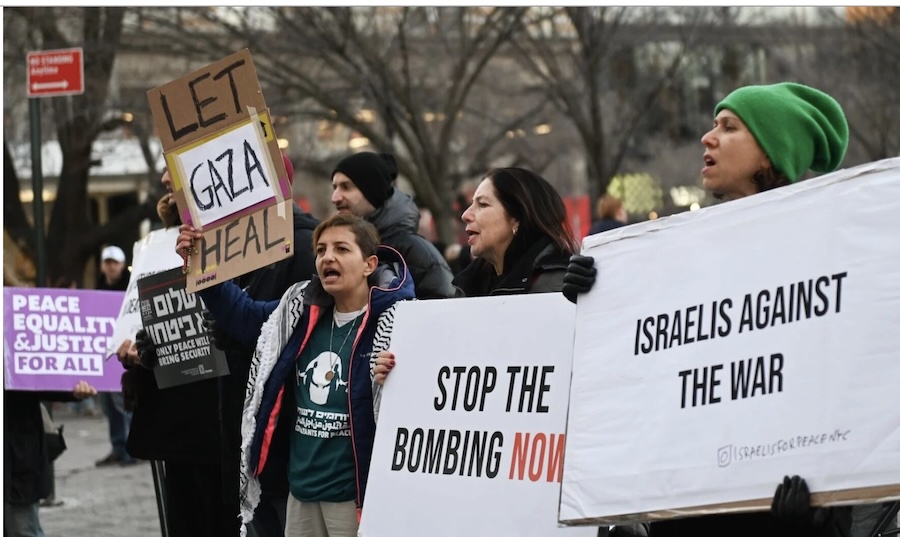
DB – Let’s start with your personal stories: how did you decide to join Combatants for Peace?
Iris Gur – Throughout my adult life, I worked in education as a teacher and as a school principal. I always saw education not just as a profession, but as the way of life I had chosen for myself. I grew up in a Jewish Israeli Zionist family. My parents arrived in Israel as refugees from Europe after the Second World War, and I grew up on stories of the Holocaust and survival. The only narrative I knew was that we, the Jewish people, had always been persecuted, and that we had no choice but to defend ourselves and our small country. The only thing I knew about Arabs was that they all wanted to destroy us.
My father was a military officer. I grew up on army bases and was very proud of the Israeli army. For most of my life, I had no opportunity to become familiar with either the Palestinian narrative or with Arab friends. I deliberately use the word “Arabs” because, in the environment where I grew up, the term “Palestinians” simply did not exist. Neither did the concept of the occupation.
Today, I can see that there were cracks in my worldview over the years, but I never allowed them to grow. The person who ultimately transformed my perspective was my daughter, Noa. 11 years ago, when she was seventeen, she decided to refuse military conscription. Through her, an entirely new world of values, ideas, and community opened up before me.
Her decision meant four months in military prison for her, and for me was the beginning of a journey of discovery – one that confronted me with the reality of the occupation, apartheid, and above all, the Palestinian people.
My decision to join Combatants for Peace came from the realization that if I truly wanted to help change the reality we are in, it could only be done in full partnership with Palestinians and through nonviolent actions.
Mai Shahin: I didn’t arrive at Combatants for Peace as a single decision. I joined through a long process of living under occupation in the West Bank, where control is not only political, but physical, emotional, and psychological. It shapes movements, breath, relationships, and the ability to imagine a future beyond survival. In that environment, resistance is not abstract. It is daily life. But over time, I began to ask a deeper question: how to resist without losing our own humanity in the process? A question that led me into trauma work, community healing, and nonviolent communication. I began to understand that occupation does not only control land – it enters the nervous system, it fragments trust, it isolates communities, and it produces cycles of grief that, if unprocessed, repeat themselves across generations.
This is where my connection with Combatants for Peace begins. It was the first space I encountered where Palestinians and Israelis were not asked to erase reality to speak. We were rather asked to stay inside reality together, while refusing violence as a response.
What makes Combatants for Peace so powerful is that it is not only a dialogue space. It is a joint movement of resistance. It insists that ending occupation, dismantling systems of domination, and protecting human dignity are not separate from relationship-building: they are part of the same struggle.
Alongside this work, and deeply connected to it, I co-founded Satyam Homeland together with Palestinians, Israelis, and international practitioners. It emerged from the same understanding: that resistance requires spaces where people can learn to remain human even inside the struggle. Satyam Homeland is a community space where Palestinians, Israelis, and internationals come together to engage in trauma and grief work, embodied healing, nonviolent resistance education, dialogue, and storytelling—and from that ground, move into action in the world. It is not separate from Combatants for Peace. It is part of a broader ecosystem of what I do: one holds the political courage of joint resistance, the other holds the communal practices that make sustained nonviolent engagement possible. They speak to each other constantly.
After October 7, this connection became even more visible. As Palestinians witnessed mass killing and destruction in Gaza, and escalating violence, settler attacks, and displacement in the West Bank, the instinct toward separation was immense. Fear and grief were not theoretical – they were lived, immediate, and heavy. And yet within Combatants for Peace, something held. We did not collapse into silence or separation. We turned toward each other – not to soften reality, but to remain capable of facing it. We cried together. We named what was happening. We disagreed. But we stayed.
And then we asked the only question that matters when everything is breaking: What do we do now? A question that we can afford thanks to the several years of building relationships that can survive rupture. This is how to be with Combatants for Peace is not only part of my work – it is the central part of what I do.
This is also why I continue this work from the West Bank, where every act of nonviolent resistance, every meeting, every step of presence carries real risk – and yet also real meaning, faith, responsibility. . . .
(Editor’s note: Two question/responses from part one are omitted here:
1. DB – This year marks the 20th anniversary of Combatants for Peace. What makes this movement so successful among the young people, in your opinion?
2. DB – It is quite extraordinary to see so many Israeli and Palestinian organizations mobilizing in coalition. What is the ingredient in your opinion for this kind of activism, based on cooperation despite the differences?
You can find the omissions here. )
DB – Both of you are often involved in actions of “Protective Presence”. Can you share some moments from your experience?
Iris – Thank you for this question, so important for me at a personal level that I feel tears in my eyes! I am part of a group called “Jordan Valley Activists.” It was established about 17 years ago by activists from Combatants for Peace and has grown into a group in its own right, thanks to the initiative of Israelis who provide accompaniment and a protective presence to Palestinian shepherds and farmers in the Jordan Valley.
We provide physical presence and assistance with food, water, legal support and any other help we can offer to the last remaining communities that are still holding on, in the face of violence by settlers and the Israeli military: demolition orders, threats of displacement, restrictions on grazing, denial of water and livelihoods and so on.
(article continued in right column)
(For a French version of this article, click here.)
How can a culture of peace be established in the Middle East?
(article continued from left column)
I joined this ‘protective presence’ activity in November 2023, when settler and military violence escalated dramatically. The violence was no longer directed only at shepherds in the fields, but also at families in their own homes. As a result, the presence of activists was expanded into 24/7 shifts.
I became closely connected with one specific community called ‘Farsiya al-Razala’, which consists of five families, including children, women, and elderly people. It is one of the last ten shepherd communities remaining in the Jordan Valley, and sadly, their time before being forcibly displaced may also be coming very soon.
Last week, I accompanied two young shepherds who were grazing their flocks in an area called Hammam al-Malih. Until a few months ago, there was a large community there: families, fields, herds, children, and even a regional elementary school. Everything was destroyed by the State of Israel. The people were violently displaced, despite the fact that the land is privately owned by a church. Across the road, alongside the community, there is a military base that has existed for many years.
In recent months, the soldiers have taken upon themselves the task of ensuring that, even after the families were expelled and the place was emptied, shepherds from nearby communities would not return to graze their flocks. In the past, there was also a spring there, that provided drinking water for both people and animals.
On the day I was there, the two young shepherds asked us not to leave them alone, because if we did, the soldiers would come and arrest them. One of them told us about his previous arrest:
“Female soldiers, 18 or 19 years old, were shouting at us and putting plastic restraints tightly around our hands. I asked them: Why? There is room for everyone here. I am only asking to live in peace.” The soldiers shouted at them: “Leave this place.”
He answered: “Where will we go? We have nowhere else to go. This is our home. We have lived here all our lives.” That day, the shepherds were able to finish grazing peacefully.
Yesterday, in the same place, two soldiers arrived and arrested one of those young men. The other managed to escape. One of the soldiers fired his M16 rifle into the air and claimed that he was not afraid of anyone. The Palestinian shepherd was taken, handcuffed, to the military base several kilometers away. A few hours later, he was released, bruised and beaten. This is only one story among hundreds of daily incidents of abuse.
Yousef, a 13-year-old boy with special needs, called me to tell me that his family had received a demolition order for their home in Farsiya. I had no words to answer him. This child and his family have no other home.
Mai – Protective Presence is where everything becomes real. It is standing with communities under immediate pressure. Farmers, shepherds, families, children who are trying to remain on their land and continue ordinary life under extraordinary conditions.
In the West Bank, especially since October 7, the level of violence, uncertainty, and instability has increased. Communities face settler attacks, military incursions, and ongoing displacement pressure every day.
In that context, presence is not symbolic. It is a form of protection, but also a form of witnessing.
It communicates something simple and essential: you are not alone.
Sometimes it prevents violence, sometimes it doesn’t. But it always interrupts isolation and isolation is one of the core tools of oppression. And this is where the connection to CFP becomes tangible, because CFP is not only dialogue, it is joint resistance in action.
And ‘Protective Presence’ is one of its clearest expressions in the field. It is also where the embodied and trauma-aware practices from Satyam Homeland become essential, because staying present in such moments requires inner grounding, not only political conviction.
Both dimensions are always present in our work.
DB – Last but not least: what can we do in order to contribute to your endeavor?
Iris – There is a lot that can be done. Beyond providing financial support, people can also come to the region and join protective presence activities as international volunteers. This does involve risks: there is a physical risk of violence from settlers, as well as the possibility of being expelled by the Israeli authorities. At the same time, visiting both the West Bank and Israel is safe and can allow people to develop a deeper and more accurate understanding of the reality. There is nothing like seeing things with your own eyes, and there is nothing like experiencing reality directly.
History has shown us that pressure from international communities can influence leaders, change policies, and even transform the course of history. People can take action by reaching out to the media, politicians, artists, public figures; by changing the public discourse; and by demanding an immediate end to violence, abuse, occupation, apartheid, and displacement.
This includes demanding access to water and livelihoods, freedom of movement, and the release of Palestinian prisoners and detainees. It means demanding the release of all human beings from lives shaped by fear and violence. The demand must be for security, freedom, and equal rights for every person living between the river and the sea.
The conversation needs to change: from supporting one side of the conflict against the other, toward understanding that the goal must be a safe and free life for all human beings.
There are 14 million people living between the Mediterranean Sea and the Jordan River: about 7 million Jews and 7 million Palestinians. Neither of them will go anywhere. Our future is shared, whether we like it or not. The question is not whether we will live together, but how. Our children deserve to grow up in freedom, security, and dignity.
Mai – The first responsibility is clarity. Reject antisemitism completely. Reject Islamophobia completely. Reject anti-Palestinian racism completely. Reject any framework that assigns unequal value to human life.
The second responsibility is truth. We cannot build justice based on denial. We must be able to name occupation, displacement, structural inequality, and violence without euphemism.
The third responsibility is support for movements that combine resistance and healing. Because this is what makes long-term transformation possible.
Combatants for Peace holds the political spine of nonviolent resistance and joint struggle. Satyam Homeland holds the embodied, emotional, and communal capacity that allows that resistance to continue without collapse. Together, they represent something rare: a way of staying human inside struggle.
For me, as a Palestinian woman working from the West Bank, this is not theory. It is daily life, shaped by risk, responsibility, grief, and also by deep commitment and trust in the relationships we have built across divides.
That is what keeps this work alive. Because in the end, what we are building is not only political change. It is the possibility that we can remain fully human while refusing systems that deny humanity to others.
– – – – – –
If you wish to make a comment on this article, you may write to coordinator@cpnn-world.org with the title “Comment on (name of article)” and we will put your comment on line. Because of the flood of spam, we have discontinued the direct application of comments.